Are you struggling to bridge the gap between your customers' needs and their immediate purchasing power? Do you find yourself losing sales because high upfront costs deter potential buyers, or spending countless hours manually tracking payments, chasing down defaulters, and reconciling ledgers? Managing an installment business in Nigeria comes with unique challenges, from erratic cash flow to the sheer administrative burden of tracking multiple payment plans.
 Nigerian entrepreneur reviewing financial documents
The Nigerian Reality: Why Upfront Payments Are a Barrier
In Nigeria's dynamic economic landscape, the ability to pay for goods and services outright is often a significant hurdle for many consumers. With average monthly incomes ranging from ₦50,000 to ₦150,000 for many, a large one-time payment for essential items like a new refrigerator, a plot of land, or even a solar power system can be prohibitive. This economic reality means that businesses relying solely on full upfront payments are inadvertently limiting their market reach and sales potential.
Consider the typical costs involved for a small to medium-sized business in Nigeria. An initial stock purchase for electronics might set you back ₦200,000 to ₦1,500,000, while fashion inventory could range from ₦150,000 to ₦800,000. Then there's annual shop rent, which can be anywhere from ₦80,000 for a small kiosk in a suburban market to a staggering ₦2,500,000 for a prime location in Lagos or Abuja. Factor in monthly operational costs like generator fuel (₦30,000 - ₦150,000) and staff salaries (₦45,000 - ₦80,000 per person), and it's clear that businesses need consistent revenue streams to thrive. When customers can't afford a lump sum, sales stagnate, and inventory sits idle, impacting your ability to cover these fixed costs.
This financial constraint on consumers doesn't just affect sales; it also impacts loyalty and growth. Businesses that offer flexible payment solutions are better positioned to capture a larger market share and build stronger customer relationships. Without such options, customers are forced to save for extended periods, potentially finding alternative solutions or simply foregoing the purchase altogether. This creates a significant missed opportunity for businesses looking to expand their customer base and achieve higher revenue targets, which for a small-scale installment business can be between ₦250,000 - ₦800,000 monthly, and for medium-scale, ₦800,000 - ₦3,000,000.
The Administrative Nightmare of Manual Installment Tracking
While the benefits of offering installment plans are clear, the execution often presents a formidable challenge, especially when managed manually. Imagine a car dealer in Abuja selling vehicles on hire purchase, a real estate developer in Kano selling plots, or a cooperative society managing loans for hundreds of members. Each client has a unique payment schedule, varying deposit amounts, and different due dates.
Manually tracking these payments typically involves:
- Physical Ledgers and Notebooks: Prone to errors, loss, and difficult to audit.
- Spreadsheets: Better than notebooks but still require constant manual updates, are easily corrupted, and lack real-time visibility.
- WhatsApp Messages and Phone Calls: The primary method for payment reminders and confirmations, leading to disjointed communication, lost messages, and a massive time sink.
- Manual Receipt Generation: Writing out receipts for every payment is tedious, time-consuming, and lacks a professional, branded touch.
- Chasing Payments: Dedicated staff members spend hours making calls, sending messages, and visiting clients to remind them of upcoming or overdue payments. This is a drain on resources and often leads to inconsistent follow-up.
- Commission Tracking: For businesses using agents, calculating commissions per payment manually is complex and highly susceptible to mistakes, leading to disputes and demotivation.
> "In the Nigerian market, trust is built on consistency and transparency. Businesses that can offer flexible payment terms and back it up with reliable, clear communication will always win."
What is an Installment Business?
An installment business is one that allows customers to pay for goods or services over an agreed period, through a series of regular, smaller payments, rather than a single upfront lump sum. This model makes high-value items or services more accessible to a wider range of customers, significantly boosting sales and market penetration.
Here's how an installment business typically works in Nigeria:
- Agreement: The business and the customer agree on the total price, the down payment (if any), the number of installments, the frequency of payments (weekly, monthly, quarterly), and any applicable interest or markup. Typical installment interest/markup in Nigeria can range from 15% to 40%, reflecting the risk, duration, and administrative costs involved.
- Contract: A formal contract is signed, detailing all terms and conditions, including default clauses. This is crucial for legal protection.
- Product/Service Delivery: The customer receives the product or service, usually after the initial down payment.
- Scheduled Payments: The customer makes regular payments according to the agreed schedule.
- Tracking and Collection: The business tracks each payment, issues receipts, and follows up on any missed payments.
- Full Ownership: Once all installments are paid, the customer gains full, unencumbered ownership of the item or service.
Benefits of the Installment Model in Nigeria:
- Increased Sales & Market Access: It opens up your products to customers who cannot afford a one-time payment, significantly expanding your customer base. This is particularly vital for items like real estate, vehicles, electronics, and solar energy systems.
- Improved Cash Flow (with good management): While payments are staggered, a well-managed installment system ensures a steady, predictable stream of income.
- Customer Loyalty: Offering flexible payment options builds trust and loyalty, encouraging repeat business and positive referrals.
- Higher Average Transaction Value: Customers are often willing to purchase higher-value items when they can pay over time.
- Competitive Edge: In a crowded market, businesses offering convenient installment plans stand out.
The Smarter Approach: Automating Installment Sales Management
The key to unlocking the full potential of an installment business in Nigeria lies in automation. Moving away from manual tracking to a streamlined, digital system transforms the administrative burden into an efficient, growth-driving process. This smarter approach focuses on centralizing data, automating routine tasks, and providing real-time insights, allowing businesses to focus on sales and customer satisfaction rather than chasing paperwork.
A robust installment management software Nigeria solution should handle everything from client onboarding to contract creation, payment tracking, and automated reminders. This means:
- Centralized Client & Asset Management: All client details, purchase history, and asset information (e.g., car VIN, property address, equipment serial number) are stored in one secure location, accessible to authorized staff.
- Automated Contract Generation: Once terms are agreed upon, the system automatically generates payment schedules, eliminating manual calculations and errors.
- Effortless Payment Recording: Payments are logged quickly, and the system instantly updates outstanding balances and generates digital receipts.
- Proactive Reminders & Notifications: Automated messages via SMS, email, or WhatsApp notify clients of upcoming payments, successful transactions, and overdue amounts, drastically reducing default rates.
- Real-time Performance Monitoring: Dashboards provide an instant overview of sales, collections, outstanding balances, and agent performance, empowering data-driven decisions.
- Simplified Agent & Commission Tracking: The system automatically calculates and tracks agent commissions based on payments received, ensuring transparency and timely payouts.
How Payvo Helps Streamline Your Installment Business
Imagine a world where manual ledgers, scattered WhatsApp messages, and endless payment reminder calls are a thing of the past. That's the world Payvo creates for your installment business. Payvo is a comprehensive business management platform specifically designed for companies that sell on installment, providing a seamless solution for every stage of your sales cycle.
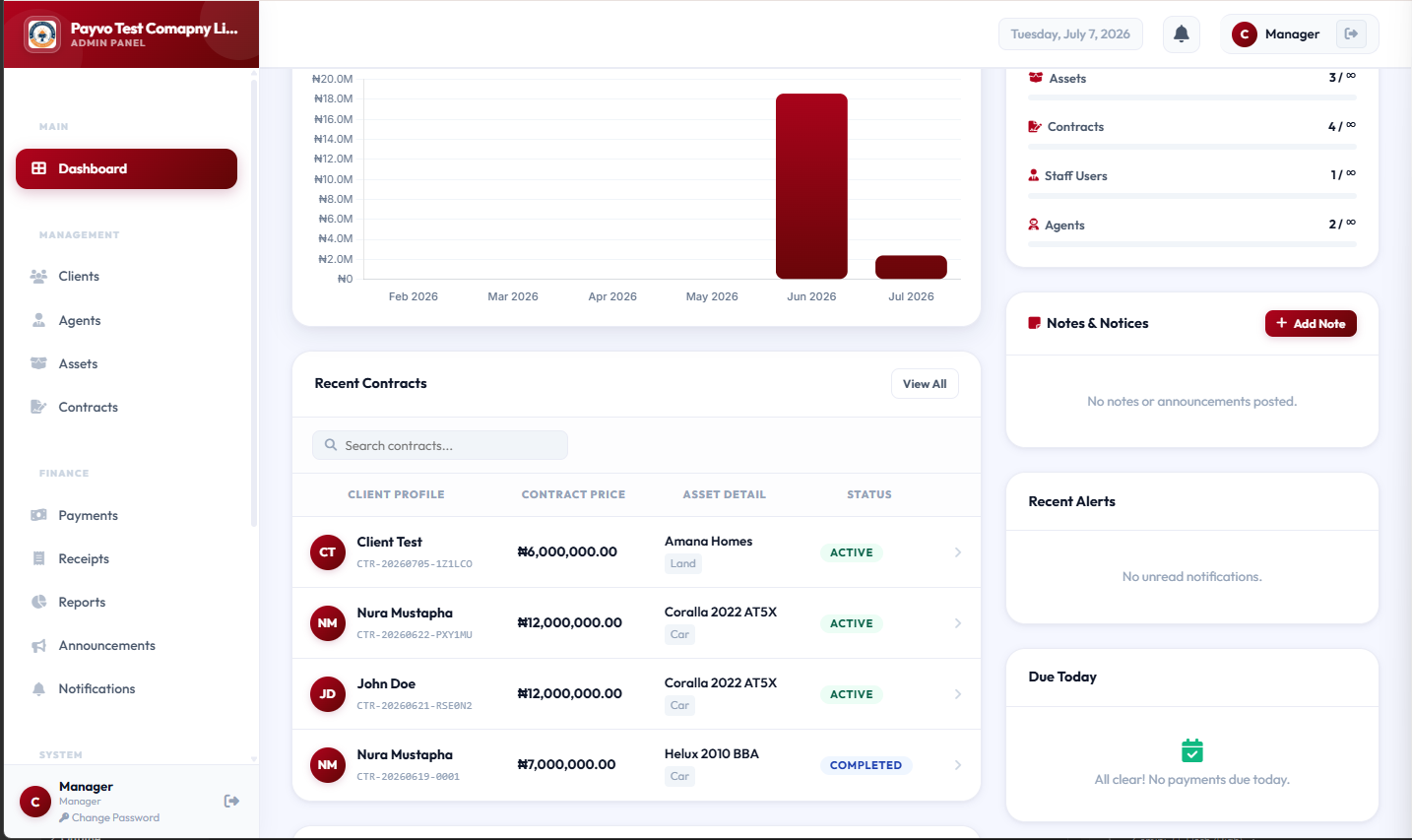 Dashboard showing total clients and active contracts
With Payvo, you can effortlessly register and manage clients, storing all their details and viewing their complete payment history at a glance. This means no more searching through files or notebooks to understand a client's status. For businesses like car dealers or solar equipment providers, the ability to register and manage assets is crucial. Payvo links each asset directly to its respective contract, ensuring you always know the status of every item sold on installment.
Creating contracts becomes a simple process. You set the payment terms once, and Payvo automatically generates the entire installment schedule, eliminating manual calculations and potential errors. Every time a payment is made, you can easily record payments, and the system instantly updates the contract status and generates branded receipts. This powerful receipt generator app Nigeria feature means professional, branded receipts (complete with your company logo and digital signature) are automatically created for every payment, and a master receipt for full contracts, which clients can view, save, or share via a public link.
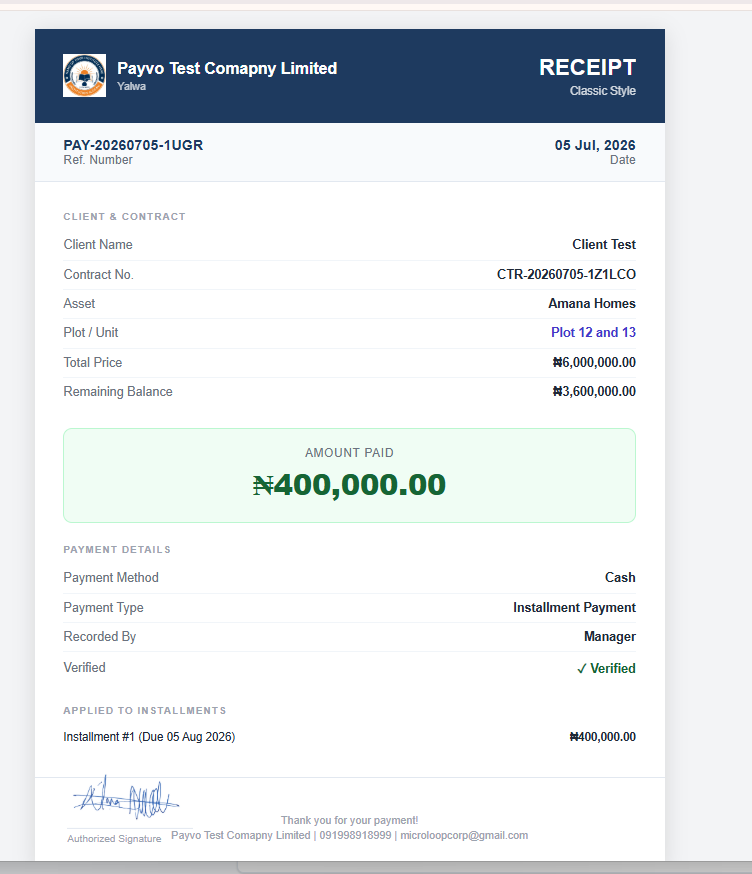 Payment receipt sample
One of Payvo's most impactful features is its WhatsApp payment notification system. It sends automatic notifications for new clients, new contracts, payments received, and crucial payment reminders via email and WhatsApp. This proactive communication drastically reduces the need for manual follow-up calls, saving your staff countless hours and significantly lowering your default rates.
For businesses with a sales team, Payvo offers robust agent commission tracking software. You can assign agents to contracts, and the system automatically calculates their commission per payment, tracking their full earnings and payout history. Agents can even log in to view their own earnings and submit withdrawal requests, fostering transparency and motivation.
Beyond these core functions, Payvo provides real-time dashboards to give you an instant overview of your business performance – total clients, active contracts, amount collected, outstanding balances, and next payments due. You can also generate reports (PDF or Excel) for accounting and record-keeping, and receive weekly email summaries covering key business metrics.
By centralizing client, asset, and contract data, automating payment tracking, and streamlining communication, Payvo acts as your ultimate contract management software Nigeria, allowing you to scale your installment business with confidence and efficiency. You can explore more features and see how Payvo can transform your operations by visiting our features page.
Proof: Side-by-Side Comparison
Let's look at how Payvo transforms the experience of managing an installment business compared to traditional, manual methods.
| Feature / Aspect | Traditional Manual Methods | Payvo's Automated System