For cooperative societies, microfinance institutions, and small businesses across Nigeria, the manual tracking of member contributions and installment payments is a constant source of anxiety. Lost ledgers, forgotten payment dates, and endless reconciliation hours aren't just inconvenient; they're direct threats to trust, efficiency, and financial stability.
The Hidden Costs of Manual Tracking for Cooperatives and Installment Businesses
The reliance on traditional paper ledgers, spreadsheets, and scattered WhatsApp messages for managing member contributions and installment sales isn't just outdated; it's a significant drain on resources and a breeding ground for errors. For cooperative societies in Nigeria, this translates into tangible financial losses and eroded member confidence.
Consider these realities:
- Data Entry Errors: Manual input is inherently prone to mistakes. A misplaced decimal, a forgotten entry, or a misread figure can throw off an entire society's financial records. The time spent finding and correcting these errors could be invested in growth.
- Lack of Real-time Visibility: When records are spread across multiple notebooks or individual spreadsheets, getting a clear, up-time picture of contributions, outstanding balances, or a member's payment history becomes a laborious task. This hinders quick decision-making and proactive follow-ups. A recent report highlighted that businesses relying on manual processes spend up to 40% more time on administrative tasks than those using automated systems, directly impacting productivity and profitability.
- Security Risks: Physical ledgers can be lost, damaged by fire or water, or even stolen. Digital spreadsheets, while better, are often not securely backed up or are vulnerable to accidental deletion. This puts sensitive financial data at significant risk.
- Inefficient Communication: Chasing members for overdue payments through individual calls or WhatsApp messages is time-consuming and often inconsistent. Without automated reminders, many payments are simply forgotten until it's too late.
- Auditing Nightmares: When it comes time for an audit, piecing together information from disparate manual records is a monumental undertaking, increasing audit costs and stress. The Nigerian Cooperative Societies Act emphasizes transparency and meticulous record-keeping, making robust tracking not just good practice but a legal necessity.
- Scalability Challenges: As a cooperative grows, manually managing hundreds or even thousands of member contributions becomes virtually impossible. This bottleneck restricts the society's ability to expand its membership or offer new services.
> "The biggest barrier to growth for many Nigerian businesses isn't a lack of opportunity, but a lack of robust internal systems to manage their operations efficiently and transparently."
The Limitations of Traditional Approaches
Let's delve deeper into why the old ways are no longer sufficient for managing installment sales and member contributions in Nigeria's dynamic economy.
The Ledger Book: A Relic of the Past
While ledger books have served cooperative societies and small businesses for decades, their limitations in the modern era are glaring. Each entry requires manual writing, cross-referencing, and constant vigilance against errors. If a page is skipped or an entry is illegible, the entire financial record for a member can be compromised. Furthermore, sharing information or generating summaries from physical ledgers is incredibly cumbersome, often requiring hours of manual tabulation. This archaic method severely limits a cooperative's ability to provide members with timely statements or respond quickly to inquiries about their contribution history.
The Spreadsheet Trap: False Sense of Security
Many businesses and cooperatives transition from paper ledgers to spreadsheets like Microsoft Excel or Google Sheets, believing it's a significant upgrade. While spreadsheets offer some advantages over paper, such as easier calculations and digital storage, they come with their own set of critical drawbacks for installment payment tracking:
- Version Control Chaos: Multiple people accessing and editing the same spreadsheet often leads to "which version is correct?" dilemmas. Without robust version control, critical data can be overwritten or lost.
- Limited Access Control: It's difficult to restrict specific users to only view or edit certain parts of a spreadsheet, leading to potential data corruption or unauthorized access to sensitive financial information.
- No Automated Reminders: Spreadsheets don't automatically send payment reminders to members or alert administrators about upcoming due dates. This still requires manual follow-up, which is time-consuming and inconsistent.
- Lack of Integration: Spreadsheets are isolated. They don't integrate with communication tools, receipt generation, or agent commission tracking, creating fragmented workflows and requiring redundant data entry.
- Audit Trail Deficiencies: While some spreadsheets offer revision history, it's often not as detailed or tamper-proof as a dedicated system, making robust auditing challenging.
- Scalability Issues: As the number of members or installment contracts grows, managing complex payment schedules, irregular payments, and historical data in a single spreadsheet becomes unwieldy and slow.
Embracing a Smarter Approach: Centralized Digital Management
The solution to these challenges lies in adopting a centralized, digital management system specifically designed for installment sales and contribution tracking. This smarter approach moves beyond manual entries and fragmented data to a unified platform that automates processes, enhances accuracy, and provides real-time insights.
Here’s what a modern system offers:
- Automated Contract and Payment Scheduling: Instead of manually calculating due dates and amounts, the system automatically generates installment schedules based on predefined contract terms. This eliminates calculation errors and ensures consistency.
- Comprehensive Client and Asset Management: All client details, their contracts, payment history, and even the assets associated with their contracts (e.g., specific plots of land, vehicles, or equipment) are stored in one secure location. This provides a 360-degree view of every member or customer.
- Real-time Payment Recording and Receipt Generation: As payments are made, they are immediately logged, and branded digital receipts are automatically generated and sent to the payer. This provides instant proof of payment and reduces disputes.
- Proactive Communication & Reminders: Automated reminders can be scheduled to notify members or customers before payments are due, significantly reducing late payments and the need for manual follow-up.
- Robust Reporting and Analytics: Dashboards provide real-time overviews of financial performance, outstanding balances, and collection rates. Detailed reports can be generated for accounting, auditing, and strategic planning.
- Secure and Accessible Data: Data is stored securely in the cloud, accessible from anywhere, at any time, with appropriate user permissions. This ensures data integrity, disaster recovery, and eliminates the risk of lost ledgers.
- Streamlined Agent and Staff Management: For businesses relying on agents, the system can track agent performance, calculate commissions automatically, and provide agents with transparency into their earnings. Staff roles and permissions can be finely tuned to control access.
 A Nigerian entrepreneur reviewing data on a tablet
How Payvo Transforms Installment and Contribution Management
This is where Payvo steps in as a purpose-built solution, designed to address the specific challenges faced by businesses and cooperative societies in Nigeria dealing with installment payments. It’s not just a payment tracking app; it's a comprehensive contract and installment management system that brings automation, transparency, and efficiency to your operations.
Payvo replaces the chaos of notebooks and scattered messages with one unified, intuitive platform. Imagine a system where from the moment a new client or cooperative member is registered, every interaction – from contract creation to payment recording and follow-up – is automated and tracked.
Here’s how Payvo directly implements the smarter approach:
- Effortless Client and Asset Registration: Easily register and manage all client details and the assets they are purchasing (e.g., properties, cars, equipment). This creates a central database for all your records.
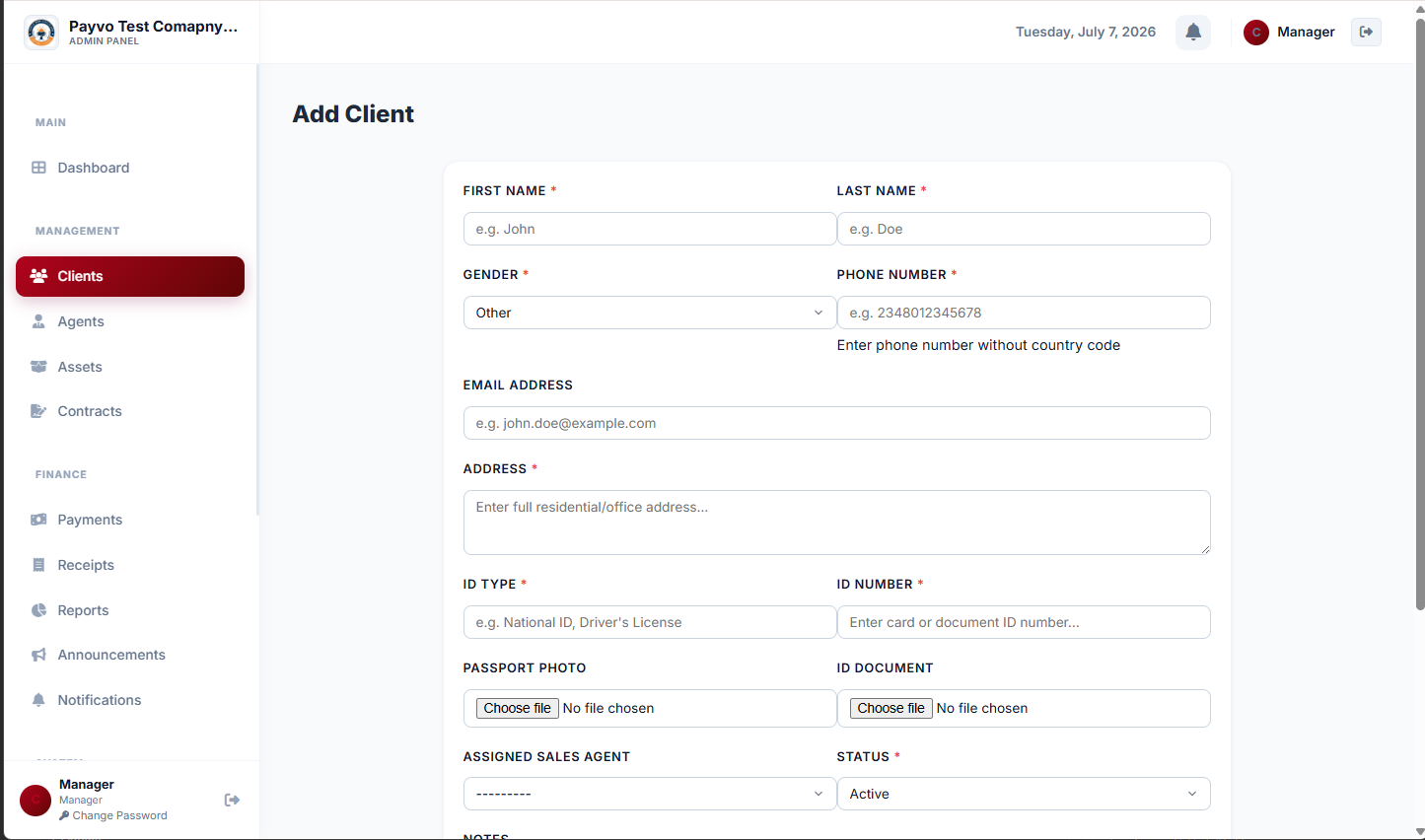 Client: Add Client page
- Automated Contract Creation: Set payment terms once, and Payvo automatically generates the full installment schedule. This eliminates manual calculations and ensures every payment is accounted for. This feature is invaluable for car dealer installment software and real estate payment tracking Nigeria.
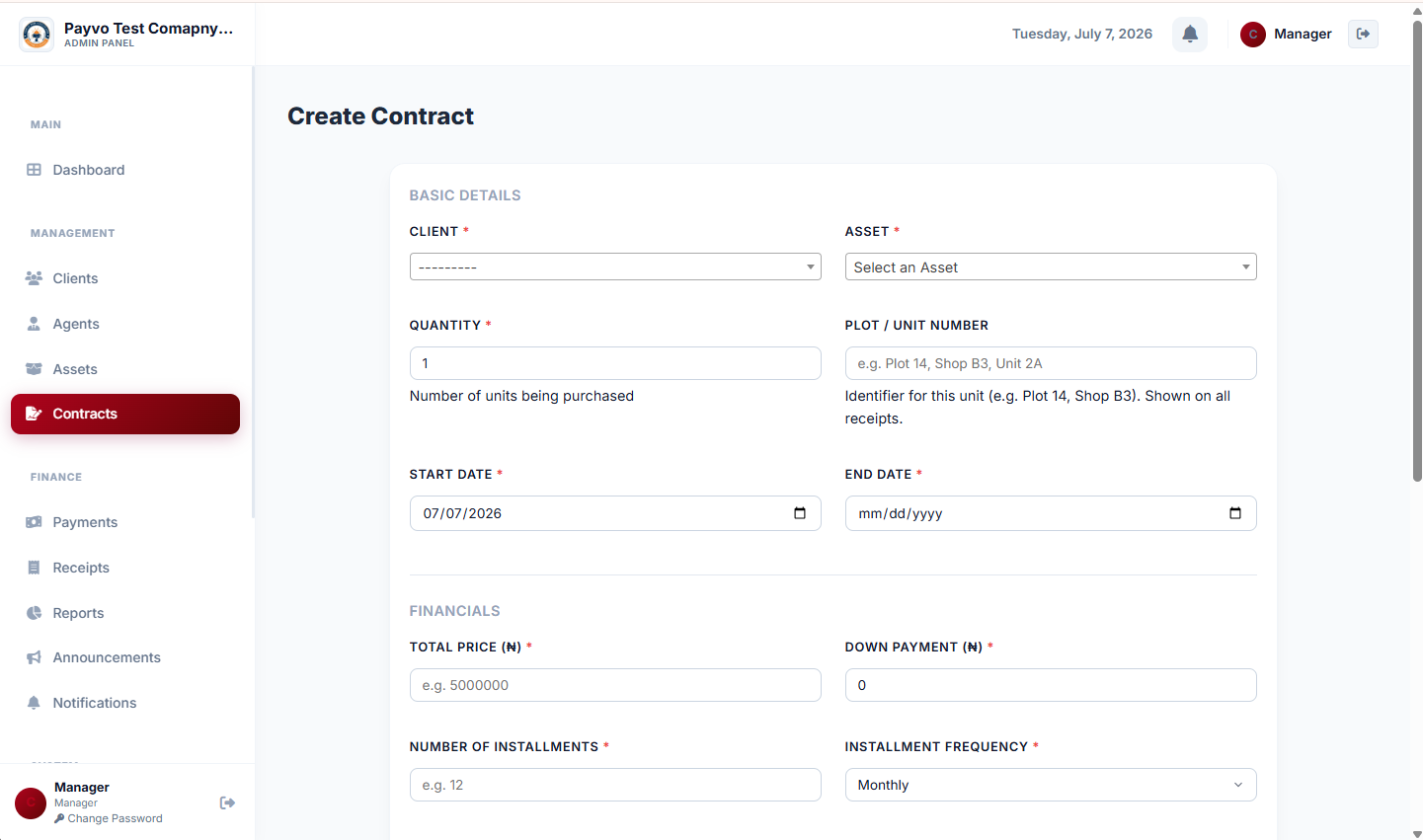 Management: Add contract (top)
- Seamless Payment Recording & Receipting: Record single payments against any contract, and Payvo instantly generates branded receipts with your company logo and digital signature. These receipts can be automatically sent via email or WhatsApp, providing instant proof of payment. This serves as an excellent receipt generator app Nigeria.
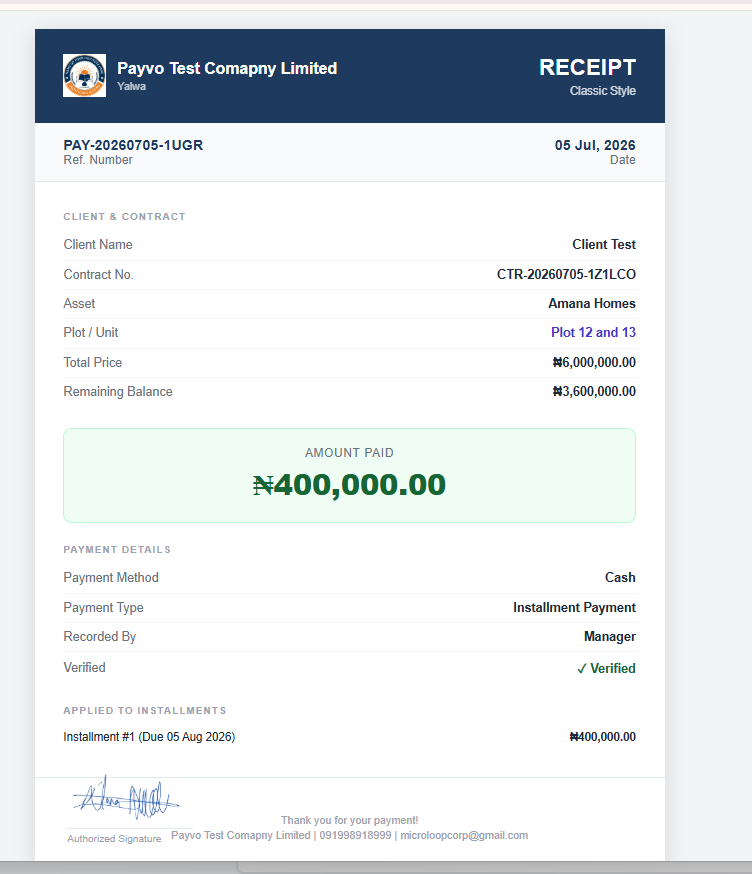 Finance: Paymnet Receipt Sample
- Proactive Payment Reminders: Say goodbye to manual follow-up calls. Payvo sends automated payment reminders before due dates via email and WhatsApp, significantly improving collection rates and reducing arrears. This is a crucial WhatsApp payment notification system for businesses.
- Real-time Dashboards and Reports: Gain instant insights into total clients, active contracts, amounts collected, outstanding balances, and next payments due through easy-to-understand dashboards. Generate detailed financial reports for accounting and auditing with just a few clicks. These features are essential for cooperative society management software Nigeria and thrift payment tracking Nigeria.
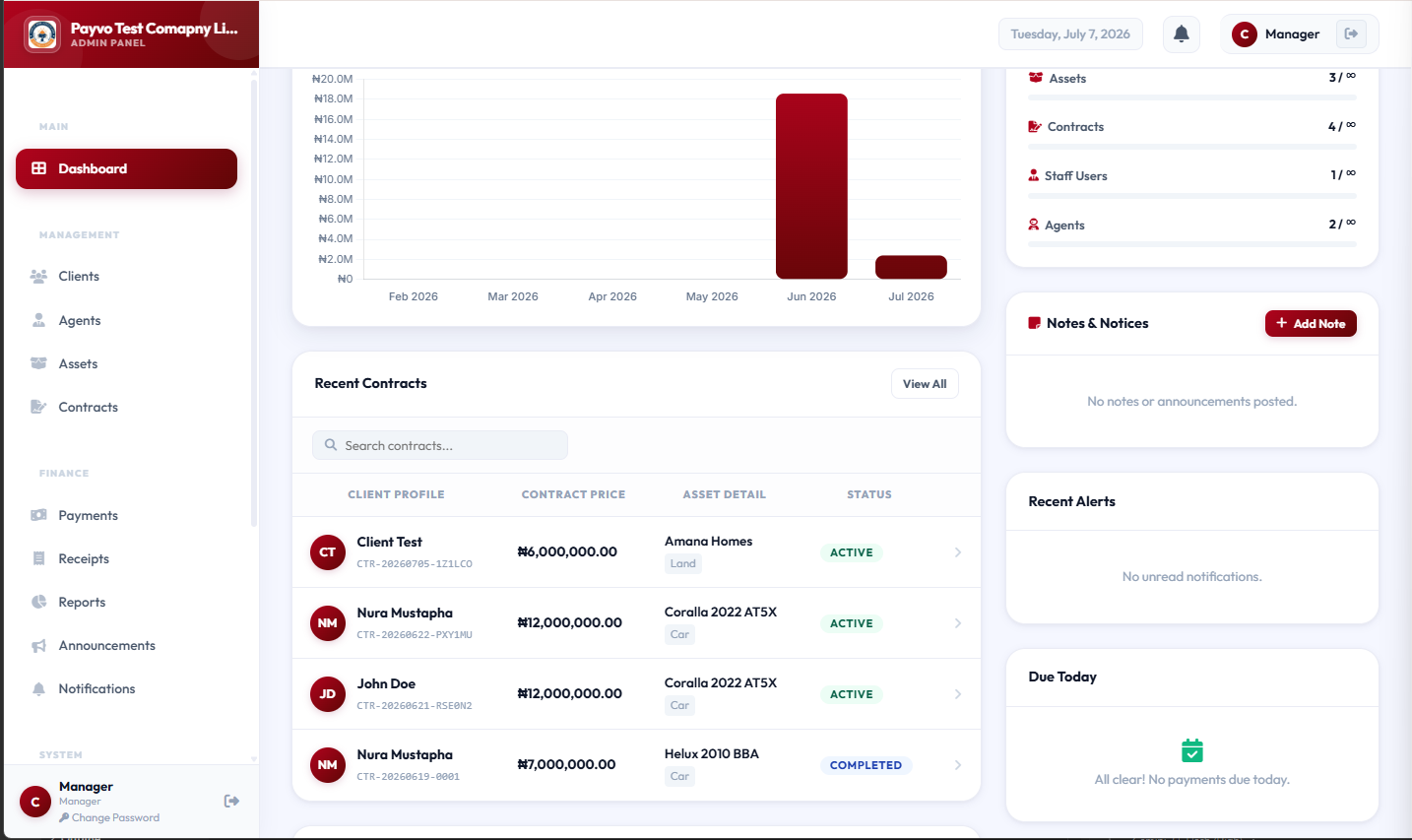 Dashobard (top)
- Robust Agent and Staff Management: For businesses with agents, Payvo automates commission calculations per payment and tracks full earnings and payout history. Agents can even track their own performance and submit withdrawal requests directly, making it a powerful agent commission tracking software.
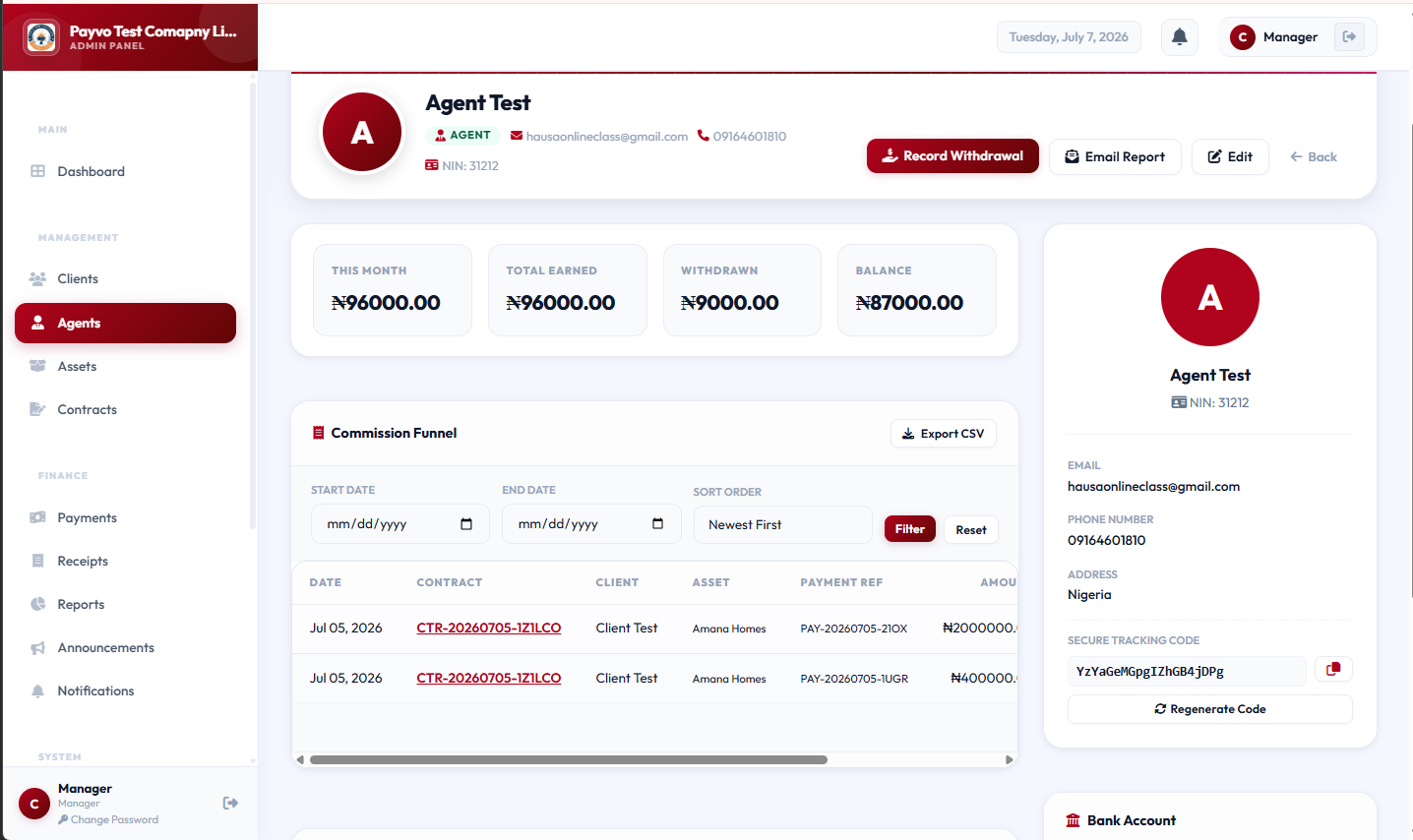 Agent: Agent details page
- Enhanced Transparency and Security: With audit logs and role-based permissions, you maintain complete control over who sees and does what within the system. All data is securely stored, accessible only to authorized personnel.
Proof: Side-by-Side Comparison
| Feature/Process | Traditional Methods (Ledgers, Basic Spreadsheets) | Modern Digital System (e.g., Payvo) |
|---|---|---|
| Contract Creation | Manual calculation of installment schedules, prone to errors, time-consuming. | Automated schedule generation based on set terms, instant and accurate. |
| Payment Recording | Manual entry in ledgers/spreadsheets, risk of missed entries or errors. | Instant digital logging, linked directly to contracts, full audit trail. |
| Receipt Generation | Manual writing of paper receipts, often generic, slow process. | Automated, branded digital receipts (email/WhatsApp), instant delivery, professional. |
| Payment Reminders | Manual calls/WhatsApp messages, inconsistent, high effort, often late. | Automated reminders via email/WhatsApp before due dates, proactive, consistent. |
| Client Data Access | Scattered across various records, difficult to get a complete history quickly. | Centralized client profiles with full payment history, contracts, and assets, accessible instantly. |
| Reporting & Analytics | Manual tabulation, time-consuming, limited real-time insights. | Real-time dashboards, automated financial reports (PDF/Excel), quick decision-making. |
| Agent Management | Manual commission tracking, disputes over earnings, opaque process. | Automated commission calculation, transparent agent portals, clear payout history. |
| Data Security | Vulnerable to physical damage, loss, or unauthorized access. | Secure cloud storage, role-based access, audit logs, disaster recovery. |
| Scalability | Becomes unmanageable with growth, limits expansion. | Designed for growth, handles large volumes of clients and contracts seamlessly. |
| Cost | Hidden costs in errors, lost time, lost revenue from missed payments, audit complexity. | Investment in system, but significant ROI through efficiency, error reduction, and improved collections. |
 A Nigerian small business owner using a modern payment system
Frequently Asked Questions
Q1: What is installment management software and who needs it?
Installment management software is a digital system designed to automate the tracking, billing, and collection of payments made in periodic installments. It's essential for any business or organization that sells goods or services on credit or collects regular contributions. This includes cooperative societies, microfinance institutions, real estate developers selling properties, car dealerships offering hire purchase, solar and equipment leasing companies, building material suppliers extending credit, and any small business managing recurring payments. Essentially, if your business model involves "buy now, pay later" or regular contributions, you need robust installment tracking.
Q2: How can a cooperative society in Nigeria benefit from a payment tracking app like Payvo?
Cooperative societies in Nigeria can benefit immensely from a dedicated payment tracking app. It eliminates manual ledger-keeping, reduces errors in member contribution tracking, automates payment reminders to improve collection rates, and provides real-time visibility into the society's financial health. It also generates official receipts automatically, enhances transparency for members, simplifies auditing, and allows for efficient management of agents or staff, all while ensuring compliance with the Nigerian Cooperative Societies Act. It's a comprehensive solution for cooperative society management software.
Q3: Is it secure to manage sensitive financial data on a digital platform?
Yes, modern digital platforms like Payvo are built with robust security measures, often exceeding the security of manual or basic spreadsheet systems. Data is typically encrypted, stored in secure cloud environments, and protected by features like role-based access control, audit logs, and regular backups. This ensures that only authorized personnel can access specific information and provides a clear trail of all activities, making it far more secure than physical ledgers prone to loss or damage. Transparency and security are paramount, as detailed in our privacy policy.
Q4: Can this type of software handle different payment schedules and irregular payments?
Absolutely. A key advantage of specialized installment management software is its flexibility. It allows businesses to define various contract terms, including down payments, fixed installment amounts, varying payment frequencies (weekly, monthly, quarterly), and even accommodate irregular payments or early settlements. The system automatically adjusts schedules and calculates outstanding balances, providing accurate figures regardless of payment patterns. This flexibility is crucial for businesses like car dealers or real estate developers who often deal with customized payment plans.
Q5: How does automated payment notification via WhatsApp and email work?
Automated payment notifications are a core feature of effective installment tracking. Once a client or member is registered and a contract is created, the system allows you to schedule automated reminders to be sent via email or WhatsApp days before a payment is due. When a payment is recorded, an instant confirmation and a digital receipt are also sent. This proactive communication reduces the need for manual follow-ups, minimizes late payments, and keeps clients well-informed, significantly boosting customer satisfaction and collection efficiency.
Q6: What if I have multiple agents or staff managing different contracts?
Advanced installment management systems are designed for team collaboration. They allow you to add multiple staff accounts with role-based permissions, meaning you can control exactly what each staff member or agent can see and do within the system. For agents, the software can automatically calculate commissions based on payments received and provide them with a dedicated portal to track their earnings and performance, fostering transparency and motivation. Learn more about agent tracking capabilities.
 A sleek, modern office scene
Ready to transform how your cooperative society or business manages member contributions and installment sales? Ditch the ledgers and spreadsheets. Experience the efficiency, transparency, and peace of mind that comes with a dedicated installment management system.
Take control of your finances and empower your growth. Register into Payvo today and discover a smarter way to manage your business.