<p>In Nigeria's dynamic market, businesses selling goods or services on credit face a constant battle: managing scattered payment records, chasing down overdue installments, and manually calculating agent commissions. The frustration of lost ledgers, missed reminders, and inefficient tracking can quickly erode profits and customer trust. Many small to medium enterprises (SMEs) are now turning to technology, specifically open-source solutions, to bring order to this chaos.</p>
 Nigerian entrepreneur reviewing business finances
The Evolving Landscape of Installment Sales in 2026
The Nigerian economy in 2026 continues its trajectory of digital transformation, impacting how businesses manage credit sales. From real estate developers in Abuja offering payment plans to car dealers in Lagos selling on hire purchase, and even cooperative societies in Kano providing micro-loans, the demand for robust installment management is higher than ever. Businesses are recognizing that efficient tracking isn't just about collecting payments; it's about building customer loyalty and scaling operations.
Market data reveals a significant shift: businesses that automate their payment tracking report up to a 30% reduction in payment defaults and a 20% increase in customer retention, according to a recent industry survey. The manual methods of the past — notebooks, spreadsheets, and scattered WhatsApp messages — are no longer sustainable for growth. Businesses need reliable systems that can handle everything from client registration and contract generation to payment reminders and agent commission tracking. This is where dedicated installment management software, including customizable open-source options, becomes indispensable. The alternative, a manual system, often leads to significant operational overheads, including the cost of dedicated staff for reconciliation and follow-ups, which can easily exceed ₦50,000 to ₦150,000 monthly in salaries for even basic administrative roles.
What You Need Before You Start
Before diving into the world of open-source installment management systems, ensure you have these prerequisites in place:
- Clear Business Requirements: Understand exactly what features your business needs (client management, asset tracking, payment reminders, agent commissions, reporting).
- Technical Aptitude or Developer Access: Open-source solutions often require technical knowledge for setup, customization, and maintenance. Be prepared to either learn the basics or hire a developer.
- Budget for Customization & Hosting: While the software itself is free, there are costs associated with hosting, domain names, customization, and ongoing maintenance.
- Reliable Internet Connectivity: Essential for any cloud-based or online system operation, typically costing ₦10,000 to ₦30,000 monthly.
- Payment Gateway Account (Optional but Recommended): If you plan to accept online payments, set up an account with a local provider like Paystack or Flutterwave.
Step-by-Step: Implementing an Open-Source Installment Management System
Adopting an open-source solution requires a structured approach. Here’s how to navigate the process:
Step 1: Define Your Core Needs and Research Open-Source Projects
Begin by outlining the specific challenges your current installment management process faces. Are you struggling with client information, asset tracking, payment reminders, or agent commission calculations? Document these needs meticulously. Once clear, head to platforms like GitHub to search for projects. Use keywords such as "installment management," "loan management," "credit sales," or "payment tracking." Look for projects with active communities, recent updates, and clear documentation. Evaluate their features against your defined needs. Many projects might offer a basic framework, but often require significant tailoring to fit the nuances of your Nigerian business operations, such as handling specific payment structures or local tax requirements.
Step 2: Set Up Your Development Environment and Choose Your Hosting
After identifying a promising project, you'll need a suitable environment to run and customize it. If you have an in-house developer, they will likely set this up on a local machine. For businesses without dedicated IT staff, you'll need to decide on hosting.
You have two primary options:
- Local Hosting: For very small businesses with minimal data or a need for offline access, you might host the system on a dedicated server/desktop PC. This can cost anywhere from ₦50,000 to ₦150,000 for the hardware. However, this option requires managing security, backups, and uptime yourself.
- Cloud Hosting: For scalability, reliability, and security, cloud hosting is generally preferred. This could involve services like AWS, Azure, or Google Cloud (or their local equivalents). A basic domain name and shared hosting for a small online presence might cost ₦20,000 to ₦50,000 annually. For a growing SME with significant data, a more robust cloud solution could be ₦80,000 to ₦250,000 annually.
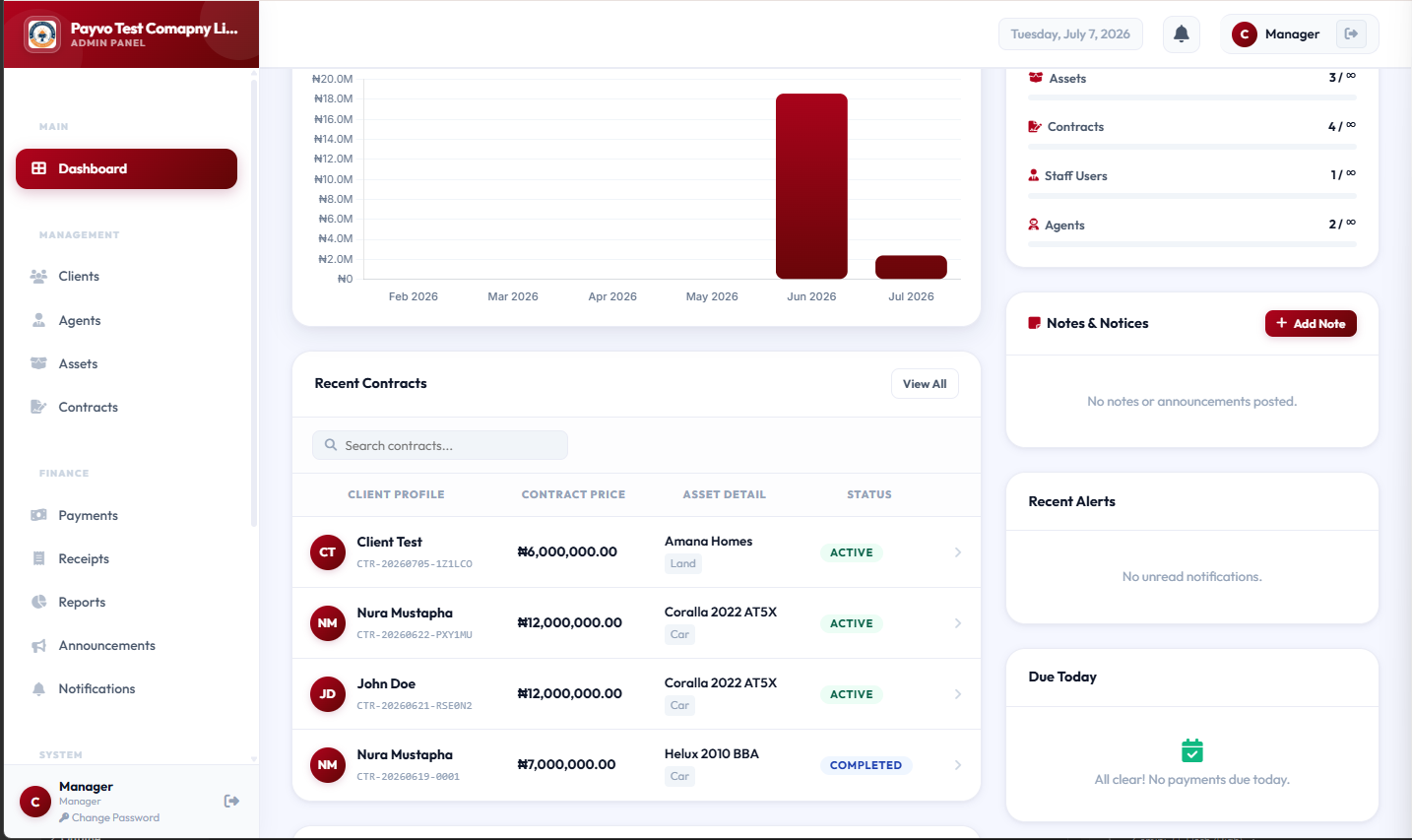 Dashboard showing active contracts and balances
Step 3: Customize the System to Your Business Logic
This is often the most critical and resource-intensive step. Open-source systems provide a foundation, but rarely fit a business's unique workflow out-of-the-box. You'll likely need to:
- Integrate Local Payment Gateways: If you plan to accept online payments, you'll need to integrate with local providers like Paystack or Flutterwave. The initial setup cost for this can range from ₦100,000 to ₦300,000, plus transaction fees of 1.5% - 2.5% + ₦100 per successful payment.
- Tailor Contract and Payment Schedules: Ensure the system can handle your specific installment terms, grace periods, and late payment penalties.
- Develop Custom Reporting: Most generic open-source systems might not offer the specific financial reports or audit trails required for your business or local regulations.
- Add Agent Commission Logic: If you work with agents, you'll need to build in logic to track their sales, calculate commissions per payment, and manage their payouts.
- Implement Notification Systems: Integrate SMS or WhatsApp gateways for automated payment reminders and notifications. A monthly cost for SMS gateway integration can be ₦10,000 to ₦30,000. Email marketing service integration for customer engagement might cost ₦5,000 to ₦15,000 monthly.
The cost for a junior developer to customize and maintain an open-source system in-house for a small business can be ₦50,000 – ₦150,000 per month. For SMEs outsourcing this, a freelance developer or small agency might charge a monthly retainer of ₦150,000 – ₦400,000. For advanced customization or feature development, a one-time cost of ₦200,000 – ₦700,000 by a skilled developer is common.
Step 4: Data Migration and Testing
Once customized, you'll need to migrate existing client, contract, and payment data into the new system. This requires careful planning to avoid data loss or corruption. After migration, rigorous testing is crucial. Test every feature: client registration, contract creation, payment recording, receipt generation, reminders, and reporting. Involve key staff members in the testing phase to ensure the system meets their operational needs.
Step 5: Staff Training and Deployment
Before a full launch, train your staff on how to use the new system effectively. Provide clear documentation and conduct hands-on training sessions. A smooth transition depends heavily on user adoption. Once staff are comfortable, deploy the system for live operations. Even after deployment, ongoing monitoring and support will be necessary.
For businesses looking for a more streamlined, ready-to-use solution that handles all these complexities without the need for extensive development, a platform like Payvo offers a compelling alternative. It's built specifically for companies that sell on installment, providing features like client and asset management, automated contract generation, payment recording, branded receipt generation, and automated notifications via email and WhatsApp. This removes the significant development burden associated with open-source options, allowing businesses to focus on sales rather than system maintenance. Payvo also includes robust agent tracking and commission management, real-time dashboards, and comprehensive reporting, all designed to replace manual processes and scattered records with one automated system.
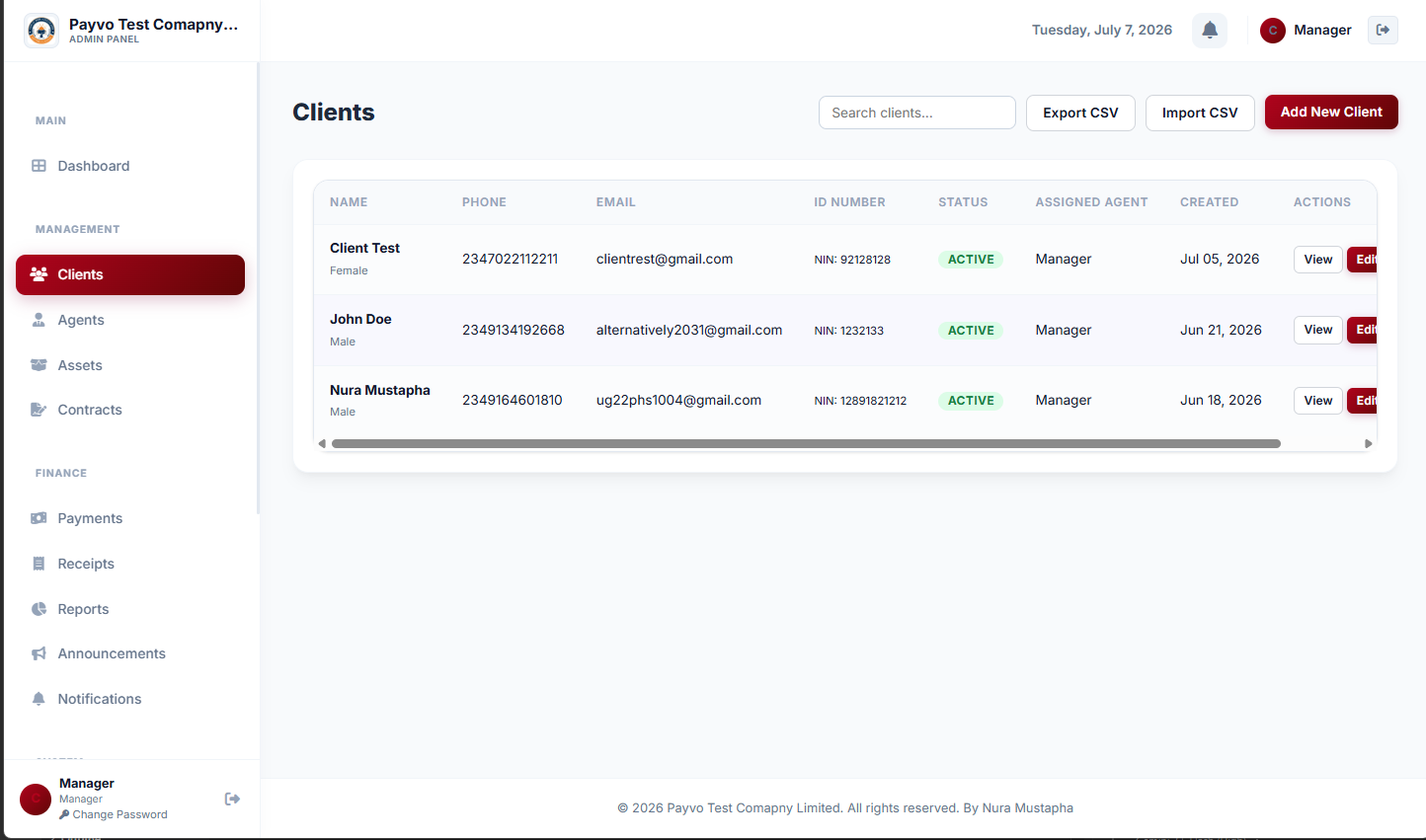 Payvo dashboard showing client list
Step 6: Ongoing Maintenance and Updates
Open-source systems require continuous maintenance. This includes applying security patches, updating dependencies, and potentially upgrading the core software to newer versions. Neglecting maintenance can lead to security vulnerabilities or system instability. Budget for ongoing developer time for these tasks, whether in-house or outsourced.
Common Mistakes to Avoid
- Underestimating Customization Costs: Many businesses focus only on the "free" aspect of open-source and forget the significant cost and time investment required for tailoring, integration, and ongoing maintenance.
- Ignoring Security: Open-source doesn't automatically mean secure. Proper security configurations, regular updates, and backups are paramount to protect sensitive client financial data.
- Lack of Documentation: Failing to document your customizations and configurations can make future maintenance or developer transitions incredibly difficult and costly.
- Poor Data Migration: Rushing data migration without proper validation can lead to significant errors, impacting financial records and customer trust.
- Neglecting User Training: A powerful system is useless if your staff doesn't know how to use it efficiently. Invest in thorough training.
- Choosing an Inactive Project: Opting for an open-source project with no recent updates or community support means you'll be largely on your own for bug fixes and new features.
How to Track and Grow After Launch
Once your installment management system is live, tracking its impact and leveraging its capabilities for growth is crucial.
- Monitor Key Performance Indicators (KPIs): Focus on metrics like collection rates, average days to payment, default rates, and agent performance. A good system should provide dashboards and reports to visualize these.
- Utilize Automated Reminders: Actively use the system's automated payment reminders via SMS or WhatsApp. This significantly reduces the manual effort of follow-ups and improves collection efficiency.
- Leverage Data for Insights: Analyze payment trends, identify bottlenecks, and understand which installment plans or products perform best. This data can inform your business strategy, from pricing adjustments to new product offerings.
- Optimize Agent Performance: If your system includes agent tracking, use the data to identify top performers, provide targeted training, and optimize commission structures. Payvo, for instance, offers detailed agent tracking features that allow managers to assign agents to contracts, automatically calculate commission per payment, and track full earnings and payout history, even allowing agents to self-track their earnings.
- Solicit Client Feedback: Understand your clients' experience with the payment process. Is it clear? Are reminders helpful or intrusive? Use this feedback to refine your system and communication.
- Regular Reporting: Generate regular financial reports (e.g., weekly, monthly) to keep a pulse on your business's financial health. Most effective systems allow you to export payment and contract data as PDF or Excel for accounting and record-keeping, and Payvo even sends automatic email summaries covering key business performance metrics.
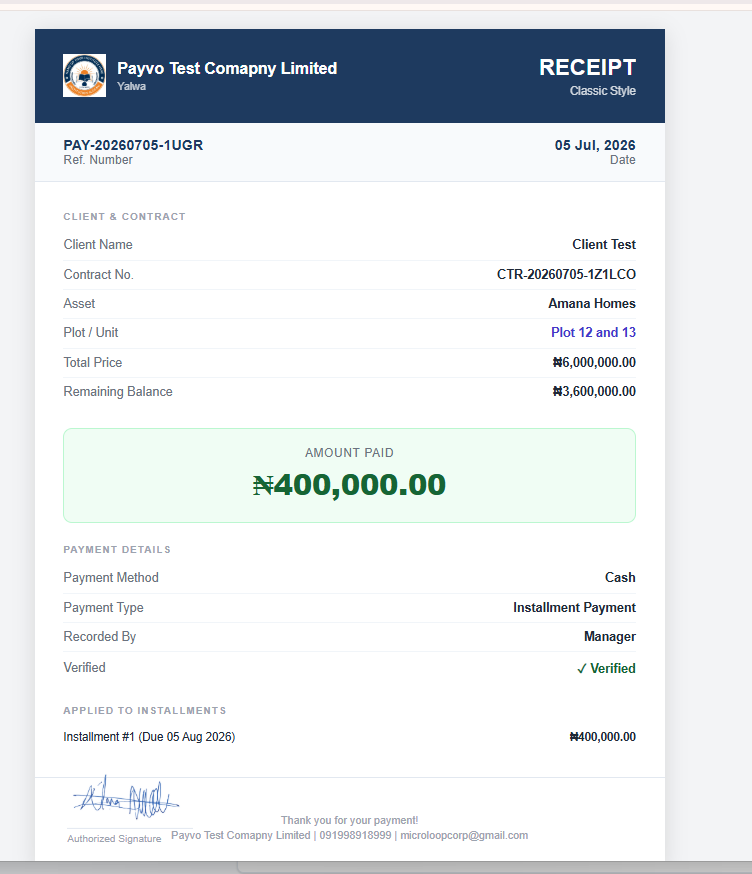 Finance: Payment Receipt Sample
"In the Nigerian market, a business's ability to manage its cash flow from installment sales is not just about survival, it's about defining its potential for expansion and its reputation for reliability."
Frequently Asked Questions
Q1: Is open-source installment software truly free?
A1: The software itself is typically free to download and use. However, "free" doesn't mean "cost-free." You will incur costs for hosting (₦20,000 - ₦250,000 annually), customization by developers (₦50,000 - ₦400,000 monthly or ₦200,000 - ₦700,000 for one-time features), security, maintenance, and potentially integrating third-party services like SMS gateways (₦10,000 - ₦30,000 monthly) or payment gateways (₦100,000 - ₦300,000 initial setup).
Q2: How long does it take to set up an open-source installment management system?
A2: The timeline varies greatly depending on the complexity of the chosen project and the extent of customization required. A basic setup might take a few weeks for an experienced developer, while a fully customized system with integrations could take several months. This doesn't include the time for data migration and staff training.
Q3: What are the risks of using an open-source solution for financial data?
A3: The main risks include security vulnerabilities if the code isn't regularly updated or properly secured, lack of dedicated support (relying on community forums), and the potential for a project to become inactive, leaving you without future updates or bug fixes. It requires a commitment to ongoing technical management.
Q4: Can these systems handle Nigerian specific payment terms and currencies?
A4: Most open-source systems are built with a global perspective. While they can typically handle different currencies, specific Nigerian payment terms (e.g., unique installment structures, specific legal requirements for contracts) will almost certainly require custom development to ensure full compliance and functionality. This is a key area where a locally built solution like Payvo offers an advantage, as it's designed with the Nigerian market in mind.
Q5: What if I don't have a developer on staff?
A5: If you lack in-house technical expertise, you'll need to hire a freelance developer or an agency. This introduces additional costs and management overheads. Alternatively, consider a ready-made, subscription-based solution like Payvo that handles all the technical complexities for you, allowing you to focus on your core business. You can explore Payvo's comprehensive features here.
Ready to Streamline Your Installment Sales?
Managing installment sales doesn't have to be a manual headache. Whether you choose to invest in customizing an open-source solution or opt for a purpose-built platform, the right system can transform your operations. If you're a real estate developer, car dealer, cooperative, or any business selling on credit, explore how automated tools can enhance your efficiency, improve collections, and drive growth. Discover a smarter way to manage your contracts and payments by visiting Payvo.ng today and see how easy it can be to get started.