Are you tired of chasing down installment payments, sifting through stacks of ledgers, or deciphering scattered WhatsApp messages to figure out who owes what? Do payment reminders feel like a full-time job, and tracking agent commissions a mathematical nightmare? You're not alone. Many Nigerian businesses operating on an installment model grapple with inefficiencies that eat into profits and stunt growth.
 A small business owner in nigeria looking stressed
The High Cost of Manual Installment Tracking in 2026
In 2026, relying on manual methods like spreadsheets, notebooks, and individual WhatsApp chats for managing installment sales is more than just inconvenient – it's a significant drain on your business's resources and potential. From real estate developers in Abuja to car dealers in Kano and cooperative societies across the nation, the challenges are universal.
Consider these common pain points:
- Lost Revenue from Missed Payments: Without automated reminders, clients easily forget due dates. Manually calling each client is time-consuming and often inconsistent. This leads to delayed payments and, in many cases, outright defaults, directly impacting your cash flow.
- Inaccurate Records and Disputes: Juggling multiple spreadsheets or physical ledgers often results in errors. A misplaced entry, a forgotten payment, or an incorrectly calculated balance can lead to frustrating disputes with clients, damaging your reputation and consuming valuable time to resolve.
- Inefficient Staff Time: Your team spends countless hours on administrative tasks that could be automated: generating receipts, sending reminders, reconciling payments, and calculating commissions. This diverts their energy from core business activities like sales and customer service. According to a 2025 survey, Nigerian SMEs spend an average of 15-20 hours weekly on manual record-keeping for installment sales, time that could be better spent growing the business.
- Lack of Real-time Business Insights: Can you tell, right now, your total outstanding balance across all contracts? Or which agent is bringing in the most consistent payments? Manual systems make it nearly impossible to get real-time, accurate insights into your business's financial health, hindering strategic decision-making.
- Agent Management Headaches: Tracking commissions for agents who sell on installment, especially when payments come in sporadically, is notoriously complex. Manual calculations are prone to errors, leading to mistrust and demotivation among your sales force. Ensuring agents are paid correctly and on time is crucial for retaining top talent.
The Hidden Costs of Basic Software and DIY Solutions
While some businesses attempt to mitigate these issues with basic accounting software or by cobbling together generic tools, these often fall short when it comes to the specific complexities of installment sales.
- Generic Accounting Software Limitations: Standard accounting packages are excellent for general ledgers and financial reporting, but they typically lack the specialized features needed for installment management. They often don't handle recurring installment schedules automatically, track assets linked to contracts, or manage agent commissions based on received payments. This means you'll still be doing a significant amount of manual work outside the software.
- The Spreadsheet Trap: While initially free, advanced spreadsheets quickly become unwieldy. They are prone to human error, difficult to scale, offer no real-time collaboration, and lack security features. One accidental deletion or formula error can compromise months of data. The time spent troubleshooting complex spreadsheets often outweighs any initial cost savings.
- Integration Gaps: Many businesses find themselves using separate tools for client management, payment tracking, and communication. This fragmented approach leads to data silos, duplicate entries, and a lack of a unified view of your operations. The effort to manually move data between systems negates any efficiency gains.
- Security Concerns: Storing sensitive client payment data in unsecured spreadsheets or generic cloud drives poses a significant security risk. Dedicated installment management software offers robust security protocols to protect both your business and your clients' information.
- One-time Setup/Implementation: For more complex tools, this can be ₦50,000 - ₦300,000.
- Training Costs: Getting your team up to speed can cost ₦10,000 - ₦40,000 per user/session.
- Internet Data: A reliable connection for cloud-based tools can add ₦10,000 - ₦30,000 monthly.
- IT Support: External IT retainers can be ₦30,000 - ₦100,000 monthly if you lack in-house expertise.
> "In the dynamic Nigerian market, businesses that embrace automation for their core processes, especially payment collection and client management, are not just surviving; they are poised for exponential growth. Manual processes are a silent killer of efficiency and profitability."
Embracing a Smarter Approach: Integrated Installment Management
The smarter approach for businesses dealing with installment sales is to adopt an integrated installment management software. This isn't just about digitizing existing manual processes; it's about transforming them. This type of software provides a centralized system that automates the entire lifecycle of an installment sale, from client onboarding and contract creation to payment collection, receipt generation, and agent commission tracking.
Imagine a system where:
- Client records are comprehensive and instantly accessible: No more searching through files or asking clients for details you should already have.
- Contracts are created with automated payment schedules: Set terms once, and the system handles all future payment calculations and due dates.
- Payments are recorded instantly, and receipts are automatically generated: Clients receive professional, branded receipts without any manual intervention.
- Automated reminders go out before due dates: Significantly reducing late payments and the need for manual follow-ups.
- Assets are linked directly to contracts: Making it easy to track a specific property, vehicle, or equipment throughout its payment tenure.
- Agent commissions are calculated automatically: Based on actual payments received, ensuring transparency and accuracy.
- Real-time dashboards provide a clear overview: Instantly see your cash flow, outstanding balances, and agent performance.
How Payvo Transforms Installment Businesses
This is where Payvo comes in. Payvo is a comprehensive business management platform specifically designed for companies that sell on installment. It replaces the chaos of manual tracking, scattered WhatsApp messages, and error-prone spreadsheets with a streamlined, automated system. From the moment a client is added to the system, to the final installment payment, Payvo handles it all.
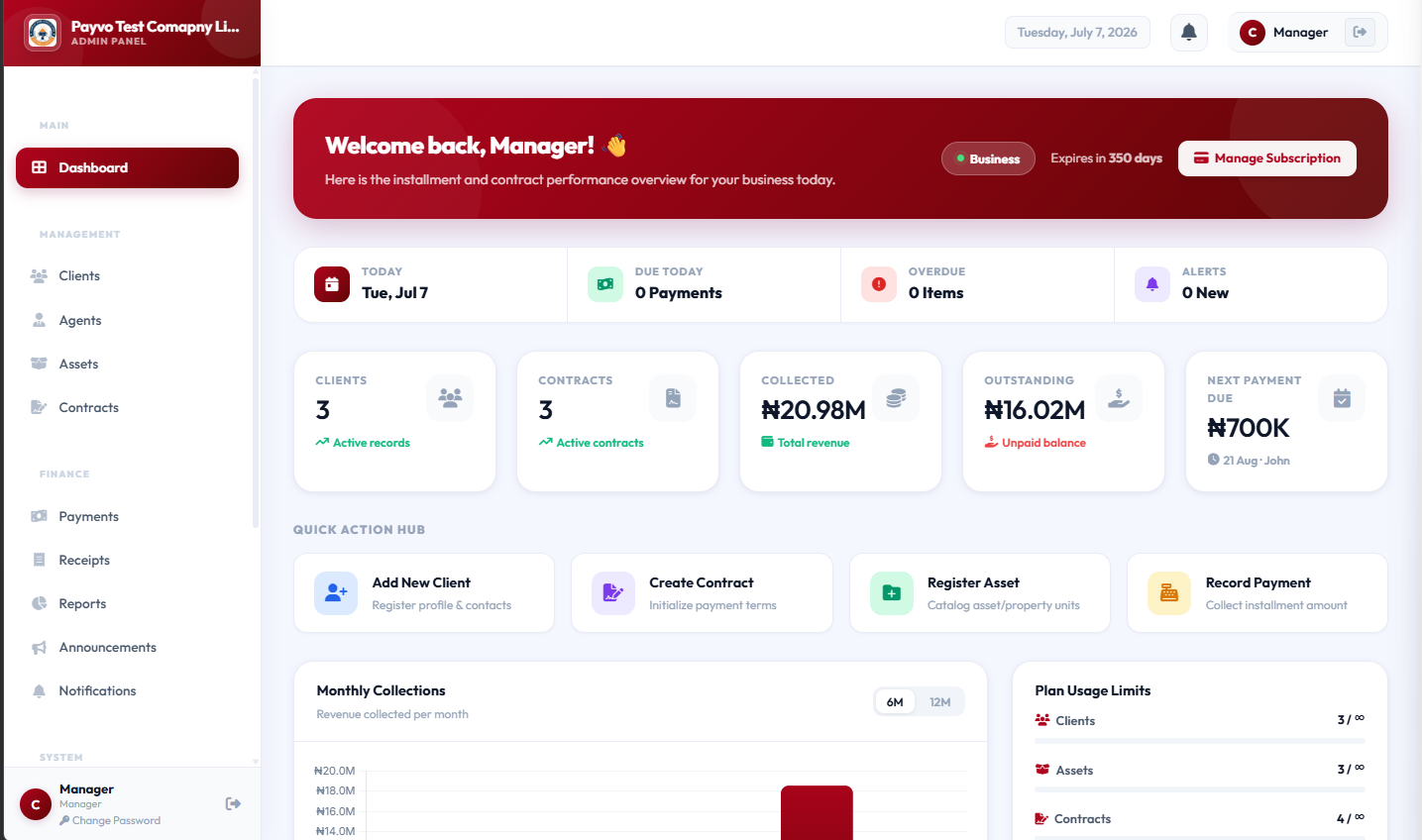 Payvo Dashboard displaying key metrics like total clients, active contracts, and amount collected
With Payvo, you can:
- Centralize Client and Asset Management: Easily register and manage all your client details, including their complete payment history. You can also track assets like properties, cars, or equipment, linking them directly to specific contracts. This means no more guessing which client is associated with which asset or payment plan.
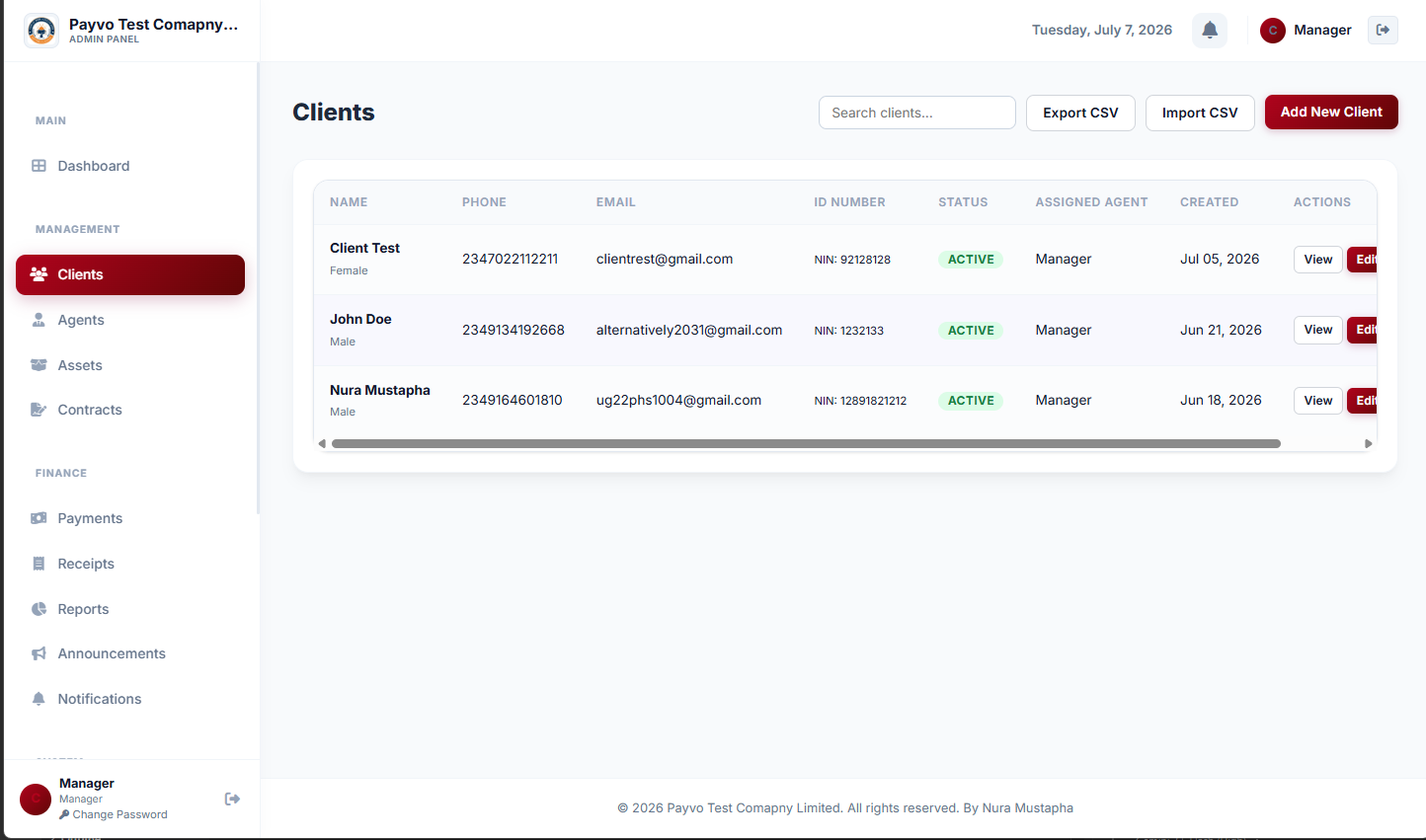 Payvo Client List Page showing various client details
- Automate Contract and Payment Scheduling: Create contracts with ease. Once you set the payment terms, Payvo automatically generates the entire installment schedule. When payments come in, you can log them against the contract, and Payvo keeps a full, immutable history.
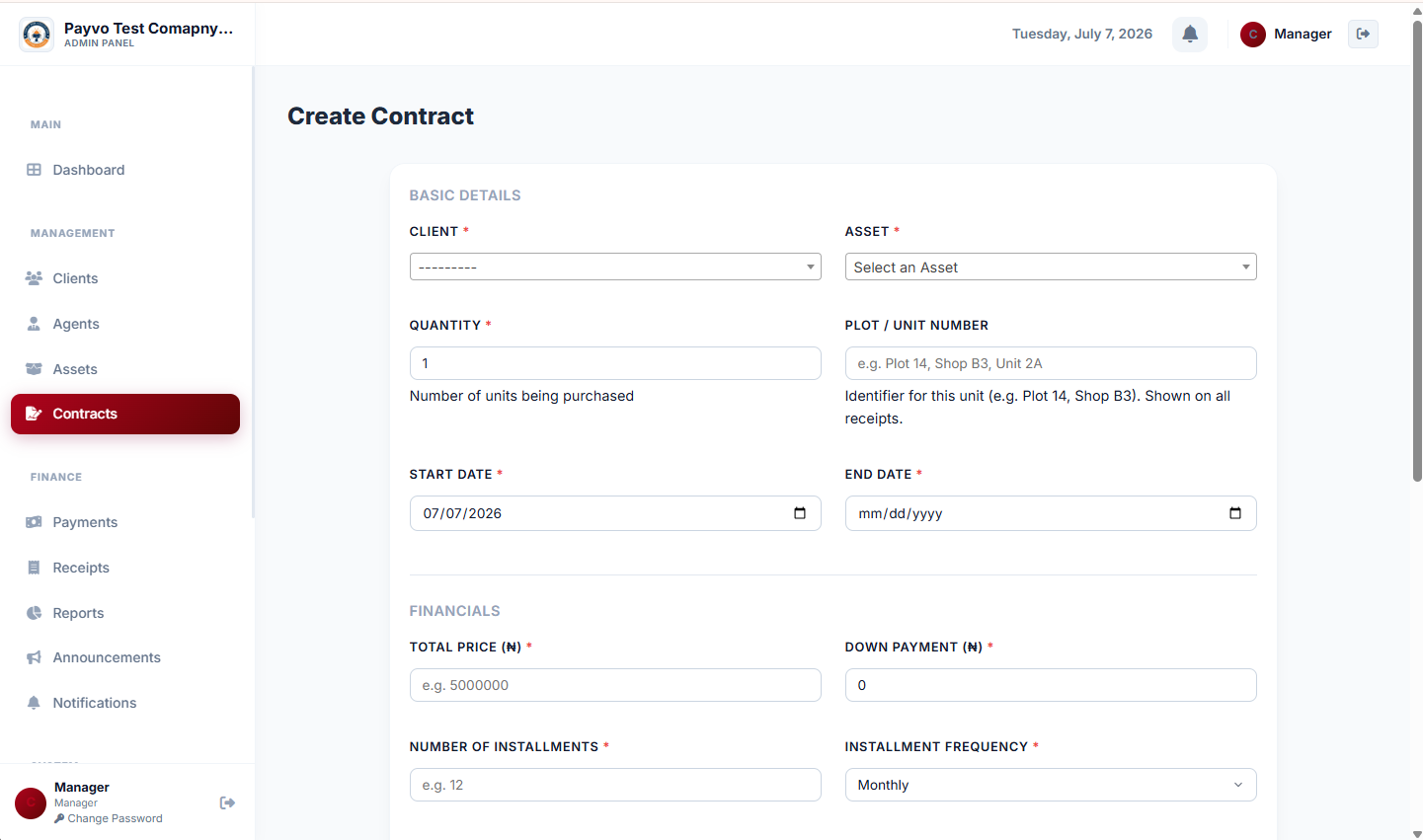 Payvo Add Contract Page with fields for payment terms
- Generate Instant, Branded Receipts & Notifications: Every payment recorded automatically triggers a professional, branded receipt (with your company logo, colors, and digital signature). These receipts, along with new client, new contract, and payment received notifications, can be sent automatically via email and our integrated WhatsApp payment notification system. Clients receive a public receipt link they can view, save, or share, enhancing trust and professionalism.
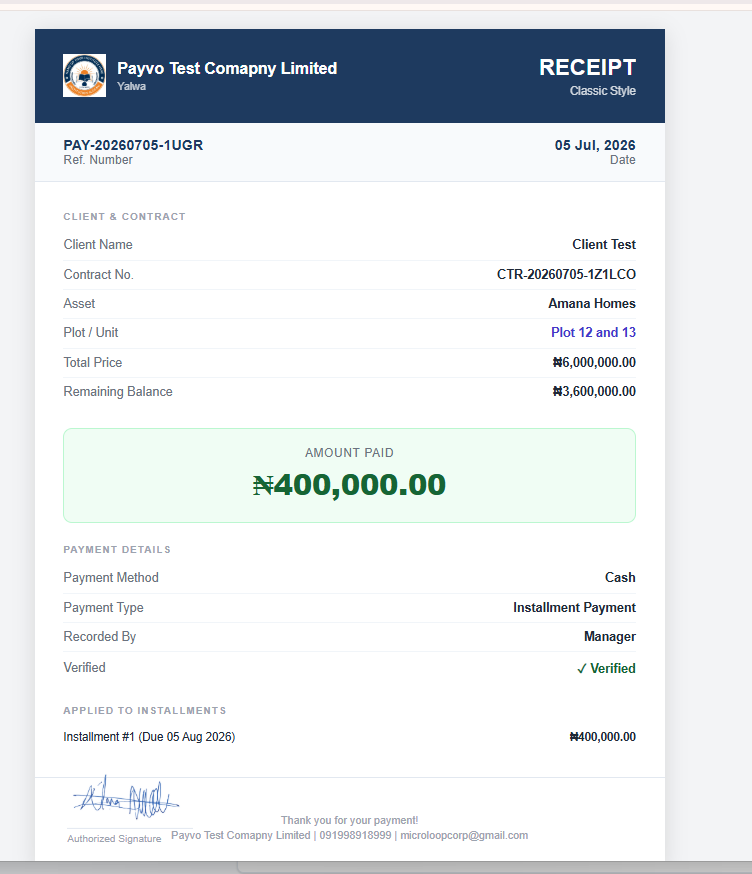 Payvo Payment Receipt Sample showing a branded receipt
- Streamline Agent and Staff Management: For businesses with sales agents, Payvo offers robust agent commission tracking software. Assign agents to contracts, and the system automatically calculates their commission per payment received, tracking their full earnings and payout history. Agents can even log in to track their own KPIs and submit withdrawal requests, fostering transparency and motivation. Business owners can also add staff accounts with role-based permissions, controlling access and ensuring accountability. Learn more about our agent tracking page.
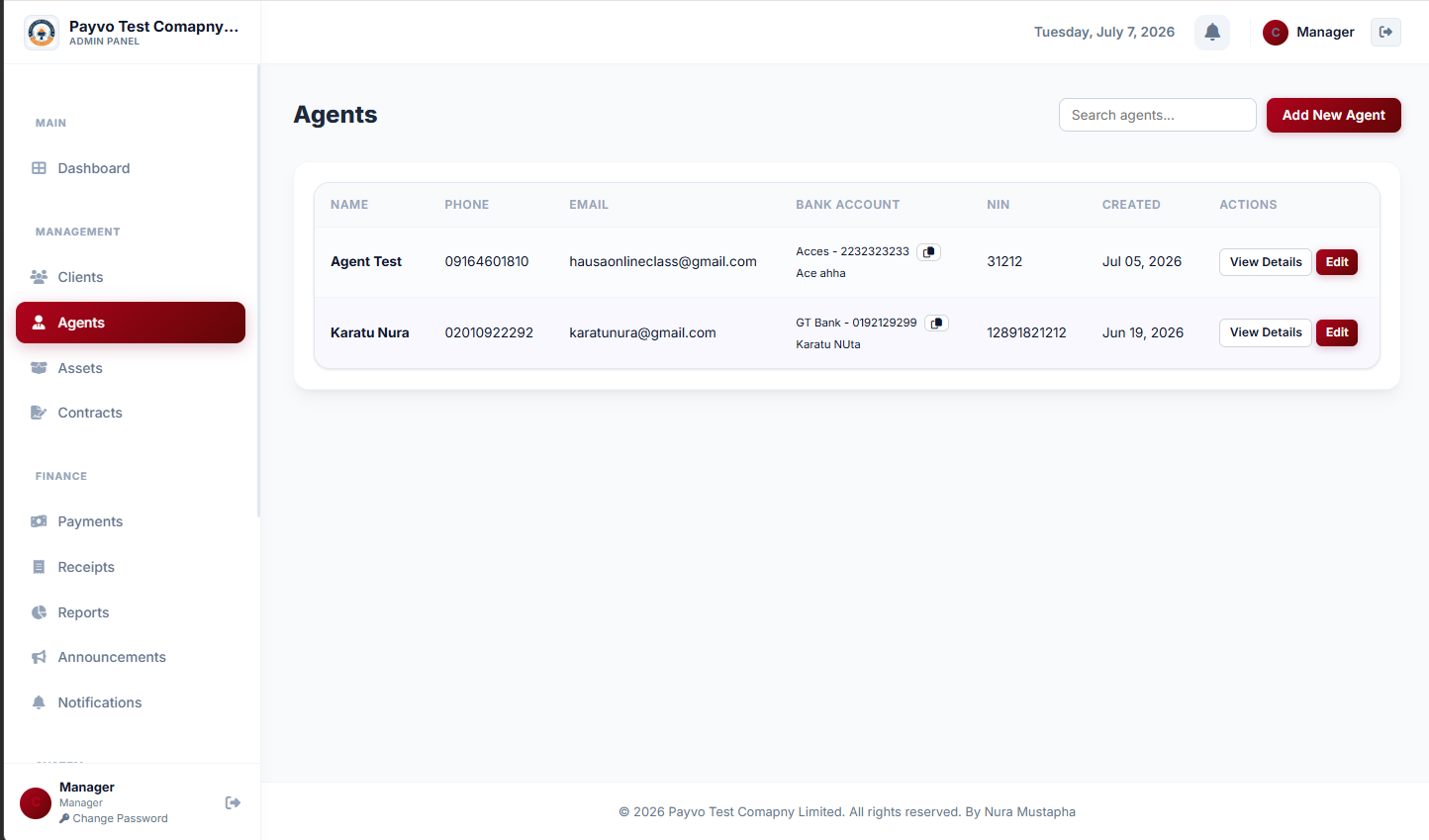 Payvo Agents List Page displaying various agent details
- Gain Real-time Business Insights and Reports: Payvo’s real-time dashboards provide an instant overview of your total clients, active contracts, amount collected, outstanding balances, and next payment due dates. You can also generate comprehensive reports in PDF or Excel for accounting and record-keeping, and receive weekly email summaries of your key business performance metrics. This powerful reporting transforms how you analyze your business.
Proof: Side-by-Side Comparison
Let's look at how a dedicated installment management software like Payvo compares to traditional manual systems or generic tools.
| Feature / Aspect | Traditional Methods (Spreadsheets, Ledgers, WhatsApp) | Dedicated Installment Management Software (e.g., Payvo) |
|---|---|---|
| Client Records | Scattered across notebooks, multiple spreadsheets, or individual phone contacts. Prone to duplication and outdated info. | Centralized, comprehensive client profiles with full payment history, contact details, and linked contracts. |
| Contract Creation | Manual calculation of installment schedules, prone to errors. Time-consuming setup. | Automated installment schedule generation based on defined terms. Quick and error-free. |
| Payment Tracking | Manual logging in ledgers/spreadsheets. Difficult to reconcile. | Instant recording of payments against contracts. Full, immutable payment history. |
| Receipt Generation | Manual writing, printing, or sending basic text messages. Inconsistent branding. | Automated, branded digital receipts (email/WhatsApp) for every payment. Professional and consistent. |
| Payment Reminders | Manual calls, individual WhatsApp messages. Inconsistent and time-consuming. | Automated, scheduled reminders via email and WhatsApp before due dates. Reduces late payments. |
| Asset Management | Often disconnected from client/payment records. Difficult to track specific items. | Assets linked directly to contracts and clients, providing a clear overview of inventory on installment. |
| Agent Commission Tracking | Manual calculation, often leading to disputes and errors. | Automated calculation of commissions per payment received. Transparent agent self-tracking. |
| Reporting & Insights | Requires manual aggregation and analysis. Time-delayed, often inaccurate. | Real-time dashboards, automated weekly reports, exportable data (PDF/Excel) for instant insights. |
| Data Security | Low security, vulnerable to loss, damage, or unauthorized access. | Robust security protocols, audit logs, and secure cloud storage. |
| Scalability | Very difficult to scale as business grows. More clients = more chaos. | Designed to scale with your business, managing hundreds or thousands of contracts effortlessly. |
| Staff Efficiency | High administrative burden, diverting staff from core tasks. | Significantly reduces manual workload, freeing staff for sales and customer service. |
 A sleek 3d illustration of a secure digital
Frequently Asked Questions
Q1: What is the average cost of installment business software in Nigeria in 2026?
The cost of installment business software in Nigeria varies significantly based on features and scale. Basic tiers for smaller businesses might range from ₦5,000 - ₦15,000 per month. Mid-tier solutions offering more features like inventory and CRM could be ₦20,000 - ₦70,000 monthly. Enterprise or highly specialized systems can go from ₦100,000 to ₦500,000+ per month, especially for comprehensive ERP systems. One-time setup fees can also range from ₦50,000 to ₦300,000 for complex implementations. When evaluating options, it's crucial to look beyond the monthly fee to include potential setup, training, and integration costs.
Q2: Can installment management software track agent commissions accurately?
Yes, dedicated installment management software like Payvo is designed to accurately track agent commissions. It allows you to assign agents to specific contracts and automatically calculates their commission based on each payment received from the client. This eliminates manual calculation errors, provides transparency, and allows agents to even track their own earnings, reducing disputes and fostering trust. This feature is particularly valuable for car dealer installment software and real estate payment tracking Nigeria.
Q3: How does a receipt generator app Nigeria benefit my business?
A receipt generator app in Nigeria, especially one integrated into an installment management system, offers immense benefits. It automates the creation and distribution of professional, branded receipts for every payment. This saves significant time, eliminates manual errors, and provides clients with instant proof of payment, enhancing their trust and your business's credibility. Systems like Payvo can send these receipts automatically via email and WhatsApp, making the process seamless for both you and your customers.
Q4: Is it secure to store client payment data on these platforms?
Reputable installment management software prioritizes data security. They employ robust encryption, secure cloud infrastructure, and access controls to protect sensitive client payment information. Unlike spreadsheets or generic cloud storage, these platforms are built with security in mind, often including audit logs to track all activities. Always check a provider's privacy policy and terms of service, such as Payvo's privacy policy and terms of service, to ensure their practices align with your security standards.
Q5: Can this software integrate with my existing business communication tools like WhatsApp?
Many modern installment management software solutions offer integrations with popular communication tools. For instance, Payvo includes a robust WhatsApp payment notification system that allows you to send automated payment reminders, payment received notifications, and contract updates directly to your clients via WhatsApp. This ensures high deliverability and convenience, meeting customers where they are most active.
Ready to Transform Your Installment Business?
Stop letting manual processes hold your business back. Embrace the efficiency, accuracy, and growth potential that comes with a dedicated installment management solution. Discover how Payvo can streamline your operations, improve cash flow, and empower your team.