In Nigeria, businesses lose an estimated ₦300 billion annually due to inefficient tracking of installment payments and credit sales. For many real estate developers, car dealers, and cooperative societies, managing hundreds of client contracts, payment schedules, and agent commissions remains a chaotic mix of ledgers, spreadsheets, and endless WhatsApp messages. This manual approach isn't just time-consuming; it's a direct drain on profits and a barrier to scaling.
 Nigerian entrepreneur reviewing complex payment schedules on a
The Installment Sales Landscape in Nigeria: 2026 Realities
The Nigerian market for installment sales is booming in 2026. From real estate in Abuja and Lagos, where a plot of land can range from ₦5,000,000 to ₦150,000,000, to hire purchase vehicles averaging ₦3,000,000 to ₦15,000,000, and solar equipment leases at ₦500,000 to ₦5,000,000, credit-based transactions are the backbone for many consumers and businesses. This growth, however, brings significant operational challenges. Businesses grapple with high rates of payment default, reconciliation errors, and disputes over payment history. Manual systems simply cannot keep pace. A robust system is no longer a luxury but a necessity for survival and growth. Without proper automation, even a successful business can find itself drowning in administrative overhead and lost revenue.
What You Need Before You Start
Building an effective installment management system, especially with PHP, requires a solid foundation. Before you write a single line of code, gather these essentials:
- Clear Business Requirements: Define exactly what your system needs to do. Who are the users? What types of contracts will it manage? What reports are critical?
- Technical Stack:
- PHP Framework: Laravel (highly recommended for its robust features and community support), Symfony, or CodeIgniter.
- Database: MySQL or PostgreSQL for data storage.
- Frontend: HTML, CSS, JavaScript (with a framework like React, Vue.js, or Alpine.js for interactivity).
- Server: A reliable web server like Nginx or Apache.
- Version Control: Git for collaborative development and tracking changes.
- Hosting Environment: A reliable cloud hosting provider (e.g., AWS, DigitalOcean, Azure) or a dedicated server.
- Development Environment: A local development setup (e.g., XAMPP, Laragon, Docker).
- Budget & Resources: Factor in developer time (if outsourcing, expect project costs from ₦500,000 for a basic system to over ₦5,000,000 for a comprehensive one), software licenses (if any), and ongoing maintenance.
- Legal & Compliance Understanding: Familiarity with Nigerian consumer protection laws and data privacy regulations, especially concerning financial data.
Step-by-Step: Building an Installment Management System with PHP
Developing a comprehensive installment management system involves several critical phases. We’ll break down the core components and how to approach them using PHP.
Step 1: Database Design and Setup
This is the foundation of your system. A well-structured database ensures data integrity and efficient retrieval. You'll need tables for clients, assets, contracts, payments, users (for staff/agents), and potentially notifications.
- Clients Table:
clientid(PK),name,address,phonenumber,email,NIN,BVN(for KYC),date_registered. - Assets Table:
assetid(PK),assettype(e.g., 'car', 'land', 'solar panel'),serialnumber/registrationnumber,description,initial_value,status(e.g., 'available', 'sold', 'repossessed'). - Contracts Table:
contractid(PK),clientid(FK),assetid(FK),startdate,enddate,totalamount,downpayment,interestrate,numberofinstallments,installmentamount,duedayofmonth,status(e.g., 'active', 'completed', 'defaulted'),agent_id(FK). - Payments Table:
paymentid(PK),contractid(FK),amountpaid,paymentdate,duedate,paymentmethod,receiptnumber,recordedbyuserid(FK). - Users Table:
user_id(PK),name,email,password,role(e.g., 'admin', 'staff', 'agent').
Step 2: User Authentication and Authorization
Implement a robust user management system. This ensures that only authorized personnel can access sensitive financial data and perform specific actions.
- User Registration & Login: Create forms for new users to sign up and existing users to log in. Hash passwords securely using functions like
password_hash()in PHP. - Role-Based Access Control (RBAC): Define roles (e.g., Admin, Sales Agent, Finance Officer) and assign specific permissions to each role. For instance, an Admin can create new users and view all reports, while a Sales Agent can only create contracts and view their own clients. You can manage staff accounts effectively by assigning role-based permissions, ensuring data security and operational efficiency.
- Session Management: Use PHP sessions to maintain user login state and protect against unauthorized access.
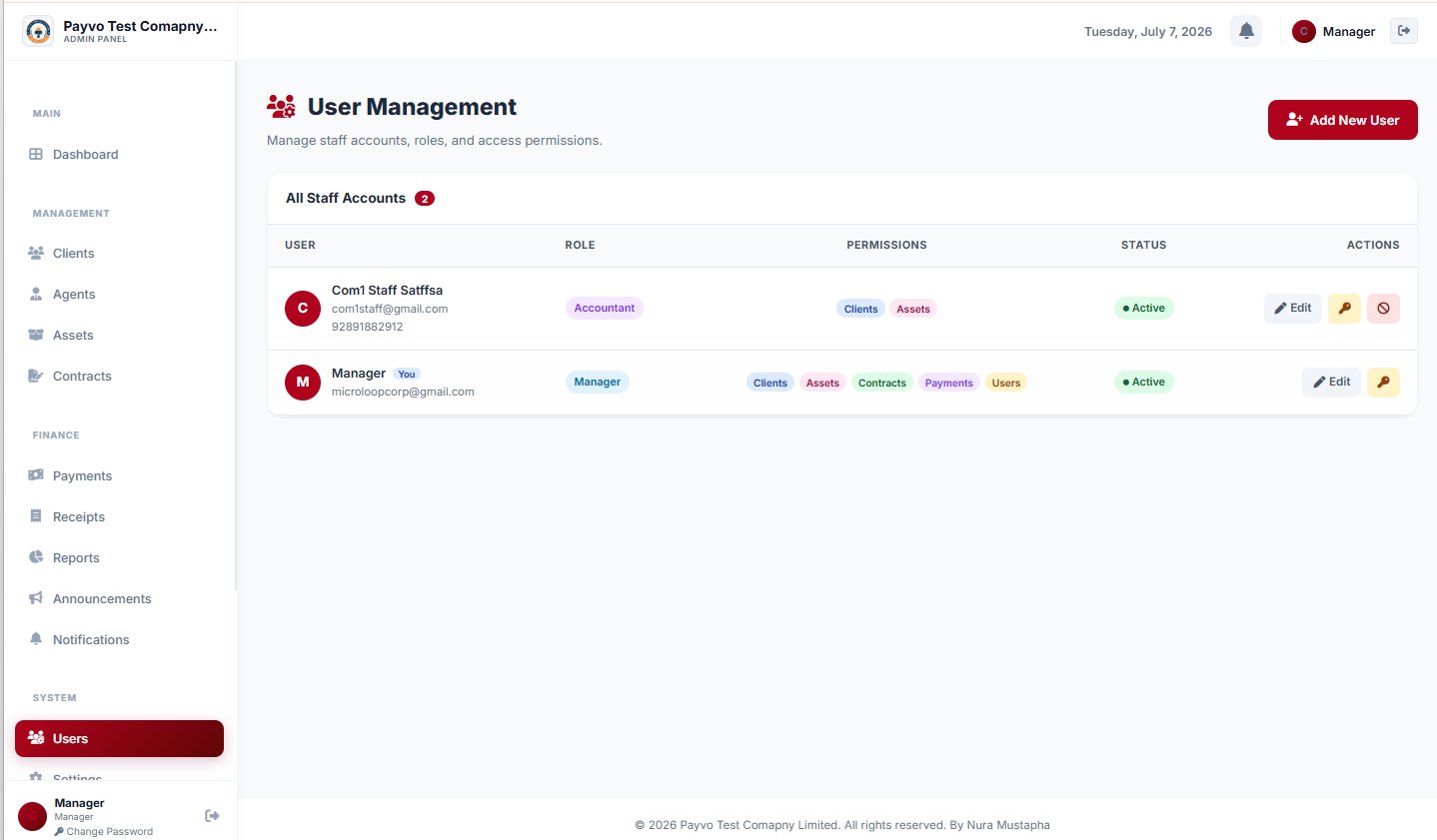 Admin: User Management Page
Step 3: Client and Asset Management Modules
These are your core data entry points. The system needs to efficiently register and track every client and every asset.
- Client Registration: Develop a form to capture comprehensive client details, including contact information, identification (NIN/BVN), and any relevant notes. This is crucial for building a strong client database.
- Client Profile View: Create a page where users can view a client's complete details, including their history of contracts and payments. This helps in understanding client engagement and payment behavior.
- Asset Registration: Design a module to add details of items sold on installment, whether it's a vehicle, a piece of land, or solar equipment. Each asset should have a unique identifier and relevant descriptive fields.
- Asset Tracking: Implement features to link assets directly to contracts and track their status (e.g., 'available', 'under contract', 'repossessed').
Step 4: Contract Creation and Installment Scheduling
This is where the magic of automation begins. The system should automatically generate installment schedules based on contract terms.
- Contract Form: Create a detailed form to input all contract parameters: client, asset, total amount, down payment, interest rate, number of installments, and payment frequency (e.g., monthly, quarterly).
- Automated Schedule Generation: Upon contract creation, your PHP backend should calculate and populate the
paymentstable with all future installment due dates and amounts. This eliminates manual calculation errors and saves significant time. For example, if a client buys an asset for ₦5,000,000 with a ₦1,000,000 down payment and 12 monthly installments, the system should automatically schedule 12 payments of ₦333,333.33 each. - Contract Details View: Display all contract terms, including the full installment schedule and payment history, in a clear, accessible format. This is vital for both staff and clients.
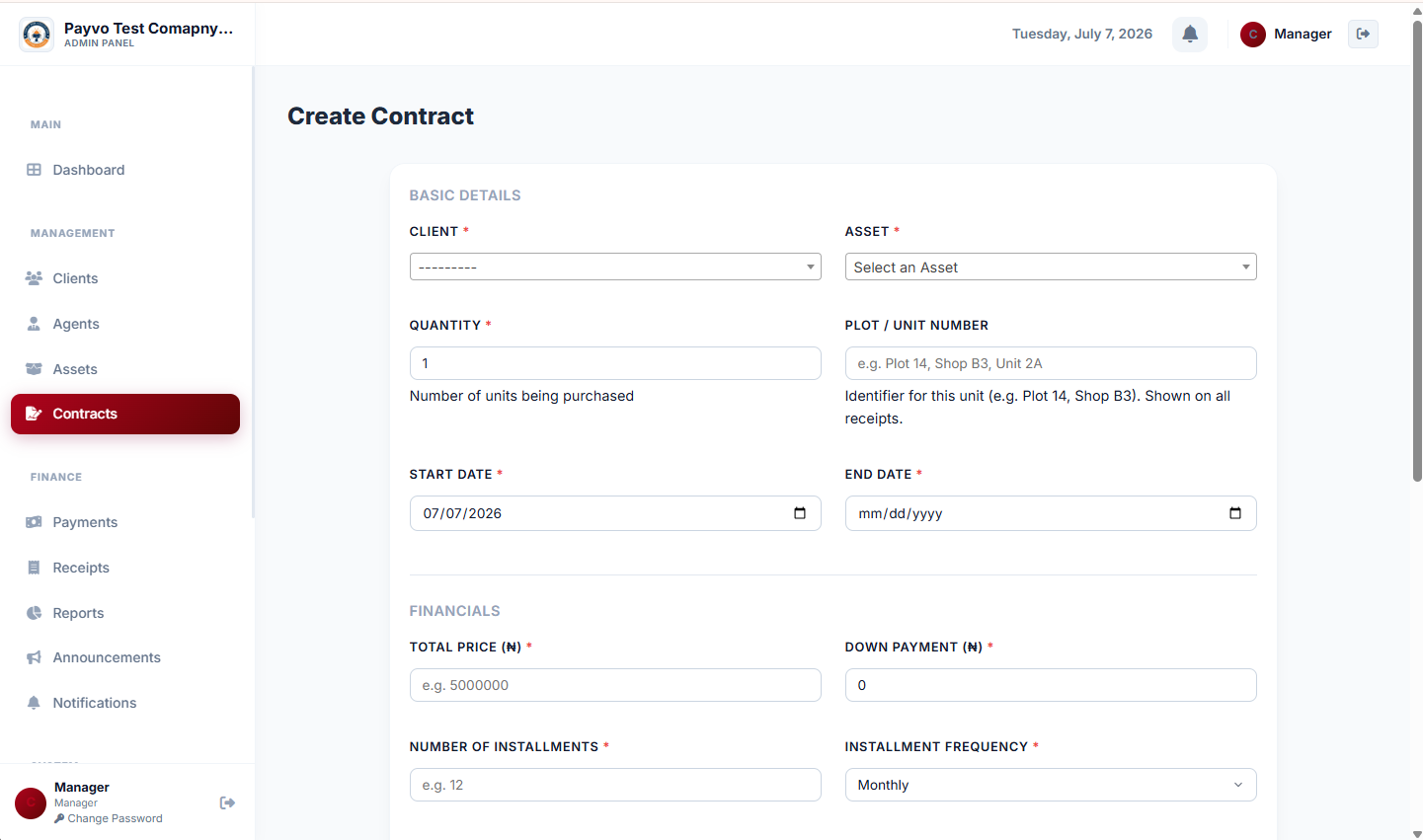 Management: Add contract (top)
Step 5: Payment Recording and Receipt Generation
Accurate payment recording and instant receipt generation are non-negotiable for transparency and trust.
- Record Payments: Develop an interface for staff to log payments received against specific contracts. The system should automatically update the outstanding balance.
- Automated Receipt Generation: After each payment, the system should instantly generate a branded receipt. This receipt should include your company logo, payment details, and a unique receipt number. This is a significant upgrade from manual receipts and enhances professionalism. A robust
receipt generator app Nigeriais crucial for credibility. - Payment History: Maintain a comprehensive log of all payments made, accessible from both the client and contract detail pages.
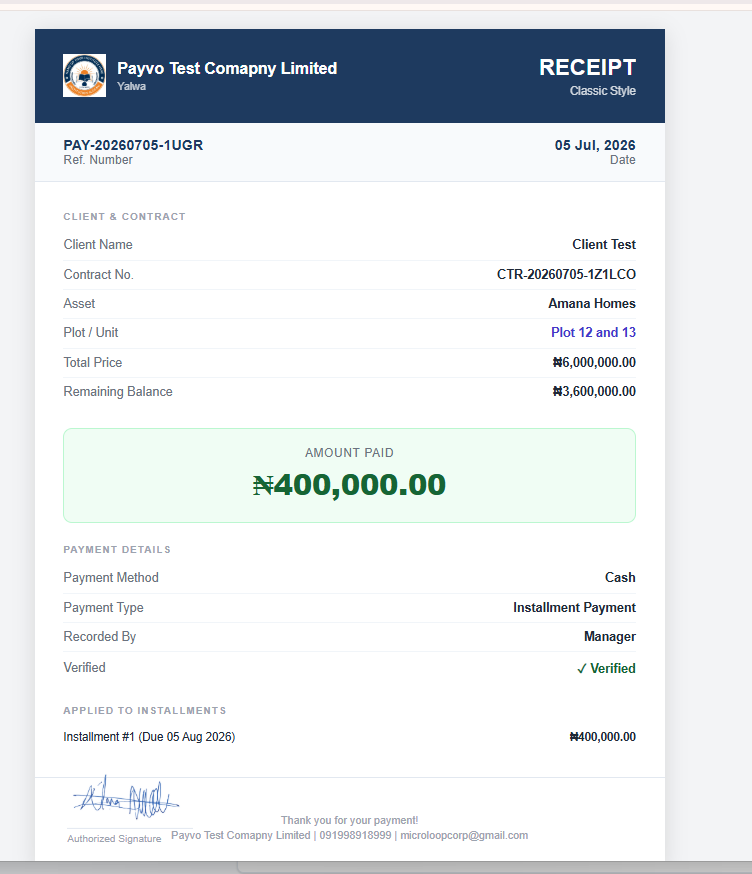 Finance: Paymnet Receipt Sample
Step 6: Automated Notifications and Reminders
Proactive communication significantly reduces payment defaults and improves client satisfaction.
- WhatsApp and Email Integration: Integrate your PHP system with WhatsApp and email APIs to send automated notifications. Libraries like
Twiliofor WhatsApp orPHPMailerfor email can be used. - Payment Reminders: Schedule automated reminders to be sent a few days before an installment is due. This helps clients remember their obligations without needing manual follow-up calls.
- Payment Confirmation: Send instant notifications to clients confirming successful payment receipt, including a link to their digital receipt.
- Contract Confirmation: Notify clients when a new contract is created or updated. A
WhatsApp payment notification systemis highly effective in the Nigerian context.
Step 7: Agent and Commission Management
If your business relies on agents for sales, automating commission tracking is essential for fairness and motivation.
- Agent Registration: Create a module to register sales agents, linking them to the contracts they facilitate.
- Commission Calculation: Implement logic to automatically calculate agent commissions based on payments received for their assigned contracts. This can be a percentage of the down payment, a percentage of each installment, or a flat fee.
- Agent Dashboard: Provide agents with a secure login to view their earnings, active contracts, and commission payout history. This fosters transparency and empowers agents. This also addresses the need for
agent commission tracking software. - Withdrawal Requests: Allow agents to submit withdrawal requests for their earned commissions directly through the system, streamlining the payout process.
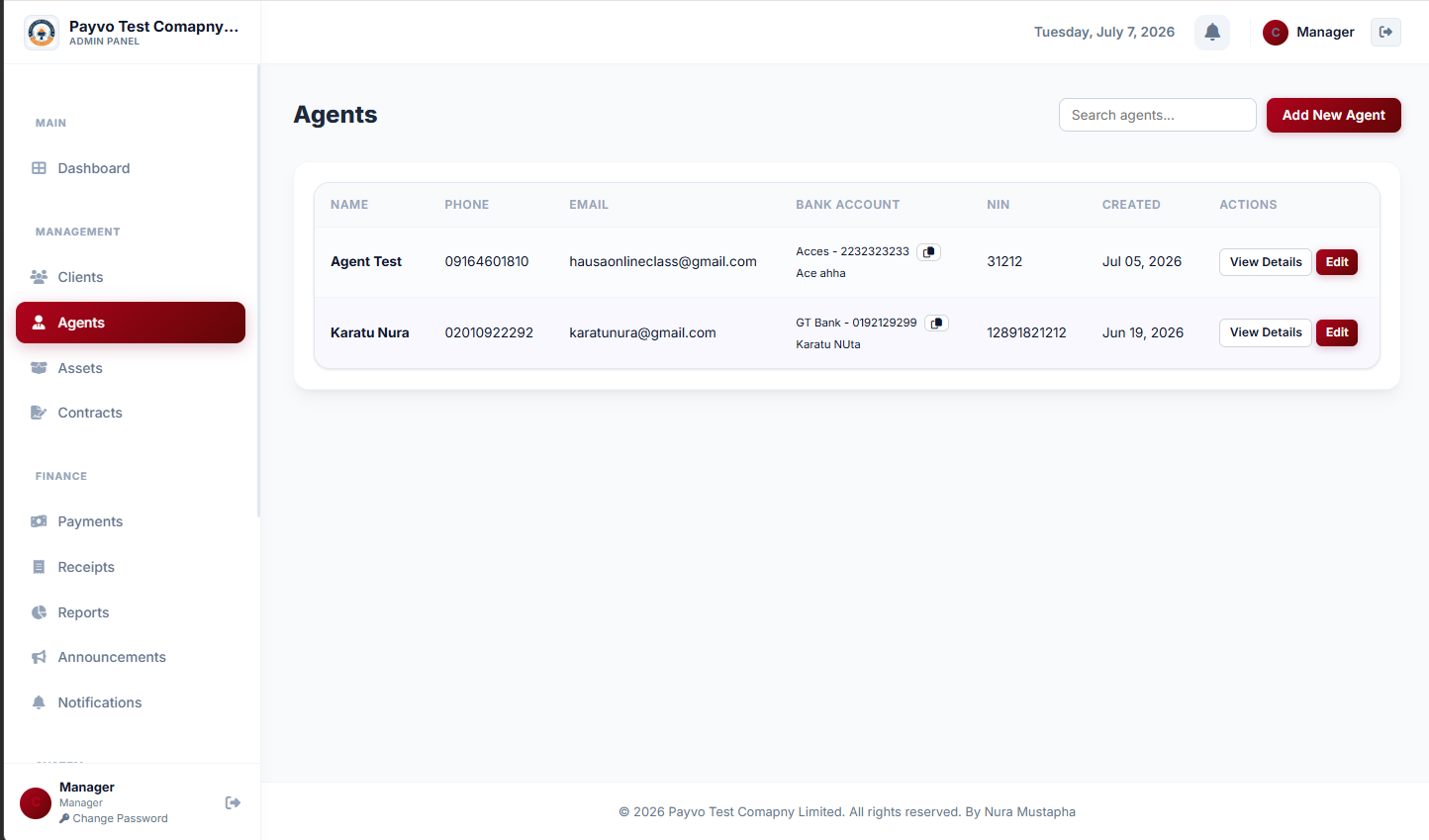 Agent: Agents list page
Step 8: Reporting and Analytics
Real-time insights are crucial for informed decision-making and business growth.
- Dashboard: Develop a dashboard that provides an overview of key metrics: total clients, active contracts, amount collected, outstanding balances, and upcoming payments. This gives business owners a snapshot of their operations.
- Financial Reports: Generate reports on payment trends, outstanding debts, default rates, and revenue projections. These can be exported as PDF or Excel files for accounting purposes.
- Audit Logs: Implement an audit log to track all significant actions performed within the system (e.g., contract creation, payment recording, user login). This ensures accountability and security.
installment management software Nigeria. You can learn more about its powerful features by visiting the Payvo features page.
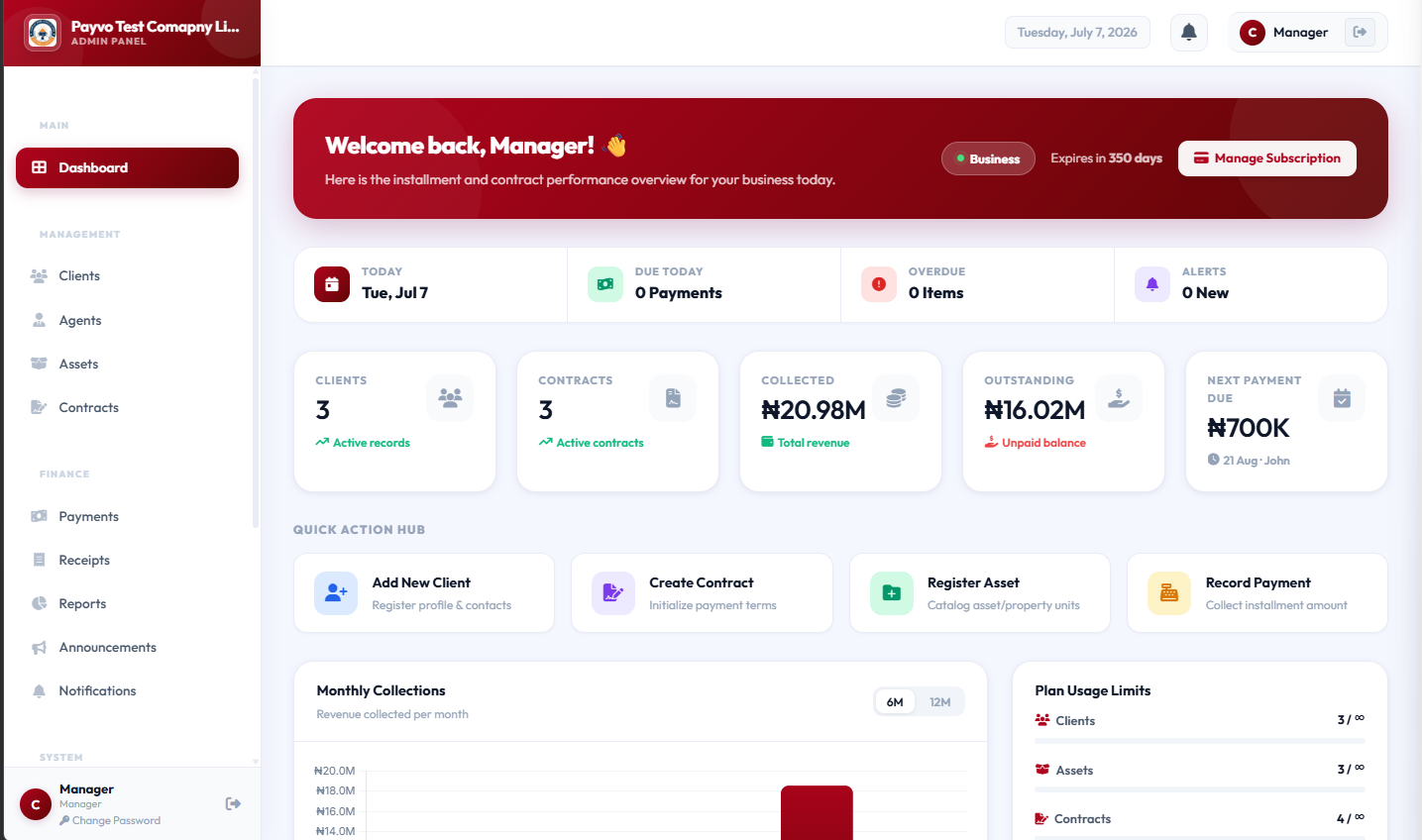 Dashboard (bottom)
Common Mistakes to Avoid
Developing an installment management system is complex. Sidestep these common pitfalls to ensure a successful implementation:
- Underestimating Security: Financial data is highly sensitive. Neglecting security measures like input validation, SQL injection prevention, cross-site scripting (XSS) protection, and strong password hashing can lead to catastrophic data breaches.
- Poor Database Design: A poorly designed database will lead to performance issues, data inconsistencies, and make future modifications extremely difficult. Invest time in proper normalization and indexing.
- Ignoring User Experience (UX): Even with powerful features, a clunky, non-intuitive interface will frustrate users and lead to errors. Prioritize clean design and ease of use.
- Lack of Scalability Planning: As your business grows, your system needs to handle more data and users. Design with scalability in mind from the start, especially for a
contract management software Nigeriasolution. - Inadequate Testing: Thoroughly test every module, especially payment calculations, reminder schedules, and report generation, to catch bugs before they impact real financial operations.
- Neglecting Backup and Recovery: Data loss can be fatal. Implement a robust backup strategy and test your recovery procedures regularly.
- Building Everything from Scratch When Alternatives Exist: While a custom build offers flexibility, it's often more expensive and time-consuming than leveraging a specialized, ready-made solution, especially for core functionalities like
how to track installment payments.
How to Track and Grow After Launch
Launching your installment management system is just the beginning. Continuous monitoring and strategic growth are key.
- Key Performance Indicators (KPIs):
- Collection Rate: Percentage of due payments successfully collected.
- Default Rate: Percentage of contracts in default.
- Average Payment Lag: How many days, on average, payments are delayed.
- Client Retention Rate: How many clients renew or enter new contracts.
- Agent Performance: Track commission earned per agent, contracts closed, and client satisfaction.
- Regular System Audits: Periodically review system performance, security logs, and user activity.
- User Feedback Loop: Actively solicit feedback from staff and agents. Their insights are invaluable for identifying areas for improvement and new features.
- Data-Driven Decisions: Use the reports and dashboards generated by your system to make informed business decisions. For example, if default rates are high for a specific asset type, you might adjust your credit policies.
- Continuous Improvement: The business landscape evolves, and so should your system. Plan for regular updates, feature enhancements, and security patches.
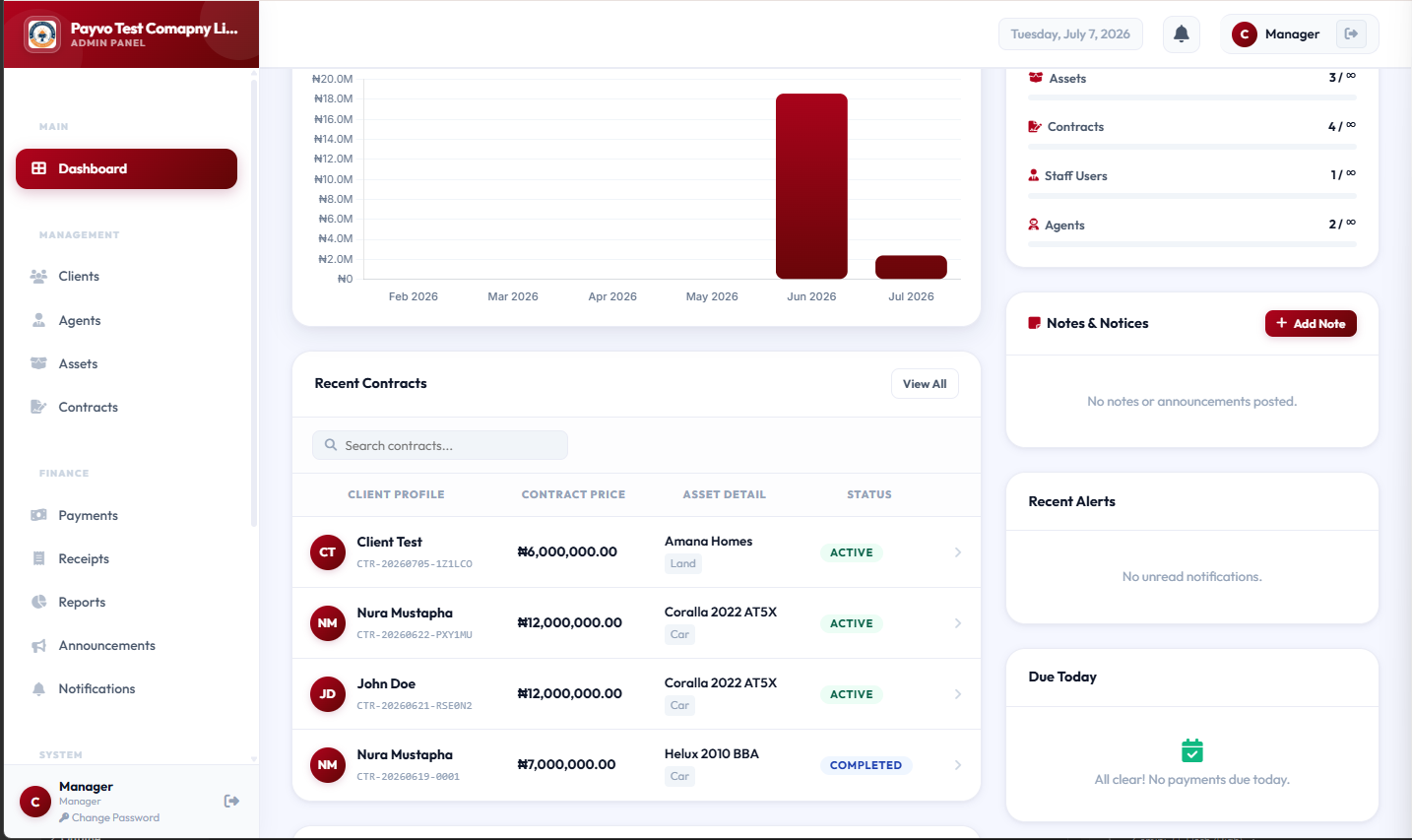 Dashobard (top)
Frequently Asked Questions
Q1: Is PHP still a good choice for building a modern installment management system in 2026?
Yes, absolutely. PHP, especially with modern frameworks like Laravel, remains a powerful, flexible, and widely supported language for web development. Its vast community, extensive libraries, and performance improvements make it an excellent choice for robust business applications. Many enterprise-level systems and popular platforms are built on PHP.
Q2: How much does it typically cost to build a custom PHP installment management system in Nigeria?
The cost varies significantly based on complexity, features, and developer experience. A basic system with core functionalities might range from ₦500,000 to ₦2,500,000. A more advanced system, including features like WhatsApp integration, agent management, and detailed analytics, could cost anywhere from ₦3,000,000 to over ₦10,000,000. This doesn't include ongoing maintenance and hosting.
Q3: What are the key security considerations for handling financial data in Nigeria?
Security is paramount. You must implement strong encryption for sensitive data (passwords, BVN), use secure coding practices to prevent common vulnerabilities (SQL injection, XSS), enforce strong authentication and authorization, regularly update your software, and ensure compliance with Nigerian data protection regulations. Regular security audits are also highly recommended.
Q4: Can a PHP system integrate with mobile money or other local payment gateways?
Yes, modern PHP frameworks and libraries make integration with various APIs straightforward. You can integrate with Nigerian payment gateways like Paystack, Flutterwave, or even direct bank transfer APIs to automate payment reception and reconciliation. This adds immense value, especially for a business payment tracking app Nigeria.
Q5: How can I ensure my clients receive payment reminders effectively?
Utilize multiple channels. A WhatsApp payment notification system is highly effective in Nigeria due to its widespread adoption. Complement this with email reminders and possibly SMS. Allow clients to set their preferred reminder frequency. Providing a public link to their contract and payment history also empowers them to track their own obligations.
Ready to Streamline Your Installment Sales?
Building a custom system requires significant time, resources, and expertise. If you're a real estate developer, car dealer, cooperative society, or any business managing installment sales in Nigeria, and you're looking for a robust, ready-to-use solution, consider Payvo. It's designed to take the complexity out of installment management, allowing you to focus on growth. Simplify client management, automate contracts, track payments, generate receipts, and manage agents effortlessly. Explore how Payvo can transform your operations by visiting our public home page or jump straight to registration to see it in action.