Chasing down late payments feels like a never-ending battle. You’re constantly sifting through ledgers, cross-referencing WhatsApp chats, and wondering if that last payment was actually recorded. This isn't just frustrating; it's actively costing your business time, money, and customer trust.
The Hidden Costs of Manual Installment Management
Many Nigerian businesses, from car dealers selling on hire purchase in Kaduna to real estate developers in Abuja, rely on installment sales to make high-value products accessible. However, managing these complex payment plans manually is a recipe for inefficiency and financial leakage. In 2026, businesses that haven't optimized their installment tracking are falling behind. Recent data indicates that businesses still relying on manual processes spend 25% more time on administrative tasks compared to those using digital solutions, directly impacting productivity and profitability.
One of the biggest pain points is the sheer volume of data involved. Each client, each asset, each payment schedule, and every single transaction needs meticulous tracking. When this is done with notebooks, spreadsheets, and scattered WhatsApp messages, errors are inevitable. A missed payment reminder, a miscalculated balance, or a lost receipt can quickly erode customer confidence and lead to disputes. For small business owners researching "how to manage installment sales," the initial cost savings of manual tracking are quickly dwarfed by the long-term operational overhead and lost revenue.
Consider the potential for fraud, both internal and external. Without a robust system, unauthorized adjustments to payment records or unrecorded cash payments can go unnoticed for extended periods. This lack of transparency impacts not only your bottom line but also your ability to make informed business decisions.
> "In the installment business, clarity and consistency are not just good practices; they are the bedrock of trust and sustained profitability."
The Ripple Effect of Inefficient Tracking
The problems extend beyond just tracking payments. Imagine a real estate developer in Kano trying to reconcile payments across dozens of ongoing contracts. Or a cooperative society managing hundreds of member loans. The lack of a centralized, automated system means:
- Delayed Cash Flow: Manual reconciliation slows down the identification of overdue payments, delaying follow-ups and impacting your operational capital.
- Customer Dissatisfaction: Inconsistent information, delayed receipts, or repeated requests for payment details frustrate clients, leading to higher churn rates.
- Operational Bottlenecks: Staff spend countless hours on routine administrative tasks that could be automated, diverting resources from core business activities like sales or customer service.
- Poor Decision-Making: Without real-time insights into your financial health, identifying trends, forecasting revenue, or making strategic adjustments becomes a guessing game.
5 Signs Your Installment Business Needs a Management System Right Now
If any of the following scenarios sound familiar, it's a clear indication that your current approach to installment management is holding your business back.
1. You're Drowning in Paperwork and Spreadsheets
Are your office desks piled high with client files, payment slips, and contract documents? Do you have multiple spreadsheets for different aspects of your business – one for clients, another for assets, a third for payments, and a fourth for agent commissions? This manual labyrinth is a significant drain on resources.
- Lost Documents: Important contracts or payment records can easily go missing, leading to disputes and financial losses.
- Error-Prone Data Entry: Each time data is manually transferred from one document to another, the risk of human error increases exponentially. A small mistake in a payment amount or due date can have cascading effects.
- Time-Consuming Audits: When it comes time for an audit or to generate financial reports, sifting through physical records or disparate digital files is a monumental task that can take days, if not weeks.
 A busy Nigerian businesswoman looking overwhelmed by stacks of paper and multiple open spreadsheets on her laptop.
2. Payment Reminders Are a Manual Nightmare
Do your staff spend hours each week calling or messaging clients to remind them about upcoming or overdue payments? This manual follow-up process is not only inefficient but also inconsistent, leading to missed payments and strained client relationships.
- Inconsistent Communication: Different staff members might use varying tones or provide differing information, leading to confusion for clients.
- Time-Consuming: Each call or message takes time away from more productive activities like sales or customer support.
- Delayed Follow-ups: If a staff member is busy, payment reminders might be delayed, giving clients more time to default and reducing your chances of timely collection.
- Lack of Proof: Manual WhatsApp messages or calls often lack the formal proof of communication that a system-generated notification provides, making dispute resolution harder.
3. You Struggle to Track Agent Commissions Accurately
For businesses like real estate developers or car dealers who rely on sales agents, accurately tracking commissions can be a major headache. If commissions are calculated manually, often based on partial payments or complex payout structures, discrepancies are common.
- Disputes with Agents: Inaccurate commission calculations can lead to mistrust and disputes with your sales team, impacting morale and productivity.
- Overpayment or Underpayment: Without an automated system, you risk either overpaying agents, which impacts your profitability, or underpaying them, leading to high agent turnover.
- Lack of Transparency: Agents often lack a clear, real-time view of their earnings, making it difficult for them to track their performance and understand their payouts. This is a common issue for businesses seeking agent commission tracking software.
4. You Lack Real-time Insight into Your Business Performance
Can you tell, at a glance, how many active contracts you have, your total outstanding balance, or your projected revenue for the next quarter? Many small business owners research "business payment tracking app Nigeria" precisely because they lack this critical visibility. Without real-time dashboards and comprehensive reporting, your business decisions are based on outdated or incomplete information.
- Delayed Financial Reporting: Generating monthly or quarterly financial reports becomes a laborious manual task, often completed weeks after the period ends, making proactive management impossible.
- Difficulty Identifying Trends: You can't easily spot trends in payment behavior, popular assets, or agent performance without aggregated data.
- Inaccurate Forecasting: Without current data, forecasting cash flow and future revenue becomes highly unreliable, impacting your ability to plan for growth or manage expenses.
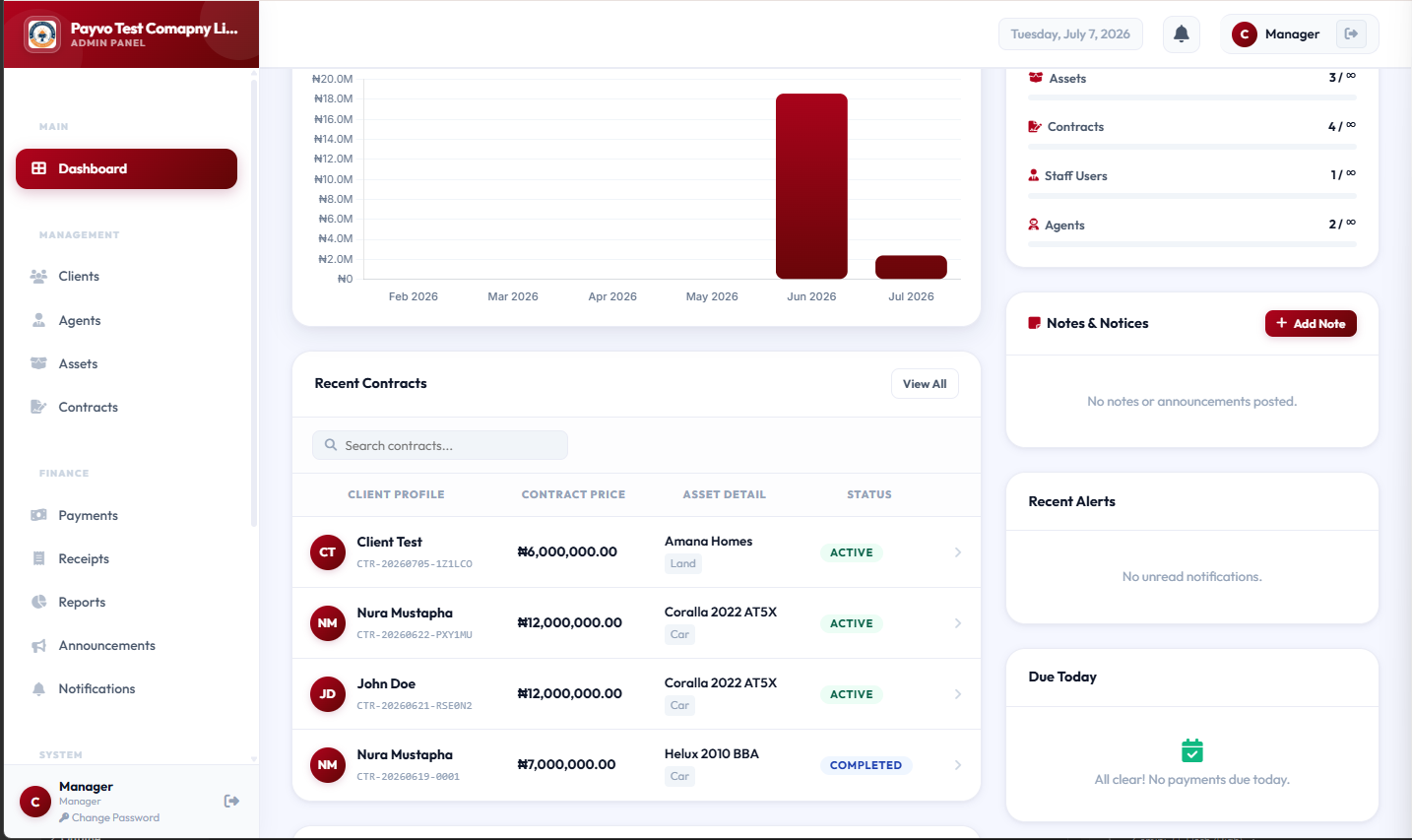 Dashobard (top)
This lack of strategic insight means you're operating in the dark, unable to respond quickly to market changes or internal challenges.
5. Client Information and Payment History Are Dispersed and Inconsistent
If a client calls with a query about their payment history, how quickly can you provide an accurate answer? For many businesses, client details, contract terms, and payment records are scattered across various notebooks, spreadsheets, or even different staff members' personal devices.
- Poor Customer Experience: Clients expect quick, accurate responses. If your staff has to hunt for information, it reflects poorly on your professionalism.
- Data Duplication and Inconsistency: The same client's information might be entered multiple times, with inconsistencies, leading to errors in billing or communication.
- Security Risks: Storing sensitive client data in unsecured locations like personal phones or unencrypted spreadsheets poses significant data privacy and security risks.
The Smarter Approach: Centralized, Automated Installment Management
The solution to these pervasive problems lies in adopting a centralized and automated installment management software Nigeria. This approach moves your entire installment sales process from chaotic, manual methods to a streamlined, digital platform. Instead of reacting to problems, you proactively manage your business with clear visibility and automated workflows.
The core principle is simple: consolidate all client data, asset information, contract terms, and payment records into a single, secure system. Once integrated, this system can then automate repetitive tasks, such as generating payment schedules, sending reminders, and producing receipts.
Consider the benefits for a building material supplier selling on credit. Instead of manually tracking each customer's credit limit, payment due dates, and outstanding balance, an automated system handles it all. This frees up staff to focus on sales and customer relationships, rather than administrative drudgery. For cooperative societies and microfinance operators, this means enhanced transparency and reduced risk.
This smarter approach also empowers your team. Staff members have instant access to accurate, up-to-date information, enabling them to serve clients more effectively and resolve issues quickly. Managers gain unprecedented insight into business performance through real-time dashboards and comprehensive reports, allowing for data-driven decision-making. Ultimately, it transforms your installment business from a reactive operation into a proactive, efficient, and profitable enterprise.
 A clean 3D isometric illustration of a stylized digital dashboard showing various business metrics like sales, outstanding payments, and client growth.
related to sales, outstanding payments, and client growth, all presented in an intuitive and easy-to-understand layout. The color palette incorporates navy blue, white, and green accent colors. The composition is bright and modern with ample negative space on the right. 16:9 landscape. No text, no logos, no watermarks.)
Key Elements of an Effective Installment Management System:
- Centralized Client & Asset Database: A single source of truth for all client details and assets sold on installment.
- Automated Contract Generation: Define terms once, and the system handles the rest, including payment schedules.
- Seamless Payment Tracking: Record payments accurately and instantly update client balances.
- Automated Communication: Timely payment reminders and receipts sent automatically.
- Comprehensive Reporting: Real-time dashboards and exportable reports for financial oversight.
- Role-Based Access: Secure access for staff, ensuring data integrity and accountability.
- Agent Management: Automated commission tracking and agent self-service portals.
How Payvo Helps Transform Your Installment Business
This is where Payvo steps in as a purpose-built solution designed for businesses like yours selling on installment in Nigeria. Payvo is a full business management platform that replaces the chaos of manual tracking with a streamlined, automated system. It addresses every pain point discussed, providing a comprehensive solution from client onboarding to payment collection and reporting.
With Payvo, real estate developers, car dealers, cooperative societies, and building material suppliers can effortlessly manage their entire installment sales cycle. For instance, registering new clients is straightforward, allowing you to store full client details and view their complete payment history at a glance.
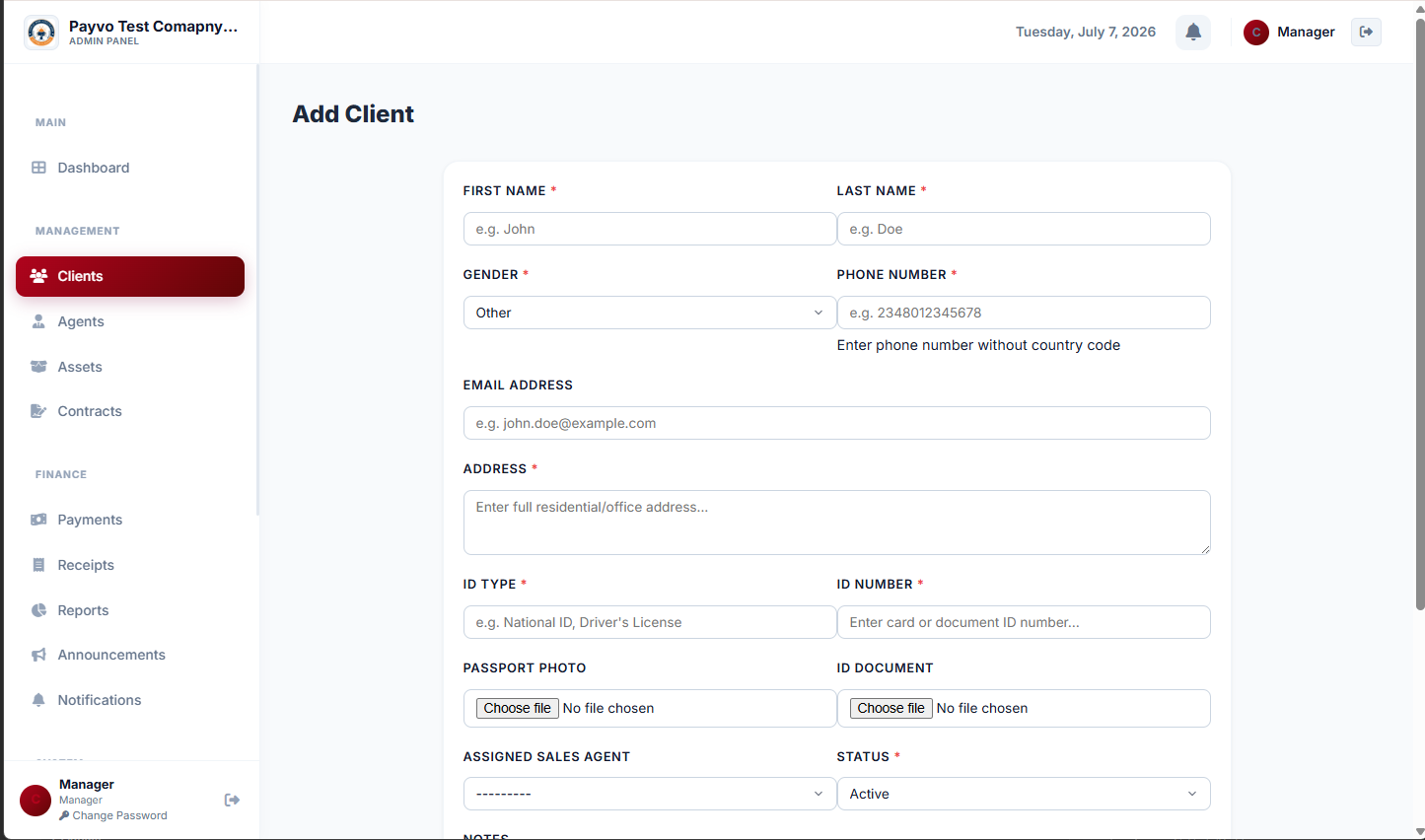 Client: Add Client page
You can also register and manage all your assets – be it property, vehicles, or equipment – linking them directly to specific contracts. Creating contracts becomes simple: you set payment terms once, and the installment schedules are generated automatically, eliminating manual calculation errors.
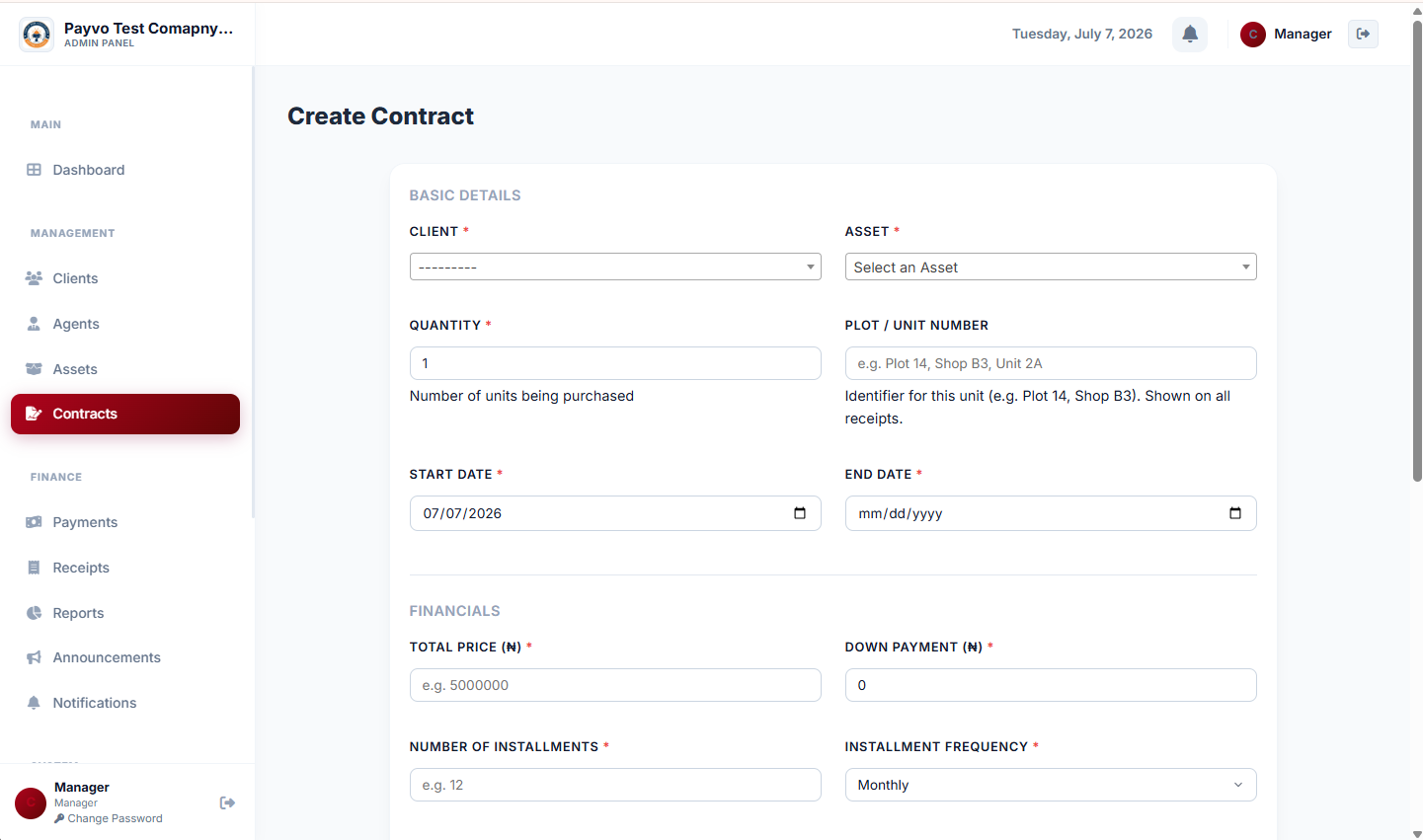 Management: Add contract (top)
Recording payments is equally efficient; you log single payments against any contract, and the full history is tracked instantly. Every payment triggers the automatic generation of branded receipts, complete with your company logo and digital signature, and a master receipt for full contracts. This ensures professionalism and provides clients with immediate proof of payment.
One of Payvo's most powerful features is its WhatsApp payment notification system. It sends automatic notifications for new clients, new contracts, payment received, and crucial payment reminders via email and WhatsApp. This includes a public receipt link clients can view, save, or share, drastically reducing the need for manual follow-up calls and improving collection rates. For small business payment tracking, this automation is invaluable.
For businesses with sales teams, the agent commission tracking software within Payvo is a game-changer. You can assign agents to contracts, automatically calculate commission per payment, and track their full earnings and payout history. Agents can even log in with a unique code to view their own KPIs and submit withdrawal requests directly, streamlining the entire process. Learn more about how to empower your sales team on our Agent Tracking Page.
Payvo also offers real-time dashboards to give you an immediate overview of your business – total clients, active contracts, amount collected, outstanding balances, and next payment due. This critical insight helps you make informed decisions. You can also generate detailed reports, exporting payment and contract data as PDF or Excel for accounting and record-keeping, and receive weekly company reports via email summarizing key performance metrics. This robust contract management software Nigeria solution ensures you're always in control.
Explore the full range of capabilities on our Features Page. Payvo replaces notebooks, scattered WhatsApp messages, and manual tracking with one automated system – from the moment a client is added, to the contract being created, to every payment being recorded, receipted, and followed up on, automatically.
 A Nigerian entrepreneur smiling confidently while looking at a tablet displaying a clean, modern business dashboard.
Proof: Side-by-Side Comparison
Let's look at how a modern installment management system compares to traditional methods.
| Feature / Aspect | Traditional Manual Methods (Notebooks, Spreadsheets, WhatsApp) | Modern Installment Management System (e.g., Payvo) |
|---|---|---|
| Client Management | Fragmented records, potential data duplication, hard to access | Centralized client database, complete payment history per client, easy search |
| Contract Creation | Manual drafting, error-prone calculations, inconsistent terms | Automated contract generation, pre-defined terms, automatic schedule calculation |
| Payment Tracking | Manual ledger entries, easy to miss payments, no real-time view | Automated recording, instant balance updates, real-time tracking of all payments |
| Receipt Generation | Manual carbon copies, often delayed or forgotten | Automated branded receipts (email/WhatsApp), instant delivery, digital proof |
| Payment Reminders | Manual calls/messages (WhatsApp), inconsistent, time-consuming | Automated email & WhatsApp reminders, scheduled in advance, public receipt link |
| Agent Commission | Manual calculation, prone to disputes, lack of transparency | Automated calculation per payment, real-time agent dashboards, clear payout history |
| Business Insights | Limited to what can be manually compiled, often outdated | Real-time dashboards, comprehensive reports (PDF/Excel), weekly summaries |
| Data Security & Integrity | High risk of loss, damage, unauthorized access, human error | Secure cloud storage, audit logs, role-based permissions, data backup |
| Staff Efficiency | High administrative burden, reactive problem-solving | Reduced admin time, proactive management, focus on core business activities |
| Customer Experience | Inconsistent communication, delayed responses, potential disputes | Professional, consistent communication, instant information, high satisfaction |
Frequently Asked Questions
Q1: What is an installment management software and who needs it?
An installment management software is a digital platform designed to automate and streamline the entire process of selling products or services on installment. This includes managing client details, creating payment contracts, tracking payments, sending reminders, and generating reports. Businesses that sell on credit or hire purchase, such as real estate developers & property sellers in Kano, Kaduna, and Abuja, car dealers selling on hire purchase, cooperative societies & microfinance operators, solar/equipment leasing companies, and building material suppliers selling on credit, all stand to benefit immensely. Essentially, any small business owner researching "how to track installment payments" needs such a system.
Q2: How does a WhatsApp payment notification system improve collections?
A WhatsApp payment notification system significantly improves collections by ensuring timely and consistent communication with clients. Instead of relying on manual calls or messages, the system automatically sends payment reminders before due dates and notifications upon payment receipt. This reduces the likelihood of clients forgetting payments and provides them with immediate, verifiable proof of transaction. The convenience and immediacy of WhatsApp messaging, combined with a public receipt link, make it easier for clients to stay informed and make payments promptly, ultimately boosting your collection rates and reducing arrears.
Q3: Can this system help me track agent commissions accurately?
Yes, absolutely. A key feature of modern installment management software is robust agent commission tracking. It allows you to assign agents to specific contracts and automatically calculates their commission based on the payment terms and collection status. This eliminates manual calculation errors, provides agents with a transparent view of their earnings, and streamlines the payout process. This agent commission tracking software is crucial for motivating your sales team and maintaining fair, accurate compensation, preventing disputes, and ensuring your team is fully aligned with your sales goals.
Q4: Is a payment management system for SMEs affordable for small businesses in Nigeria?
Many payment management systems for SMEs are designed with scalability and affordability in mind, offering various pricing tiers to suit different business sizes and needs. The initial investment in such a system often pays for itself quickly through increased efficiency, reduced errors, improved cash flow, and better customer retention. When evaluating costs, consider the hidden expenses of manual systems, such as lost payments, staff time wasted on administrative tasks, and potential disputes. Platforms like Payvo offer clear pricing structures, making it accessible for small business owners researching a business payment tracking app Nigeria to find a plan that fits their budget. You can check our Pricing Page for more details.
Q5: How secure is my data with an online installment business management Nigeria solution?
Reputable online installment business management solutions prioritize data security. They employ advanced encryption, secure cloud hosting, regular backups, and strict access controls (like role-based permissions) to protect your sensitive client and financial data. Unlike manual records that can be lost or stolen, or unencrypted spreadsheets vulnerable to cyber threats, a dedicated system provides a much higher level of security and data integrity. Always look for providers that adhere to international security standards and offer features like audit logs for tracking all system activities, ensuring your data is safe and compliant. We take data privacy seriously; you can review our Privacy Policy Page for more information.
Ready to Transform Your Installment Business?
Stop letting manual processes hold your business back. Embrace efficiency, gain real-time insights, and empower your team with a system designed for success. Discover how effortless installment management can be.