Ignoring your installment sales contract details is like pouring water into a basket – you'll lose everything, eventually. You see, in 2026 Nigeria, where cash flow is king and trust can be scarce, a shaky contract isn't just bad business; it's a direct path to lost money, wasted time, and endless headaches. Every single business owner I've met, from the smallest provision shop in Ikorodu to the biggest car dealer in Abuja, has a story about an installment agreement gone wrong, simply because the initial paperwork was as clear as muddy water.
 Business owner looking stressed at paperwork
The Silent Killer: Vague Installment Sales Contracts
Let's be honest, many of us start small. You sell a generator on credit, or a plot of land in Kaduna, and you just write down the basic terms in a notebook. Maybe you send a few WhatsApp messages to confirm payment dates. You think you're being flexible, building relationships. But what happens when that customer in Kano misses a payment, then another? You call them, they tell you "Ah, no, that wasn't the agreement," and suddenly, your memory against their memory is all you have.
This isn't just about losing a single payment. It's about the cumulative damage. Think about a solar installation company in Port Harcourt. They sell a ₦450,000 system, with a ₦150,000 down payment and ₦25,000 monthly installments for a year. If just five customers default or dispute the terms because your installment sales contract wasn't clear, that’s ₦125,000 in missed payments per customer over five months, easily totaling ₦625,000. That kind of hole can sink a small business, especially when you're counting on that cash to pay your own suppliers or staff.
The financial damage is real. You're losing money, sure, but you're also losing time chasing payments, time you could use finding new customers or improving your business. And what about the legal fees if it escalates? Getting a lawyer to draft a formal demand letter or even start collection can cost you anywhere from ₦50,000 to ₦250,000, depending on who you go to and the complexity. That’s money you're spending just to get back money you should have secured in the first place. This is why having proper payment contract records and a solid installment agreement details are crucial.
Why the Usual Advice Doesn't Work
Most people will tell you, "Just get a lawyer to draft a contract." And yes, a lawyer is essential for complex deals. But for your everyday installment sales, especially if you're a small real estate developer in Enugu selling plots for ₦1,500,000 each or a furniture shop in Aba selling items for ₦80,000, running to a lawyer for every single transaction is not just expensive, it's impractical.
Imagine paying ₦50,000 for legal consultation every time you sell a car on hire purchase. If you sell five cars a month, that's ₦250,000 just on legal fees, before you even print the contract. And printing? Even basic contract printouts for multiple copies can set you back ₦5,000 to ₦20,000 for a larger retailer with branded documents. Then there's the stamp duty, which can be ₦1,000 to ₦10,000 depending on the contract value. These costs add up fast, eating into your already slim margins.
Then there's the "spreadsheet solution." Many business owners swear by Excel or Google Sheets for their business payment tracking app Nigeria needs. You create columns for customer names, amounts, dates. It works for a while, when you have maybe 10-20 customers. But when you hit 50, 100, or even 200 installment agreements, especially if you're a cooperative society in Ibadan managing hundreds of members, those spreadsheets become a nightmare. Finding a specific payment, calculating an outstanding balance accurately, or even knowing which agent is responsible for a particular customer becomes a full-time job. One wrong formula, one deleted row, and your entire financial record is messed up. I've seen it happen. It's a mess.
The Better Way: The Comprehensive Installment Sales Contract Checklist
The truth is, you need a system that gives you the formality of a legal document without the constant legal fees, and the organization of a database without the spreadsheet headaches. It’s about being proactive, not reactive. You need a clear, consistent structure for every installment sales contract.
Here’s a checklist of what every good installment sales contract should include. This isn't just about what you write down; it's about what you record and track consistently.
1. Parties to the Agreement
You might think this is obvious, but it’s often overlooked.
- Full Legal Names: Not just "Mr. John" but "John Obinna Chukwu." For businesses, the full registered company name.
- Contact Information: This means reliable phone numbers (plural, if possible), active email addresses, and a verifiable physical address. What if their primary phone number changes?
- Identification Details: For individuals, a copy of their valid national ID, driver's license, or passport. For businesses, CAC registration documents. This is crucial for any potential debt collection agency involvement later on, which can charge 10% to 30% of the recovered amount.
- Agent Information: If an agent facilitated the sale, record their name and agent commission tracking software details. This is vital for commission reconciliation and accountability.
2. Item/Asset Details
Be as specific as possible. Don't just say "a car."
- Detailed Description: For a car, it's make, model, year, colour, VIN (Vehicle Identification Number), and engine number. For land, it's plot number, size, location (e.g., "Plot 187, Phase 2, Graceland Estate, Apo, Abuja"), and any survey plan references. For a solar system, it’s the brand, model, capacity (e.g., 5kVA inverter, 2x200Ah batteries), and serial numbers.
- Condition: Especially for used items, note the condition at the time of sale. "As is" is fine, but specifics help.
- Unique Identifiers: Serial numbers, IMEI, registration numbers, property IDs. These are your proof of ownership.
3. Financial Terms: The Core of Your Installment Agreement Details
This is where most disputes happen, so clarity is paramount.
- Total Purchase Price: The agreed-upon price of the item or asset. Be clear if it includes VAT or other charges.
- Initial Deposit/Down Payment: The exact amount paid upfront and the date it was received.
- Outstanding Balance: The total amount remaining after the deposit.
- Installment Amount: The specific amount to be paid per installment (e.g., ₦18,750).
- Payment Frequency: Weekly, bi-weekly, monthly, quarterly.
- Number of Installments: Total number of payments required.
- Payment Due Dates: A clear schedule of when each payment is expected. This isn't just "every month"; it's "every 15th of the month."
- Late Payment Penalties: What happens if a payment is missed? A specific percentage (e.g., 5% of the overdue amount) or a fixed fee (e.g., ₦2,500).
- Grace Period: Is there a period after the due date before a late fee kicks in? (e.g., 3 days).
- Mode of Payment: How are payments to be made? Bank transfer, POS, cash? Specify bank account details.
- Receipt Generation: Confirmation that a receipt will be issued for every payment.
4. Terms and Conditions
This section covers the nitty-gritty.
- Ownership Transfer: When does ownership officially transfer to the buyer? Is it after the first payment, or only after the final payment? For hire-purchase agreements, ownership typically transfers after the last installment.
- Default Clause: What constitutes a default? (e.g., missing 2 consecutive payments). What are the consequences? (e.g., repossession for hire-purchase, legal action for land).
- Early Repayment: Can the customer pay off the balance early? Are there any discounts or penalties for doing so?
- Dispute Resolution: How will disagreements be handled? Mediation, arbitration, or through the courts?
- Governing Law: Which state's laws apply to the contract?
- Signatures: Signatures of both parties, witnesses, and the date.
5. Record Keeping and Communication
This is where your system truly comes into its own.
- Payment History Log: A detailed record of every payment received, including date, amount, payment method, and the running balance.
- Communication Log: Keep records of all significant communication – calls, emails, WhatsApp messages – related to the contract, especially payment reminders or discussions about missed payments. A WhatsApp payment notification system can help automate this.
- Receipts: Digital and/or physical receipts for every transaction. A good receipt generator app Nigeria can provide professional-looking receipts automatically.
How Payvo Fits Into This
Now, you might be thinking, "Emeka, this is a lot of information to track!" And you'd be right. Trying to manage all these contract management software Nigeria details with notebooks, scattered WhatsApp chats, and complex spreadsheets? It's a recipe for disaster. This is where an installment management software Nigeria solution like Payvo steps in.
Instead of manually updating spreadsheets or digging through old ledgers, Payvo lets you create detailed installment contracts digitally. You input all the customer, asset, and financial terms once. It automatically calculates payment schedules, tracks payments, and shows you outstanding balances. For a real estate business selling plots in Epe, Lagos, you can see at a glance which customer has paid for Plot 123, how much they still owe, and when their next payment is due. It’s a dedicated business payment tracking app Nigeria needs.
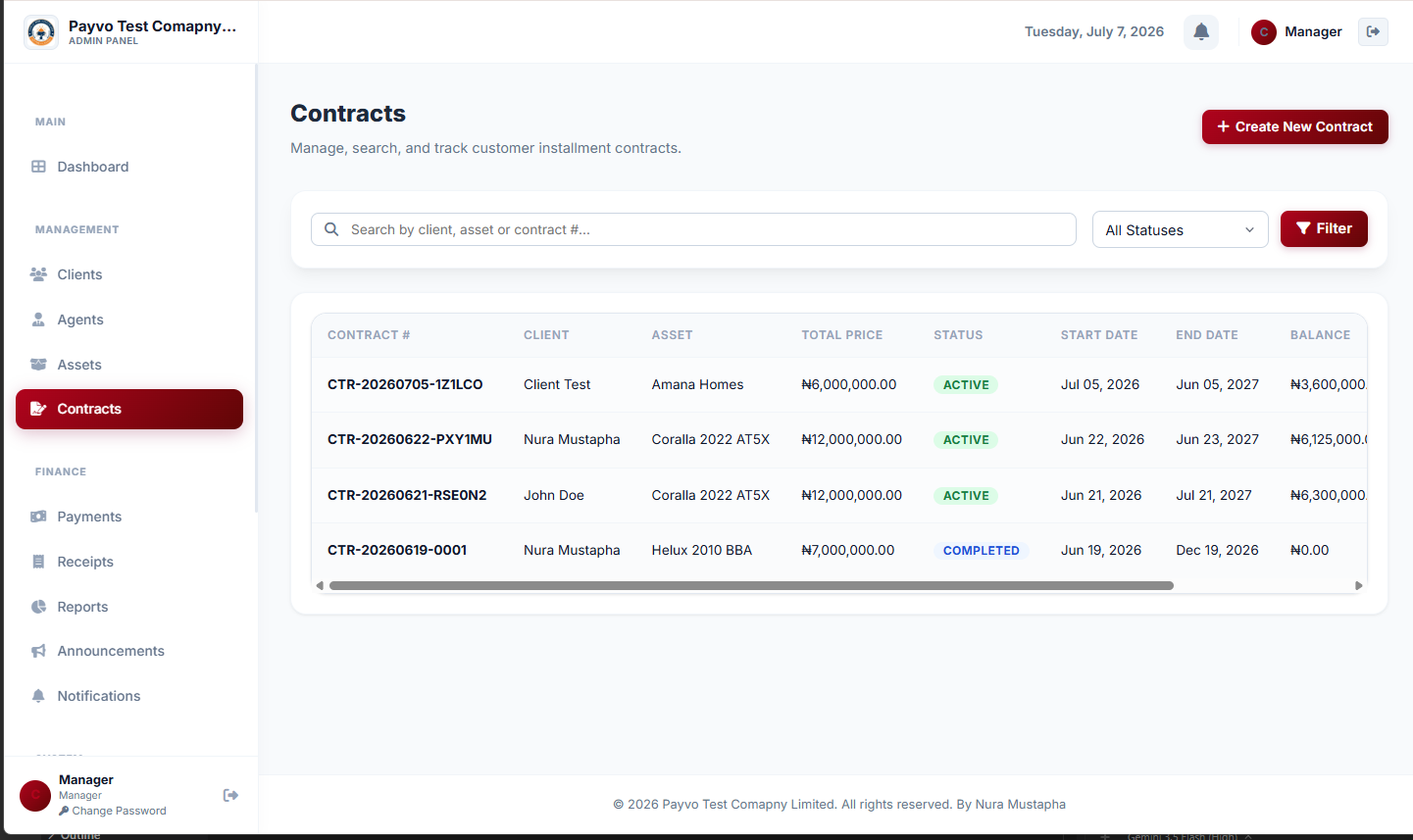 Contracts list page
When a customer pays, you simply record it, and Payvo updates the balance and generates a professional receipt. This saves you so much time and eliminates calculation errors. For a car dealer managing multiple hire-purchase agreements, you can track each vehicle, each customer, and each payment without breaking a sweat. It's essentially a car dealer installment software that brings sanity to your operations.
Side-by-Side: Old Way vs. New Way
Let's look at the difference this makes for a business, say, a solar equipment leasing company in Ibadan trying to manage 50 active installment contracts in 2026.
| Feature | Traditional Approach (Notebooks & Spreadsheets) | Modern Approach (Installment Management Software like Payvo) |
|---|---|---|
| Contract Creation | Manual writing, printing, legal review for each new contract (₦50k-₦250k per contract) | Digital templates, pre-filled details, quick generation (reduced legal fees over time) |
| Payment Tracking | Manual entry in ledger (₦2k-₦8k for books), risk of errors, slow updates | Automated recording, instant balance updates, real-time overview |
| Due Date Reminders | Manual calls/SMS (₦5k-₦20k/month credit), forgotten reminders | Automated SMS/WhatsApp notifications, scheduled reminders |
| Outstanding Balance | Manual calculation, prone to errors, time-consuming | Instant, accurate calculation, clear visibility of who owes what |
| Receipt Generation | Manual writing, carbon copies, branding issues | Professional digital receipts, automatically generated and sent |
| Agent Performance | Manual tracking, difficult to verify sales and collections | Automated agent commission tracking software, clear performance metrics |
| Dispute Resolution | "He said, she said," relying on memory or scattered notes | Clear, documented payment history, easily accessible contract terms |
| Cost of Errors | Lost revenue from uncollected debts, legal fees, damaged reputation | Minimized errors, improved cash flow, reduced administrative burden |
The Numbers: What This Actually Means for Your Business
Let's quantify this. Imagine you're a building material supplier in Onitsha Main Market, selling cement and iron rods on installment. You have 30 active customers, each paying an average of ₦15,000 weekly.
Scenario 1: Manual Tracking
You're relying on a physical ledger and occasional SMS reminders.
- Time Spent Tracking: Let's say 2 hours per day just reconciling payments, calculating balances, and sending reminders. At ₦1,000/hour (minimum wage equivalent for your time), that's ₦2,000/day or ₦40,000/month.
- Cost of Printing/Stationery: Roughly ₦5,000/month for ledgers, receipts, and basic contract copies.
- SMS/Call Credit: ₦10,000/month for reminders and chasing.
- Lost Revenue (due to missed payments/disputes): Even if only 10% of your customers (3 people) dispute a payment or slip through the cracks, leading to a loss of just one ₦15,000 installment each, that's ₦45,000 lost monthly.
- Total Monthly Cost/Loss: ₦40,000 + ₦5,000 + ₦10,000 + ₦45,000 = ₦100,000.
You invest in an efficient system.
- Software Subscription: Let's assume an average of ₦20,000/month for a basic subscription that handles your volume.
- Time Spent Tracking: Reduced to 30 minutes per day. That's ₦500/day or ₦10,000/month.
- Cost of Printing/Stationery: Reduced significantly, maybe ₦1,000/month for occasional printouts.
- SMS/Call Credit: Potentially integrated or reduced to ₦5,000/month for calls outside automated reminders.
- Lost Revenue (minimized): With clear records and automated reminders, disputes and missed payments are significantly reduced. Let's say ₦5,000 lost monthly (minimal).
- Total Monthly Cost/Loss: ₦20,000 (software) + ₦10,000 (time) + ₦1,000 (print) + ₦5,000 (SMS) + ₦5,000 (loss) = ₦41,000.
> "Many small businesses fail not because they don't make sales, but because they can't effectively collect what they're owed. Your record-keeping system is your invisible cash register."
FAQ: Questions Nigerian Business Owners Actually Ask
Q1: Do I really need a formal installment sales contract for small items?
A: Absolutely! Even for a ₦30,000 phone sold on installment in Computer Village, a clear agreement protects both you and the customer. It prevents "he said, she said" arguments and clarifies expectations. It’s not about the value of the item, it's about the principle of the agreement.
Q2: What if my customer can't read or write? How do I get them to sign?
A: This is common. You need to have the contract read and explained to them in a language they understand, in the presence of a neutral witness (who also signs). Their thumbprint can serve as their signature. Always make sure they fully comprehend the terms.
Q3: How can I send payment reminders without constantly calling customers?
A: This is where a good system comes in. Many installment management software Nigeria solutions offer automated SMS or WhatsApp payment notification system features. You set it once, and it sends reminders automatically before or on the due date. This saves you time and keeps your relationships professional.
Q4: My business is very small, just starting. Is installment management software necessary?
A: When you're just starting and have one or two installment customers, a well-organized notebook might suffice. But the moment you start seeing consistent growth – say, 5-10 active installment customers – you should seriously consider it. The cost of a basic subscription is often far less than the money you'll lose from a single disputed payment or forgotten due date. Think of it as an investment in your future growth, not an expense. For real estate payment tracking Nigeria, it's practically a necessity from day one.
Q5: What's the biggest mistake businesses make with installment agreements?
A: The biggest mistake is failing to document everything thoroughly and consistently. Not having clear installment agreement details, not tracking every payment, and not having a system for follow-ups. This leads to confusion, disputes, and ultimately, lost revenue. Your agent commission tracking software should also be tied into this for full visibility.
Take the First Step
You've seen the numbers. You've heard the stories. You know the importance of a solid installment sales contract and robust payment contract records. Don't wait until you lose thousands of naira, or a good customer, because of poor record-keeping.
Take control of your installment sales today. Explore how Payvo can help you manage your customers, contracts, and payments in one organized system. You can start by checking out their features for managing hire purchases or even how they help real estate businesses. Visit Payvo.ng to learn more and see how simple it can be to manage your installment sales professionally.