Did you know that 63% of small and medium-sized real estate businesses in Nigeria still rely primarily on manual record-keeping for their installment sales? That's a staggering number, especially when you consider the complexity of tracking property sales records, agent commissions, and client payments over months, sometimes years. For real estate agents, this isn't just an inconvenience; it's a direct hit to your pocket and reputation. This article will serve as your comprehensive Installment Sales: A Real Estate Agent's Guide to Better Record Keeping.
 A busy lagos real estate office with agents
The Hidden Costs of Disorganized Real Estate Payment Tracking in Nigeria
Let's be honest, you're not just selling land or houses; you're selling dreams. And a big part of that dream, for many Nigerians, is paying in installments. It makes property ownership accessible. But for you, the agent or developer, it introduces a whole world of headaches if your records are scattered. I’ve seen it countless times in my 12 years managing retail shops before consulting. A client comes in, swears they paid ₦200,000 last month, but your ledger says ₦150,000. Now what?
This isn't just about a disagreement; it's about real financial losses. Imagine a real estate agent in Abuja, managing 15 different plots sold on installment. Each plot has a different payment schedule: some monthly, some quarterly. Some clients paid a large deposit, others a smaller one. If you’re tracking all of this in a series of notebooks, maybe a few Excel sheets, and a mountain of WhatsApp messages, you're bound to miss something. A missed payment reminder means a delayed payment. A miscalculated balance means you might ask for too little, or worse, too much, eroding client trust.
A study in 2023 showed that Nigerian businesses lose an average of ₦187,500 annually per contract due due to poor record-keeping, leading to disputes, delayed payments, and outright forgotten balances. Think about that for a moment. That’s enough to cover a decent internet subscription for a year (₦10,000 - ₦30,000 monthly) or even a basic accounting software subscription (₦30,000 - ₦100,000 annually). This isn't just theory; it's money walking out of your business because your system isn't tight.
And it's not just the money. It's the time. How many hours do you or your staff spend each week trying to reconcile payments, dig through old receipts, or confirm what a client truly owes? That's time you could be using to close new deals, scout new properties, or even just relax. Time, as they say, is money. When you're constantly chasing down payment details, you're losing both.
<blockquote cite="https://payvo.ng/blog/">
"The biggest mistake a growing business makes isn't failing to make sales, it's failing to track them properly. Especially when those sales are spread out over time."
</blockquote>
Why the Usual Advice Doesn't Work for Real Estate Agents
Most people will tell you, "Just use Excel!" or "Get a good notebook!" And for a business with one or two installment sales, fine, maybe. But for a real estate agent dealing with multiple properties, multiple clients, and potentially multiple agents, that advice quickly falls apart.
Let's break it down:
- Excel Spreadsheets: Yes, they're powerful. You can create formulas, track payments, and even calculate outstanding balances. But who maintains those formulas? What happens when someone accidentally deletes a row or inputs a payment in the wrong cell? I've seen entire spreadsheets corrupted, leading to weeks of trying to piece together information. And it doesn't solve the problem of generating professional receipts or sending automated reminders. You're still doing a lot of manual work outside the spreadsheet.
- Physical Ledgers/Notebooks: This is the most common method, especially for smaller agencies or those in less urban areas. It feels secure because it's tangible. But try finding Mrs. Adebayo's payment history for plot 7B from three years ago when you have 50 other clients and five full notebooks. It's a nightmare. Plus, they can get lost, damaged, or simply become illegible. What about when an agent leaves? Does he take his notebook with him? You lose all that historical data.
The problem with these traditional methods isn't that they're entirely useless; it's that they don't scale. As your business grows, as you sell more properties in places like Kano, Kaduna, or Abuja, these methods become bottlenecks. They create more work, more errors, and ultimately, more stress. You need something built for the job, something that understands the specific challenges of installment sales in real estate.
The Better Way: Centralized Installment Management for Real Estate
The solution isn't to work harder; it's to work smarter. What you need is a centralized system that brings all your property sales records, client details, payment schedules, and agent activities into one easy-to-manage platform. This isn't some fancy, complicated software only for big corporations. It's practical. It's designed for businesses like yours.
Here’s how a structured approach to real estate payment tracking in Nigeria should look:
- Digital Client Profiles: Every client gets a dedicated digital profile. This isn't just their name and number; it's their contact details, identification documents, and a complete history of all their interactions and purchases. This is crucial for building long-term relationships and for compliance.
- Contract Management Software Nigeria: Each property sale on installment needs a clear, digital contract. This contract should outline the property details, the total price, the initial deposit, the installment amount, frequency, and due dates. This removes all ambiguity. Legal fees for contract review can be substantial (₦50,000 - ₦200,000 per contract), but having a clear digital record reduces the need for constant legal intervention in disputes.
- Automated Payment Scheduling & Reminders: No more manually remembering when Mrs. Okoro's next payment for her plot in Lugbe is due. The system automatically calculates the schedule based on the contract terms and can even send out reminders to clients. This alone can drastically reduce late payments.
- Real-time Payment Tracking: When a client pays, whether by bank transfer or cash, you record it instantly in the system. The system then automatically updates their outstanding balance. No more guesswork. No more arguments. You know exactly what has been paid and what is still owed.
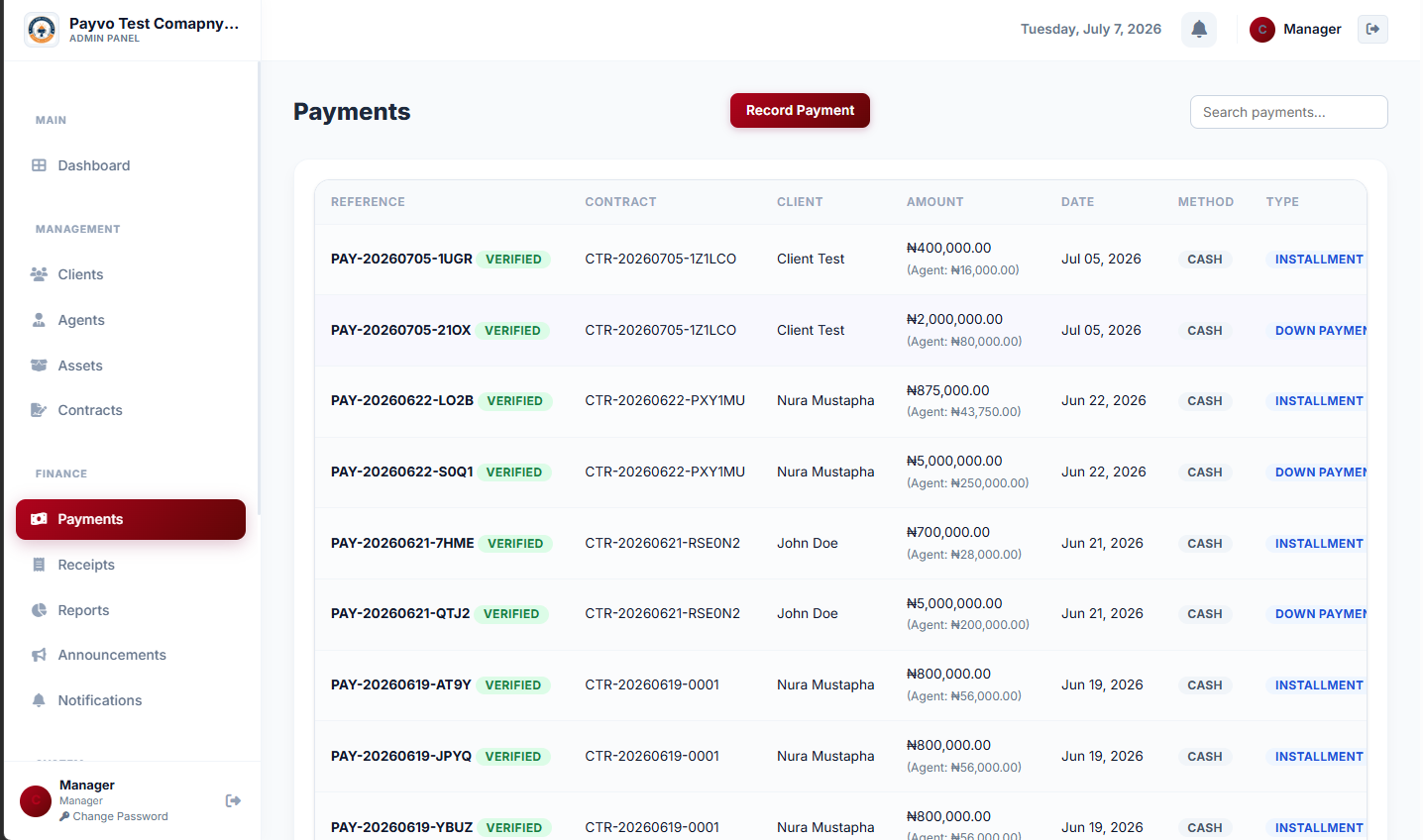 Dashboard showing a list of payments
A clear view of all your recorded payments.
- Digital Receipt Generation: After each payment, the system should instantly generate a professional, branded receipt. You can then send this to the client via email or WhatsApp. This looks professional, provides proof of payment, and maintains a clear audit trail. This is much better than scribbling on a carbon copy receipt book.
- Agent Management Platform and Commission Tracking: If you have a team of agents, you need to know who sold what, who is managing which client, and what commission they are due. A good system tracks agent performance and automatically calculates commissions based on payments received. This fosters transparency and motivates your team.
- Financial Reporting: At any point, you should be able to pull up a report showing your total collections for the month, outstanding balances, and overdue payments. This gives you a clear financial overview, helping you make better business decisions.
How Payvo Fits Into This
This is where a tool like Payvo comes in. You see, Payvo isn't just another generic software; it's an installment management software Nigeria businesses, especially real estate agents, can use to bring sanity to their operations. Instead of juggling notebooks, spreadsheets, and WhatsApp chats, Payvo centralizes all those critical details for you.
When you create a contract in Payvo, you're not just typing in numbers. You're building a digital record that links a specific client to a specific property, with a clear, predefined payment schedule. The system handles the calculations for you. When a client makes a payment, you simply record it, and Payvo automatically updates the outstanding balance. It's designed to make your life easier, not more complicated.
Need to know which payments are due next week? Payvo shows you. Want to see how much a particular client has paid so far for their plot in Apo? It's right there. This kind of immediate, accurate information is invaluable for managing your cash flow and maintaining strong client relationships. It also offers features like agent management platform capabilities, so you can assign clients to agents and track their sales activities, ensuring transparent agent commission tracking software.
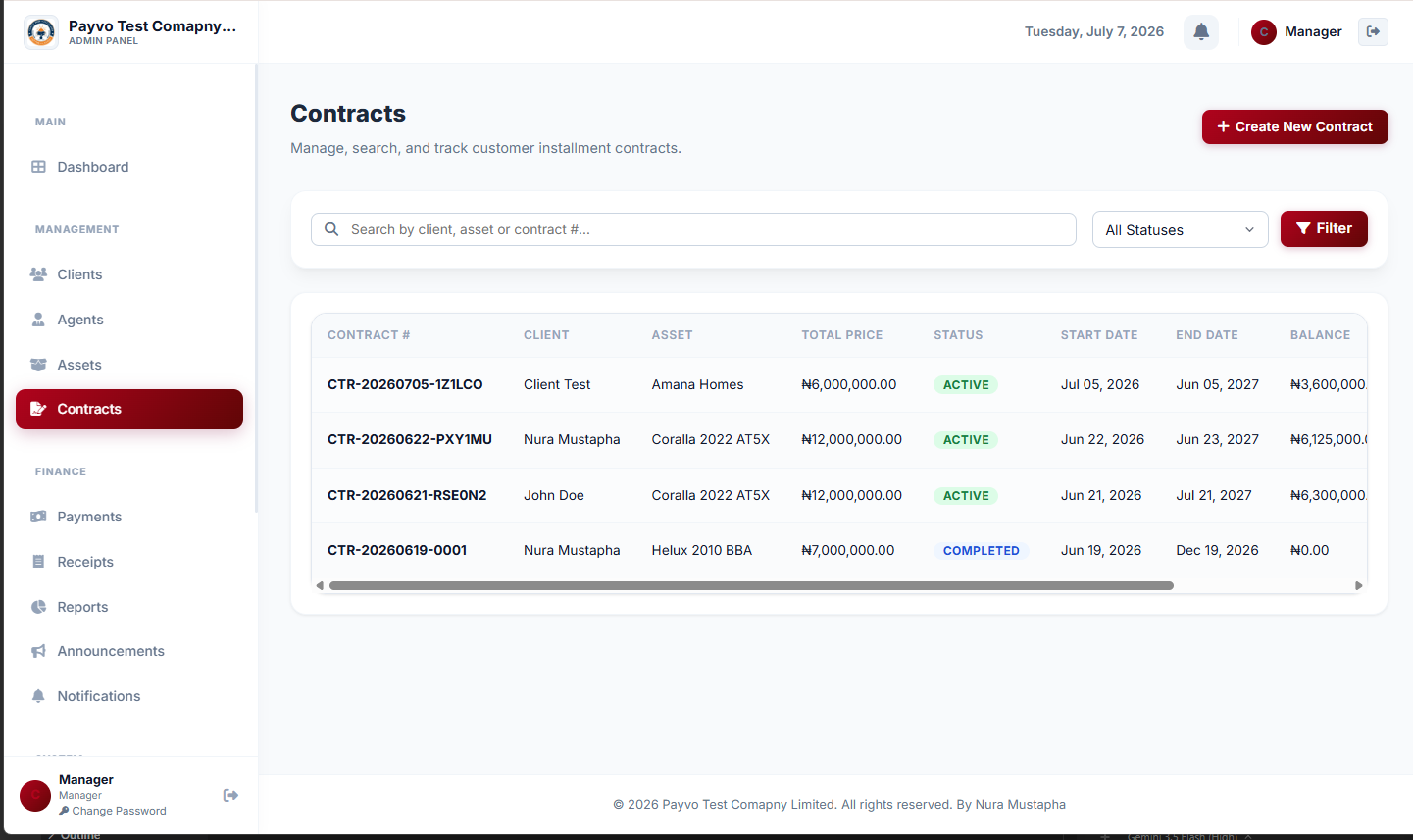 Dashboard showing a list of contracts
Your central hub for all installment contracts.
Side-by-Side: Old Way vs. New Way
Let's look at a quick comparison of how things typically run versus how they could run with a dedicated installment management software Nigeria solution.
| Feature | Traditional Approach (Excel/Notebooks/WhatsApp) | Modern Approach (e.g., Payvo) |
|---|---|---|
| Record Keeping | Scattered across physical ledgers, multiple spreadsheets, and chat histories. | Centralized digital database for all clients, properties, and contracts. |
| Payment Tracking | Manual entry in ledgers/Excel; cross-referencing bank statements and chat proofs. | Digital recording of payments; automatic update of outstanding balances. |
| Outstanding Balances | Manual calculation, prone to errors and disputes. | Automatically calculated and displayed in real-time. |
| Payment Reminders | Manual calls or WhatsApp messages; often forgotten or inconsistent. | Automated reminders via email or WhatsApp payment notification system. |
| Receipt Generation | Hand-written carbon copy receipts; time-consuming and unprofessional. | Instant, professional digital receipts with your branding, sent directly to clients. |
| Agent Management | Informal tracking, difficult to verify sales and calculate commissions accurately. | Clear assignment of clients to agents; transparent agent commission tracking software. |
| Financial Reporting | Tedious manual aggregation of data from various sources; often delayed. | Instant, on-demand reports for collections, overdue payments, and sales performance. |
| Data Security & Backup | Vulnerable to loss, damage, or theft; no easy backup. | Secure cloud storage; automatic backups; accessible from anywhere. |
You can see the difference, right? It's not just about convenience; it's about efficiency, accuracy, and professionalism.
The Numbers: What This Actually Means for Your Business
Let's talk about the practical impact on your bottom line. We already mentioned the average loss of ₦187,500 annually per contract due to poor record-keeping. Imagine you have 10 active installment contracts. That's potentially ₦1,875,000 in lost revenue or wasted time annually.
Now, let's consider what it costs to get organized:
- Basic Accounting Software (Annual): ₦30,000 - ₦100,000. This might help with general accounting, but not specific installment tracking.
- Junior Admin Staff (Monthly): ₦60,000 - ₦120,000. That's ₦720,000 - ₦1,440,000 annually just to manage your manual records, and they can still make errors.
- Internet Subscription (Monthly): ₦10,000 - ₦30,000. Essential for any modern business.
- Professional Indemnity Insurance (Annual): ₦100,000 - ₦500,000. This protects you against errors and omissions, which are more likely with manual systems.
Let's say a reliable software subscription costs you ₦15,000 - ₦40,000 per month. That’s ₦180,000 - ₦480,000 per year. For that investment, you get automated tracking, reduced errors, improved cash flow from timely payments, and better client relationships. The return on investment is clear. You save money, save time, and build a more reputable, efficient business.
Think about a real estate developer in Kaduna with 25 plots on installment. Each plot is ₦3,500,000, with a ₦700,000 deposit and ₦100,000 monthly payments for 28 months. That’s 25 separate payment schedules to track. Doing that manually is a recipe for disaster. But with an organized system, the developer can easily see:
- Total expected monthly income from installments.
- Which clients are consistent.
- Which clients are lagging behind.
- The overall financial health of their installment portfolio.
FAQ: Questions Nigerian Business Owners Actually Ask
How do I track multiple clients paying for different properties on installment?
This is a common challenge. The best way is to use a centralized installment management software Nigeria tool. Each client gets a profile, and each property they're paying for has its own contract with a clear payment schedule. This way, you can see all your clients and all their active contracts in one place, like on the Payvo dashboard. It’s a lot easier than trying to cross-reference multiple notebooks or spreadsheets.
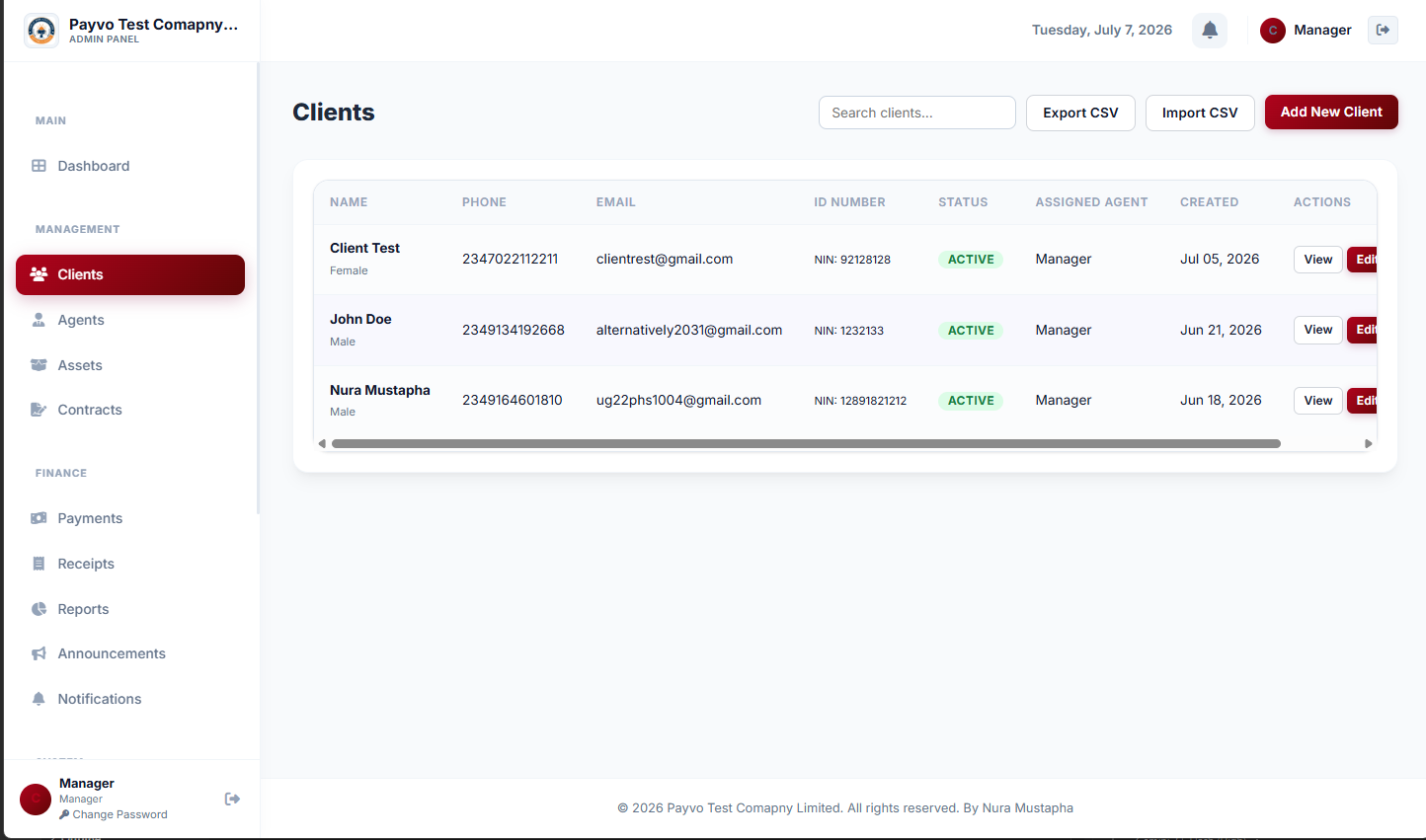 Dashboard showing client list
A clear list of all your clients.
What if I have agents? Can I track their sales and commissions?
Absolutely. A good agent management platform allows you to assign clients and contracts to specific agents. This means you can track who sold what, monitor their client interactions, and accurately calculate their commissions based on actual payments received. This transparency helps foster trust and accountability within your sales team. Payvo, for instance, provides clear agent commission tracking software to simplify this.
Is it really necessary to move from WhatsApp for payment notifications?
While WhatsApp is great for quick communication, relying solely on it for payment notifications and confirmations can be risky. Information gets buried, and it's hard to verify formal payment records. A dedicated system can send automated, professional notifications (including receipts) via email or a WhatsApp payment notification system integration, which is much more reliable and verifiable. This ensures customers get timely reminders and proof of payment without you having to manually send each one.
How can I generate professional receipts for installment payments?
Forget the old carbon copy receipt books. A modern receipt generator app Nigeria businesses can use will automatically create branded, digital receipts every time a payment is recorded. These can then be instantly shared with your clients via email or WhatsApp, giving them a professional record and saving you time and effort. This elevates your business's image.
What are the main features to look for in a business payment tracking app Nigeria?
You'll want a system that offers:
- Customer management
- Asset/property management
- Contract management software Nigeria capabilities
- Installment scheduling
- Payment tracking and outstanding balance calculation
- Digital receipt generation
- Financial reporting
- And if you have a team, agent management platform features.
Take the First Step
You've seen the numbers. You know the headaches of manual record-keeping. It's time to move beyond guesswork and endless reconciliation. Taking control of your installment sales is not just about adopting new software; it's about adopting a smarter way of doing business.
Ready to see how a dedicated system can transform your real estate operations? Explore Payvo and learn more about how it can help you manage your real estate installment sales, track payments, and monitor outstanding balances in one organized place. Visit our real estate solutions page or better yet, register into Payvo today and experience the difference for yourself.