You are losing money right now because your installment payment tracking is probably a mess. Yes, I said it. Many Nigerian SMEs, from real estate developers in Abuja to solar equipment lessors in Port Harcourt, are making critical mistakes that cost them thousands, even millions, of naira every year in lost payments, wasted time, and fractured customer relationships.
 Small business owner looking stressed at a cluttered
I've seen it firsthand, the frantic calls, the arguments with customers about balances, the late-night sessions trying to reconcile a month's worth of transactions from a stack of faded carbon copies. This isn't just about being organized; it’s about your bottom line. If you're selling anything on credit or installment, whether it's a plot of land in Kano, a Keke Napep on hire purchase, or building materials to a contractor, you need to understand the common pitfalls in installment payment tracking. Let's dig into the honest breakdown of what these errors cost you and how to fix them in 2026.
The Honest Breakdown: What These Mistakes Actually Cost
Let's not mince words. Every error in your payment tracking system translates directly into naira and kobo out of your pocket. It's not just the direct loss of an unpaid installment; it's the ripple effect.
1. Missed Entries and Inaccurate Records
This is perhaps the most common and insidious error. A customer pays ₦75,000 for their monthly land installment, but it's recorded as ₦57,000, or worse, not recorded at all. Perhaps your agent collected it and forgot to remit or note it down.
Cost of a single missed entry: If you have just one customer whose ₦75,000 payment goes unrecorded each month, that's ₦900,000 lost per year from one* customer. Imagine if it's five or ten.
- Cost of reconciliation: Manually sifting through bank statements, POS printouts, and WhatsApp chats to find a single missed payment can take hours. If your time is worth ₦5,000/hour, that's easily ₦15,000 – ₦20,000 for a few hours of frustrating detective work.
- Opportunity Cost: That time spent chasing a missing ₦75,000 could have been used to close a new deal worth ₦500,000. This is the hidden cost.
2. Inconsistent Customer Names and Contract Details
"Was it Mr. Okafor or Mr. Okoro who bought plot 3B?" "Did Mrs. Audu pay for the solar panel installation or the inverter upgrade?" When customer names are inconsistent across your ledgers, receipt books, and bank records, it's a recipe for disaster. This often leads to payment record errors.
- Legal Fees for Disputes: Imagine a customer claiming they've paid in full, but your records show otherwise because you have two entries for "Alhaji Musa" with different contract numbers. Resolving this might require legal consultation, costing you anywhere from ₦50,000 for a simple review to ₦300,000 for drafting a more complex agreement or dispute resolution.
- Reputational Damage: A customer who feels wrongly accused of non-payment will tell their friends. In Nigeria, word-of-mouth is gold. Losing trust can cost you future sales worth millions.
- Operational Delays: Your team spends valuable time trying to match payments to the correct customer or contract, delaying other critical tasks.
3. Incorrect Balance Calculations
This is a classic. You've got a customer paying ₦120,000 monthly for a car on hire purchase. After 10 payments, they ask for their balance. Your calculation says ₦1,200,000 outstanding, but theirs says ₦800,000. Why? Maybe you miscalculated interest, or they made an extra payment you missed.
- Direct Financial Loss: If you undercharge due to a calculation error, that money is simply gone. If you overcharge, you risk losing the customer and facing a difficult refund process.
- Software Costs (if you try to fix it): To get accurate calculations, you might invest in basic accounting software for ₦5,000 - ₦20,000/month. While this is an investment, it's cheaper than constant errors. Or, if you need something custom for complex installment structures, that's ₦500,000 - ₦3,000,000 for custom software development.
- Time Wasted on Explanations: Your staff spends hours explaining convoluted calculations, eroding customer confidence.
4. Forgotten Due Dates and Missed Follow-ups
You have a customer in Kaduna who buys building materials on credit, with payments due on the 15th of every month. You forget to send a reminder, and they pay late, or not at all. This is a common installment business problem.
- Delayed Cash Flow: Every late payment impacts your ability to pay suppliers, staff, or invest in growth. If ₦500,000 in payments is delayed by a week, that's a week you can't use that capital.
- Cost of Reminders: Setting up an SMS gateway for payment reminders might cost ₦5 - ₦15 per SMS. If you send 100 reminders a month, that's ₦500 - ₦1,500. This is a small cost for a huge benefit.
- Increased Collection Efforts: Chasing overdue payments takes more effort than a simple reminder. This might involve calls, visits, or even debt collection services, which charge 15% - 35% of the recovered debt. Imagine paying ₦175,000 to recover a ₦500,000 debt.
5. Lack of Standardized Receipt Generation
Are your receipts handwritten, sometimes barely legible? Do they lack key details like remaining balance or next due date? A poorly generated receipt can lead to major payment record errors.
- Dispute Resolution Nightmare: Without clear, standardized receipts, it's your word against the customer's. This makes proving payment or non-payment incredibly difficult.
- Fraud Risk: Unstandardized receipts are easier to forge or manipulate, opening your business to internal or external fraud.
- Professional Image: A messy receipt signals a messy business. This subtly erodes trust, especially for high-value items like property.
6. Poor Reconciliation Processes
At the end of the month, do you struggle to match your bank statement deposits to individual customer payments and contracts? This lack of clarity is a major installment business problem.
- Hidden Discrepancies: Without regular reconciliation, you won't spot missed payments, bank errors, or even internal theft until it's too late.
- Wasted Time: An average business owner or staff member can spend ₦30,000 - ₦100,000/month worth of their time on manual reconciliation, which could be spent on sales or strategy.
- Inaccurate Financial Reporting: If your reconciliation is weak, your financial reports are fiction. How can you make good business decisions with bad data?
7. Over-reliance on Manual Systems (Notebooks, Spreadsheets, WhatsApp)
You started with a notebook. Then you moved to a basic Excel sheet. Now your customer service is done via WhatsApp. Each system works in isolation, creating data silos and making holistic installment payment tracking a nightmare.
- Scalability Issues: What works for 10 customers will collapse at 100. As your business grows, these manual systems become bottlenecks.
- Human Error: Typing errors, forgotten updates, misfiled papers – the more manual steps, the higher the chance of error.
- Data Security Risks: A lost notebook or a corrupted spreadsheet can wipe out years of critical financial data. How much would it cost to rebuild all your client payment histories? Potentially your entire business.
The Income Side: What You Can Realistically Earn (and Lose)
When your installment payment tracking is solid, your income becomes predictable. You can forecast cash flow, plan investments, and even expand. But when it's chaotic, you're always playing catch-up.
Let's imagine a small real estate developer in Kaduna. They sell plots of land for ₦1,500,000 each, with a ₦300,000 down payment and ₦100,000 monthly installments for 12 months.
Scenario A: Efficient Tracking
- They sell 5 plots a month.
- They have a robust system that sends automated reminders and tracks payments accurately.
- Collection rate: 95%.
- Monthly expected income from installments: 5 plots x ₦100,000 = ₦500,000 (from new sales) + existing collections.
- Actual monthly collection: ₦475,000 (from new sales) + 95% of previous months' installments.
- Their profit margins are clear. They can project when they'll break even on land acquisition and infrastructure. They can reinvest confidently.
- They also sell 5 plots a month.
- They rely on a mix of handwritten ledgers, bank alerts, and WhatsApp messages.
- Collection rate: 70% due to forgotten follow-ups, payment record errors, and customer disputes.
- Monthly expected income from installments: ₦500,000.
- Actual monthly collection: ₦350,000 (from new sales) + 70% of previous months' installments.
- Timeline to break even is extended, cash flow is tight, and opportunities for growth are missed. They might even have to dip into personal funds to cover business expenses.
The Hidden Costs Nobody Mentions
Beyond the direct financial losses, there are deeper, often overlooked costs associated with poor installment payment tracking.
- Staff Burnout and Turnover: Imagine your administrative staff spending 60% of their day chasing payments and reconciling messy records. They get frustrated, make more mistakes, and eventually leave. The cost of recruiting and training a new staff member can easily be ₦100,000 – ₦300,000.
- Increased Bank Charges: If you're manually tracking payments and constantly making small transfers to consolidate funds or correct errors, those ₦10 - ₦50 bank charges per transaction add up. For a busy business, this could be ₦5,000 – ₦15,000 monthly in avoidable fees.
- Power Generation Costs: In Nigeria, power is a factor. If your staff are working late into the night trying to sort out payment discrepancies, your generator is running longer. That's more fuel, potentially ₦15,000 - ₦80,000/month for fuel, impacting your operational costs.
- Lost Sleep and Stress: As a business owner, the mental toll of not knowing your true financial standing is immense. That stress can impact your health, your family life, and your ability to make clear decisions. What's the cost of that? Priceless, some would say.
How Successful Nigerian Business Owners Control These Numbers
So, how do the smart ones do it? They don't just work harder; they work smarter. They understand that technology isn't a luxury; it's a necessity for any business dealing with recurring payments in 2026.
- Centralized Data Management: They move away from scattered notebooks and individual spreadsheets. All customer information, contract details, payment schedules, and payment records live in one single source of truth. This eliminates inconsistent customer names and ensures everyone on the team sees the same, up-to-date information.
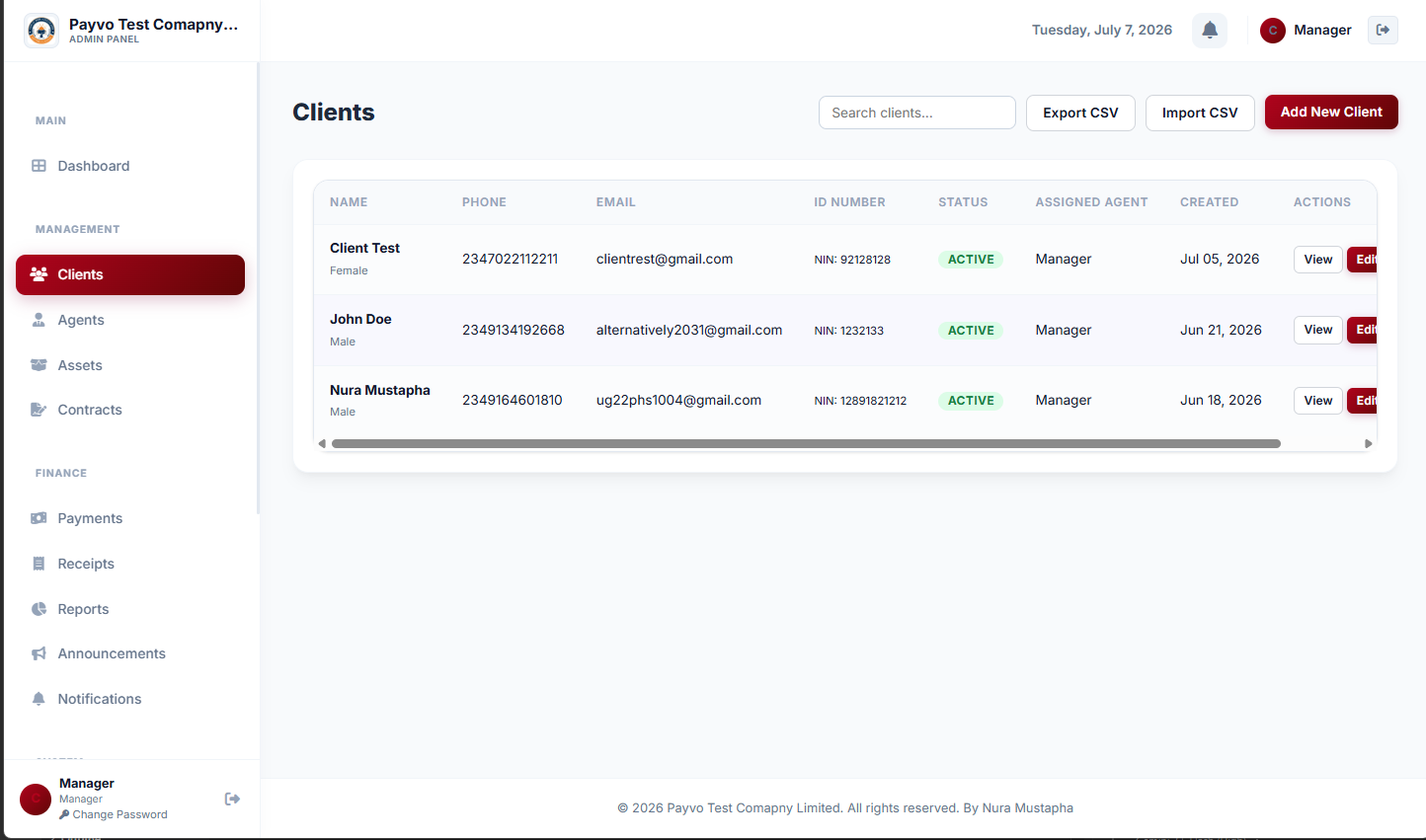 Clients list page
- Automated Payment Scheduling and Reminders: They set up systems that automatically calculate due dates, upcoming payments, and outstanding balances. More importantly, these systems can send automated reminders via SMS or WhatsApp days before a payment is due. This drastically reduces forgotten due dates and improves cash flow.
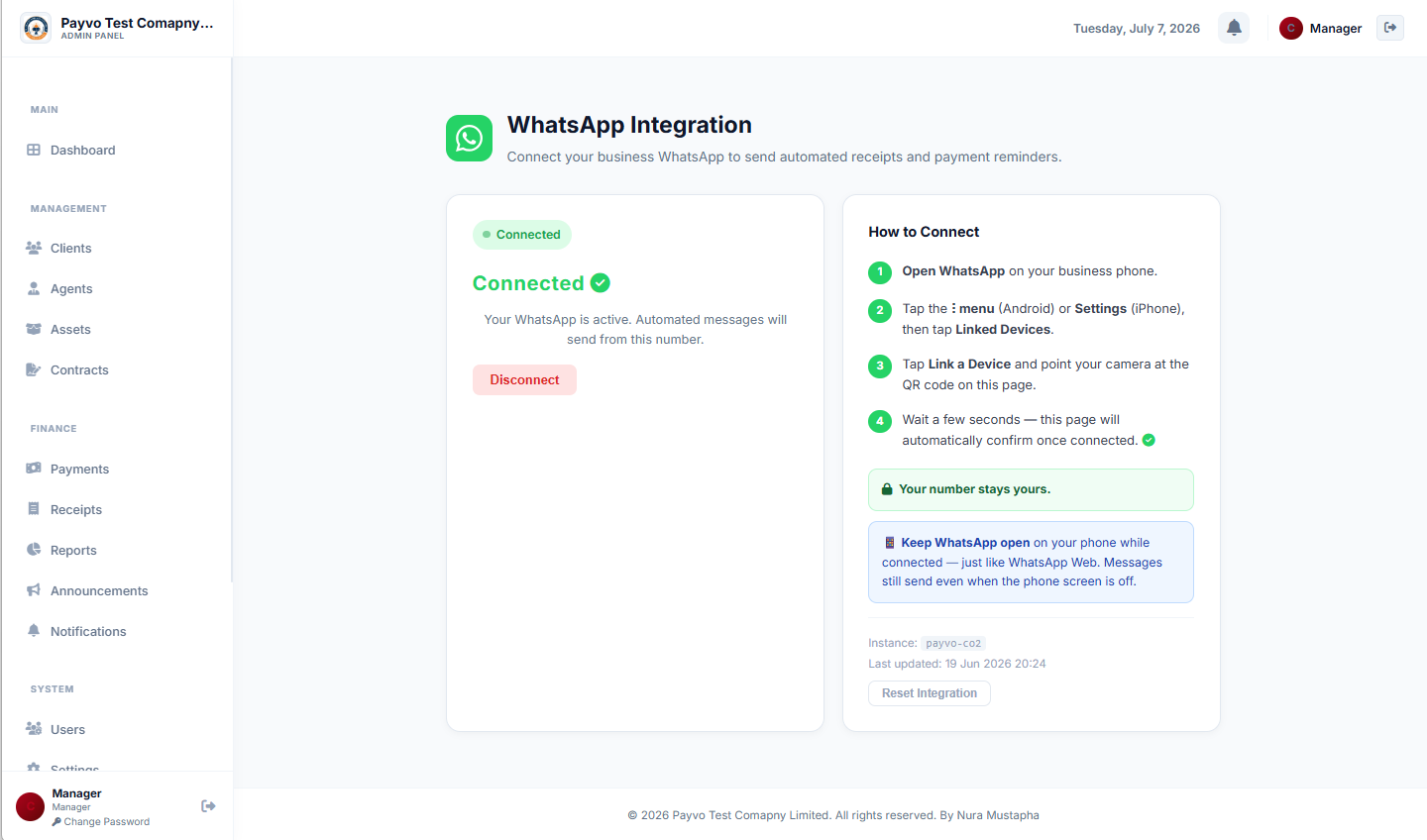 Whatsapp Integration
- Digital Receipt Generation: Every payment gets a professional, detailed digital receipt. This receipt clearly states the amount paid, the date, the remaining balance, and the next due date. This tackles the issue of weak record reconciliation and provides undeniable proof of payment. A good receipt generator app Nigeria can handle this for you.
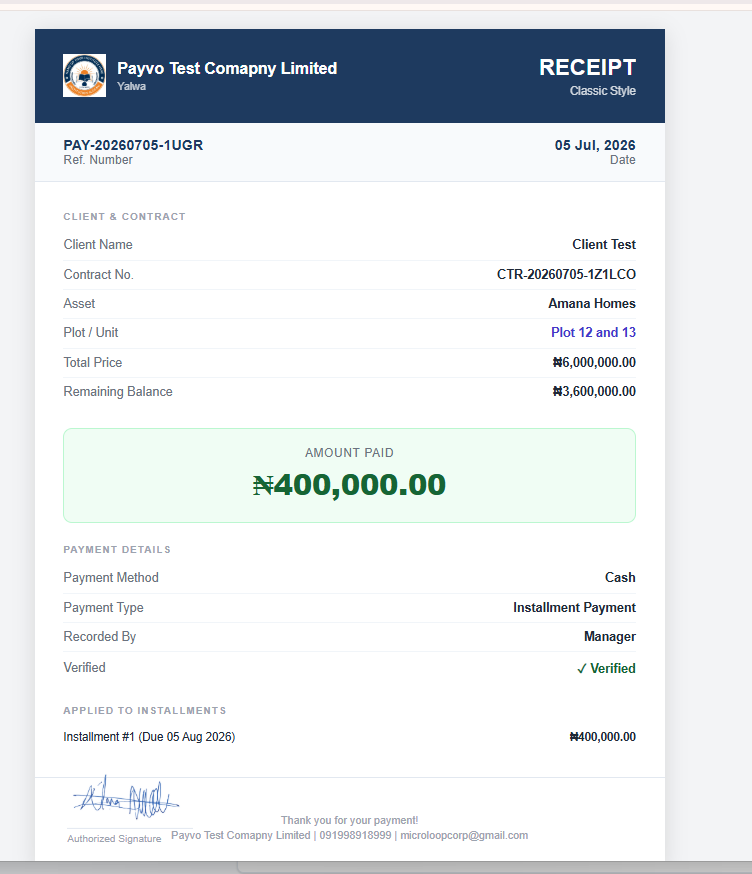 Payment Receipt Sample
- Real-time Balance Tracking: No more manual calculations. A good system instantly updates a customer's outstanding balance as soon as a payment is recorded. This eliminates incorrect balance calculations and builds trust with customers.
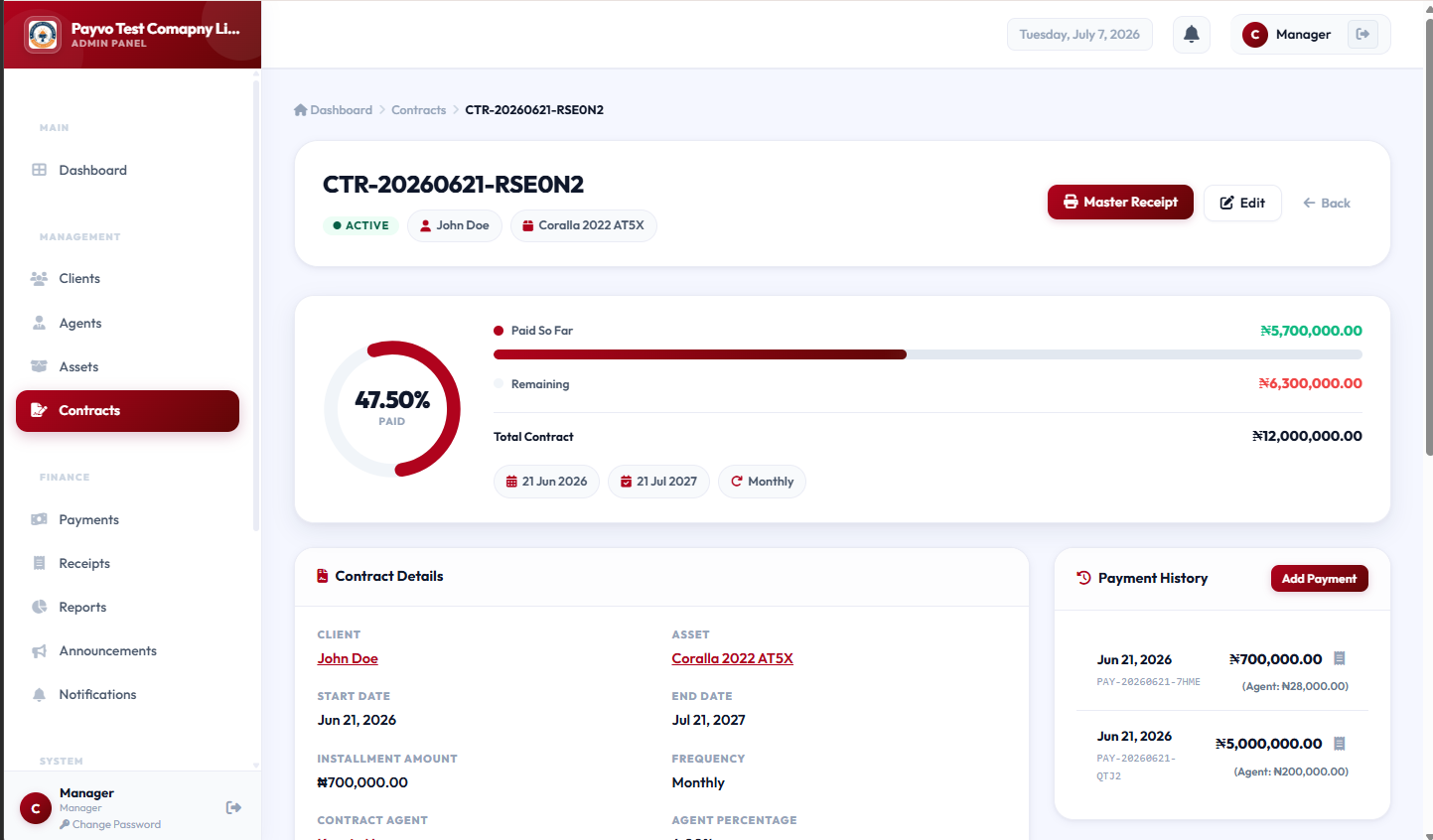 Contract Details View (top)
- Agent Commission Tracking Software: For businesses with sales agents (like real estate or solar companies), they use platforms that link payments directly to the agent responsible for the sale. This ensures accurate agent commission tracking and prevents disputes. You can learn more about this on the agent tracking page.
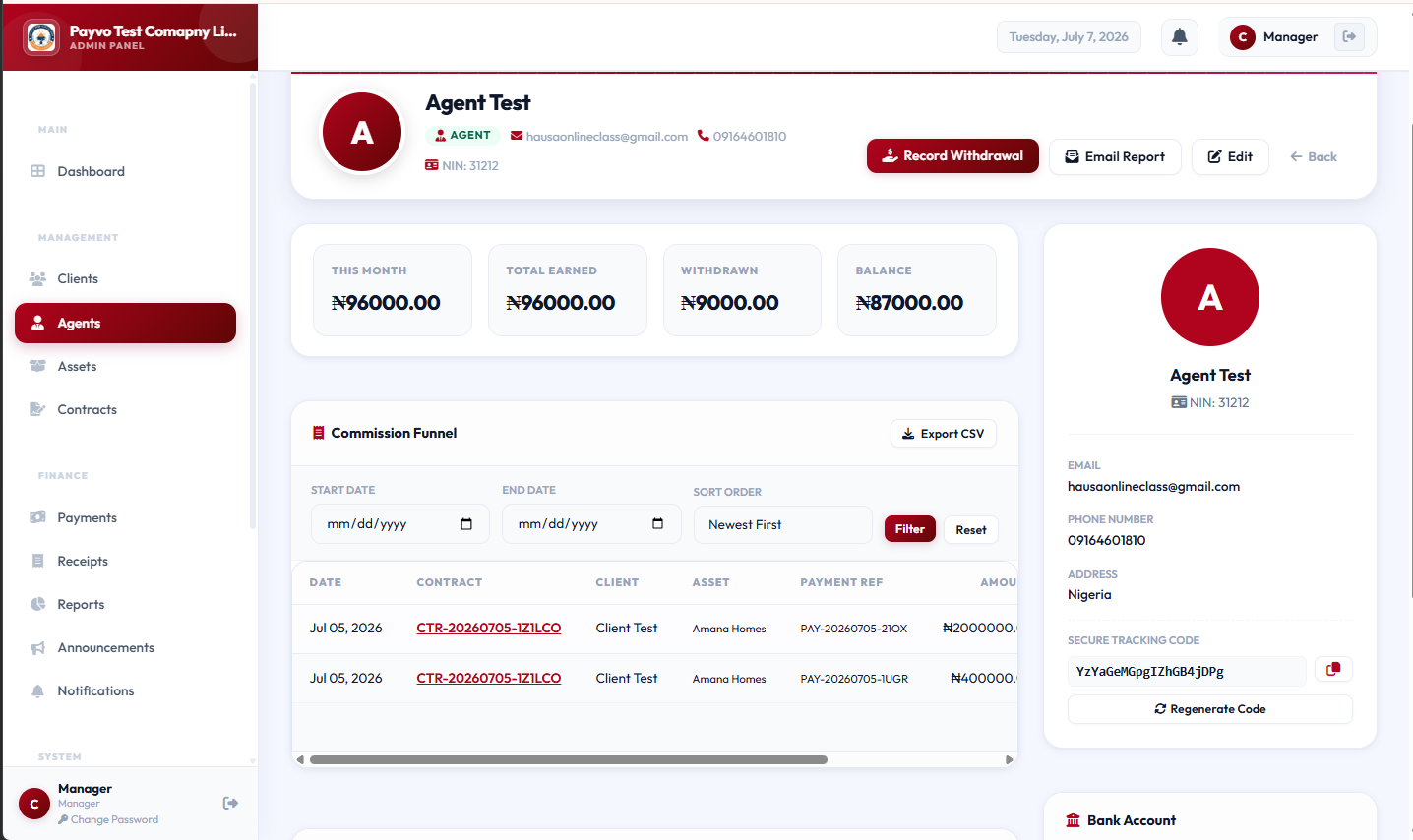 Agent: Agent details page
- Regular Reconciliation Features: The best systems provide dashboards and reports that make reconciliation easy. You can quickly see all payments recorded against all expected payments, making it simple to spot discrepancies. This helps avoid payment record errors.
Real Comparison: Manual vs. Systemized Operations
Let's look at the stark differences in costs and efficiency.
| Feature/Cost Category | Manual Operations (Notebooks, Spreadsheets, WhatsApp) | Systemized Operations (Using a Tool like Payvo) |
|---|---|---|
| Setup Cost | ₦0 (Notebooks/Excel are "free") | ₦0 – ₦25,000 (Monthly subscription for basic plan, e.g., Payvo) |
| Monthly Operating Cost | ₦5,000 - ₦15,000 (Stationery, printing, SMS for manual reminders) | ₦5,000 - ₦20,000 (Software subscription, automated SMS/WhatsApp gateway fees) |
| Lost Payments (Monthly) | ₦50,000 - ₦500,000+ (Due to missed entries, forgotten follow-ups, disputes) | ₦0 - ₦20,000 (Minimal, mostly due to genuine customer inability to pay, not tracking errors) |
| Time Spent on Reconciliation | 20-40 hours/month (Owner or staff time) | 2-5 hours/month (Quick review of reports) |
| Opportunity Cost (Monthly) | ₦30,000 - ₦100,000 (Time spent on admin vs. sales/growth) | ₦0 (Time freed up for strategic activities) |
| Dispute Resolution | Frequent, stressful, often results in customer loss or legal fees (₦50,000 - ₦300,000 per serious case) | Rare, quick resolution with clear digital records |
| Cash Flow Predictability | Low, highly volatile | High, stable, easy to forecast |
| Scalability | Very poor, breaks down with growth | Excellent, handles hundreds/thousands of contracts easily |
| Staff Morale | Low, high burnout | High, focused on productive tasks |
| Security of Data | Poor (lost notebooks, corrupted files) | High (cloud-based, backups, access control) |
| Total Hidden/Lost Costs (Monthly) | ₦100,000 - ₦700,000+ | ₦0 - ₦30,000 |
The numbers speak for themselves. The initial investment in a proper business payment tracking app Nigeria is dwarfed by the massive savings and increased revenue you gain. It's not an expense; it's a critical investment in your business's future.
Frequently Asked Financial Questions
Q1: Is accounting software enough for installment payment tracking?
A: While general accounting software (like QuickBooks or Sage) can record transactions, it's often not specialized enough for the intricacies of installment sales, especially for businesses like car dealers or real estate. You might struggle with detailed contract management software Nigeria, automated payment schedules, specific outstanding balance calculations for each installment, and agent commission tracking. A dedicated installment management software Nigeria like Payvo is purpose-built for these needs.
Q2: How much should I budget for a reliable installment management system in 2026?
A: For most Nigerian SMEs, a reliable system will cost between ₦5,000 and ₦20,000 per month for a subscription. This covers basic features for managing customers, contracts, payments, and receipts. If you have a very large team or complex integration needs, costs can go up, but for the core functionality, that range is realistic. Check the pricing page for current details.
Q3: Can a WhatsApp payment notification system replace a dedicated tracking app?
A: Absolutely not. WhatsApp is an excellent communication tool, but it's not a financial record-keeping system. Relying solely on WhatsApp for payment notifications and tracking means you'll still face challenges with missed entries, incorrect balances, and difficult reconciliation. A dedicated app can integrate with WhatsApp for notifications, but it's the core system that stores and manages the data reliably.
Q4: My business is very small, with only a few installment clients. Do I really need a system?
A: Even with a few clients, the principles of accurate tracking apply. While you might manage with a spreadsheet for a very short time, as soon as you hit 10-15 active installment contracts, errors will creep in. Starting with a system early, even a basic plan, builds good habits and makes scaling much easier. Preventing installment payment tracking mistakes from the start is always better than fixing them later.
Q5: How can I ensure my agents accurately record payments and track commissions?
A: This is a common challenge, especially in real estate payment tracking Nigeria. The best approach is to use an agent commission tracking software that is integrated with your payment system. Agents can record payments directly (with necessary approvals), and their commissions are automatically calculated based on collected amounts. This reduces manual errors and disputes. Platforms like Payvo offer specific features for agent management. You can see how it works for real estate here and hire purchases here.
Your Next Step to Financial Clarity
If you've recognized any of these installment payment tracking mistakes in your business, it's time to act. The cost of inaction is far greater than the cost of implementing a solution. You don't have to overhaul your entire operation overnight, but you can start by centralizing your critical data.
Take a moment to explore how a dedicated installment management software can transform your business. Visit Payvo's website to see how they help businesses like yours manage contracts, track payments, and maintain clear financial records. You can even register for free to see how it works. Stop losing money to avoidable errors and start building a more profitable, predictable business today.