Your business thrives on installment sales, but keeping track of every customer, payment, and due date feels like a never-ending battle. Receipts vanish, calculations get mixed up, and chasing overdue payments becomes a full-time job. You know there has to be a better way than wrestling with complicated spreadsheets or piles of notebooks.
 Nigerian business owner looking stressed at a desk
The Hidden Costs of Manual Installment Tracking
For many Nigerian businesses, from real estate developers in Abuja to car dealers in Kaduna, offering installment plans is crucial for attracting customers. However, managing these payments manually, often through tracking payments in spreadsheets or physical ledgers, introduces significant risks and inefficiencies. What seems like a cost-effective solution often incurs hidden expenses that erode profits and customer trust.
Consider the time wasted. An average staff member's hour is valued between ₦500 and ₦1,500. If your team spends hours each week manually updating records, cross-referencing payments, and calculating balances, those hours quickly add up. For a business with 50 active installment contracts, even 5 hours a week spent on manual tracking can cost between ₦2,500 and ₦7,500 weekly, or ₦130,000 to ₦390,000 annually. This is time that could be spent on sales, customer service, or business growth.
Then there's the issue of errors. A single data entry mistake in Excel can lead to an incorrect balance, a missed payment reminder, or a dispute with a customer. The estimated loss per data entry error can range from ₦5,000 to ₦50,000 due to incorrect calculations or missed payments. Imagine the impact if this happens frequently across dozens or hundreds of customers. These errors not only cost money but also damage your business's reputation and customer relationships. For cooperative societies or microfinance operators, accurate record-keeping is not just about profit; it's about trust and regulatory compliance.
Furthermore, relying on spreadsheets for contract management software Nigeria often means a lack of centralized information. Customer details, contract terms, payment histories, and communication records are often scattered across different files, WhatsApp chats, and even staff members' memories. This makes it incredibly difficult to get a clear, real-time overview of your business's financial health, track agent performance, or respond quickly to customer inquiries. Real estate payment tracking Nigeria, for example, requires precision, especially when dealing with high-value assets and long payment schedules.
Why Excel Falls Short for Growing Businesses
Microsoft Excel is a powerful tool for many tasks, and for a business with just a handful of installment contracts, it might seem sufficient. You can set up formulas, create basic tables, and perform calculations. A basic Microsoft 365 Personal subscription, including Excel, costs around ₦25,000 - ₦35,000 per year. For an online advanced Excel training course, a business owner might invest ₦15,000 - ₦50,000 to master complex features. However, as your customer base expands, the limitations of using Excel for comprehensive installment management become glaringly obvious.
Scaling Challenges and Data Integrity
When you start managing dozens or hundreds of installment contracts, Excel spreadsheets become unwieldy. Each customer might have a separate sheet, or all data might be crammed into one massive file. This makes it incredibly difficult to:
- Track specific payments: Finding a particular payment record for a customer can involve endless scrolling and filtering.
- Monitor due dates efficiently: Setting up reliable automated reminders in Excel is complex and prone to manual oversight.
- Calculate outstanding balances accurately: A single misplaced formula or accidental deletion can corrupt an entire sheet, leading to major discrepancies.
- Generate consistent receipts: Creating professional, branded receipts for each payment is a manual, time-consuming process.
- Manage multiple users: When more than one person needs to access and update the spreadsheet, version control issues and accidental overwrites become common, making installment tracking Excel a nightmare.
Lack of Automation and Communication Gaps
Excel doesn't inherently automate key processes that are vital for installment management. There are no built-in features for:
- Automated payment reminders: You'd have to manually check due dates and send SMS or WhatsApp messages, which is inefficient.
- WhatsApp payment notification system: Integrating directly with communication channels for instant updates is not standard in Excel.
- Digital receipt generation: While you can create templates, each receipt needs manual population and saving, requiring a separate receipt generator app Nigeria workaround.
- Agent commission tracking: For businesses with sales agents, accurately calculating and tracking commissions based on collected installment payments is a complex, error-prone task in Excel. Without a dedicated agent commission tracking software, disputes can arise.
Security and Accessibility Concerns
Storing sensitive customer and financial data in Excel spreadsheets, especially if they are shared via email or cloud drives without proper controls, poses security risks. It's harder to manage access permissions effectively, and a lost or corrupted file can mean losing critical business data. While cloud storage offers some accessibility, reliable internet data costs, ranging from ₦5,000 - ₦15,000 monthly, are still a factor, and collaborative editing can lead to version conflicts.
Ultimately, while Excel is a versatile tool, it wasn't designed as a dedicated installment management software Nigeria. Its general-purpose nature means it lacks the specialized features and robustness required for efficient, accurate, and scalable installment payment tracking.
 A business team looking confused at a complex
The Smarter Approach: Dedicated Installment Management Software
Imagine a system where every customer's contract, payment schedule, and history are instantly accessible. A system that automatically calculates outstanding balances, sends timely reminders, and generates professional receipts with a few clicks. This is the promise of dedicated installment management software.
Instead of generic tables, you get purpose-built modules for customer management, asset tracking, and contract administration. This means:
- Centralized Data: All customer details, contracts, payment records, and communication logs are stored in one secure location. This provides a single source of truth for your business.
- Automated Calculations: The software automatically calculates due dates, outstanding balances, and payment schedules, eliminating manual errors and saving countless hours.
- Streamlined Workflows: Recording payments, generating receipts, and sending reminders become quick, standardized processes, freeing up your staff to focus on more strategic tasks.
- Enhanced Reporting: Gain instant insights into your business's financial performance, identify overdue accounts, and track payment trends with comprehensive reports.
- Improved Customer Communication: Automated notifications and easy access to payment histories allow for proactive and transparent communication with your customers, reducing disputes.
How Payvo Helps You Master Installment Sales
This is where Payvo comes in. Payvo is an intuitive, robust installment management software Nigeria designed specifically for businesses that sell on installment. It transforms the chaotic process of manual tracking into a streamlined, efficient operation, allowing you to focus on growing your business rather than chasing payments.
With Payvo, you can easily:
- Onboard Customers and Assets: Register new customers and the assets they purchase (like properties, vehicles, or equipment) in a few simple steps. This is crucial for real estate developers needing to manage multiple property buyers or car dealers needing car dealer installment software.
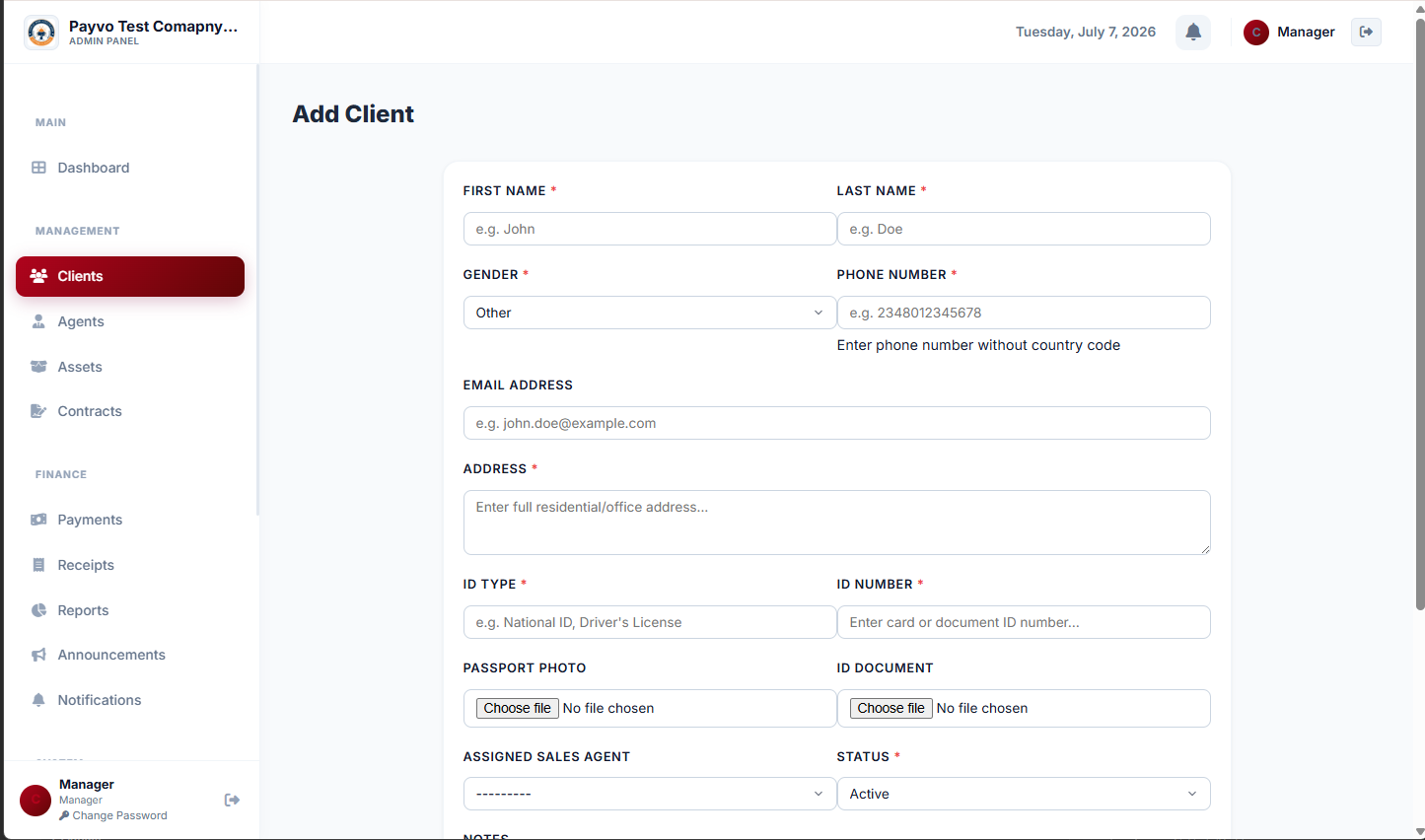 Client: Add Client page
- Create and Manage Contracts: Generate detailed installment contracts that outline payment frequencies, due dates, and initial deposits. Whether you're managing hire-purchase agreements or land payments, Payvo helps you maintain clear records.
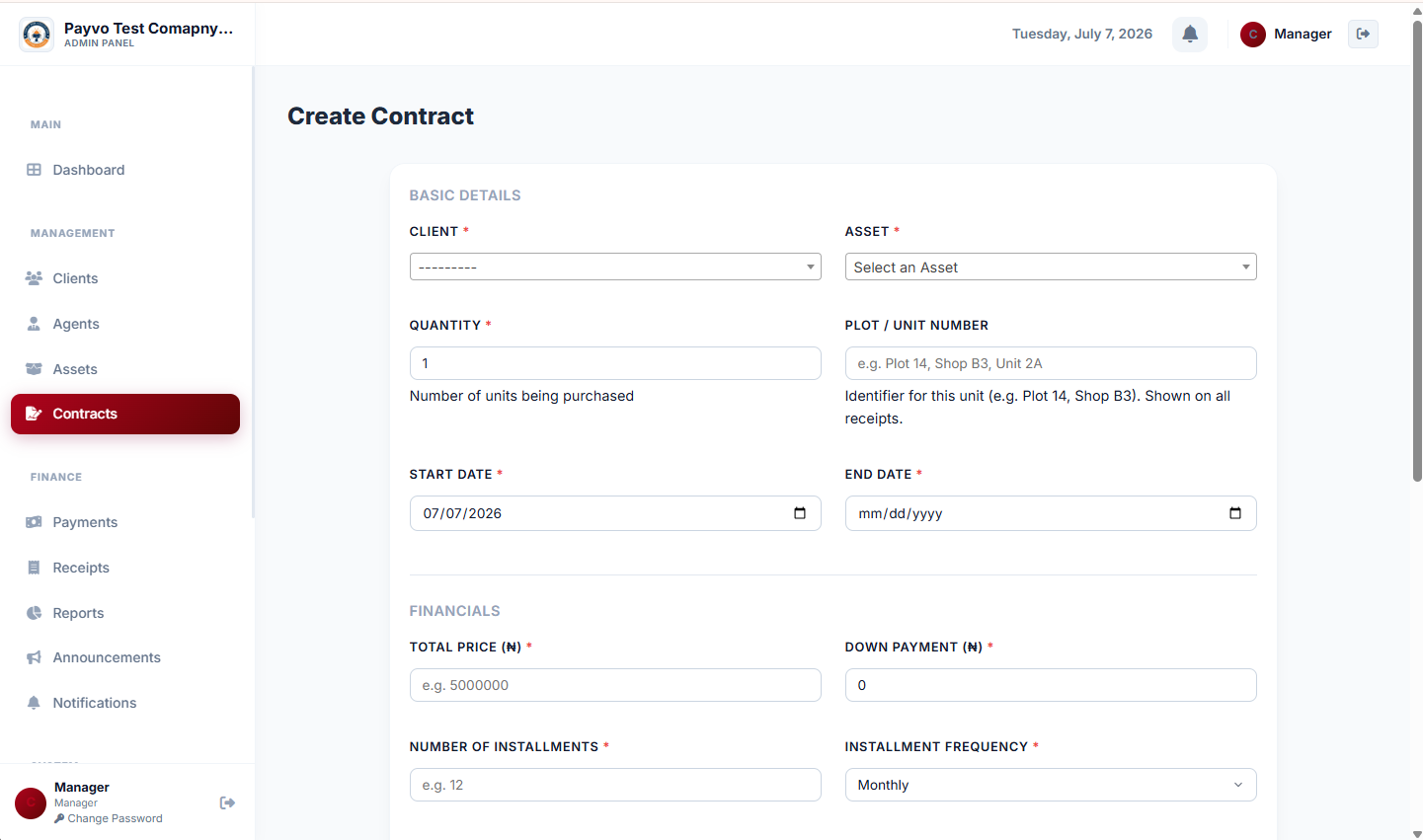 Management: Add contract (top)
- Record Payments Seamlessly: Log customer payments quickly, whether they're cash, bank transfers, or POS transactions. Payvo automatically updates the outstanding balance for each contract.
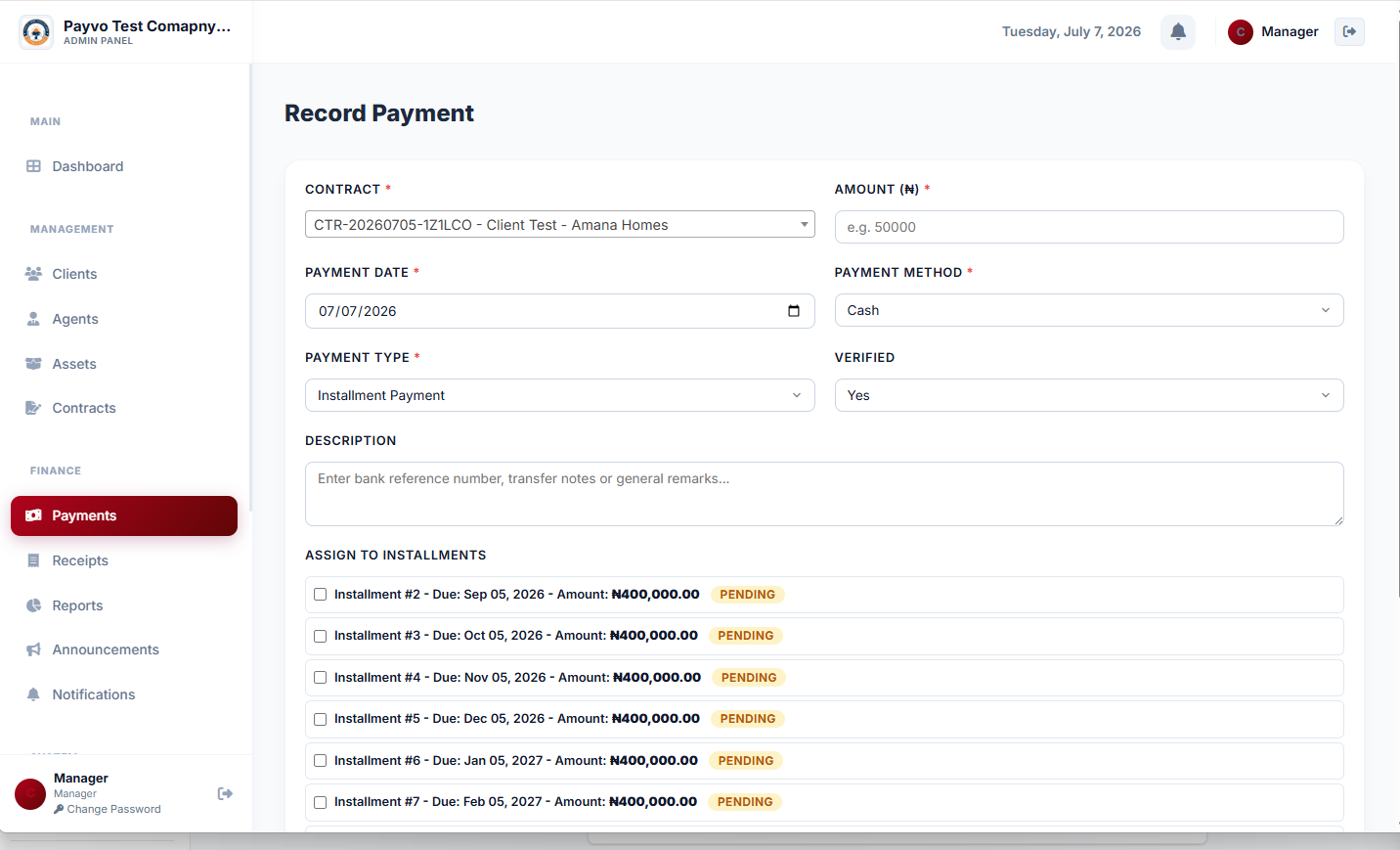 Finance: Record Payments Page
- Track Outstanding Balances Instantly: Get a real-time view of what each customer owes, how much they've paid, and which payments are overdue. No more complex calculations or digging through multiple files.
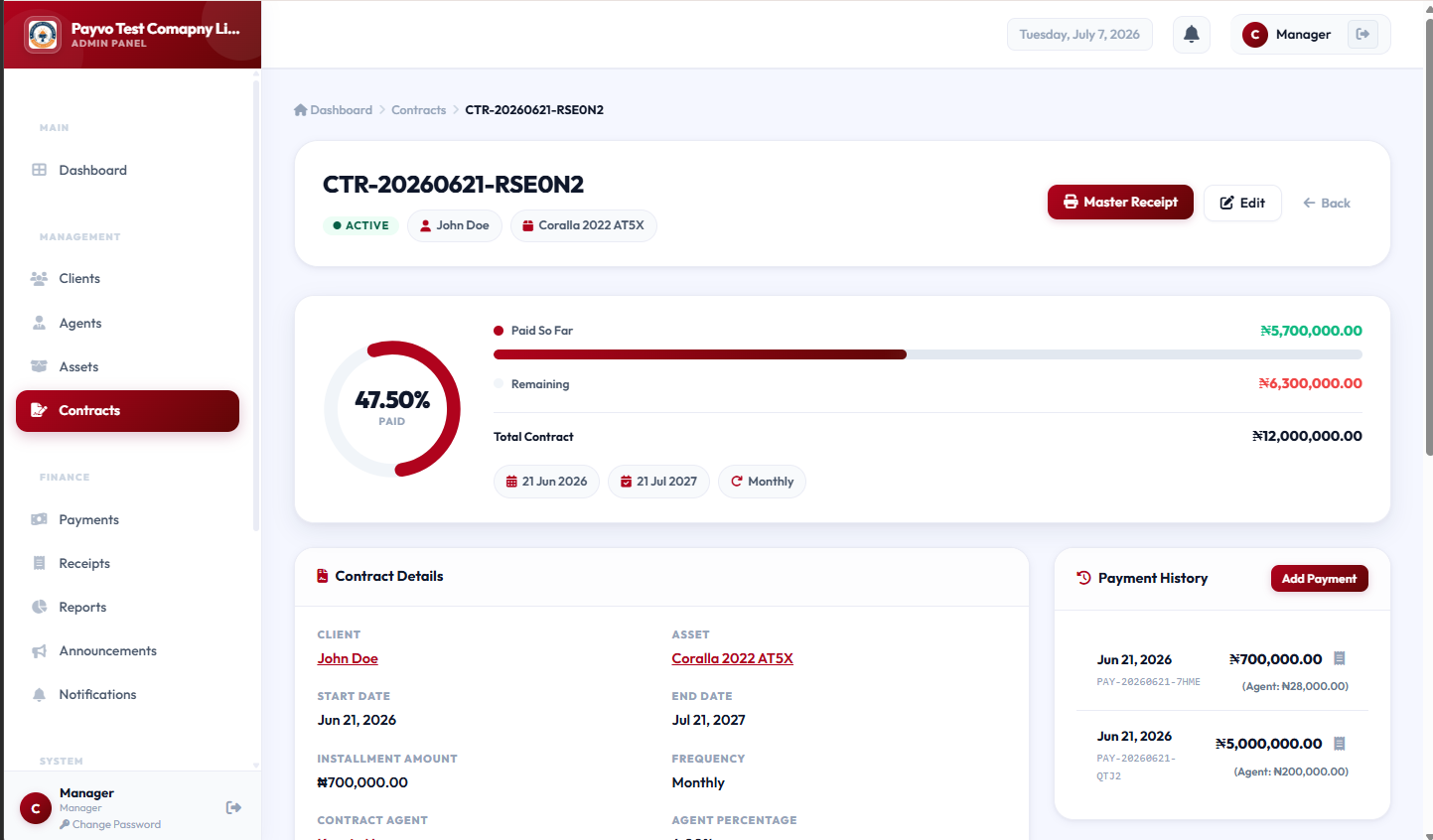 Management: Contract Details View (top)
- Generate Professional Receipts: Issue digital receipts instantly, giving your customers a clear record of their payments. You can even customize them to reflect your brand. This eliminates the need for a separate receipt generator app Nigeria.
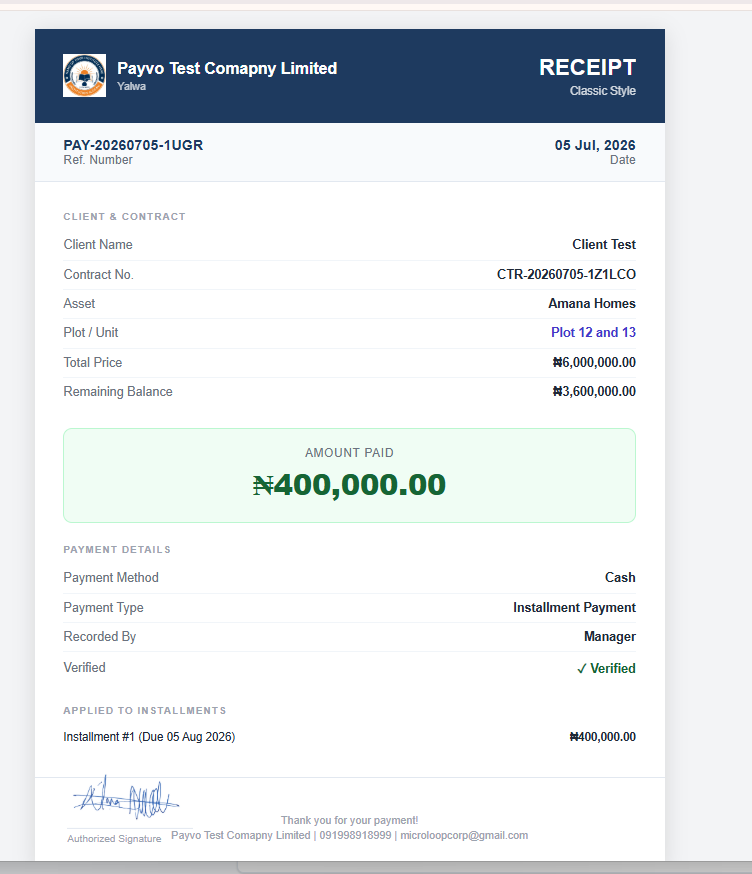 Finance: Paymnet Receipt Sample
- Automate Reminders (Optional): Leverage the optional WhatsApp payment notification system to send automated payment reminders and confirmations, improving collection rates and customer satisfaction.
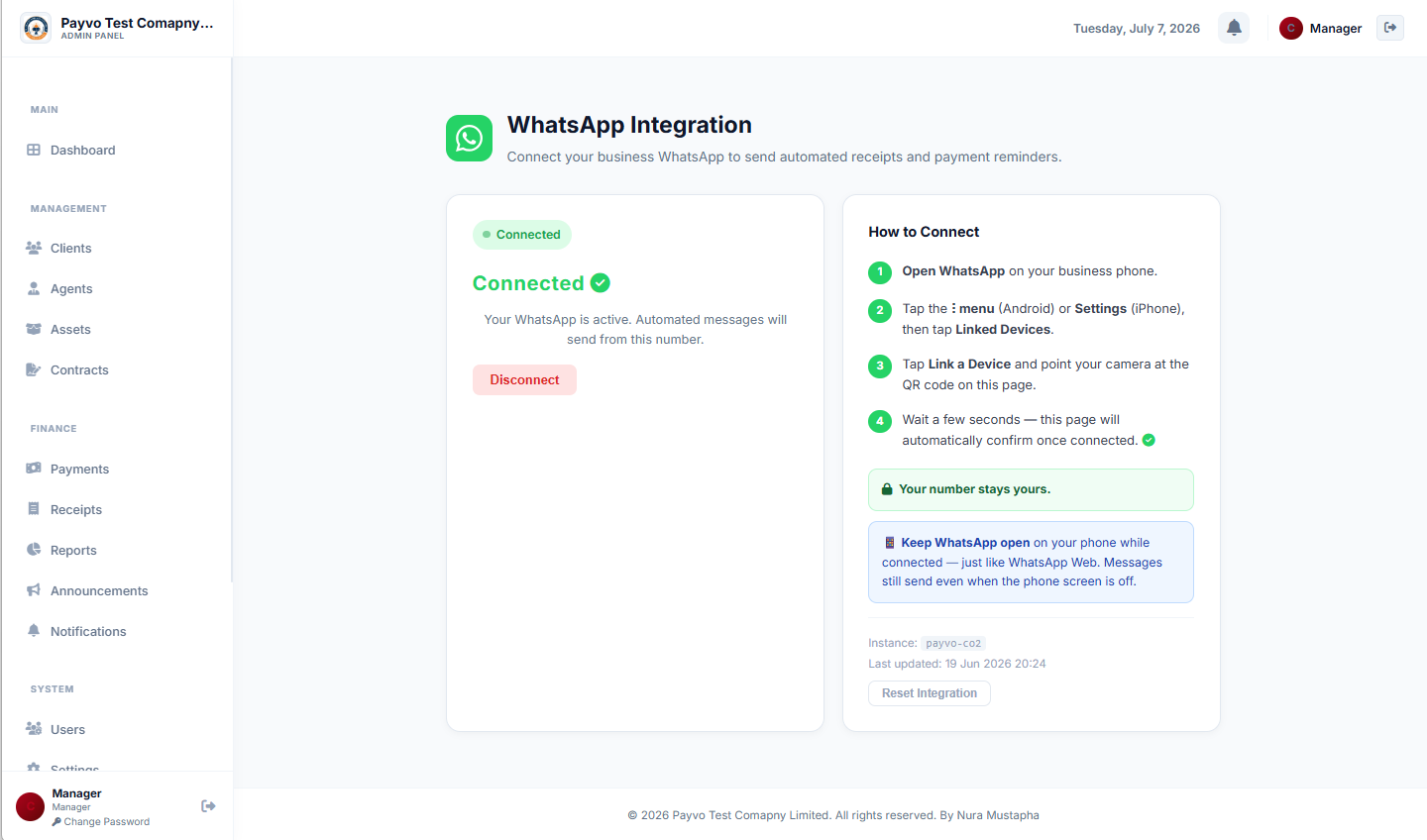 Admin: Whatsapp Integration
- Manage Agents and Commissions: For businesses with sales teams, Payvo provides robust agent commission tracking software and user management features, ensuring accurate commission calculations and clear accountability. You can explore these capabilities on our agent tracking page.
Proof: Side-by-Side Comparison
Let's look at a clear comparison between traditional manual methods, specifically using Excel, and the efficiency offered by a dedicated installment management software like Payvo in 2026.
| Feature / Aspect | Traditional Manual (Excel/Notebooks) | Dedicated Installment Management Software (e.g., Payvo)