Manual tracking of installment payments for your estate business is a ticking time bomb. You might think you're saving money by using notebooks or complex spreadsheets, but come 2026, those methods are costing you far more in lost payments and wasted time than any software ever could. You need a clear, organized system if you want to know how to track outstanding balances for estate businesses: a complete guide to success in property sales.
 Estate developer reviewing land plots on a tablet
Why Most People Get This Wrong from Day One
Let's be honest, many of us start small. You sell a plot of land in Abuja, then another in Kano, and before you know it, you have 15, then 50, then 100 clients. Each one has a different payment plan, a unique down payment, and varying due dates. You're trying to keep track of land installment balances with a pile of paper files and an Excel sheet that crashes every other week. That’s the reality for many real estate developers and property sellers in Nigeria today.
The biggest mistake? Underestimating the sheer administrative load. You think, "Ah, I'll just jot it down." But that jotting turns into a nightmare when Mrs. Adebayo insists she paid last Tuesday, and you can't find the receipt. Or when Mr. Okoro, who bought a plot in your Kaduna estate, is three months behind, but you only realized it because you stumbled upon his file. You're wasting precious hours searching through WhatsApp chats for payment confirmations and reconciling bank statements manually. This is why having proper real estate payment tracking is so crucial.
The truth is, those old ways are costing you hard cash. Think about it: a dedicated accounting staff in Lagos or Abuja can cost you anywhere from ₦60,000 to ₦120,000 monthly. Even a part-time bookkeeper for a few hours a week will run you ₦30,000 to ₦50,000. If you're losing just one or two installment payments a month because of poor tracking, you're already paying more than what a good system would cost. And that's not even counting the stress, the disputes, and the damage to your reputation.
Before You Do Anything: The Foundation Work
Before you even think about software or fancy systems, you need to lay some groundwork. This isn't just about collecting money; it's about building a sustainable business.
First, you need clear, legally sound contracts. Every single land sale, every apartment lease, must have a detailed contract outlining the total price, the down payment, the installment amounts, due dates, and penalties for late payments. Don't rely on verbal agreements or vague promises. In Nigeria, a well-drafted contract is your first line of defense. You can consult a legal professional for about ₦50,000 to ₦150,000 per case or hour for initial advice on standard contract templates, which is a worthwhile investment.
Next, get your business registered properly. If you haven't already, register with the Corporate Affairs Commission (CAC). This gives your business legitimacy and makes it easier to open corporate bank accounts, which are essential for tracking payments. You'll need your Certificate of Incorporation and other relevant business permits.
Finally, dedicate a specific bank account for all installment payments. Mixing business and personal funds is a recipe for disaster. When you have a separate account, it's much easier to reconcile incoming payments against your records. This also simplifies things for your real estate payment tracking in Nigeria.
The Step-by-Step Path (What Actually Works)
Right, so you've got your contracts in order and a dedicated bank account. Now, let's talk about the actual process of tracking those outstanding balances. This isn't rocket science, but it requires discipline.
Step 1: Standardize Your Contract Terms
Most guides will tell you to just create a contract. That's the wrong way to think about it. You need standardized contracts. For every type of property you sell – a 500sqm plot, a 3-bedroom apartment, a commercial space – have a template. This ensures consistency and makes it easier to onboard new sales agents. If you're selling a land plot in Kano, the terms should largely mirror one in Abuja, adjusted for local market rates.
Why it matters: Consistency reduces errors and legal disputes. If every client gets a slightly different deal, tracking becomes a nightmare.
Common shortcut that backfires: Customizing every single contract from scratch. It's slow, error-prone, and makes auditing impossible.
Action item: Develop 2-3 standard contract templates for your most common property types. For example, a template for a ₦1.5 million plot with a 20% down payment and 12 monthly installments, and another for a ₦7.5 million apartment with a 30% down payment and 24 monthly installments.
Step 2: Centralize All Client and Property Data
This is where the rubber meets the road. You absolutely must have one central place for all your client information and property details. Think about it: where do you go right now if you need to know everything about Mr. Obi's plot in your new estate in Kaduna? Is it in a folder, a spreadsheet, or scattered across multiple WhatsApp chats?
Why it matters: A central database means no more searching, no more "I can't find it," and a single source of truth for everyone on your team. This is key for effective installment management software Nigeria.
Common shortcut that backfires: Using separate Excel sheets for clients, another for properties, and another for payments. These rarely sync, leading to conflicting information.
Action item: Create a single system where you can input client names, contact details, the specific property they bought (e.g., Plot 34B, Phase 2, Sunshine Estate), the total contract value, and the agreed payment schedule.
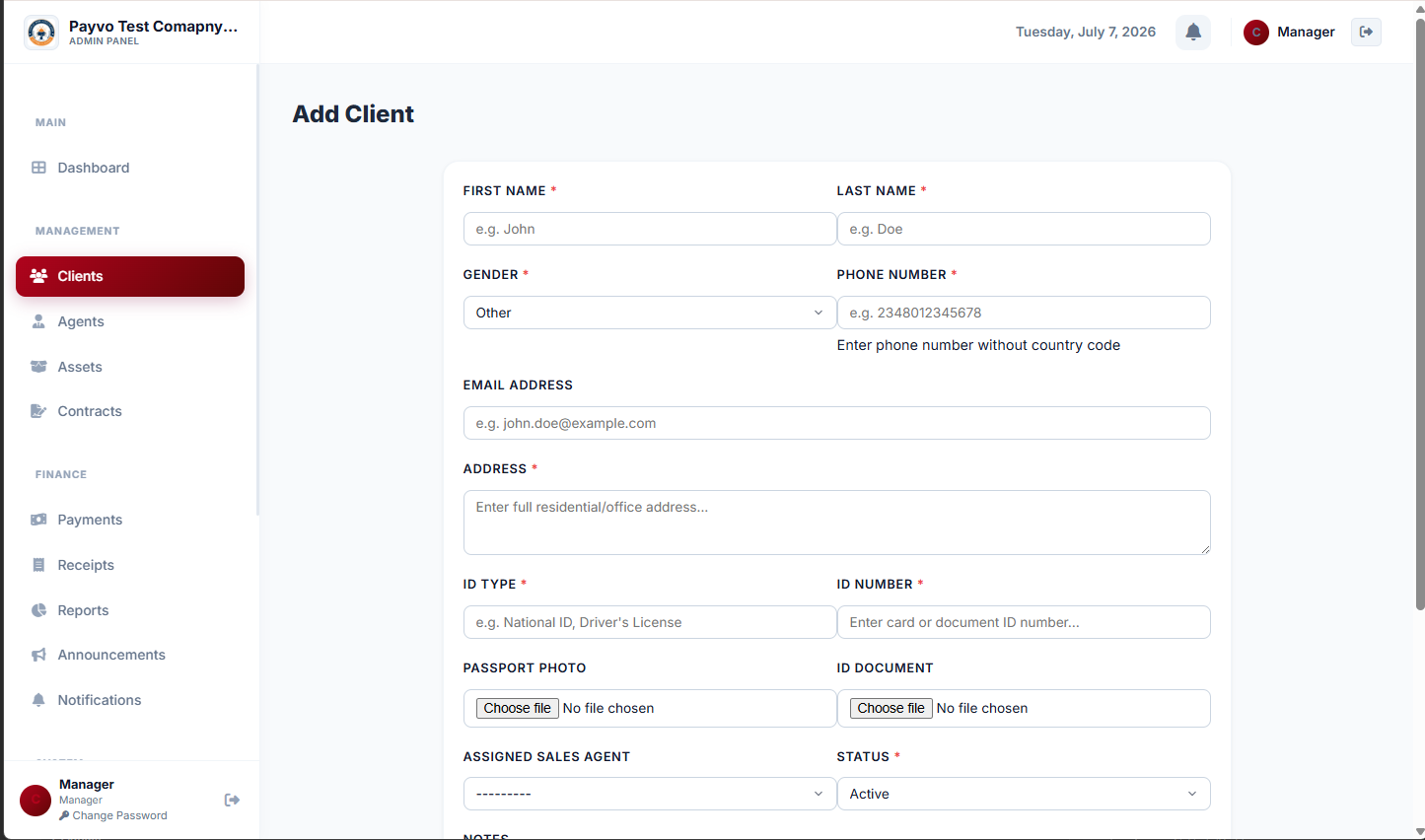 Client: Add Client page
Step 3: Implement a Robust Payment Tracking System
This is the core of how to track outstanding balances for estate businesses. You need a system that records every payment, links it to the specific contract and client, and automatically updates the outstanding balance. This is where a dedicated installment management software Nigeria solution comes in handy.
If you're still using pen and paper, you're building a house of cards. A small real estate business in Port Harcourt trying to manage 30 active installment contracts with just a ledger book will quickly fall behind. Every payment must be recorded, dated, and reconciled against bank statements.
Why it matters: Accurate payment tracking is the only way to know who owes what, when. It helps you identify overdue payments immediately and generate accurate receipts.
Common shortcut that backfires: Relying on bank alerts alone. Bank alerts tell you money came in, but not who it's from or what it's for, without manual cross-referencing.
Action item: Use a system like Payvo. It lets you register clients, add assets (like land plots or apartments), create installment contracts with structured payment schedules, and record payments against those contracts. It automatically calculates the remaining balance, so you always know where you stand. It's a proper business payment tracking app Nigeria businesses can rely on.
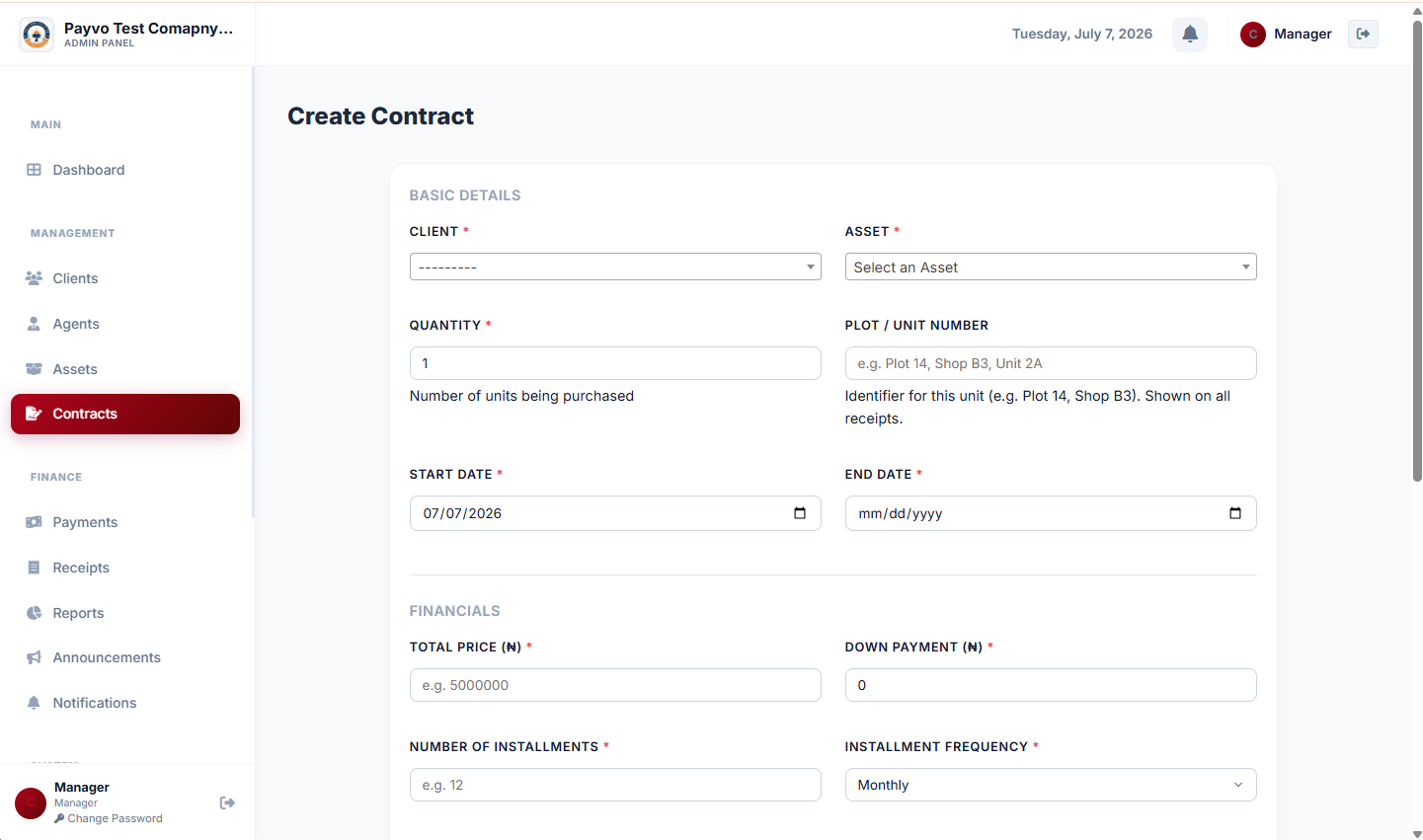 Management: Add contract (top)
Step 4: Automate Payment Reminders and Notifications
Let's be real: people forget. They get busy. A friendly reminder can often be the difference between a timely payment and a late one. You don't want your agents spending all their time chasing clients when they could be closing new sales.
Why it matters: Automated reminders significantly reduce late payments and free up your team's time. A WhatsApp payment notification system can be incredibly effective in the Nigerian context.
Common shortcut that backfires: Manual reminders. You’ll forget, or your agent will, and then you're back to square one, chasing overdue payments.
Action item: Set up automated SMS or WhatsApp reminders that go out a few days before a payment is due, and another one if a payment becomes overdue. Systems like Payvo often have these features built-in, or you can integrate with an SMS gateway service, which costs about ₦2,000 to ₦5,000 monthly.
Step 5: Regular Reconciliation and Reporting
This isn't a one-and-done task. You need to regularly check your records against your bank statements. At least weekly, if not daily. This helps catch discrepancies early. Also, generate reports to see the overall health of your installment sales.
Why it matters: Regular reconciliation ensures your records are accurate and helps identify any potential fraud or errors. Reports give you a bird's-eye view of your outstanding balances, collections, and overdue accounts.
Common shortcut that backfires: Waiting till month-end to reconcile. By then, errors are harder to trace, and overdue payments have piled up.
Action item: Schedule weekly reconciliation sessions. Generate reports on outstanding balances, upcoming payments, and payment history. This helps you track land installment balances effectively.
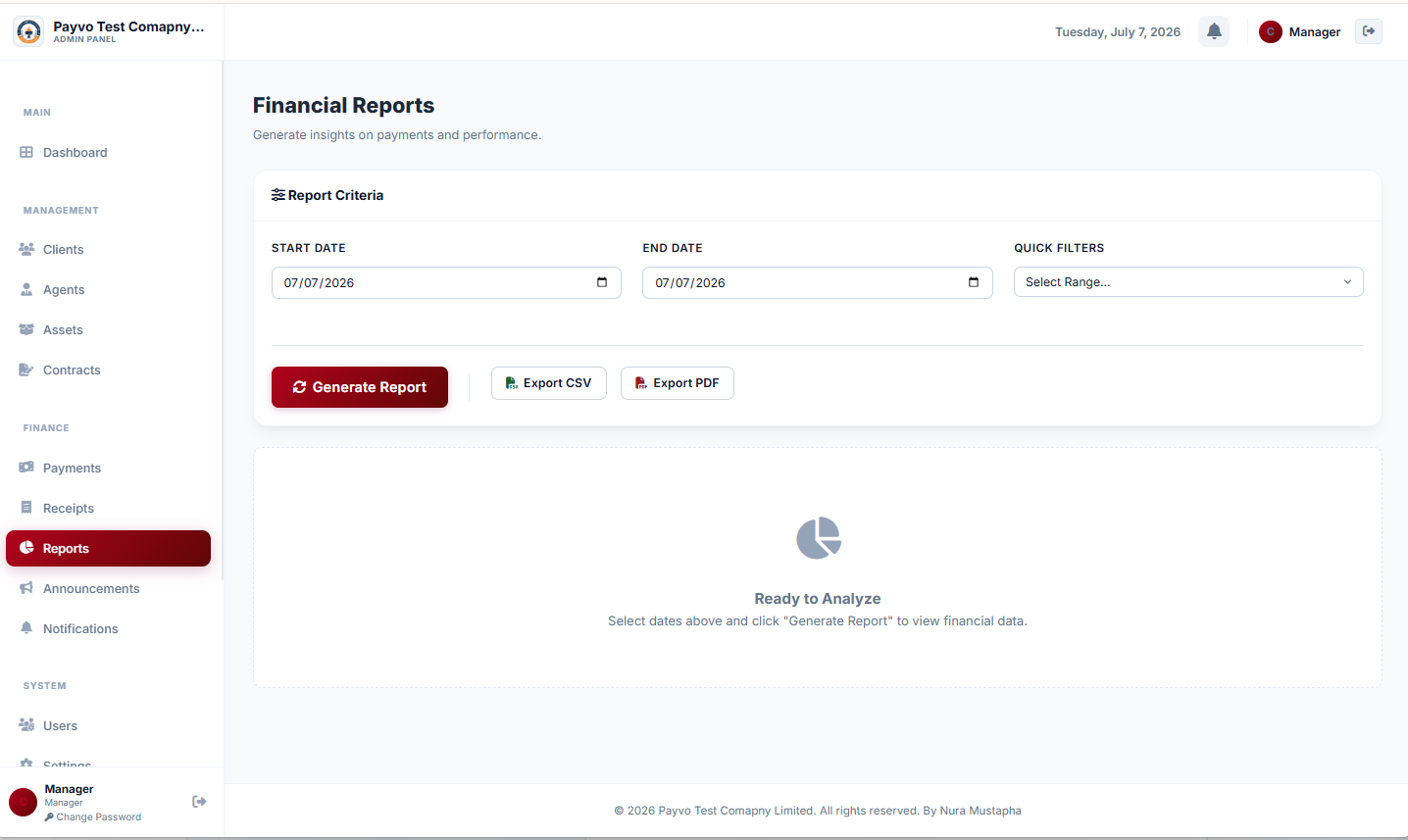 Finance: Financial Reports Page
Step 6: Agent Commission Tracking
If you work with agents, you know how crucial it is to track their performance and commissions accurately. They need to know what they've earned, and you need to ensure they're focused on collecting payments, not just making sales. This is where an agent commission tracking software becomes invaluable.
Why it matters: Clear, transparent commission tracking motivates agents and prevents disputes. It also helps you understand the true cost of each sale.
Common shortcut that backfires: Calculating commissions manually at the end of the month based on scattered payment records. This leads to arguments and demotivated agents.
Action item: Integrate agent performance into your tracking system. Ensure that payments recorded are linked to the agent responsible for that sale, so commissions can be accurately calculated based on collected funds, not just sales agreements. You can manage your agents efficiently through a system that supports agent tracking.
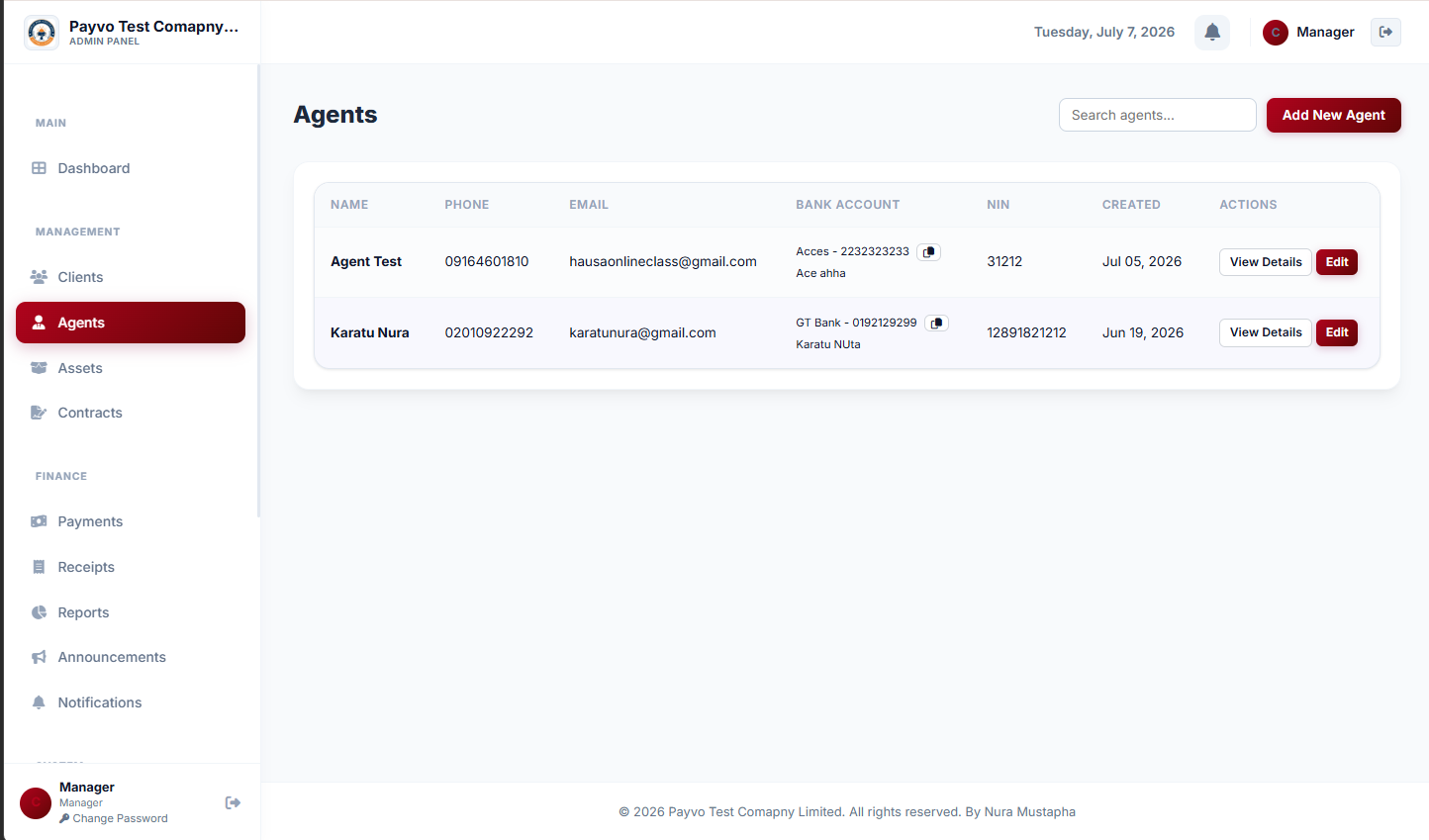 Agent: Agents list page
The Numbers That Will Make or Break You
Understanding the financial realities of managing installment sales is critical. It's not just about the profit from the property itself, but the cost of managing those payments.
Let's break down some figures for your estate business in 2026:
- Basic Accounting Software Subscription: You're looking at ₦5,000 - ₦15,000 monthly for a decent cloud-based solution. This is a non-negotiable expense if you want to scale.
- Custom Spreadsheet Development: If you try to go the cheap route and get a local IT student to build you a custom Excel sheet, it'll cost you ₦15,000 - ₦50,000 one-time. But remember, it's a one-time solution that often lacks scalability and real-time updates.
- Dedicated Accounting Staff Salary: As I mentioned earlier, ₦60,000 - ₦120,000 monthly for a junior accountant. That's a significant overhead, especially if you're a smaller operation.
- Part-time Bookkeeper/Data Entry: If you only need a few hours a week, budget ₦30,000 - ₦50,000 monthly.
- Internet Data Costs: For reliable access to online records and software, you'll spend about ₦5,000 - ₦10,000 monthly. Don't skimp here; slow internet equals lost productivity.
- Printer & Scanner: A one-time cost of ₦40,000 - ₦80,000 for printing invoices and scanning documents. Essential for physical backups and client records.
- Stationery & Consumables: Paper, ink, receipt books – budget ₦3,000 - ₦7,000 monthly.
- SMS Gateway Service: For automated reminders, ₦2,000 - ₦5,000 monthly. A small price to pay to keep payments flowing.
- Basic Laptop/Desktop Computer: A one-time investment of ₦150,000 - ₦300,000. You need reliable hardware to run your software.
Growth After Launch: The Next 90 Days
So, you've set up your system, you're tracking payments, and you're feeling more in control. What next? The first 90 days after implementing a new tracking system are crucial for cementing new habits and optimizing your process.
First, review your collection rates. Are more payments coming in on time? Are overdue accounts being flagged and addressed faster? Your new contract management software Nigeria should give you clear insights into this. Look at your reports weekly. If you see a cluster of overdue payments from a specific estate or agent, dig deeper.
Second, train your team thoroughly. If you have sales agents or administrative staff, make sure they understand how to use the new system. Show them how to input new clients, create contracts, and record payments. This is especially important for cooperative society management software or any business with multiple stakeholders. Make sure they understand the benefits for them – less chasing, clearer commissions, happier clients.
Third, gather feedback. Ask your agents and even some trusted clients about their experience. Are the payment reminders helpful? Is the receipt generator app Nigeria easy to use? Adjust your processes based on their feedback. Maybe you need to send reminders 5 days before, not 3. Maybe clients prefer WhatsApp messages over SMS.
Anyway, don't just set it and forget it. A system is only as good as the people using it and the data it contains. Continuous improvement is key.
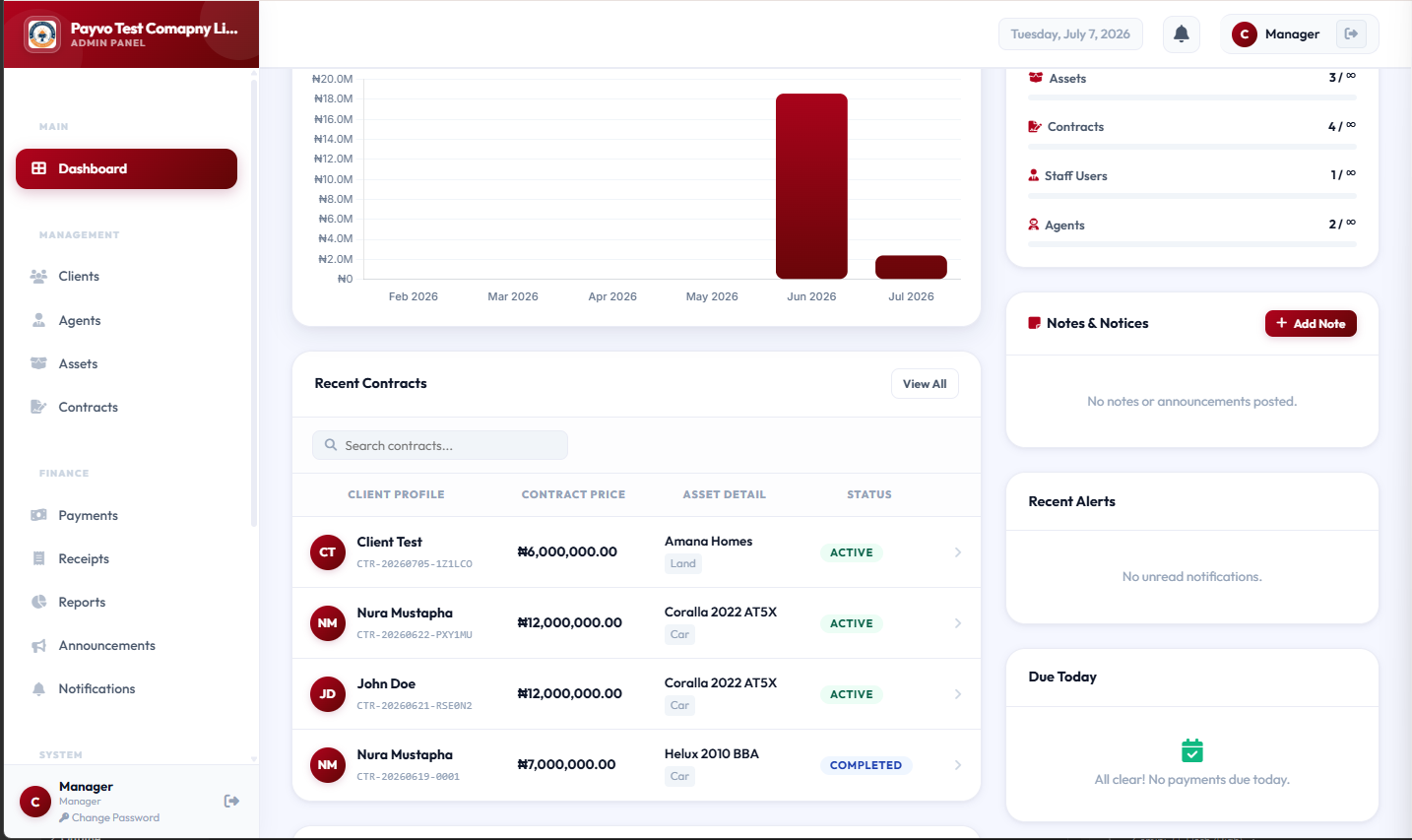 Dashboard (top)
FAQ: Answers to What You're Actually Googling
How do I effectively manage multiple property buyers and their varied payment schedules?
This is a common headache for real estate businesses, especially when dealing with different estates or property types. The key is a centralized system that allows you to associate each buyer with a specific property, an individual contract, and a unique payment schedule. Manual methods quickly become unmanageable. Look for real estate payment tracking solutions that allow you to segment clients by property, agent, or payment status. This way, you can easily pull up all clients for your "Palmview Estate" in Lekki, for instance, and see their individual land installment balances at a glance.
What's the best way to send payment reminders to clients in Nigeria?
Honestly, a WhatsApp payment notification system combined with SMS is usually the most effective. Many Nigerians are on WhatsApp, and it allows for richer communication (like sending a digital receipt link). SMS acts as a reliable backup. The trick is automation. You don't want to manually send these. A system that can automatically trigger these messages based on due dates or overdue statuses saves immense time and improves collection rates. Payvo offers features to help with these notifications.
Can an Excel spreadsheet handle tracking outstanding balances for a growing estate business?
For a very small estate business with maybe 5-10 active contracts, a well-structured Excel sheet might suffice initially. However, as you grow to 20, 50, or 100+ clients, Excel becomes incredibly prone to errors. Formulas break, data gets accidentally deleted, and it's nearly impossible for multiple people to update it in real-time without creating conflicting versions. Plus, generating reports or specific client statements is a manual, time-consuming process. It lacks the robust auditing, automated reminders, and centralized data management that a dedicated installment management software Nigeria provides.
How can I track agent commissions accurately based on collected payments, not just sales?
This is a critical point for motivating your sales team. You need a system that links each payment received to the specific contract and, in turn, to the agent who facilitated that sale. When a payment is recorded, the system should automatically update the agent's commission ledger. This ensures agents are paid only on actual collections, not just agreements, and provides transparency. Good agent commission tracking software will allow you to define commission structures (e.g., a percentage of the down payment, or a percentage of each installment collected) and generate reports for each agent.
Is a receipt generator app Nigeria necessary, or can I just use manual receipts?
While manual receipt books are common, a digital receipt generator app Nigeria offers significant advantages. It ensures consistency, professional branding, and easy storage. Digital receipts can be automatically sent to clients via email or WhatsApp, reducing physical paper handling and making it easier for clients to track their payments. More importantly, when integrated with your payment tracking system, it automatically records the receipt in the client's payment history, eliminating manual data entry and potential errors.
> "Your cash flow is the heartbeat of your estate business. Without a clear, real-time view of your outstanding balances, you're operating blind, risking not just profits, but the very survival of your enterprise."
Ready? Here's Where to Start
If you're tired of chasing payments, sifting through WhatsApp messages, and stressing over your estate outstanding balances, it's time for a change. You've seen the costs of manual tracking and the benefits of a structured approach.
Take the first step towards better organization and improved cash flow today. Head over to Payvo's public home page to learn more about how our installment management software Nigeria can transform your real estate business. You can explore our specific solutions for real estate developers and property sellers, or even book a demo to see it in action. Stop managing your growth with outdated tools, and start building a more efficient, profitable future.