Your manual tracking system for multiple installment contracts per customer is a ticking time bomb. I've seen it countless times: a busy car dealer in Ikeja, juggling three different hire-purchase agreements for one customer on separate notebooks, only to realize a payment was misallocated, leading to a heated argument and a lost client. Or a cooperative society in Kano, trying to reconcile a member's loan for a grinding machine with their separate contribution for a plot of land, all on faded ledger sheets. It’s not just inefficient; it's actively costing you money, reputation, and sleep. This simplified guide will show you how to track multiple installment contracts per customer without the headache.
 A busy nigerian businesswoman reviewing digital contracts on
Why Most People Get This Wrong from Day One
Let's be honest, when you first started offering installment payments, it felt like a brilliant idea. More sales, happier customers, right? And for one or two customers, a simple notebook or a basic Excel sheet works just fine. But then your business grows. That one customer who bought a generator on installment now wants to buy a solar panel setup from you, also on installment. Suddenly, you have Mrs. Adebayo with two active contracts, different payment schedules, and separate outstanding balances. This is where the wheels usually come off.
The biggest mistake I see Nigerian SMEs make is trying to scale a manual system. They believe they can just "add another sheet" or "buy a bigger ledger." But that's like trying to put out a bonfire with a teacup. The complexity doesn't just double; it multiplies exponentially. You're dealing with:
- Conflicting Payment Schedules: One contract might be weekly, another monthly. One due on the 5th, another on the 20th. How do you keep these straight without missing a beat?
- Muddled Balances: Did that ₦20,000 payment go towards the car or the repair kit? If your records aren't crystal clear, you're open to disputes and potential losses. I once worked with a building materials supplier in Onitsha whose customer swore they overpaid by ₦35,000 because the supplier couldn't definitively show which cement delivery the last payment covered. It was a mess.
- Agent Commission Headaches: If you have sales agents, tracking their commission when one customer has multiple deals becomes a nightmare. Was Agent Emeka responsible for both sales, or did Agent Fatima close the second one? An agent commission tracking software integrated with your contracts is crucial here.
Many businesses also fall into the trap of using a generic receipt generator app Nigeria for individual payments, but then have no way to link those receipts cleanly to specific contracts under one customer. It's a patchwork solution that eventually unravels.
Before You Do Anything: The Foundation Work
Before you even think about software or new processes, you need to lay some groundwork. This isn't optional; it's essential for preventing future headaches, especially when managing multiple installment contracts.
- Define Your Contract Types Clearly: Not all installment sales are the same. Are you selling land plots (real estate payment tracking Nigeria), vehicles (car dealer installment software), or electronics? Each might have slightly different terms. Document these standard terms.
- Standardize Your Customer Onboarding: When a customer signs up for their first contract, what information do you collect? When they sign up for their second or third, what changes?
- Legal Review of Your Agreements: This is often overlooked, but crucial. If a customer defaults on one contract, does it impact their other contracts with you? What happens if they pay off one but still owe on another?
- Capital for Growth & Tools: You'll need some funds to invest in proper systems. Don't think of this as an expense, but an investment.
Without these foundational steps, any system you implement will just be building on shaky ground. You need clarity and consistency first.
The Step-by-Step Path (What Actually Works)
Alright, so you've got your foundation. Now, how do we actually manage these multiple installment contracts without losing our minds or our money? This isn't about magic; it's about structured processes and the right tools.
Step 1: Centralize Customer Records (The Golden Rule)
This is non-negotiable. Every single interaction, every detail about a customer, needs to live in one place. Not three different notebooks, not five WhatsApp chats, not scattered files.
- What to do: Implement a system where each customer has a unique profile. When they take out a new contract, it's linked to their existing profile, not a new one. This creates a unified view.
- Common shortcut that backfires: Creating a new physical folder or spreadsheet row for every new contract, even if it's the same customer. This quickly leads to duplicate data, errors, and a fragmented understanding of your client.
- Specific action item: Choose a customer relationship management (CRM) system or an installment management software Nigeria that allows you to create a single customer profile and attach multiple contracts to it.
Step 2: Assign Unique Identifiers to Every Contract
Just as customers need unique IDs, so do your contracts. This prevents confusion, especially when payments come in.
- What to do: Every single installment agreement, regardless of the customer, needs its own distinct contract ID. This could be a simple sequential number (e.g., C001, C002) or something more descriptive (e.g., JOS-LAND-005, LAG-CAR-012).
- Common shortcut that backfires: Relying on the customer to tell you which contract the payment is for, or worse, guessing. This is a recipe for misallocated funds and disputes.
Step 3: Implement Clear Payment Allocation Procedures
This is where many businesses bleed money. Without a strict process, payments can get lost or incorrectly applied.
What to do: When a customer makes a payment, your team must* confirm which contract it applies to. If the customer has multiple contracts, they should specify. If they don't, your team should ask before processing.
- Why it matters: Let's say a customer owes ₦100,000 on Contract A and ₦50,000 on Contract B. They pay ₦50,000. If you apply it to Contract A, Contract B remains fully due. If you apply it to Contract B, Contract A still has a ₦100,000 balance. The customer needs to know where their money went, and so do you. This is the core of effective business payment tracking app Nigeria usage.
- Common shortcut that backfires: Just applying the payment to the oldest outstanding balance, or the largest one, without confirmation. This can lead to customer frustration and accusations of mismanaging their funds.
Step 4: Leverage Specialized Installment Management Software
This is where you move from surviving to thriving. Trying to manage multiple installment contracts manually, especially with multiple customers, is simply not sustainable in 2026.
- What to do: Invest in an installment management software Nigeria that's built for this exact challenge. You need a system that allows you to:
- Create a single customer profile.
- Attach multiple, distinct contracts to that profile.
- Record payments against specific contracts.
- Show a consolidated view of the customer's total outstanding balance across all their active contracts.
- Generate receipts for individual payments linked to specific contracts.
- Ideally, it should also offer features like agent commission tracking software and a WhatsApp payment notification system for reminders.
- Why it matters: This isn't just about automation; it's about accuracy, transparency, and scalability. A good system eliminates manual calculation errors, provides real-time data, and gives you peace of mind. Imagine a real estate developer in Abuja trying to manually track payments from one client who bought three different plots of land over time. It's a nightmare. A system like Payvo allows you to see all three land contracts under that single client, their individual payment status, and their total outstanding balance.
- Common shortcut that backfires: Sticking with Excel or paper ledgers because "it's always worked." This might save you a few thousand naira monthly on a subscription, but it costs you tens or hundreds of thousands in lost payments, wasted time, and customer disputes.
- Specific action item: Research and select an installment management software Nigeria. Look for one that explicitly supports linking multiple installment contracts per customer. Many platforms, including Payvo, are designed precisely for this.
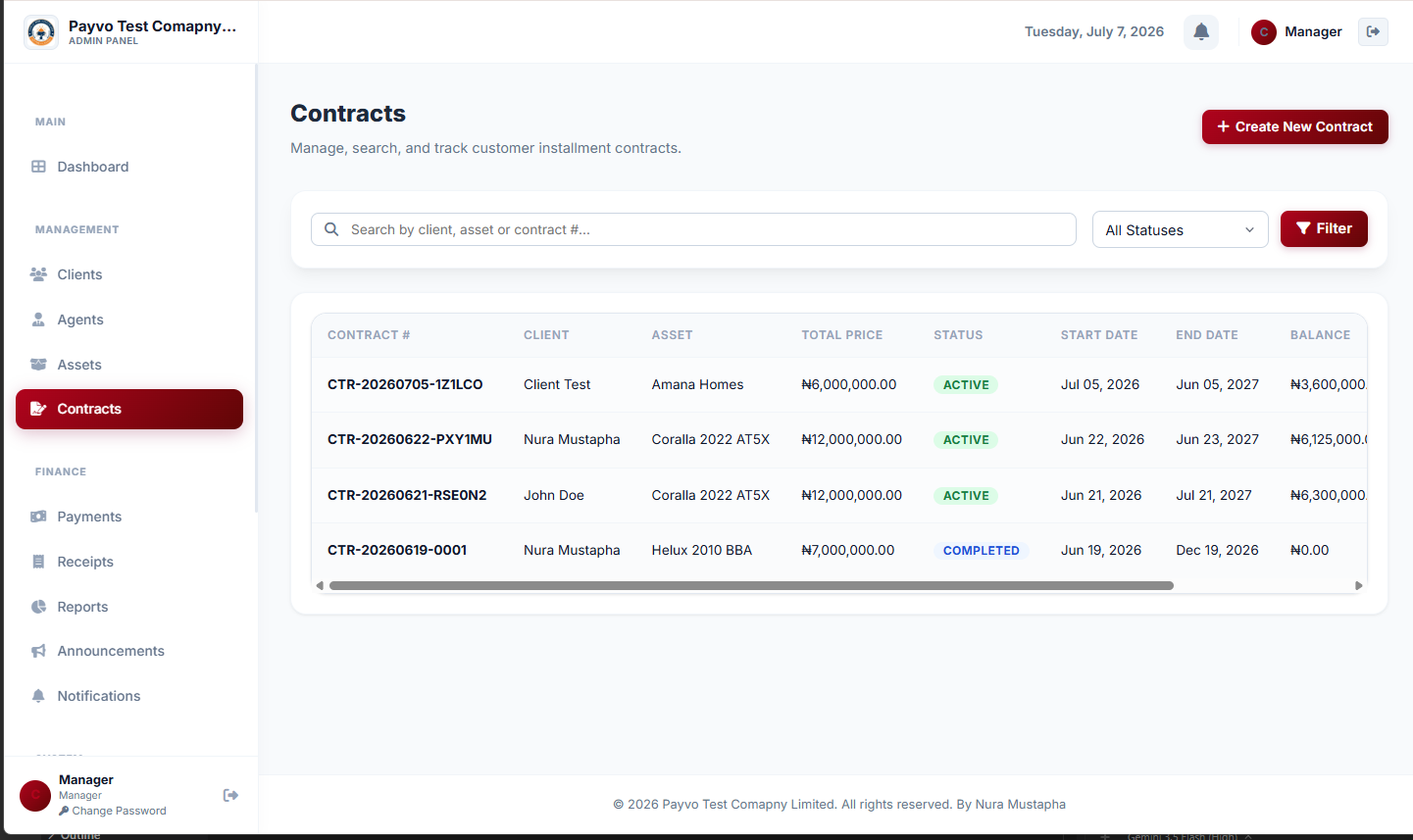 Dashboard showing multiple contracts for a single client
This dashboard view from Payvo shows how multiple contracts for different clients can be managed, with each contract having its own status and details.
Step 5: Automate Reminders and Notifications
Chasing payments manually is time-consuming and often awkward. Automation is your friend.
- What to do: Set up automated reminders for upcoming payments and overdue payments. These can be SMS, email, or even WhatsApp messages.
- Why it matters: Consistent reminders reduce late payments. If a customer has three contracts, they might remember one due date but forget the other two. Gentle, automated nudges help them stay on track without you having to make awkward calls. This is where a WhatsApp payment notification system shines.
- Common shortcut that backfires: Only contacting customers when they're significantly overdue. By then, they might have spent the money, or you've already lost valuable time.
- Specific action item: Configure your chosen installment management software to send automated payment reminders 3-5 days before a due date, and then follow-up notifications if a payment becomes overdue.
Step 6: Regularly Reconcile and Review
Even with the best system, periodic checks are vital.
- What to do: At least once a month, review your customer accounts. Look at those with multiple contracts. Are all payments correctly allocated? Are there any discrepancies?
- Why it matters: This catches errors early before they become major problems. It also gives you a holistic view of your customer relationships. You might notice a customer consistently paying late on one contract but always on time for another, which can inform your future engagement with them.
- Common shortcut that backfires: Trusting the system blindly without any human oversight. Software is powerful, but human error in data entry can still occur.
- Specific action item: Schedule a recurring "Account Reconciliation" meeting or task for yourself or a dedicated staff member. Focus specifically on customers with multiple installment contracts.
The Numbers That Will Make or Break You
Understanding the financial implications of managing installment sales, especially multiple contracts per customer, is crucial. This isn't just about sales; it's about operational costs and potential revenue. Let's break down the real Nigerian figures you need to consider in 2026.
Startup Costs: Getting Your System in Place
When you decide to get serious about installment management, there are initial investments.
- Software Subscription (Initial): For a basic cloud-based tracking tool, you're looking at ₦5,000 - ₦15,000/month. If you need more advanced features, agent management, or higher customer capacity, it could be ₦20,000 - ₦50,000/month. This is your core installment management software Nigeria.
- Dedicated Device: If your field agents or shop owners need a dedicated smartphone or tablet for payment recording and contract access, budget ₦40,000 - ₦150,000 per device.
- Legal Consultation: Getting those contract templates right is a one-time cost of ₦50,000 - ₦200,000. This protects you from future disputes.
- Printer & Consumables: For printing contracts and receipts, a one-time purchase of ₦30,000 - ₦80,000.
- Staff Training: A half-day session on using the new system could cost ₦10,000 - ₦30,000 per person. This is vital for smooth adoption.
Monthly Running Costs: Keeping the Engine Running
Once you're set up, there are recurring costs.
- Software Subscription: This continues monthly, as above (₦5,000 - ₦50,000).
- Internet Data: Reliable connectivity for cloud-based tracking is non-negotiable: ₦5,000 - ₦15,000/month.
- SMS Notifications: For automated payment reminders, budget ₦3,000 - ₦8,000 per 1,000 messages. If you have hundreds of customers, this adds up.
- Customer Service Staff: If you grow, you might need someone dedicated to managing inquiries. An entry-level salary is ₦60,000 - ₦120,000/month. This person could also handle agent commission tracking software tasks.
- Office Space (if applicable): If you need a dedicated space, rent varies wildly: ₦80,000 - ₦250,000/year in a small town, but ₦1,500,000 - ₦4,000,000/year in prime Lagos/Abuja locations.
Expected Revenue Timelines & Payback
Here's the part that really matters: when do you see a return?
For businesses with an average customer contract value of ₦150,000 - ₦500,000, reducing just one or two payment defaults per month due to better tracking can easily cover your software costs. The peace of mind and time saved are invaluable.
> "The true cost of a manual system isn't what you pay for notebooks; it's the lost revenue from untracked payments, the wasted hours chasing discrepancies, and the damage to your reputation from avoidable disputes."
If you sell high-ticket items like land (real estate payment tracking Nigeria) or cars (car dealer installment software), where a single default can mean hundreds of thousands or even millions of naira, the payback period for investing in proper installment management software is incredibly fast – sometimes just one prevented default. For cooperative society management software, efficient tracking means better member trust and financial stability.
Don't shy away from these numbers. They represent the investment in a more efficient, profitable, and less stressful business.
Growth After Launch: The Next 90 Days
So, you've implemented a robust system to track multiple installment contracts per customer. What next? The first 90 days post-launch are critical for cementing your new processes and truly seeing the benefits. This isn't a "set it and forget it" situation.
- Monitor Adoption Closely: In the first month, watch how your team uses the new system. Are they logging all payments correctly? Are they linking new contracts to existing customer profiles? Identify bottlenecks or areas where further training might be needed. A simple check of your audit log (if your software has one) can reveal a lot.
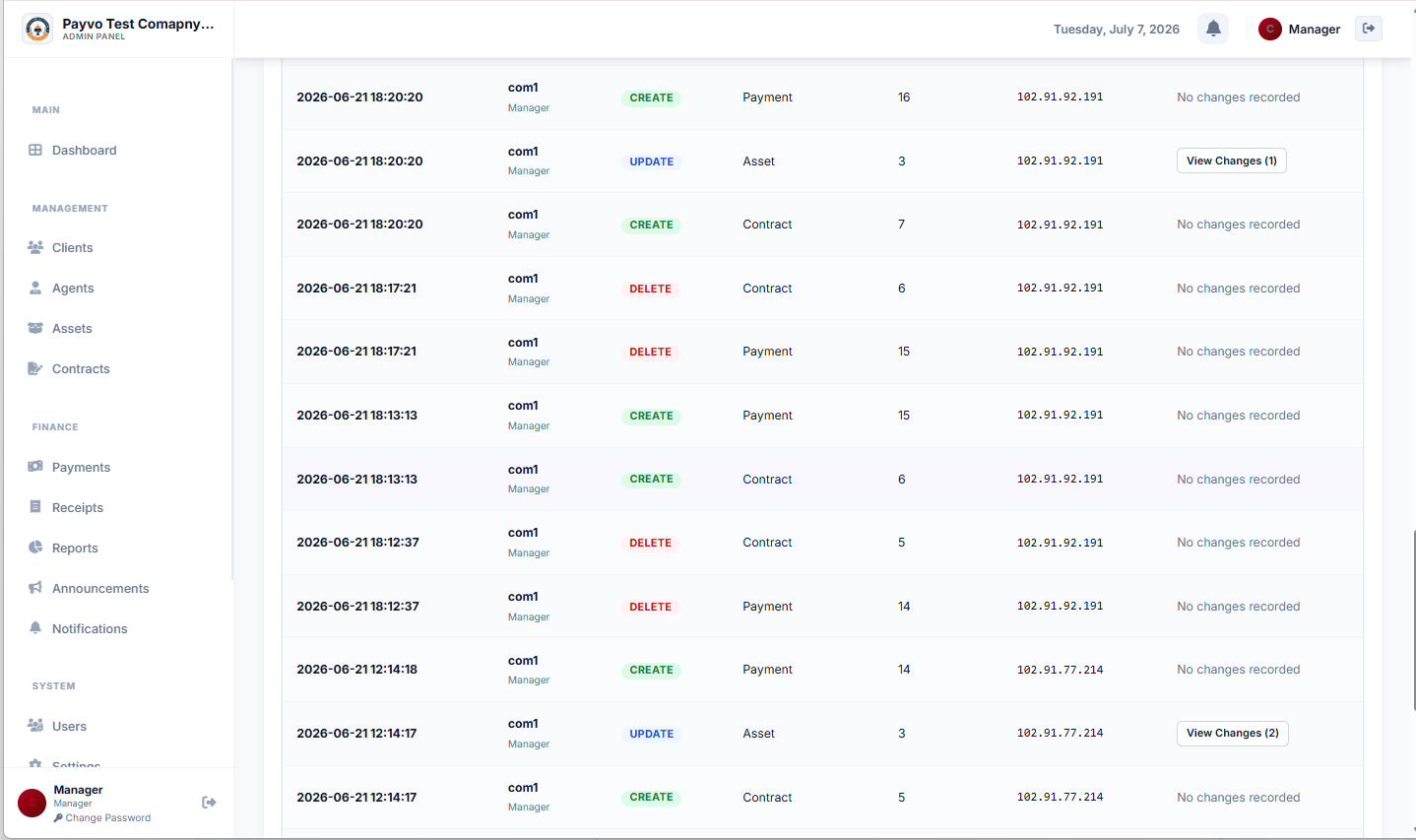 Admin: Audit Log Page
An audit log provides a clear history of actions taken within the system, crucial for monitoring adoption and identifying issues.
- Fine-Tune Your Communication: Review the effectiveness of your automated payment reminders. Are customers responding well? Are they still missing payments? You might need to adjust the timing or wording of your WhatsApp payment notification system messages. Perhaps a reminder 5 days before, and another 1 day before, works better than just one.
- Analyze Payment Trends: Now that you have consolidated data, start looking for patterns. Which customers with multiple contracts are consistently on time? Who struggles? This insight is invaluable for future credit decisions and for proactively reaching out to support customers who might be facing difficulties. Your installment management software Nigeria should provide reports that help you see these trends.
- Leverage Agent Tracking: If you have sales agents, use the agent commission tracking software features. Understand which agents are bringing in reliable installment customers, and how well they manage their client relationships, especially those with multiple deals. This can inform incentives and training. Payvo, for example, offers agent management capabilities that can help here.
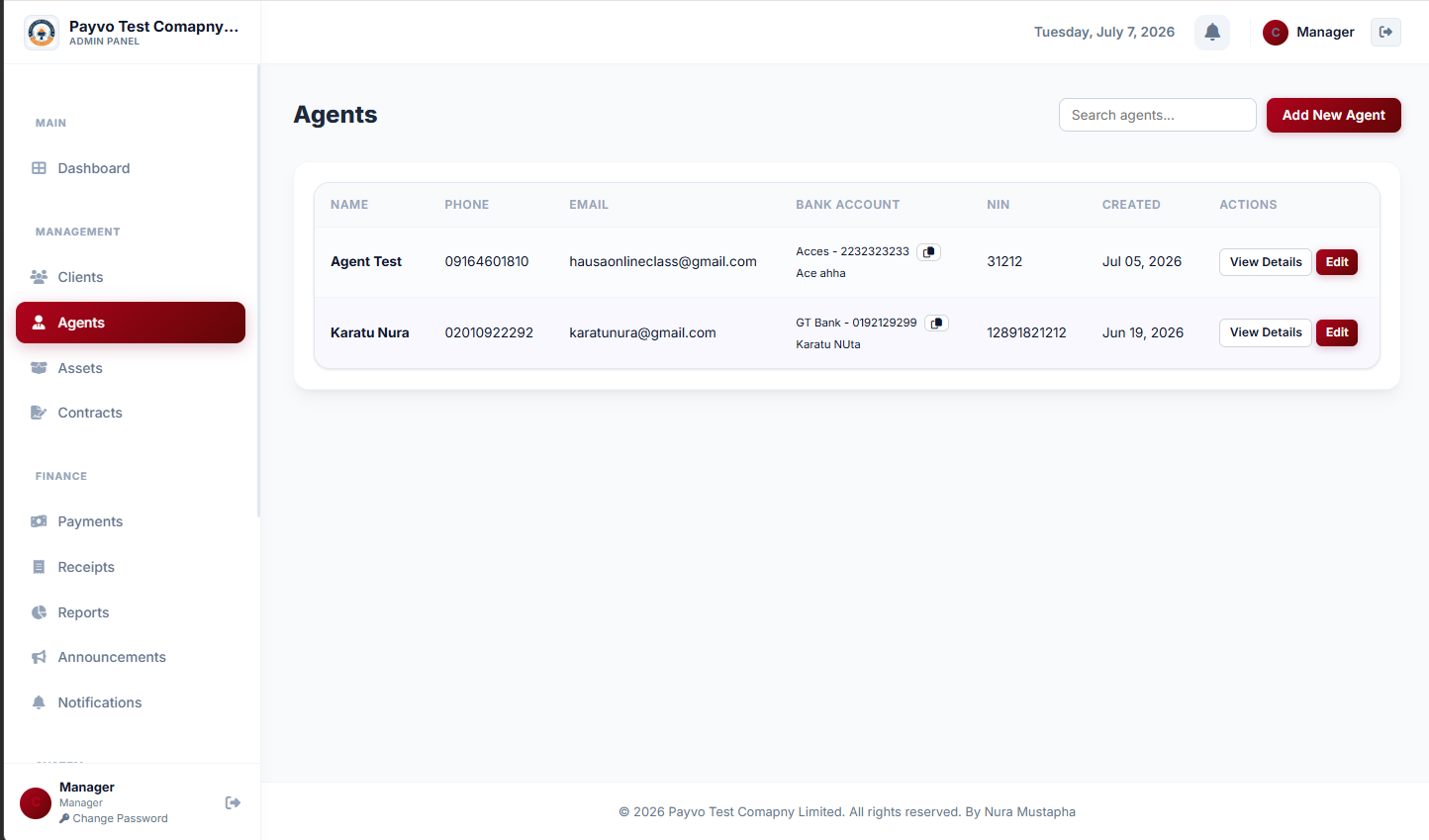 Agent: Agents list page
A clear list of agents and their associated contracts helps manage commissions and performance effectively.
- Gather Customer Feedback: Ask your customers if they find the new payment process clearer. Do they appreciate the digital receipts? Their feedback can highlight areas for improvement and also reinforce the value of your professional approach.
- Review Your Contract Templates: After a few months of real-world application, revisit your legal contract templates. Did any clauses cause confusion? Were there any situations with multiple contracts that weren't adequately covered? It's an iterative process.
FAQ: Answers to What You're Actually Googling
Q1: How do I track installment payments for multiple properties or vehicles bought by one customer?
A1: The key is to use a dedicated installment management software Nigeria that allows you to create a single customer profile and then link multiple distinct contracts (one for each property or vehicle) to that profile. Each contract should have its own unique ID, payment schedule, and outstanding balance. When a payment comes in, you record it against the specific contract it's intended for. This ensures clarity for both you and the customer. For real estate payment tracking Nigeria or car dealer installment software, this is non-negotiable.
Q2: What's the best way to manage agent commissions when a customer has several installment contracts?
A2: You need an agent commission tracking software that integrates with your contract management system. Each contract should be assigned to the agent who closed it. When payments are made on that specific contract, the system should automatically calculate the agent's commission based on your predefined rules. This prevents disputes and ensures fair compensation, even when one customer has multiple installment contracts handled by different agents over time.
Q3: Can I use WhatsApp to send payment reminders for different installment contracts to the same customer?
A3: Yes, you absolutely can, and it's highly effective in Nigeria. Many modern installment management software solutions offer a WhatsApp payment notification system. This allows you to send automated, personalized messages to customers, reminding them about specific upcoming payments for each of their active contracts. This helps keep them informed and reduces late payments without manual effort.
Q4: My cooperative society has members with multiple loans and savings plans. How can we track these effectively?
A4: For cooperative society management software, the principle is the same: centralize the member's profile. Each loan or savings plan should be treated as a separate "contract" or "account" linked to that member. Your software should allow you to view the member's overall financial standing with the cooperative, including all their active loans, savings balances, and payment histories, all from one dashboard. This provides a comprehensive view of each member's engagement.
Q5: How do I generate separate receipts for each installment payment if a customer has multiple active contracts?
A5: A good receipt generator app Nigeria, integrated within your installment management software, will handle this. When you record a payment against a specific contract, the system should automatically generate a receipt that clearly states the contract ID, the amount paid, the remaining balance for that specific contract, and the date. This avoids confusion and provides clear proof of payment for each individual agreement.
Ready? Here's Where to Start
If you're tired of the chaos of managing multiple installment contracts per customer with notebooks and spreadsheets, it's time for a change. You've seen the costs, the risks, and the clear path to a more organized, profitable business. The first step is often the hardest, but it doesn't have to be. Take a moment to explore solutions built specifically for businesses like yours. You can start by checking out how a dedicated platform like Payvo can help you centralize your customer records, manage every contract distinctly, and automate your payment tracking. Visit the Payvo website today to see the features that can transform your operations, or even book a demo to see it in action. Your peace of mind, and your bottom line, will thank you.