You are losing money right now because you don't properly track your installment sales for retail businesses. I know, because I've seen countless shops, from large electronics stores in Computer Village to small furniture showrooms in Aba, make the same mistake, thinking a ledger book or WhatsApp chats are enough to manage customer payments.
 A busy electronics shop in computer village lagos
Why Most People Get This Wrong from Day One
Look, it's not that you're lazy or don't care. It’s that many business owners, especially those just starting out or running a small retail shop, are trying to juggle everything. You’re handling inventory, dealing with suppliers, serving customers, and then you’re supposed to be an accountant too? It's a lot.
The real problem is that we often underestimate the true cost of "just managing." You see a customer eager to buy a ₦187,500 television on installment, and you quickly scribble down their details in a notebook. Or maybe you create a basic spreadsheet, thinking you'll update it religiously. Here's the thing, though — does that actually work when you have 20, 50, or even 100 customers paying you weekly or monthly?
What happens when a customer says they paid last Tuesday, but your record shows otherwise? Or when you forget to follow up on an overdue payment because you were busy at Balogun Market? These small oversights, they add up. They drain your time, create disputes with customers, and worst of all, they cost you real money. I've seen businesses lose ₦50,000 to ₦150,000 in a year just from poor tracking. That's not small change for any retail business in Nigeria, especially when many people live on less than ₦2,000 a day.
Most guides will tell you to "get organized." That's the wrong way to think about it. You need a system that forces organization, a system that makes it harder to mess up than to get it right. Relying on manual methods for installment retail management is like trying to catch water with a sieve. You'll lose more than you keep.
Before You Do Anything: The Foundation Work
Before you even think about how to track installment payments, you need to lay some groundwork. This isn’t about fancy software yet; it’s about having a clear understanding of your own business and its offerings.
First, standardize your installment terms. Don't just make it up on the fly. What's your minimum down payment? Is it 20%? 30%? What's the maximum repayment period – 3 months, 6 months? Are you charging interest? If so, how much? A clear policy, written down and understood by all your staff, prevents confusion and disputes later. For example, a car dealer offering hire-purchase for a vehicle worth ₦3,500,000 might require a ₦700,000 down payment and 10 monthly installments of ₦280,000. This needs to be crystal clear from the start.
Next, get your customer onboarding right. This is crucial. You need accurate customer information: full name, phone number, physical address, next of kin details, and a valid ID. These aren't just for formality; they are your lifeline if payments go south. Imagine trying to chase down a customer for a ₦75,000 outstanding balance on an inverter sold in Port Harcourt with only a WhatsApp number. It's a nightmare. A proper customer registration process, even if it's just a dedicated form, takes about 5-10 minutes per customer but saves you hours of headaches.
Finally, categorize your products or assets. If you're selling anything from mobile phones to plots of land, you need a clear way to identify each item. Give them unique IDs, note their original price, and any specific terms attached to them. This might seem basic, but when you have 50 different types of solar panels or 20 different land plots in an estate in Abuja, you need to know exactly which one was sold to whom. This initial setup might take you a day or two, but it's time well spent.
The Step-by-Step Path (What Actually Works)
Alright, so you’ve got your foundation. Now, let’s talk about the practical steps to actually track installment sales for retail businesses without losing your mind or your money. This isn't theoretical; this is what I've seen work for shops just like yours.
Step 1: Document Every Single Agreement Formally
When a customer agrees to an installment plan, you need a formal contract. Not just a handshake or a WhatsApp message. A written document, signed by both parties, outlining the product, the total price, the down payment, the installment amounts, due dates, and any penalties for late payments. This is your legal backbone.
- Why it matters: This contract protects you. If a customer defaults, you have a clear document to refer to. It also ensures both parties understand the terms, preventing "I thought you said..." arguments. For a real estate developer in Kano, this contract is everything when selling a plot of land on installment.
- Common shortcut that backfires: Relying on verbal agreements or vague notes. When disputes arise, words are easily forgotten, but a signed contract speaks volumes.
- Action item: Create a standardized installment sales contract template for your business. Make sure it's legally sound for Nigerian context.
Step 2: Centralize Customer and Product Records
Stop scattering information across different notebooks, phones, or even different staff members. All customer details, all product information (especially for things like car dealer installment software needs), and every single contract detail must live in one place.
- Why it matters: Imagine you need to know how many customers are buying a particular item, or which customers are handled by a specific agent. If records are scattered, this is impossible. Centralization gives you a single source of truth.
- Common shortcut that backfires: Using multiple Excel sheets or individual staff members keeping their own records. This leads to conflicting data, lost information, and a lot of wasted time trying to reconcile everything.
- Action item: Choose a system for centralized record-keeping. This could be a dedicated spreadsheet system if you're very small, but honestly, it quickly becomes unwieldy.
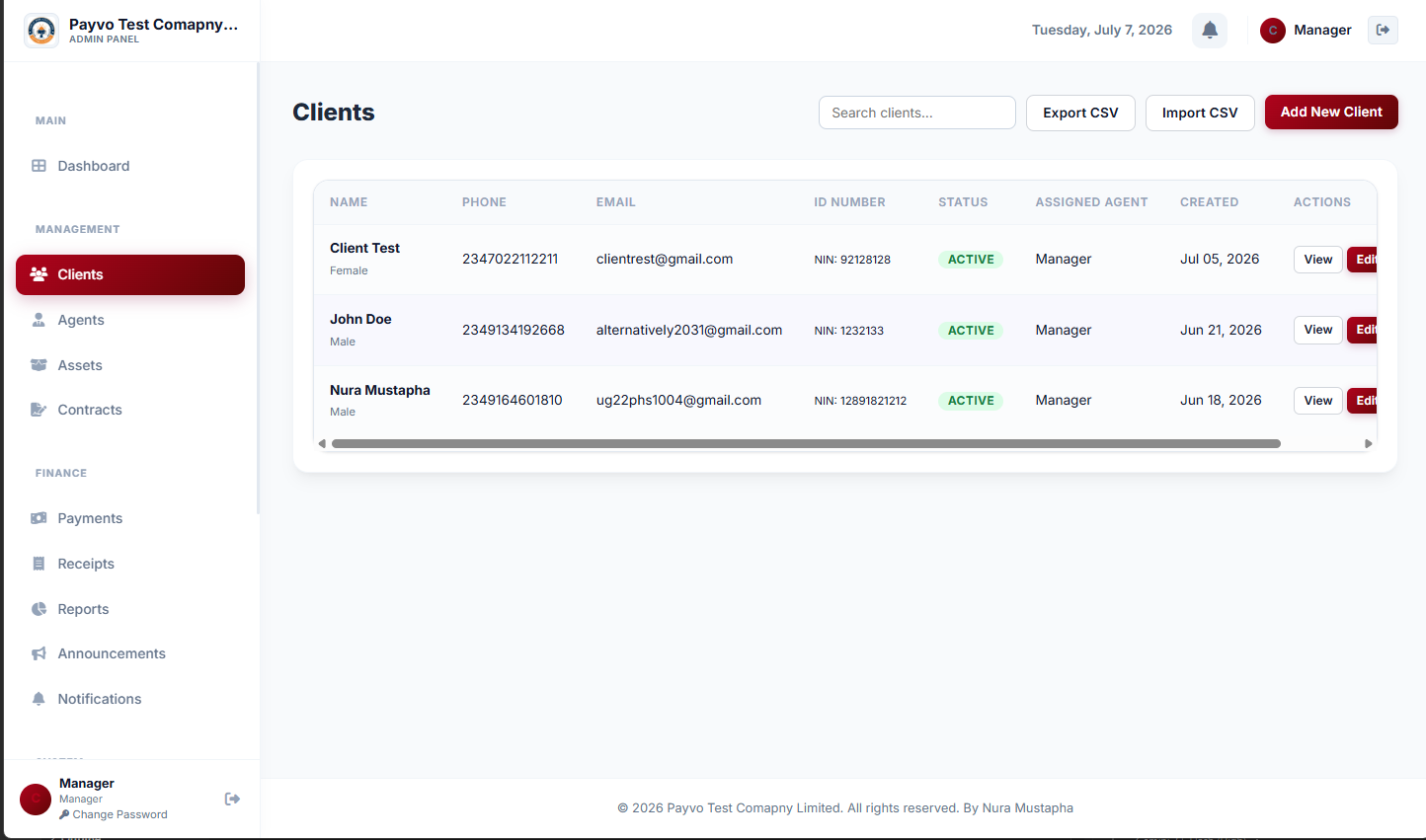 Dashboard showing a list of clients
A centralized view of your clients helps you manage your retail payment tracking more effectively.
Step 3: Schedule Payments with Precision
This is where the rubber meets the road. For every installment contract, you need a clear payment schedule: date due, amount due. This isn't just for you; it's for the customer too.
- Why it matters: A precise schedule makes it easy to see who needs to pay when. It helps you anticipate cash flow and follow up proactively. For cooperative society management software, knowing exact payment dates is critical for their operations.
- Common shortcut that backfires: "Just remember to pay next month." People forget. They get busy. Without a clear, documented schedule, you're setting yourself up for late payments and missed collections.
- Action item: For each contract, create a detailed payment schedule.
Step 4: Record Every Payment and Generate Receipts
Every single payment, no matter how small, must be recorded immediately and accurately. And for every payment received, issue a receipt. This is non-negotiable for retail installment sales.
- Why it matters: Receipts are proof of payment for the customer and a record for you. They prevent disputes and make your business look professional. This is also how you track your outstanding balances.
- Common shortcut that backfires: "I'll issue the receipt later" or "It's just cash, no need for a receipt." This is a recipe for fraud, error, and customer distrust. How do you prove payment if there's no receipt?
- Action item: Implement a system for immediate payment recording and receipt generation. This is where a specialized tool becomes incredibly useful. For instance, a system like Payvo allows you to record payments against specific contracts and automatically generate a professional digital receipt. It simplifies the process, ensures accuracy, and even helps with WhatsApp payment notification system setup.
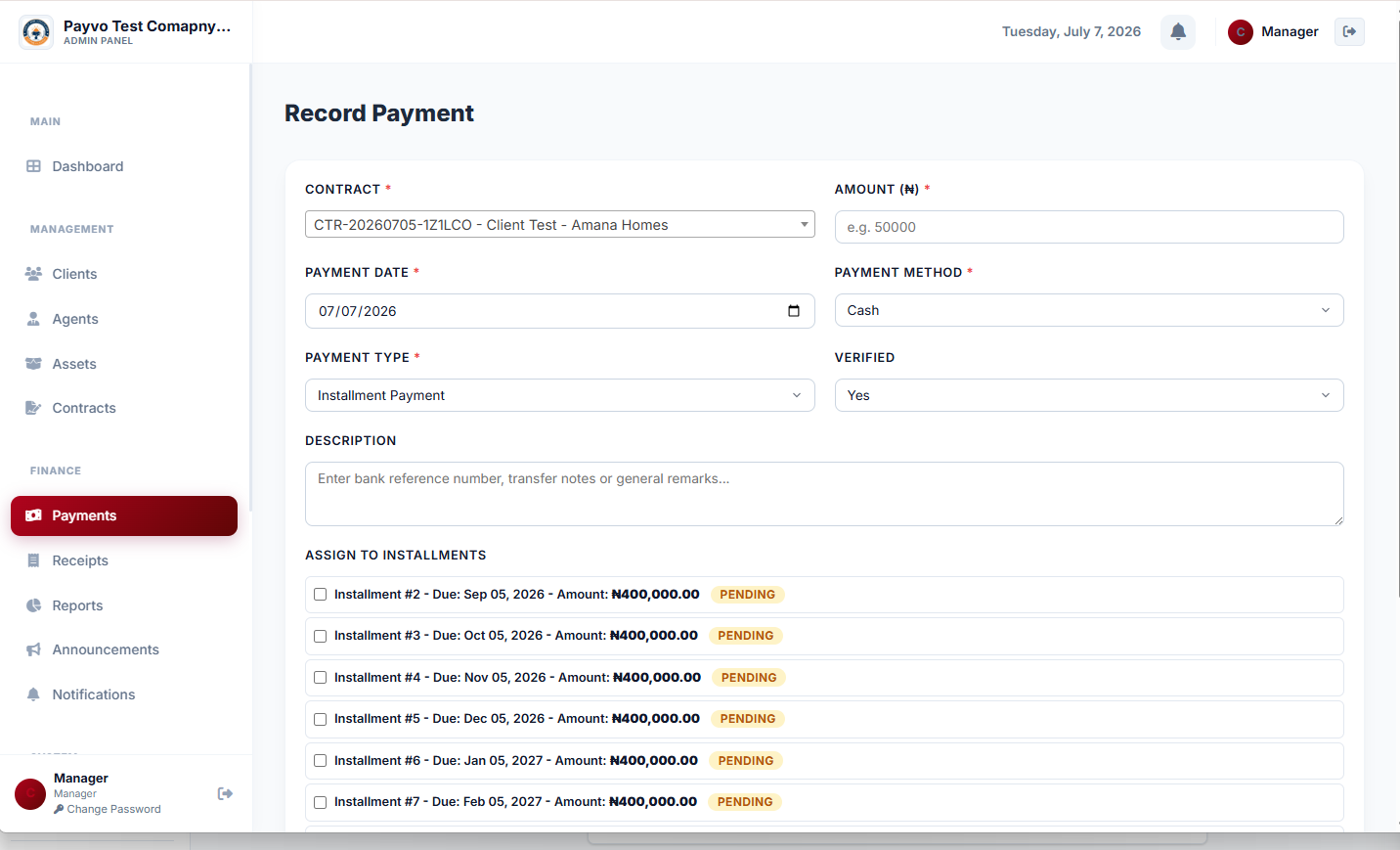 Dashboard showing how to record a payment
Recording payments quickly and accurately is key to managing installment sales.
Step 5: Proactive Follow-Up and Communication
Don't wait until a payment is weeks overdue. Your system should alert you to upcoming and slightly overdue payments. This allows for polite, proactive communication.
- Why it matters: Gentle reminders often work better than aggressive demands. It shows you're organized and gives customers a chance to rectify the situation before it escalates. Good communication also builds trust.
- Common shortcut that backfires: Only contacting customers when they're significantly overdue. By then, it's harder to recover the payment, and the relationship might be strained.
- Action item: Set up reminders for yourself or use a system that automatically sends payment reminders.
Step 6: Regularly Reconcile and Review
At least once a week, ideally daily, review your payment records against your bank statements or cash box. Check outstanding balances and identify any discrepancies.
- Why it matters: This catches errors early, prevents fraud, and gives you an accurate picture of your financial health. It’s how you truly know your monthly profit margins.
- Common shortcut that backfires: Only checking records at the end of the month or quarter. By then, errors are harder to trace and correct.
- Action item: Schedule dedicated time each week to reconcile your installment payment records.
The Numbers That Will Make or Break You
Let's get real about the costs of tracking installment sales in Nigeria in 2026. This isn't just about software; it's about the entire ecosystem.
Manual Tracking Costs:
- Basic Ledger Book/Notebook: ₦500 - ₦1,500. Seems cheap, right? But factor in the cost of your time, errors, and lost payments. That ₦1,000 book can easily cost you ₦50,000 in missed collections.
- Simple Spreadsheet Software (e.g., Microsoft Excel subscription): ₦5,000 - ₦10,000/month. Plus, you need a laptop (₦150,000 - ₦500,000) and the expertise to build and maintain the sheet. If you're paying someone ₦80,000 a month to manage complex spreadsheets for your real estate payment tracking Nigeria, that's already a significant cost.
- Smartphone for Mobile Tracking App: ₦40,000 - ₦150,000. Many modern business payment tracking apps run well on smartphones.
- Basic POS System (Hardware + Software): ₦150,000 - ₦400,000 (one-time). This is for a full retail setup, often including a printer.
- Small Printer (for receipts/records): ₦25,000 - ₦60,000. Essential for physical receipts.
- Training on Basic Accounting/POS Use: ₦15,000 - ₦50,000. You or your staff will need to know how to use the system.
- POS Software Subscription (Cloud-based, basic features): ₦8,000 - ₦25,000/month. This is for the software that does the actual tracking.
- Data Bundle for Cloud-based Apps/POS: ₦3,000 - ₦10,000/month. Crucial for any online system, including a WhatsApp payment notification system.
- Entry-level Staff Salary (to manage records): ₦40,000 - ₦70,000/month.
- Mid-level Staff Salary (experienced in record keeping/POS): ₦80,000 - ₦150,000/month.
<blockquote style="background-color: #f9f9f9; border-left: 5px solid #ccc; padding: 15px;">
"The biggest cost isn't what you spend on a system, it's the hidden losses from not having one."
</blockquote>
Growth After Launch: The Next 90 Days
So, you've got your system in place. What happens next? The first 90 days are critical for establishing momentum and proving the value of your new approach to how to track installment sales for retail businesses.
Day 1-30: Refine and Train.
Don't expect perfection immediately. There will be glitches. Your staff might resist the change. Focus on training. Ensure everyone understands how to use the new system, whether it's for recording a payment or generating a receipt. If you're using something like Payvo, take advantage of its intuitive interface for contract management software Nigeria. Run through scenarios: what if a customer makes a partial payment? What if they want to change their due date? Refine your internal processes based on real-world feedback.
Day 31-60: Proactive Engagement.
This is where you start seeing the real benefits. Use your system's features to proactively engage with customers. Send out those polite payment reminders a few days before the due date. Follow up on slightly overdue accounts. If your system has a WhatsApp payment notification system, use it! You'll notice a significant reduction in late payments and improved customer relationships. For a car dealer, this proactive approach can drastically improve their hire-purchase payment collection rates.
Day 61-90: Analyze and Optimize.
Now you have data. Look at your financial reports. Which products are selling best on installment? Which payment plans have the highest success rates? Are certain agents performing better at collections? A good installment management software Nigeria will give you these insights. Use this information to optimize your sales strategies, adjust your terms, and reward your best agents (using features like agent commission tracking software). This continuous improvement is what drives sustainable growth.
Remember, this isn't just about tracking; it's about making smarter business decisions. The data you collect from consistently tracking your installment sales is invaluable for scaling your business.
FAQ: Answers to What You're Actually Googling
You've got questions, I know. Here are some of the common ones I hear from business owners trying to figure out how to track installment payments:
Q1: Is a basic Excel sheet really not enough for my small shop?
A: For a handful of customers (say, under 10), maybe. But as soon as you hit 15-20 active installment contracts, Excel becomes a headache. You'll spend more time building and fixing formulas, cross-referencing data, and manually generating receipts than you would making sales. Plus, Excel is prone to human error and doesn't offer features like automated reminders or agent commission tracking software. It lacks the robust features of dedicated installment management software Nigeria.
Q2: What's the biggest mistake businesses make with installment sales?
A: The biggest mistake is not having a clear, consistent, and centralized system for tracking. This leads to forgotten payments, disputes with customers, and ultimately, lost revenue. Many businesses also fail to issue proper receipts or formal contracts, which leaves them vulnerable.
Q3: How can I track car dealer installment software or real estate payment tracking Nigeria effectively?
A: For high-value items like cars or real estate, precise tracking is non-negotiable. You need a system that can handle detailed contracts, long payment schedules, and potentially multiple agents. Dedicated installment management software Nigeria, like Payvo, is built for this. It allows you to link specific assets (cars, land plots) to customer contracts, track agent performance, and monitor outstanding balances with ease.
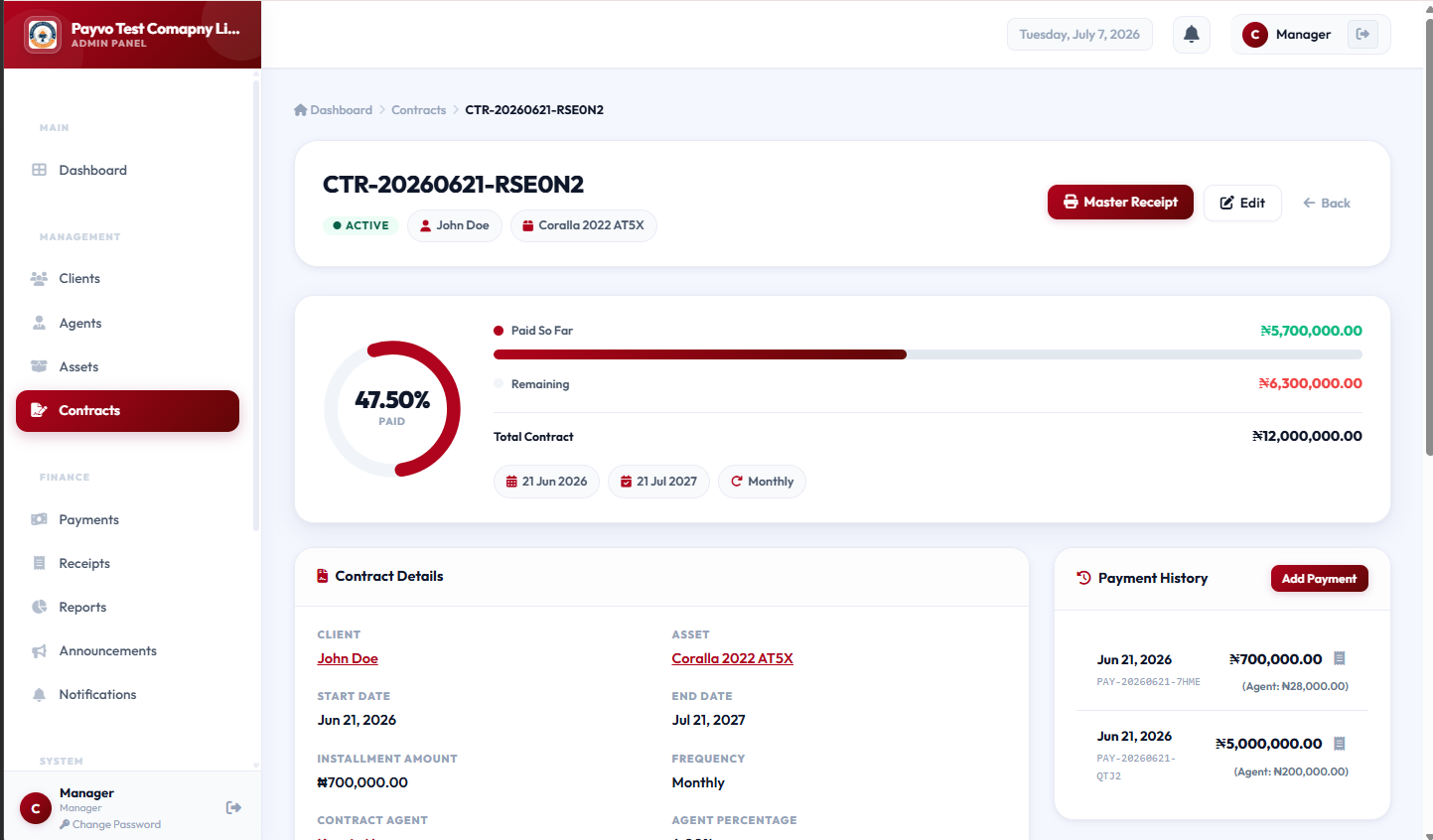 Dashboard showing contract details
A detailed view of your contract in an installment management system.
Q4: I use WhatsApp for everything. Can't I just track payments there?
A: WhatsApp is fantastic for communication, but it's terrible for structured financial record-keeping. Imagine trying to find a payment from six months ago across hundreds of chats. It's impossible. While a good system can integrate with WhatsApp for notifications, your core payment tracking should never live solely within chat apps. You need a dedicated receipt generator app Nigeria that provides verifiable records.
Q5: What kind of staff do I need to manage installment sales tracking?
A: For smaller businesses, you, the owner, can manage it with the right tools. As you grow, an existing sales assistant can be trained. If your installment volume is very high (say, over 100 active contracts), you might consider a dedicated administrative staff member. The key is that the right business payment tracking app Nigeria significantly reduces the workload, meaning you might not need a specialized accountant just for this.
Q6: What are the benefits of using a dedicated installment management software over manual methods?
A: Beyond accuracy and saving time, dedicated software offers transparency, reduces disputes, provides real-time insights into your sales and collections, automates reminders, and often includes features for agent tracking. It gives you control and visibility, which are invaluable for growth. It's about moving from reacting to problems to proactively managing your business.
Ready? Here's Where to Start
If you've been struggling with scattered records, missed payments, or endless calculations, it's time to make a change. You've seen the hidden costs of managing your installment sales manually for your retail business. The path to better organization and more profit starts with a commitment to a proper system.
Don't let another day go by losing money to inefficient tracking. Take the first step towards better installment retail management. You can explore how a system designed specifically for managing contracts and payments can transform your business by visiting the Payvo website today. Or, if you're ready to dive in, you can register into Payvo here and start organizing your installment sales the right way.