Did you know that 63% of Nigerian small businesses offering installment plans struggle with tracking payments accurately? That's a huge number, and if you're selling furniture on credit, it probably hits close to home. You know the headache of trying to keep tabs on who paid what, when, and how much they still owe. It's a major reason why many furniture stores, despite the clear demand, shy away from installment sales or end up losing money because their tracking methods are just too messy. If you're looking for how to track furniture sales on installment plans, you're not alone.
 A busy furniture showroom in lagos with customers
The Reality Check: What Nobody Tells You About Furniture Installment Sales
Everyone talks about the boom in furniture demand, especially with more people building homes or upgrading their spaces in cities like Abuja and Port Harcourt. What they don't tell you is the administrative nightmare that comes with offering installment payment options. You see a customer admiring that beautiful 7-seater sofa set for ₦450,000, and you know they can't pay cash upfront. So, you offer them a payment plan. Great for sales, right?
Here's the thing though – does that actually work smoothly? Most guides will tell you to use an Excel sheet or a notebook. That's the wrong way to think about it for long-term growth. Imagine you've got 50 customers, each paying for a different item – maybe a dining set for ₦280,000, a bed frame for ₦175,000, or a set of office chairs for ₦120,000 – all on varying weekly or monthly schedules. How do you keep track of all that without losing your mind, or worse, losing money?
The truth is, manual tracking is a time sink and a magnet for errors. I remember a furniture dealer in Ibadan whose entire record-keeping system was a stack of exercise books. He lost a customer because he swore they owed him ₦30,000, but the customer had a receipt for the payment. Turns out, his assistant forgot to update the ledger. That ₦30,000 wasn't just lost; it cost him a loyal customer. That's the real cost of poor tracking. You need something more robust, something that understands the specifics of furniture installment sales.
What You Actually Need to Get Started
Before you even think about setting up an installment plan, you need to understand the foundational elements. This isn't just about having nice furniture; it's about having a solid business structure.
Non-Negotiables:
- Initial Capital for Stock: You can't sell what you don't have. For a small workshop or roadside vendor, you're looking at ₦300,000 to ₦800,000 for basic items like plastic chairs or simple wooden pieces. If you're aiming for a modest showroom with a wider range of locally made and some imported furniture, you'll need between ₦1,500,000 and ₦5,000,000 for initial stock. This is your lifeblood.
- A Physical Space: Even if it's a small shop in a local market, you need somewhere to display your goods. Rent can range from ₦80,000 to ₦300,000 per year in a small town. In a major city suburb, expect ₦500,000 to ₦2,500,000 per year. For prime spots in Lagos Island or Abuja commercial districts, you could be looking at ₦3,000,000 to ₦10,000,000 annually. Don't forget, rent is almost always paid annually here, so budget for that lump sum.
- Clear Installment Policies: What's the minimum down payment? How long can they pay? What happens if they miss a payment? You need these rules ironed out and written down. Typically, businesses add an interest rate of 10% to 25% per annum on installment plans to cover the cost of capital and risk. Don't just pull numbers out of thin air; calculate what makes sense for your business.
- A Reliable Record-Keeping System: This is where most people fail. You can't manage furniture payment tracking with just your memory. You need a system to record customer details, contract terms, payment schedules, and actual payments. This is key for any business, whether you're a car dealer installment software user or managing cooperative society management software.
Nice-to-Haves (but quickly become necessities as you grow):
- Sales Staff: If you're serious about sales, you'll need help. An entry-level sales assistant might cost you ₦40,000 to ₦70,000 per month. An experienced salesperson, especially one on commission, could be ₦80,000 to ₦150,000 a month. They drive sales, but they also need to understand your installment process.
- Delivery Logistics: Furniture isn't small. A reliable delivery system is crucial. A used, fair-condition delivery van could set you back ₦1,500,000 to ₦4,000,000. A new, basic model? ₦6,000,000 to ₦12,000,000. Alternatively, partner with a trusted logistics company.
- Digital Tools: While I'll talk more about this later, a basic accounting software subscription (₦5,000 to ₦15,000 per month) or a custom software development for a simple installment tracker (₦150,000 to ₦500,000 one-time) can save you from a lot of future headaches. This is where you start thinking about dedicated installment retail software.
The Complete Step-by-Step Breakdown
Alright, let's break down how you can effectively track your furniture sales on installment plans. This isn't just theory; it's what I've seen work for businesses on the ground.
Step 1: Define Your Installment Policy Clearly
Before you sell a single piece of furniture on credit, you need a crystal-clear policy. This protects both you and your customer. What's the minimum down payment? Is it 20%? 30%? For a ₦250,000 sofa, that's ₦50,000 to ₦75,000 upfront. How long can they pay? 3 months? 6 months? 12 months? Longer payment periods mean more risk for you, so account for that.
And what about interest? Most businesses add 10% to 25% per annum. If a customer buys a ₦300,000 dining set over 6 months with a 15% annual interest, the total payable is not just ₦300,000. It's closer to ₦322,500, meaning monthly payments of approximately ₦53,750 after the down payment. Make sure these figures are transparent and agreed upon upfront. You don't want surprises later.
Step 2: Create a Detailed Contract for Each Sale
Every single installment sale needs a written contract. This isn't just a receipt. It's a legally binding document. It should include the full names and contact details of both parties, the specific furniture item (model, color, dimensions), the total cash price, the down payment amount, the installment amount, the payment frequency (weekly, bi-weekly, monthly), the number of installments, the total amount payable (including interest), and the consequences of late or missed payments.
I once worked with a client who just used a generic sales receipt for installment sales. When a customer defaulted on a ₦800,000 bedroom set, he had no strong legal ground to stand on because the terms were vague. Don't make that mistake. A clear contract saves you stress and potential losses. This is where contract management software Nigeria can be a lifesaver.
Step 3: Implement a Centralized Tracking System
This is where the rubber meets the road. You absolutely cannot rely on scattered notebooks, WhatsApp chats, or even complex Excel sheets when your business starts growing. You need a dedicated system to track furniture payment tracking.
Think about it: a customer calls asking for their outstanding balance on a ₦187,500 wardrobe they bought in March 2026. Do you want to spend 20 minutes digging through ledgers or scrolling through WhatsApp messages? No. You need a system that gives you that information instantly.
This is where a tool like Payvo comes in. It's designed specifically for businesses that manage installment sales. You can register your customers, add the furniture items as assets, create installment contracts with detailed payment schedules, and then easily record every single payment. It centralizes all your records, so you know exactly how much has been paid, how much is outstanding, and when the next payment is due. This is crucial for real estate payment tracking Nigeria, car dealer installment software users, and definitely for your furniture business.
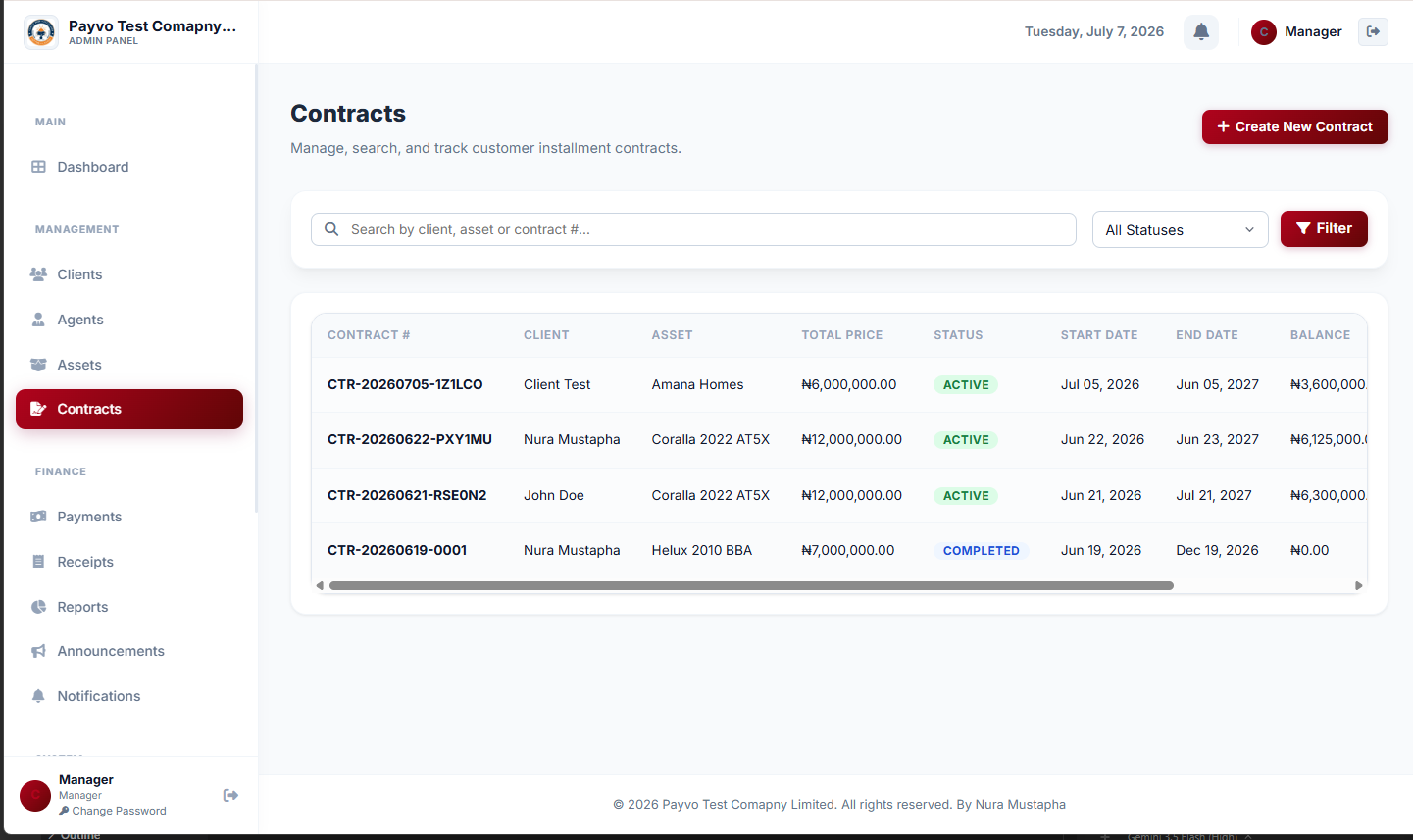 Payvo dashboard showing a list of active contracts
Payvo's contracts list page helps you see all active installment agreements at a glance.
Step 4: Record Every Payment Immediately and Accurately
When a customer makes a payment, record it. Immediately. Whether it's cash, a bank transfer, or a POS transaction, log it into your system. Generate a receipt. This isn't just good practice; it's essential for avoiding disputes and maintaining trust. A customer who receives a prompt receipt for every payment feels confident in your business.
A good receipt generator app Nigeria can make this simple. With Payvo, for instance, once you record a payment, you can generate a digital receipt instantly. This helps you track payments and provides your customer with proof of payment, eliminating any future arguments about whether they paid or not. It also helps with agent commission tracking software if you have sales agents.
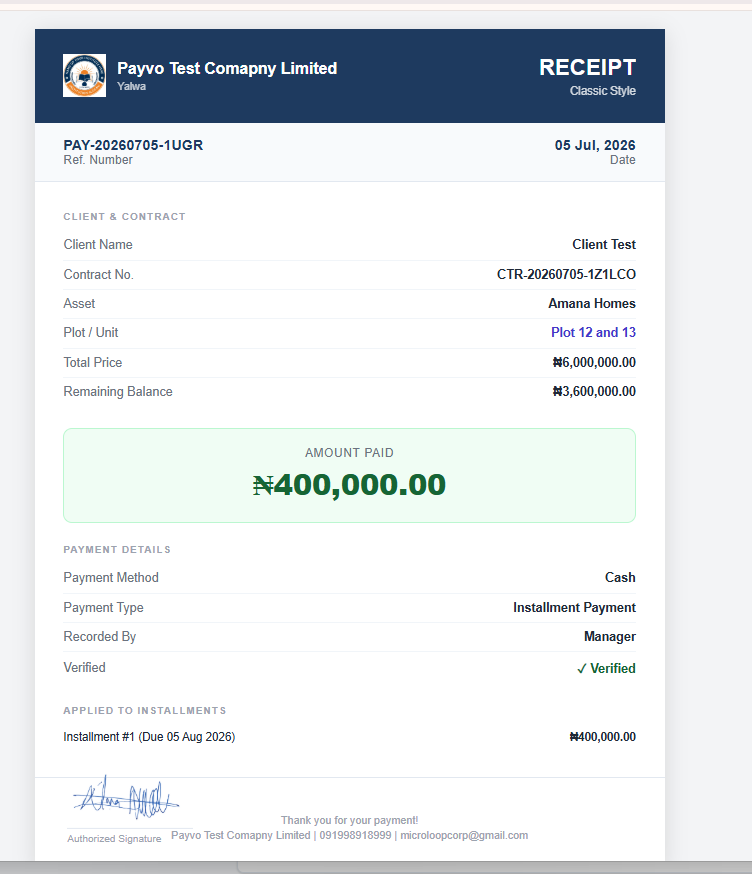 Payvo screenshot showing a sample payment receipt
A sample payment receipt generated by Payvo, ensuring clear records for both you and your customer.
Step 5: Follow Up on Overdue Payments Systematically
Late payments are a reality in installment sales. How you handle them can make or break your cash flow. You need a systematic approach, not just a frantic phone call when you remember. Your tracking system should alert you to overdue payments.
Start with a polite reminder via SMS or WhatsApp a day or two before the payment is due. If it's missed, follow up gently on the due date. If it’s still outstanding after a few days, escalate with a phone call. Your contract should outline the penalties for late payments, and you need to enforce them consistently. This consistent follow-up is why a WhatsApp payment notification system integrated into your business payment tracking app Nigeria is so valuable.
> "In installment sales, the money isn't yours until it's in your account. Treat every due date like a critical business meeting."
Step 6: Regularly Reconcile Your Records
Even with the best system, you need to regularly reconcile your payment records with your bank statements and cash inflows. This means checking that every payment recorded in your system actually reflects the money received in your accounts. This helps catch discrepancies early, whether it's a data entry error or a missing payment.
This reconciliation is a critical step for any business, from a large real estate developer in Kano to a furniture retailer in Aba. It ensures your books are accurate and gives you a true picture of your financial health.
5 Mistakes That Cost Nigerian Business Owners the Most
I’ve seen businesses make these blunders repeatedly. Don't be one of them.
- Relying Solely on Memory or Paper Ledgers: This is the biggest killer. You start with 5 installment customers, and it's manageable. But when you hit 20, 50, or 100, your memory fails, and paper ledgers become a chaotic mess. Errors multiply, customers get frustrated, and you lose money. A furniture retailer in Onitsha Main Market once told me he lost nearly ₦150,000 in a year just from misplacing payment records.
- Vague Installment Contracts: If your contract doesn't clearly state the total price, payment schedule, interest, and penalties for default, you're setting yourself up for disputes. Customers will argue, and without clear terms, you have no leverage. This is a common issue for many businesses, including those using cooperative society management software.
- Inconsistent Follow-up on Payments: You can't be strict with one customer and lenient with another. Inconsistency breeds disrespect for your terms. If you don't chase payments systematically, customers will learn they can delay, impacting your cash flow.
- Ignoring the Cost of Capital and Risk: Offering installment plans isn't free money. You're tying up your capital, and there's a risk of default. If you don't factor in a reasonable interest rate (like the 10-25% typical for customers) or a higher markup on installment items, you're essentially losing money on every credit sale. You must account for inflation and the current economic realities in Nigeria in 2026.
- Not Having a Centralized System: This ties back to mistake number one. When customer details are in one place, payment history in another, and contract terms in yet another, you're creating a fragmented, inefficient operation. This is why many businesses, from solar/equipment leasing companies to building material suppliers selling on credit, are looking for better business payment tracking app Nigeria solutions.
How to Know If You're on Track (Success Metrics)
So, you've set up your installment system. How do you know it's actually working? You need to track key performance indicators (KPIs). This isn't just about how many sofas you sell; it's about how well you manage those sales.
- Collection Rate: What percentage of your scheduled payments are you actually collecting on time? If you're consistently below 80-90%, you have a problem. This could mean your follow-up is weak, or your customers are over-committing.
- Default Rate: How many customers completely stop paying and essentially default on their contract? A high default rate (say, above 5-10% for furniture) is a huge red flag. It indicates issues with your vetting process or your recovery efforts.
- Average Payment Lag: On average, how many days late are your installment payments? If it's consistently more than 3-5 days, it affects your cash flow planning.
- Customer Lifetime Value (CLTV): Are your installment customers coming back for more, or referring others? A good installment experience can build incredible loyalty.
- Administrative Time Spent: How much time are you and your staff spending each week chasing payments or reconciling records? If it's hours and hours, your system isn't efficient enough. A good installment management software Nigeria should significantly reduce this.
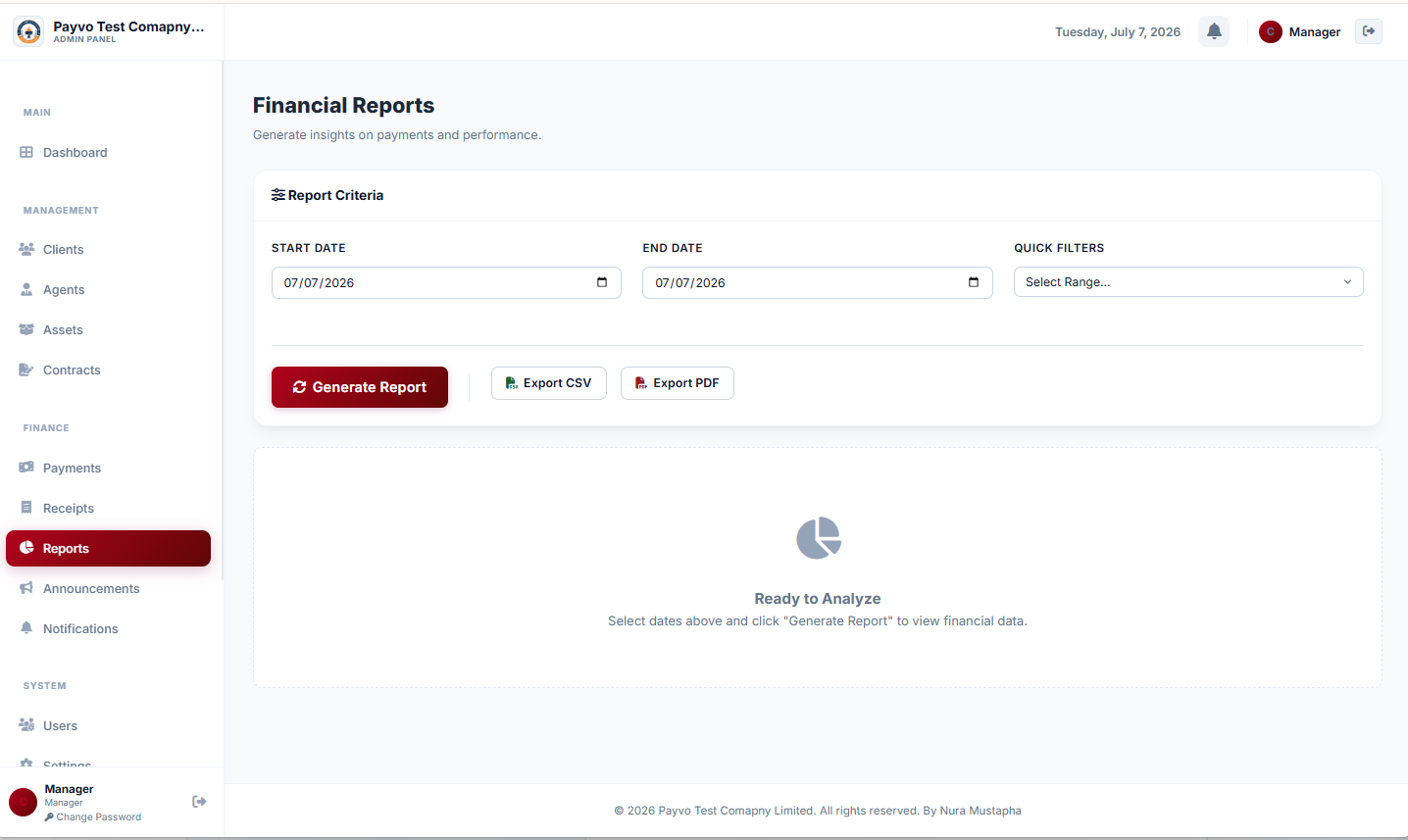 Payvo dashboard showing financial reports
Payvo's financial reports page provides a clear overview of your business's payment activity.
Real Questions People Ask (FAQ)
You've got questions, I've heard them all. Let's tackle some common ones about how to track furniture sales on installment plans.
How do I legally protect my business when selling furniture on installment?
You protect your business by having a comprehensive, signed contract for every sale. This contract must clearly outline the product, total price, payment schedule, interest, down payment, and explicit terms for late payments or default. Ensure the customer understands and agrees to all terms before signing. Consider consulting a lawyer to draft a standard contract template specific to installment retail software.
What if a customer stops paying for their furniture? Can I repossess it?
This depends entirely on your contract terms and local laws. Your contract should clearly state what happens in case of default, including the right to repossess the item. However, repossession can be a tricky and potentially costly process. Always try to negotiate a revised payment plan first. If repossession is necessary, follow legal guidelines strictly to avoid further complications. This is a critical aspect of furniture installment sales.
Is it better to offer weekly or monthly installment plans for furniture?
Both have pros and cons. Weekly payments mean smaller, more frequent collections, which can sometimes be easier for customers with daily or weekly earnings, like market traders. However, it also means more administrative work for you. Monthly payments are larger but less frequent, simplifying tracking but potentially increasing the risk of a larger missed payment. For average furniture item prices (₦25,000 - ₦500,000), monthly plans are often preferred by customers, but consider your target market's income cycle.
How can I make sure my sales agents are tracking payments correctly?
This is where agent commission tracking software and clear processes are vital. First, train your agents thoroughly on your installment policies and the importance of accurate record-keeping. Second, give them access to a system like Payvo that allows them to record payments directly and track their assigned customers. With Payvo's agent management features, you can set permissions, track their sales, and ensure they are following the correct payment recording procedures, reducing errors and ensuring proper furniture payment tracking.
What kind of fees should I charge for installment plans?
Beyond the product price, you should include an interest rate, typically between 10% and 25% per annum, to cover your cost of capital, administrative overhead, and the risk of default. Some businesses also charge a small processing fee upfront. Be transparent about all fees in your contract. This ensures your furniture installment sales are profitable.
Your Next Move
Listen, managing installment sales for your furniture business doesn't have to be a nightmare. You’ve got a clear path now, from setting up your policies to tracking every single kobo. The biggest difference maker? Moving away from manual, error-prone methods to a streamlined system.
If you’re ready to stop stressing over scattered records and start confidently growing your furniture sales on installment plans, then it’s time to check out Payvo. It’s built for Nigerian businesses just like yours, whether you’re selling furniture, managing real estate payment tracking Nigeria, or dealing with car dealer installment software needs.
Don't let poor tracking cost you another customer or another naira. Take control of your installment sales today. Visit Payvo's public home page to learn more about how it can transform your business, or simply register into Payvo and start organizing your sales right away.