₦500,000. That's often the minimum initial car deposit you're looking at for a decent used sedan in a place like Lagos or Abuja today, in 2026. For a new, entry-level ride, you might be dropping ₦2 million or more just to get your foot in the door. If you're a car dealer, a cooperative, or even just a small business helping people acquire assets, then knowing exactly how to track car deposits & monthly payments is not just important, it's the bedrock of your business. Without a solid system, those initial deposits, subsequent installments, and outstanding balances will quickly become a nightmare.
 Car dealer showing car keys to a customer
Why Most People Get This Wrong from Day One
Look, I spent twelve years running my own retail shops before I started consulting. I've seen it all. From the small provision store in Surulere trying to track credit sales with a worn-out exercise book to the electronics dealer in Alaba International Market juggling dozens of WhatsApp chats for installment plans. The biggest mistake you can make when selling anything on installment, especially something as high-value as a car, is thinking your memory or a simple spreadsheet is enough. It isn't.
Most people underestimate the sheer volume of data, the human error factor, and the administrative burden that comes with managing vehicle payment records. You might start with five customers, and it feels manageable. But what happens when you have fifty? Or a hundred? Suddenly, you're spending more time chasing payments and reconciling discrepancies than you are making new sales.
I remember this one time, a client of mine, a car dealer in Kano, was absolutely certain a customer owed him ₦187,500. The customer swore they'd paid it. He had a bank transfer receipt. My client had a gap in his spreadsheet. It took two days of digging through bank statements, WhatsApp messages, and old paper receipts just to confirm the payment. Two days wasted, and a customer who felt wrongly accused. That's the real cost of a poor system.
You see, the initial car deposit might be clear – ₦750,000, let's say. But then comes the monthly payment of ₦120,000 for 36 months, an informal dealer loan at 5% interest per month. You also have to factor in the one-time vehicle registration and licensing fee of maybe ₦75,000, the annual comprehensive insurance of ₦250,000, and a tracker installation fee of ₦60,000. How do you keep all these moving parts straight for every single customer? How do you ensure you're tracking agent commissions accurately when they bring in a sale? Most small businesses simply don't have a robust system for this, and it bites them hard.
Before You Do Anything: The Foundation Work
Before you even think about handing over keys or signing contracts, you need a solid foundation. This isn't just about tracking money; it's about protecting your business and building trust with your customers.
- Define Your Installment Terms Clearly: This sounds basic, but you'd be surprised. What's the minimum initial car deposit? For a used car, it could be anywhere from ₦500,000 in a smaller town to ₦1,500,000 in a premium Lagos dealership. For a new entry-level sedan, you're looking at ₦2,000,000 to ₦5,000,000. What's the exact monthly payment? Is there an interest rate? If you're a cooperative, maybe it's 3-8% per month. A bank loan might be 20-35% per annum. Be explicit about the total price, the deposit, the number of installments, the amount of each installment, and the due dates. No ambiguity.
- Legal Documentation is King: You need a proper hire-purchase agreement or sales contract. This document outlines everything: the vehicle details, the full purchase price, the payment schedule, default clauses, and ownership transfer. Get a lawyer to draft this for you. It's an investment, not an expense. This is your primary defense if things go south.
- Customer Vetting: Don't just sell to anyone with a deposit. Can they truly afford the monthly payments? A used sedan might have monthly payments of ₦80,000 to ₦250,000. A new one, ₦200,000 to ₦600,000. Do you have their valid ID, proof of address, and a guarantor? This isn't just for banks; it's for any business extending credit. A small cooperative society in Aba knows this well—they often require multiple guarantors and community endorsements.
- Understand Your Costs Beyond the Car: People often forget this. There's the vehicle registration and licensing (₦50,000 - ₦150,000), comprehensive insurance (₦150,000 - ₦500,000 annually), and a tracker (₦40,000 - ₦100,000 one-time, plus ₦3,000 - ₦10,000 monthly subscription). These aren't your customer's burden alone; sometimes they're rolled into the financing or managed by you initially. You need to account for them.
- Set Up a Dedicated Bank Account: Separate your installment payments from your regular sales. This makes reconciliation much easier and gives you a clear picture of your cash flow for hire purchases.
The Step-by-Step Path (What Actually Works)
Once your foundation is solid, you need a process. This is where most businesses either thrive or drown.
Step 1: Record Every Detail of the Agreement
When a customer commits, you need to capture everything. What car are they buying? What's the VIN? The agreed price? The down payment received? For a used car, say a Toyota Corolla, the agreed price might be ₦4,500,000. The customer pays an initial car deposit of ₦1,000,000. The remaining ₦3,500,000 is to be paid over 30 months at ₦116,667 per month. You need a place to log this. Don't rely on a handwritten note or a quick WhatsApp chat. That’s a recipe for disaster.
Common Shortcut That Backfires: Just writing the total amount and monthly payment on a piece of paper. This ignores the agreed terms, the breakdown of principal and interest, and any other fees. When there's a dispute, you have no detailed reference.
Action Item: Create a detailed contract for each sale, outlining all financial terms.
Step 2: Structure the Payment Schedule
This is where you break down the total outstanding amount into manageable, dated installments. If the customer is paying ₦116,667 monthly, you need to know when each of those 30 payments is due. Is it the 1st of every month? The 15th? Having a clear car installment payment schedule is non-negotiable.
Common Shortcut That Backfires: Expecting the customer to just "remember" when to pay or using a generic monthly reminder. People are busy. Life happens. Without specific due dates, payments will be late, and collections will become a headache.
Action Item: Generate a clear, dated payment schedule for the entire duration of the installment plan.
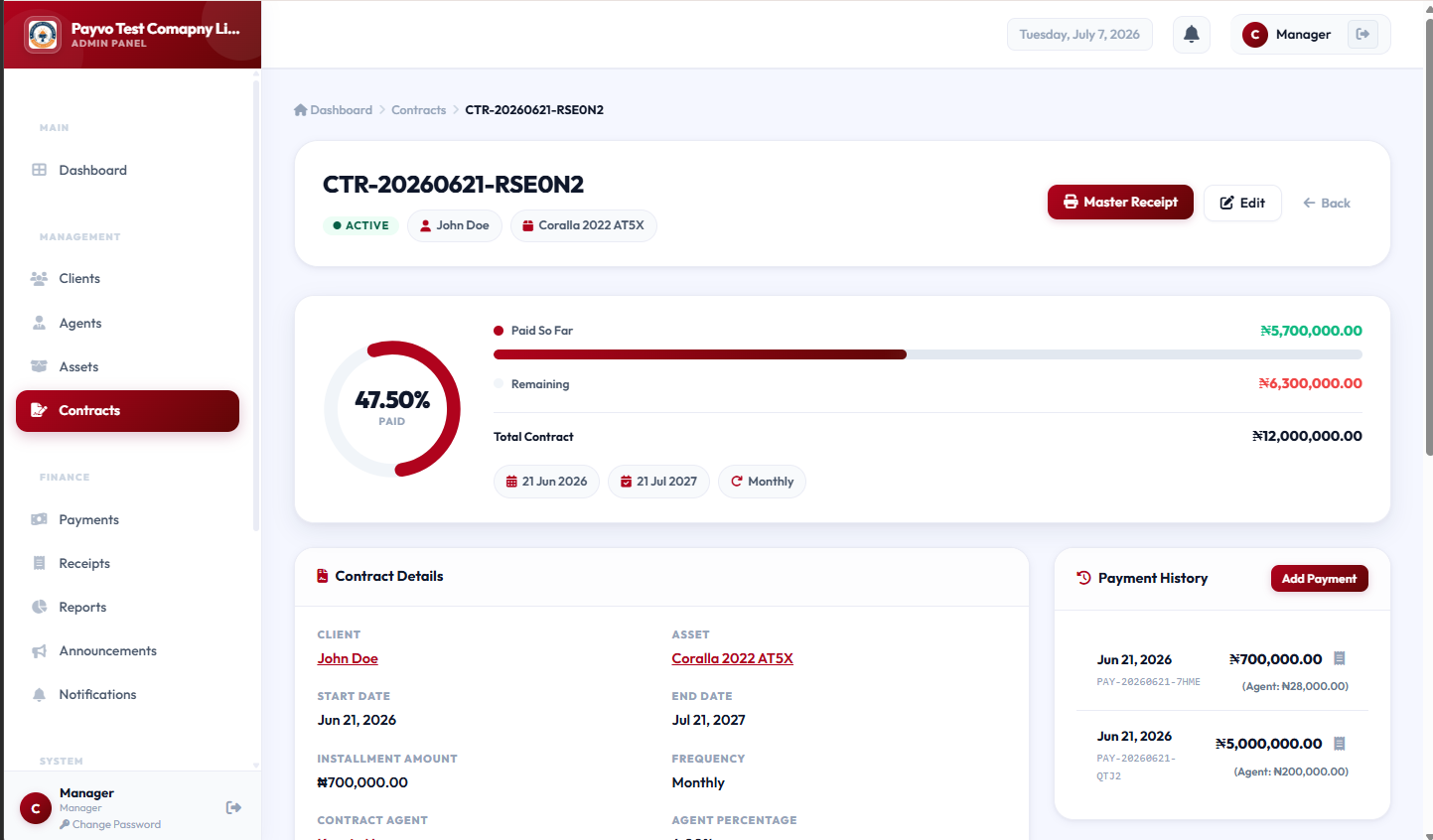 Contract details page showing payment schedule
Step 3: Log Every Payment Received
When a customer makes a payment, you need to record it immediately and accurately. This includes the amount, the date, the payment method (bank transfer, cash, POS), and who received it. This is your primary defense against "I've paid already" claims. Issue a receipt for every single transaction. A digital receipt generator app Nigeria can be a lifesaver here.
Common Shortcut That Backfires: Waiting to record payments at the end of the week or month. Cash can get misplaced. Bank transfers can be misallocated. Delays lead to errors, which lead to lost money and frustrated customers.
Action Item: Implement a system for immediate payment logging and receipt generation.
Step 4: Track Outstanding Balances and Due Dates
Now, this is the core of it all. For every customer, you need to know: how much have they paid so far? How much is still outstanding? When is their next payment due? Are they overdue? This is where a dedicated installment management software Nigeria comes into its own. Trying to do this with manual calculations or complex spreadsheets for dozens of clients is asking for trouble. You need to see at a glance if a customer in Kaduna is behind on their payment for that Hilux, or if the guy in Abuja is consistently on time for his Lexus. This is where a business payment tracking app Nigeria becomes indispensable.
Common Shortcut That Backfires: Relying on mental math or a basic Excel sheet that isn't updated regularly. You'll lose track, miscalculate, and then you're chasing payments you've already received, or worse, missing payments you should be collecting.
Action Item: Use a system that automatically calculates and displays outstanding balances and flags overdue payments. This is precisely what Payvo is built for. You can see all your contracts, their status, and payment histories in one centralized location. It’s a game-changer for car dealer installment software.
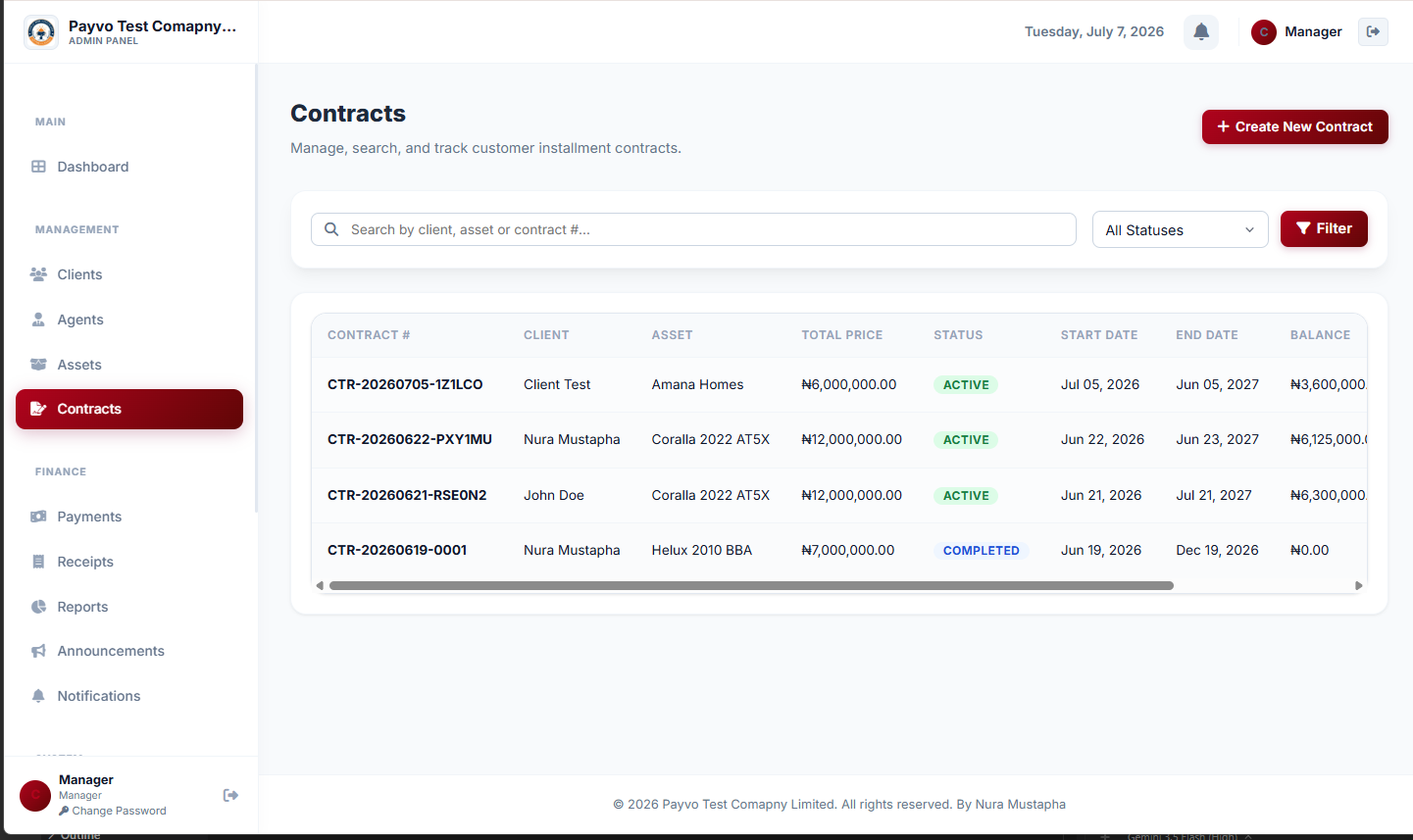 Contracts list page showing contract status
Step 5: Manage Agent Commissions (If Applicable)
If you have agents bringing in sales, you need a clear system for agent commission tracking software. How much do they get for an initial car deposit? What percentage of each monthly payment? When is it paid out? This needs to be tied directly to the customer's payment records.
Common Shortcut That Backfires: Ad-hoc commission calculations. This leads to disputes with agents, demotivation, and potentially overpaying or underpaying.
Action Item: Integrate agent commission tracking directly into your payment management system. Payvo offers agent tracking features to help you manage this effectively.
Step 6: Communicate Proactively
Don't wait for payments to be overdue to communicate. Send reminders a few days before a payment is due. Confirm payments received. A simple WhatsApp payment notification system can go a long way. This builds trust and reduces late payments.
Common Shortcut That Backfires: Only contacting customers when they're late. This makes you seem like a debt collector, not a business partner.
Action Item: Set up automated or semi-automated payment reminders and confirmations.
The Numbers That Will Make or Break You
Understanding the financial realities of selling cars on installment is crucial. It’s not just about the sale price; it’s about the ongoing costs and the profit margins.
Initial Investment (Your Cash Outlay):
- Cost of Vehicle: This varies wildly. A used sedan might cost you, the dealer, ₦3,000,000 to ₦6,000,000. A new entry-level sedan, ₦7,000,000 to ₦15,000,000.
- Refurbishment/Pre-delivery Inspection: For a used car, budget ₦100,000 - ₦500,000 to get it client-ready.
- Initial Car Deposit (Customer pays you): As mentioned, ₦500,000 - ₦1,500,000 for used, ₦2,000,000 - ₦5,000,000 for new. This is your immediate cash inflow.
- Cost of Funds: If you're using your own capital or a loan to buy the car, factor in the interest. If you're a cooperative society management software user, you know your monthly interest rates (3-8% per month is common in informal markets).
- Insurance: If you're covering the comprehensive insurance initially, that's ₦150,000 - ₦500,000 annually.
- Tracker Subscription: ₦3,000 - ₦10,000 per month or ₦30,000 - ₦80,000 per year.
- Fuel Costs (for recovery/inspection if needed): Monthly, average use can be ₦80,000 - ₦200,000 for a small car to an SUV.
- Routine Maintenance (if included/expected): Quarterly/Bi-annually, ₦30,000 - ₦150,000.
- Administrative Costs: This is often overlooked. The time spent tracking payments, sending reminders, reconciling accounts. This is where efficient contract management software Nigeria saves you significant money.
Your profit isn't just the difference between your cost and the selling price. It's also the interest you charge on the installment plan. However, this profit is spread out over 2-5 years. You need to ensure your monthly payments cover your cost of funds and operational expenses, with enough left over for profit. Many businesses fail because their cash flow is tied up in long-term installment plans, and they don't have enough working capital for new inventory.
> "The true cost of a bad tracking system isn't just lost payments; it's the lost opportunities, the damaged customer relationships, and the constant stress of not knowing where your money is."
Growth After Launch: The Next 90 Days
You've got your first few installment customers. Now what? The next 90 days are critical for establishing momentum and refining your process.
- Review Your Payment Performance: After a month or two, look at your payment records. Are most customers paying on time? Are there specific days of the month when payments are more likely to come in? Are certain agents performing better in terms of timely collections? This data is gold.
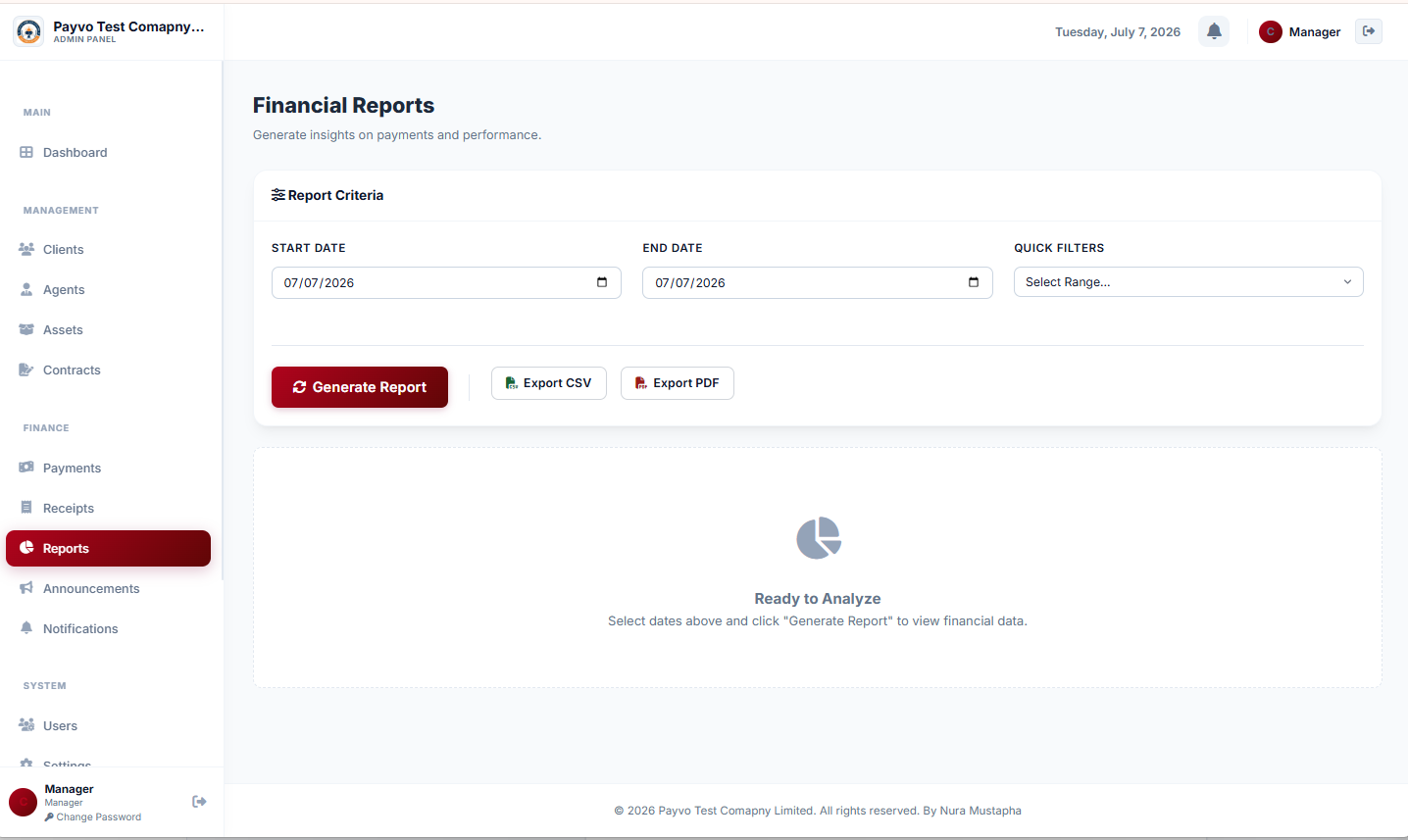 Financial Reports page
- Optimize Communication: If you’re getting a lot of late payments, maybe your reminders aren't effective. Try different timings or messages. If you're using a WhatsApp payment notification system, analyze the engagement. Payvo's optional notification features can help automate this, freeing up your time.
- Refine Your Vetting Process: If you're seeing a high rate of defaults, you need to tighten your initial customer vetting. Are you asking enough questions? Are your guarantors strong enough?
- Agent Feedback Loop: Talk to your agents. What challenges are they facing with collections? What information do they need to close deals and ensure timely payments? Your agent commission tracking software should provide clear data to support these discussions.
- Scale Smart: As you grow, you'll feel the pressure. Don't revert to manual methods. If you have 20 customers now, you might manage with Excel. But when you hit 50, 100, or more, you'll need a dedicated business payment tracking app Nigeria. This is when tools designed for hire purchases, like Payvo, become essential for managing your vehicle payment records efficiently.
FAQ: Answers to What You're Actually Googling
How do I accurately track car deposit & monthly payments for multiple customers?
The most accurate way is to use a dedicated installment management software Nigeria. Manual methods like notebooks or spreadsheets become prone to errors and consume too much time as your customer base grows. A good system will link the customer, the vehicle, the contract, the payment schedule, and all payments received, giving you a real-time outstanding balance.
What's the best way to generate payment receipts for car installment sales?
A digital receipt generator app Nigeria or a feature within your contract management software Nigeria is ideal. It ensures consistency, professional appearance, and provides a clear record for both you and your customer. It also reduces the chances of disputes.
Can I track agent commissions for car sales on installment?
Yes, absolutely. If your system is robust enough, it should allow for agent commission tracking software features. This means associating each sale and subsequent payment with the agent responsible, and then calculating their commission based on the agreed terms. This ensures fair compensation and motivates your sales team.
How do cooperative societies manage vehicle installment payments effectively?
Cooperative societies often deal with many members and various types of loans or asset acquisitions. They need specialized cooperative society management software that can handle member records, different types of agreements (like vehicle hire purchase), payment schedules, and financial reporting. Transparency and accurate record-keeping are paramount for cooperatives.
What are the key details to include in a car installment contract?
Your contract should include the full names and addresses of both parties, detailed vehicle description (make, model, VIN, plate number), total agreed purchase price, initial car deposit amount, the remaining balance, the monthly payment amount, the number of installments, specific due dates, any interest rates, late payment penalties, and terms for repossession or default. Legal counsel is advised for drafting this.
Ready? Here's Where to Start
Managing car deposits and monthly payments doesn't have to be a headache that eats into your profits and time. You've seen the pitfalls of manual tracking and the clear advantages of a structured approach. If you're serious about scaling your hire purchase business, whether you're a car dealer, a cooperative, or any business offering assets on installment, you need a system that works as hard as you do.
Stop guessing, stop searching through scattered WhatsApp chats and old ledgers. Start organizing your vehicle payment records, tracking agent commissions, and generating professional receipts with confidence. Take control of your installment sales today. Explore how Payvo can help you manage your contracts, customers, and payments all in one place. Visit Payvo's Hire Purchase page to see how you can streamline your operations, or simply register for an account and experience the difference yourself.