In Nigeria, owning a car is often seen as a significant step towards financial stability and personal freedom, yet the upfront cost remains a major barrier for millions. This creates a massive opportunity for businesses willing to bridge that gap. Imagine empowering individuals to achieve their dreams of car ownership while building a profitable venture – that's the essence of a successful car hire purchase business.
 A nigerian car dealer shaking hands with a
The Growing Demand for Vehicle Financing in 2026
The automotive market in Nigeria continues to expand, but purchasing power has not kept pace with vehicle prices. This disparity fuels the demand for flexible financing options like hire purchase. In 2026, with inflation impacting disposable income, more individuals and small businesses are seeking alternatives to outright cash purchases. This makes the car hire purchase model not just viable, but increasingly essential for market access.
Consider the sheer volume of daily commuters, small business owners, and ride-hailing drivers who rely on vehicles for their livelihood. Many cannot afford the typical ₦3,500,000 to ₦8,000,000 for a used vehicle or the ₦8,000,000 to ₦18,000,000 for a newer model upfront. Hire purchase allows them to pay in manageable installments, typically ranging from ₦150,000 to ₦350,000 monthly, depending on the vehicle and repayment period. This model isn't just about selling cars; it's about providing a critical financial service that empowers individuals and stimulates the economy. Understanding these market dynamics is crucial for anyone looking to enter this space.
What You Need Before You Start
Launching a car hire purchase business requires careful planning and a solid foundation. Here’s a checklist of prerequisites:
- Significant Capital Investment: This is a capital-intensive business. You'll need funds for vehicle acquisition, initial operating costs, and a buffer for unexpected expenses.
- Legal Expertise: Access to legal counsel is vital for drafting robust hire purchase agreements that protect your interests and comply with Nigerian law.
- Market Knowledge: A deep understanding of vehicle values, maintenance costs, and target customer demographics in your chosen operating area (e.g., Lagos, Abuja, Kano) is essential.
- Operational Infrastructure: This includes a secure location for vehicles, an office space, and a reliable system for managing contracts and payments.
- Risk Management Strategy: Plans for dealing with payment defaults, vehicle repossession, and insurance claims are non-negotiable.
Step-by-Step: How to Start a Car Hire Purchase Business in Nigeria
Embarking on a car hire purchase venture can be highly rewarding if approached systematically. Follow these steps to build a robust and compliant business.
Step 1: Develop Your Business Plan and Secure Funding
Before anything else, a comprehensive business plan is your roadmap. Detail your target market, vehicle acquisition strategy, pricing model (down payments, interest rates, installment amounts), operational costs, marketing plan, and financial projections. Research potential funding sources, which could include personal savings, loans from financial institutions, or partnerships with investors. Remember, vehicle acquisition alone can range from ₦3,500,000 for a fair used car to ₦18,000,000 for a new or well-maintained imported used vehicle per unit. You also need to factor in annual office rent, which can be ₦150,000 – ₦500,000 in smaller towns or ₦800,000 – ₦2,500,000 in major cities like Lagos.
Step 2: Register Your Business and Understand Legal Frameworks
Formalize your business by registering it with the Corporate Affairs Commission (CAC) as a limited liability company. This provides credibility and legal protection. Simultaneously, engage with a legal professional to understand the specific laws governing hire purchase agreements in Nigeria. This includes the Hire Purchase Act and other relevant consumer protection laws. Your lawyer will help you draft iron-clad contracts that outline terms, conditions, default clauses, and repossession procedures. Legal fees for drafting these agreements typically range from ₦100,000 to ₦300,000. Compliance from day one is non-negotiable to avoid future disputes.
Step 3: Acquire and Prepare Your Fleet
Carefully select vehicles that are in high demand and offer good value. Focus on reliable, fuel-efficient models that are popular for personal use or ride-hailing services. For used vehicles, thorough inspections are crucial. After acquisition, each vehicle needs proper registration and licensing, costing between ₦80,000 and ₦150,000, including plate numbers, roadworthiness certificates, and permits. Comprehensive insurance, an absolute must for hire purchase assets, will add ₦250,000 to ₦600,000 annually per vehicle. Installing a tracker on each vehicle (₦45,000 - ₦90,000) is also vital for security and asset recovery in case of default.
Step 4: Set Up Your Operational Infrastructure and Staffing
Establish a physical office, even a modest one, to handle client inquiries, paperwork, and payments. This adds a layer of professionalism. Hire competent staff for administrative duties, sales, and potentially a dedicated recovery agent. Entry-level staff salaries might start at ₦70,000 – ₦150,000 per month, while experienced personnel in major cities could command ₦120,000 – ₦250,000.
For efficient management of clients, assets, and contracts, you'll need a robust system. Manual tracking with notebooks and spreadsheets quickly becomes unmanageable as your business grows. A specialized platform like Payvo can streamline your operations significantly. It allows you to register and manage clients, track assets, create contracts with automated installment schedules, and record payments efficiently. This kind of installment management software Nigeria-based businesses rely on is critical for scale.
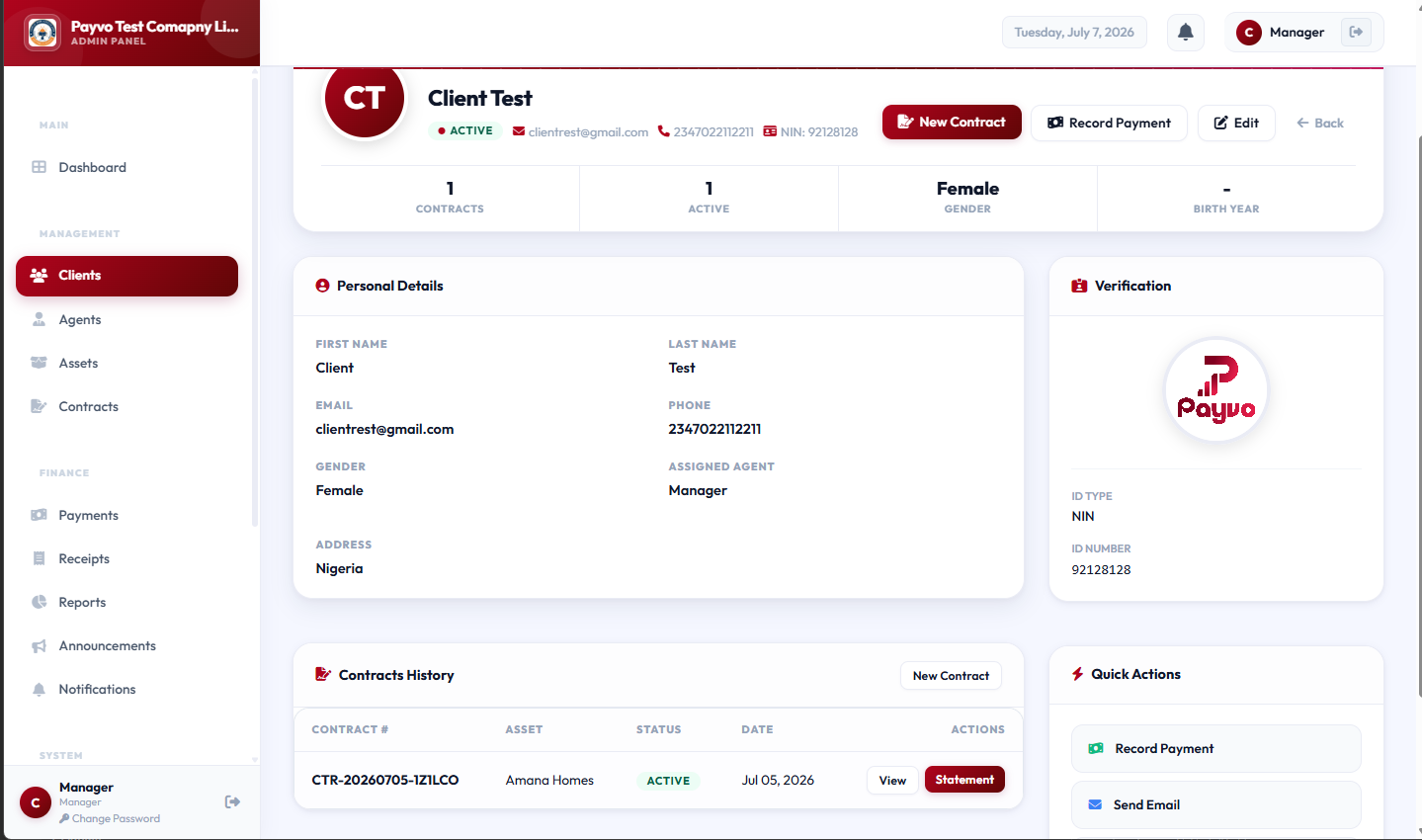 Dashboard showing client details and payment history
Step 5: Market Your Services
Develop a marketing strategy to reach your target customers. This could include online advertisements, local flyers, partnerships with ride-hailing platforms or cooperative societies, and word-of-mouth referrals. Allocate a monthly budget of ₦50,000 to ₦200,000 for marketing and advertising. Clearly communicate your hire purchase terms, including down payment requirements, installment amounts, and repayment periods. Transparency builds trust.
Step 6: Implement Robust Contract and Payment Management
This is the core of your business. Your hire purchase contracts must be clear, concise, and legally binding. For payment management, establishing a reliable system is paramount. This includes setting up payment channels (bank transfers, direct debits) and, crucially, a system for tracking every single payment. A receipt generator app Nigeria businesses can trust is vital for transparency with clients.
With a system like Payvo, you can automate much of this process. It generates branded receipts for every payment, and even a master receipt for full contracts. This eliminates manual errors and provides clients with immediate proof of payment. Furthermore, Payvo's WhatsApp payment notification system ensures clients receive automated reminders before due dates and confirmations when payments are received, significantly reducing the need for manual follow-up calls and improving collection rates.
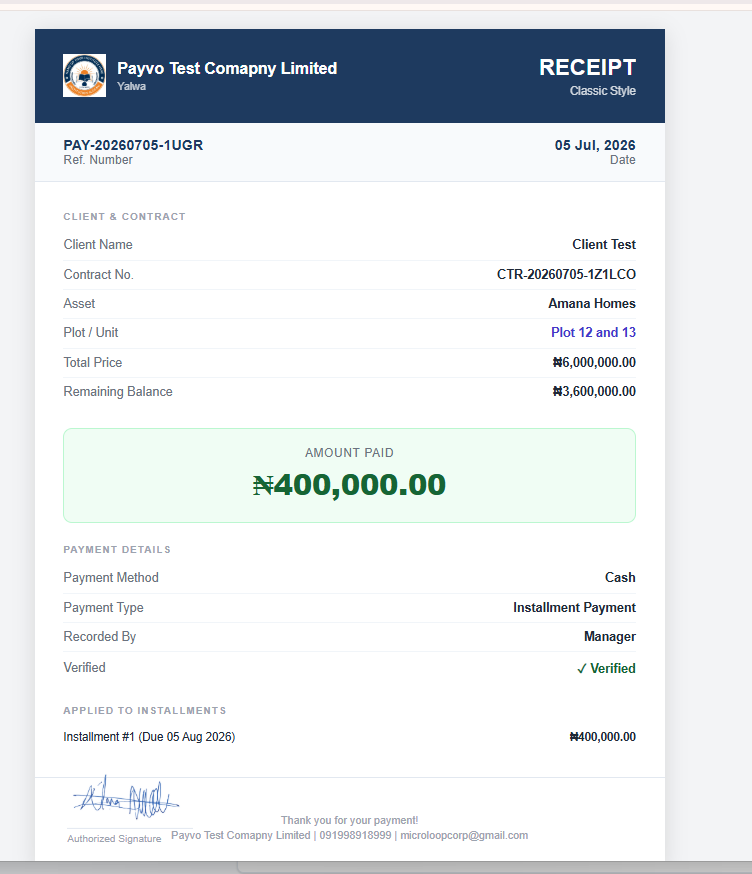 Screenshot of a payment receipt sample
Step 7: Manage Collections and Defaults
Consistent follow-up is key to successful collections. Automated payment reminders are invaluable here. Despite best efforts, some clients may default. Your contracts should clearly outline the process for managing defaults, including late payment fees and, as a last resort, vehicle repossession. Having a dedicated maintenance fund (₦30,000 - ₦70,000 per vehicle monthly) is also important to cover routine servicing and minor repairs, ensuring your assets remain in good condition.
> "In the Nigerian market, the difference between a struggling business and a thriving one often comes down to the efficiency of its payment collection and client communication systems."
Common Mistakes to Avoid
Starting any business has its pitfalls. In the car hire purchase sector, these mistakes can be particularly costly:
- Inadequate Due Diligence on Clients: Failing to properly vet clients can lead to high default rates. Implement thorough background checks and guarantor requirements.
- Poorly Drafted Contracts: Vague or legally unsound agreements can expose your business to significant risks and make repossession difficult. Always consult legal experts.
- Neglecting Vehicle Maintenance: Poorly maintained vehicles break down frequently, leading to client dissatisfaction, lost income, and higher repair costs.
- Lack of Proper Tracking System: Relying on manual records or basic spreadsheets for tracking payments, contracts, and client information is a recipe for disaster as your business scales. This is where a dedicated contract management software Nigeria businesses can use becomes essential.
- Underestimating Operational Costs: Beyond vehicle acquisition, factor in insurance, registration, maintenance, staff salaries, marketing, and legal fees.
- Ignoring Customer Service: A strong reputation for fair dealings and good customer service is crucial for client retention and referrals.
- Insufficient Capital Buffer: Unexpected expenses or prolonged default periods can cripple a business without adequate reserves.
How to Track and Grow After Launch
Once your business is operational, continuous monitoring and strategic growth are paramount. Key Performance Indicators (KPIs) to watch include:
- Default Rate: The percentage of clients failing to make payments on time. A high rate signals issues with client vetting or payment reminders.
- Collection Efficiency: How quickly and consistently you collect installments.
- Vehicle Utilization/Profitability: The profit margin per vehicle over its full repayment period (which can be ₦800,000 to ₦3,000,000 after all costs, over 18-36 months).
- Customer Acquisition Cost (CAC): How much it costs to acquire a new client.
- Client Retention Rate: How many clients complete their contracts successfully and potentially refer others.
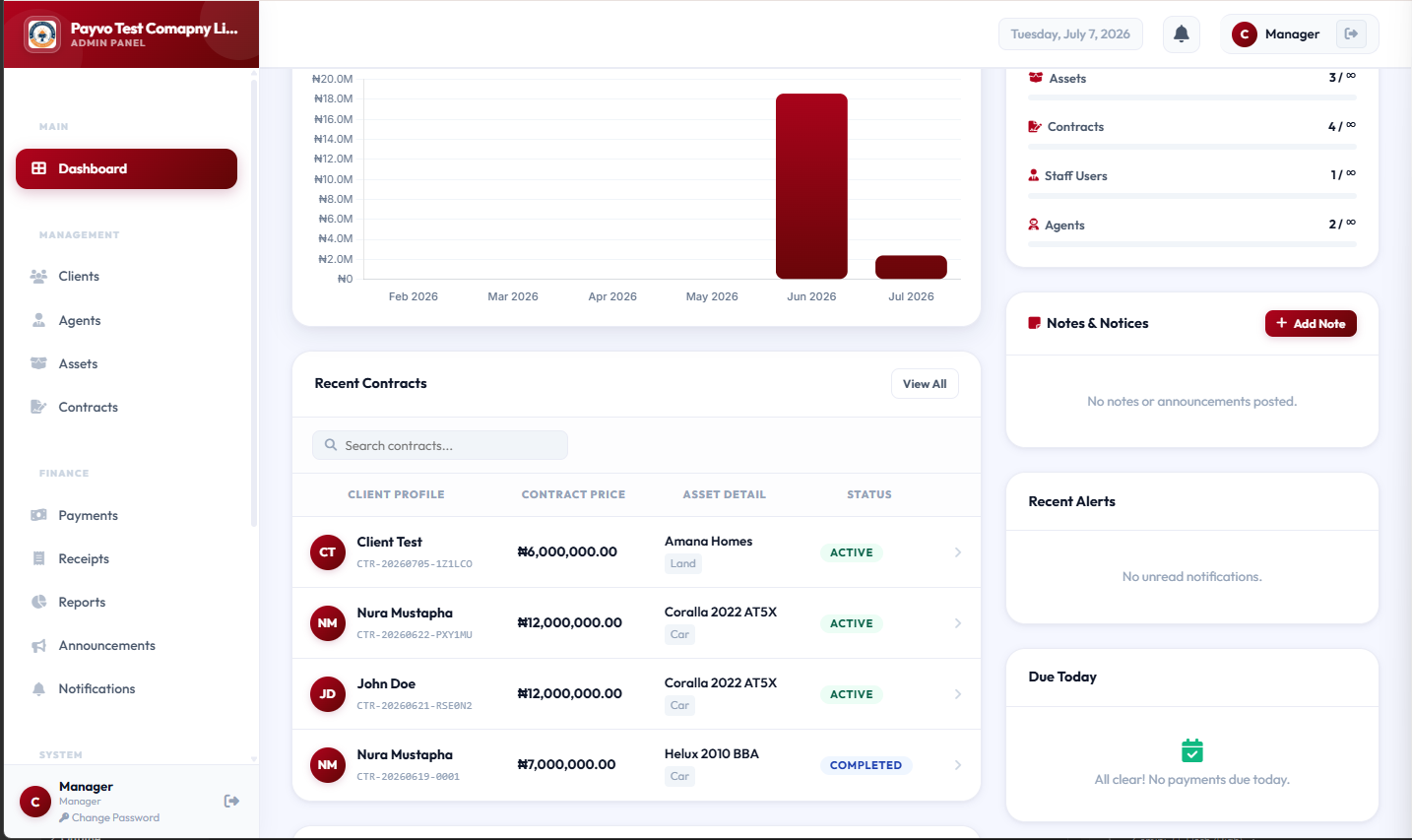 Dashboard showing key business metrics
Growth tactics can include:
- Expanding Your Fleet: As capital allows, acquire more vehicles to meet demand.
- Diversifying Vehicle Offerings: Introduce different models or price points to cater to a broader market.
- Strategic Partnerships: Collaborate with ride-hailing companies, cooperatives, or other businesses that can refer clients.
- Improving Client Vetting: Refine your process to reduce defaults and improve repayment reliability.
- Leveraging Technology: Fully utilize tools like Payvo to automate tasks, improve communication, and gain deeper insights into your operations. You can explore all the features Payvo offers for businesses selling on installment by visiting our features page.
 A business owner reviewing financial data on a
Frequently Asked Questions
What is the typical down payment for a car hire purchase in Nigeria?
Down payments typically range from 20% to 40% of the vehicle's total cost, depending on the car's value, the repayment period, and the client's creditworthiness. For a vehicle costing ₦5,000,000, a down payment could be ₦1,000,000 to ₦2,000,000.
How long is a typical car hire purchase agreement?
Most agreements in Nigeria range from 18 to 36 months, though some can extend up to 48 months for newer or more expensive vehicles. The shorter the term, the higher the monthly installments, but the less interest the client pays overall.
What happens if a client defaults on payments?
Your hire purchase agreement should clearly outline the consequences of default. This typically involves late payment penalties, a grace period for payment, and ultimately, repossession of the vehicle if the client fails to regularize their payments after repeated notices. Legal counsel is essential to ensure this process is compliant.
Do I need a physical office to run this business?
While it's possible to start small, a physical office adds credibility and provides a dedicated space for client interactions and administrative tasks. It also helps in building trust with clients who are making a significant financial commitment.
How do I manage multiple clients and their payment schedules?
Manually tracking multiple clients, their contracts, and payment schedules quickly becomes overwhelming. Utilizing a specialized installment management software Nigeria businesses can use, like Payvo, is highly recommended. It automates contract creation, payment tracking, receipt generation, and sends automated reminders, making it much easier to manage your portfolio efficiently.
Ready to Transform Your Installment Sales?
Starting a car hire purchase business in Nigeria offers immense potential to meet a critical market need and build a profitable enterprise. Success hinges on meticulous planning, robust legal frameworks, smart vehicle acquisition, and efficient operational management. By embracing technology to streamline your processes, you can focus on growth and client satisfaction.
If you're ready to take control of your installment sales, automate payment tracking, and simplify client management, explore how Payvo can empower your business. Visit our public home page to learn more about our solutions or register into Payvo today to start managing your contracts and payments with ease.