The fluorescent shop lights hummed, casting a sterile glow on Mama Ngozi's face as she stared at the worn ledger. It was nearly 11 PM on a Tuesday in October 2026, and the numbers just weren't adding up. A customer who bought a washing machine on a monthly payment plan swore she’d paid last week, but Mama Ngozi's scribbled notes told a different story. The headache was throbbing behind her eyes, a familiar companion on these late nights spent trying to reconcile scattered receipts and WhatsApp messages. This kind of confusion is exactly why learning how to sell appliances with monthly payment plans: a complete guide is so crucial for your business.
 Woman reviewing ledger in appliance store
Why Most People Get This Wrong from Day One
Let's be honest, the idea of offering monthly payment plans for appliances in Nigeria is brilliant. It makes big-ticket items like refrigerators, washing machines, and even solar inverters accessible to more people. Who wouldn't want to expand their customer base beyond those who can pay outright? But here's the thing: most business owners, especially those running small or medium-sized shops in places like Alaba International Market or Computer Village, jump into this without a proper system. They see the potential sales, but they underestimate the administrative burden.
They start with a notebook, maybe an Excel sheet, and a prayer. Initially, when you have just five or ten customers, it seems manageable. You remember Mrs. Okoro's payment date for her new blender. You know Mr. Emeka is due for his standing fan. But fast forward a few months, and you've got 50, 100, maybe even 200 customers paying you in installments. Now you’re dealing with different payment frequencies – weekly, bi-weekly, monthly. Some payments come in cash, others via bank transfer, and a growing number through POS. This scattered approach is the first, biggest mistake. It leads to missed payments, disputes, and hours wasted trying to figure out who owes what. We've seen businesses lose customers, and sometimes, even their sanity, trying to keep up.
Before You Do Anything: The Foundation Work
Before you even think about putting a "Pay in Installments" sign outside your shop, you need to lay a solid groundwork. This isn't just about having products; it's about having a plan.
1. Define Your Target Market and Products
Who are you selling to? A young couple furnishing their first apartment? A small business needing a generator or a commercial freezer? The type of customer dictates the type of appliance and the payment structure. If you're targeting customers in a local suburb of Ibadan, their budget for a refrigerator might be different from someone in Lekki, Lagos.
Next, identify the appliances that make sense for installment sales. High-value items like refrigerators, washing machines, air conditioners, and larger TVs (₦150,000 to ₦700,000) are prime candidates. Smaller items like blenders or irons (₦20,000 to ₦60,000) might work too, but the administrative effort for smaller margins needs careful consideration.
2. Determine Your Capital & Pricing Strategy
This is where the rubber meets the road. You need enough capital to buy initial stock and cover operational costs until your installment payments become consistent. For a small-scale appliance business, your initial stock purchase might range from ₦300,000 to ₦1,500,000 for basic items. A medium-scale operation, stocking refrigerators and washing machines, could need ₦2,000,000 to ₦8,000,000.
Your pricing strategy for installment plans is crucial. You can't charge the same as an outright cash sale. Why? Because you're taking on risk, and you're providing a service (the payment flexibility). Most businesses add a premium, typically 10-25% above the cash price. For example, if a washing machine is ₦187,500 cash, it might be ₦215,000 on a 6-month payment plan. Clearly communicate this to your customers. Transparency builds trust.
3. Legal & Regulatory Compliance
Don't skip this. Registering your business with the Corporate Affairs Commission (CAC) is non-negotiable. This typically costs between ₦25,000 and ₦70,000 for business name registration. It gives your business legitimacy and makes it easier to open a corporate bank account. While there isn't a specific "appliance installment sales" license, operating as a registered entity is foundational. You'll also want to draft clear, legally sound contract management software Nigeria agreements for your customers. This protects both you and them.
4. Secure Your Location & Essential Utilities
Whether it's a market stall in Onitsha Main Market or a small shop in a busy Lagos suburb, you need a physical presence. Shop rent varies wildly. A basic stall in a small town might be ₦80,000 - ₦300,000 per year. A decent shop in a major city suburb could be ₦500,000 - ₦2,500,000 annually, while a prime location on Lagos Island could hit ₦3,000,000 - ₦10,000,000 per year.
And power? Forget about it. A generator is not a luxury; it's a necessity. Budget ₦80,000 - ₦250,000 for a small generator, or ₦350,000 - ₦1,200,000 for a medium-sized one if you need consistent power for larger displays or a small office. Monthly fuel costs alone can be ₦30,000 - ₦150,000. These are real costs that eat into your profit margins if not accounted for.
The Step-by-Step Path (What Actually Works)
Now that we’ve covered the groundwork, let’s get into the nitty-gritty of managing those monthly payment plans. This is where most businesses either thrive or drown.
Step 1: Crafting Your Installment Agreement
This is your blueprint. Every single appliance sale on a payment plan needs a clear, written agreement.
What to do: Create a standard contract template that includes:
- Full customer details (name, address, phone, verifiable ID).
- Appliance details (make, model, serial number).
- Total purchase price (including installment premium).
- Initial down payment amount.
- Remaining balance.
- Payment frequency (weekly, monthly, etc.) and specific due dates.
- Late payment penalties.
- Default clauses (what happens if they stop paying).
- Ownership transfer details (usually after final payment).
Common shortcut that backfires: Just a verbal agreement or a scribble on a receipt. When issues arise, you'll have no leg to stand on.
Action item: Develop a robust contract template, perhaps with legal counsel, before your first installment sale.
Step 2: Customer Vetting & Down Payments
You can't sell to everyone. Just like a car dealer installment software helps manage risk, you need to assess your appliance customers.
What to do: Implement a simple vetting process. Ask for proof of address, employment details (if applicable), and a valid government ID. Collect a reasonable down payment. For an appliance costing ₦250,000, a 20-30% down payment (₦50,000 - ₦75,000) is standard. This shows commitment from the customer and reduces your immediate risk.
Why it matters: A down payment acts as a commitment and reduces the risk of default. Vetting helps you filter out high-risk customers.
Common shortcut that backfires: Accepting anyone with cash for a down payment. You'll end up chasing ghosts.
Action item: Set clear criteria for customer eligibility and minimum down payment percentages.
Step 3: Setting Up a Payment Schedule
This is the core of managing appliance installment payments.
What to do: Once the down payment is made and the contract signed, create a detailed payment schedule. Break down the remaining balance into equal, manageable weekly or monthly installments. For example, if a customer owes ₦180,000 after down payment and agrees to pay over 6 months, that's ₦30,000 per month. Be precise with dates.
Why it matters: A clear schedule makes it easy for the customer to plan their payments and for you to track them.
Common shortcut that backfires: Vague payment terms like "pay when you can" or "sometime next month." This is a recipe for missed payments.
Action item: For every new installment contract, generate a clear, dated payment schedule.
Step 4: Robust Payment Tracking & Record Keeping
This is arguably the most critical step, and it's where a lot of businesses struggle. Manual tracking using notebooks or spreadsheets quickly becomes overwhelming. Imagine trying to check 150 different payment dates every week!
What to do: This is where a dedicated system shines. You need an organized way to record every payment, track outstanding balances, and know exactly when the next payment is due. This is precisely what Payvo is designed for. Payvo helps you manage customer records, add assets (your appliances), create installment contracts with detailed payment schedules, and record each payment against the correct contract. It centralizes all this information, so you don't have to hunt through notebooks or WhatsApp chats. It's essentially your personal business payment tracking app Nigeria.
Why it matters: Accurate records prevent disputes, help you identify overdue payments quickly, and give you a real-time view of your business's financial health. Without it, you're flying blind.
Common shortcut that backfires: Relying on memory or informal notes. You'll forget, mix things up, and lose money.
Action item: Implement a system like Payvo for all your installment sales. It will save you countless hours and potential losses.
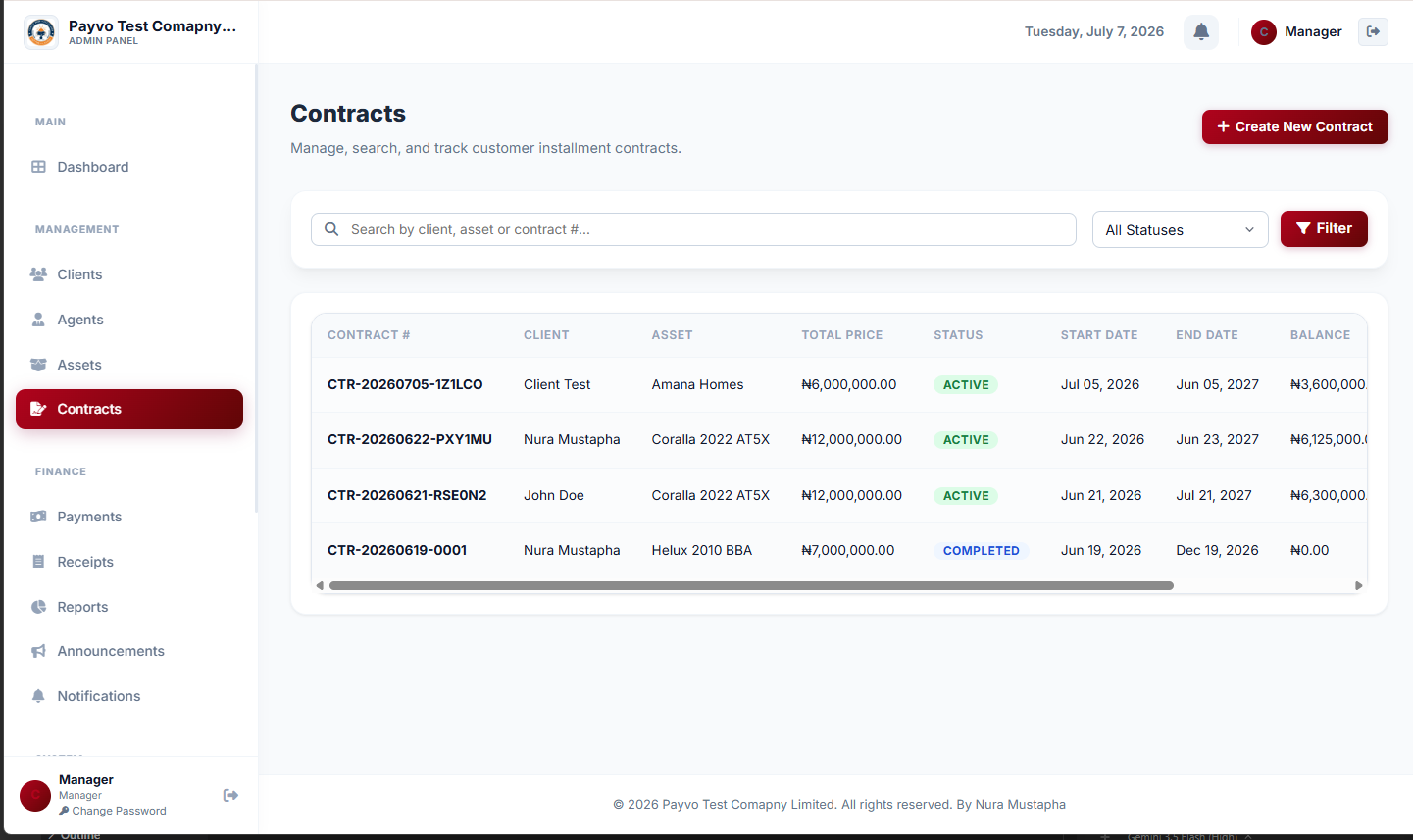 Management: Contracts list page
Step 5: Communication and Reminders
Don't wait for payments to be late before you communicate.
What to do: Proactively send payment reminders a few days before the due date. A simple SMS or WhatsApp payment notification system can work wonders. If a payment is missed, follow up promptly but politely.
Why it matters: Gentle reminders reduce late payments. Prompt follow-up shows you're serious and helps resolve issues before they escalate.
Common shortcut that backfires: Only contacting customers when they are significantly overdue. By then, it's often harder to recover the payment.
Action item: Set up a system for automated or semi-automated payment reminders.
The Numbers That Will Make or Break You
Understanding the financial realities is non-negotiable. Many businesses fail not because they don't sell, but because they don't manage their money well.
Startup Costs (Initial Outlay)
Let's break down what you'll realistically need to start an appliance business with monthly payment plans in 2026. These are ranges, remember, depending on your scale and location (small town vs. Lagos).
- Initial Stock Purchase: ₦300,000 - ₦8,000,000 (Small to medium scale, stocking blenders to washing machines). For a focused small shop, aim for at least ₦1,500,000 to have a decent variety.
- Shop Rent (Annual): ₦80,000 - ₦2,500,000 (Small town stall to busy city suburb shop). Let's pick a mid-range for a decent suburban shop: ₦750,000.
- Generator Purchase: ₦80,000 - ₦1,200,000 (Small "I-better-pass-my-neighbour" to a 10KVA). A reliable 5KVA generator might cost you around ₦450,000.
- Business Registration (CAC): ₦25,000 - ₦70,000. Budget ₦45,000.
- Initial Marketing (Flyers, Social Media Boost): ₦10,000 - ₦50,000. Let's say ₦30,000 for a solid push.
- Delivery Van (Used, Small): ₦1,500,000 - ₦4,000,000 (essential for larger appliances). If you can't afford this immediately, factor in outsourcing delivery costs. Let's budget ₦2,500,000 for a fairly used one.
So, a rough minimum startup cost for a decent, small-to-medium appliance business could easily be around ₦5,000,000 to ₦7,000,000 if you buy a delivery vehicle. If you outsource delivery, you might start with ₦2,500,000 - ₦4,000,000.
Monthly Running Costs
These are the expenses that keep coming, whether you sell or not.
- Staff Salary (1-2 Sales Assistants): ₦40,000 - ₦80,000 per person. Let's assume two staff at ₦60,000 each: ₦120,000.
- Monthly Fuel/Logistics (Generator, Deliveries): ₦30,000 - ₦150,000. Let's use ₦80,000.
- Marketing (Ongoing): ₦10,000 - ₦50,000. Budget ₦25,000.
- Rent (prorated monthly): ₦750,000 / 12 = ₦62,500.
- Internet/Communication: ₦10,000 - ₦25,000. Budget ₦15,000.
- Software (like Payvo): Plans start affordably and scale with your business. This is a small but critical investment.
Your monthly running costs could easily be between ₦200,000 and ₦400,000, even for a small operation. This is the part most people don't expect.
Expected Monthly Revenue (with Payment Plans)
This is trickier because it depends on your sales volume and collection rate.
- Small Scale (after initial setup): ₦200,000 - ₦800,000.
- Medium Scale (established clientele): ₦1,000,000 - ₦4,000,000.
Let's say you sell 10 refrigerators at ₦250,000 each on a 6-month plan. That's ₦2,500,000 in total contract value. If customers pay ₦41,667 per month, you'd expect to collect ₦416,670 10 = ₦4,166,700 over the 6 months. But in any given month, you're only collecting a fraction of that. This is why managing cash flow is so important. You need enough working capital to replenish stock before* all your installment payments come in. This is why how to track installment payments is so vital.
Growth After Launch: The Next 90 Days
The first few months after launching your appliance business with monthly payment plans are crucial. This isn't the time to relax; it's the time to double down on your systems and build momentum.
1. Monitor Your Collection Rate Closely
Pay close attention to who is paying on time and who isn't. Your collection rate is a key performance indicator. If 20% of your customers are consistently late, you have a problem. Use your installment management software Nigeria to generate reports on payment status. This data helps you identify patterns and adjust your follow-up strategy.
2. Refine Your Vetting Process
Are certain customer segments defaulting more often? Tighten your vetting for those groups. Perhaps increase the down payment, or require an additional guarantor. Don't be afraid to say "no" to a sale if the risk is too high. It's better to lose one potential sale than to chase a bad debt for months.
3. Leverage Referrals and Testimonials
Happy customers on payment plans are your best marketers. Encourage them to refer friends. Offer a small incentive, like a discount on their next appliance or a gift voucher. Ask for testimonials. Positive word-of-mouth is incredibly powerful in Nigeria.
4. Optimize Your Marketing
Are your local flyers in the right places? Is your social media boost reaching the right audience? For as little as ₦10,000 - ₦50,000 per month, you can run targeted campaigns on Facebook or Instagram. Highlight the convenience of your monthly payment options. Show actual appliances that people can afford.
5. Consider Agent Management
If your business grows, you might want to bring on sales agents. An agent commission tracking software can help manage their sales and commissions effectively. This allows you to expand your reach without directly increasing your fixed staff costs. Payvo, for instance, offers features for agent management, helping you to track their sales performance and attributed contracts.
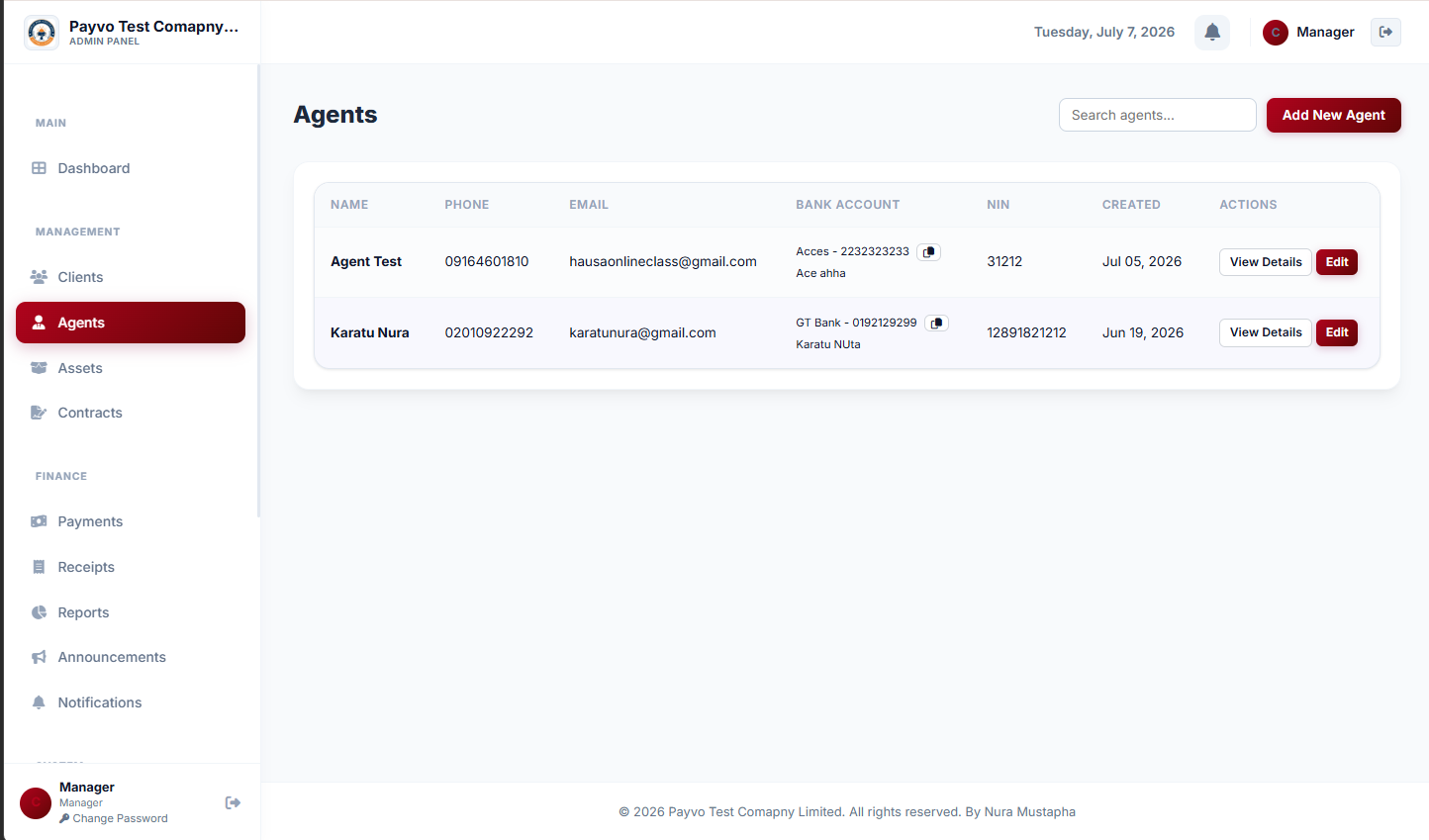 Agent: Agents list page
FAQ: Answers to What You're Actually Googling
You've got questions, I know. Here are some common ones I hear from business owners looking to manage appliance sales records.
Q1: How do I handle customers who stop paying their monthly installments?
This is a tough one, but it happens. First, your contract should clearly outline the consequences. Start with polite reminders, then escalate to more formal notices. If the appliance is still with them, your contract should give you the right to reclaim it. In some cases, you might need to involve legal counsel. This is why having accurate contract management software Nigeria is so important – it provides all the documentation you need.
Q2: What's the best way to generate receipts for monthly payments?
Manually writing receipts is slow and prone to errors. Using a receipt generator app Nigeria is far more efficient. With a system like Payvo, every payment recorded automatically generates a digital receipt that you can send to the customer via email or WhatsApp. This saves time and ensures accuracy.
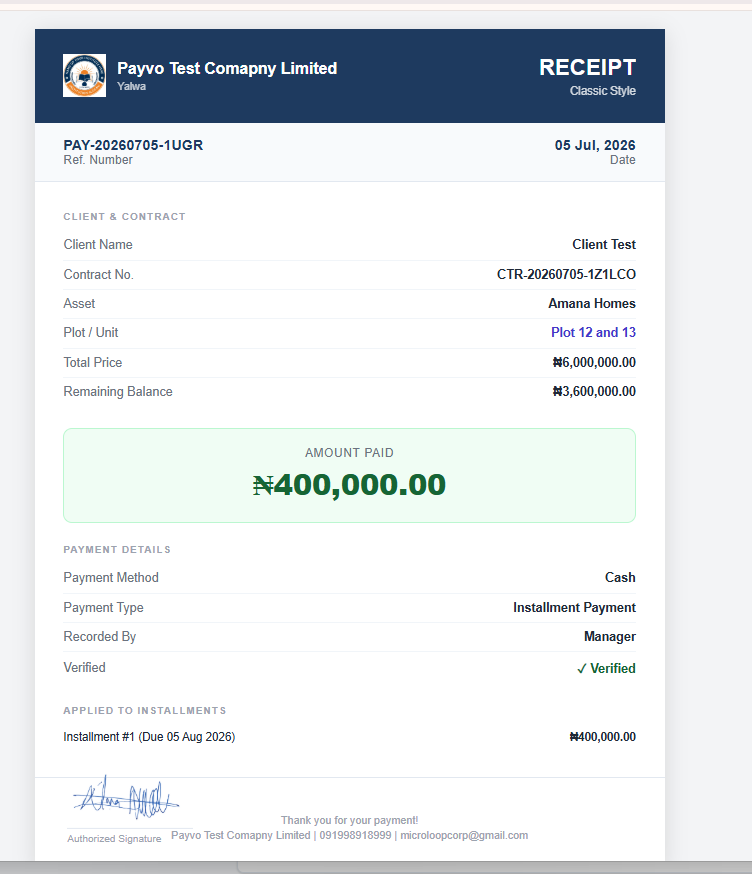 Finance: Paymnet Receipt Sample
Q3: Can I offer payment plans for other items, like solar panels or property?
Absolutely! The principles of managing installment payments are highly transferable. Solar/equipment leasing companies use similar models, as do real estate payment tracking Nigeria businesses for land or property. Even cooperative society management software often includes installment tracking for member contributions or loans. The core need is to track scheduled payments and outstanding balances, regardless of the asset.
Q4: How much profit can I expect from selling appliances on monthly payment plans?
Your profit margin will depend on your pricing strategy (the premium you add), your cost of goods, and your operational efficiency. Typically, a 10-25% premium on the cash price is common for installment plans. After factoring in operating costs and potential defaults, aim for a net profit margin of 5-15%. It might seem lower than outright sales, but the increased sales volume and customer reach often make it worthwhile. You're trading immediate high profit for consistent, long-term revenue.
Q5: Is it really worth investing in software for this, or can I just use Excel?
You can use Excel, just like you can use a bicycle to travel from Lagos to Kano. But is it efficient? Is it scalable? As soon as you have more than 20-30 active installment contracts, Excel becomes a nightmare. Formulas break, data gets lost, and it doesn't send reminders or generate receipts automatically. A dedicated monthly payment plan software like Payvo is built for this specific purpose. It automates the tedious parts, reduces errors, and gives you actionable insights, allowing you to focus on selling more appliances and less on administrative headaches. It's an investment that pays for itself in saved time, reduced losses, and better customer relationships.
> "The true cost of a bad record-keeping system isn't just the money lost; it's the mental energy drained, the opportunities missed, and the trust eroded when you can't tell your customer exactly what they owe."
Ready? Here's Where to Start
Selling appliances with monthly payment plans is a fantastic way to grow your business in 2026. It opens up your market and helps more Nigerians access essential household items. But the success hinges entirely on your ability to manage those installment payments efficiently.
If you're tired of scattered records, endless calculations, and the constant worry of missed payments, it's time for a change. Don't let administrative chaos hold your business back. Explore how Payvo can simplify your installment management, centralize your records, and give you the peace of mind to focus on what you do best: selling great appliances. Visit our website to learn more about our features, or better yet, create a free account today and see how easy it is to bring order to your sales process. Your future self (and your accountant) will thank you.