Ever found yourself staring at a stack of payment receipts, a messy spreadsheet, or even just a long WhatsApp chat, trying to figure out exactly how much that property buyer in Kaduna still owes you? You're not alone. Many real estate developers and property sellers in Nigeria, from Lagos to Kano, grapple with this daily. It's a frustrating reality, especially when you need to prepare a payment statement for property buyers quickly and accurately in 2026. The truth is, relying on manual methods for land payment history can lead to errors, disputes, and ultimately, lost income.
 A frustrated property developer looking at scattered paper
The Reality Check: What Nobody Tells You About Property Payment Tracking
Let's be honest, managing installment sales for property is far more complex than selling a one-off item. You're dealing with substantial amounts, often over several years, and the stakes are incredibly high. Most new developers or even established ones running a small operation don't fully account for the hidden costs and administrative burden of poor record-keeping. They think a basic Excel sheet or a notebook will suffice. That's the wrong way to think about it.
Here's the thing: every single payment, every agreement, every outstanding balance needs to be crystal clear. We're talking about legal documents, significant financial commitments, and the trust you build with your buyers. Without a proper property payment statement, you're exposed. For instance, a simple error in calculating an outstanding balance of ₦187,500 could cost you that amount directly, or worse, damage your reputation.
Consider the typical costs involved in a property transaction beyond the land itself. You have legal fees for drafting sales agreements, which can range from ₦150,000 to ₦750,000 depending on the property value and lawyer's experience. Then there are survey plan fees, another ₦120,000 to ₦350,000. And let's not forget the big one: Governor's Consent or C of O processing fees, which can be anywhere from ₦500,000 to a staggering ₦3,000,000 or even more, often as a percentage of the property value, especially in prime Lagos areas. These aren't one-time hits; they often factor into the total contract amount your buyer is paying off.
The point is, if your internal tracking for the buyer's payments isn't watertight, how can you effectively manage these other costs or even provide accurate updates? A recent informal survey among small to medium-sized real estate firms in Abuja showed that over 63% reported disputes with buyers at least once a quarter due to unclear payment records. That's a lot of wasted time and potential legal fees, all because someone couldn't easily pull up an accurate installment account statement.
What You Actually Need to Get Started
So, you want to prepare a clear and professional payment statement for your property buyers. It’s not just about listing numbers; it’s about providing transparency and building confidence.
Non-Negotiables:
- A Clear Sales Agreement/Deed of Assignment: This is your foundation. It must explicitly state the total property value, initial deposit, installment amount, frequency (monthly, quarterly), and the total duration. Without this, any payment statement is just guesswork. Legal fees for drafting this? Budget ₦150,000 - ₦750,000 for a solid one.
- Accurate Records of Every Payment Received: This means dates, amounts, payment method (bank transfer, cash, POS), and who received it. No "I remember they paid last Tuesday" kind of talk. Every single transaction needs a digital or physical receipt.
- A System for Calculating Outstanding Balances: Whether it’s a manual ledger, a spreadsheet, or specialized software, you need a reliable way to subtract payments from the total contract amount and know the remaining balance.
- Proof of Property Ownership/Title: Before any money exchanges hands, ensure you have the necessary documents like a Survey Plan (₦120,000 - ₦350,000) and evidence of Governor's Consent or a Certificate of Occupancy. Buyers need this assurance, and it underpins the entire agreement.
- Basic Financial Literacy: You or your staff must understand debits, credits, and how to track installment payments. It sounds obvious, but you'd be surprised.
Nice-to-Haves (but quickly becoming essential):
- Digital Record-Keeping: Moving away from paper means less chance of loss, easier searching, and better security. This is where a business payment tracking app Nigeria can really make a difference.
- Automated Reminders: For both you and your buyers. A simple WhatsApp payment notification system can significantly reduce late payments.
- Agent Commission Tracking Software: If you work with agents, knowing their commission status on each sale is vital. It avoids misunderstandings and keeps your agent network motivated.
- Centralized Communication: All communication about payments should be in one place, not scattered across WhatsApp, calls, and emails.
The Complete Step-by-Step Breakdown: How to Prepare a Payment Statement for Property Buyers
Let's walk through this process, step-by-step. Remember, consistency is key here.
Step 1: Gather All Contractual Information
Before you even think about numbers, you need the full picture of the agreement. Pull out the signed sales agreement or deed of assignment for the specific property. This document is your bible.
It should clearly state the total purchase price of the property, say ₦15,000,000 for a plot in a developing estate in Apo, Abuja. You also need the initial deposit amount, the agreed installment amount (e.g., ₦500,000 monthly), the payment frequency, and the total duration of the payment plan. These details form the backbone of your property payment statement.
Step 2: Compile a Comprehensive Payment History
This is where the rubber meets the road. Go through all your records—bank statements, cash receipt books, POS transaction logs—and list every single payment the buyer has made. For each entry, you need the exact date the payment was received, the amount, and the method of payment.
Don't just write "Paid ₦500k." Be specific: "2026-09-15: ₦500,000, Bank Transfer (UBA Account ending in 1234)." This level of detail is crucial for transparency and resolving any future discrepancies. If you're using a system like Payvo, this step becomes significantly easier as all payments are recorded against the specific contract.
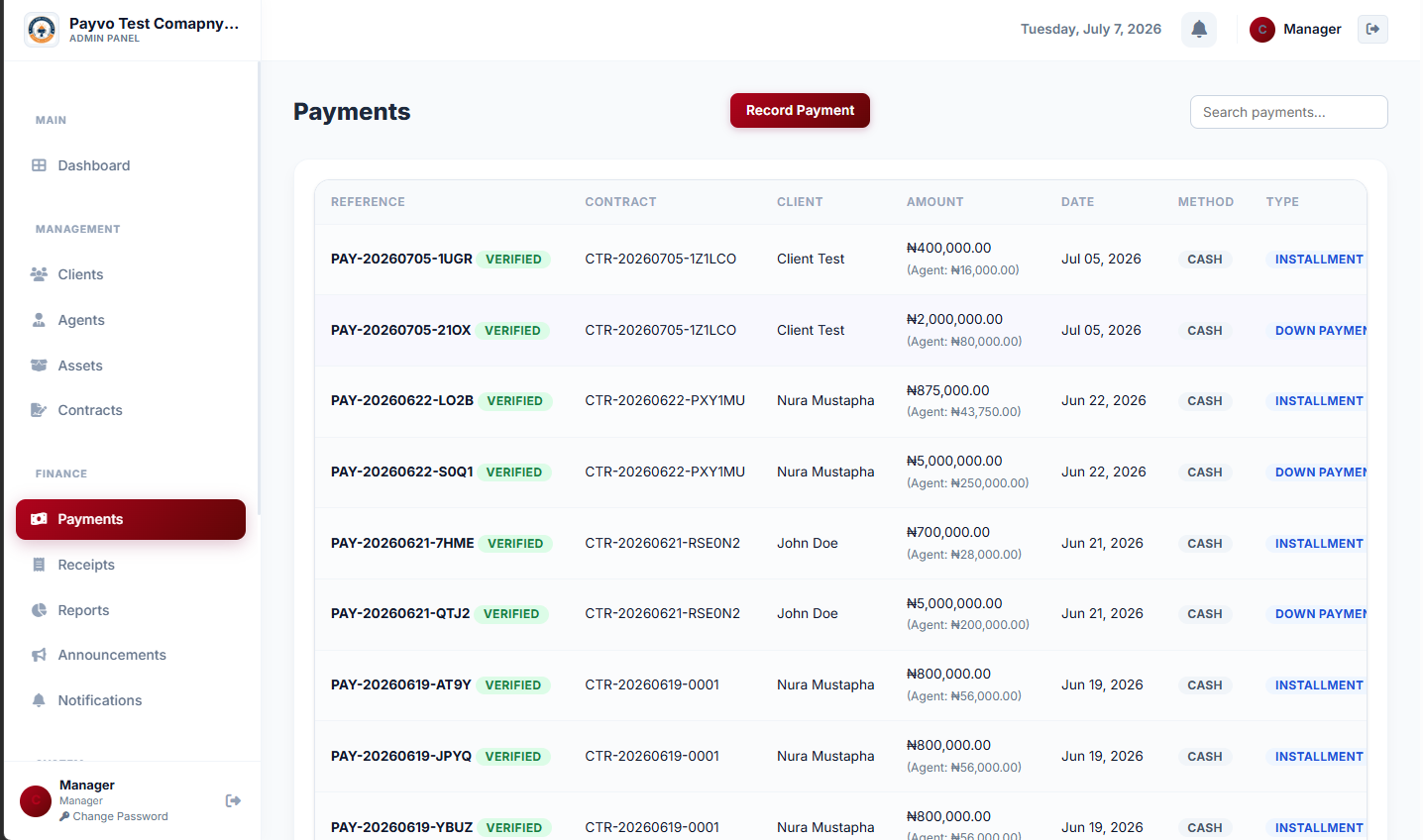 A Payvo dashboard showing a list of recorded payments
Step 3: Calculate the Current Outstanding Balance
With the total contract value and the sum of all payments received, you can now determine the remaining balance. Simple arithmetic, right? Total Contract Value minus Total Payments Received equals Outstanding Balance.
However, many businesses stumble here by not accounting for potential penalties for late payments (if stipulated in the contract) or any additional charges that might have been agreed upon. Ensure your calculations are precise. For example, if a buyer agreed to a ₦10,000,000 property and has paid ₦7,500,000, their current outstanding balance is ₦2,500,000. This calculation should be clear and verifiable.
Step 4: Structure Your Payment Statement
A good property payment statement isn't just a jumble of numbers. It needs a clear, professional format. Think of it as an official document.
Start with your company's letterhead, contact details, and the date the statement was prepared. Then, include the buyer's full name, contact information, and the specific property details (plot number, estate name, location). The body of the statement should clearly display:
- Property Details: Full description of the land or house.
- Original Contract Amount: The total agreed price.
- Initial Deposit: Amount paid upfront.
- Payment Schedule: A summary of agreed installment amounts and due dates.
- Detailed Payment History: A chronological list of all payments received, including date, amount, and payment method.
- Total Amount Paid to Date: The sum of all payments.
- Outstanding Balance: The amount still owed.
- Next Payment Due Date & Amount: Very important for clarity.
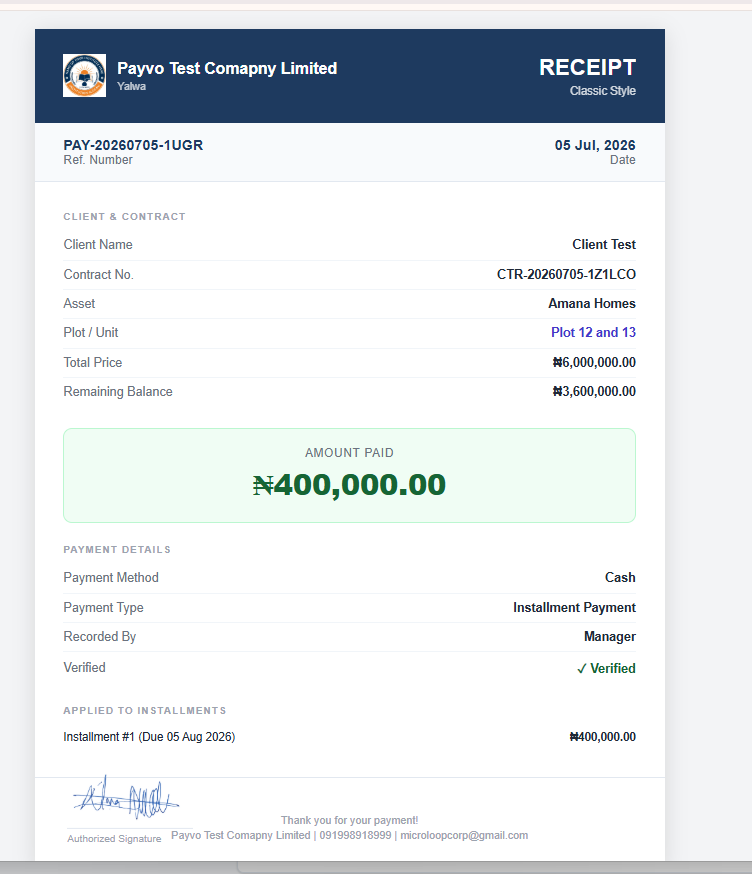 A sample digital receipt generated from Payvo
Step 5: Review and Verify
Never send out a payment statement without a thorough review. Double-check every figure, every date, and every calculation. A single misplaced decimal point or incorrect date can lead to a major headache.
Have a second person, if possible, cross-reference the statement with the original contract and payment records. This is your final safeguard against errors. Once verified, you can issue the statement to the property buyer, either as a printed document or a secure digital copy. This meticulous approach builds trust and professionalism, something invaluable in the real estate sector.
5 Mistakes That Cost Nigerian Business Owners the Most
I've seen these mistakes play out time and again, not just in real estate but with car dealer installment software users, building material suppliers selling on credit, and even cooperative society management software operators. They always lead to losses.
- Relying Solely on Verbal Agreements and WhatsApp Chats: "Ah, we discussed it on WhatsApp." This is a recipe for disaster. When disputes arise, those casual chats hold little legal weight. Always get agreements in writing and formalize payment notifications. I once consulted for a small land seller in Onitsha Main Market who lost ₦450,000 because he couldn't prove a buyer's payment schedule was overdue, as all communication was informal on WhatsApp.
- Inconsistent Record-Keeping: One month you're using a notebook, the next an Excel sheet, then a random Google Doc. This fragmented approach makes it impossible to get a clear land payment history. When a buyer asks for an installment account statement, you'll be scrambling, and that looks unprofessional.
- Ignoring the "Small" Fees: Title search fees (₦30,000 - ₦100,000) or development levies (₦50,000 - ₦500,000) might seem minor compared to the property value, but they add up. If these aren't clearly communicated and tracked in the payment plan, they become points of contention later.
- No Clear Process for Overdue Payments: What happens when a payment is missed? Is there a grace period? A penalty? If your contract management software Nigeria doesn't have these details clearly outlined and communicated, you're just hoping for the best. Hope isn't a business strategy.
- Lack of Centralized Data: Imagine having 50 property buyers across different estates. Their contracts are in one folder, payment proofs in another, and agent details on a separate sheet. How do you get an overview? This lack of a central business payment tracking app Nigeria means you can't easily track installment payments, identify defaulting clients, or even properly pay your agents.
How to Know If You're on Track (Success Metrics)
So, how do you know if your payment statement preparation and overall payment tracking are actually working for your real estate business? It's not just about sending out statements; it's about what those statements represent.
- Reduced Payment Disputes: If you find yourself spending less time arguing with buyers about how much they've paid or owe, you're definitely on the right track. This means your property payment statement is clear and accurate. Aim for less than 5% of your active contracts having payment-related disputes in any given quarter.
- Consistent Cash Flow: Are payments coming in more regularly? Are fewer payments overdue? This indicates your payment schedules are well-communicated and your tracking system is effective. For a growing real estate business, a predictable cash flow is gold.
- Quick Statement Generation: How long does it take you to prepare a detailed payment statement for property buyers? If it takes more than 15-20 minutes, you need to refine your process or invest in a better system. With a dedicated installment management software Nigeria like Payvo, you should be able to generate an installment account statement in minutes, not hours.
- High Buyer Satisfaction: Happy buyers are repeat buyers and referrers. When they receive clear, professional statements, it builds their confidence in your business. You can gauge this through informal feedback or even a quick survey.
- Accurate Agent Commission Tracking: If your agents are always clear on what they're owed for each sale and you can provide them with a transparent breakdown, your agent commission tracking software is doing its job. This transparency keeps your sales force motivated and reduces internal friction.
- Easy Access to Land Payment History: Can you instantly pull up the complete land payment history for any plot or buyer? If yes, your records are organized. This is crucial for real estate payment tracking Nigeria, where transactions can span years.
- Efficient Business Payment Tracking: Your ability to see overall collections, outstanding amounts, and upcoming payments across all your properties at a glance means your business payment tracking app Nigeria is giving you the insights you need to make informed decisions.
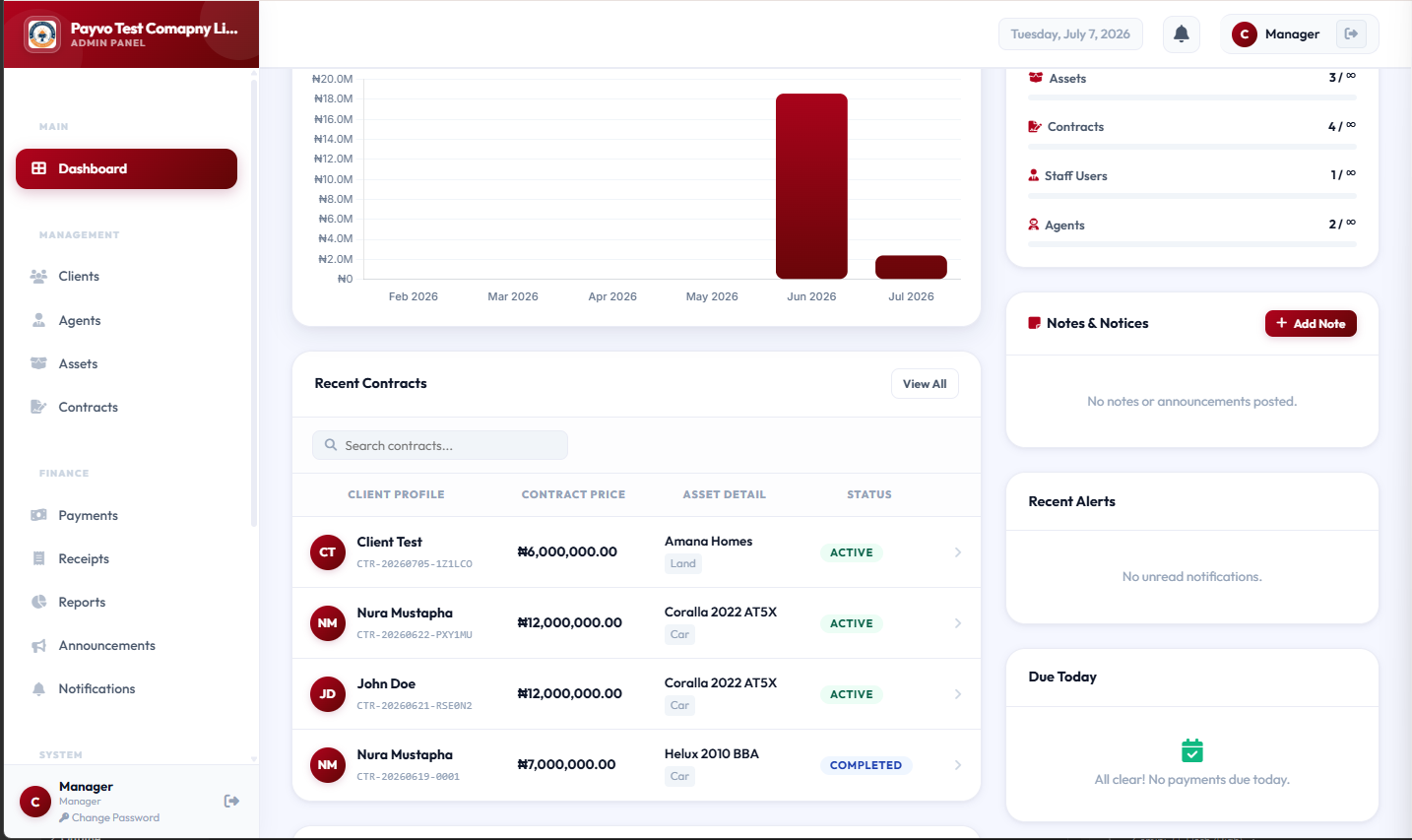 A Payvo dashboard showing an overview of contracts and payments
Real Questions People Ask (FAQ)
Q1: What information should a property payment statement contain?
A comprehensive property payment statement should include your company details, the buyer's contact information, the property description (e.g., Plot 15, Sunshine Estate, Enugu), the original contract amount, the initial deposit, a detailed payment history (date, amount, method for each payment), the total amount paid to date, the current outstanding balance, and the next payment due date and amount. It’s essentially a full land payment history.
Q2: How can I track installment payments efficiently for multiple properties?
For multiple properties and buyers, manual methods like notebooks or basic spreadsheets quickly become overwhelming. The most efficient way to track installment payments is by using a specialized installment management software Nigeria. These systems centralize all customer, property, contract, and payment data, allowing you to generate an installment account statement for any buyer at any time and get an overview of all your ongoing contracts.
Q3: Is a digital receipt generator app in Nigeria legally valid?
Absolutely, as long as it clearly documents the transaction details (date, amount, parties involved, purpose of payment) and can be securely stored and retrieved. Digital receipts generated by a reliable system like Payvo are generally accepted. They offer advantages over paper receipts, like easy retrieval and less risk of loss. Always ensure your digital receipts are backed up.
Q4: What are the biggest risks of not having a clear property payment statement?
The biggest risks include payment disputes with buyers, which can lead to legal battles and reputational damage; inaccurate financial reporting, making it hard to assess your business's health; cash flow issues due to missed or unrecorded payments; and difficulties in managing agent commissions. Without a clear property payment statement, you lack transparency and control over your sales.
Q5: Can I use WhatsApp for payment notifications and tracking?
While WhatsApp is excellent for communication, relying solely on it for payment tracking or as your primary contract management software Nigeria is risky. Conversations can get lost, calculations are manual, and it's not a structured financial record. A better approach is to use a dedicated system that can integrate with a WhatsApp payment notification system for automated alerts, but keeps the core payment history and contract details in a secure, organized database.
Your Next Move
The truth is, managing property sales on installment in Nigeria in 2026 demands precision and professionalism. You can't afford to lose track of payments, deal with constant disputes, or waste hours trying to piece together a buyer's land payment history. It's time to move beyond the manual chaos and embrace a system that gives you clarity and control.
If you're ready to streamline your property payment statement generation, improve your real estate payment tracking Nigeria, and centralize your customer and contract records, then it's time to explore Payvo. It's built specifically to help businesses like yours manage installment sales, track customer payments, and monitor outstanding balances in one organized place.
Don't let manual errors or disorganization cost you another kobo. Take control of your installment sales today. Register for Payvo and experience the difference.