Do you ever feel like you're drowning in a sea of paper, trying to match bank alerts to faded carbon copies, all while a customer is breathing down your neck asking "How much do I still owe?" If you're a car dealer in Nigeria offering hire-purchase, I bet that scenario hits close to home. It's 2026, and yet, I still see so many businesses struggling with the basics of how to organize car hire-purchase receipts – a problem that costs them time, money, and trust. You're not alone; managing vehicle payment receipts for multiple customers paying installments can feel like a full-time job in itself.
 Man looking frustrated at a pile of paper
Why Most People Get This Wrong from Day One
Let's be honest, when you start a car hire-purchase business, the focus is on selling cars, right? You're thinking about sourcing reliable used Toyota Corollas or Honda Civics, negotiating the initial deposit (which can be anywhere from ₦1,500,000 to ₦3,500,000 for a decent one), and getting that agreement signed. Record-keeping often feels like an afterthought, a necessary evil.
The biggest mistake I see? Relying on a patchwork system. One minute, it's a worn-out notebook from Balogun Market; the next, it's a few lines in an Excel sheet, and then a quick WhatsApp message confirming payment. This works fine when you have two or three customers. But what happens when you have twenty, fifty, or even a hundred clients making monthly installment payments of ₦150,000 to ₦400,000? That's when the chaos begins.
You miss a payment, a customer disputes a balance, or worse, an agent pockets some cash without proper documentation. Suddenly, your profit margins are shrinking, and your reputation is taking a hit. It's not just about losing money; it's about losing control. Many businesses also fail to factor in the true cost of these arrangements beyond the car's price – things like legal fees for agreement documentation (which can be ₦50,000 to ₦150,000), comprehensive insurance (₦150,000 to ₦450,000 annually), and even tracking device installation (₦40,000 to ₦80,000). Without proper receipt management, these critical expenses become black holes.
Before You Do Anything: The Foundation Work
Before you even think about handing over keys or collecting another installment, you need a solid foundation. This isn't just about receipts; it's about your entire operation.
- Define Your Hire-Purchase Terms Clearly: What's your standard interest rate? Most informal arrangements in Nigeria hover between 18% and 35% annually. How long are your payment plans – 12, 24, or 36 months? Be transparent with customers from day one. This clarity prevents disputes later.
- Legalize Everything: Get a proper hire-purchase agreement drafted by a lawyer. Don't rely on photocopied templates from "that guy at the market." A good contract protects both you and your customer. This also helps when you need to enforce terms.
- Dedicated Bank Account: All business payments should go into a separate business account. Mixing personal and business funds is a recipe for disaster and makes tracking vehicle payment receipts impossible.
- Initial Record-Keeping System: Even if it's basic, decide on one method to start. A sturdy ledger book and a file cabinet are better than nothing. You need a way to track the initial deposit, the vehicle details, and the customer's contact information. This is where your journey to organized installment receipt management begins.
- Understand Your Cash Flow Needs: Can your business survive if two or three customers miss payments? Vehicle maintenance alone can cost ₦20,000 to ₦50,000 monthly, and fuel can be a staggering ₦80,000 to ₦250,000 for a commercial driver. You need reserves.
The Step-by-Step Path (What Actually Works)
Alright, now let's get into the nitty-gritty of how to organize car hire-purchase receipts effectively. This isn't just about stacking papers; it's about building a system that works for your business, whether you're selling cars in Kano or operating a fleet in Lagos.
Step 1: Standardize Your Receipt Generation
What to do: Every single payment, no matter how small, must generate a formal receipt. This means having pre-printed receipt books with serial numbers or using a digital receipt generator app Nigeria businesses can trust.
Why it matters: A standardized receipt acts as undeniable proof of payment. It details the amount, date, payment method, remaining balance, and the specific contract it applies to. This eliminates "he said, she said" arguments. Imagine a customer coming to your car lot in Computer Village, claiming they paid ₦200,000 last month, but your records show ₦150,000. A clear receipt settles it instantly.
Common shortcut that backfires: Just writing "paid" on a piece of paper or sending a WhatsApp message. While convenient, these aren't official and can be easily disputed or lost.
Action item: Invest in custom receipt books or subscribe to a service that offers digital receipt generation. Ensure every receipt includes your business name, contact info, customer name, vehicle details, amount paid, date, balance due, and the signature of the recipient.
Step 2: Create a Dedicated Filing System for Each Customer
What to do: For every hire-purchase customer, create a physical folder and/or a digital folder. This is where all their documents live.
Why it matters: Centralization is key. When a customer calls with a query, you shouldn't be scrambling. You should be able to pull up their file (physical or digital) and see everything: the initial contract, copies of their ID, every single vehicle payment receipt, and any communication. This level of organization helps with contract management software Nigeria businesses need.
Common shortcut that backfires: Throwing all receipts into one general box or relying solely on your phone's gallery. When you need to find a specific receipt from six months ago, you'll spend hours searching, if you find it at all.
Action item: Purchase durable file folders (you can get a pack of 50 for about ₦8,500 at any stationery shop). Label each folder clearly with the customer's name and vehicle registration number. For digital, create a folder structure on your computer or cloud storage (e.g., "Customers > [Customer Name] > Receipts").
Step 3: Implement a Dual Record-Keeping Approach (Physical & Digital)
What to do: For every payment, record it physically and digitally. This provides a crucial backup.
Why it matters: What if your office floods? What if your laptop crashes? Having both physical and digital records means you're never completely exposed. Physical receipts are great for immediate proof and for customers who prefer paper. Digital records are searchable, shareable, and less prone to physical damage. For instance, a cooperative society management software often emphasizes this dual approach for its members' contributions.
Common shortcut that backfires: Choosing one over the other. Relying solely on paper means you can't quickly search or share data. Relying solely on digital means you might be stuck if there's a power outage or network issue.
Action item: After issuing a physical receipt, immediately scan or take a clear photo of it. Upload this digital copy to the customer's dedicated digital folder. For smaller businesses, a basic scanner or even a good smartphone camera will do. Consider a digital storage subscription for secure backup; services can range from ₦2,000 to ₦5,000/month.
Step 4: Leverage Technology for Seamless Installment Management
What to do: This is where you move beyond manual systems. Adopt an installment management software Nigeria car dealers are increasingly using. A tool like Payvo can transform how you manage car hire-purchase receipts.
Why it matters: Imagine a system where you input a payment, and it automatically updates the customer's balance, generates a professional receipt, and sends a WhatsApp payment notification system message to the customer. This isn't a dream; it's what modern business payment tracking app Nigeria offers. Payvo helps you track installment payments, manage contracts, and see your entire payment history at a glance. It eliminates manual calculations, reduces errors, and frees up your time to focus on sales.
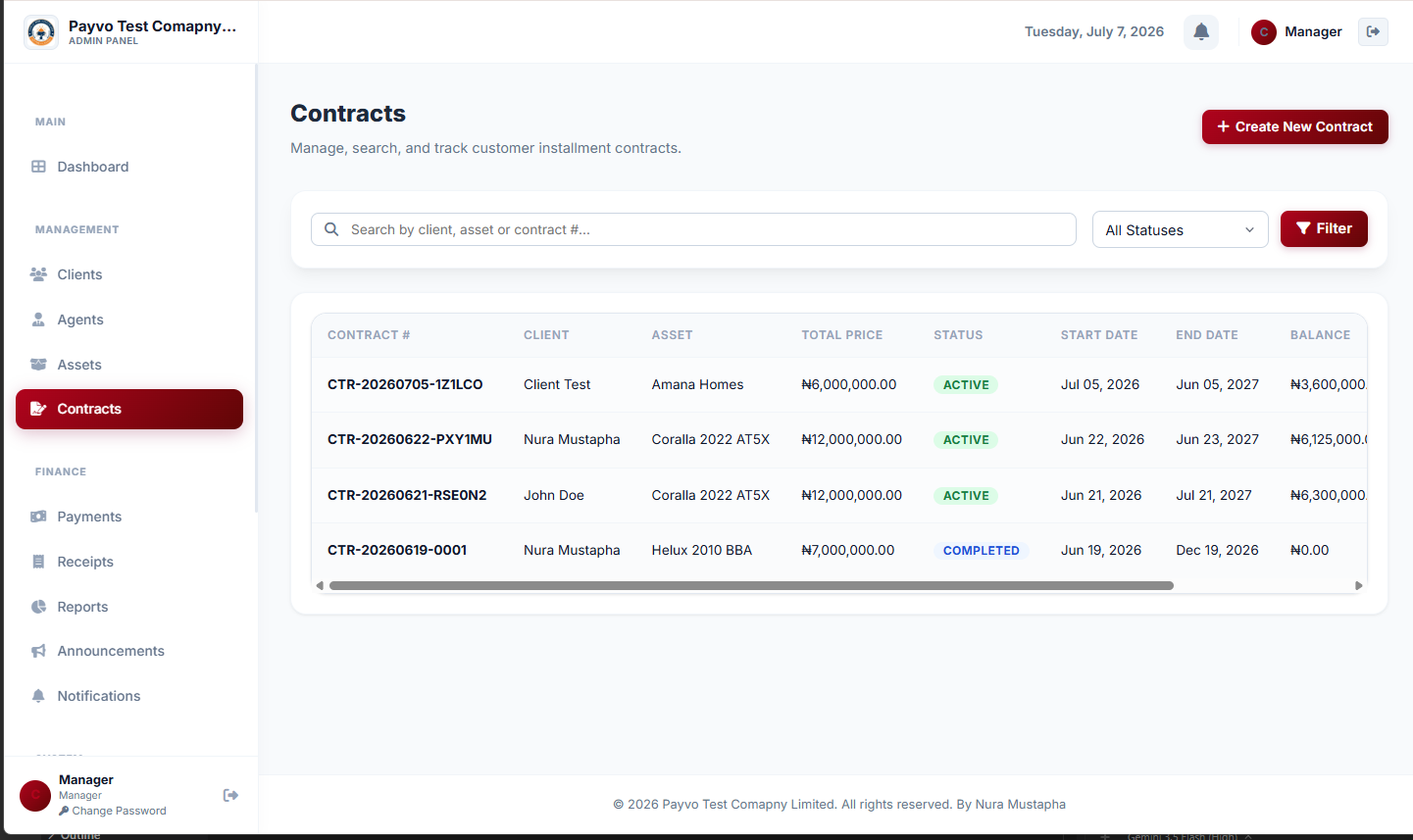 Payvo Contracts List Page
Common shortcut that backfires: Thinking you can manage hundreds of contracts manually forever. The moment you scale, manual systems become a bottleneck, leading to errors, lost revenue, and endless stress. You also lose the ability to track agent commission tracking software effectively if you rely on disparate systems.
Action item: Explore dedicated platforms for hire-purchase. Go to Payvo's website (https://payvo.ng/) to see how such a system can centralize your customer records, payment schedules, and receipt generation. It’s built for businesses like yours.
Step 5: Regular Reconciliation and Audits
What to do: At least once a month, reconcile your payment records with your bank statements and customer files.
Why it matters: This step catches discrepancies early. Maybe a customer made a transfer that wasn't recorded, or perhaps there's a data entry error. Regular audits ensure your books are always accurate, preventing major headaches down the line. This is also crucial for real estate payment tracking Nigeria property sellers use.
Common shortcut that backfires: Only checking records when a problem arises. By then, it might be too late, and the discrepancy could be much larger and harder to trace.
Action item: Schedule a specific day each month for reconciliation. Dedicate 2-4 hours to go through your bank statements and cross-reference them with your receipt records and your installment management software.
The Numbers That Will Make or Break You
Understanding the financial landscape of hire-purchase is non-negotiable. It's not just about the car's price; it's about the ecosystem of costs and revenues.
Startup Costs (Beyond the Car Itself):
- Initial Deposit for Car: As mentioned, ₦1,500,000 - ₦3,500,000 for a reliable used vehicle. This is your primary capital outlay.
- Legal Fees: Budget ₦50,000 - ₦150,000 for a solid hire-purchase agreement. Don't skimp here.
- Vehicle Registration & Licensing: Annually, expect ₦40,000 - ₦80,000 per vehicle. This is usually transferred to the buyer after full payment, but you might bear initial costs.
- Comprehensive Insurance: This is vital for hire-purchase. Plan for ₦150,000 - ₦450,000 annually per vehicle. Many providers require this.
- Tracking Device Installation: Often a requirement by financiers or for security, costing ₦40,000 - ₦80,000 per car.
- Record Keeping Supplies: Initial purchase of folders, notebooks, pens: ₦5,000 - ₦15,000.
- Software Subscription: For a robust installment management software, budget anywhere from ₦10,000 to ₦50,000+ monthly, depending on features and customer volume.
- Maintenance & Servicing: Even a well-maintained used car needs attention. Budget ₦20,000 - ₦50,000 monthly for routine checks, oil changes, and minor repairs.
- Fuel Costs: If you're managing a fleet or repossession, fuel is a major factor: ₦80,000 - ₦250,000 monthly depending on usage.
- Digital Storage: Cloud services for backup: ₦2,000 - ₦5,000/month.
The beauty of hire-purchase is recurring revenue. However, you need to understand that your profit isn't immediate. Your initial deposit covers a portion of your cost, and the rest comes in over 12-36 months. With monthly installments from ₦150,000 to ₦400,000, you need consistent payments to stay afloat and cover your own operational costs. A single customer defaulting can significantly impact your cash flow, especially if you have high fixed costs. This is why meticulous receipt management and payment tracking are not just administrative tasks; they are revenue protection strategies.
Growth After Launch: The Next 90 Days
So, you've got your car hire-purchase business running, and you're diligently organizing your vehicle payment receipts. What's next? The first 90 days post-launch (or post-system implementation) are critical for building momentum and refining your processes.
- Monitor Payment Trends: Are customers consistently paying on time? Are there specific days of the month when payments tend to come in? Use your business payment tracking app Nigeria to identify these patterns. If you notice a cluster of late payments around the 5th of the month, perhaps adjust your follow-up schedule.
- Customer Feedback Loop: Talk to your customers. Are the payment reminders helpful? Is the receipt clear? Understanding their experience can highlight areas for improvement in your communication and receipt delivery.
- Agent Performance Tracking: If you have agents bringing in clients, use agent commission tracking software features to monitor their sales, collection rates, and overall performance. This helps you identify your top performers and those who might need additional training. A good system will show you which agents have the most successful contracts and the fewest payment issues.
- Refine Your Follow-Up System: For late payments, what's your protocol? A polite reminder email, a WhatsApp message, or a phone call? Having a clear, consistent sequence of actions backed by accurate receipt records is crucial.
- Review Your Contracts: After a few months, revisit your standard hire-purchase contract. Are there clauses that are causing confusion? Are your interest rates competitive but also profitable? Your real estate payment tracking Nigeria counterparts do this regularly to adapt to market conditions.
 Person reviewing digital financial reports on a tablet
FAQ: Answers to What You're Actually Googling
Q1: What's the best way to handle car hire purchase receipts if I have agents collecting payments?
This is where things get tricky without a solid system. The best way is to centralize everything. Agents should use a dedicated tool or process to record payments immediately as they receive them. If they collect cash, they must issue a formal receipt on the spot and remit the funds to the business account daily. A reliable agent commission tracking software integrated with your main installment management system is vital. This way, every payment is logged, and you have clear oversight, reducing the risk of fraud and ensuring your vehicle payment receipts are accurate.
Q2: How can I send payment reminders and receipts automatically?
You need an installment management software Nigeria businesses are adopting. Many platforms offer automated features. Once a payment is recorded, the system can automatically generate and send a digital receipt via email or even through a WhatsApp payment notification system. For reminders, you can set schedules for upcoming payments, overdue payments, or even thank-you messages after a successful transaction. This frees up countless hours and improves customer satisfaction.
Q3: My customers often pay with bank transfers. How do I reconcile these with my car hire purchase receipts?
This is a common challenge. For bank transfers, insist that customers include their name and contract number in the transfer description. Then, when you receive the alert, immediately match it to the customer's record in your business payment tracking app Nigeria. Generate a receipt for that transfer, noting the transaction ID. Regularly compare your bank statement with your payment records to catch any unmatched transfers. This meticulous approach ensures every transfer has a corresponding receipt and is properly allocated.
Q4: I use Excel. Is that good enough for organizing car hire purchase receipts?
For a very small operation (say, under 5 customers), Excel can work if you're extremely diligent. But it's prone to human error, formulas can break, and it doesn't automate receipt generation or notifications. As soon as you scale, or if you want robust reporting, agent tracking, or secure cloud access, Excel becomes a liability. A dedicated installment management software Nigeria offers is far more efficient and secure for managing your contracts and generating vehicle payment receipts. It's purpose-built for this exact challenge, unlike a generic spreadsheet.
Q5: How do I ensure my car dealer installment software is secure?
When choosing a car dealer installment software, look for platforms that emphasize data security. This includes features like user authentication, data encryption, regular backups, and compliance with data protection regulations (like NDPR in Nigeria). Check if they offer role-based access, so different staff members only see the information relevant to their job. Always use strong, unique passwords, and educate your team about data security best practices. Your customer data and financial records are too valuable to compromise.
Ready? Here's Where to Start
Organizing car hire-purchase receipts doesn't have to be a headache. It's about implementing a systematic approach and leveraging the right tools. If you're tired of the paper chase, the disputes, and the constant worry about your financial records, it's time for a change.
Start by exploring how a dedicated solution can simplify your operations. Visit Payvo's website today to see how our installment management software can help you track payments, generate receipts, and manage your contracts all in one place. Take control of your car hire-purchase business – your peace of mind and your profit margins will thank you. Ready to transform how you manage your vehicle payment receipts? Register for Payvo and experience the difference.