Ever felt like you’re drowning in notebooks, spreadsheets, and WhatsApp chats, just trying to keep track of who owes you what? You know, when you’ve got customers paying for land in Abuja, or maybe cars on hire purchase in Lagos, or even solar panels in Kano, and each one has their own payment schedule? Let's be honest, trying to manage installment sales for multiple customers can feel like you're herding cats, especially when you consider that a typical Nigerian business might juggle anywhere from ₦200,000 to ₦1,500,000 in monthly installment revenue. It's a goldmine, but only if you can actually keep track of it all.
 A small business owner in nigeria looking overwhelmed
The Reality Check: What Nobody Tells You About Managing Installments
Most people, when they think about offering installment sales, focus on the immediate boost to sales. And that's fair. You make big-ticket items accessible, you expand your customer base, and you move more products. But here's the thing: nobody really sits you down and tells you about the administrative mountain you're about to climb.
When I started my first retail shop, selling electronics in Computer Village, I thought a simple ledger book would do. Boy, was I wrong. Within months, I had over 50 customers on payment plans, and my ledger looked like a spider's web. I was losing sleep, constantly cross-checking payments, and even then, mistakes happened. A customer would swear they paid last week, and I'd be digging through pages, trying to find a record. It’s a common story. Many businesses, from property developers in Kaduna to car dealers in Port Harcourt, still rely on manual methods, and that's where things get messy and costly.
Consider the real costs of poor management. If you're running a small electronics shop, you might be looking at an estimated monthly loss of ₦10,000 to ₦100,000 due to bad debt or simply mismanaged accounts. That's money directly out of your pocket. Then there's the time you waste. Imagine spending 3-4 hours each week just chasing payments or reconciling accounts that should have been straightforward. That's time you could be using to find new customers, improve your products, or even just relax a bit. Time is money, especially when your staff salary alone could be ₦45,000 to ₦90,000 per person per month. You need them focused on sales, not on playing detective with payment slips.
What You Actually Need to Get Started with Installment Sales
Alright, so you're ready to dive into installment sales, or maybe you're already doing it and looking for a better way. This isn't just about having products to sell; it's about setting up a system that works, right from the jump. Here’s what you truly need.
Non-Negotiables (Don't even think about it without these):
- A Clear Installment Policy: You need to define your terms. How much is the down payment? What's the interest rate, if any? What's the payment frequency – weekly, bi-weekly, monthly? How long is the payment period? What happens if a payment is missed? Don't leave anything to chance. Write it down, make it clear, and ensure every customer understands it before they sign anything. This is your first line of defense against disputes.
- Initial Capital for Stock: You can't sell what you don't have. For a small-scale trader in a local market, your initial stock purchase might be around ₦150,000. But if you’re a medium-sized electronics shop in a city suburb, you're looking at ₦750,000 or more. Make sure you have enough to keep your shelves stocked and meet demand.
- A Dedicated Space (Even if Small): Whether it's a kiosk in Balogun Market or a proper shop, you need a place of business. Annual shop rent can range from ₦80,000 for a small stall in a community market to a whopping ₦2,500,000 for prime retail space on Lagos Island. Don't forget the security deposit, which could be another ₦40,000 to ₦1,250,000.
- Legal Agreement Template: You need a solid contract. This isn't just a handshake deal. Get a legal professional to draft a basic agreement. This could cost you anywhere from ₦15,000 for a simple template to ₦100,000 for a more comprehensive legal review. It's an investment, not an expense.
- Reliable Power & Internet: This is Nigeria, so a small generator is almost always a must, costing ₦80,000 - ₦300,000. And fuel? Prepare for ₦20,000 - ₦100,000 monthly. For online transactions and communication, you’ll need internet data, probably around ₦5,000 - ₦15,000 a month. You can't track payments if your system is down or you can't communicate.
- POS Terminal: A basic standalone POS can be ₦60,000 - ₦150,000. It helps streamline cash and card payments.
- Marketing Budget: Even ₦10,000 - ₦50,000 a month for flyers or social media boosts can make a difference. People need to know you offer installment plans.
- Basic Accounting Software: This is where things get truly efficient. An annual subscription could be ₦30,000 - ₦120,000. It helps you track sales, manage finances, and crucially, keep tabs on your installment customers. This is where a proper business payment tracking app Nigeria comes into play.
The Complete Step-by-Step Breakdown
Alright, let’s break down how you can actually set up and manage installment sales, especially when you start getting a lot of customers. This is the practical, no-nonsense approach.
Step 1: Define Your Installment Terms Clearly
Before you sell anything on installment, you need a crystal-clear policy. This isn't just for your customers; it's for you and your staff. What’s the minimum down payment? Is it 10% or 25%? What’s the repayment frequency – weekly, bi-weekly, monthly? For how long can someone pay? A solar panel company, for example, might offer a 6-month plan, while a real estate developer might have a 2-year payment schedule for a plot of land in Kano.
Make sure every single detail is documented. This includes late payment penalties, early repayment incentives, and what happens in case of default. When you have these terms clearly outlined, it removes ambiguity, reduces disputes, and sets the right expectations from the start. You can even have a small, printed leaflet summarizing these terms for customers to take home.
- Actionable Tip: Create a simple, one-page document outlining all your installment terms. Have your staff memorize the key points and be able to explain them clearly. This will save you endless headaches down the line.
Step 2: Onboard Your Customers Thoroughly
This is more than just collecting a name and number. When you’re dealing with installment payments, you need comprehensive customer information. Get their full name, current address, a reliable phone number (and maybe an alternative contact), and a valid ID. For larger purchases, like a car or a plot of land, you might even need a guarantor.
Think about a cooperative society in Ibadan. They need to know their members inside out to ensure repayments. Verifying customer details upfront, perhaps even doing a quick background check if the value is high enough, can drastically reduce your risk of bad debt. This initial investment in time pays off by filtering out potential defaulters and ensuring you have the necessary information for follow-up.
- Actionable Tip: Develop a standardized customer onboarding form. Don't skip any fields. Make sure it includes a section for their signature acknowledging the installment terms you defined in Step 1.
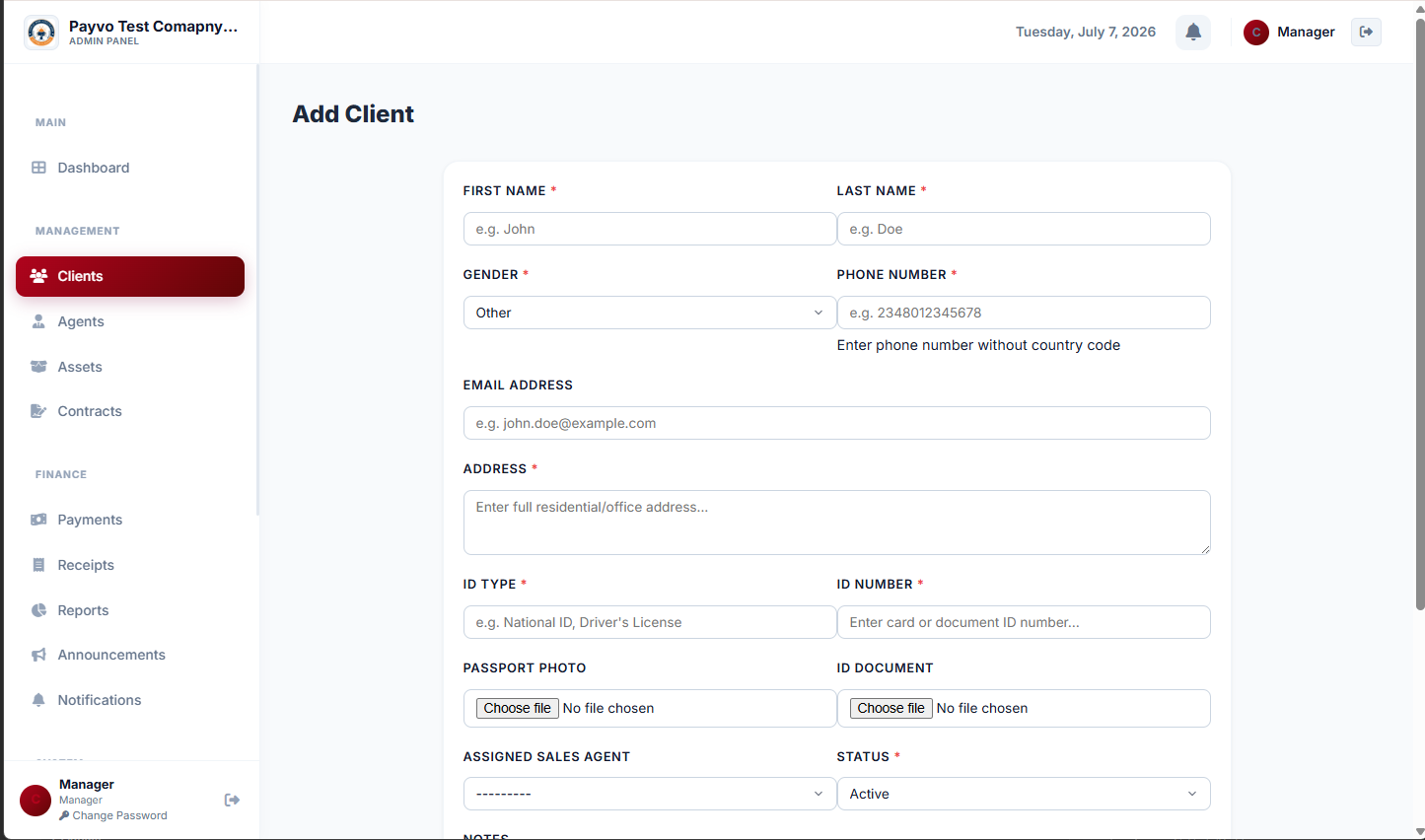 Client: Add Client page
Step 3: Implement Robust Contract Management
Every single installment sale needs a formal contract. A verbal agreement simply won't cut it when you're managing many installment customers. This contract should detail the item purchased, the total price, the down payment amount, the remaining balance, the payment schedule (dates and amounts), and the agreed-upon terms. For a car dealer selling on hire purchase, this contract is their lifeline.
Having a clear, signed contract protects both you and your customer. It provides a legal basis for collection if things go south, and it gives the customer a clear understanding of their obligations. Keeping these contracts organized is crucial. You can't be rummaging through dusty files when you need to check a payment history. This is where contract management software Nigeria can be a game-changer, especially as your business grows.
- Actionable Tip: Use numbered contracts. Keep both a physical and a digital copy. Scan all signed agreements and save them in an organized digital folder.
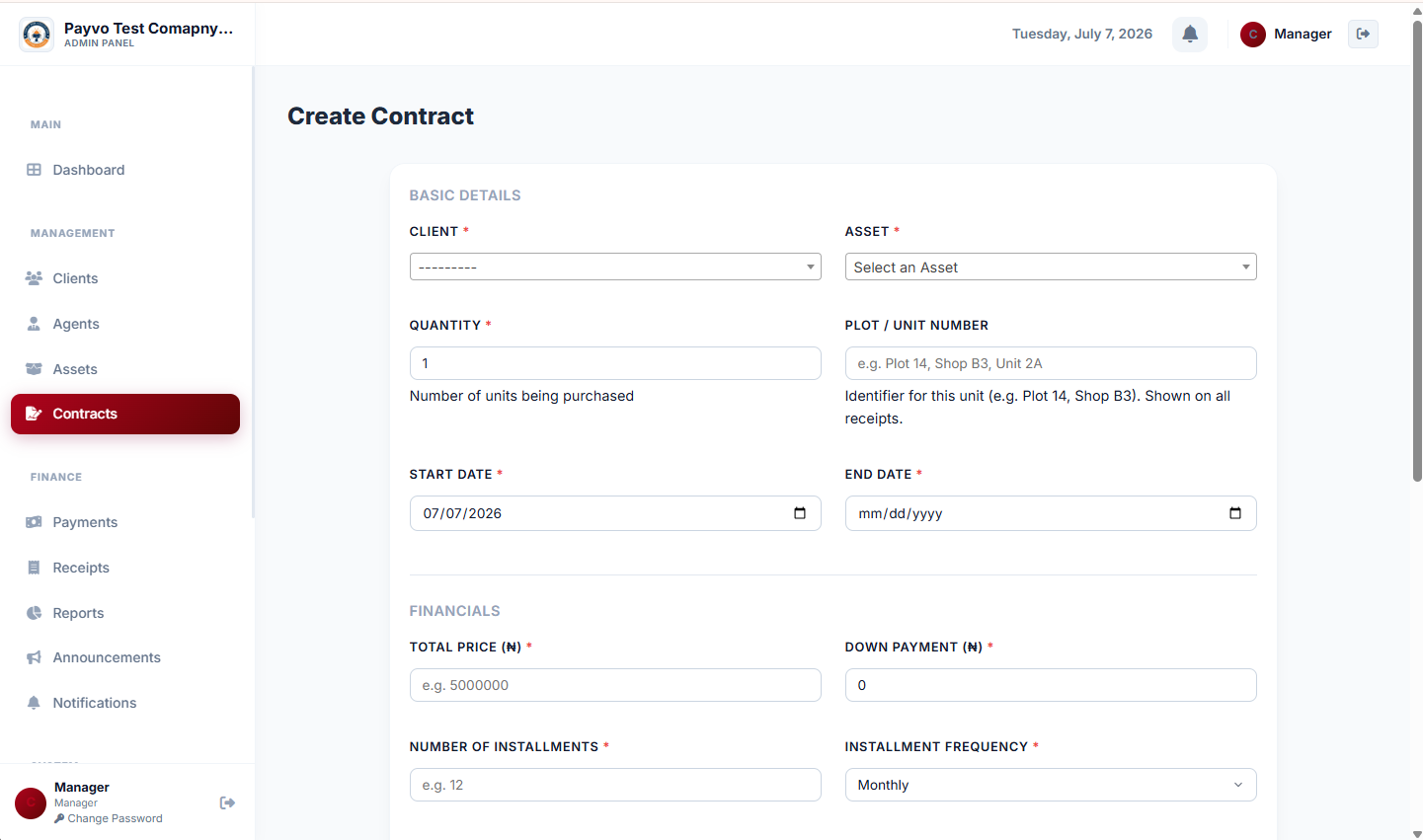 Management: Add contract (top)
Step 4: Systemize Your Payment Tracking
This is the absolute core of managing installment sales for multiple customers. If you're still using a paper ledger or a basic Excel sheet, you're building a house on sand. You need a reliable system to record every payment, track due dates, and calculate outstanding balances automatically. Imagine a busy building material supplier in Onitsha Main Market, selling cement and roofing sheets on credit. They can't afford to miss a payment or miscalculate a balance.
This is where a business payment tracking app Nigeria becomes indispensable. You need something that can handle all your installment customers, track payment dates, automatically update balances, and even send reminders. A good installment customer management software will free you from manual calculations and endless reconciliation. It gives you a clear, real-time view of your finances.
<blockquote cite="https://payvo.ng/about/">
"The biggest mistake a growing business makes is trying to manage tomorrow's problems with yesterday's tools. Manual tracking works until it doesn't, and by then, the cost of fixing the mess is far higher than investing in a proper system from the start."
</blockquote>
This is exactly why you need a solution like Payvo. With Payvo, you can register your customers, add the assets they're buying (be it a plot of land or an inverter), create detailed installment contracts, and record every single payment. It automatically tracks outstanding balances and due dates, giving you a clear picture without the guesswork. This kind of system is essential for payment tracking at scale.
- Actionable Tip: Invest in a dedicated installment management software Nigeria. Look for one that simplifies payment recording, automates balance tracking, and helps you manage many installment customers without breaking a sweat.
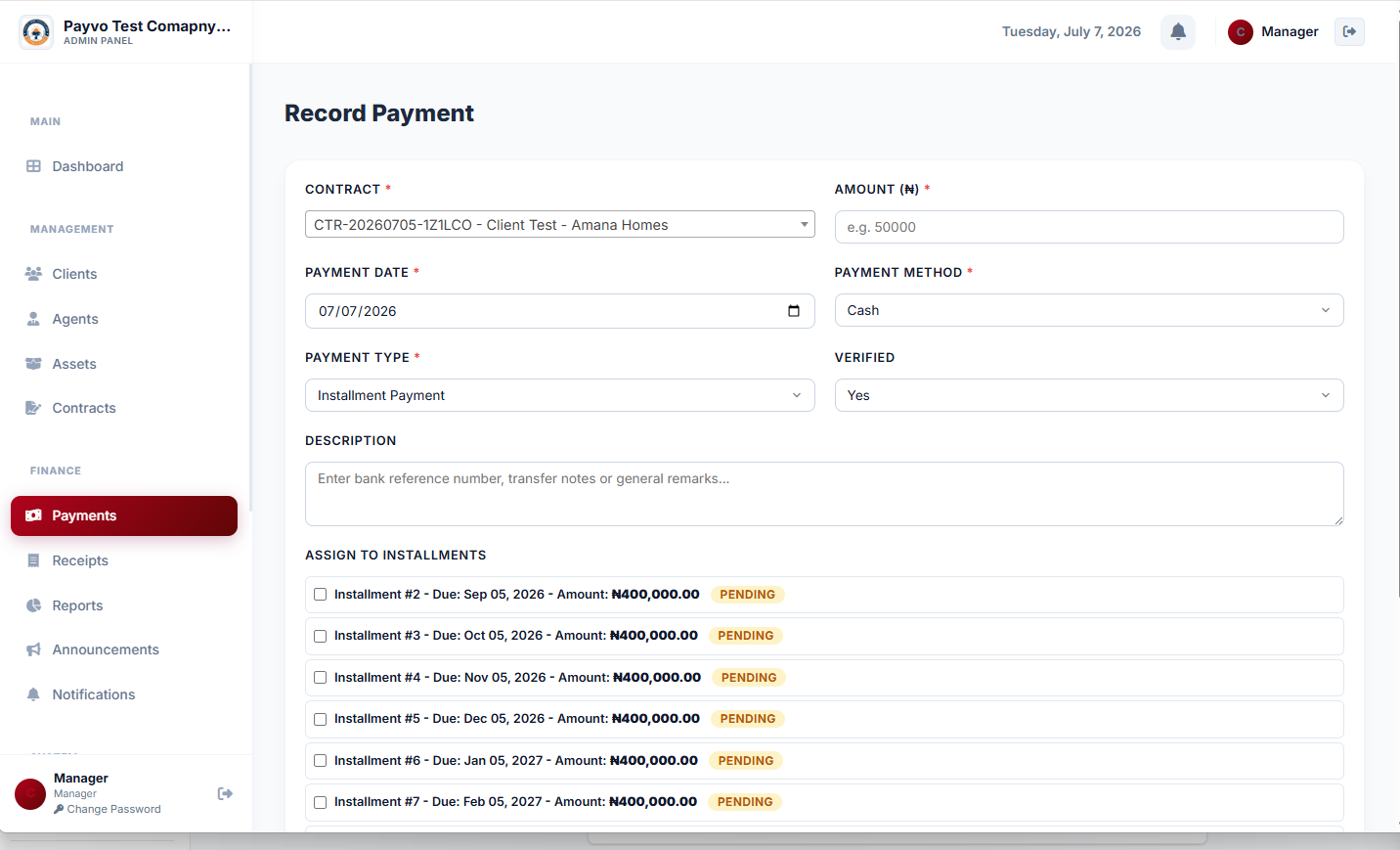 Finance: Record Payments Page
Step 5: Automate Communication and Reminders
Chasing customers for payments is one of the most time-consuming and often awkward parts of installment sales. Why not let a system do it for you? With a proper setup, you can automate payment reminders via SMS or WhatsApp payment notification system days before a payment is due. You can also send automated confirmations once a payment is received.
Think about a busy real estate developer in Kano. They have hundreds of clients across different estates. Manually calling or messaging each one is impossible. An automated system ensures consistent communication, reduces the burden on your staff, and helps improve your collection rates. It also provides a professional touch, showing your customers you're organized.
- Actionable Tip: Set up automated reminders for upcoming payments and overdue accounts. A simple "Your payment of ₦X is due on Y date" can make a huge difference.
Step 6: Generate and Issue Digital Receipts
Every payment received should be acknowledged with a receipt. This is non-negotiable for transparency and record-keeping. While physical receipts are common, digital receipts are more efficient and easier to track, especially when you manage many installment customers. A good receipt generator app Nigeria can create professional, branded receipts that you can send directly to your customers via email or WhatsApp.
Digital receipts also simplify your own record-keeping. No more lost paper slips or illegible handwriting. They provide a clear audit trail for every transaction, making reconciliation much easier.
- Actionable Tip: Issue a digital receipt for every payment, no matter how small. Ensure it clearly states the amount paid, the outstanding balance, and the date of payment.
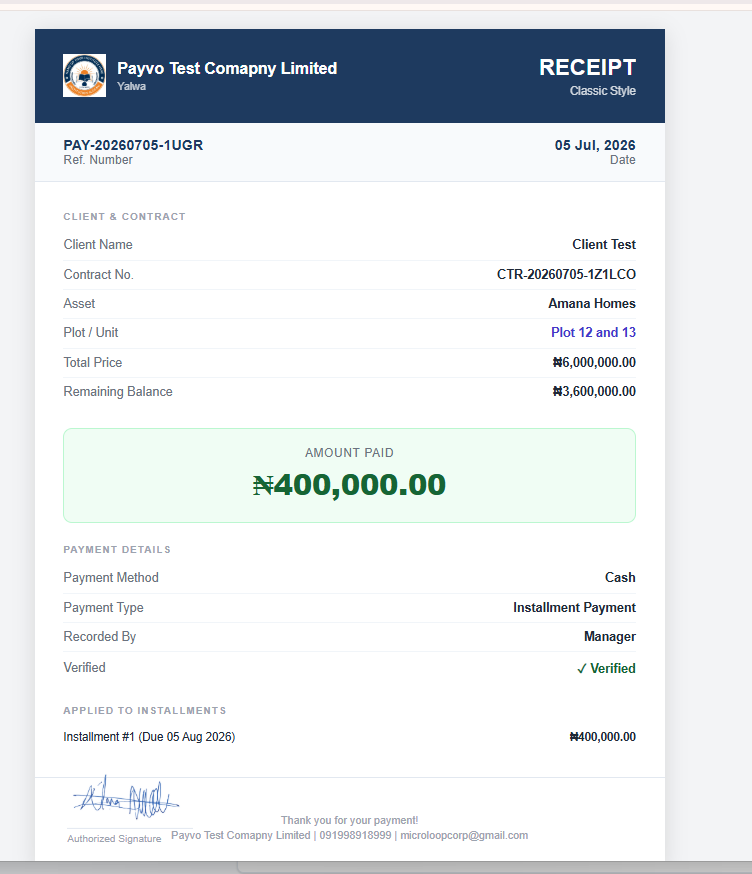 Finance: Paymnet Receipt Sample
Step 7: Monitor and Analyze Your Performance
You can't improve what you don't measure. Regularly review your installment sales performance. How many new contracts did you sign this month? What's your collection rate? How many customers are defaulting, and what's the total value of overdue payments? For a cooperative society, knowing these figures is crucial for their financial health.
Regular analysis helps you identify trends, adjust your terms if necessary, and spot potential problems early. If you see a spike in defaults, for example, you might need to re-evaluate your customer vetting process or your reminder system. This data-driven approach is what separates surviving businesses from thriving ones.
- Actionable Tip: Schedule a weekly or bi-weekly review of your installment sales report. Look for patterns, identify your best-performing products or agents, and address any red flags immediately.
5 Mistakes That Cost Nigerian Business Owners the Most
I've seen these mistakes play out time and time again in my years running shops and consulting. They might seem small, but they bleed money.
- Relying Solely on Memory or Paper Ledgers: This is the classic trap. You start with a few customers, and it works. Then you hit 20, 50, 100 customers, and suddenly, you can't remember who paid what or when. I once had a client, a furniture seller in Aba, who lost track of ₦187,500 in overdue payments because his ledger was a mess and his memory was overloaded. He had no idea until he finally tried to reconcile his books.
- Lack of Clear Contracts: Handshake deals are for friends, not business, especially when money is involved. Without a signed, legally sound contract, you have very little recourse if a customer decides not to pay. This is why car dealer installment software often emphasizes robust contract generation. It’s not about mistrust; it’s about professionalism.
- Ignoring Overdue Payments for Too Long: "Ah, they will pay eventually." This is a dangerous mindset. The longer a payment is overdue, the harder it is to collect. A small debt can quickly become a large, unrecoverable loss. Implement a strict follow-up schedule and stick to it. Don't be afraid to chase what's rightfully yours.
- Inefficient Agent Commission Tracking: If you have sales agents, especially in real estate or solar, you need a transparent system for their commissions. If agents don't know exactly what they're earning or when, motivation drops, and disputes arise. This is where agent commission tracking software comes in. Without it, you're inviting chaos.
- Not Investing in Proper Technology: Many business owners see software as an expense, not an investment. But the cost of mismanaged accounts, lost payments, and wasted time far outweighs the cost of a good installment management software Nigeria. Trying to manage payment tracking at scale with manual methods is a false economy.
How to Know If You're on Track (Success Metrics)
So, you've put in the work, you've set up your systems. How do you know if it's actually working? You need key performance indicators (KPIs) to tell you if you’re moving forward or just spinning your wheels.
- Collection Rate: This is probably your most important metric. What percentage of your due payments are you actually collecting each month? If you're consistently hitting 85-95% or higher, you're doing well. If it's below 70%, you have a problem. A good installment customer management software can generate reports that make this very clear.
- Average Days to Collect: How long, on average, does it take for a customer to pay after their due date? The lower this number, the better. If customers are consistently paying 5-10 days late, it suggests your reminder system might need tweaking or your terms aren't firm enough.
- Default Rate: What percentage of your installment contracts end in total default? This needs to be as low as possible. A high default rate indicates issues with your customer vetting, your product pricing, or your collection process.
- Customer Retention Rate: Are your installment customers coming back for more, or referring others? Happy customers who have a smooth payment experience are your best marketers.
- Administrative Time Saved: This is harder to quantify in naira, but you'll feel it. If you and your staff are spending significantly less time chasing payments and reconciling accounts, that's a huge win. This time can then be redirected to growth.
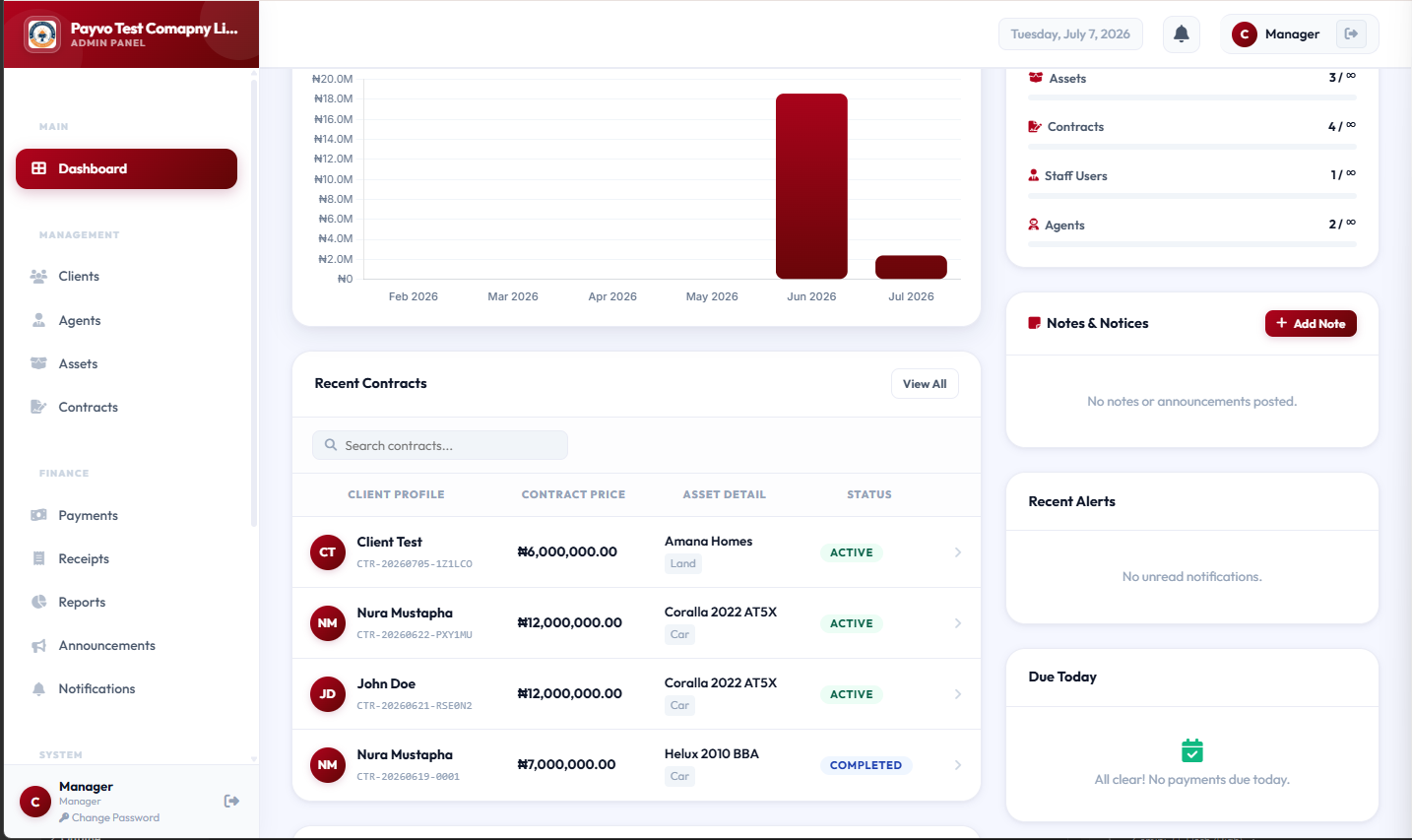 Dashobard (top)
Real Questions People Ask (FAQ)
Q1: How do I track installment payments for multiple properties or units?
A: For real estate payment tracking Nigeria, you need a system that can associate specific properties or units with individual customer contracts. Each property (e.g., plot number, apartment unit) should be uniquely identified, and then linked to the buyer's installment agreement. This ensures you know exactly which customer is paying for which asset. Many property developers use basic spreadsheets, but a dedicated installment customer management software is far more efficient for this, allowing you to manage assets and contracts separately yet linked.
Q2: What's the best way to handle agent commissions when payments are in installments?
A: This is a tricky one if not managed properly. The best way is to tie agent commissions directly to collected payments, not just signed contracts. So, if an agent earns 5% on a ₦5,000,000 property, they get their commission proportionally as the customer makes payments. An agent commission tracking software integrated into your payment system can automate this, ensuring fairness and transparency. You can track agent performance and their payouts easily, which boosts morale and reduces disputes.
Q3: Can I use WhatsApp to manage installment payments, or do I need something else?
A: WhatsApp is great for communication, but it's not a payment tracking system. You can use it for sending reminders or confirmations, especially with a WhatsApp payment notification system, but the actual record-keeping needs to happen elsewhere. Relying solely on WhatsApp conversations for payment details is risky; messages can get lost, deleted, or become hard to search. For serious payment tracking at scale, you need a structured installment management software Nigeria that can integrate with WhatsApp for notifications, but keeps the core financial records secure and organized.
Q4: How can I make sure customers don't forget their payment due dates?
A: The key here is consistent, polite, and automated reminders. Sending an SMS or WhatsApp message a few days before the due date, and then perhaps a gentle follow-up on the day it's due, works wonders. A good business payment tracking app Nigeria will have features to schedule these reminders automatically. This proactive approach reduces late payments significantly without you having to manually chase every customer.
Q5: What's the typical profit margin I should aim for on installment sales in Nigeria?
A: This varies widely by industry, but generally, you'd aim for a higher profit margin on installment sales compared to upfront cash sales. Why? Because you're taking on more risk and administrative burden. Typical profit margins on goods sold via installment can range from 15% to 40% after factoring in increased risk and administrative costs. For instance, a solar company might mark up their products more to cover the longer payment terms and potential for defaults. Just make sure your pricing remains competitive and attractive to customers.
Your Next Move
Look, managing installment sales for multiple customers isn't easy, but it's how many Nigerian businesses grow. You can keep struggling with notebooks and spreadsheets, or you can choose a smarter path. If you're serious about taking control of your installment sales, organizing your customers, and tracking every single payment without the headache, then it's time to check out a dedicated solution.
Ready to see how a professional installment customer management software can transform your business? Go ahead and Register into Payvo page today. You'll thank me later.