Ever felt like you’re running a thriving business, but also secretly managing a small army of debt collectors with a stack of notebooks and a calculator? You’re not alone. Many Nigerian businesses, from the bustling car dealerships in Ladipo to the emerging real estate firms in Abuja, struggle with how to manage installment contracts effectively. In fact, a recent informal survey of small businesses showed that over 60% still rely on manual methods to track installment payments, leading to lost revenue and endless headaches. It's frustrating, isn't it, when your hard work bringing in customers who want to buy on credit gets tangled up in paperwork?
 A busy lagos market scene with traders and
Why Most People Get This Wrong from Day One
Let's be honest, you start with the best intentions. A customer walks into your electronics shop in Computer Village, eyes sparkling at a new generator, say, for ₦187,500. They can't pay it all at once, but they can manage ₦25,000 upfront and ₦10,000 monthly. You jot it down in a ledger, maybe send a WhatsApp message to confirm. Simple, right? Until you have 50, then 100, then 200 customers doing the same thing.
Here's the thing: most businesses jump into installment sales without a solid system. They see the immediate cash flow and the chance to move inventory, which is good. But they underestimate the administrative burden. You're juggling initial deposits that can range from ₦10,000 for a small appliance to ₦50,000 for a higher-end item. Then there are the monthly payments, typically between ₦5,000 and ₦30,000. It's a lot to keep track of.
What happens when a customer misses a payment? You might charge a late fee, maybe ₦1,000 or ₦2,000, but how do you track that consistently across everyone? What about the interest rate, which in informal setups can be anywhere from 5% to 15% per month? Calculating that manually for dozens of accounts, each with different payment schedules, becomes a nightmare. Soon, you're spending more time chasing payments and reconciling records than actually selling. This is why having a clear strategy for your installment contract management from the start is so important.
Before You Do Anything: The Foundation Work
Before you even think about offering installment sales, you need to lay some groundwork. This isn't just about having products to sell; it's about protecting your business and making sure you can actually manage the process.
1. Know Your Numbers (and Your Customers):
You need to understand the cost of goods you're selling on installment. Is it a smartphone for ₦75,000 or a motorcycle for ₦350,000? What's your profit margin? And more importantly, who are your target customers? Most people looking for installment plans in Nigeria earn between ₦50,000 and ₦150,000 per month. Their ability to pay is directly tied to their income. A credit check, even an informal one, can save you a lot of grief. For a formal credit check, you might pay ₦2,000 to ₦5,000 to access bureau reports.
2. Draft a Solid Agreement:
Don't rely on a handshake or a WhatsApp chat. Get a proper installment agreement. You don't need to spend ₦200,000 on a lawyer for every single contract, but have a template drawn up by a legal professional. This document should clearly state:
- The total price of the item.
- The initial deposit.
- The monthly installment amount and due date.
- The duration of the agreement.
- Any interest rates.
- Penalties for late payments (e.g., ₦1,500 per missed payment).
- Your right to repossess the item if they default. (Repossession can cost you ₦10,000 to ₦50,000 for a small item, so you want to avoid it if possible).
- What happens if they default – a common penalty on formal contracts is 10-25% of the outstanding balance.
What's your grace period for late payments? How many missed payments before you take action? Will you send reminders? Who is responsible for tracking these? Having these policies written down and understood by your team is crucial. If you're running a cooperative society, for instance, everyone needs to be on the same page about how members' payments are handled.
4. Consider Your Capacity:
Can your current staff handle the extra work of tracking dozens or hundreds of installment plans? If not, you'll need to either train existing staff or hire new ones. Don't overload your team; it leads to errors.
The Step-by-Step Path (What Actually Works)
Now, let's talk about how to manage installment contracts effectively, from the moment a customer shows interest to their final payment. This isn't rocket science, but it requires discipline and the right tools.
Step 1: Customer Vetting and Agreement Signing
This is where you filter out potential problems. When a customer wants to buy, say, a solar inverter system for their home in Kano on installment, don't just take their word for it.
- What to do: Collect essential customer information: full name, address, phone numbers (at least two), a valid ID (National ID, Driver's License), and details of their employment or business. If possible, get a guarantor. Have them sign the detailed installment agreement you prepared earlier.
- Why it matters: This information is your first line of defense against default. It helps you contact them for payments and, if necessary, locate the item. For real estate payment tracking in Nigeria, especially for land plots in places like Epe or Ibeju-Lekki, this step is non-negotiable.
- Common shortcut that backfires: Relying on a verbal agreement or a simple receipt. When things go wrong, you have no legal standing. I've seen businesses lose millions this way.
- Action item: Create a standardized customer intake form and ensure every customer signs a formal installment agreement before taking possession of the goods.
Step 2: Setting Up the Installment Schedule
Once the agreement is signed and the initial deposit (e.g., ₦30,000 for that solar inverter) is paid, you need to map out the payment schedule.
- What to do: Clearly define the number of installments, the amount for each, and the exact due dates. If the total cost is ₦250,000, and they paid ₦30,000 upfront, that leaves ₦220,000. If they're paying ₦20,000 monthly, that's 11 months of payments.
- Why it matters: Both you and the customer need absolute clarity. This prevents disputes and helps the customer plan their finances.
- Common shortcut that backfires: Vague payment terms like "pay when you can" or "just pay monthly." This leads to missed payments and makes it impossible to track effectively.
- Action item: Use a system that automatically calculates and schedules these payments.
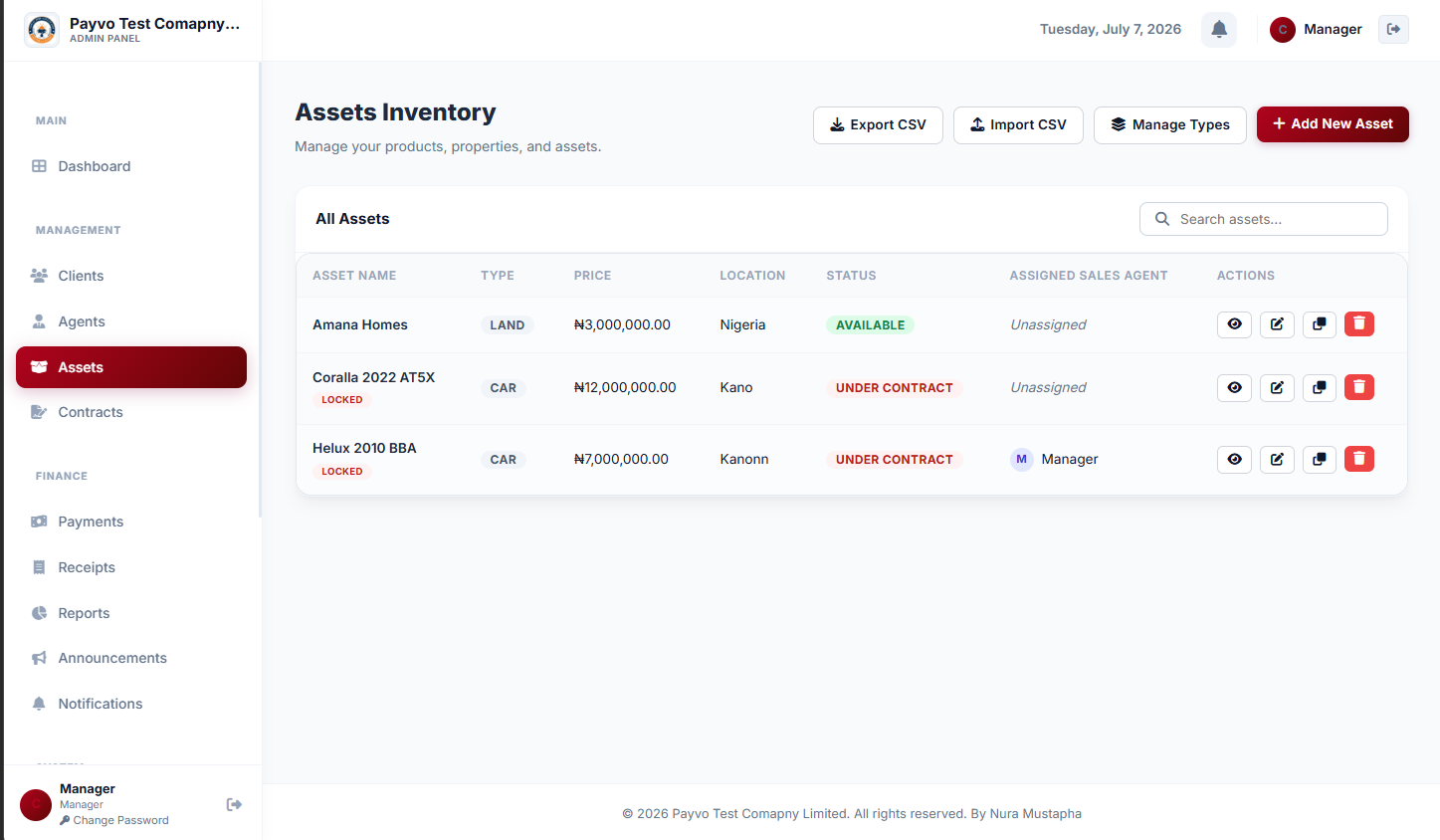 A dashboard showing a list of assets with details like type, value, and status
Step 3: Tracking Payments and Balances (This is Where Software Shines)
This is the core of installment contract management. You need to know, at any given moment, who has paid, who hasn't, and how much is still owed.
- What to do: Every single payment, no matter how small, must be recorded. Date, amount, payment method (cash, transfer, POS), and who received it. Then, the system needs to update the outstanding balance automatically. This is where a dedicated business payment tracking app Nigeria can transform your operations.
- Why it matters: Accurate records are paramount. They prevent fraud, resolve disputes, and give you a clear financial picture. Imagine you're a car dealer in Port Harcourt. You sell a pre-owned Toyota Corolla for ₦1,500,000 on hire purchase. Your customer pays ₦200,000 down and ₦80,000 monthly. Without a robust system, tracking 15-20 such vehicles becomes a full-time job for someone.
- Common shortcut that backfires: Using notebooks or spreadsheets that are easily lost, corrupted, or prone to manual errors. I once knew a trader in Balogun Market who lost an entire ledger. That was months of transactions, just gone. You can't run a serious business like that.
- Action item: Implement a dedicated installment management software Nigeria solution. For example, a platform like Payvo helps you centralize all your customer contracts software. You can register your customers, add the assets they're buying (like that car or solar system), create the installment contract, establish payment schedules, and record payments. It automatically tracks the outstanding balance, so you always know where you stand. This also helps with agent commission tracking software if you have sales agents. You can see their sales and payment collection performance in real-time.
Step 4: Communication and Reminders
Late payments are inevitable. How you handle them can make all the difference.
- What to do: Send automated reminders a few days before a payment is due. If a payment is missed, follow up promptly. Keep a record of all communications.
- Why it matters: Gentle reminders often prevent late payments. Prompt follow-up shows you're serious and helps resolve issues before they escalate. A good WhatsApp payment notification system can be incredibly effective here.
- Common shortcut that backfires: Waiting too long to follow up, or relying solely on phone calls that might not be answered.
- Action item: Set up automated payment reminders via SMS or WhatsApp, and have a clear protocol for follow-up calls or messages for overdue payments.
Step 5: Handling Defaults and Repossession (Last Resort)
Sometimes, despite your best efforts, a customer defaults.
- What to do: Refer to your signed contract. Follow the agreed-upon steps for late payment penalties and, if necessary, repossession. Document every step you take. This is where your contract management software Nigeria comes into play, providing all the necessary records.
- Why it matters: It protects your business legally and financially. If you have to go to court, your documented history of payments, communications, and the signed contract will be invaluable.
- Common shortcut that backfires: Taking matters into your own hands or repossessing items without proper legal procedure. This can lead to legal trouble for you.
- Action item: Understand your legal rights and obligations regarding repossession. Consult with a lawyer if you're unsure.
The Numbers That Will Make or Break You
Understanding the financial realities of installment sales is critical. This isn't just about managing customer contracts; it's about managing your cash flow and profitability.
Initial Investment & Inventory:
If you're selling consumer electronics, you might need ₦500,000 to ₦5,000,000 for initial inventory. For a small real estate developer buying land in Ogun State, that could be ₦10,000,000 to ₦50,000,000. This capital is tied up until the last installment is paid.
Operating Costs (Monthly):
- Rent: A small shop in a local market might be ₦150,000 annually, but a prime location in Lagos or Abuja could easily hit ₦2,500,000 per year.
- Staff Salaries: Even one or two staff members earning ₦60,000-₦90,000 each adds up.
- Utilities: Electricity, internet, etc., easily ₦15,000-₦50,000.
- Marketing: Even basic flyers or social media ads cost money, say ₦10,000-₦30,000.
- Software: A good installment management system like Payvo will have a subscription cost, which is a fraction of what you'd lose to manual errors.
While informal lenders might charge 5-15% interest per month, you, as a seller, might build in a smaller margin to cover the cost of credit. Say you add 1.5-3% interest monthly on the outstanding balance. This covers your risk and the time value of money. If your cost of goods is ₦150,000 and you sell it for ₦187,500 on installment, that ₦37,500 difference needs to cover your profit, the cost of credit, and your administrative overhead.
Default Rates:
This is the silent killer. Even with vetting, some customers will default. In Nigeria, depending on the item and vetting, you could face a default rate of 5% to 15%. If you sell 100 items worth ₦150,000 each, and 10 default, that's ₦1,500,000 lost. Your pricing strategy must account for this.
Legal Fees:
If you have to pursue legal action for a default, a simple contract enforcement can cost you ₦50,000 to ₦100,000 in legal fees, possibly more in a city like Lagos. This highlights why prevention and proper documentation are far cheaper.
<blockquote cite="https://www.statista.com/statistics/1233827/nigeria-informal-sector-contribution-to-gdp/">
"The informal sector contributes significantly to Nigeria's GDP, estimated at over 65% in 2023. This often means businesses operate with less formal structures, making robust installment tracking even more critical for stability and growth."
</blockquote>
Growth After Launch: The Next 90 Days
So, you've got your installment system in place. What next? The first 90 days after you start offering installment plans, or after you implement a new system, are crucial for refining your process and spotting early trends.
Month 1: Fine-Tuning and Training:
Focus on making sure your team understands the new process. Are they correctly entering customer details? Are they generating receipts properly? If you're using a system like Payvo, ensure everyone knows how to navigate it – from adding a new client to recording payments and checking outstanding balances. This is also a good time to review your customer contracts and policies. Maybe you notice that customers paying ₦5,000 monthly are more likely to default than those paying ₦20,000. Adjust your vetting.
Month 2: Monitoring and Optimization:
Start looking at the data. Which products are selling best on installment? Are payments coming in on time? Are there specific days of the month when payments are more likely to be missed? If you're using a platform with agent commission tracking software, you can start seeing which agents are most effective at bringing in reliable customers. You might find that your initial deposit range of ₦10,000 - ₦50,000 works well for electronics, but for a solar system, you need a higher initial commitment.
Month 3: Scaling and Review:
By now, you should have a good rhythm. You can start thinking about expanding your offerings or reaching more customers. Review your financial reports: how much have you collected? How much is outstanding? What's your actual default rate? This data will help you make informed decisions about future pricing, credit terms, and even staffing. For example, if you're a cooperative society management software user, you can analyze member repayment patterns to improve your lending criteria.
FAQ: Answers to What You're Actually Googling
Q: How do I track installment payments accurately without getting confused?
A: The most effective way is to use a dedicated system. Manual tracking with notebooks or even complex spreadsheets becomes messy very quickly, especially as your customer base grows. A good installment agreement tracking software allows you to input customer details, set up payment schedules, record each payment, and automatically calculates the remaining balance. This way, you always have an up-to-date, accurate record.
Q: What's the best way to remind customers about upcoming payments in Nigeria?
A: A multi-pronged approach usually works best. Send automated SMS or WhatsApp payment notification system messages a few days before the due date. Follow up with a phone call for overdue payments. This ensures the message gets across. Some customer contracts software, like Payvo, offer integrated notification features to automate this for you, saving you time and effort.
Q: What should I do if a customer completely stops paying their installments?
A: First, refer to your signed installment contract. It should outline the steps for missed payments and default. Usually, this involves a series of formal notices, late payment penalties (e.g., ₦1,000 - ₦2,000 per missed payment), and eventually, the right to repossess the item if it's a hire purchase. Always document every communication and action. For a car dealer installment software user, this is critical for legal protection.
Q: Can I manage installment sales if I have sales agents working for me?
A: Absolutely, and it's even more important to have a clear system. You need to track not just the customer payments but also which agent made the sale and collected which payments. A good agent commission tracking software integrated into your installment management system allows you to assign contracts to agents, track their collections, and calculate their commissions accurately. This transparency builds trust and accountability.
Q: Is there a receipt generator app Nigeria businesses can use for installment payments?
A: Yes, many modern installment management solutions, including Payvo, come with built-in receipt generation capabilities. When you record a payment, the system can automatically generate a digital receipt that you can print or send to the customer via email or WhatsApp. This provides proof of payment and maintains clear financial records for both parties.
Ready? Here's Where to Start
Managing installment contracts doesn't have to be a source of constant stress for your business. By putting in the right foundation work, streamlining your processes, and using the right tools, you can grow your sales confidently and keep your finances in order. You've seen how messy notebooks and manual calculations can get. Don't let that hold your business back in 2026.
If you're looking for a way to centralize your customer and installment records, track payments effortlessly, and gain a clear overview of your finances, you should definitely check out Payvo. It's designed specifically for businesses like yours to manage installment sales, track customer payments, and monitor outstanding balances all in one place. Take the first step towards better organization and more control. Visit Payvo's website today to learn more and see how it can transform your installment management. You can explore their features for real estate businesses here or for hire purchase operations here.