Have you ever found yourself staring at a stack of notebooks, a cluttered spreadsheet, or endless WhatsApp chats, trying to figure out exactly how much that customer still owes you for the plot of land they bought or the generator they picked up? You're not alone. In Nigeria, managing down payments and remaining balances for installment sales is a headache for over 60% of small and medium businesses by 2026, according to informal surveys I've seen. It’s a common frustration, this constant struggle to keep track of every kobo, every due date, every agreement. And let’s be honest, that frustration can cost you real money.
 A small business owner in nigeria looking thoughtfully
Why Most People Get This Wrong from Day One
The truth is, many of us start with the best intentions. You have a customer who wants to buy a solar inverter system for ₦750,000, but they can only afford a ₦150,000 down payment. You agree to weekly installments of ₦25,000. Sounds simple, right? You jot it down in a notebook, or maybe you open a new tab in your Google Sheet. Then another customer comes for a hire-purchase Keke Napep, needing a ₦350,000 down payment on a ₦1.8 million vehicle, with monthly repayments. Before you know it, you have ten, twenty, fifty such agreements.
This is where the wheels usually fall off. The biggest mistake I see businesses make is underestimating the administrative burden of installment sales. They focus on making the sale – which is good! – but neglect to set up a solid system for the follow-up. This isn't just about losing track of a payment; it's about losing trust, losing time, and ultimately, losing profits. I once worked with a client in Kano who sold building materials on credit. He lost over ₦2.3 million in a year simply because he couldn't accurately reconcile who had paid what, and when. His records were a mix of handwritten notes and disjointed WhatsApp chats. That’s a significant chunk of change for any SME, especially when the average Nigerian is earning between ₦50,000 and ₦150,000 per month in 2026. This isn't a problem of dishonesty from customers; it's often a problem of poor tracking from the business.
Another common pitfall? Relying on memory. Your brain is for brilliant ideas and strategy, not for storing the payment schedule of twenty different customers. And yet, so many business owners, especially those selling properties in Abuja or vehicles in Lagos, try to do just that. They’ll remember Mrs. Obi paid last week, but forget if it was for her land in Lugbe or the car she bought from them two months ago. This haphazard approach is a recipe for disputes, cash flow problems, and unnecessary stress.
Before You Do Anything: The Foundation Work
Before you even think about accepting a down payment, you need to lay a solid foundation. This isn't just about having a product to sell; it's about having a clear, enforceable process. Without it, you're building on sand.
First, define your terms. What's the minimum down payment you'll accept? For a small retail business selling electronics, it might be 10-20% of the item's cost. For a land developer in Kaduna, it could range from ₦500,000 to ₦3,000,000 for a small plot. Be specific. This isn't a guess; it's a business decision that impacts your cash flow and risk. Also, how long will the installment period be? Weekly, monthly, quarterly? For how many months? A clear payment schedule is non-negotiable.
Next, you need a formal agreement. I cannot stress this enough. A verbal agreement is worth the paper it’s written on – nothing. Even for a small equipment purchase, get it in writing. This doesn't have to be a complex legal document for every transaction, especially if you're a new business just starting with under ₦500,000. But a simple, signed document outlining the total cost, the down payment, the installment amount, frequency, and consequences of default is crucial. You can get a lawyer to draft a template for around ₦30,000 to ₦150,000, depending on the complexity. This protects both you and your customer.
Finally, consider your capacity. Can your current team handle the extra work of tracking these payments? If you're a one-person show managing a provision store in Surulere and suddenly start selling refrigerators on installment, you might quickly get overwhelmed. Be realistic about the time and resources needed for consistent follow-up and record-keeping.
<blockquote cite="https://payvo.ng/">
"The biggest challenge for businesses offering installment payments isn't finding customers; it's effectively managing the customer relationship and payment lifecycle after the initial sale."
</blockquote>
The Step-by-Step Path (What Actually Works)
Alright, so you’ve got your terms, your agreement, and you know what you’re getting into. Now, let’s talk about the practical steps to manage down payments and remaining balances like a pro. This is where you move from intention to execution, and where a good system truly shines.
Step 1: Document the Initial Down Payment Immediately
This might seem obvious, but you’d be surprised how many businesses get this wrong. The moment a customer makes a down payment, whether it's ₦80,000 for a shop rental or ₦1.5 million for a delivery van, you need to record it. Don't wait till the end of the day. Don't rely on a bank alert alone. Issue a receipt – a physical one if you must, but a digital one is far better for tracking.
The common shortcut that backfires here is simply trusting bank alerts or verbal confirmations. While these are good, they aren't a robust record. What if the customer disputes the amount later? What if your bank statement is unclear? An immediate, clear record prevents future headaches.
Action Item: Create a standard receipt format. For example, if you’re selling solar systems, ensure your receipt clearly states the total cost of the system, the amount paid as down payment, the date, and the remaining balance.
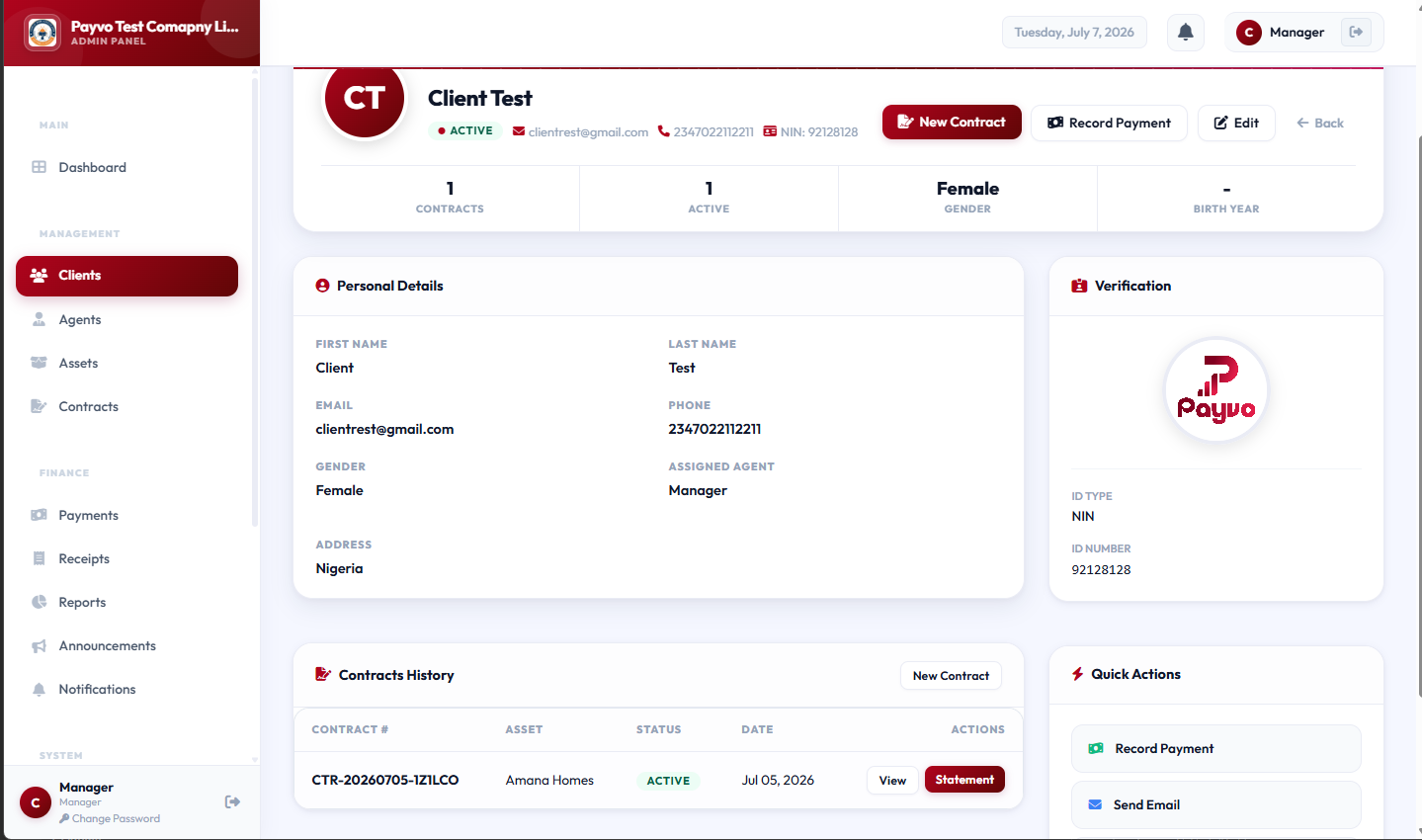 A clean, modern digital dashboard showing customer details and payment history
Step 2: Create a Detailed Payment Schedule
Once the down payment is received, the remaining balance needs to be broken down into manageable installments. This is where precision matters. For a land sale in Onitsha Main Market, if a plot costs ₦2,500,000 and the down payment was ₦750,000, that leaves ₦1,750,000. If they agree to pay over 12 months, that's roughly ₦145,833.33 per month. Don't round down to ₦145,000 and expect to magically make up the difference later. Every kobo counts.
The common shortcut: Rounding numbers or using vague "pay as you can" terms. This leads to discrepancies and makes it impossible to track accurate remaining balances.
Action Item: For every installment sale, generate a clear schedule detailing each payment amount and its exact due date. This helps both you and your customer know what's expected.
Step 3: Implement a Reliable System for Tracking Installments
This is the most critical step for managing down payments and remaining balances effectively. You need a system that centralizes all your customer information, contract details, payment schedules, and payment records. Relying on notebooks or even basic spreadsheets becomes unsustainable as your business grows. Imagine trying to check the remaining balance for 50 different customers across various sheets and WhatsApp chats – it’s a nightmare!
This is where a dedicated tool, like Payvo, comes in handy. It’s an installment management software designed specifically to help Nigerian businesses – from real estate developers in Kano to car dealers selling on hire purchase – keep all these moving parts organized. You can easily add customers, register assets (like vehicles or land plots), create contracts that include the initial down payment and subsequent installment schedules, and then record payments as they come in. This automatically updates the remaining balance, giving you a real-time view of what's owed. It helps you avoid those frantic searches through paper records or endless scrolling through messages, making it an essential business payment tracking app in Nigeria.
The common shortcut: Trying to manage everything with manual calculations and disparate tools. It's time-consuming, prone to error, and lacks the visibility you need to make informed decisions.
Action Item: Explore and adopt a robust contract management software Nigeria solution. Start by inputting your existing customer agreements and then use it for all new installment sales.
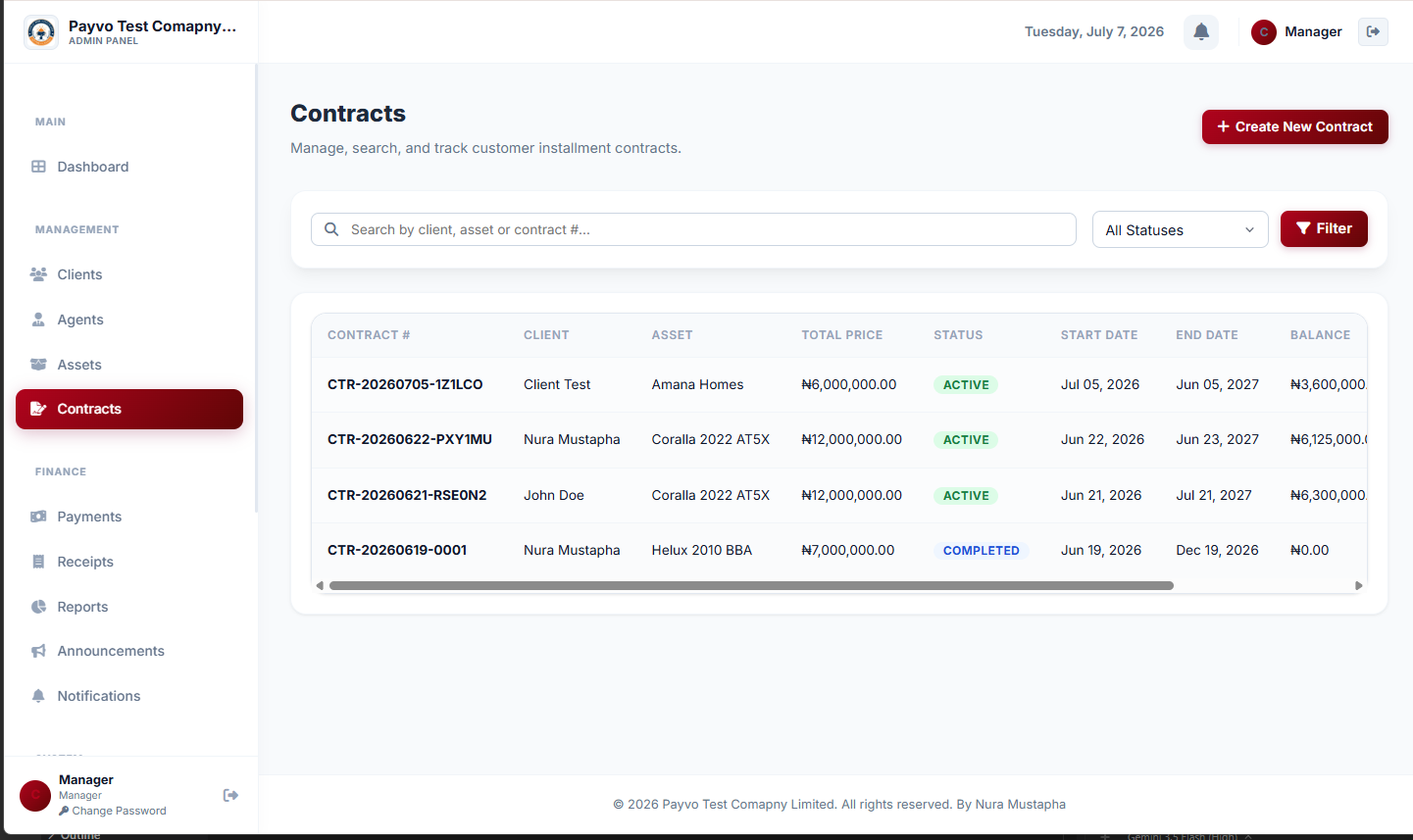 A view of the Payvo dashboard showing a list of contracts with their details
Step 4: Record Every Payment Accurately and Issue Receipts
Each time a customer makes an installment payment, record it immediately against their specific contract within your system. This isn't just about noting the amount; it's about noting the date, the payment method (cash, bank transfer, POS), and who processed it. Then, issue a digital receipt. A receipt generator app Nigeria can automate this, sending proof of payment directly to your customer. This builds trust and provides an undeniable record.
The common shortcut: Accepting payments without issuing receipts or delaying record-keeping. This creates ambiguity and opens the door for disputes. "I paid you last week!" "No, you didn't, the record shows you didn't." Sound familiar?
Action Item: Ensure every payment, no matter how small, is recorded in your installment management software Nigeria and a digital receipt is sent to the customer immediately.
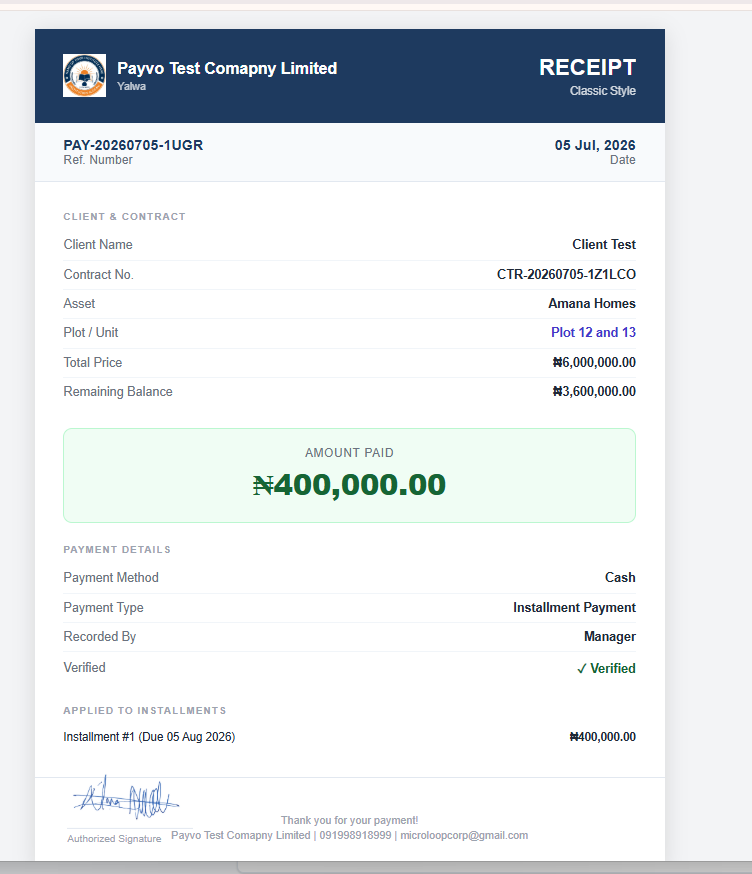 A sample digital receipt generated by Payvo, showing payment details
Step 5: Regularly Review Outstanding Balances and Follow Up
Don't wait for payments to be severely overdue before taking action. Your system should allow you to quickly see which payments are coming due and which are already overdue. A cooperative society management software, for instance, thrives on this kind of proactive management.
The common shortcut: Only checking records when there's a problem or when you need money. This reactive approach often means payments are significantly delayed, or worse, forgotten.
Action Item: Set aside dedicated time each week to review your outstanding balances. Use automated reminders (if your system has them, like a WhatsApp payment notification system) to gently nudge customers before or on their due dates.
Step 6: Define and Enforce Consequences for Non-Payment
This is the part most people don't expect, but it's crucial. What happens if a customer misses a payment? Is there a late fee? A grace period? Will you repossess the item (for hire-purchase)? Or re-allocate the land (for real estate)? Your contract should clearly outline these consequences, and you must be prepared to enforce them. In my years, I've seen businesses crumble because they were too lenient, or worse, inconsistent, with their enforcement.
The common shortcut: Avoiding uncomfortable conversations or being inconsistent with enforcement. This teaches customers that your payment terms aren't serious.
Action Item: Make sure your payment agreements clearly state the consequences of default, and communicate these clearly to your customers upfront.
The Numbers That Will Make or Break You
Understanding the financial realities of installment sales is not just about tracking; it's about strategic planning. You need to know your costs and revenue projections inside out.
Let's talk about initial capital. If you're a solar equipment leasing company, your down payment for small equipment might be ₦50,000 – ₦300,000. But for a real estate developer, an initial deposit for a prime Lagos Island retail space could be as high as ₦2,000,000 (annually, of course, because shop rent is annual here). A down payment for a commercial Keke Napep could be ₦300,000, while a small delivery van might require ₦1,500,000 upfront. These are significant sums, and they tie up your capital.
Consider the cost of money. If you're borrowing to finance your inventory or assets, the interest rates can be crippling, especially from informal lenders or cooperative societies, where rates can range from 5% to 15% per month. Yes, you read that right – per month! A bank loan might have a processing fee of 1% to 3% of the loan amount, but the monthly installments can still be substantial, ranging from ₦20,000 to ₦150,000. This means every missed or delayed payment impacts your ability to service your own debts.
Your cash flow will be directly affected by how well you manage down payment tracking and remaining balance management. If you’re selling building materials on credit, and your supplier requires a 30% down payment on a ₦5,000,000 order (that’s ₦1,500,000), but your customers are only paying 10% down and then dragging their feet on installments, you’re in a liquidity crunch. You're constantly chasing funds to meet your own obligations.
This is why accurate payment tracking is not just an administrative task; it's a financial imperative. You need to be able to forecast your incoming payments reliably. You need to know, at any given moment, your total outstanding receivables. This data empowers you to make smarter business decisions, like when to reorder stock, when to expand, or when to tighten your credit terms. Without this clarity, you're essentially driving blind, hoping for the best.
Growth After Launch: The Next 90 Days
Launching an installment sales model is one thing; making it sustainable and profitable is another. The first 90 days after you implement a structured system for tracking down payments and remaining balances are crucial for establishing momentum and refining your process.
During this period, focus on consistency. Make sure every single transaction, from the smallest down payment on a phone at Computer Village to a large land sale in Port Harcourt, is entered into your contract management software Nigeria. Don't skip any. This is how you build reliable data.
Actively use the reporting features of your chosen system. For instance, a good business payment tracking app Nigeria will show you your payment collection rates, identify which customers are consistently late, and highlight your total outstanding balances. This isn't just about looking at numbers; it's about understanding trends. Are most people missing their payments on the third installment? Is there a particular product that has a higher default rate? This insight is gold.
Consider implementing an agent commission tracking software if you have a sales team. Your agents are often the first point of contact and play a huge role in payment collection. Knowing who sold what, and tracking their collection performance, can motivate them and ensure accountability. This is especially vital for real estate payment tracking Nigeria, where agents are key.
Also, gather feedback from your customers. Are the payment reminders helpful? Is the receipt system clear? A quick call or WhatsApp message can give you valuable insights and help you improve your process. Remember, a happy customer is more likely to pay on time.
FAQ: Answers to What You're Actually Googling
Here are some common questions I get asked about managing down payments and remaining balances:
How can I track installment payments effectively without using complicated software?
Honestly, "complicated software" is often less complicated than a pile of notebooks and spreadsheets. For very small volumes (say, 1-5 active installment contracts), a well-organized Google Sheet can work, but it requires extreme discipline. You'll need columns for customer name, item, total price, down payment, remaining balance, installment amount, due dates, and a separate tab for each payment received. The key is manual updating and consistent reconciliation. However, as soon as you hit 10+ contracts, you'll feel the pain and realize a dedicated installment management software Nigeria solution saves you more time and stress than it costs.
What’s the best way to calculate the remaining balance after a down payment?
It's straightforward: Total Price - Down Payment = Remaining Balance. Then, Remaining Balance / Number of Installments = Per Installment Amount. The challenge isn't the calculation itself, but consistently tracking each subsequent payment against that remaining balance. If a customer misses a payment or makes a partial payment, your calculations get more complex. This is where a system that automatically adjusts the remaining balance with each recorded payment becomes invaluable.
How do I handle customers who consistently pay late?
First, ensure your contract clearly outlines late payment penalties or consequences. Second, use automated reminders (like a WhatsApp payment notification system) that go out a few days before and on the due date. If a customer is still late, a polite, firm follow-up call or message is necessary. For persistent late payers, you might need to re-evaluate their payment terms, offer a revised schedule, or, as a last resort, enforce the default clauses in your agreement. Consistency is key here; don't let it slide repeatedly.
Can I use a regular receipt generator app Nigeria for installment payments?
While a general receipt generator can produce a receipt for each payment, it typically won't track the overall contract, the remaining balance, or the payment schedule. You'll still need a separate system (like a spreadsheet or a dedicated installment tracking solution) to link those individual receipts back to the main agreement and calculate what's still owed. This is why integrated solutions are more efficient for remaining balance management.
Is it really necessary to have a contract management software Nigeria for small businesses?
"Necessary" depends on your definition of small. If you have more than five active installment agreements, or if these agreements represent a significant portion of your revenue, then yes, it becomes necessary for efficient operation and financial health. The cost of manual errors, lost time, and potential disputes far outweighs the subscription cost of a good system. It’s an investment in the sanity and sustainability of your business.
Ready? Here's Where to Start
Managing down payments and remaining balances doesn't have to be a constant source of stress. You've seen the pitfalls, understood the foundation work, and walked through the steps that actually work. Now, it's time to take action.
If you're tired of scattered records, endless manual calculations, and the anxiety of not knowing your exact financial standing, explore how a dedicated installment management solution can transform your operations. Visit Payvo's public home page to learn more about how it helps businesses like yours in Nigeria streamline their payment tracking. You can also dive straight into the features page to see what's possible, or register into Payvo page to try it out for yourself. Take control of your installment sales today.