Everyone tells you the secret to growing your phone business is to offer installment plans. "Just let them pay small-small," they'll say. And yes, it sounds like a brilliant idea to unlock sales for customers who can't afford a full payment upfront for that new Tecno Spark 20 or Infinix Hot 40. But here's the honest truth: most people who jump into this without a proper system end up with a huge headache. They lose track of payments, deal with endless arguments, and sometimes, even lose their capital. If you want to know how to manage customers buying phones on installment plans without losing your mind or your money, you're in the right place. I’m here to tell you why the common advice is often wrong, and what you actually need to do in 2026 to make it work.
 A busy phone shop in a nigerian market
Why Most People Get This Wrong from Day One
The biggest mistake I see businesses make when diving into installment sales, especially for electronics, is underestimating the administrative burden. You see a customer eager to buy a ₦95,000 Infinix Hot 40, they pay a ₦30,000 deposit, and you think, "Great, ₦65,000 more to go!" You scribble it down in a notebook, maybe send a WhatsApp message confirming the balance, and then… life happens.
Suddenly, you have ten, twenty, fifty customers, all on different payment schedules – weekly, bi-weekly, monthly. Someone pays ₦5,000, another pays ₦7,500. Are they on time? Are they late? How much do they really owe? This is where the wheels fall off. Manual tracking with notebooks or even basic spreadsheets quickly becomes a nightmare. You spend hours reconciling payments, chasing customers, and dealing with disputes because your records are scattered.
Think about it: the average small phone vendor in a bustling market like Computer Village or Alaba International might move 10-20 entry-level phones a month. If half of those are on installment, you’re looking at 5-10 active contracts, each with its own rhythm. Without a solid process, that's 5-10 potential sources of confusion. And in Nigeria, where power supply can be erratic and internet access isn't always stable, relying on a fragile system is a recipe for disaster. This isn't just about losing track; it's about losing trust, losing time, and ultimately, losing money. Many businesses, from car dealers selling on hire purchase to cooperative societies, face similar challenges. You need a system that works, not just a wish and a prayer.
Before You Do Anything: The Foundation Work
Before you even think of handing over that shiny new phone, you need to build a rock-solid foundation. This isn't optional; it's survival.
1. Secure Your Capital & Stock
You can't sell what you don't have. For a small-scale vendor, initial stock for 5-10 entry-level smartphones will set you back anywhere from ₦250,000 to ₦800,000. This isn't just for the phones themselves, but also a buffer for operating costs. If you’re eyeing mid-range models, a single unit could be ₦150,000 - ₦350,000. Don't overextend yourself. Start small, understand your market, and grow. Trying to run an installment business on a shoestring budget, hoping the next payment comes in to buy more stock, is a dangerous game.
2. Understand Your Operating Costs
This is where many businesses fail. They only calculate the cost of the phone and the profit margin. But what about everything else?
- Shop Rent (Annual): A small kiosk in a suburban market might be ₦120,000 per year (₦10,000/month), but a decent shop in a city like Ibadan or Abuja could easily hit ₦1,800,000 annually (₦150,000/month).
- Staff Salary (Monthly): If you hire a sales assistant, expect to pay ₦40,000 - ₦80,000 monthly, depending on experience and location.
- Internet/Data (Monthly): You'll need reliable internet for business operations, processing payments, and communication. Budget ₦5,000 - ₦15,000.
- Generator Fuel (Monthly): Power is not guaranteed. If you rely on a generator, factor in ₦15,000 - ₦50,000 monthly for fuel.
3. Draft a Solid Installment Agreement
This is non-negotiable. A handshake and a verbal agreement are not enough. You need a written contract. This document should clearly state:
- The full price of the phone.
- The initial down payment (usually 20%-40% of the phone price to mitigate risk).
- The installment amounts and frequencies (weekly, bi-weekly, monthly).
- The total number of payments and the final payment date.
- Any interest rates (often 5%-10% monthly on the outstanding balance, built into the total price to cover risk and cost of capital).
- Consequences of late payments (penalties, repossession clauses).
- Guarantor details (crucial for recovery).
4. Implement a Robust Customer Verification Process
You can't just sell to anyone who walks in. You need to know who your customers are.
- Valid ID: National ID card, Driver's License, or Voters Card.
- Proof of Address: Utility bill (electricity, water) or a tenancy agreement.
- Guarantor: A reliable guarantor with their own valid ID and contact details. This is especially important for higher-value items.
- Credit Check (Optional but Recommended): For a small fee (₦2,000 - ₦5,000), you can access basic credit bureau data or run local guarantor checks. This might sound like too much for a phone, but it significantly reduces your risk.
The Step-by-Step Path (What Actually Works)
Now that your foundation is solid, let's talk about the practical steps to manage customers buying phones on installment plans effectively.
Step 1: Standardize Your Installment Offers
Don't customize every single payment plan. It's a logistical nightmare.
What to do: Create 2-3 standard installment plans (e.g., 4-week, 8-week, 12-week plans) with fixed down payments and regular payment amounts.
Why it matters: Standardization simplifies tracking and communication. Customers know what to expect, and your team isn't calculating bespoke plans daily. This also helps you manage customer records more efficiently.
Common shortcut that backfires: Letting customers dictate their own payment schedules. You'll end up with 50 different plans for 50 customers.
Action Item: For each phone model you sell, define your standard down payment percentage (e.g., 30%) and the maximum installment duration. Calculate the weekly/monthly payment for each plan.
Step 2: Digitize Your Customer and Product Records
Paper records are prone to loss, damage, and errors. WhatsApp chats are not a database.
What to do: Move all customer information, phone details, and contract terms into a digital system.
Why it matters: Centralized digital records mean you can quickly look up any customer, see their payment history, and know their outstanding balance. This is crucial for managing disputes and ensuring accurate tracking. Imagine a customer arguing they paid ₦10,000 last week when your book says ₦5,000. A clear, digital record ends the argument immediately.
Common shortcut that backfires: Relying solely on notebooks or scattered WhatsApp messages. When a phone crashes or a notebook goes missing, so does your entire business history.
Action Item: Start with a simple spreadsheet for now if you must, but plan to upgrade. For a truly robust solution, consider an installment management software Nigeria businesses are already using. You'll want to add customer details, phone IMEI, purchase date, and agreed payment terms.
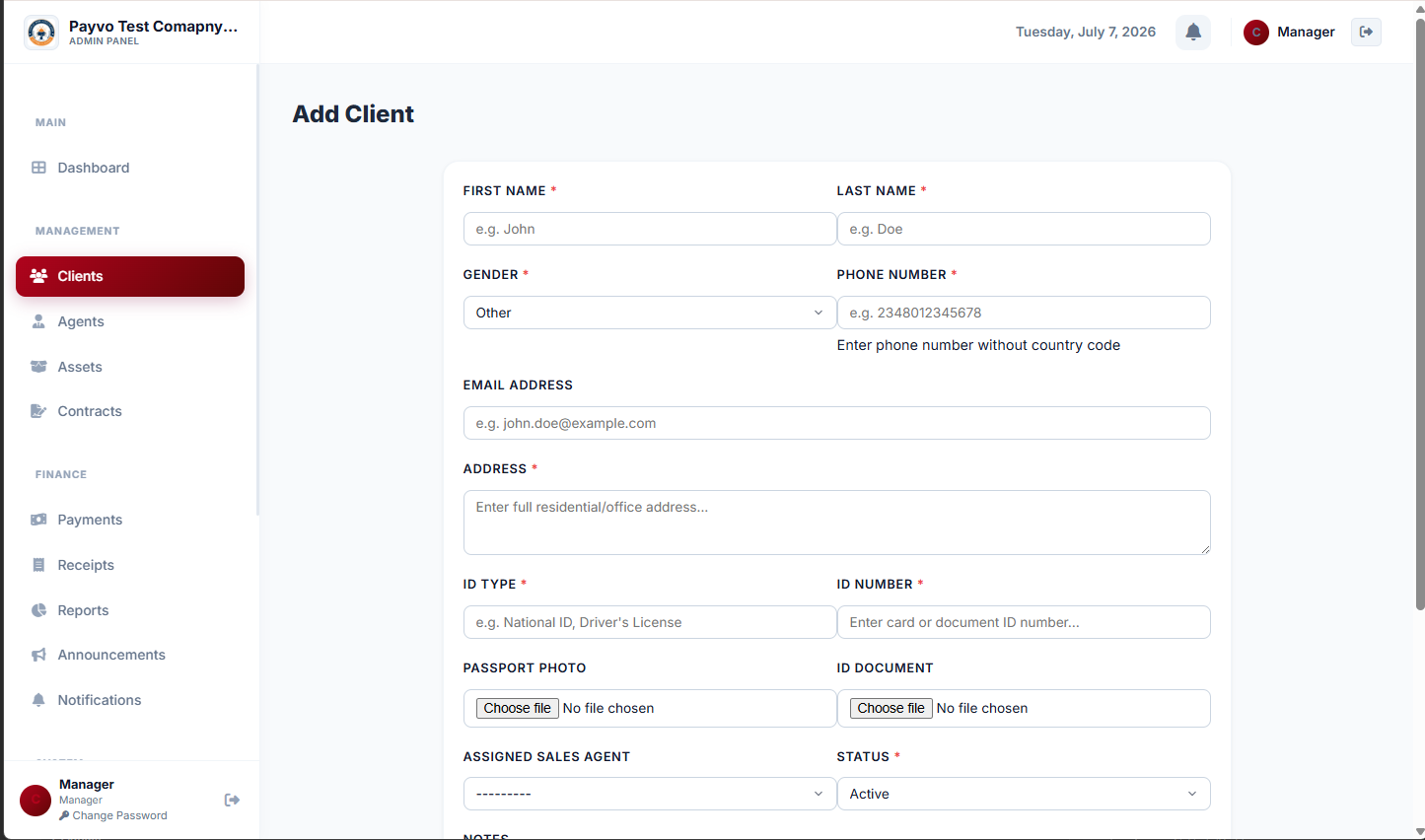 Client: Add Client page
Step 3: Automate Payment Scheduling and Reminders
Chasing customers for payment is time-consuming and awkward.
What to do: Set up automated payment schedules and reminders.
Why it matters: This reduces missed payments and frees up your staff to focus on sales, not debt collection. A gentle reminder before a due date can make all the difference. This is a game-changer for businesses that manage car dealer installment software or even real estate payment tracking Nigeria.
Common shortcut that backfires: Manually calling or messaging every customer. This is not scalable and burns out your team.
Action Item: This is where a dedicated system like Payvo shines. It allows you to create contracts with specific payment schedules, automatically calculate outstanding balances, and even send automated WhatsApp payment notification system messages. You can easily manage customer records, set up payment schedules, and track every single transaction.
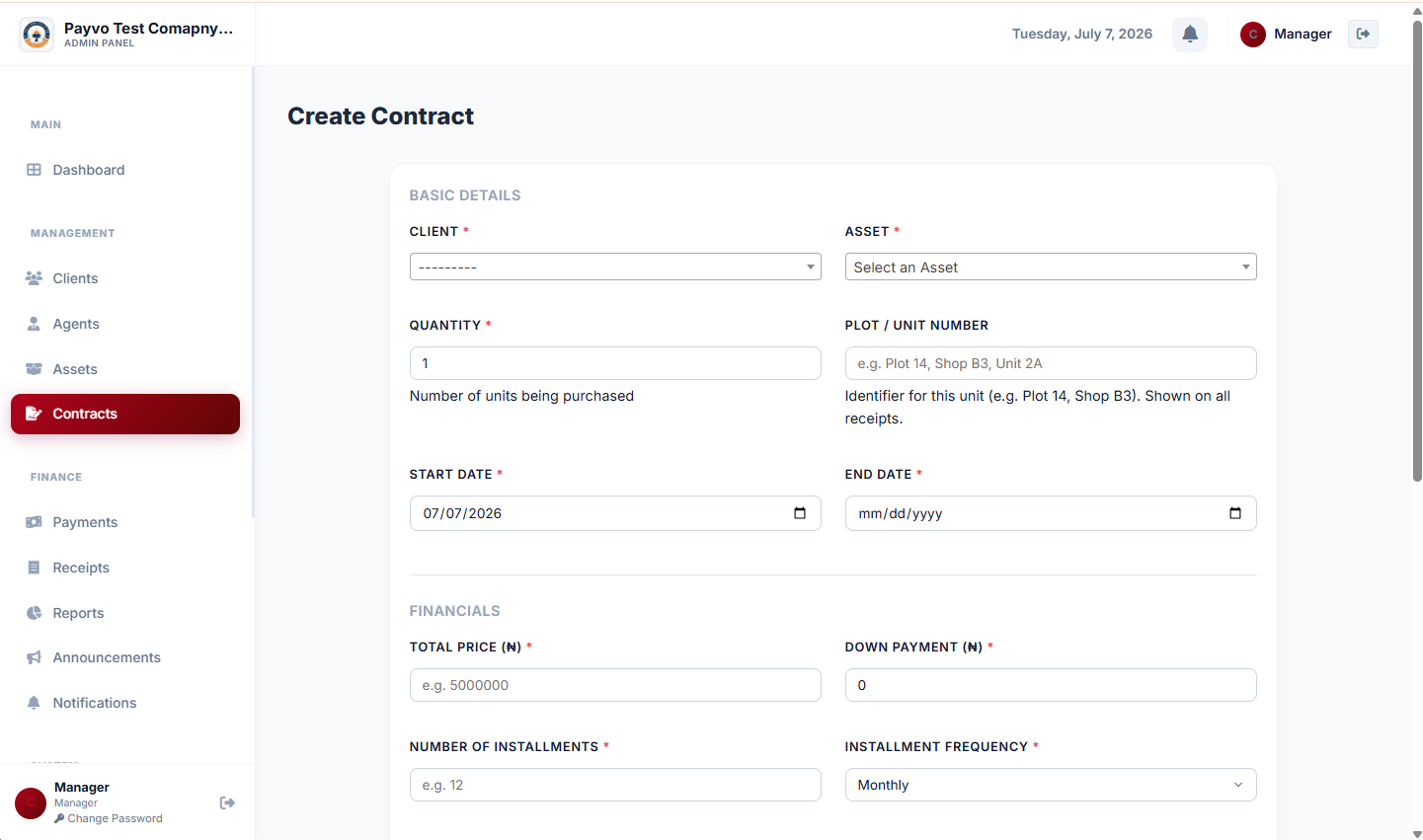 Management: Add contract (top)
Step 4: Institute a Clear Payment Recording Process
Every payment must be recorded immediately and accurately, and a receipt generated.
What to do: When a customer pays, record the payment in your system, update their balance, and issue a digital receipt instantly.
Why it matters: This builds trust with your customers and provides undeniable proof of payment for both parties. It also helps you maintain clear financial records and understand your cash flow.
Common shortcut that backfires: Waiting until the end of the day to record payments, or only issuing paper receipts that can get lost. This leads to discrepancies and disputes.
Action Item: Use a receipt generator app Nigeria businesses can rely on. With Payvo, you can record payments quickly and generate professional digital receipts that can be sent directly to the customer.
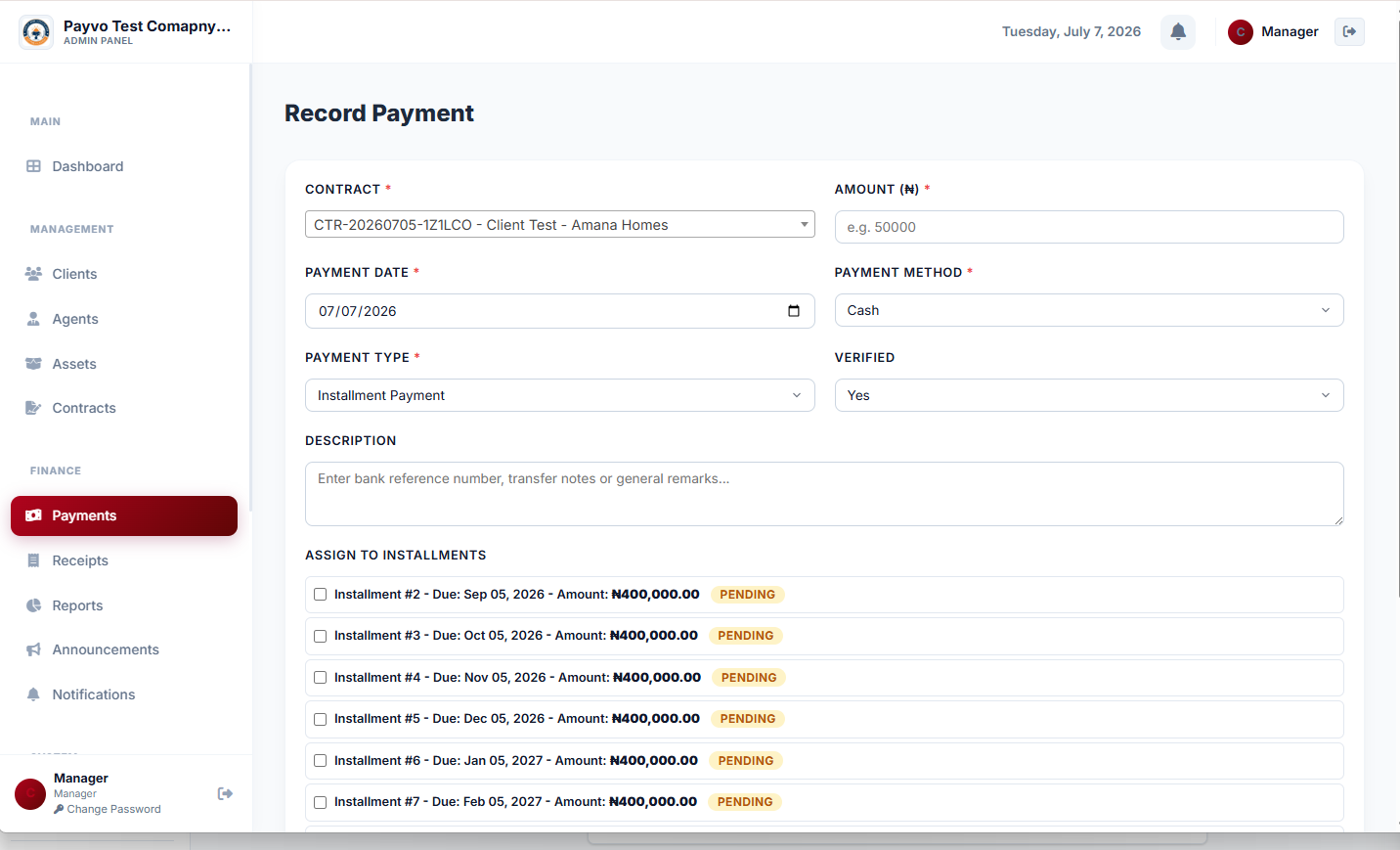 Finance: Record Payments Page
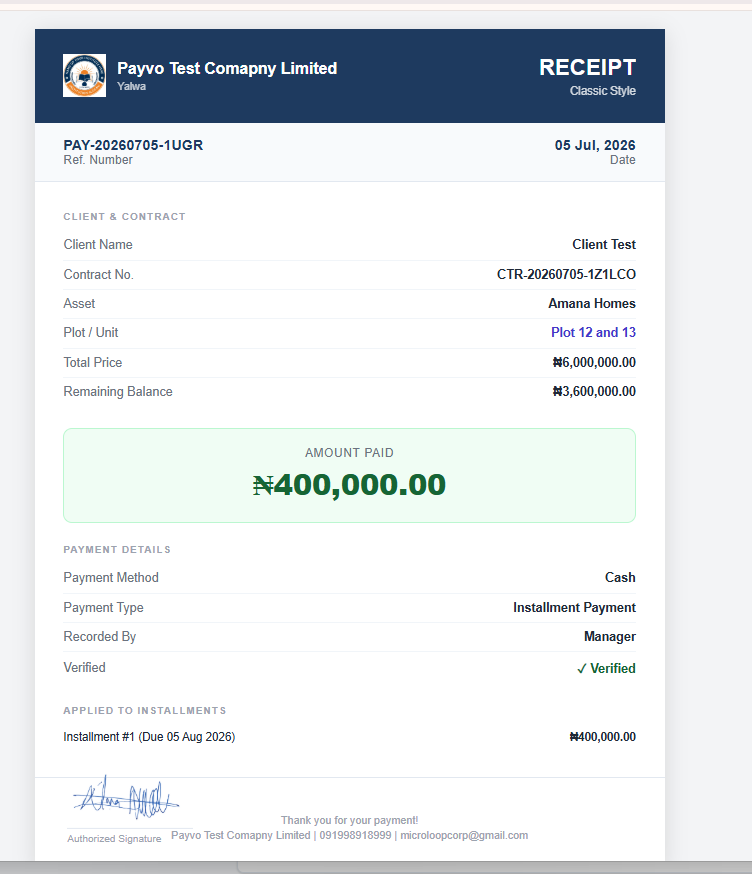 Finance: Paymnet Receipt Sample
Step 5: Regularly Review Outstanding Balances and Follow Up
Don't wait until a payment is weeks overdue.
What to do: Set aside dedicated time each week to review all active installment contracts. Identify overdue payments and promptly follow up.
Why it matters: Early intervention is key. A payment that's one day late is easier to recover than one that's a month late. This proactive approach helps you keep your collections on track and reduces the risk of bad debt.
Common shortcut that backfires: Only checking records when you need cash or when a customer complains. This means you're always playing catch-up.
Action Item: Leverage the reporting features of your installment management software Nigeria solution to quickly see who owes what. Prioritize follow-ups based on the amount owed and the payment history.
> "The difference between a struggling business and a thriving one often isn't the sales volume, but the efficiency of its collections."
The Numbers That Will Make or Break You
Understanding your financials is paramount. Let's break down the real costs and potential earnings for a phone installment business in Nigeria in 2026.
Startup Costs (Initial Outlay)
- Initial Stock (5-10 entry-level smartphones): ₦250,000 - ₦800,000. This is your core inventory.
- Shop Rent (Annual): ₦120,000 - ₦1,800,000. Let's say you get a decent spot in a mid-sized city for ₦750,000/year.
- Legal Fees for Installment Agreement: ₦30,000 - ₦100,000. Budget ₦60,000 for a solid contract.
- Basic Shop Setup (shelves, signage, basic security): ₦50,000 - ₦200,000. Let's go with ₦100,000.
- Working Capital Buffer (3 months operating costs): This is crucial.
So, a realistic startup cost could be: ₦600,000 (stock) + ₦750,000 (rent) + ₦60,000 (legal) + ₦100,000 (setup) = ₦1,510,000. Then add about ₦300,000 for 3 months of basic operating costs (staff, internet, fuel). Total Initial Investment: ₦1,810,000. This is a significant sum, even for a small business.
Monthly Running Costs
- Shop Rent (amortized): ₦62,500 (₦750,000 / 12 months)
- Staff Salary: ₦55,000 (average for one assistant)
- Internet/Data: ₦10,000
- Generator Fuel: ₦30,000 (assuming erratic power)
- Marketing/Promotions: ₦15,000 (flyers, local social media ads)
- Miscellaneous (repairs, cleaning supplies): ₦10,000
- Software (e.g., Payvo subscription): Let's budget ₦15,000 - ₦30,000 depending on your plan and needs.
Total Monthly Operating Costs: ₦197,500.
Revenue and Profitability
- Cost of a Single Entry-Level Smartphone: ₦50,000 - ₦120,000. Let's use ₦75,000.
- Gross Profit Margin (per phone): 15% - 25%. On a ₦75,000 phone, that's ₦11,250 - ₦18,750.
- Installment Price Markup: To cover risk, interest, and administrative costs, you might sell a ₦75,000 phone for ₦90,000 - ₦100,000 on installment, giving you a higher effective margin.
- Expected Monthly Revenue (Small-scale, 10-20 phones sold): ₦500,000 - ₦1,500,000. This assumes a mix of cash and installment sales.
Let's assume you sell 15 phones a month at an average installment price of ₦95,000. Total Revenue = 15 phones * ₦95,000 = ₦1,425,000. Cost of Goods Sold (COGS) = 15 phones * ₦75,000 (your purchase price) = ₦1,125,000. Gross Profit = ₦1,425,000 - ₦1,125,000 = ₦300,000.
Subtract your monthly operating costs (₦197,500) from your gross profit (₦300,000).
Net Profit: ₦102,500 per month.
This is a simplified calculation, but it shows you need to sell a decent volume and manage your collections tightly to be profitable. If your collection rate drops, or your operating costs increase, that ₦102,500 can quickly disappear. This is why tools that help you track installment payments and manage your finances are not luxuries, but necessities. You need to keep a close eye on your profit margins, especially if you're offering competitive rates or dealing with longer payment terms.
Growth After Launch: The Next 90 Days
You've launched your installment plan. Now what? The first 90 days are critical for establishing momentum and refining your process.
Month 1: Focus on Onboarding and Education
Your first few installment customers are your guinea pigs. Treat them well, but also learn from them.
- Perfect your onboarding: Ensure every customer understands the contract, payment schedule, and your follow-up process.
- Gather feedback: Ask your first 5-10 customers about their experience. What was clear? What was confusing? Use this to refine your process.
- Monitor payment behavior: Are payments coming in on time? Are there common days people miss? This data is gold.
- Train your team: If you have staff, ensure they are fully conversant with the installment process and how to use your business payment tracking app Nigeria. An agent commission tracking software can also be integrated if you pay your sales team based on collections.
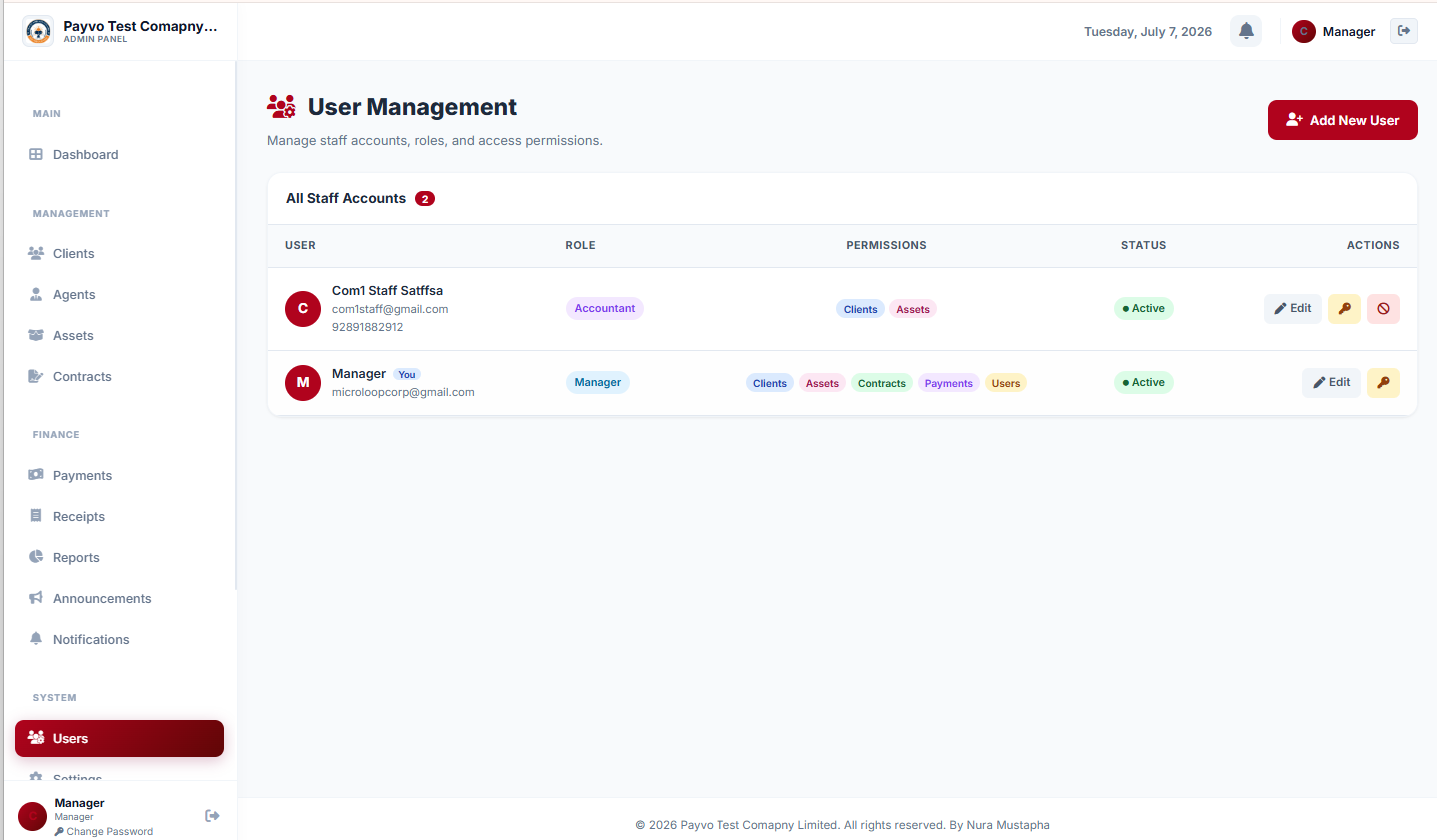 Admin: User Management Page
Month 2: Refine and Optimize
Based on Month 1's insights, make adjustments.
- Adjust payment reminders: If customers are consistently paying late on Wednesdays, send a reminder on Tuesday morning.
- Streamline communication: Use WhatsApp payment notification system features to send bulk reminders or personalized messages without manual effort.
- Review default rates: Are you seeing more defaults than expected? Revisit your customer verification process or down payment requirements.
- Explore agent management: If you have multiple sales agents, consider a system that allows you to track agent performance, sales, and collections. This is vital for managing growth, particularly for a cooperative society management software or a real estate payment tracking Nigeria system.
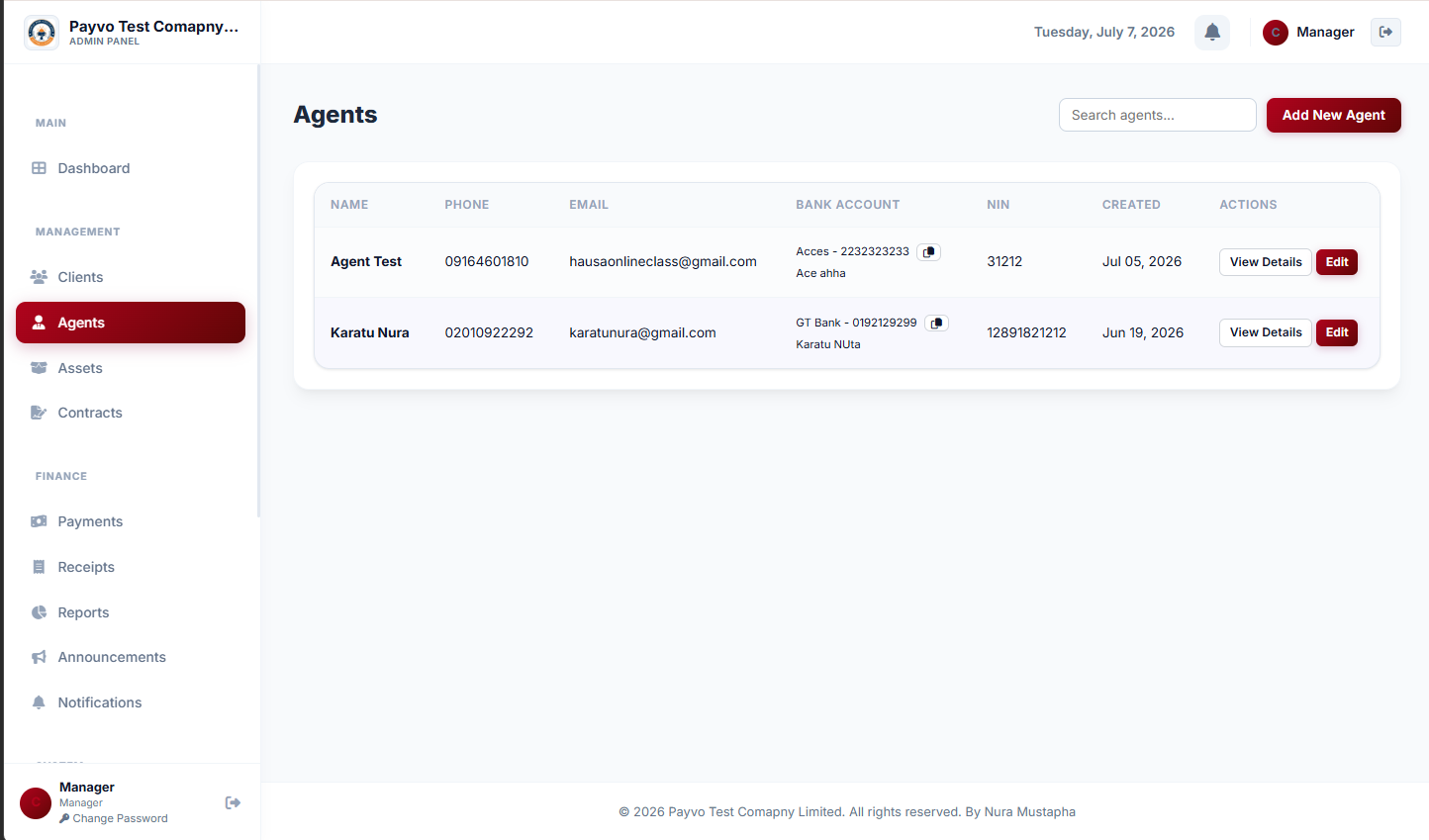 Agent: Agents list page
Month 3: Scale Smartly
Once your process feels stable, you can start scaling.
- Increase marketing: Promote your installment plans more widely, now that you have a proven system.
- Diversify stock: Consider adding a few mid-range phones (₦150,000 - ₦350,000) to your installment offerings, but ensure your contract management software Nigeria can handle higher values.
- Expand customer base: Actively seek out new customers, perhaps through local partnerships or targeted ads in areas like Kano, Kaduna, or Abuja.
- Track your monthly profit margins: Use financial reports to understand your true profitability and make informed decisions.
- Consider Payvo: As you scale, managing everything manually becomes impossible. A system like Payvo can help you maintain detailed records of customers, assets, contracts, and payments, making your operations smoother and more organized. It provides a centralized hub for all your installment transactions, from real estate to solar equipment leasing companies.
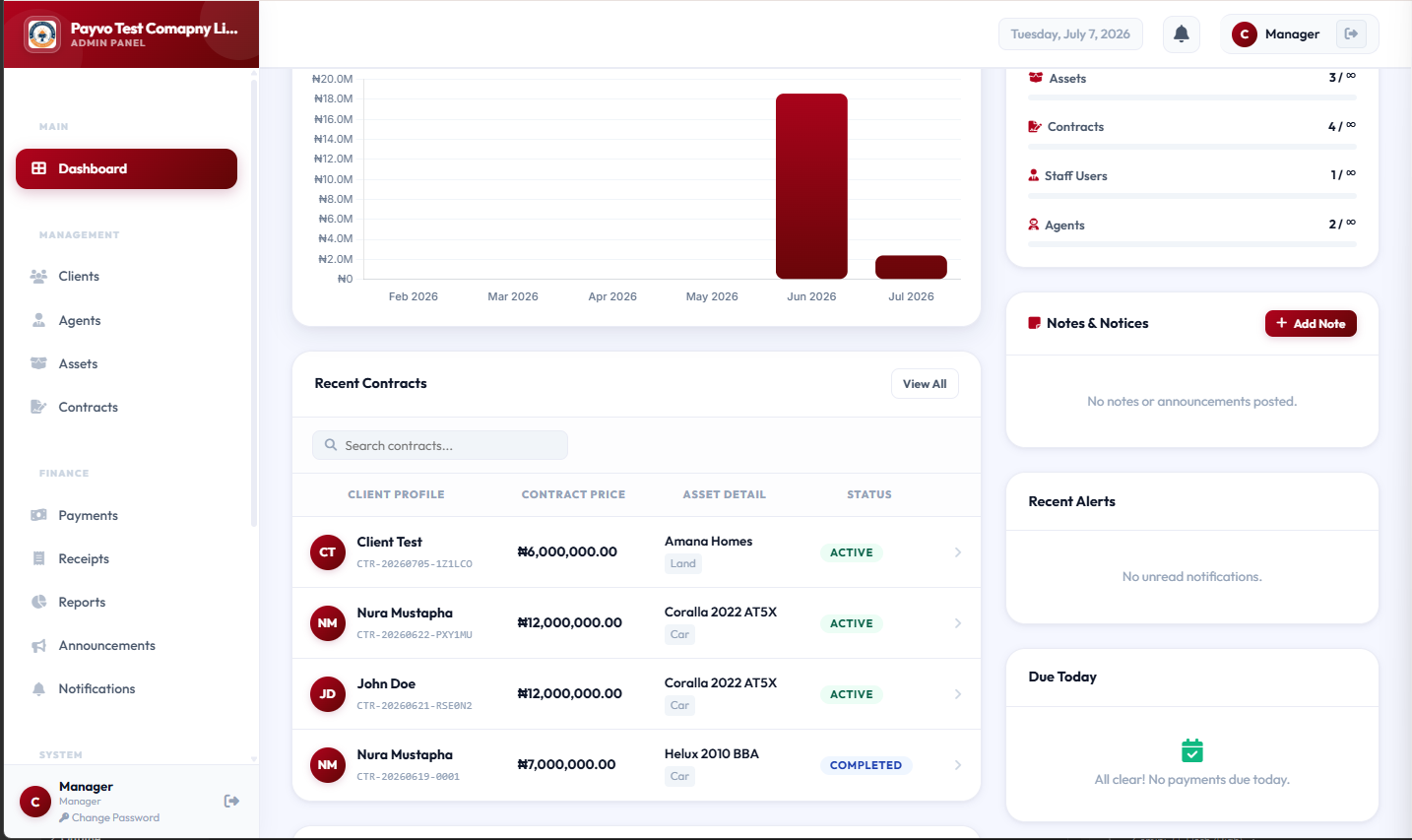 Dashobard (top)
FAQ: Answers to What You're Actually Googling
Q1: How do I track installment payments without complicated spreadsheets?
A: Forget those complex Excel sheets that break with one wrong click. The best way is to use a dedicated installment management software Nigeria solution. These systems are built specifically for tracking customer payments, outstanding balances, and due dates without requiring advanced spreadsheet skills. Many even offer receipt generation and automated reminders.
Q2: What's the best way to deal with customers who miss payments?
A: Proactive communication is key. First, send a polite, automated reminder a day or two before the due date. If a payment is missed, follow up immediately with a polite message. If it persists, refer to your installment agreement. Having a legally binding contract and a guarantor makes a huge difference. Don't let delays fester; it gets harder to collect as time passes.
Q3: Can I offer installment plans for expensive phones like iPhones or high-end Samsung models?
A: Absolutely, but the risk is higher, so your due diligence needs to be stricter. For phones costing ₦500,000 or more, you should demand a higher down payment (e.g., 40-50%), require multiple strong guarantors, and possibly even consider collateral. Your interest rates might also be slightly higher to offset the increased risk. A robust contract management software Nigeria solution is essential for these high-value items.
Q4: How do I calculate the interest rate for installment payments?
A: Typically, the "interest" isn't explicitly stated as a separate fee but is baked into the total installment price. For example, if a phone costs ₦80,000 cash, you might sell it for ₦96,000 on a 3-month installment plan. That ₦16,000 difference over three months effectively covers your cost of capital, risk, and administrative overhead. This works out to an effective monthly interest of about 6.7% on the original cash price. Always clearly state the total installment price to the customer.
Q5: Is it really worth it to sell phones on installment given the risks?
A: Yes, it can be, if done correctly. Installment plans open up a much larger market segment for you. Many Nigerians, even those with steady incomes, prefer to pay small-small rather than a lump sum. This can significantly boost your sales volume and overall revenue. The key is to mitigate the risks with solid contracts, thorough customer verification, and an efficient system to track installment payments. Without these, you're just gambling.
Ready? Here's Where to Start
Managing customers buying phones on installment plans isn't a walk in the park, but it's a powerful way to grow your business in Nigeria. You need discipline, clear processes, and the right tools. Stop struggling with notebooks and scattered WhatsApp messages. It's 2026, and there's a better way.
If you're serious about taking control of your installment sales, tracking payments, and knowing your outstanding balances at a glance, then it's time to explore a dedicated solution. Payvo is built for businesses like yours, helping you manage everything from customer records and contracts to payment schedules and digital receipts.
Don't let the fear of administrative chaos hold you back from unlocking a massive market. Take the first step towards organized and profitable installment sales. Visit Payvo.ng today to learn more about how our system can transform your operations. Or, if you're ready to dive in, register for Payvo and see the difference a truly organized system makes.