In 2026, over ₦1.5 trillion is tied up in informal credit across Nigeria, much of it in installment sales. While offering flexible payment options can dramatically boost sales, managing these arrangements manually often leads to missed payments, disputes, and significant losses. The challenge isn't just selling; it's effectively tracking every kobo owed and collected.
 Nigerian small business owner reviewing ledgers
The Evolving Landscape of Installment Sales in Nigeria
The Nigerian market thrives on flexibility, and installment sales have become a cornerstone for businesses selling everything from mobile phones to generators, and even real estate. Customers, often operating on tight budgets or irregular income streams, find installment plans an accessible path to acquiring essential goods and services. This trend is particularly evident in sectors like consumer electronics, where the value of goods typically sold on installment ranges from ₦15,000 to ₦300,000, covering items like smartphones, refrigerators, and small generators. Real estate developers in cities like Abuja and Lagos also leverage payment plans for properties valued at millions, breaking down large sums into manageable periodic payments.
However, this flexibility comes with its own set of challenges. Businesses grapple with the complexity of tracking numerous contracts, calculating interest (which can range from an implied 5% to 20% in informal credit arrangements), and managing a default rate that can swing from 5% to as high as 25% depending on vetting and economic conditions. Manual systems, relying on ledgers and memory, are prone to errors and can quickly become overwhelmed. The good news is that digital tools are now making it easier for Nigerian businesses to embrace and manage these crucial payment structures effectively. This shift allows businesses to cater to a wider customer base while safeguarding their bottom line. To learn more about how we help businesses navigate these challenges, visit our About Payvo Page.
What You Need Before You Start
Before you set up your first installment payment schedule, ensure you have these fundamentals in place:
- Clear Product/Service Pricing: Know the outright sale price and your desired profit margin.
- Deposit Requirements: Determine the initial deposit amount (e.g., ₦5,000 - ₦50,000 for goods, potentially higher for property).
- Payment Frequency Options: Decide if you'll offer weekly, bi-weekly, or monthly payments.
- Interest/Markup Policy: Establish how you'll account for the cost of credit (e.g., a simple markup or an explicit interest rate).
- Legal Agreement Template: A basic contract or agreement outlining terms, conditions, and consequences of default. Printing these can cost ₦100 - ₦500 per customer.
- Tracking System: Whether a physical ledger (₦800 - ₦2,500) or digital software, you need a reliable way to record payments.
- Communication Channels: How you'll reach customers for reminders and updates (e.g., WhatsApp, SMS, email).
Step-by-Step: How to Create an Installment Payment Schedule for Customers
Creating a structured installment payment schedule is critical for managing cash flow and customer relationships. Follow these steps to set up an effective system.
Step 1: Define Your Installment Policy and Terms
Before approaching customers, you need a clear, consistent policy. This includes:
- Minimum Deposit: What percentage or fixed amount must a customer pay upfront? For instance, a mobile phone worth ₦80,000 might require an initial deposit of ₦10,000 – ₦20,000. For higher-value items like a generator costing ₦250,000, the deposit could be ₦30,000 – ₦50,000.
- Payment Period: How long are you willing to extend the payments? Common periods range from 3 to 12 months, but for high-value assets like plots of land, it could be 24 months or more.
- Payment Frequency: Will payments be weekly (e.g., for lower-value goods like a blender), bi-weekly, or monthly (more common for higher-value items and services)?
- Pricing Strategy: Decide if you will offer the item at its cash price plus an interest rate, or a slightly higher "installment price" that incorporates your financing costs. The implied interest rate can be 5% - 20% depending on the market and risk.
- Late Payment Penalties: What are the consequences for missed payments? A typical late fee might be ₦500 - ₦2,500 per week or month, depending on the item's value and the overall payment amount. Clearly communicate these terms from the outset.
Step 2: Vet Your Customer and Agree on Terms
Customer vetting is paramount to minimizing default rates. Don't skip this step, especially in a market where the default rate can be 5% to 25%.
- Basic Information: Collect full name, address, phone numbers (at least two), and a valid ID (National ID, Driver's License, Voter's Card).
- Proof of Income/Business: Request evidence of stable income or business activity. This could be salary slips, bank statements, or business registration documents. For cooperative societies, confirming membership and good standing is crucial.
- Guarantor (Optional but Recommended): For higher-value items, requiring a guarantor adds an extra layer of security.
- Discuss and Agree: Clearly explain all terms, including the total installment price, deposit, monthly installment payment (e.g., ₦2,000 - ₦25,000), due dates, and penalties. Ensure the customer fully understands and agrees.
Step 3: Draft and Sign the Installment Agreement
A written agreement protects both you and your customer. It formalizes the understanding and provides a reference point for any future disputes.
- Essential Clauses:
- Full details of seller and buyer.
- Description of the item/service being sold (including serial numbers for electronics, plot numbers for land, etc.).
- Total installment price.
- Deposit amount paid.
- Remaining balance.
- Installment amount and frequency.
- Specific due dates for each payment.
- Late payment penalties.
- Conditions for repossession or legal action in case of default.
- Signatures of both parties and witnesses.
- Cost: Basic contract printing can cost ₦100 - ₦500 per customer.
- Digital Tools: Using a contract management software Nigeria solution can simplify this process, allowing you to generate professional agreements quickly.
Step 4: Calculate the Installment Schedule
This is where the numbers come together.
- Remaining Balance: Total Installment Price - Initial Deposit.
- Number of Payments: Based on your agreed payment period and frequency (e.g., 6 months x 4 weeks/month = 24 weekly payments).
- Installment Amount: Remaining Balance / Number of Payments.
- Due Dates: Clearly map out each due date. For example, if a customer pays ₦10,000 monthly for 6 months starting October 15, 2026, the due dates would be November 15, December 15, and so on.
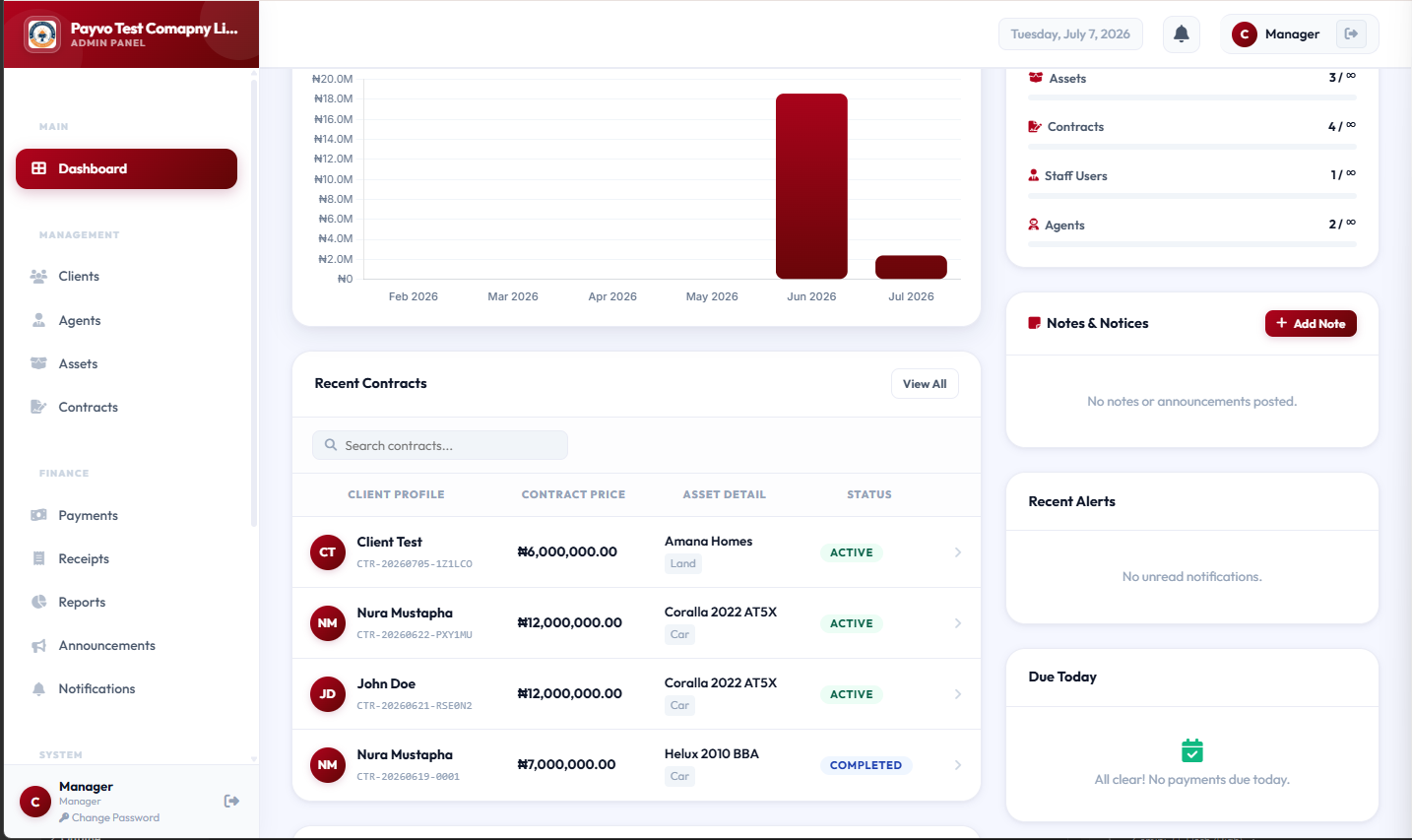 Dashobard (top)
Step 5: Set Up Your Tracking System
Accurate tracking is the backbone of successful installment sales. Without it, you risk losing money and customers.
- Manual System: A sturdy ledger book (₦800 - ₦2,500) can work for a very small number of clients. Dedicate a page per customer, recording every payment date, amount, balance, and receipt number.
- Spreadsheet: For a slightly larger scale, a spreadsheet can help, but it requires diligent manual updates and is prone to errors.
- Automated Software: This is where an installment management software Nigeria truly shines. A system like Payvo allows you to:
- Register and manage clients: Store full client details and view complete payment history per client.
- Register and manage assets: Track items sold, linked directly to contracts.
- Create contracts: Set payment terms once, and installment schedules are generated automatically.
- Record payments: Log single payments against any contract, with full history tracked.
- Generate receipts: Branded receipts are created automatically for every payment, plus a master receipt for full contracts. This eliminates the need for manual receipt books and provides professionalism.
- Automate notifications: Send new client, new contract, payment received, and payment reminders automatically via email and WhatsApp. This feature, a robust WhatsApp payment notification system, is invaluable for reducing manual follow-up.
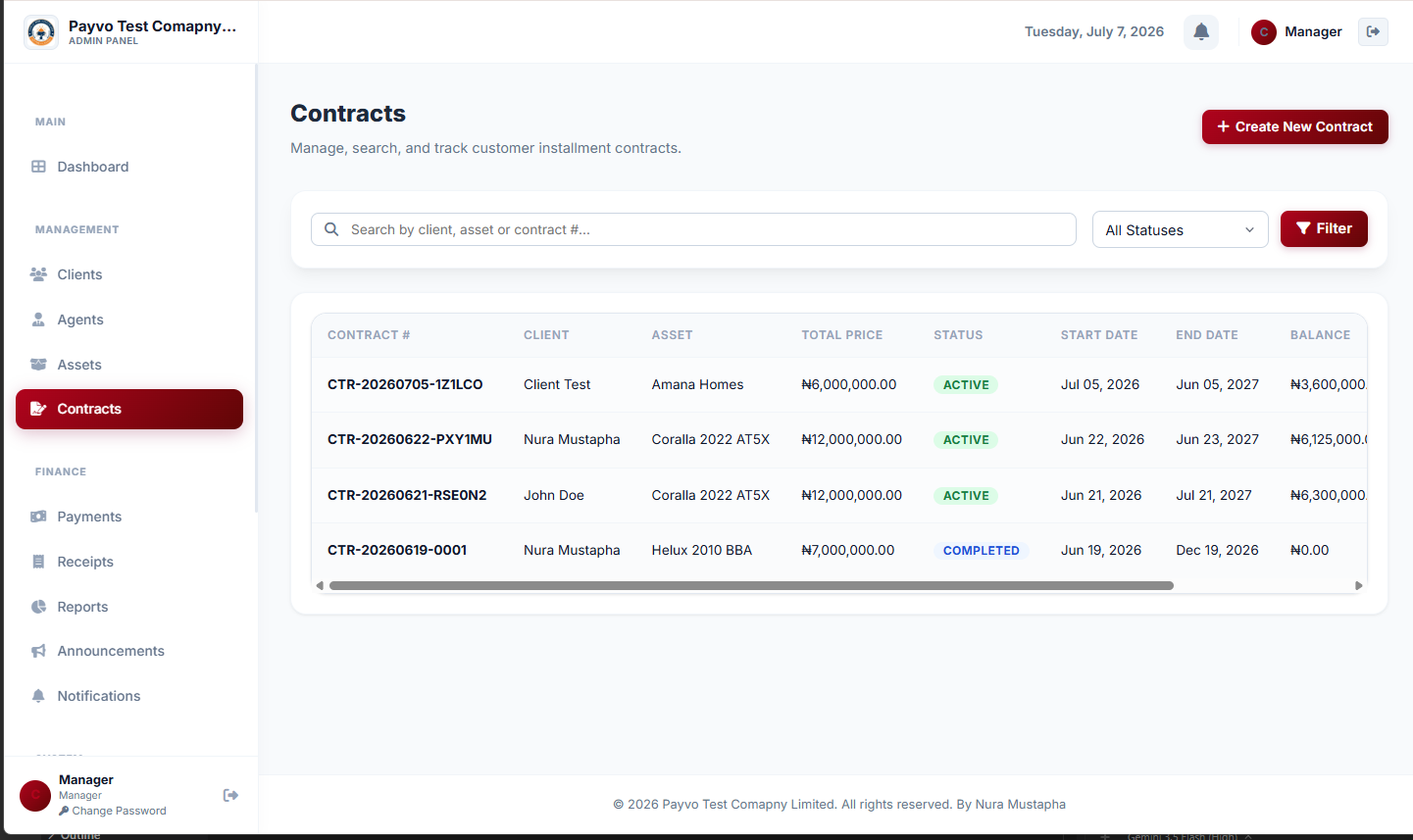 Management: Contracts list page
Step 6: Communicate and Remind
Proactive communication is key to reducing late payments and maintaining good customer relations.
- Initial Confirmation: Send a confirmation of the contract and the full payment schedule after signing.
- Payment Reminders: Automated reminders sent before due dates significantly improve on-time payments. A good system will handle this for you, sending messages directly to customers' phones.
- Payment Confirmation: Always send a confirmation and receipt after each payment. This builds trust and transparency. Payvo, for example, generates branded receipts with your company logo and digital signature for every payment, providing clients with a public link to view, save, or share their receipt.
- Late Payment Notifications: Gently remind customers of overdue payments and applicable late fees.
Step 7: Manage Defaults and Recoveries
Even with the best systems, defaults can happen. Have a clear, structured approach.
- Grace Period: Offer a short grace period (e.g., 3-7 days) before applying late fees.
- Escalation:
- Initial reminder (automated).
- Personal call/message.
- Formal letter/email reminding them of terms.
- Discussion of revised payment plan (if feasible).
- Legal action or repossession (as per contract terms).
- Record Everything: Document all communication and actions taken regarding defaults. This is crucial for legal protection.
Common Mistakes to Avoid
Managing installment sales can be tricky, but many pitfalls can be sidestepped with careful planning.
- No Written Agreement: Relying on verbal agreements is a recipe for disputes and losses. Always have a signed contract.
- Inadequate Customer Vetting: Selling to anyone without checking their ability to pay significantly increases your default risk. This is especially true for items like generators or household appliances, where the value is substantial.
- Poor Record Keeping: Manual ledgers can get lost, damaged, or contain errors. Inaccurate records lead to confusion, customer disputes, and financial losses. This is why a robust business payment tracking app Nigeria is essential.
- Lack of Communication: Failing to send reminders or acknowledge payments can lead to customers forgetting due dates or feeling neglected, increasing the likelihood of late payments.
- Ignoring Late Payments: Allowing late payments to slide without consequence signals to customers that payment terms are flexible, encouraging further delays.
- Over-extending Credit: Offering installment plans that are too long or for amounts that strain a customer's income will inevitably lead to defaults. Be realistic about what your customers can afford on a monthly basis (e.g., ₦2,000 - ₦25,000).
How to Track and Grow After Launch
Once your installment payment system is up and running, consistent tracking and analysis are key to sustainable growth.
- Monitor Key Performance Indicators (KPIs):
- Default Rate: Track the percentage of customers who fail to complete payments. Aim to keep this as low as possible.
- On-Time Payment Rate: The percentage of payments made by their due date.
- Average Collection Period: How long, on average, it takes to collect full payment for an installment contract.
- Customer Acquisition Cost (CAC) vs. Lifetime Value (LTV): Understand if the cost of acquiring a customer on an installment plan justifies their long-term value.
- Leverage Data for Better Decisions:
- Analyze which products sell best on installment and which payment frequencies are most effective for different customer segments.
- Identify patterns in defaults to refine your vetting process.
- Use data to project cash flow and manage inventory.
- Refine Your Offerings: Based on your insights, adjust your deposit requirements, payment periods, and pricing strategies to optimize sales and minimize risk. Perhaps a slightly higher initial deposit for a particular product category reduces defaults.
- Utilize Agent Tracking: If you work with sales agents, having a system to track their performance is crucial. Agents are often the first point of contact and their ability to vet clients and follow up on payments directly impacts your success. A solution with Agent Tracking Page capabilities can help you assign agents to contracts, automatically calculate commission per payment, and track full earnings and payout history. This ensures transparency and motivates your sales force.
- Automated Reporting: A robust system will provide you with automatic weekly company reports delivered to your email, summarizing key business performance metrics. This allows you to stay informed without manually crunching numbers. You can also generate comprehensive financial reports, exportable as PDF or Excel, for accounting and deeper analysis.
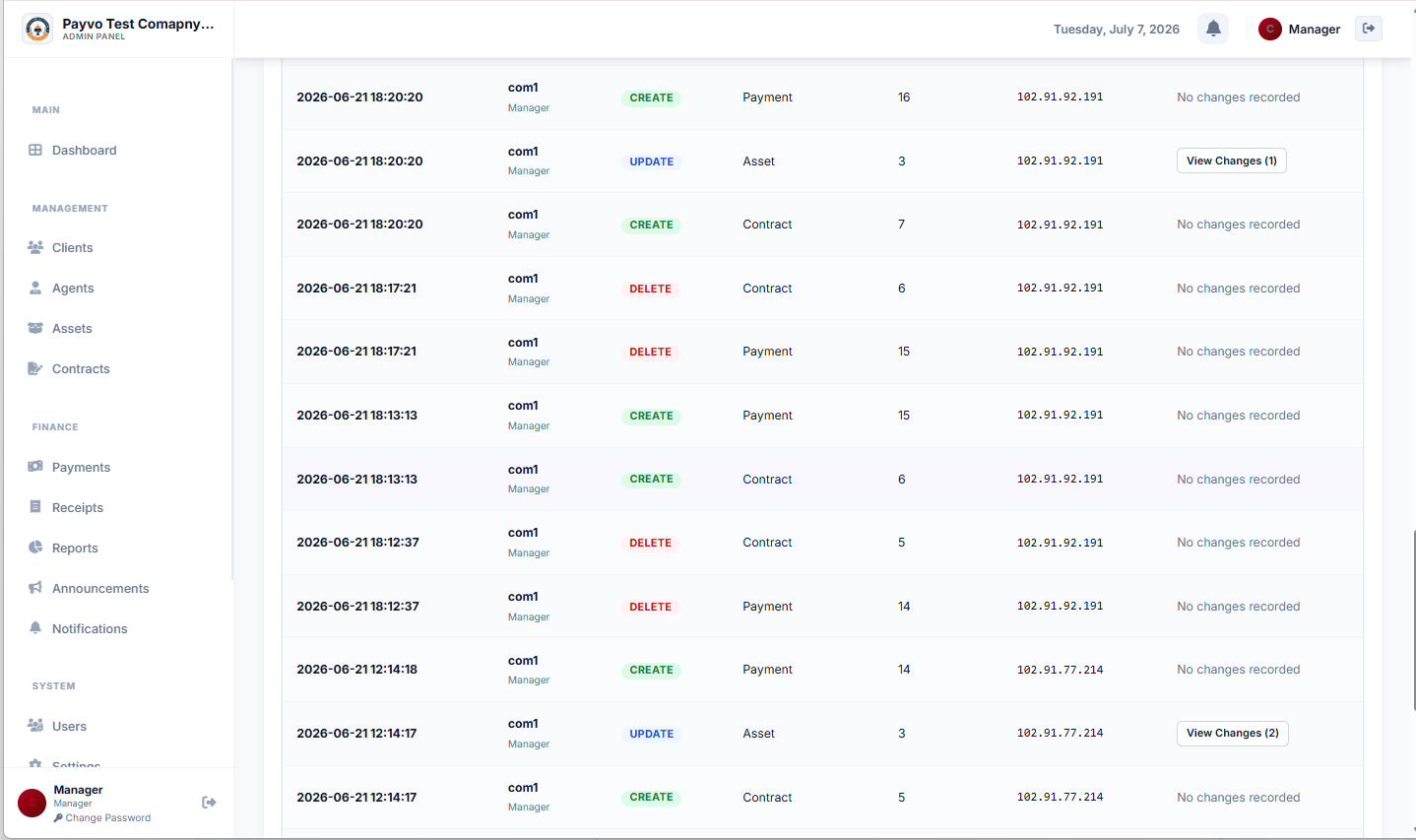 Admin: Audit Log Page
Frequently Asked Questions
Q1: How do I calculate the weekly or monthly installment amount?
A: First, subtract the initial deposit from the total installment price to get the remaining balance. Then, divide this remaining balance by the total number of payments (e.g., if it's a 6-month plan with monthly payments, that's 6 payments; if it's weekly for 6 months, that's 24 payments). For example, if a ₦100,000 item requires a ₦10,000 deposit and the remaining ₦90,000 is paid over 6 months, the monthly installment would be ₦90,000 / 6 = ₦15,000. Many installment management software Nigeria solutions include an instalment calculator to automate this.
Q2: What's a reasonable late payment fee in Nigeria?
A: Late payment fees should be clearly stated in your contract and proportionate to the installment amount. For smaller items and payments, ₦500 - ₦1,000 per week might be appropriate. For higher-value items or monthly installments, ₦1,500 - ₦2,500 per month is more common. The goal is to encourage timely payment, not to penalize excessively.
Q3: How can I effectively send payment reminders to many customers?
A: Manual reminders are time-consuming and inefficient. The most effective way is to use an automated system that sends reminders via WhatsApp and email. This ensures consistent communication without manual effort. Such a WhatsApp payment notification system is a feature of modern contract management software Nigeria.
Q4: What if a customer defaults completely?
A: Your written contract should outline the steps. This typically involves a series of escalating reminders, attempts to renegotiate the payment plan, and as a last resort, repossession of the item (if applicable and legally permissible) or legal action to recover the debt. Thorough customer vetting in Step 2 is your best defense against this.
Q5: Can I track agent commissions for installment sales?
A: Yes, especially with specialized software. A good system allows you to assign agents to specific contracts. As payments are made, the system automatically calculates the agent's commission based on pre-defined percentages or fixed amounts per payment. This ensures accurate and transparent commission tracking, which is vital for motivating your sales team. You can explore more about this on our Agent Tracking Page.
 Female entrepreneur discussing business with colleague
Ready to Streamline Your Installment Sales?
Managing installment payments doesn't have to be a manual headache. By implementing a clear process and leveraging the right tools, you can boost your sales, reduce defaults, and build stronger customer relationships. If you're ready to transform your installment management from scattered notebooks and endless WhatsApp messages into a seamless, automated system, consider exploring solutions designed for the Nigerian market. Begin your journey to smarter sales today by visiting our Public Home Page and discovering how simple it can be.