Are you still sifting through ledgers, checking bank alerts, and scrolling through endless WhatsApp chats just to confirm a single customer payment? In Nigeria's dynamic market, where installment sales drive growth for many businesses, a scattered approach to tracking transactions isn't just inefficient—it's actively costing you money and peace of mind. Without a clear, centralized payment view, missed payments become the norm, reconciliation a nightmare, and growth an uphill battle.
 Businessman reviewing financial data on a tablet
The Evolving Landscape of Installment Sales in Nigeria
The Nigerian economy, particularly in sectors like real estate, automotive, solar energy, and cooperative societies, relies heavily on installment payment models. This approach makes high-value assets and services accessible to a broader customer base, fueling transactions that might otherwise be impossible. In 2026, we see a continued surge in demand for flexible payment options, but this flexibility introduces complexity for businesses. Managing hundreds, if not thousands, of individual payment schedules, due dates, outstanding balances, and client communications manually is no longer sustainable. Businesses must adapt to maintain efficiency and profitability.
A recent survey indicates that businesses leveraging digital tools for payment tracking report up to a 30% reduction in payment collection times and a significant decrease in overdue accounts. This shift towards digital solutions is not just a trend; it's a necessity for survival and growth. From small-scale building material suppliers in Kano offering credit to large real estate developers in Abuja managing property sales, the need for robust payment tracking dashboard solutions is universal. Manual systems, often relying on paper records or basic spreadsheets, are prone to human error, data loss, and offer little in terms of real-time insights or automated reminders. The average Nigerian business owner cannot afford to lose track of payments, especially when operating on tight margins.
What You Need Before You Start
Before diving into creating a robust payment view, ensure you have these prerequisites in place:
- Clear Payment Terms: Define your installment plans, due dates, late payment policies, and any associated fees upfront.
- Customer Data: A centralized record of all your customers, including contact information and the specific assets or services they are purchasing.
- Dedicated Personnel: Someone responsible for managing payments, even if it's the business owner initially.
- Reliable Internet Access: Essential for any cloud-based
business payment tracking app Nigeriaor online system. Budget around ₦5,000 - ₦20,000 per month for reliable data, depending on usage. - Basic Hardware: A laptop or desktop for management (₦150,000 - ₦400,000) and a receipt printer (₦30,000 - ₦120,000) for physical proof of transactions.
- Initial Capital for Software: Be prepared for potential software subscription fees or one-time development costs.
Step-by-Step: How to Create a Payment View: Track Customer Transactions & Payments
Building an effective payment view requires a structured approach. This guide will walk you through setting up a system that provides a clear, real-time overview of all your customer transactions and payments.
Step 1: Define Your Data Requirements
The first crucial step is to clearly outline what information your payment view absolutely must display. This isn't just about recording a payment; it's about understanding the full context of every transaction. You need to capture details that inform business decisions and simplify customer interactions.
Consider including fields for customer full name, contact information (phone, email, WhatsApp), the specific asset or service purchased (e.g., plot number, car model, solar panel type), the total contract value, the agreed-upon installment amount, the payment frequency, and the original due dates. Beyond this, a robust payment view should show the actual payment date, the amount paid, the method of payment, and the remaining outstanding balance. For businesses dealing with car dealer installment software or real estate payment tracking Nigeria, capturing asset-specific details like VIN or property ID is also critical.
Step 2: Choose Your Tracking Method
Once you know what data you need, the next step is deciding how you'll track it. While manual ledgers and spreadsheets might seem cost-effective initially, they quickly become unmanageable as your business grows. For businesses managing installment management software Nigeria, especially those with numerous clients and agents, a dedicated digital solution is paramount.
You have a few options:
- Custom-Built Software: This offers ultimate flexibility but comes with a significant upfront cost (₦300,000 - ₦1,500,000 for basic functionality from a local freelancer/small agency). It's suitable for businesses with highly unique needs.
- Off-the-shelf Accounting Software: Many general accounting packages offer some level of invoicing and payment tracking. However, they may lack the specialized features needed for complex installment plans, like automatic installment scheduling or agent commission tracking. Monthly subscriptions typically range from ₦5,000 - ₦25,000.
- Specialized Installment Management Systems: These platforms are designed specifically for businesses that sell on installment. They automate many of the repetitive tasks associated with tracking payments, generating receipts, and sending reminders. Such systems often provide a comprehensive
payment dashboardandcustomer payment historyviews right out of the box.
Step 3: Implement Your Payment Tracking System
Implementing your chosen system is where the rubber meets the road. This involves setting up the software, migrating existing data, and configuring it to match your business processes. For specialized installment management systems, this often means creating client profiles, adding assets, and then setting up contracts.
For instance, with a system like Payvo, you would begin by registering your clients, storing their full details, and then linking them to the assets they are purchasing. You can then create contracts by setting the payment terms once, and the system automatically generates the full installment schedule. This automation eliminates manual calculation errors and ensures consistency across all your agreements. The system also allows you to record single payments against any contract, with a full history tracked and a receipt generator app Nigeria creating branded receipts automatically.
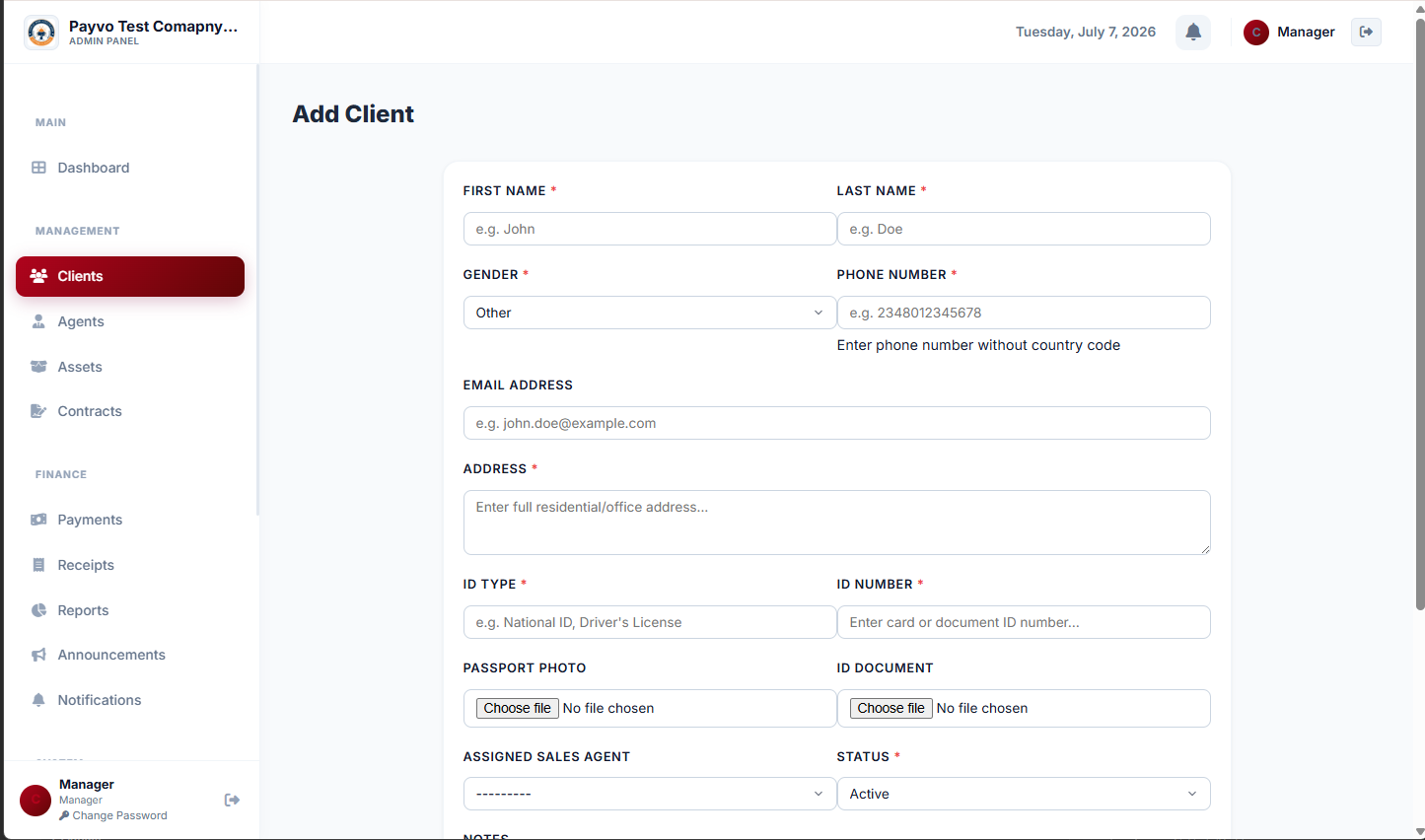 Admin: Add Client page
Step 4: Automate Notifications and Reminders
One of the biggest time-sinks in managing installment payments is chasing down clients for due payments. A robust payment view should be proactive, not just reactive. Integrating automated notifications and reminders significantly reduces your workload and improves collection rates.
Your system should be able to send automated reminders before due dates, via email or WhatsApp payment notification system. This removes the need for manual follow-up calls and ensures clients are aware of their upcoming obligations. When a payment is received, the system should also automatically send a confirmation and a link to their digital receipt. Such features are invaluable for businesses dealing with high volumes of transactions, like cooperative society management software operators.
Step 5: Establish a Clear Payment Recording Process
Consistency in recording payments is vital for maintaining an accurate payment view. Every payment, regardless of method (cash, bank transfer, POS), must be logged immediately and accurately.
Ensure your team knows how to record payments in the system. The record should include the date, amount, payment method, and ideally, a reference number. A good system will allow you to log single payments against any contract, and instantly update the outstanding balance. It should also automatically generate branded receipts with your company logo and digital signature, which can be sent to the client. This ensures that your payment tracking dashboard is always up-to-date and reflects the true financial standing of each client.
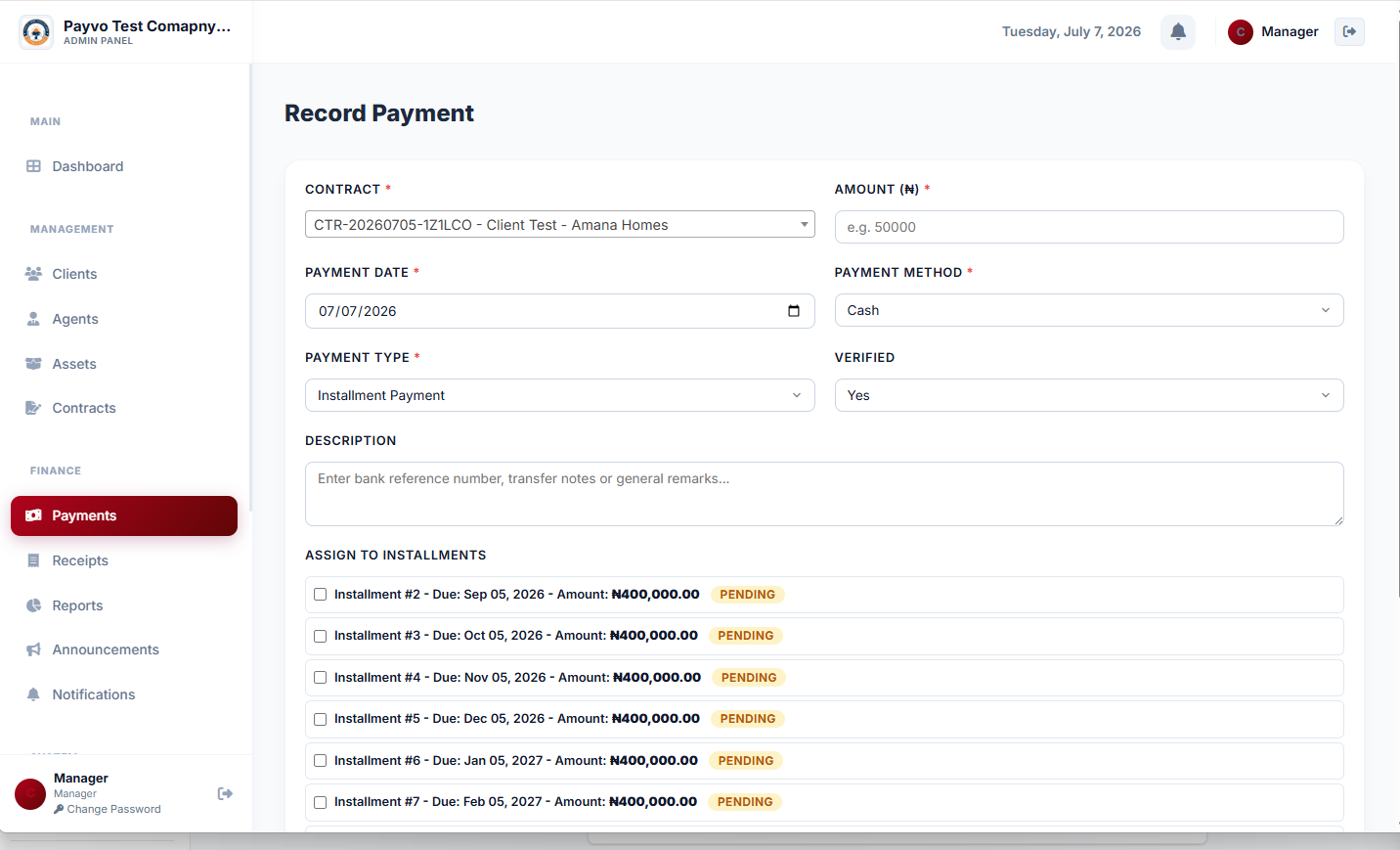 Finance: Record Payments Page
Step 6: Monitor and Report
A payment view isn't just for recording; it's for understanding and strategizing. Regularly monitoring your dashboard and generating reports is crucial for business health.
Your system should offer real-time dashboards where you can see total clients, active contracts, amount collected, outstanding balances, and next payments due at a glance. Beyond the dashboard, the ability to generate detailed reports (PDF or Excel) for accounting and record-keeping is essential. These reports help you analyze payment trends, identify potential bottlenecks, and plan future cash flow. For businesses managing agents, agent commission tracking software features within the system can also provide reports on agent performance and commission payouts.
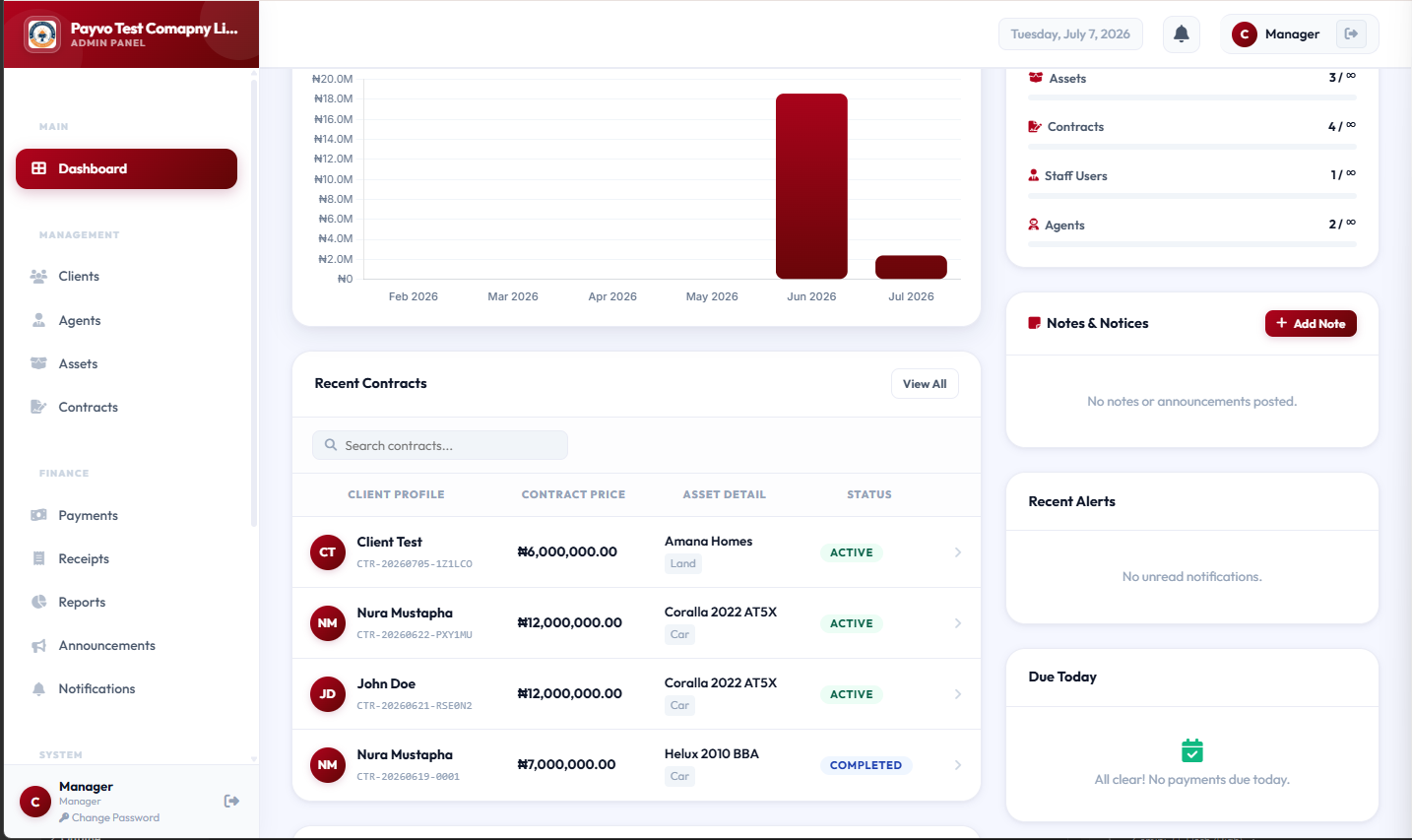 Dashobard (top)
Common Mistakes to Avoid
Even with the best intentions, businesses can fall into common traps when setting up their payment view. Being aware of these can save you significant headaches.
- Over-reliance on Manual Systems: Thinking spreadsheets are sufficient for long-term growth is a common pitfall. They lack automation, security, and scalability.
- Inconsistent Data Entry: If payments are not recorded uniformly or promptly, your "payment view" becomes unreliable, leading to reconciliation errors and customer disputes.
- Ignoring Automation Opportunities: Failing to leverage automated reminders and notifications means your team will spend excessive time on manual follow-ups, diverting resources from core business activities.
- Lack of Staff Training: Even the best system is useless if your staff doesn't know how to use it properly. Budget for one-time staff training (₦15,000 - ₦50,000).
- Neglecting Security: Payment data is sensitive. Using systems without proper access controls or audit logs can expose your business to fraud and data breaches.
- Not Centralizing Information: Having client data in one place, contract details in another, and payment records in a third creates a fragmented view, making it impossible to get a holistic understanding of a client's status.
How to Track and Grow After Launch
Once your payment view is up and running, the work isn't over. Continuous tracking and analysis are key to maximizing its benefits and fueling business growth.
Regularly review your payment tracking dashboard for insights into your financial health. Look for patterns in payment behavior: Are certain installments consistently late? Which agents are performing best? Are there particular assets with higher default rates? These insights can inform adjustments to your sales strategies, payment terms, or even product offerings. Utilize the reporting features of your system to generate weekly or monthly summaries. For example, Payvo sends automatic email summaries to company notification emails, covering key business performance metrics, offering a quick snapshot of your business's pulse. This helps you identify trends, forecast cash flow, and make data-driven decisions. Beyond financial metrics, track customer satisfaction related to payment processes. A smooth, transparent payment experience builds trust and encourages repeat business. Consider exploring additional features like agent self-tracking for your sales team, which can motivate them by allowing them to view their own earnings and submit withdrawal requests directly.
 Nigerian business owner reviewing sales reports
Frequently Asked Questions
Q1: What should a comprehensive payment view contain?
A comprehensive payment view should provide a real-time snapshot of all client financial interactions. This includes client details, asset details, the original contract terms, the full customer payment history, outstanding balances, next due dates, overdue amounts, payment methods, and the current collection status. It should also clearly show generated receipts for each transaction and offer a way to generate reports.
Q2: How can a receipt generator app Nigeria benefit my business?
A receipt generator app, especially one integrated into your payment system, automates the creation of professional, branded receipts for every payment. This saves time, reduces errors, enhances your brand image, and provides instant proof of payment for both you and your customer. It also streamlines reconciliation and record-keeping, ensuring every transaction is properly documented.
Q3: Is a WhatsApp payment notification system truly necessary?
Absolutely. In Nigeria, WhatsApp is a primary communication channel for many. Integrating automated payment notifications via WhatsApp ensures that your payment reminders and confirmations reach your clients quickly and reliably. This significantly improves communication, reduces late payments, and enhances customer satisfaction by meeting them on their preferred platform.
Q4: How much does it cost to set up a robust payment view system?
The cost varies significantly. For a basic off-the-shelf accounting software subscription, you might pay ₦5,000 - ₦25,000 per month. A custom-built solution could range from ₦300,000 - ₦1,500,000 initially. Specialized contract management software Nigeria systems often fall in between, offering robust features for a manageable monthly or annual fee, plus hardware costs for laptops/printers. Don't forget the monthly internet data costs (₦5,000 - ₦20,000) and potential power/generator fuel (₦15,000 - ₦80,000).
Q5: Can these systems help with agent commission tracking?
Yes, many modern installment management software Nigeria solutions include features for agent commission tracking software. They allow you to assign agents to contracts, automatically calculate their commission per payment received, and track their full earnings and payout history. Some even offer agent self-tracking portals where agents can view their performance and submit withdrawal requests, streamlining the entire commission management process.
Ready to Streamline Your Installment Sales?
Stop letting manual processes hold your business back. A robust payment view is no longer a luxury but a necessity for any Nigerian business selling on installment. If you're ready to gain crystal-clear visibility into every transaction, automate your payment reminders, and empower your team with a centralized payment view, explore how a dedicated platform can transform your operations. Visit our Features Page to learn more about how a comprehensive system can manage your clients, contracts, and payments with ease. Or, if you're ready to take the next step, you can Register into Payvo page today and experience the difference.