For many Nigerian businesses, managing customer payments on a monthly plan can feel like navigating a maze blindfolded. Missed payments, forgotten due dates, and endless manual calculations are not just inconveniences; they directly impact cash flow and growth. In 2026, relying on notebooks and memory for installment sales is a significant business risk.
 A small business owner in nigeria reviewing ledgers
The Evolving Landscape of Installment Sales in Nigeria
The demand for flexible payment options, like monthly payment plans, has surged across Nigeria in 2026. From real estate developers in Abuja offering plots on installment to car dealers in Lagos selling vehicles on hire purchase, businesses are increasingly adopting these models to make high-value goods and services accessible. This shift, while boosting sales, introduces a complex administrative burden. Businesses need robust systems to handle the intricacies of each monthly payment plan, track customer payments, and manage outstanding balances. Without a clear system, the benefits of increased sales can quickly be overshadowed by operational chaos, leading to disputes and lost revenue.
Consider a real estate developer selling a plot of land for ₦5,000,000 with a ₦1,000,000 down payment and the remaining ₦4,000,000 spread over 24 months. That’s ₦166,667 per month per customer. Now multiply that by dozens or even hundreds of customers. The sheer volume of transactions and individual payment schedules makes manual tracking nearly impossible. Similarly, a cooperative society managing hundreds of members' contributions or a solar company offering monthly inverter payments faces similar challenges. The need for a structured approach to manage these payment schedules isn't just about efficiency; it's about financial stability and customer trust.
What You Need Before You Start
Before you dive into creating and managing monthly payment schedules, ensure you have these foundational elements in place:
- Clear Product/Service Pricing: Define the total cost and any applicable interest or fees.
- Initial Deposit/Down Payment Policy: Determine the minimum upfront payment required.
- Payment Frequency & Duration: Decide if payments are monthly, bi-monthly, or weekly, and over how many periods.
- Late Payment Policy: Establish clear penalties or grace periods for overdue payments.
- Communication Channels: How will you send reminders and receipts? (e.g., SMS, WhatsApp, email).
- Dedicated Record-Keeping System: A reliable method for tracking every transaction and customer interaction.
- Legal Consultation (Optional but Recommended): For drafting simple, enforceable payment agreements. A one-time consultation could cost between ₦30,000 and ₦100,000.
Step-by-Step: How to Create a Monthly Payment Schedule for Customers
Creating an effective monthly payment schedule involves more than just dividing the total cost. It requires a systematic approach that considers both your business needs and your customers' ability to pay.
Step 1: Define Your Installment Policy and Terms
Before engaging customers, clearly outline your business's installment payment policy. This includes the minimum down payment, the maximum duration for payment, and any late payment fees. For instance, a building material supplier might require a 20% down payment on cement orders and allow the remaining 80% to be paid over 3 months.
Consider a scenario: A customer wants to purchase an item costing ₦300,000. Your policy might state a ₦60,000 (20%) down payment, with the remaining ₦240,000 to be paid over 6 months. This means ₦40,000 per month. Transparency is key here. Clearly communicate these terms to your customers from the outset to avoid misunderstandings later.
Step 2: Calculate the Monthly Installment Amount
Once the total cost, down payment, and payment duration are established, calculate the monthly installment.
Formula: (Total Price - Down Payment) / Number of Months = Monthly Installment
Example:
- Product Price: ₦500,000
- Down Payment: ₦100,000 (20%)
- Remaining Balance: ₦400,000
- Payment Duration: 10 months
- Monthly Installment: ₦400,000 / 10 = ₦40,000
Step 3: Set Up Due Dates and Payment Milestones
Assign specific due dates for each monthly payment. It's often beneficial to align these with common salary cycles (e.g., the last day of the month, or the 5th of each month). Consistency helps customers remember their obligations. Create a clear payment schedule that lists each installment amount and its corresponding due date.
For a 10-month plan starting in October 2026, the schedule might look like this:
- Initial Payment: ₦100,000 (October 11, 2026)
- Installment 1: ₦40,000 (November 5, 2026)
- Installment 2: ₦40,000 (December 5, 2026)
- ...and so on, until the final payment in August 2027.
Step 4: Draft a Clear Payment Agreement
A written agreement is crucial. This document should detail:
- Full names and contact information of both parties.
- Description of the product/service.
- Total purchase price.
- Down payment amount.
- Monthly installment amount.
- Payment frequency and all due dates.
- Late payment penalties.
- Conditions for default and termination.
- Signatures of both parties.
Step 5: Implement a Tracking System
This is where many businesses struggle. Without a reliable system, tracking who paid what, when, and how much is still owed becomes a nightmare. You need a system that can:
- Record each customer's details.
- Store their specific payment schedule.
- Log every payment received.
- Automatically update outstanding balances.
- Generate payment receipts.
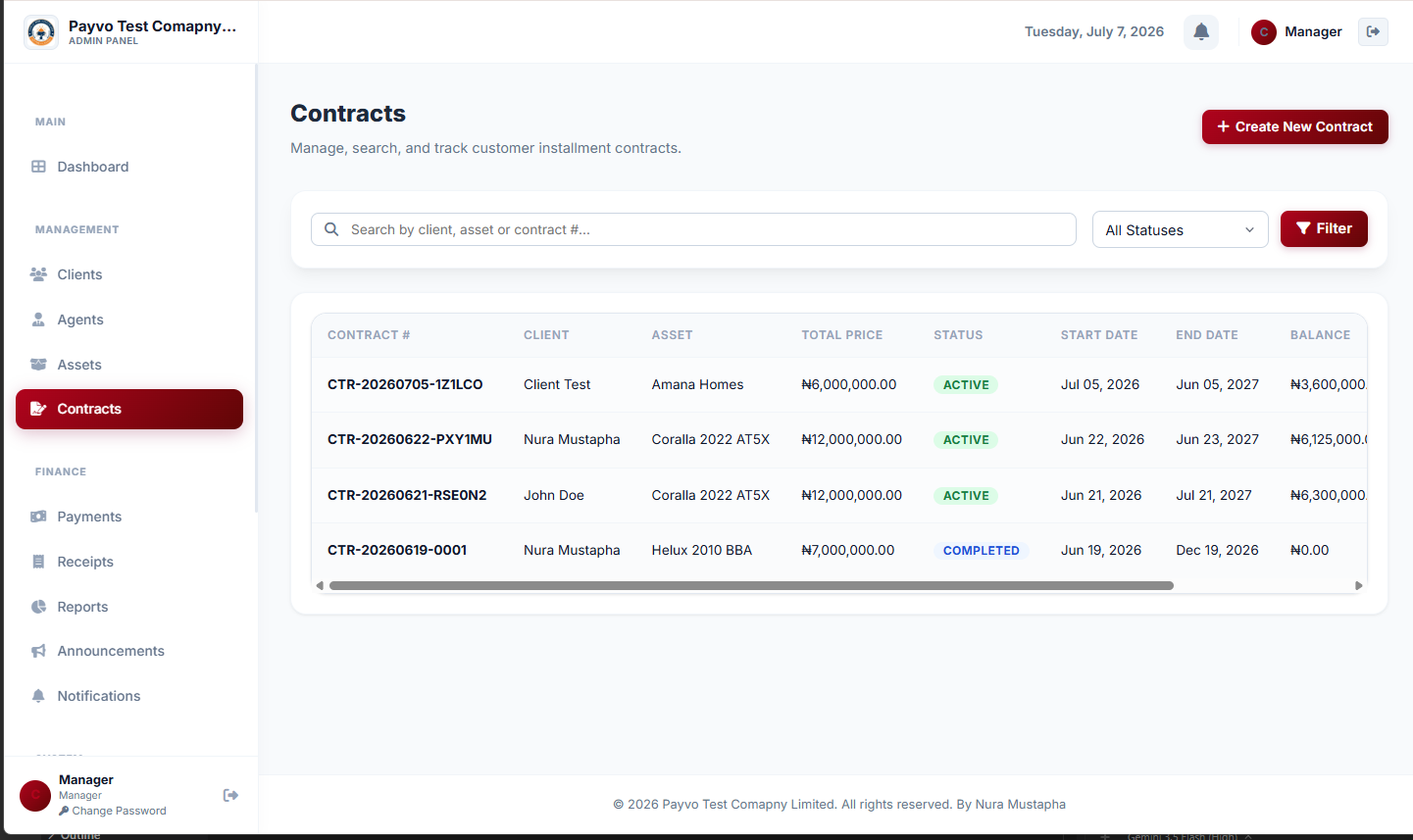 A dashboard showing a list of contracts with details like customer name, amount, and status
This is where a tool like Payvo becomes invaluable. It centralizes all your customer, asset, and contract information, allowing you to create and manage installment schedules effortlessly. You can register customers, add assets, create contracts with specific monthly payment plans, and record payments as they come in, ensuring accurate outstanding balances.
Step 6: Automate Reminders and Communication
Proactive communication significantly reduces late payments. Set up automated reminders to notify customers a few days before their payment is due. This could be via SMS, email, or even WhatsApp. A WhatsApp payment notification system can be particularly effective in Nigeria due to its widespread use.
You can also automate confirmation messages once a payment is received, along with a digital receipt. This not only keeps customers informed but also builds trust. For businesses using Payvo, integrated communication features help manage these reminders and confirmations efficiently.
Step 7: Record Payments and Update Balances
Every time a customer makes a payment, record it immediately and accurately. This updates their outstanding balance in real-time. Ensure you issue a receipt for every payment, whether digital or physical. This practice is vital for transparency and dispute resolution.
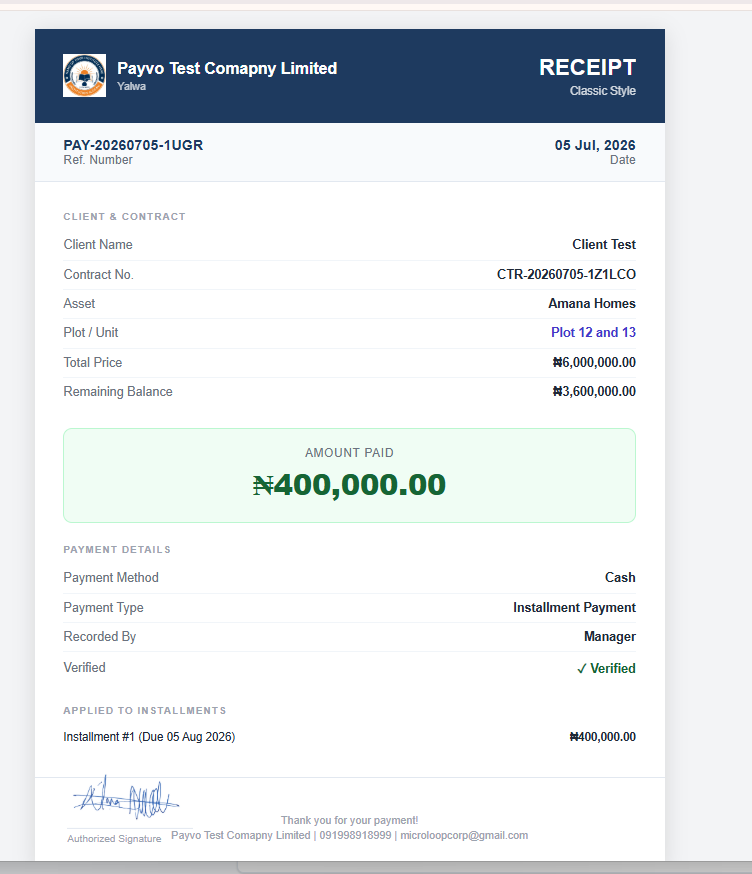 A page displaying a payment receipt sample with transaction details
For a cooperative society, this means ensuring every member's monthly contribution is logged correctly, preventing discrepancies that can erode trust. A robust receipt generator app Nigeria businesses can trust is crucial for this step.
Step 8: Monitor and Follow Up on Overdue Payments
Regularly review your payment schedules to identify overdue payments. Promptly follow up with customers who miss their due dates. This follow-up should be professional and polite, reminding them of their obligation and any applicable late fees. Have a clear process for escalating overdue accounts, which might involve a series of reminders, phone calls, and eventually, formal notices as per your agreement.
Common Mistakes to Avoid
- Vague Payment Terms: Never leave payment amounts, dates, or penalties open to interpretation. Clarity prevents disputes.
- Manual Tracking for Growth: Relying solely on notebooks or complex spreadsheets as your business grows leads to errors, lost data, and significant administrative overhead.
- Neglecting Follow-Up: Assuming customers will pay on time without reminders or follow-up is a recipe for missed payments and cash flow problems.
- Inconsistent Record Keeping: Inaccurate or incomplete payment records can lead to customer disputes and make it impossible to know your true financial standing.
- Ignoring Legal Agreements: Operating without a signed payment agreement leaves your business vulnerable in case of default.
- Poor Communication: Failing to send payment reminders or receipts can frustrate customers and damage trust.
How to Track and Grow After Launch
Once your monthly payment schedule system is in place, the work isn't over. Continuous tracking and analysis are vital for growth.
- Key Performance Indicators (KPIs): Monitor metrics like on-time payment rate, average days overdue, and default rate. These insights help you refine your payment policies.
- Customer Payment History: Analyze individual customer payment behavior. Consistent payers might qualify for better terms on future purchases, while repeat defaulters might require stricter agreements.
- Agent Performance: If you use agents (common for real estate payment tracking Nigeria companies or hire purchase businesses), track their collection rates and success in managing their customer portfolios. Tools with agent commission tracking software can be highly beneficial here.
- Financial Reporting: Regularly generate reports on total collections, outstanding balances, and upcoming revenues. This provides a clear picture of your cash flow and financial health. Payvo offers comprehensive financial reports page to give you these insights at a glance.
- Feedback Loop: Collect feedback from customers on the payment process. Are reminders helpful? Is the payment method convenient? Use this information to improve the customer experience.
Frequently Asked Questions
Q1: What is the ideal payment frequency for customers in Nigeria?
A1: While this article focuses on monthly payment plans, the ideal frequency depends on your product, customer base, and their income cycles. Monthly is common for larger purchases like property or vehicles, aligning with salaries. Weekly or bi-weekly might be better for smaller, everyday items or for customers with irregular income.
Q2: How much should I charge for late payment fees?
A2: Late payment fees should be clearly stated in your payment agreement. In Nigeria, a common practice is a flat fee (e.g., ₦1,000 - ₦5,000 per missed payment) or a small percentage of the overdue amount (e.g., 2-5%). Ensure it's reasonable and proportionate to the overdue amount.
Q3: Can I manage my payment schedules using WhatsApp?
A3: WhatsApp is excellent for communication and sending reminders or receipts. However, it is not a structured record-keeping system. Relying solely on WhatsApp for managing your installment payment schedule can lead to disorganization, missed payments, and difficulties in calculating outstanding balances, especially as your business grows. You need a dedicated system that integrates with or complements your WhatsApp communication.
Q4: How can I encourage customers to pay on time?
A4: Clear communication, automated reminders, and making payment convenient are key. Consider offering small incentives for early or on-time payments, or clearly communicating the benefits of completing payments (e.g., full ownership, warranty activation). A positive customer relationship fostered through transparent processes also plays a big role.
Q5: What are the costs associated with implementing a robust payment tracking system?
A5: Costs vary depending on the solution. Initial software/app subscriptions for payment tracking can range from ₦5,000 - ₦25,000/month. Data/internet costs for consistent access might be ₦3,000 - ₦10,000/month. SMS/communication costs for reminders could be ₦1,000 - ₦5,000/month. While there's an investment, the efficiency gains and reduced losses from missed payments often far outweigh these costs.
Ready to Streamline Your Monthly Payment Schedules?
Implementing effective monthly payment plans doesn't have to be a burden. By adopting a structured approach and leveraging the right tools, you can manage your installment sales efficiently, improve cash flow, and build stronger customer relationships. Explore how a dedicated installment management software Nigeria businesses are using can transform your operations. Visit the Payvo landing page to learn more about organizing your customer payments and contracts.