Managing installment payments for your business isn't just about collecting money; it's about precision, transparency, and maintaining customer trust. In Nigeria's dynamic market, where many depend on flexible payment plans for everything from land to solar panels, relying on notebooks or scattered spreadsheets can quickly lead to lost revenue, disputes, and wasted time. The right installment payment software can transform this chaotic process into a streamlined operation.
 Nigerian business owner reviewing ledgers with a calculator
The Evolving Landscape of Installment Sales in 2026
The Nigerian economy in 2026 continues to see a strong demand for installment payment options, making high-value goods and services accessible to a broader customer base. From real estate developers selling plots in Abuja to car dealers offering hire-purchase in Lagos, businesses are increasingly adopting flexible payment models. However, this flexibility brings administrative complexity. Many businesses still grapple with manual processes – notebooks, Excel sheets, and even WhatsApp messages – to track customer payments. This often results in:
- Inaccurate Records: Misplaced receipts or calculation errors leading to disputes.
- Wasted Time: Staff spending hours chasing payments and reconciling accounts.
- Missed Opportunities: Inability to quickly identify overdue payments or assess financial health.
What You Need Before You Start
Before diving into choosing installment payment software, ensure you have a clear understanding of your current operations and future needs. This preparation will help you select a system that truly aligns with your business goals.
- Define Your Current Process: Document how you currently manage installment sales, from customer onboarding to payment collection and receipt generation. Identify pain points.
- List Essential Features: What are the absolute must-haves for your business? (e.g., customer tracking, payment scheduling, balance tracking, receipt generation).
- Budget Allocation: Determine a realistic budget for software subscriptions, potential setup fees, and hardware. Remember, costs can range from ₦15,000 for basic monthly subscriptions to over ₦250,000 for advanced features or enterprise solutions, with potential one-time setup fees of ₦50,000 to ₦300,000.
- Team Size and Technical Proficiency: Consider who will be using the software and their comfort level with new technology. This impacts the need for staff training, which can cost anywhere from ₦20,000 to ₦100,000 initially.
- Internet Connectivity: Cloud-based software requires reliable internet. Budget around ₦5,000 to ₦15,000 monthly for data costs.
Step-by-Step: Choosing Installment Payment Software
Selecting the right installment management system requires careful consideration. Follow these steps to make an informed decision that benefits your business long-term.
Step 1: Understand Your Business's Unique Needs
Every business has specific requirements. A real estate developer in Kaduna will have different needs than a solar equipment leasing company in Port Harcourt. Begin by detailing your operational workflow. Do you sell land plots, vehicles, electronics, or offer credit through a cooperative? How many customers do you manage? Do you have agents who need to track their sales and commissions?
For instance, a real estate business might require robust asset tracking for individual plots and units, while a car dealer needs detailed vehicle identification and hire-purchase contract management. Understanding these nuances is crucial. Consider how many contracts you typically manage per month, the average value of your installment sales, and your typical payment frequency (weekly, monthly, quarterly). This detailed understanding will guide your feature requirements.
Step 2: Identify Core Features Essential for Installment Management
Focus on the non-negotiable features that will directly solve your current pain points. These are the pillars of any effective installment payment software. Look for systems that offer:
- Customer Management: The ability to add, edit, and view all customer details, including contact information and payment history, in one centralized location.
- Contract Management: Tools to create and store detailed installment agreements, outlining terms, payment schedules, down payments, and outstanding balances.
- Payment Tracking: A clear way to record every payment received, whether cash, bank transfer, or POS transaction. This feature should automatically update the customer's balance.
- Installment Scheduling: The capacity to set up flexible payment plans with customizable frequencies and due dates.
- Outstanding Balance Tracking: Real-time visibility into what each customer owes and when their next payment is due. This helps you monitor your financial health and identify overdue accounts.
- Receipt Generation: The ability to issue professional digital receipts for every payment, which is vital for transparency and record-keeping. A good receipt generator app Nigeria should be a priority.
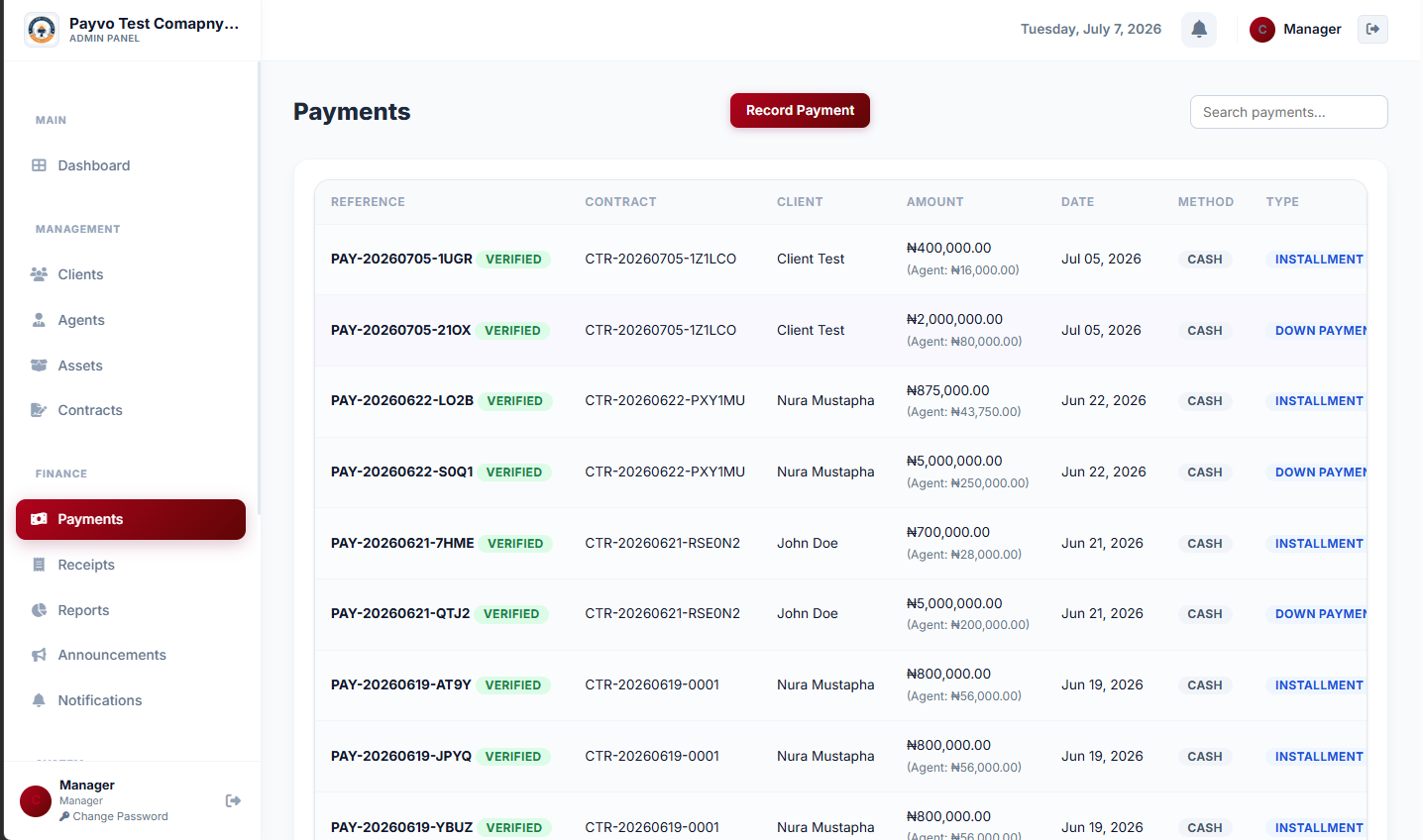 Finance: Payment List Page
Step 3: Evaluate Software Scalability and User-Friendliness
As your business grows, your software needs will evolve. Choose a solution that can scale with you, accommodating more customers, contracts, and potentially more users or agents. Equally important is user-friendliness. The best software is intuitive and easy for your staff to learn and use, minimizing the need for extensive training. Look for a clean interface and logical workflows.
Consider whether the software supports agent commission tracking software if you rely on a sales team. For businesses managing multiple agents, features that allow agents to track their specific sales and commissions can be invaluable for motivation and accountability. Explore the available features at Payvo's features page to see how different functionalities can support your growth.
Step 4: Consider Reporting and Analytics Capabilities
Effective reporting is critical for making informed business decisions. Your installment payment software should provide clear financial reports, showing total collections, outstanding balances, overdue payments, and payment trends. This data helps you understand your cash flow, identify potential issues, and forecast future revenue. Look for dashboards that offer an at-a-glance overview of your business's financial status.
Step 5: Assess Integration and Communication Features
While core installment management is paramount, consider how the software integrates with other tools you use. Many Nigerian businesses rely heavily on WhatsApp for customer communication. A WhatsApp payment notification system can significantly improve customer engagement by sending automated reminders and payment confirmations. Other useful integrations might include payment gateways for online transactions or even basic accounting software.
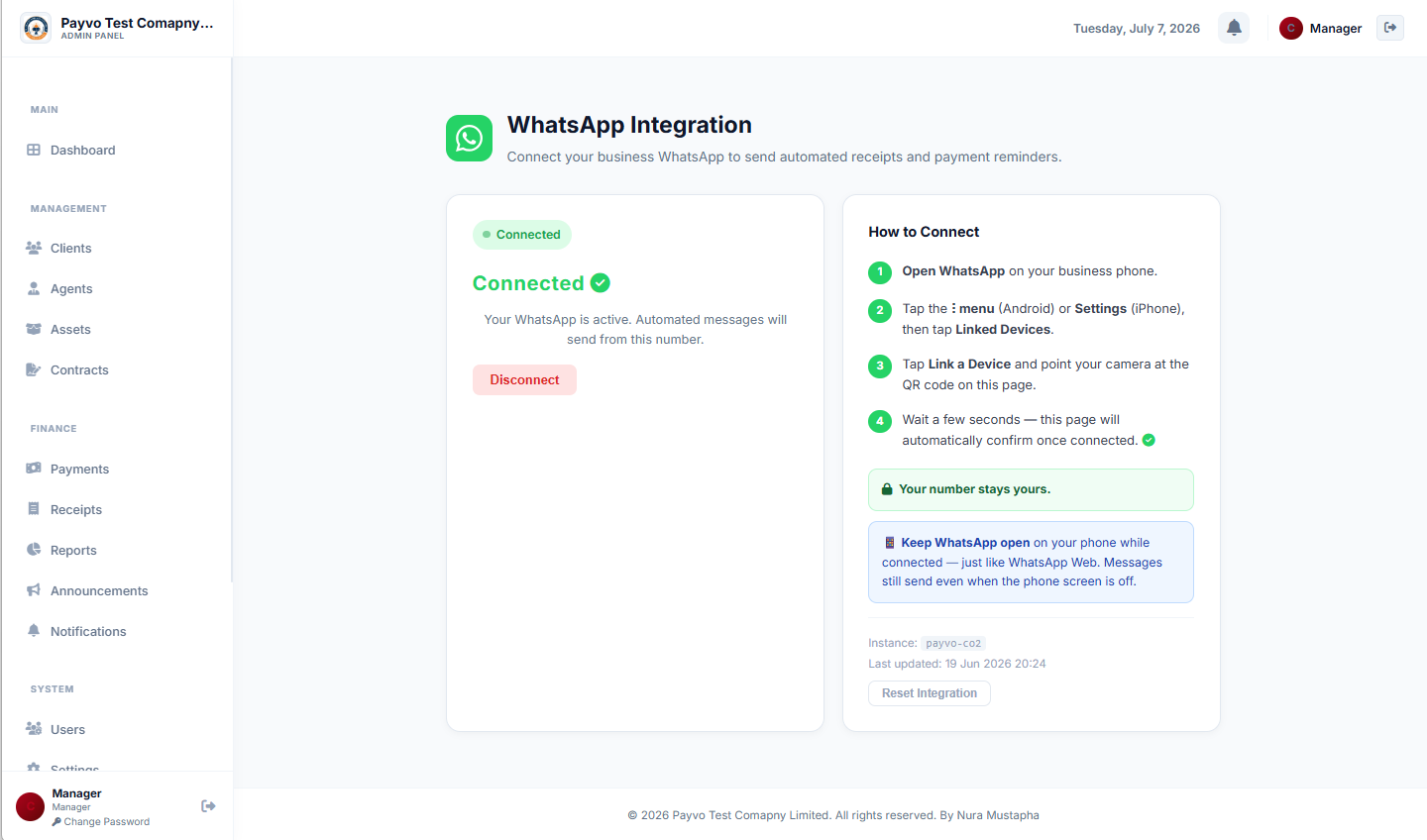 Admin: Whatsapp Integration
However, it's important to differentiate between essential integrations and optional add-ons. You don't need every bell and whistle from day one. Focus on what genuinely simplifies your operations. For example, a system that allows you to easily export data for your accountant might be more critical than a complex API integration you'll never use.
Step 6: Understand Pricing and Support
Software costs vary significantly. Basic plans for installment tracking software might start from ₦15,000 – ₦50,000 per month, while advanced or enterprise solutions could range from ₦70,000 – ₦250,000 monthly. Some providers may also charge a one-time setup fee (₦50,000 – ₦300,000) or transaction fees (0.5% – 2.5% per installment).
Beyond the monthly subscription, inquire about customer support. What channels are available (phone, email, chat)? What are the response times? Reliable support is crucial, especially when you're adopting new technology. Review the Payvo pricing page to understand typical cost structures and available plans.
Step 7: Test Drive and Get Feedback
Before committing, take advantage of free trials or demos. This hands-on experience is invaluable. Use the trial to simulate your actual business processes: add customers, create contracts, record payments, and generate receipts. Get feedback from your staff who will be using the system daily. Their input is vital for long-term adoption.
> "The true test of any business software isn't its features list, but how seamlessly it integrates into your daily operations and solves real problems for your team and customers."
Common Mistakes to Avoid
Choosing the wrong installment management system can be costly and disruptive. Steer clear of these common pitfalls:
- Overlooking Scalability: Selecting a system that works for your current size but won't grow with your business, forcing another migration down the line.
- Ignoring User Experience: Opting for feature-rich software that is overly complex or difficult for your staff to use, leading to low adoption and errors.
- Underestimating Support Needs: Choosing a provider with poor customer support, leaving you stranded when issues arise.
- Focusing Only on Price: Going for the cheapest option without thoroughly evaluating its features, reliability, and long-term value. A low upfront cost can lead to higher operational costs if the software is inefficient.
- Skipping the Demo/Trial: Not taking the time to test the software with your actual business scenarios before purchasing.
- Not Involving Your Team: Making the decision in isolation without input from the staff who will be using the system daily. Their insights are invaluable.
How to Track and Grow After Launch
Once you've implemented your installment management system, the work isn't over. Continuous monitoring and adaptation are key to maximizing its benefits and driving business growth.
- Monitor Key Performance Indicators (KPIs): Regularly review metrics like on-time payment rates, average outstanding balance per customer, and the number of overdue accounts. Your business payment tracking app Nigeria should provide these insights.
- Gather User Feedback: Continuously solicit feedback from your team. Are there any bottlenecks? Can workflows be improved? Software is a tool, and its effectiveness depends on how well it serves your users.
- Leverage Reporting for Strategic Decisions: Use the financial reports generated by the system to identify trends. For example, if you notice a particular product line has a high rate of late payments, you might adjust your terms or follow-up strategy for those sales.
- Promote Installment Options: Actively market your flexible payment options to attract more customers. Budget around ₦30,000 to ₦150,000 monthly for marketing, depending on your reach. Highlight how your streamlined process makes paying in installments easy and transparent.
- Utilize Communication Features: If your system includes a WhatsApp payment notification system, use it to send automated payment reminders and confirmations. This reduces manual effort and improves customer satisfaction.
- Review and Optimize Processes: Periodically review your entire installment sales process. Can you automate more steps? Are there any redundant tasks? Tools like Payvo offer robust reporting and agent tracking capabilities that can help you identify areas for improvement and ensure your business is running efficiently. You can learn more about how Payvo supports agent tracking here.
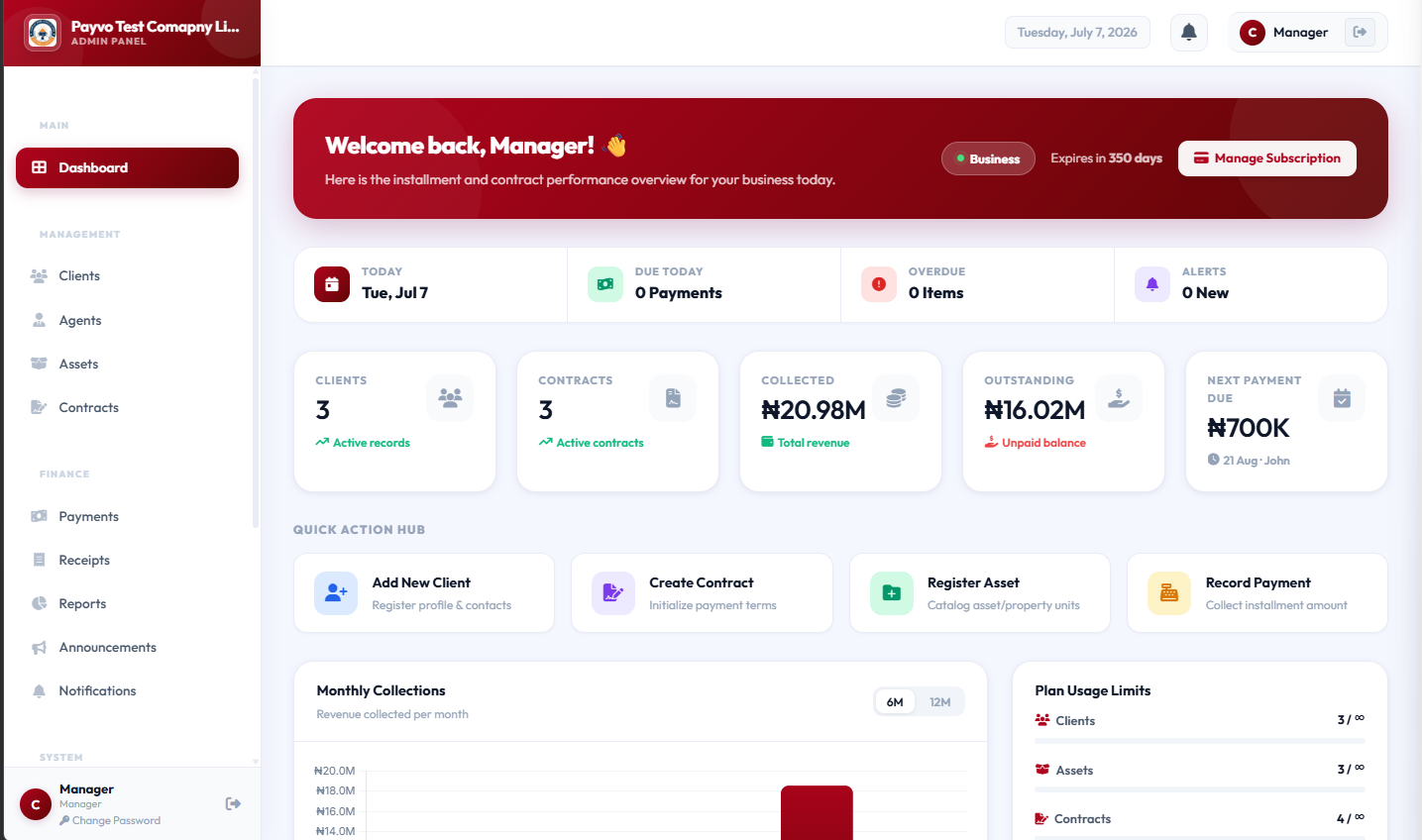 Dashboard (bottom)
Frequently Asked Questions
What is installment management software?
Installment management software is a specialized tool designed to help businesses track and manage customer payments made over a period, rather than a single upfront payment. It centralizes customer information, contract details, payment schedules, and records, making it easier to monitor outstanding balances and generate receipts. It's crucial for businesses offering flexible payment plans for products like real estate, vehicles, or consumer goods.
How much does installment payment software cost in Nigeria?
Costs vary based on features and provider. Basic monthly subscriptions for small businesses might range from ₦15,000 to ₦50,000. More advanced systems for larger retailers or those needing extensive features can cost between ₦70,000 and ₦250,000 per month. Additionally, expect potential one-time setup fees of ₦50,000 to ₦300,000 and transaction fees of 0.5% to 2.5% of the payment value.
Can I use WhatsApp to manage installment payments?
While WhatsApp is excellent for customer communication, it is not a structured installment management system. Relying solely on WhatsApp for tracking payments can lead to disorganized records, missed payments, and disputes over outstanding balances. A dedicated installment payment software often includes a WhatsApp payment notification system feature to complement your communication, while keeping all financial records organized.
Is installment management software suitable for cooperative societies?
Absolutely. Cooperative societies and microfinance operators often manage numerous members making regular contributions or loan repayments. A robust cooperative society management software streamlines the tracking of these scheduled payments, member balances, and financial records, significantly reducing administrative burden and improving transparency. You can explore solutions tailored for fintech and modern credit here.
What is the difference between an installment payment system and a payment gateway?
An installment payment system (like an installment management system) focuses on managing the contractual agreements and scheduled payments over time. It tracks what is owed, what has been paid, and balances. A payment gateway, on the other hand, is a technology that facilitates the actual transaction of money from the customer to the business, typically for online payments. While some installment systems integrate with payment gateways, their core functions are distinct.
How can I track real estate payments in Nigeria more efficiently?
For real estate developers and property sellers, efficiently tracking land installment payments is critical. A specialized real estate payment tracking Nigeria software allows you to manage multiple buyers, individual property units, payment schedules, and outstanding balances in one system. This eliminates manual errors and provides a clear overview of your sales and collections. Learn more about solutions for real estate here.
 Nigerian skyline with modern buildings at dusk
Ready to Streamline Your Installment Sales?
Choosing the right installment payment software is a strategic decision that can significantly impact your business's efficiency, financial health, and customer relationships. By understanding your needs, evaluating core features, and considering scalability, you can select a system that empowers your business to grow. If you're a real estate developer, car dealer, cooperative, or any business managing installment sales, a dedicated contract management software Nigeria can transform your operations. Explore how Payvo can help you manage your installment contracts and payments more effectively. Register for Payvo today and experience the difference a streamlined system can make.