Ever felt that knot in your stomach when a customer asks, "How much do I still owe on this car?" and you have to scramble through a stack of notebooks, WhatsApp chats, and maybe a dusty Excel sheet just to give them an answer? You're not alone. In Nigeria, where hire-purchase deals are lifelines for many businesses, keeping track of every kobo can feel like chasing a chicken in Balogun Market – chaotic and frustrating. A recent survey showed that over 60% of small businesses offering installment plans struggle with accurate record-keeping, leading to disputes and lost revenue. Knowing exactly How to Calculate Your Car's Remaining Hire Purchase Balance isn't just good practice; it's essential for your peace of mind and your bottom line.
 A car dealer in lagos showing a customer
The Reality Check: What Nobody Tells You About Hire Purchase Balances
You see the initial down payment, you see the monthly instalments coming in (mostly), and you think, "Ah, money is flowing." But here's the thing: hire purchase isn't just about subtracting payments from the original price. There are hidden costs, interest rates that compound, and administrative charges that can make your head spin if you're not careful. Most dealers, especially the smaller ones in places like Ladipo or Berger, often quote a flat repayment amount without breaking down the interest. That can lead to confusion, both for you and your customer.
For instance, a fairly used Toyota Corolla that sells for, say, ₦6,500,000 might come with a ₦1,800,000 down payment. Then you’re looking at monthly repayments over 24 months. If you're dealing with a microfinance bank or a lender, their annual interest rates can range from 18% to a staggering 35%. That's a huge chunk! On top of that, you've got processing fees from ₦50,000 to ₦250,000, mandatory comprehensive insurance of ₦150,000 to ₦400,000 (especially high in Lagos), and a tracker installation costing ₦40,000 to ₦80,000. These aren't minor expenses; they significantly inflate the total amount the customer owes. If you're not factoring these in precisely, your calculation of the car installment balance will always be off.
What You Actually Need to Get Started
Before you even think about calculating balances, you need to have your house in order. Trust me, I learned this the hard way with my retail shops. You can't track what you haven't properly recorded.
Non-Negotiables:
- A Clear Contract: This is your bible. It must detail the initial car price (e.g., ₦5,850,000 for a used Honda Civic), the down payment (let's say ₦1,462,500, which is 25%), the total hire purchase price, the annual interest rate (e.g., 28%), the repayment frequency (weekly, monthly), the number of installments, and any associated fees like processing or insurance. Without this, you're building on sand.
- Accurate Payment Records: Every single payment, no matter how small, needs to be logged with the date, amount, and payment method. Bank transfers, cash, POS payments – everything. This is where most businesses falter, relying on memory or scribbled notes that disappear. This is also where a good business payment tracking app Nigeria becomes indispensable.
- Understanding of Interest Calculation: Is it simple interest? Reducing balance? Most hire-purchase agreements in Nigeria use a flat interest rate or a reducing balance method. Know which one applies to your contracts.
- Time and Patience: This isn't a five-minute job if you're doing it manually.
- Dedicated Installment Management Software: Trying to manage 20, 50, or even 100 hire-purchase contracts with notebooks is a recipe for disaster. You need a system that can handle the complexity, track payments, and automatically calculate balances. Imagine trying to explain an overdue payment to a customer in Abuja when your records are in a dusty ledger in Lagos. Not ideal.
- Agent Commission Tracking Software: If you have agents selling cars on commission, you need to track their sales and payments accurately. This prevents disputes and keeps your sales force motivated.
- Digital Receipt Generator App Nigeria: Professional receipts instill confidence in your customers and provide a verifiable paper trail.
The Complete Step-by-Step Breakdown
Right, so you've got your basics sorted. Now, let's get into the meat of it – how to calculate that remaining balance. This isn't just about giving a number; it's about being able to explain how you got that number.
Step 1: Confirm the Initial Hire Purchase Agreement Details
First things first, pull out that contract. Not the one in your head, the physical or digital document. You need the exact figures. What was the agreed-upon selling price of the vehicle? Let's say you sold a fairly used Toyota Camry for ₦7,200,000.
What was the down payment? Let's assume the customer paid ₦2,160,000 upfront. What about the interest rate? For a hire-purchase deal, it might be 25% annually. And how many months did you agree for repayment? Say, 36 months. Don't forget any one-time charges like registration (₦120,000), comprehensive insurance (₦350,000), and a tracker (₦65,000). These are part of the total cost the customer is financing.
Step 2: Calculate the Total Amount Financed (Principal + Interest + Fees)
This is where many business owners get it wrong. They only consider the car's price minus the down payment. But all those extra charges add up.
Let's use our Toyota Camry example:
- Car Price: ₦7,200,000
- Down Payment: ₦2,160,000
- Amount to be financed (before interest/fees): ₦7,200,000 - ₦2,160,000 = ₦5,040,000
- Registration: ₦120,000
- Insurance: ₦350,000
- Tracker: ₦65,000
- Total Additional Fees: ₦120,000 + ₦350,000 + ₦65,000 = ₦535,000
Now, calculate the interest. If it's a flat interest rate of 25% over 36 months, you'd calculate 25% of ₦5,575,000, which is ₦1,393,750.
Total Amount to be Repaid (including principal, fees, and interest): ₦5,575,000 + ₦1,393,750 = ₦6,968,750. This is the actual figure the customer is paying over the 36 months, after their down payment.
Step 3: Determine the Scheduled Monthly Repayment Amount
Once you have the total amount to be repaid, divide it by the number of months.
Using our example: ₦6,968,750 / 36 months = ₦193,576.39 per month.
This is the fixed amount the customer is expected to pay each month. This figure should be clearly stated in your contract.
Step 4: Track All Payments Received
This is where accuracy is paramount. Every payment, big or small, on time or late, needs to be recorded. Let's say your customer has made 10 payments of ₦193,576.39.
Total Paid So Far: 10 payments * ₦193,576.39 = ₦1,935,763.90.
This step is critical for any car dealer installment software. If you're manually tracking this, you're prone to errors. A simple mistake of forgetting to record one payment, or miskeying an amount, can lead to hours of reconciliation later.
Actionable Tip:
Don't rely on bank alerts or paper receipts alone. Implement a system, even if it's just a dedicated spreadsheet initially, to log every transaction immediately. For growing businesses, a proper installment management software Nigeria solution is a game-changer for this.
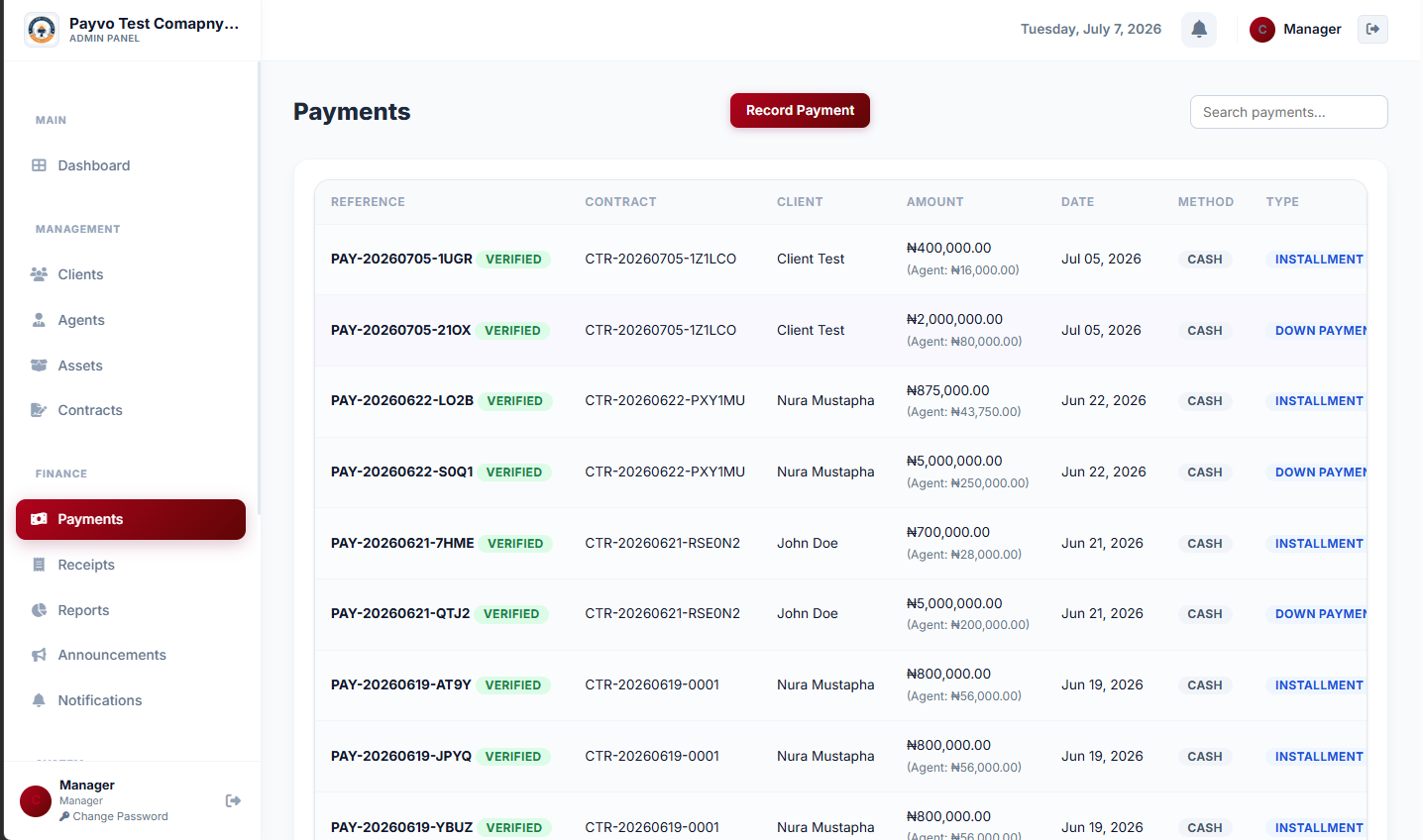 Screenshot of Payvo's payment list page, showing recorded transactions
Step 5: Calculate the Remaining Balance
Subtract the total amount paid so far from the total amount to be repaid.
Remaining Balance: ₦6,968,750 - ₦1,935,763.90 = ₦5,032,986.10.
This is the customer's current outstanding balance.
Now, this seems straightforward, right? But here’s the kicker: what if the customer sometimes pays less? What if they pay late and incur penalties? What if they pay extra? These variables complicate things significantly if you're using manual methods. This is why a robust contract management software Nigeria is crucial. It automatically adjusts for these scenarios, giving you a real-time car installment balance.
Actionable Tip:
Always reconcile your records with the customer's payment history regularly. Don't wait until there's a dispute to cross-check. A brief phone call or a WhatsApp payment notification system can help you stay aligned.
> "Many small businesses underestimate the administrative burden of installment sales until it's too late. The cost of manual errors and customer disputes often outweighs the perceived savings of not investing in proper tracking systems."
Step 6: Account for Late Payment Penalties and Other Adjustments
This is where the calculation gets tricky without a system. Most hire-purchase contracts include late payment penalties. Let's say your contract specifies a penalty of ₦15,000 for every missed or late payment. If your customer missed two payments, that's an additional ₦30,000 added to their outstanding balance.
Similarly, if the customer made an extra payment or you offered a discount for early payment, these adjustments need to be accurately reflected. This is why you need to carefully track all recorded payments and contract adjustments. Without a system that automatically factors these in, your manual calculations become a headache. This is where a platform like Payvo shines, helping you manage these dynamic changes without breaking a sweat. You can track all these nuances and even use it as a receipt generator app Nigeria.
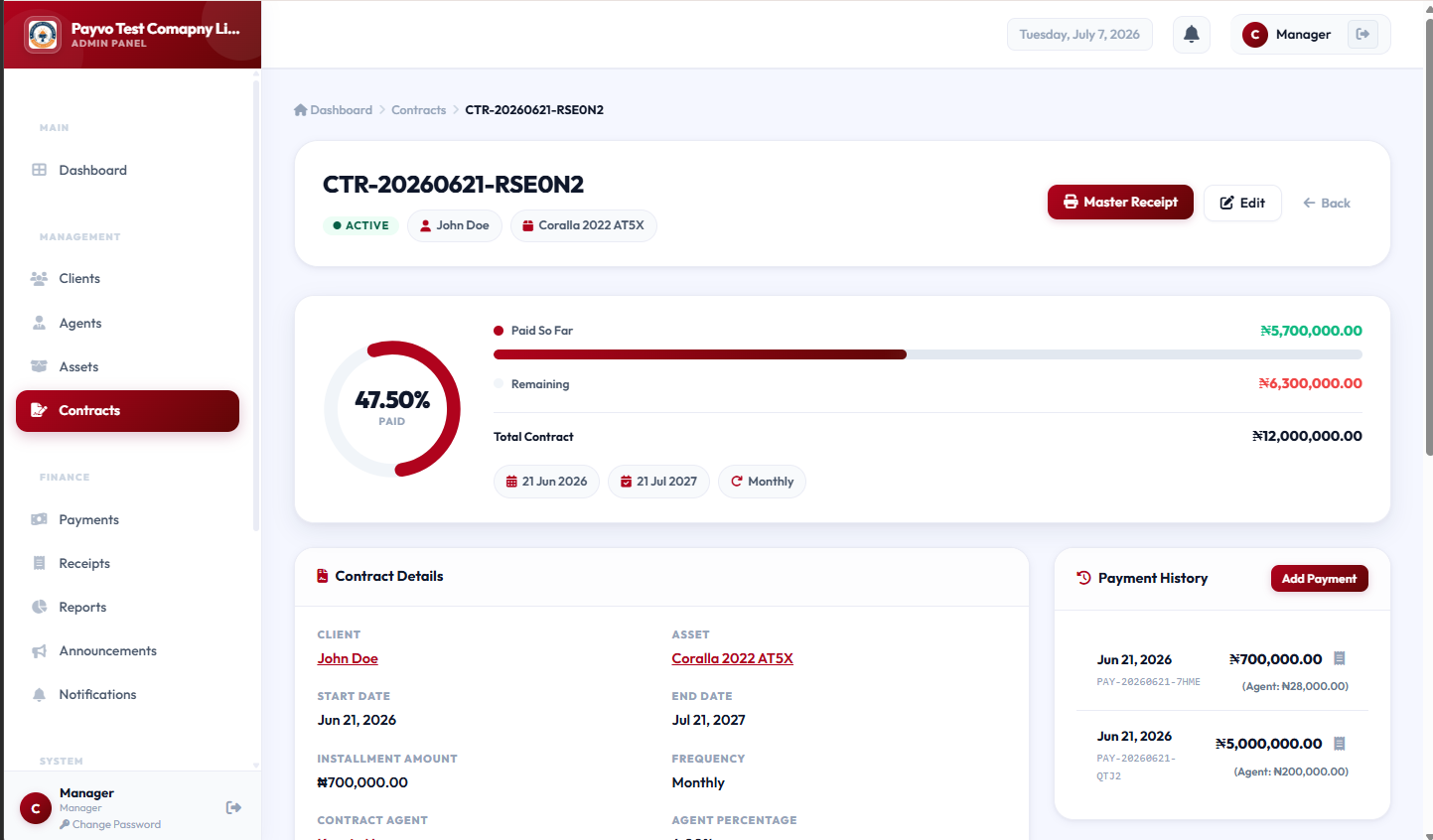 Screenshot of Payvo's contract details view, showing payment history and remaining balance
5 Mistakes That Cost Nigerian Business Owners the Most
I've seen these mistakes play out countless times in shops, from Alaba International Market to Kano textile market. They don't just cost you money; they cost you reputation and peace of mind.
- Relying on Memory and WhatsApp Chats: "Ah, Mr. Obinna said he paid last week, let me check my phone." This is a recipe for disaster. WhatsApp is for communication, not financial record-keeping. Payments get lost, dates get confused, and before you know it, you're in a heated argument with a customer over an alleged payment you have no record of. This is why a dedicated business payment tracking app Nigeria is a must-have.
- Ignoring the True Cost of Interest and Fees: Many businesses only focus on the principal. They forget that processing fees (₦50,000-₦250,000), insurance (₦150,000-₦400,000), and especially the high interest rates (18-35%) are all part of the customer's financial obligation. Not factoring these into your initial calculation means you're underestimating the total repayment, which will throw your remaining balance off.
- Inconsistent Record-Keeping: One day it's a notebook, the next it's an Excel sheet, then a random piece of paper. This inconsistency is a major cause of financial leakage. You need a centralized, consistent system. If you're a car dealer in Lagos or Kano, this is even more crucial for managing your inventory and customer base.
- Lack of Clear Communication with Customers: When a customer doesn't know their exact car installment balance, they get suspicious. They might feel cheated or confused. Regular statements, even automated ones, showing their payments and remaining balance build trust. This is where a WhatsApp payment notification system integrated into your tracking can be very effective.
- Underestimating the Value of an Agent Commission Tracking Software: If your agents are bringing in the sales, you need to track their performance and commissions accurately. Manual tracking can lead to errors, demotivation, and even fraud. A good agent commission tracking software ensures transparency for both you and your sales team.
How to Know If You're on Track (Success Metrics)
So, how do you know if your installment tracking is actually working? It's not just about getting the number right once; it's about having a system that consistently delivers accurate information and helps your business grow.
- Zero Payment Disputes: When a customer asks for their balance, you should be able to provide it instantly and confidently, with a detailed breakdown. If you're still having arguments over payments, your system isn't working.
- Low Default Rate: While you can't eliminate defaults entirely, clear communication and accurate tracking of outstanding balances can significantly reduce them. When customers know their obligations and receive timely reminders, they're more likely to pay.
- Efficient Agent Management: Your sales agents should be able to see their targets, their sales, and their commissions without constantly bugging you. This means you need transparent agent commission tracking software.
- Real-time Financial Overview: You should be able to pull up reports on total outstanding balances, payments collected, and overdue accounts at any time. This allows you to make informed business decisions. A dashboard that shows you everything at a glance, like what Payvo offers, is invaluable. You can see your financial health without needing to crunch numbers for hours.
- Scalability: Can your current system handle 10 more cars? 50 more customers? If not, you're not on track for growth. Your installment management software Nigeria solution needs to grow with you.
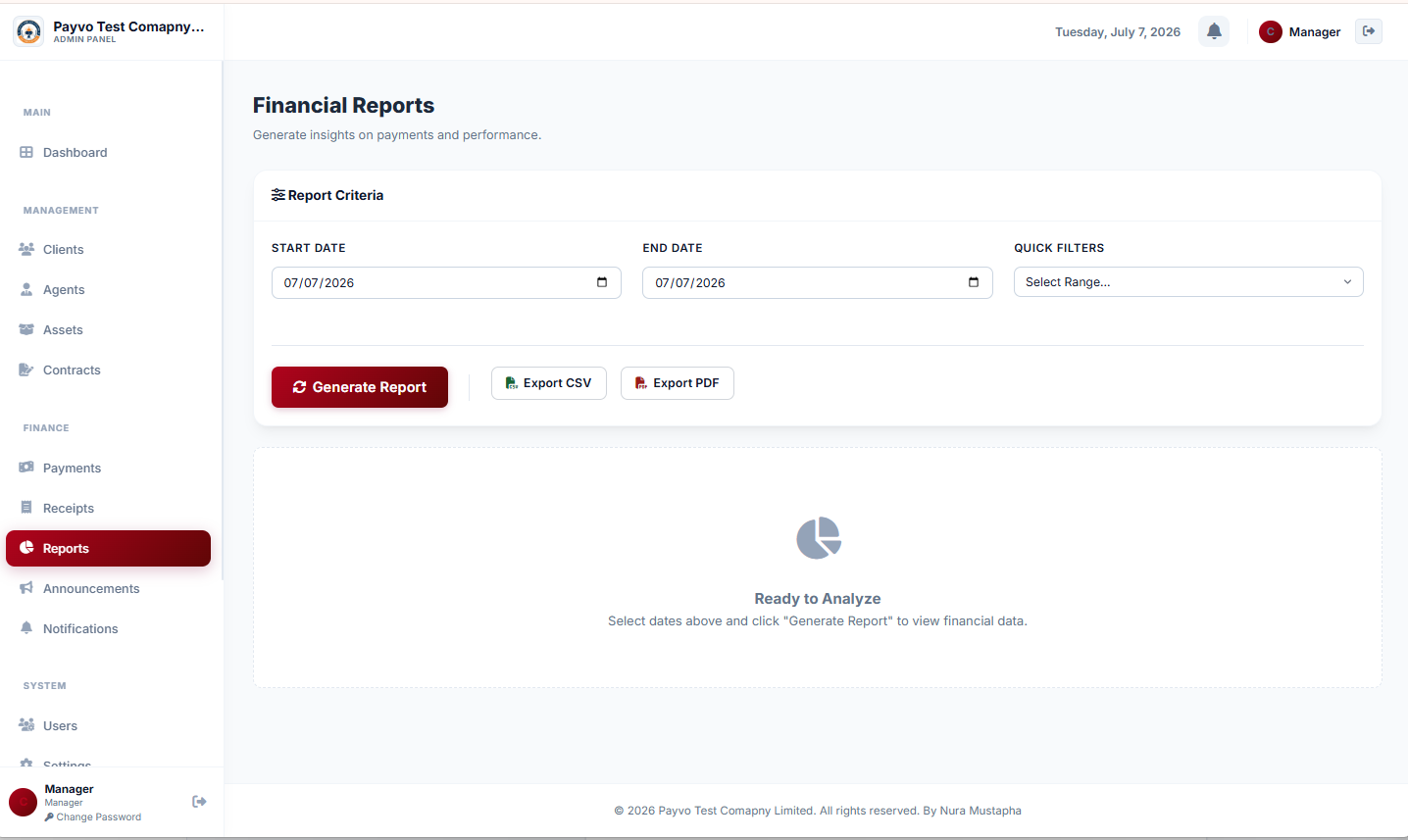 Dashboard showing an overview of financial reports and overdue payments
Real Questions People Ask (FAQ)
Q1: How do I calculate a car buyer's remaining hire-purchase balance if they sometimes pay extra or less than the agreed amount?
A: This is a common challenge, and it's why manual calculations often fail. If a customer pays extra, that surplus should reduce the principal amount faster, potentially shortening the repayment period or reducing future interest (if using a reducing balance method). If they pay less, the deficit needs to be added to the outstanding balance, and possibly attract late fees as per your contract. You absolutely need a system that can handle these dynamic adjustments. A simple spreadsheet can become a nightmare. This is exactly where a tool like Payvo helps you to accurately track installment payments, reconciling all recorded payments and contract adjustments.
Q2: What's the difference between simple interest and reducing balance interest in hire purchase?
A: With simple interest, the interest is calculated on the original principal amount for the entire loan term. So, if you financed ₦5,000,000 at 20% simple interest over 2 years, the interest amount remains fixed, regardless of how many payments you've made. With reducing balance interest, the interest is calculated on the remaining principal balance after each payment. This means as you pay down the principal, the interest portion of your payment reduces over time. Most hire-purchase deals from formal lenders in Nigeria use a flat rate, which is simpler but means you pay the same interest portion throughout. Always confirm which method your contracts use, as it significantly impacts the car installment balance.
Q3: Can I use Excel to track my car installment balance for multiple customers?
A: You can, but it's not ideal for a growing business. For one or two customers, maybe. But once you have 10, 20, or 50 customers, managing formulas, inputting payments, tracking due dates, and generating reports in Excel becomes incredibly time-consuming and prone to human error. One wrong formula or forgotten entry can mess up everything. Plus, Excel doesn't easily handle automated reminders or agent commission tracking software. It’s a temporary fix, not a long-term solution for professional vehicle payment calculator needs.
Q4: How can I ensure my customers get timely payment reminders without me calling them constantly?
A: This is where automation comes in. Manually calling every customer is a huge drain on your time. Modern installment management software Nigeria often comes with built-in features for automated reminders via SMS or WhatsApp. You can set up schedules for reminders a few days before a payment is due, on the due date, and if a payment is overdue. This not only saves you time but also improves customer satisfaction by providing proactive communication. This is a key feature of any good business payment tracking app Nigeria.
Q5: What are the typical hidden costs I should watch out for when setting up a hire purchase agreement?
A: Beyond the car price and obvious interest, look out for:
- Processing or Admin Fees: These can range from ₦50,000 to ₦250,000 and are often non-refundable.
- Insurance: Comprehensive insurance is usually mandatory for the duration of the hire purchase, costing between ₦150,000 and ₦400,000 annually.
- Tracker Installation: Many lenders require a tracker, which can be ₦40,000 to ₦80,000.
- Vehicle Registration & Licensing: New registration costs can be ₦80,000 to ₦150,000.
- Legal Fees: For drafting the hire purchase agreement.
- Late Payment Penalties: Clearly defined in the contract, these can add ₦5,000 to ₦25,000 monthly or a percentage of the overdue amount. Always factor these into the total amount financed to avoid surprises and accurately calculate the remaining hire purchase balance.
Your Next Move
If you're tired of the endless calculations, the disputes, and the constant worry about your car installment balance, it's time to streamline your operations. Stop managing your vehicle payment calculator with pen and paper or error-prone spreadsheets. Take control of your hire purchase business. Explore how a dedicated platform can help you manage contracts, track payments, and calculate balances with ease. Visit Payvo's hire purchase solution page today and see how you can bring order to your sales.