For many Nigerian businesses, selling on installment is the backbone of their growth, making high-value goods like properties, vehicles, or solar systems accessible. Yet, the moment a customer signs an installment agreement, a critical question emerges: how do you accurately track what they still owe? Miscalculating an outstanding balance can lead to disputes, lost revenue, and damaged customer relationships, turning a promising sale into a persistent headache.
 Nigerian business owner reviewing financial documents at a
The Realities of Installment Sales in Nigeria in 2026
The Nigerian economy in 2026 continues to see a strong demand for installment payment options across various sectors. From real estate developers in Abuja offering payment plans for plots of land to car dealers in Lagos selling vehicles on hire purchase, businesses are leveraging installment sales to boost accessibility and sales volume. However, this growth brings administrative complexities. A 2026 industry report indicated that businesses offering installment plans spend an average of 10-15 hours per week manually tracking payments and balances, with many still relying on notebooks, spreadsheets, and even WhatsApp conversations. This manual approach is prone to errors, especially when dealing with the typical loan principal range of ₦50,000 to ₦5,000,000, and interest rates that can fluctuate from 3% to 10% monthly depending on the lender or business model. Without a clear, systematic way to calculate and track customer installment balances, businesses risk disputes over payments, delayed collections, and an inability to accurately assess their financial health.
What You Need Before You Start
Before you dive into calculating outstanding balances, ensure you have these fundamental elements in place:
- The Original Contract: This document is your bedrock. It must clearly state the total sale price, any initial deposit paid, the agreed-upon installment amount, payment frequency (e.g., weekly, monthly), the total number of installments, and the tenor of the loan (e.g., 3 to 24 months).
- A Reliable Record-Keeping System: Whether it's a dedicated software, a meticulously maintained spreadsheet, or a physical ledger, you need a system to log every payment received. This system should be accessible and regularly updated.
- Proof of Payments: Keep copies of all receipts issued and bank statements confirming payments. This is crucial for resolving any discrepancies.
- Clear Payment Terms: Ensure your customers fully understand the payment schedule, including due dates and any penalties for late payments, which can range from ₦500 to ₦5,000 daily or weekly.
Step-by-Step: How to Calculate Outstanding Balances for Installment Loans
Accurately calculating outstanding balances is a continuous process, not a one-time event. Follow these steps to maintain precise records and avoid common pitfalls.
Step 1: Understand the Initial Loan Principal and Total Repayable Amount
Begin by clarifying the total financial obligation. The initial loan principal is the base amount the customer borrowed or the cost of the item being sold on installment. However, the total repayable amount will often be higher due to interest, processing fees, and other charges.
For example, if you sell a solar inverter system for ₦750,000 with a processing fee of ₦5,000 and an agreed-upon interest that brings the total cost to ₦850,000, this ₦850,000 is your total repayable amount. This is the figure you'll use to track customer installment balance. Always ensure this is clearly communicated and documented in the contract.
Step 2: Record the Initial Deposit (Down Payment)
The first step in reducing the total repayable amount is to subtract any initial deposit or down payment made by the customer. This initial payment is crucial as it immediately lowers the outstanding sum.
Let's say a customer buys a plot of land for a total repayable amount of ₦2,500,000. They make an initial deposit of ₦500,000.
- Total Repayable Amount: ₦2,500,000
- Less Initial Deposit: ₦500,000
- Remaining Balance After Deposit: ₦2,000,000
Step 3: Track All Subsequent Installment Payments
This is where meticulous record-keeping becomes paramount. Every time a customer makes an installment payment, it must be recorded accurately against their account. This includes the date of payment, the amount paid, and the method of payment.
For a business managing multiple customers, a manual system with notebooks or generic spreadsheets quickly becomes overwhelming. This is where a robust business payment tracking app Nigeria can transform operations. Software designed for contract management software Nigeria streamlines this process by centralizing all payment records.
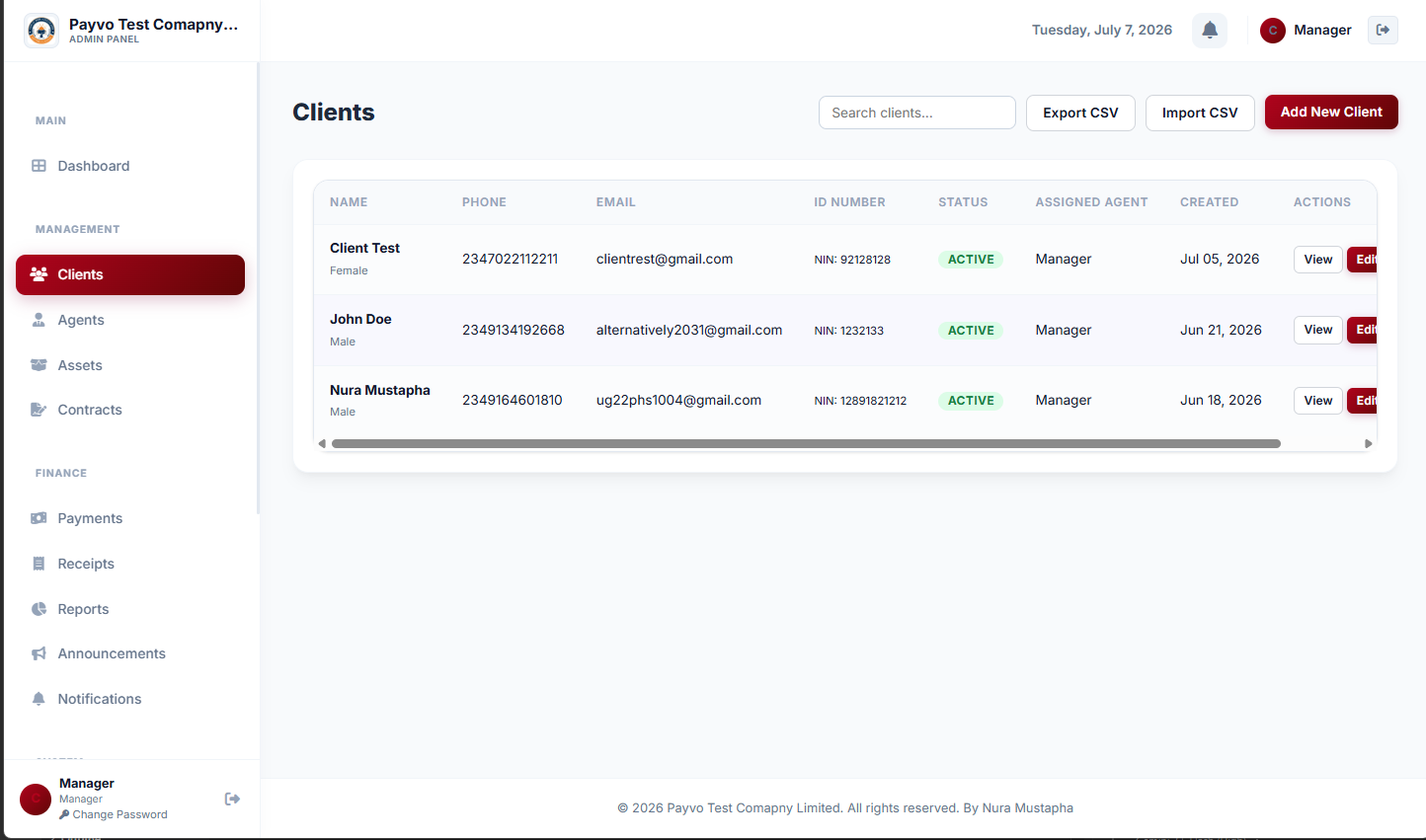 Client: Clients list page
Step 4: Calculate the Current Outstanding Balance
To calculate the current outstanding balance, you simply subtract the sum of all payments received (initial deposit + all subsequent installment payments) from the total repayable amount.
Formula:
Outstanding Balance = Total Repayable Amount – (Initial Deposit + Sum of All Installment Payments Received)
Let's continue our land sale example:
- Total Repayable Amount: ₦2,500,000
- Initial Deposit: ₦500,000
- Installment Payments Received to Date:
- Payment 1: ₦100,000
- Payment 2: ₦100,000
- Payment 3: ₦100,000
- Total Payments Received: ₦500,000 (deposit) + ₦300,000 (installments) = ₦800,000
- Current Outstanding Balance: ₦2,500,000 – ₦800,000 = ₦1,700,000
Step 5: Account for Interest and Penalties (If Applicable)
If your installment agreements include interest or late payment penalties, these must be factored into the outstanding balance. Interest can be calculated based on the reducing balance or a flat rate, as stipulated in your contract. Late payment penalties, typically ranging from ₦500 to ₦5,000 per instance, are added to the outstanding amount.
It's crucial to clearly define how interest is applied and when penalties are incurred in your contract. Transparency builds trust and prevents disputes. A cooperative society management software, for instance, must have clear rules for members. Tools like Payvo, an installment management software Nigeria, can automate the application of such charges based on predefined contract terms, ensuring consistency and reducing manual calculation errors.
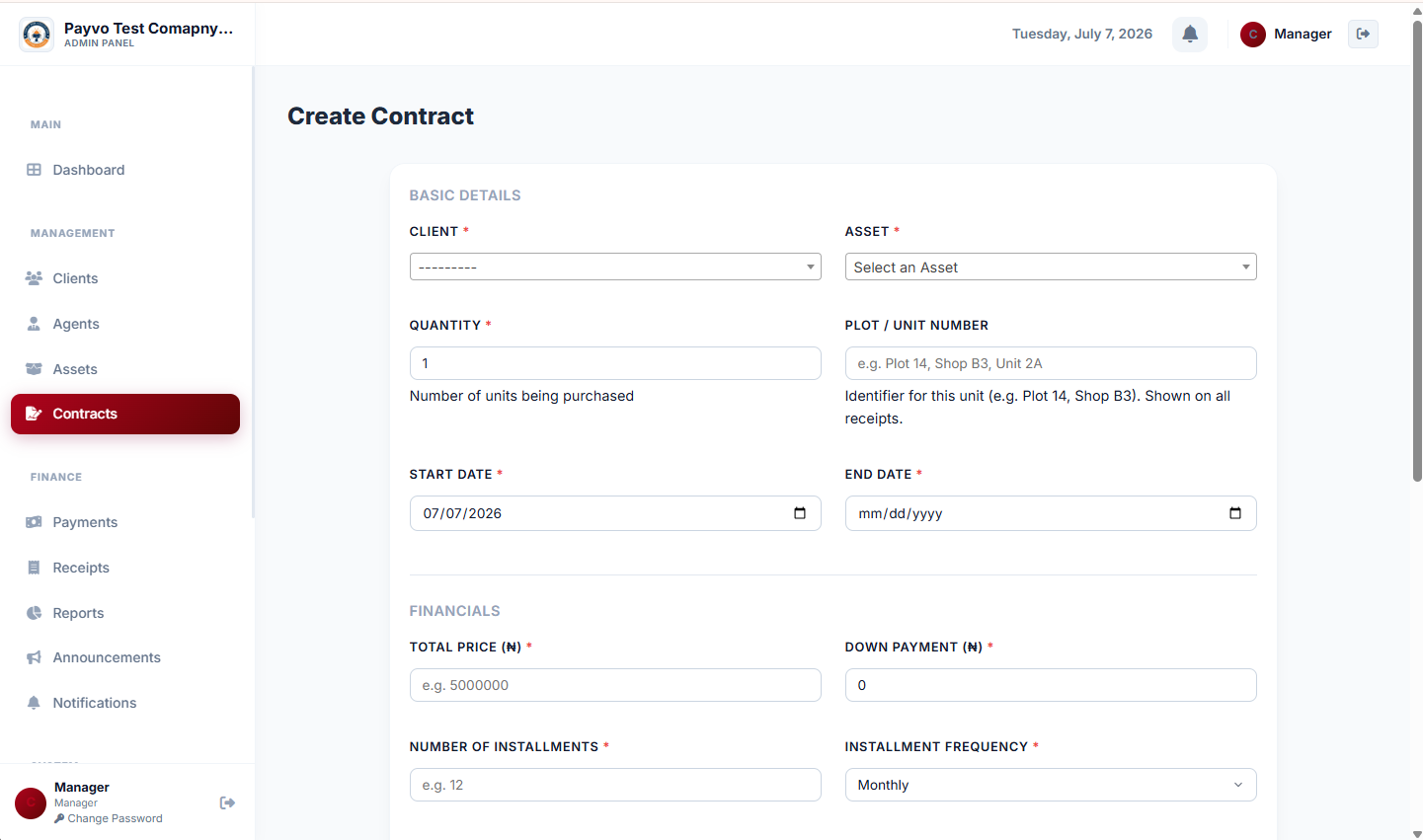 Management: Add contract (top)
Step 6: Generate and Issue Payment Receipts
Every payment received, whether it's an initial deposit or an installment, should be accompanied by a professional receipt. This receipt serves as proof of payment for the customer and an essential record for your business. It should clearly state the amount paid, the date, the remaining balance, and the next due date.
A receipt generator app Nigeria can help you create these documents quickly and professionally. Digital receipts are particularly useful as they can be sent instantly via email or WhatsApp, providing customers with immediate confirmation.
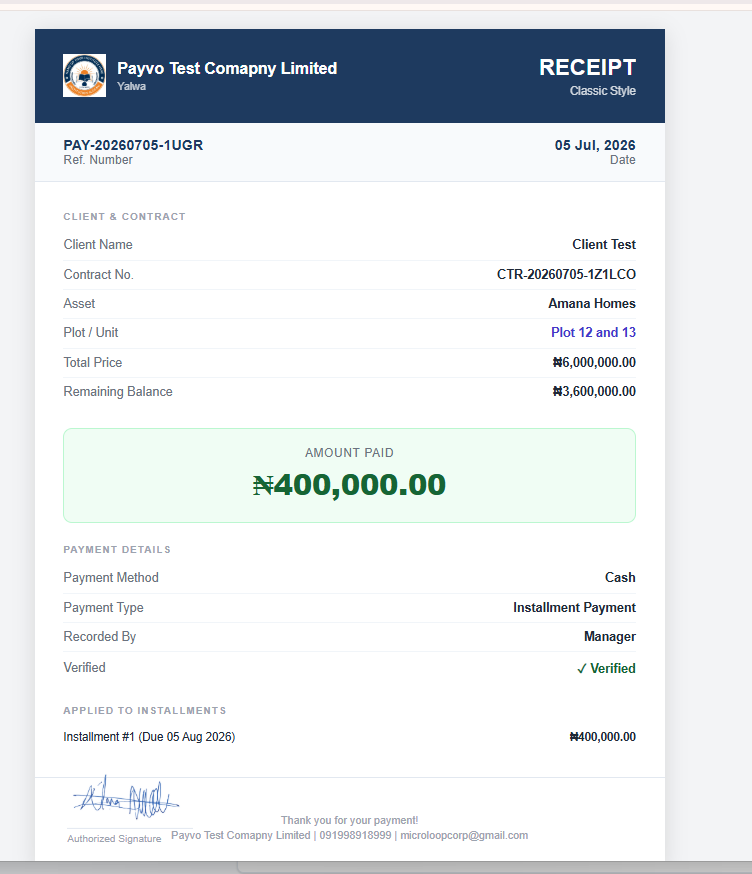 Finance: Paymnet Receipt Sample
Step 7: Regularly Reconcile Records
Even with automated systems, periodic reconciliation is vital. Compare your internal records with bank statements and customer payment confirmations. This helps catch any errors, missed payments, or unrecorded transactions. For car dealer installment software users, reconciling weekly or monthly ensures that vehicle ownership documents are released accurately upon full payment.
> "In the world of installment sales, what you don't track accurately today will cost you more than just money tomorrow – it will cost you customer trust and operational efficiency."
Common Mistakes to Avoid
Managing installment payments comes with its share of potential pitfalls. Being aware of these can save your business significant headaches and financial losses.
- Inconsistent Record Keeping: Relying on scattered notes, multiple spreadsheets, or memory will inevitably lead to errors. Without a single, authoritative source of truth for payment records, disputes are guaranteed.
- Lack of Clear Contracts: Vague or incomplete contracts regarding total cost, interest rates, payment schedules, and penalties are a recipe for confusion and legal issues. Ensure every detail is explicitly stated and understood by both parties.
- Ignoring Late Payments: Failing to address late payments promptly can signal to customers that due dates are flexible, leading to further delays and potential defaults. Implement a clear policy and follow through.
- Manual Calculation Errors: Human error in calculating outstanding balances, especially with interest or penalties, is common. Even a small miscalculation can accumulate over many installments and customers.
- Poor Communication: Not sending regular payment reminders or clear statements of account can lead to customers forgetting due dates or being unaware of their current balance. A WhatsApp payment notification system can be very effective here.
- Underestimating Administrative Load: As your business grows, the administrative burden of tracking installment payments grows exponentially. What works for 5 customers will break down at 50 or 500.
How to Track and Grow After Launch
Once you have a system for calculating outstanding balances, the next step is to leverage this data for growth and efficiency. Effective tracking isn't just about knowing what's owed; it's about understanding your cash flow, identifying trends, and making informed business decisions.
- Monitor Key Performance Indicators (KPIs): Track metrics like collection rate, average days to payment, and the percentage of overdue accounts. This gives you a clear picture of your installment portfolio's health. For example, if your average days to payment are increasing, it might signal a need to review your reminder system or payment terms.
- Automate Notifications: Implement automated reminders for upcoming payments and overdue balances. A WhatsApp payment notification system can significantly improve collection rates by gently prompting customers. This also frees up your staff from repetitive manual follow-ups.
- Utilize Reporting Features: Generate regular reports on outstanding balances, payment histories, and revenue collected. These reports are invaluable for financial planning, identifying your best-performing contracts, and understanding potential cash flow gaps. For businesses using a dedicated installment management software Nigeria, these reports are often generated with a few clicks.
- Agent Performance Tracking: If you work with agents for sales or collections, implement agent commission tracking software. This allows you to monitor their performance based on payments collected, not just sales made, ensuring incentives align with your business goals.
- Customer Relationship Management: Use your payment data to understand customer behavior. Identify customers who consistently pay on time and those who frequently default. This insight can inform future sales strategies and risk assessment.
- Scale with Technology: As your customer base grows, manual systems become unsustainable. Investing in a robust installment management software like Payvo allows you to efficiently manage hundreds or thousands of contracts, track customer balances, and automate many administrative tasks, enabling you to focus on growth rather than getting bogged down in paperwork. You can explore a demo to see how it fits your operations by visiting the Payvo demo page.
Frequently Asked Questions
Q1: What is the most common reason for discrepancies in outstanding balances?
The most common reason is inconsistent or manual record-keeping. Missing payment entries, calculation errors, and unrecorded penalties or interest charges often lead to disagreements. This is why a centralized business payment tracking app Nigeria is critical.
Q2: How often should I update customer installment balance records?
Ideally, records should be updated immediately after each payment is received. For businesses with frequent payments, this might be daily. At a minimum, weekly updates are necessary to maintain accuracy and prevent large discrepancies.
Q3: Can I include late payment penalties in the outstanding balance?
Yes, if your contract explicitly states the terms for late payment penalties. These penalties should be clearly communicated to the customer and added to their outstanding balance according to the agreed-upon schedule. Always ensure your contract legally supports such additions.
Q4: What if a customer disputes their outstanding balance?
If a dispute arises, refer immediately to the signed contract and all payment records (receipts, bank statements). A transparent and well-maintained record-keeping system, like that offered by contract management software Nigeria, will provide the necessary evidence to resolve the issue quickly and fairly.
Q5: Is there a simple formula to calculate outstanding balance if a customer misses payments?
The core formula remains the same: Total Repayable Amount - (Initial Deposit + Sum of All Payments Received). If a customer misses payments, their "Sum of All Payments Received" will simply be lower than expected, resulting in a higher outstanding balance. Any late fees would then be added on top of this.
Ready to Streamline Your Installment Tracking?
Managing installment sales effectively is crucial for business growth in Nigeria, but manual processes can quickly become a bottleneck. If you're tired of sifting through notebooks, wrestling with complex spreadsheets, or managing payment reminders through WhatsApp, it's time for a more organized approach. Discover how Payvo can centralize your customer records, automate payment tracking, and provide accurate outstanding balance calculations, giving you clarity and control over your installment portfolio. Visit the Payvo website today to learn more about how our installment management software can transform your operations and help you scale your business with confidence.