Miscalculating installment interest can cost your Nigerian business thousands of Naira annually, erode profits, and damage customer trust. In a market where a 15-40% markup on cash sales is common, getting installment pricing wrong means you're leaving significant money on the table or, worse, losing it to defaults. Mastering interest calculation isn't just about profit; it's about sustainable growth and precise financial planning in a dynamic economy.
 Nigerian business owner reviewing financial documents
The Installment Economy in Nigeria: A 2026 Perspective
In 2026, installment sales are more crucial than ever for Nigerian businesses looking to expand their customer base and boost revenue. With average monthly incomes ranging from ₦50,000 to ₦150,000, many consumers simply cannot afford outright cash purchases for significant items like electronics, appliances, vehicles, or even property. This creates a massive opportunity for businesses willing to offer flexible payment plans. For instance, a solar equipment leasing company might offer a ₦300,000 system on a 12-month plan, making it accessible to a wider demographic.
However, this opportunity comes with complexities. Financing inventory through microfinance banks can incur interest rates of 3-7% per month, while informal lenders might charge 10-25% monthly. This means the cost of capital is high, and businesses must factor this into their installment pricing to remain profitable. Furthermore, the default rate on unsecured installment sales can range from 10-30%, a significant risk that needs to be mitigated through careful contract structuring and customer vetting. Businesses need robust systems to track these intricate financial arrangements, a challenge that many still grapple with using manual methods. Understanding how to accurately calculate interest and structure repayment schedules is not just good practice; it's essential for survival and growth in Nigeria's competitive market.
What You Need Before You Start
Before diving into installment sales and customer loans, ensure you have these foundational elements in place:
- Clear Business Objectives: Define what you aim to achieve with installment sales (e.g., increased sales volume, higher profit margins, market penetration).
- Initial Capital for Inventory: Whether self-funded or via a loan, ensure you have the stock to sell.
- Defined Target Market: Understand your customers' financial capacity and payment habits.
- Basic Legal Understanding: Familiarity with consumer protection laws and contract enforceability in Nigeria. Consider consulting a legal professional for drafting robust installment sale agreements, which can cost between ₦30,000 and ₦100,000 for a solid template.
- Verification Process: A system for vetting customers to assess their creditworthiness. This could involve basic credit checks costing ₦500 - ₦2,000 per customer or thorough guarantor requirements.
- Record-Keeping Tools: Whether it's a dedicated software or detailed ledgers, you need a reliable way to track every transaction.
- Customer Service Plan: A strategy for managing customer inquiries, complaints, and payment reminders.
Step-by-Step: How to Calculate Interest on Installment Sales & Customer Loans
Mastering interest calculation for installment sales is a critical skill for any Nigerian business offering credit. Here’s a step-by-step guide to ensure accuracy and profitability.
Step 1: Determine Your Base Cash Price and Desired Profit Margin
Start with the actual cash price of the item you're selling. This is your Cost of Goods Sold (COGS) plus your standard cash profit margin. For example, if you sell a washing machine with a COGS of ₦80,000 and typically aim for a 25% cash profit margin, your cash sale price is ₦100,000 (₦80,000 + 25% of ₦80,000). This cash price is the baseline for all subsequent calculations.
Next, decide on the additional profit margin you need to cover the risks and costs associated with offering credit. This margin accounts for factors like the time value of money, potential defaults, administrative costs, and the cost of financing your inventory. While typical cash markups are 15-40%, net profit margins on installment sales often fall to 5-15% after accounting for financing and defaults. This means your installment price needs to be significantly higher than your cash price to achieve a reasonable net profit.
Step 2: Establish the Interest Rate and Installment Period
This is where many businesses make mistakes. There are two primary ways to apply interest: simple interest or reducing balance interest.
- Simple Interest (Flat Rate): The interest is calculated on the original principal amount for the entire duration of the loan. This is often easier to calculate but can be more expensive for the customer over time if not clearly explained.
- Reducing Balance Interest: Interest is calculated only on the outstanding principal balance each month. As the customer pays down the principal, the interest portion of subsequent payments decreases. This is generally fairer to the customer and more transparent.
For installment sales in Nigeria, a monthly interest rate is more common. Rates can range from 3-7% per month for microfinance loans, so your customer interest rate should reflect your cost of capital plus your risk premium. Installment periods typically range from 3 to 12 months for electronics and appliances.
Consider your market and product. A car dealer might offer a 24-month plan, while a building material supplier might offer 6 months.
Step 3: Determine the Down Payment
A down payment is crucial for mitigating risk and ensuring customer commitment. Typical down payments range from 10% to 30% of the item's value. A higher down payment reduces your exposure and the total amount the customer needs to finance.
Calculation: If your item is ₦120,000 (installment price) and you require a 20% down payment, the down payment is ₦24,000 (0.20 \ ₦120,000). The amount to be financed then becomes ₦96,000.
Step 4: Calculate the Total Repayable Amount
Once you have the principal amount to be financed (after down payment) and the interest rate, you can calculate the total amount the customer needs to repay.
Method 1: Simple Interest Calculation
If you choose simple interest, calculate the total interest first and add it to the principal.
Formula: Total Interest = Principal Financed \ (Monthly Interest Rate \* Number of Months)
- Example: Principal Financed = ₦96,000. Monthly Simple Interest Rate = 3%. Installment Period = 6 months.
- Total Repayable = Principal Financed + Total Interest = ₦96,000 + ₦17,280 = ₦113,280
This is more complex to calculate manually but is fairer. You'll need a financial calculator or a spreadsheet. The formula for monthly payment (M) is:
M = P \[ i(1 + i)^n ] / \[ (1 + i)^n – 1]
Where:
- P = Principal Loan Amount (amount financed after down payment)
- i = Monthly Interest Rate (annual rate divided by 12)
- n = Total Number of Payments (installment period in months)
- Example: Principal Financed = ₦96,000. Monthly Interest Rate = 3% (0.03). Number of Payments = 6 months.
- M = ₦96,000 \[ 0.03(1 + 0.03)^6 ] / \[ (1 + 0.03)^6 – 1]
- (1 + 0.03)^6 = 1.19405
- M = ₦96,000 \[ 0.0358215 ] / \[ 0.19405 ]
- M ≈ ₦17,722.46 (monthly payment)
- Total Interest = ₦106,334.76 - ₦96,000 = ₦10,334.76
Step 5: Calculate the Monthly Installment Payment
Once you have the total repayable amount, divide it by the number of installment periods.
- Simple Interest Example: Total Repayable = ₦113,280. Installment Period = 6 months.
- Monthly Payment = ₦113,280 / 6 = ₦18,880
- Reducing Balance Example: We already calculated the monthly payment (M) as ₦17,722.46.
Step 6: Create a Clear Repayment Schedule
Provide your customer with a detailed repayment schedule outlining each payment date, the amount due, and the outstanding balance. Transparency builds trust and reduces disputes.
For businesses managing multiple installment contracts, manual tracking becomes a nightmare. This is where an installment management software Nigeria solution like Payvo becomes invaluable. It allows you to create contracts with specified payment terms, and the installment schedules are generated automatically. This eliminates manual calculation errors and provides customers with clear, consistent payment plans.
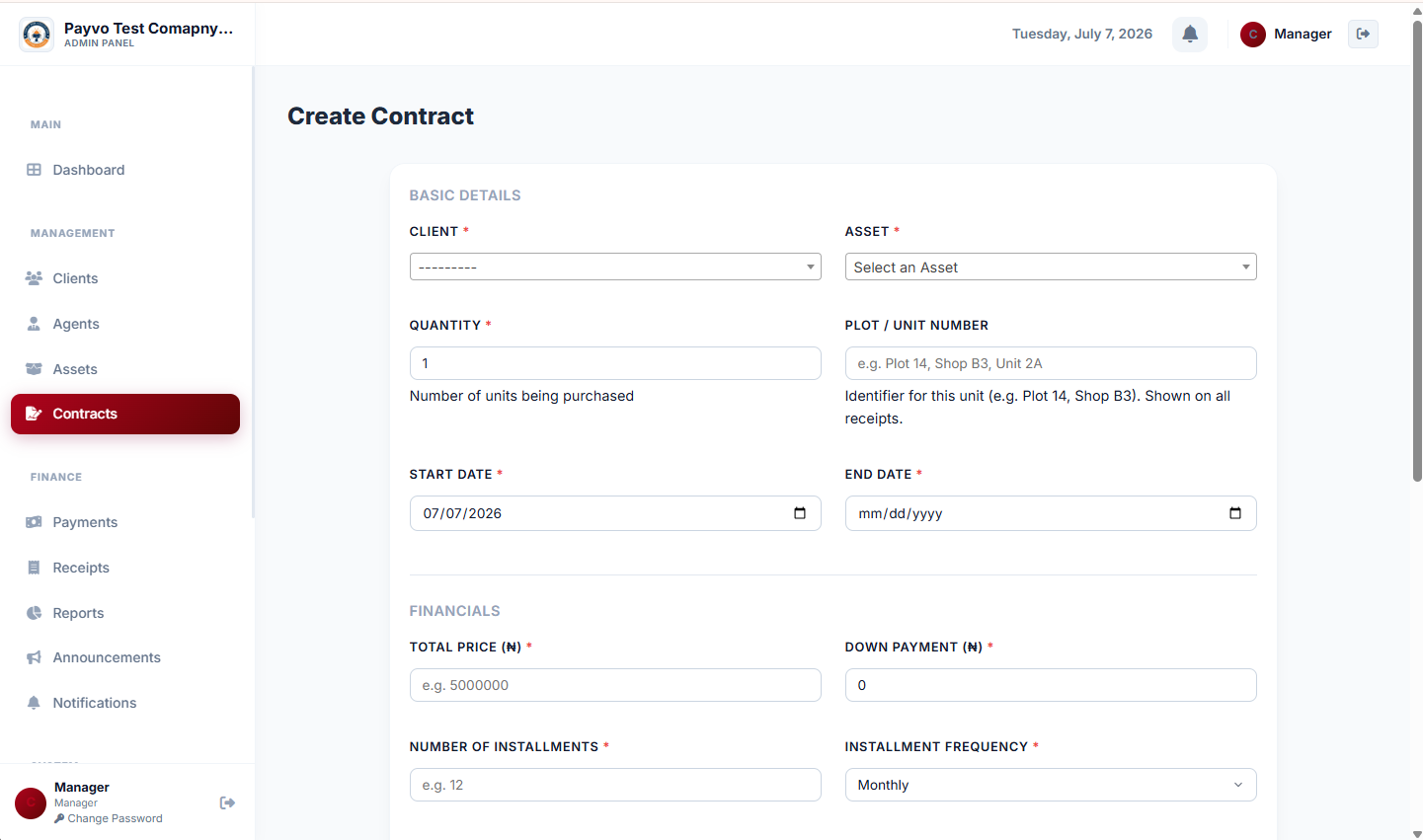 Management: Add contract (top)
Step 7: Document the Agreement Formally
A well-drafted installment sale agreement is your legal protection. It should clearly state:
- The cash price of the item.
- The installment price.
- The down payment amount.
- The principal amount financed.
- The interest rate (and whether it's simple or reducing balance).
- The total number of installments.
- The monthly installment amount.
- Payment due dates.
- Penalties for late payments.
- Consequences of default (e.g., repossession clauses).
- Any additional fees (e.g., processing fees).
> "In Nigeria's installment economy, trust is built on transparency. A clear, well-documented payment plan is the bedrock of a successful credit sale, far more effective than any strong-arm recovery tactic."
Step 8: Implement a Robust Tracking and Notification System
Once the contract is signed, the real work begins: tracking payments and ensuring timely collections.
- Payment Recording: Every payment received must be accurately logged against the correct contract.
- Receipt Generation: Provide customers with a receipt for every payment. This is essential for their records and your accountability.
- Reminders: Proactive payment reminders significantly reduce late payments and defaults.
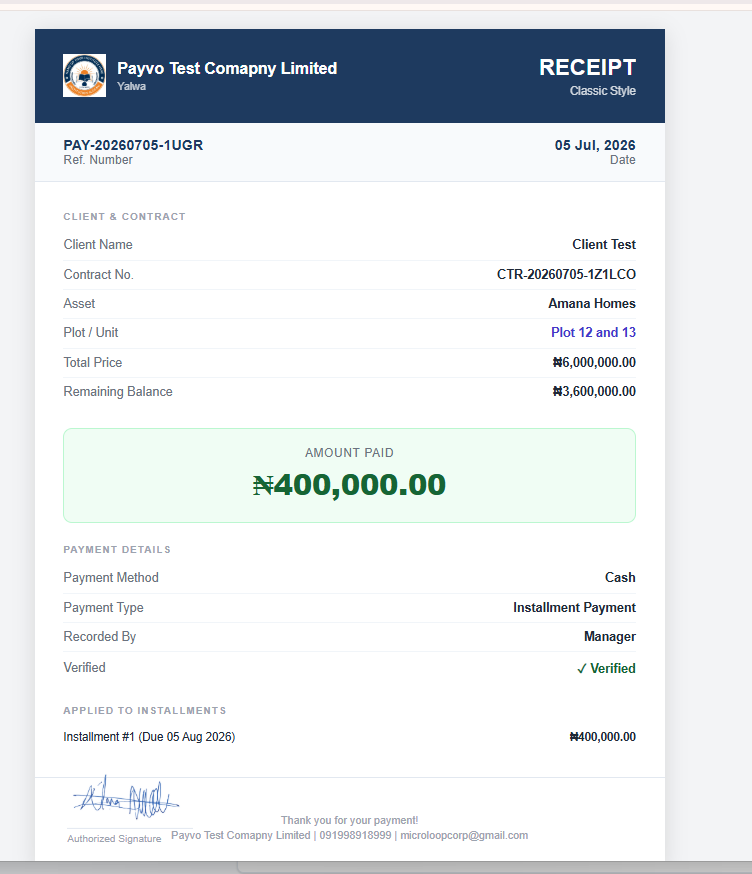 Finance: Paymnet Receipt Sample
Common Mistakes to Avoid
Offering installment sales can be highly profitable, but several pitfalls can quickly turn a good opportunity into a financial drain.
- Underestimating Default Rates: Don't assume everyone will pay on time. With default rates ranging from 10-30% on unsecured installment sales, factor this risk into your pricing and cash flow projections.
- Lack of Clear Contracts: Vague terms lead to disputes. Always have a legally sound, detailed installment agreement signed by both parties.
- Poor Customer Vetting: Selling to anyone who walks in the door without basic verification (costing ₦500 - ₦2,000) is a recipe for high default rates. Know your customer.
- Manual Tracking Errors: Relying on notebooks or complex spreadsheets for tracking payments, due dates, and outstanding balances is prone to human error, leading to lost revenue and customer dissatisfaction.
- Inconsistent Follow-Up: Failing to send timely payment reminders or follow up on missed payments allows small issues to escalate into full defaults.
- Over-Complicating Interest: While reducing balance is fairer, if your customers struggle to understand it, they might perceive it as deceptive. Ensure your chosen interest method is clear and easily explainable.
How to Track and Grow After Launch
Once you've implemented your installment sales process, continuous tracking and analysis are vital for growth and profitability.
- Monitor Key Performance Indicators (KPIs):
- Default Rate: Track the percentage of customers who fail to make payments as agreed. If it's consistently above 15-20%, review your vetting process or pricing.
- Collection Rate: The percentage of due payments actually collected.
- Average Payment Lag: How many days, on average, payments are delayed.
- Customer Acquisition Cost (CAC) for Installment Sales: How much it costs to acquire a new customer who buys on installment.
- Net Profit Margin on Installment Sales: As noted, this is often lower than cash sales (5-15%) due to added costs and risks.
- Leverage Analytics and Reporting: Use your installment management software Nigeria solution to generate regular reports. Look for trends in payment behavior, identify your most profitable products, and pinpoint periods with higher defaults. Payvo's real-time dashboards and financial reports allow you to see total clients, active contracts, amount collected, outstanding balances, and next payments due at a glance, providing the data you need to make informed decisions. You can also generate reports for accounting and record-keeping, ensuring full financial visibility.
- Refine Your Customer Vetting: Based on your default rates, continuously improve your screening process. This might involve requiring more robust guarantors or adjusting down payment requirements for certain customer segments.
- Optimize Your Pricing: Regularly review your interest rates and installment pricing structures. Are you covering your costs (including financing and potential defaults)? Are you competitive in the market? Use an instalment interest calculator to test different scenarios.
- Enhance Communication: Automate WhatsApp payment notification system messages for payment reminders, successful payments, and contract updates. Good communication reduces misunderstandings and improves customer satisfaction.
- Empower Your Sales Agents: If you use agents, ensure they have the tools to track their performance and commissions. An agent commission tracking software feature, like that offered by Payvo, allows agents to view their earnings and submit withdrawal requests, motivating them to drive sales and collections.
- Seek Feedback: Regularly ask customers for feedback on your installment plans. What works well? What could be improved? This direct input can lead to valuable adjustments.
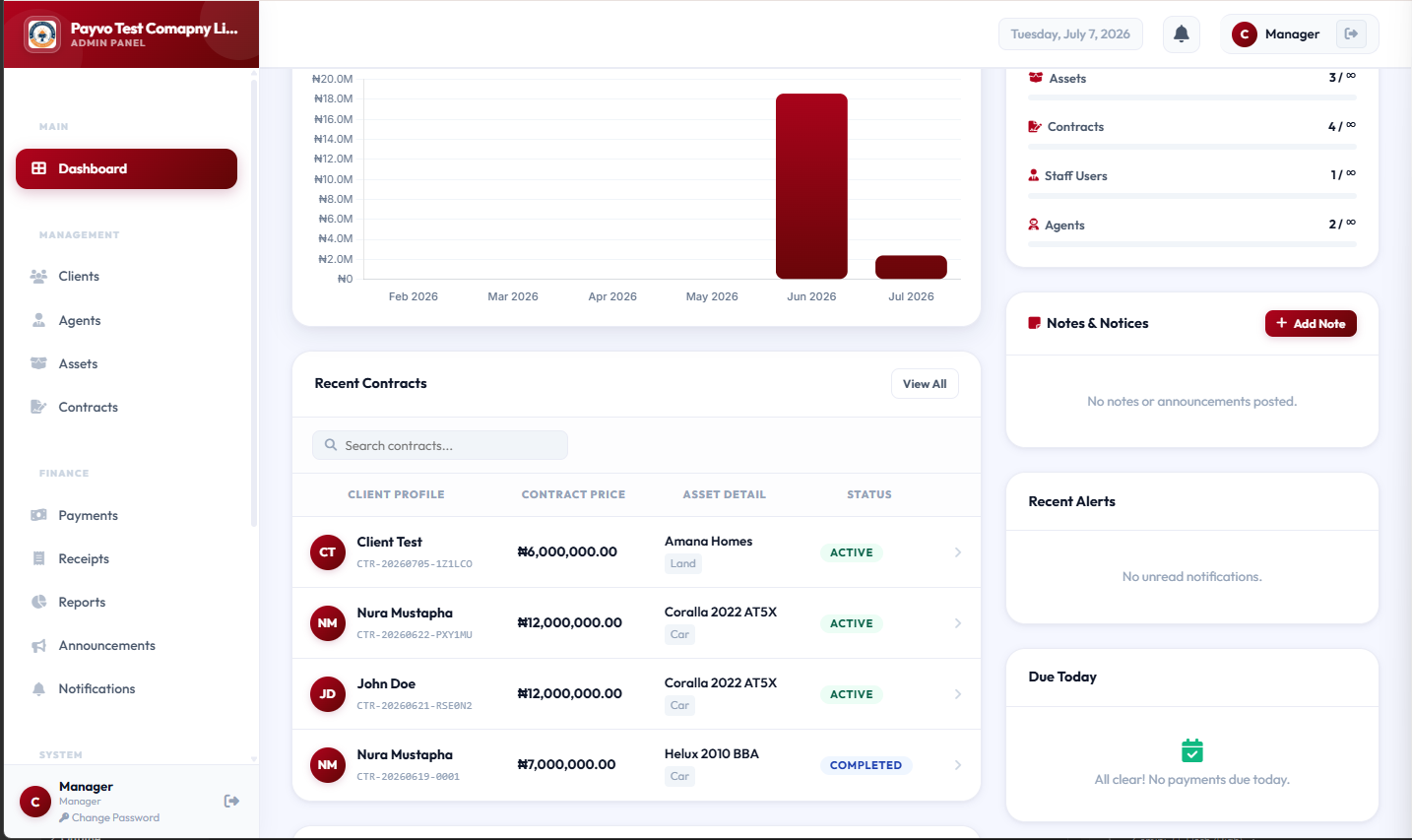 Dashobard (top)
Frequently Asked Questions
Q1: What is the difference between simple interest and reducing balance interest?
A1: Simple interest is calculated on the original principal amount for the entire loan term, meaning the interest portion of each payment remains constant. Reducing balance interest is calculated only on the outstanding principal balance, so as you pay down the principal, the interest charged in subsequent periods decreases. Reducing balance is generally fairer to the borrower as they pay less total interest over time.
Q2: How much down payment should I ask for on an installment sale?
A2: The typical down payment in Nigeria for installment sales ranges from 10% to 30% of the item's value. The ideal percentage depends on the item's cost, the customer's creditworthiness, and your business's risk tolerance. Higher-risk customers or more expensive items usually warrant a larger down payment to mitigate your exposure.
Q3: What happens if a customer defaults on an installment payment?
A3: Your installment sale agreement should clearly outline the consequences of default. This typically includes late payment penalties (e.g., a fixed fee or an increased interest rate) and, for continued non-payment, potential repossession of the asset. You might also engage a recovery agent, which can cost between ₦5,000 and ₦20,000 per defaulted account. A robust contract management software Nigeria solution helps track these situations and automate follow-ups.
Q4: Can I manage agent commissions for installment sales with software?
A4: Yes, modern installment management software often includes features for agent commission tracking. Platforms like Payvo allow you to assign agents to contracts, automatically calculate their commission per payment received, and track their full earnings and payout history. This streamlines commission management and provides transparency for your sales team. You can learn more about this on our agent tracking page.
Q5: What legal documents do I need for installment sales in Nigeria?
A5: You absolutely need a comprehensive Installment Sale Agreement or Hire Purchase Agreement. This document should detail the item being sold, the total price, down payment, financed amount, interest rate, repayment schedule, late payment penalties, and terms for default and repossession. It's advisable to have this drafted or reviewed by a legal professional to ensure it complies with Nigerian contract law and protects your business.
Ready to Streamline Your Installment Sales?
Stop wrestling with complex calculations and scattered records. Take control of your installment sales, customer loans, and payment tracking with a system built for the Nigerian market. Explore how Payvo can help you automate contracts, generate receipts, send timely reminders, and gain clear financial insights. Visit our features page to see how we can transform your business operations, or register into Payvo today to get started.