₦350,000. That's the difference between a smoothly managed multi-plot land sale and a nightmare of confusion for a real estate developer in a place like Kaduna or Abuja. It's not just the cost of a land survey; it's the potential financial loss from misallocated payments, customer disputes, and wasted time when you don't properly manage how to avoid payment confusion for customers buying multiple plots. I’ve seen it firsthand, running my own shops for years before moving into consulting, and believe me, confusion always costs you.
 A real estate agent reviews documents with a
The Reality Check: What Nobody Tells You About Multi-Plot Payments
Look, everyone talks about making the sale. "Get the customer!" they shout. But nobody really drills down into the nitty-gritty of what happens after the customer agrees to buy not just one, but maybe three or four plots from your estate in Kano or even a couple of commercial spaces in Lagos. This isn't a simple transaction anymore. You've got distinct properties, different payment schedules, and a single customer sending in lump sums that need to be carefully allocated.
Here's the thing: most small real estate developers, especially the new ones, try to manage this with a combination of Excel sheets, paper ledgers, and WhatsApp messages. It's a recipe for disaster, honestly. When a customer sends you ₦500,000, is that for Plot A's second installment or Plot B's down payment? Or maybe it's a mix? Without a clear system, you're guessing, and guessing in business means losing money. You're looking at potential losses from uncollected development levies (which can be anywhere from ₦50,000 to ₦250,000 per plot), forgotten agency fees (5% to 10% of total land value, mind you), and even legal fees for dispute resolution that could run you ₦300,000 to ₦1,500,000 for complex cases. These aren't small change, and they add up fast.
What You Actually Need to Get Started
Managing multiple plot sales isn't just about having land to sell. It's about having the right tools and mindset. You need to think like a professional, even if you're a one-man operation selling plots in a developing area outside Abuja.
Non-Negotiables:
- Clear Documentation for Each Plot: This isn't just about the Deed of Assignment. Each plot needs its own survey (₦150,000 to ₦350,000 per plot), its own perfection process (₦200,000 to ₦600,000 per plot), and crucially, its own distinct identifier. Plot 12, Block C, Phase 2. That's not just for the legal documents; it's for your internal records too.
- Individual Contracts per Plot (or a Master Contract with Clear Addendums): Even if a customer buys five plots, each plot should have its own payment schedule, its own agreed price, and its own terms. Mixing them up into one big, vague agreement is asking for trouble. Legal fees for drafting comprehensive agreements can range from ₦300,000 to ₦1,500,000, so get it right from the start.
- A Centralized Payment Tracking System: Forget scattered notebooks or endless WhatsApp chats. You need a dedicated system to record every single payment against the correct plot and contract. This is where a proper business payment tracking app Nigeria can save your sanity.
- Dedicated Bank Account for Business: Please, for the love of all that is holy, don't mix your personal funds with your business money. It makes reconciliation a nightmare and opens you up to all sorts of issues. Bank transfer charges are minimal (₦25 - ₦50 per transaction), so there's no excuse.
Nice-to-Haves (but quickly become necessities as you grow):
- Agent Commission Tracking Software: If you have agents selling for you, you need a transparent way to track their sales and commissions. This prevents arguments and keeps everyone motivated. Agent commission tracking software often comes as part of a larger property management suite.
- Digital Receipt Generator App Nigeria: Sending professional, branded receipts instantly builds trust and ensures both you and the customer have proof of payment.
- WhatsApp Payment Notification System: Automating payment reminders and confirmations via WhatsApp can drastically reduce your administrative workload and improve customer communication.
- Property Management Software Subscription: For anything more than a handful of plots, a dedicated system is a game-changer. Subscriptions typically range from ₦20,000 to ₦80,000 monthly for basic to advanced features.
"The biggest mistake in real estate isn't buying bad land; it's managing good land badly."
>
The Complete Step-by-Step Breakdown
Alright, let's break this down into actionable steps. This is how you set yourself up for success, whether you're managing land buyer records for a small estate in Nasarawa or a large development in Port Harcourt.
### Step 1: Assign Unique Identifiers to Every Plot
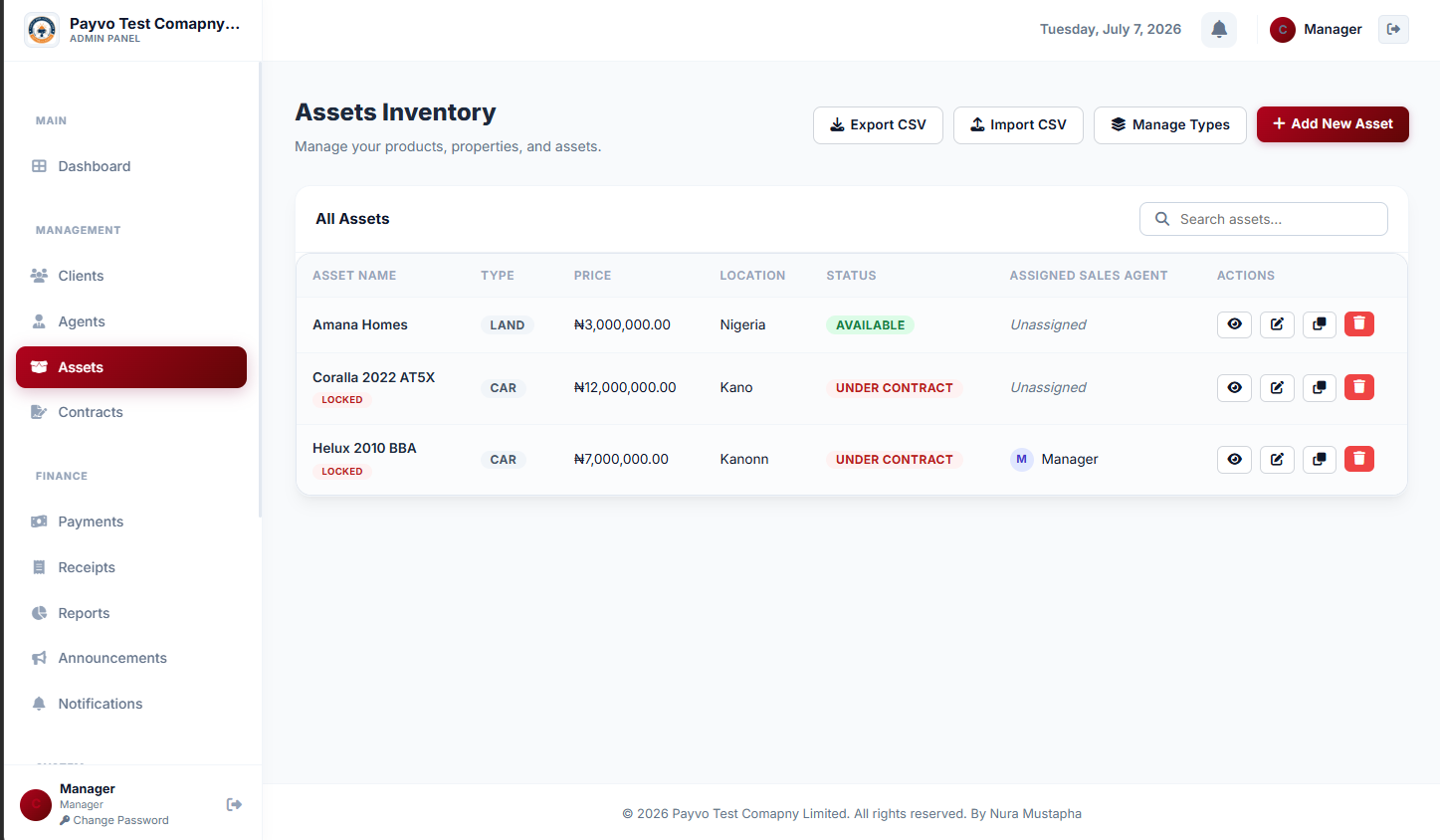
Before you even think about selling, every single plot of land in your inventory needs a unique, unambiguous identifier. This isn't just "Plot 1" or "The one near the big tree." It needs to be something like "Estate Name-Phase-Block-Plot Number" (e.g., "SunriseEstate-Ph2-BlkA-P17").
This identifier will follow the plot through every document, every contract, and every payment. When a customer calls, you shouldn't have to guess which plot they're talking about. This clarity is foundational to avoiding payment confusion for customers buying multiple plots, especially when you're dealing with multiple plot payment tracking.
 A close-up of a digital dashboard showing a list of assets
### Step 2: Draft Individual Contracts for Each Plot Sale
Even if Mr. Obinna wants to buy three plots, say Plot 17, 18, and 19 in Block A, Phase 2, you must have three separate contracts. Each contract clearly states the specific plot's unique identifier, its individual purchase price, its specific payment schedule, and any associated fees like stamp duty (1.5% - 3% of land value).
This might seem like extra paperwork, but trust me, it saves you headaches down the road. If one plot's payment falls behind, it doesn't automatically complicate the others. It also makes it crystal clear for the customer what they are paying for with each installment. You can link these contracts under a single customer profile, but the contractual obligations for each plot must remain distinct.
### Step 3: Implement a Centralized Installment Management System
This is where the rubber meets the road. You need a system that can handle multiple contracts per customer, track individual payment schedules, and accurately record every payment against the correct contract and plot. Manual methods just don't cut it once you start growing. Imagine trying to reconcile a customer's payment history across three different notebooks for three different plots. It's a mess.
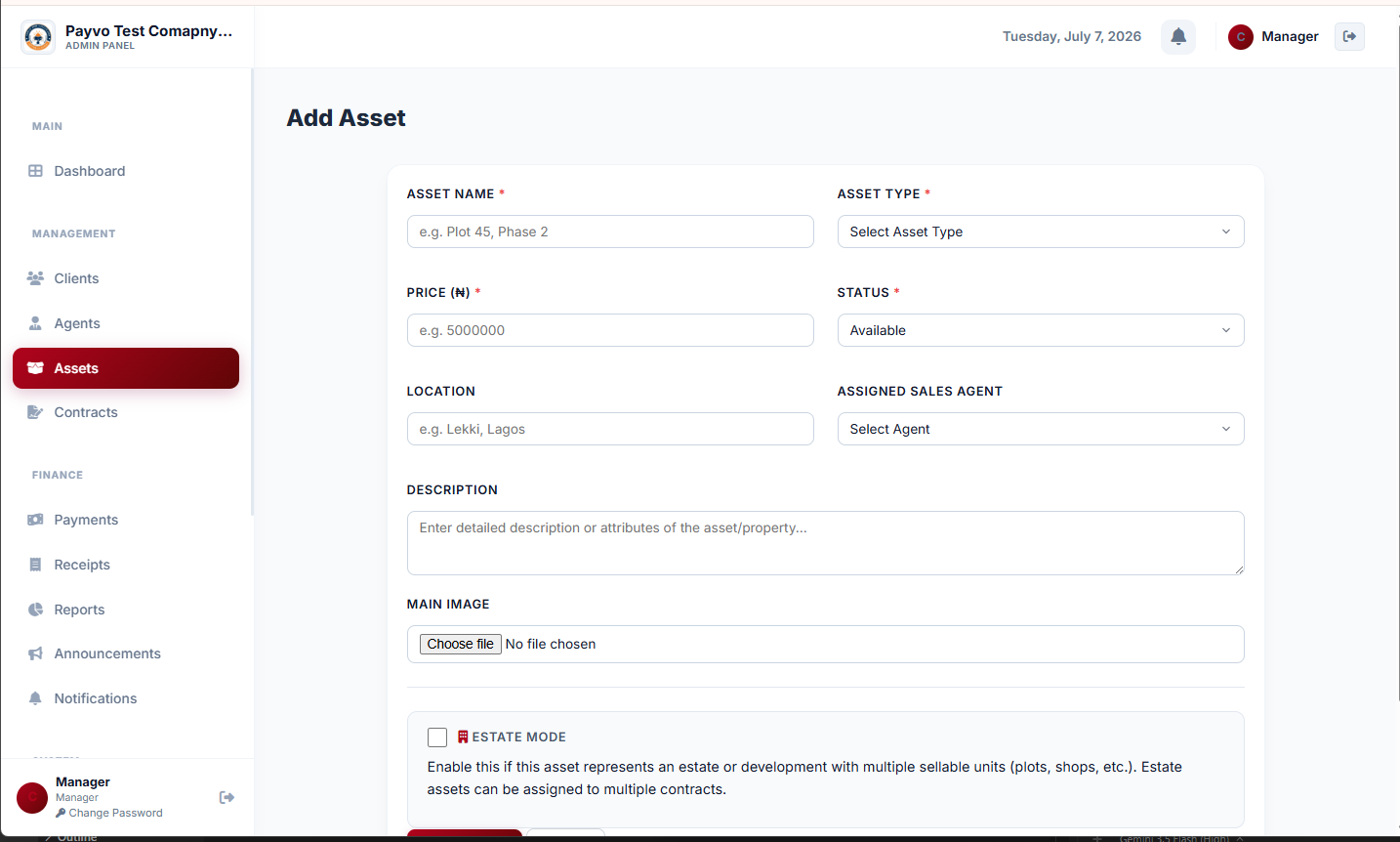
This is exactly what Payvo was built for. It's an installment management software Nigeria that lets you register customers, add assets (your plots!), create distinct installment contracts for each, set up payment schedules, and record every single payment. When a customer sends money, you record it against the specific plot's contract, eliminating any ambiguity. This is how you keep your plot sales management organized. You can explore how it works for real estate businesses here: https://payvo.ng/real-estate/.
 A screenshot of Payvo's interface for adding a new asset
### Step 4: Educate Your Customers on Payment Allocation
Don't assume your customers know your internal processes. When they're making payments, especially bank transfers, instruct them clearly on how to reference their payments. Ask them to include the specific plot identifier or contract number in the transfer description.
For example, "Payment for SunriseEstate-Ph2-BlkA-P17 installment 2." This small step significantly reduces the time you spend trying to figure out where a payment belongs, especially for customers buying multiple plots. Make this a part of your payment instructions on receipts and invoices.
### Step 5: Generate and Distribute Digital Receipts Promptly
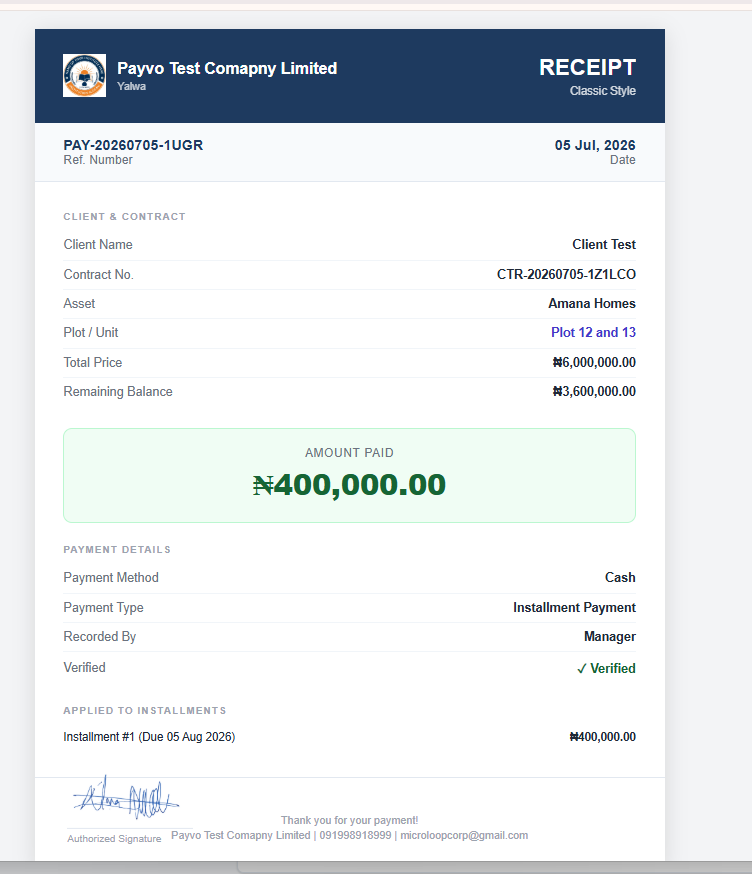
Every payment received must be acknowledged with a professional receipt. Not just any receipt – one that clearly states the amount received, the specific plot it's allocated to, the remaining balance for that particular plot, and the next due date. A digital receipt generator app Nigeria can automate this.
With a system like Payvo, you can generate and send these receipts instantly, often with just a few clicks. This gives both you and your customer an undeniable record, reducing the chance of disputes and building trust. You'll find that having a clear receipt list page available for review is invaluable.
 A sample digital payment receipt from Payvo
5 Mistakes That Cost Nigerian Business Owners the Most
I've seen these mistakes play out time and time again, not just in real estate but across car dealer installment software users, cooperative society management software, and even solar/equipment leasing companies. They're universal.
- Relying Solely on Memory or Informal Notes: You start with one or two customers, you think you can remember everything. Then you get 10, then 20, then 50. Your brain is not a database. I once worked with a car dealer in Ojuelegba who lost ₦1.2 million over six months because he couldn't prove a customer missed payments on a hire-purchase vehicle; his records were just scribbled notes.
- Mixing Payments Across Different Plots/Contracts: This is the cardinal sin when a customer is buying multiple plots. A customer sends ₦750,000, and you just mark it down as a general payment. Later, they might argue it was for Plot A, while you thought it was for Plot B. Without clear allocation, you lose. This is why a solid land buyer records system is non-negotiable.
- Lack of Formal Communication and Receipts: "Ah, we talked on WhatsApp, he knows." No, he doesn't know. He remembers a conversation. A formal, dated, digital receipt for every single payment, detailing allocation and remaining balance, is your best friend. It’s not just polite; it’s legally crucial.
- Ignoring Overdue Payments for Too Long: When a customer misses a payment, especially for a single plot in a multi-plot deal, it's easy to let it slide, thinking they'll catch up. But often, it signals bigger problems. Early intervention, with a polite but firm reminder, is key. Many systems now offer a WhatsApp payment notification system to help with this.
- Not Reconciling Records Regularly: Even with a good system, you need to set aside time, say once a week or bi-weekly, to compare your bank statements with your payment tracking system. Digital payment gateway transaction fees (1.5% - 2.5% + ₦100, capped at ₦2,000-₦3,000) and bank transfer charges need to be accounted for. An hour of reconciliation can save you days of headache later.
How to Know If You're on Track (Success Metrics)
So, how do you measure if you're actually doing a good job managing these multi-plot payments? It's not just about collecting money; it's about efficiency, accuracy, and customer satisfaction.
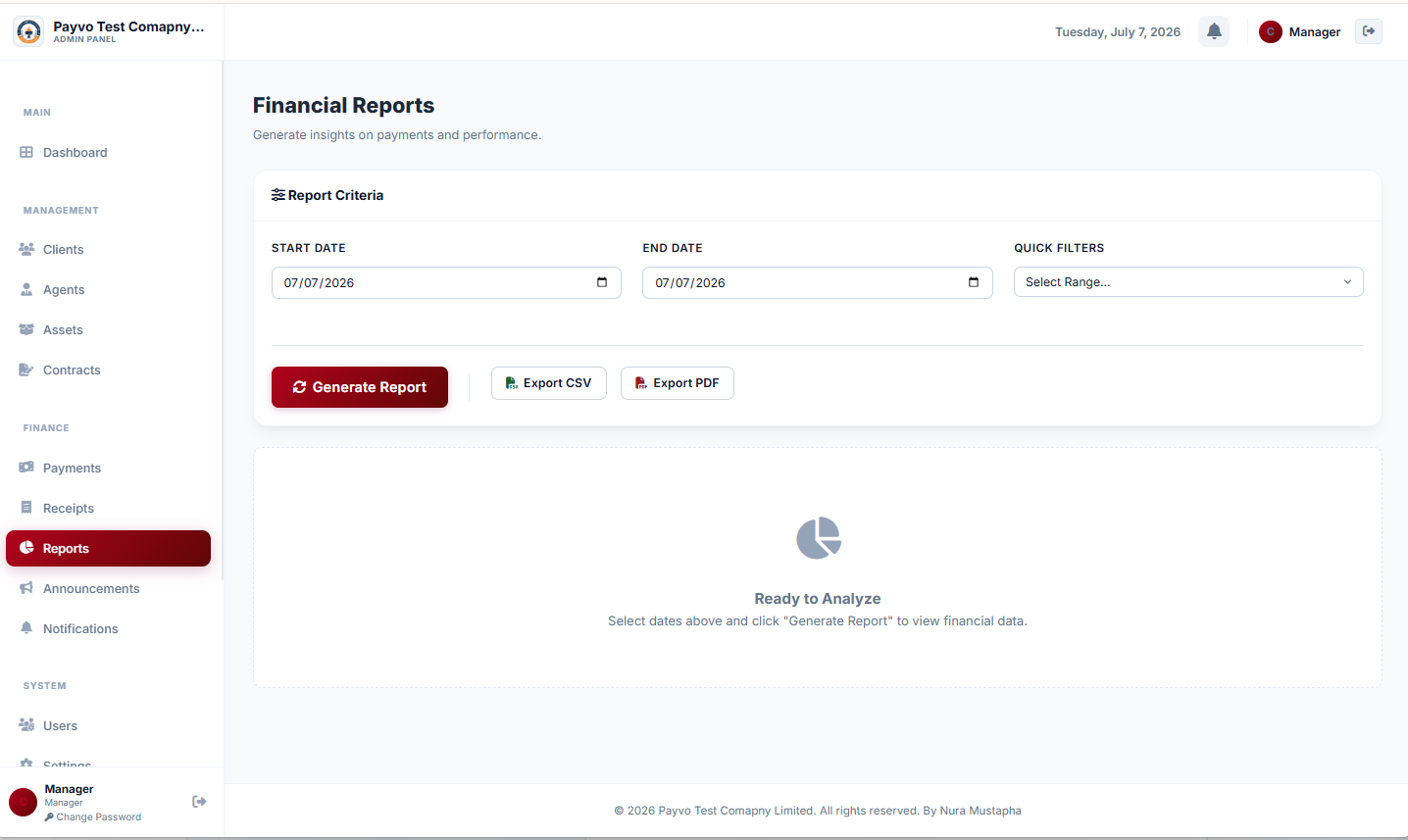
- Dispute Resolution Time: How quickly can you resolve a customer query about their payment history? If it takes more than 15 minutes to pull up all their records for every plot, you've got a problem. With good contract management software Nigeria, this should be almost instant.
- Payment Allocation Accuracy: Are you consistently allocating payments to the correct plot and contract without manual intervention or double-checking? Your error rate should be close to zero.
- Overdue Payment Rate: Track the percentage of payments that are overdue by more than 7 days. For real estate payment tracking Nigeria, a healthy rate is typically under 5%. If it's higher, you might need to re-evaluate your communication or reminder system.
- Time Spent on Reconciliation: How many hours do you or your staff spend each week trying to match payments to contracts? If you're spending more than 2-3 hours for every 50 active contracts, your system is inefficient. Professional accountant/auditor costs (₦100,000 - ₦400,000 monthly) are a clear indicator of how much manual reconciliation can cost you.
- Customer Satisfaction Scores: While harder to measure, happy customers who feel their payments are accurately tracked are more likely to refer others and complete their payments. A good business payment tracking app Nigeria contributes significantly to this.
 A screenshot of Payvo's financial reports page
Real Questions People Ask (FAQ)
How do I track installment payments for multiple land plots effectively?
The most effective way is to assign a unique identifier to each plot, create a separate contract for each plot, even if sold to the same customer, and then use a dedicated installment management software Nigeria to record and track all payments against these individual contracts. This ensures clear land buyer records.
What is the best agent commission tracking software for real estate?
Many comprehensive property management software solutions include agent commission tracking features. Look for one that integrates with your overall sales and payment tracking system, allowing agents to see their sales progress and commissions clearly, without compromising sensitive financial data. Payvo offers agent management features for businesses with teams; you can learn more about its capabilities for real estate at https://payvo.ng/real-estate/.
Can a receipt generator app Nigeria help with managing payments for different plots?
Yes, absolutely. A good digital receipt generator app Nigeria, especially one integrated with your payment tracking system, will automatically generate receipts that clearly state which specific plot a payment is for, the amount received, and the remaining balance for that particular plot. This prevents confusion and provides clear proof of payment.
How can I avoid confusion when customers pay for different plots using bank transfers?
The key is clear instruction and robust tracking. Instruct your customers to always include the specific plot identifier or contract number in the bank transfer narration. On your end, use a system that allows you to manually allocate incoming bank transfers to the correct contract and plot, then issue a corresponding digital receipt.
Is it really necessary to have separate contracts for each plot if one customer buys several?
Yes, it is highly recommended. While you can link all contracts to one customer profile, having separate contracts for each plot ensures that payment terms, specific plot details, and any potential issues (like a delayed payment) are tied to that individual plot, not the entire multi-plot deal. This significantly reduces the complexity of managing multiple plot payment tracking and potential disputes.
Your Next Move
If you're a real estate developer, a car dealer, or any business managing installment sales, especially when customers are buying multiple items, it's time to stop the confusion. Don't let scattered records and manual tracking cost you money and reputation. Take control of your sales and payments. Visit Payvo's public home page at https://payvo.ng/ to see how a dedicated installment management system can transform your business.