For many Nigerian businesses, especially those dealing in installment sales, calculating sales commissions can feel like a weekly or monthly headache. Errors are common, disputes arise, and valuable time that could be spent growing the business is instead consumed by manual spreadsheets and endless reconciliations. In 2026, relying on pen and paper or basic Excel for commission management isn't just inefficient; it's a direct drain on your bottom line.
 Business owner looking stressed while reviewing financial documents
The Evolving Landscape of Sales in Nigeria
The Nigerian market, particularly in sectors like real estate, automotive sales, solar energy, and cooperative finance, is increasingly driven by installment payment models. This approach makes high-value assets and services accessible to a broader customer base, but it also introduces significant complexities for businesses. According to recent market analyses, a substantial portion of consumer spending power in 2026 is channeled through structured payment plans, making efficient installment management software Nigeria a critical need. Businesses are finding that their sales teams are more motivated by clear, timely, and accurate commission payouts. The average sales commission rate in Nigeria can range from 5% to 20% of sales, depending on the industry and product margin. For a small to medium business with monthly sales volumes ranging from ₦500,000 to ₦10,000,000+, even minor errors in commission calculation can lead to substantial financial discrepancies and agent dissatisfaction. The shift towards digital transactions and remote work further underscores the need for robust, automated systems to handle these intricacies.
What You Need Before You Start
Before diving into automating your sales commissions, ensure you have the following in place:
- Clear Commission Structure: Define your commission rates (e.g., percentage of sale, flat fee per unit, tiered rates) and any conditions (e.g., paid upon down payment, paid upon full collection, clawbacks for returns).
- Agent Information: A comprehensive list of all sales agents, their contact details, and any unique identifiers.
- Sales Data: Access to accurate records of all sales, including customer details, product/service sold, sale value, and payment terms.
- Payment Tracking Method: A reliable way to record customer payments as they come in. This is crucial for commission calculation based on collections.
- Budget for Automation: While automation saves money in the long run, there's an initial investment. Basic sales commission software subscriptions in Nigeria typically range from ₦15,000 to ₦50,000 per month. For more custom or comprehensive solutions, one-time development costs can be ₦500,000 to ₦5,000,000.
- Internet Connectivity: For cloud-based solutions, a stable internet connection is essential. Budget around ₦10,000 - ₦30,000 per month for adequate internet data.
- Basic Hardware: An entry-level laptop for administrative tasks can cost ₦150,000 - ₦350,000.
Step-by-Step: How to Automate Sales Commissions
Automating sales commissions transforms a complex, error-prone task into a streamlined process. Follow these steps to implement an efficient system for your business.
Step 1: Define Your Commission Rules and Policies
Before any software can help, you must clearly articulate your commission structure. This goes beyond just a percentage; it includes the nuances of your business. For instance, do agents earn commission on the initial deposit, or only as customer payments are collected? Are there different rates for different products or sales volumes? What happens if a customer defaults or returns an item? Document these policies meticulously. This clarity is fundamental for setting up any commission management system, ensuring fairness, and preventing disputes.
Step 2: Choose the Right Automation Tool
Selecting the appropriate software is paramount. For businesses in Nigeria dealing with installment sales, you need a solution that specifically addresses the complexities of tracking partial payments and calculating commissions based on actual collections, not just initial sales figures. Look for systems that offer robust sales agent commission software capabilities. These tools should integrate client management, contract tracking, and payment processing.
Consider a platform like Payvo, which is designed precisely for businesses that sell on installment. It allows you to automate commission payout by linking agent commissions directly to specific contracts and payments. This means that as soon as a customer makes an installment payment, the system can automatically calculate the agent's due commission for that payment, removing manual calculations entirely.
Step 3: Set Up Your Agent and Commission Profiles
Once you've chosen your software, the next step is to populate it with your agent data and commission rules. Each sales agent should have a profile within the system. This includes their name, contact information, and specific commission rates or structures assigned to them. For example, if you have junior agents earning 5% and senior agents earning 10% on property sales, this needs to be configured. The system should also allow you to assign agents to specific contracts or sales.
Payvo simplifies this by allowing you to add agents and define their commission structures. You can assign agents to contracts, and the system automatically calculates commission per payment received. This feature is crucial for agent commission tracking software and provides transparency for both management and agents.
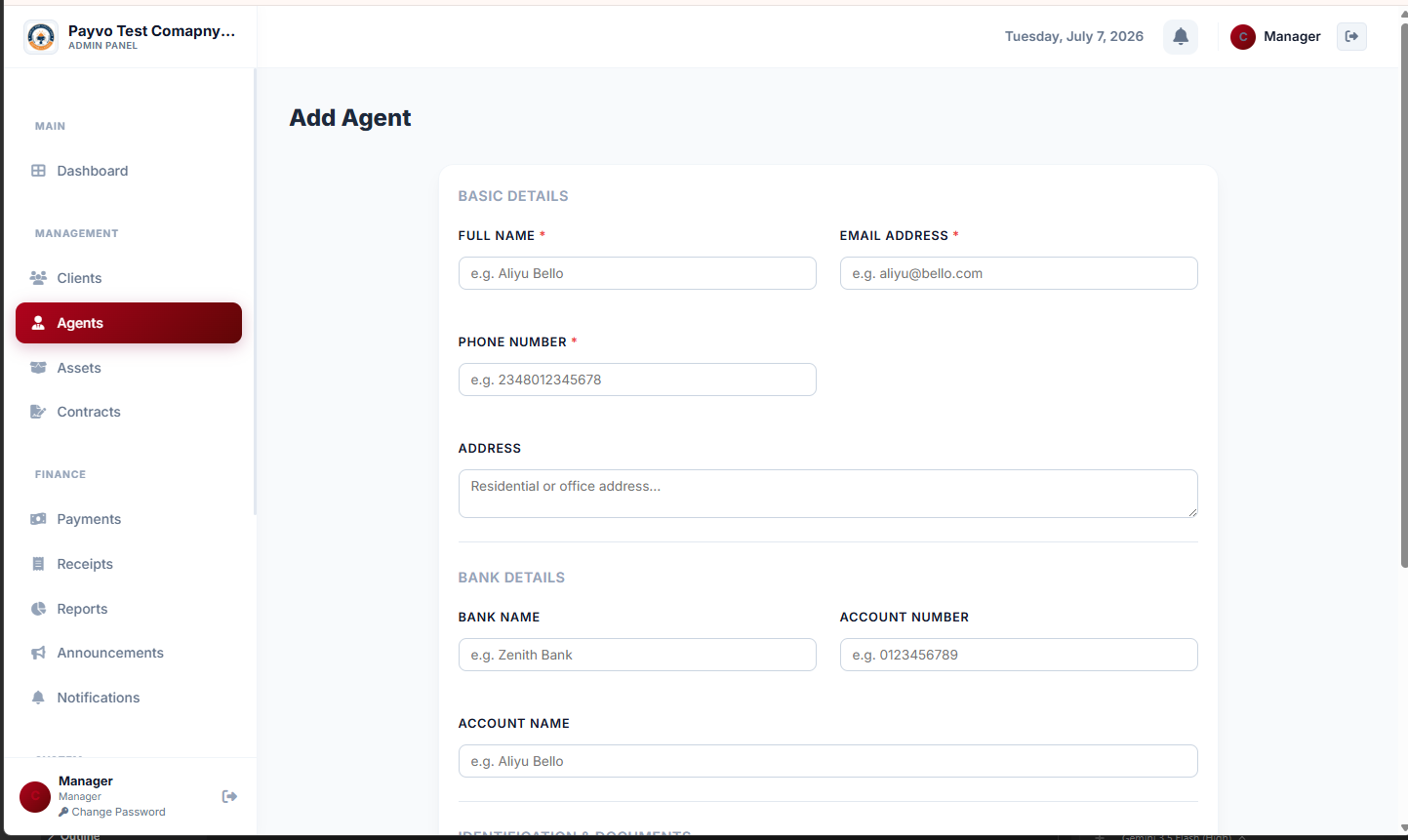 Agent: Add agent page
Step 4: Integrate Client and Contract Management
Effective commission automation is deeply intertwined with how you manage your clients and their contracts. Your chosen system should enable you to register new clients, capture their full details, and link them to specific contracts. For businesses selling properties, vehicles, or equipment on installment, the ability to register and manage assets linked to these contracts is also vital.
With a platform like Payvo, you can register and manage clients, storing their full details and viewing their complete payment history. You can also register and manage assets, tracking cars, property, or equipment linked directly to contracts. When creating contracts, you set the payment terms once, and the installment schedules are generated automatically. This comprehensive approach ensures that every aspect of the sale, from client onboarding to payment schedules, is connected, providing a solid foundation for accurate commission calculations.
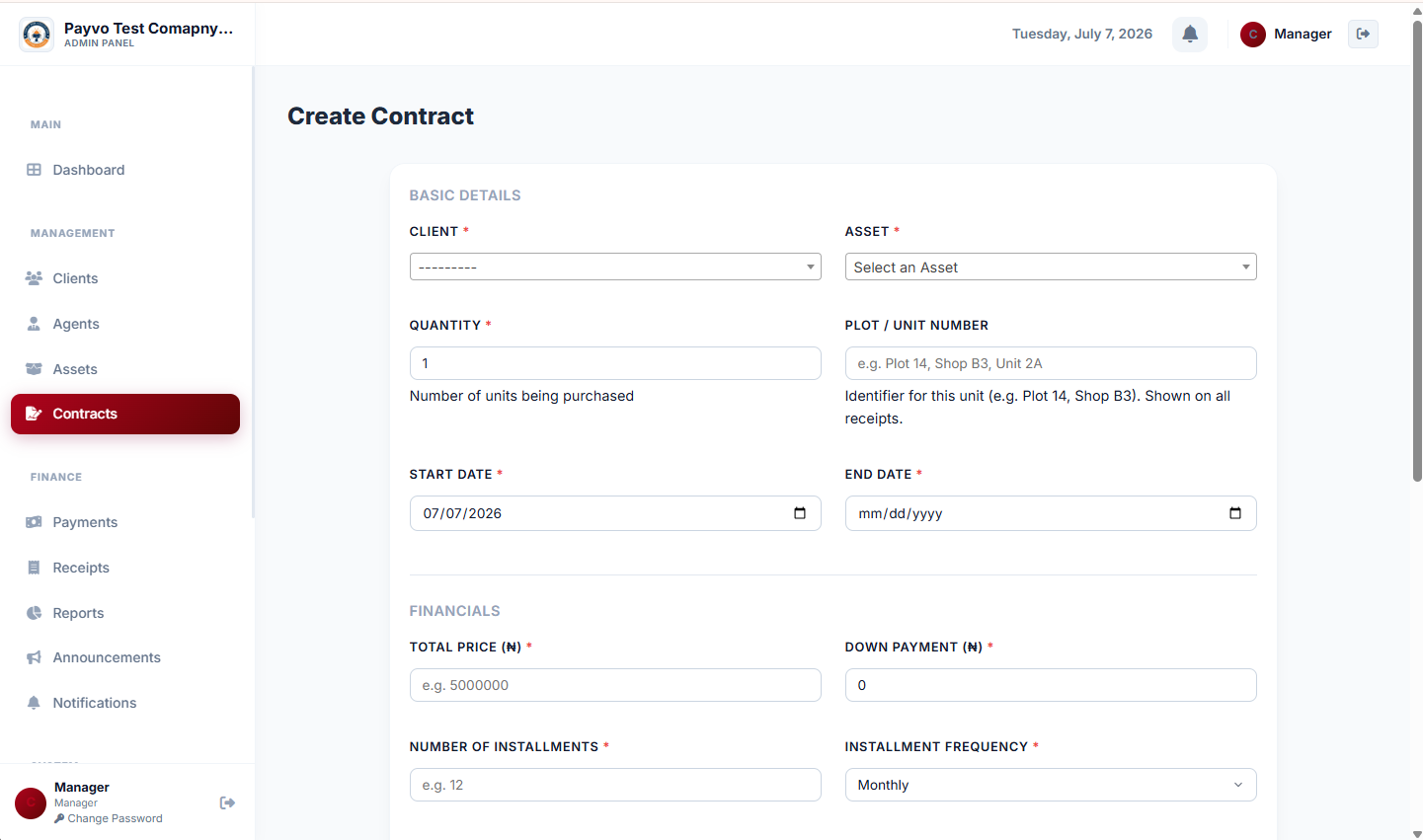 Management: Add contract (top)
Step 5: Automate Payment Tracking and Receipt Generation
The core of commission automation for installment sales lies in accurate and timely payment tracking. Your system must be able to record individual customer payments efficiently. Each payment should be logged against the specific contract, and the system should automatically update the outstanding balance. Crucially, every payment should trigger the generation of a professional receipt.
This is where a business payment tracking app Nigeria truly shines. Payvo allows you to record single payments against any contract, with a full history tracked. It also generates branded receipts (with your company logo, colors, and signature) automatically for every payment. These receipts can be sent via email or WhatsApp, including a public receipt link clients can view, save, or share, enhancing customer trust and reducing administrative burden. This also directly feeds into the commission calculation, ensuring agents are paid based on collected funds.
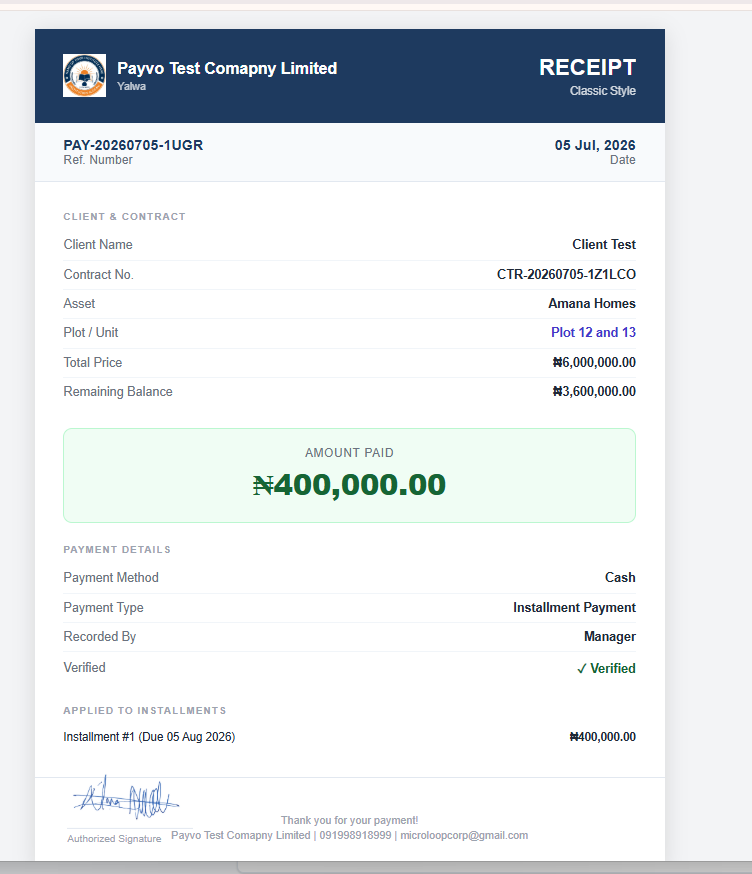 Finance: Paymnet Receipt Sample
Step 6: Automate Commission Calculation and Payouts
With clients, contracts, agents, and payments all linked within the system, the automation of commission calculation becomes seamless. The software should automatically calculate the commission due to each agent based on the payments collected for their assigned contracts. This removes the need for manual reconciliation and significantly reduces errors.
Furthermore, a robust system should provide agents with visibility into their earnings. This transparency is a huge motivator. Payvo's agent tracking page allows agents to log in with a code to view their own earnings and submit withdrawal requests directly, which managers are notified of instantly. This level of self-service empowers agents and streamlines the payout process, helping you to automate commission payout.
Step 7: Leverage Automated Notifications and Reminders
Beyond calculation, automation extends to communication. Your system should send automated notifications for various events. This includes informing clients of new contracts, payment receipts, and, critically, sending payment reminders before due dates. For agents, notifications about new commissions earned or payout statuses are invaluable.
Payvo's WhatsApp payment notification system and email integration ensure that new clients, new contracts, payment received notifications, and payment reminders are sent automatically. This drastically reduces the need for manual follow-up calls, improving collection rates and freeing up your team's time.
> "In the competitive Nigerian market, the ability to pay commissions accurately and on time isn't just good practice; it's a strategic advantage that attracts and retains top sales talent and fuels business growth."
Step 8: Monitor Performance and Generate Reports
Finally, an automated system isn't just for processing; it's for insight. You should be able to view real-time dashboards showing key performance indicators like total clients, active contracts, amount collected, outstanding balances, and next payment due. The system should also generate comprehensive reports that can be exported for accounting and record-keeping purposes.
Payvo provides real-time dashboards and the ability to generate detailed reports, allowing you to track everything securely. Weekly company reports delivered to your email keep you informed about key business performance metrics, enabling data-driven decisions and ensuring compliance.
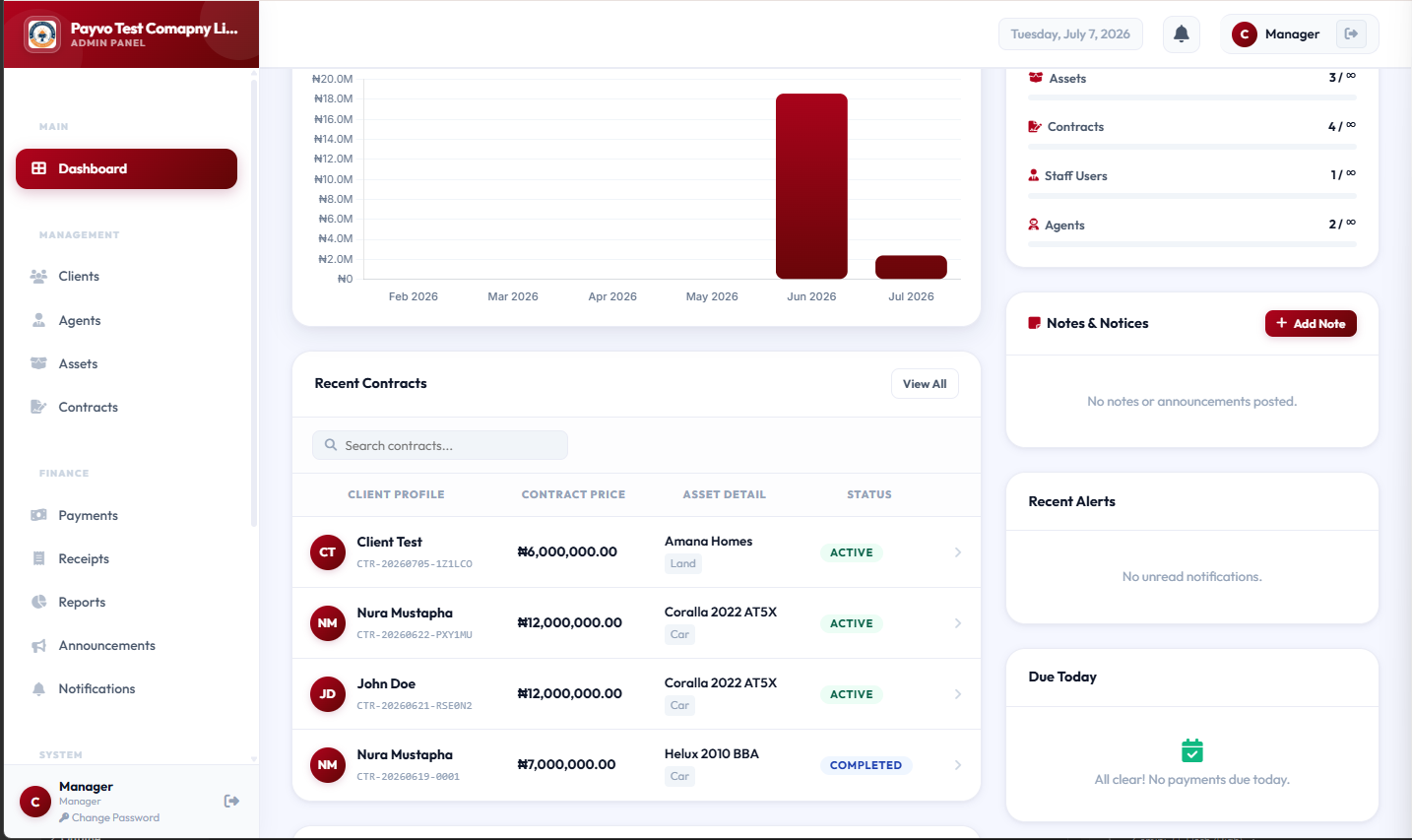 Dashobard (top)
Common Mistakes to Avoid
Automating sales commissions can be transformative, but pitfalls exist. Be aware of these common mistakes:
- Unclear Commission Structures: Rushing into automation without clearly defined and documented commission rules will lead to confusion and incorrect payouts, regardless of the software.
- Ignoring Agent Input: Failing to involve your sales agents in the process, especially during the definition of rules or system testing, can lead to resistance and mistrust.
- Overlooking Training: Expecting staff to instantly adapt to a new system without adequate training (which can cost ₦50,000 - ₦200,000 for a small team) will result in errors and underutilization of the software.
- Neglecting Data Accuracy: Garbage in, garbage out. If your initial client, contract, or payment data is inaccurate, your automated commission calculations will also be flawed.
- Choosing the Wrong Tool: Opting for a generic CRM or accounting software that doesn't specialize in installment sales and commission tracking will leave significant gaps in your automation. A dedicated contract management software Nigeria solution is crucial.
- Poor Internet Infrastructure: Relying on cloud-based solutions without a stable and reliable internet connection for your office or remote staff will hamper productivity.
How to Track and Grow After Launch
After successfully automating your sales commission process, the work isn't over. Continuous tracking and strategic growth are key.
- Monitor Key Metrics: Regularly review your dashboards. Look at sales volume per agent, average commission earned, payment collection rates, and contract completion rates. These metrics provide insights into agent performance and overall business health.
- Analyze Commission Payouts: Ensure that commission payouts are consistent with your policies and that agents are satisfied. Use the reporting features of your receipt generator app Nigeria to audit payouts.
- Gather Agent Feedback: Conduct regular check-ins with your sales team. Their direct experience with the automated system and commission payouts is invaluable for identifying areas for improvement.
- Refine Commission Structures: Based on performance data and market conditions, don't be afraid to adjust your commission structures. Automation makes these adjustments easier to implement and track.
- Leverage Automated Communications: Utilize the automated payment reminders to improve collection rates. Higher collection rates directly translate to more commissions paid and healthier cash flow.
- Scale Your Operations: With the administrative burden of commission management removed, your team can focus more on sales and client acquisition. Use the freed-up resources to expand your market reach, whether you're a real estate developer in Abuja or a car dealer selling on hire purchase in Lagos.
- Utilize Reporting for Strategic Decisions: Export payment and contract data as PDF or Excel files from your system. This data is invaluable for financial planning, forecasting, and making informed strategic decisions about product pricing, sales targets, and market expansion.
 Nigerian business owner reviewing growth charts on a
Frequently Asked Questions
Q1: How much does it cost to automate sales commissions in Nigeria?
The cost varies significantly. Basic sales commission software subscriptions can range from ₦15,000 to ₦50,000 per month. If you require custom development, expect to pay between ₦500,000 and ₦5,000,000 as a one-time fee. Don't forget operational costs like internet data (₦10,000 - ₦30,000/month) and potential IT consultant fees (₦80,000 - ₦300,000 per project) for setup.
Q2: Can automation really reduce errors in commission calculations?
Absolutely. Manual calculations, especially with complex commission structures and installment payments, are highly prone to human error. An automated system, once correctly configured, eliminates these errors by consistently applying the defined rules to every transaction. This ensures accurate payouts and reduces disputes with sales agents.
Q3: Is an automated system suitable for small businesses with only a few agents?
Yes, even small businesses can benefit immensely. While the cost might seem significant initially, the time saved, reduction in errors, improved agent morale, and better cash flow management quickly offset the investment. For a business with 5-10 agents, the administrative time saved can be substantial, allowing owners to focus on growth. Payvo offers scalable solutions suitable for businesses of all sizes, from a handful of agents to much larger teams.
Q4: How do automated payment reminders help my business?
Automated payment reminders, especially through channels like WhatsApp, significantly improve your collection rates. By notifying customers before their payment due dates, you reduce late payments and defaults. This not only ensures a steadier cash flow for your business but also means agents receive their commissions on time, boosting their motivation. This is a core benefit of a robust cooperative society management software or any installment tracking system.
Q5: What kind of reports can I expect from an automated commission system?
A good system will provide a range of reports essential for financial oversight and strategic planning. These include summaries of sales performance by agent, detailed breakdowns of commissions earned per agent, payment collection reports, outstanding balance reports, and contract status overviews. These reports are invaluable for accounting, auditing, and making data-driven decisions.
Ready to Streamline Your Sales Operations?
Stop losing time and money to manual commission calculations and payment tracking. Discover how a dedicated platform can transform your installment sales business. Visit Payvo.ng to explore features like automated commission tracking, client and contract management, and real-time reporting, all designed for the Nigerian market. Ready to take control? Register into Payvo today and experience the future of installment sales management.