₦375,000. That's the average amount a real estate business in Nigeria can lose per defaulting client if they can't effectively track land installment payments. Think about it: a single plot of land in a peri-urban area might sell for ₦5 million, with a 20% profit margin, meaning ₦1 million in potential profit. If a buyer pays half and then disappears, and your records are scattered, you're not just losing the remaining profit, you're losing the capital you put in. Knowing exactly how Real Estate Businesses Track Land Payments by Installment, and keeping those records tight, isn't just about good bookkeeping; it's about protecting your entire business.
 Real estate agent showing land plot to a
The Silent Leak: Why Scattered Land Payment Tracking Costs You Millions
You know the drill. You've got customers buying plots in your estate in Kaduna, another set in Abuja, maybe even some in a developing area near Lagos. Each one has a different payment plan: some pay monthly, some quarterly, some just drop cash whenever they have it. How do you keep track? Most times, it's a mix of Excel sheets, a few notebooks, and countless WhatsApp chats with agents and clients. But here's the real problem with that approach: it's a silent leak, draining your profits without you even realizing it.
Let's be honest about this. When records are scattered, you're looking at increased administrative costs, potential disputes, and, worst of all, lost revenue. For instance, the legal fees for a simple land transaction can range from ₦100,000 to ₦750,000. Imagine going to court over a payment dispute because your records are incomplete. That’s money and time you can't get back. And what about the cost of land documentation, from ₦150,000 to ₦500,000 per plot? All that investment just to lose track of payments? It doesn't make sense.
I remember a client in Kano who sold 50 plots in a new estate. He had one guy, Malam Musa, managing all the payments with a big, thick ledger and his phone. Everything seemed fine until Malam Musa fell ill for two weeks. Chaos! Nobody knew who had paid what, who was due next, or what the outstanding balance was for half the clients. They lost about ₦1.8 million in potential collections that month because they couldn't follow up properly. That's the financial damage of poor plot payment tracking – it’s real, and it hurts. This scattered approach also makes it impossible to accurately track agent commission, leading to demotivated sales teams.
Why the Usual "Excel or Notebook" Advice Doesn't Work for Growing Real Estate Businesses
Every business guru will tell you, "Just use Excel!" or "A good old notebook never fails!" While those tools are fine for a solitary transaction or when you're just starting with one or two clients, they completely fall apart when your real estate business starts to grow. And let's be frank, you're not in this business to stay small, are you?
Here's the thing though — does a spreadsheet or a notebook actually work when you have 30, 50, or even 100 clients, each with a unique land installment payment tracking schedule? No, it doesn't. You spend hours manually updating figures, calculating outstanding balances, and then cross-referencing with bank statements. One wrong formula, one missed entry, and your entire financial picture is skewed. I've seen businesses nearly collapse because they couldn't reconcile their records.
Consider the human error factor. Someone records ₦150,000 instead of ₦250,000. Or they forget to mark a payment altogether because they were busy handling another client. These aren't malicious acts; they're just everyday mistakes that become amplified when you're dealing with high-value assets like land. You can't afford to be guessing about hundreds of thousands or even millions of naira.
And what about communication? Most people rely on WhatsApp to send payment reminders or receipts. But a WhatsApp payment notification system isn't a record-keeping system. Messages get lost, deleted, or simply buried under new chats. Trying to pull up a client's full payment history from a WhatsApp conversation is like looking for a needle in a haystack. It’s inefficient, unprofessional, and frankly, risky for your reputation. This is why the typical advice, while well-intentioned, is often the wrong way to think about managing your real estate installment software needs.
The Better Way: A Centralized System for Land Payment Tracking
So, if notebooks and spreadsheets are out, what's the solution for real estate payment tracking in Nigeria? It's simple: a centralized, dedicated system. You need one place where every detail about every land sale, every client, and every payment is recorded, updated, and easily accessible. This isn't just about technology; it's about shifting your mindset from reactive firefighting to proactive management.
Think about it like this: every plot you sell on installment is a mini-project. Each project has a client, an asset (the land), a contract with specific terms, and a series of expected payments. A centralized system helps you link all these pieces together seamlessly. This means you can:
- Link each buyer to a specific plot: No more confusion over which Mr. Adebayo bought plot 17 vs. plot 23.
- Attach contracts and legal documents: All agreements are stored with the client and plot record, easily retrievable. This is crucial for contract management software Nigeria businesses need.
- Generate clear payment schedules: Set up weekly, monthly, or quarterly payment plans for each client, with automated due dates.
- Record every payment accurately: Whether it's a bank transfer, cash, or POS payment, every transaction is logged against the correct client and contract.
- Track remaining balances in real-time: Instantly know how much a client has paid and what they still owe, without manual calculations.
- Monitor agent performance: See which agents are bringing in payments and manage their commissions effectively. This is where agent commission tracking software becomes vital.
 Real estate professional reviewing digital dashboard
How Payvo Fits Into This
This is where a tool like Payvo comes in. You see, Payvo isn't just some generic accounting software; it's an installment management software Nigeria real estate developers can actually use. It's built specifically to handle the complexities of scheduled payments for high-value assets like land.
Imagine this: you've just closed a deal for a ₦15 million plot in a prime location in Abuja. The client pays a ₦5 million down payment and agrees to pay the remaining ₦10 million over 20 months, at ₦500,000 per month. Instead of setting up a new spreadsheet or scribbling in a notebook, you simply log into Payvo. You create a new client record, add the plot as an asset, and then set up the installment contract. The system automatically calculates the payment schedule, sets due dates, and tracks every payment recorded against that contract. It's designed to be your central hub for all your plot payment tracking needs.
You can record payments, generate professional digital receipts for your clients, and instantly see their outstanding balance. No more arguments about how much was paid or when. Plus, for your agents, it means less time on administrative tasks and more time selling. They can even get an overview of their clients' payment status, which is a key part of effective agent commission tracking software. Payvo helps you move from chaos to clarity, giving you confidence in your financial records.
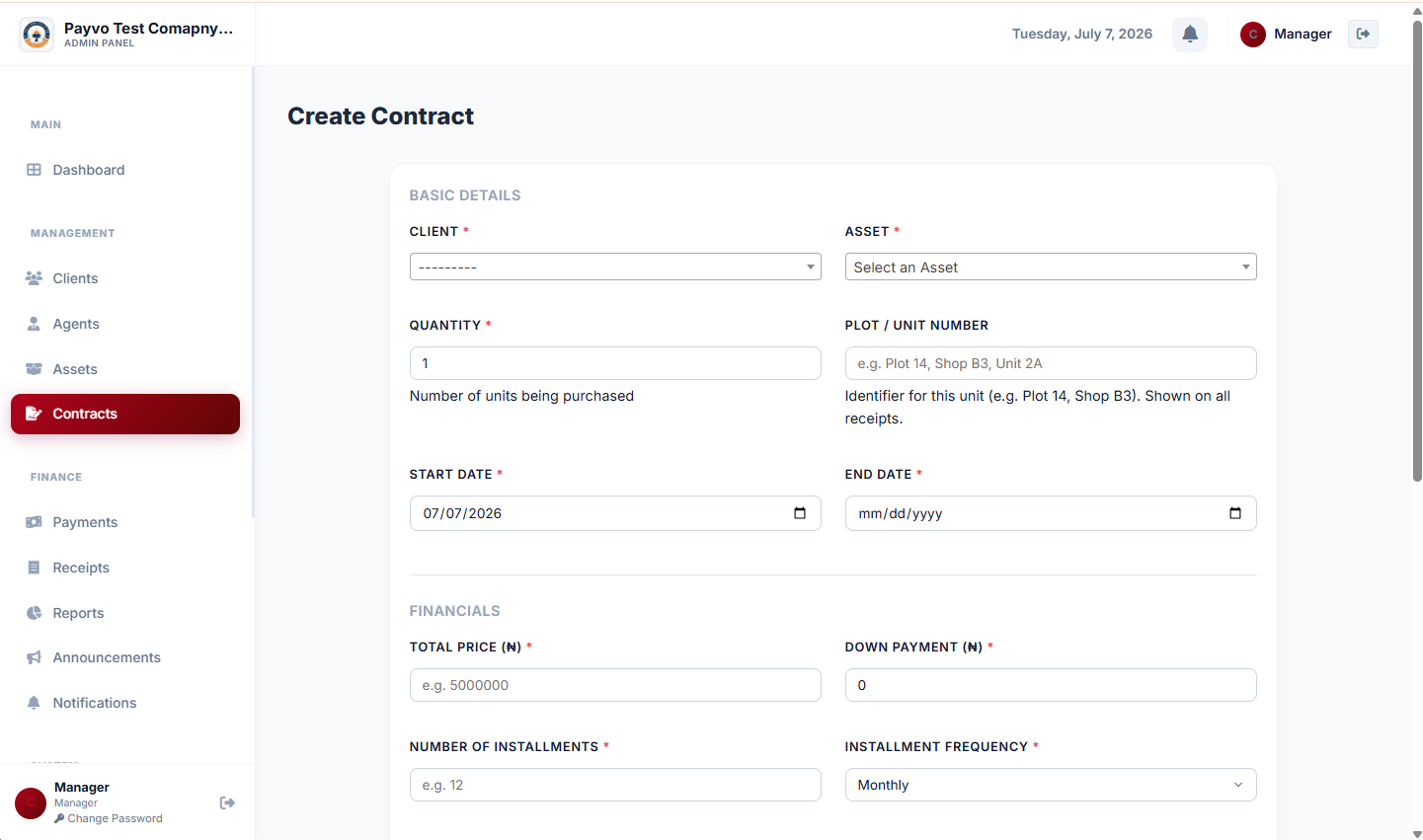 Management: Add contract (top)
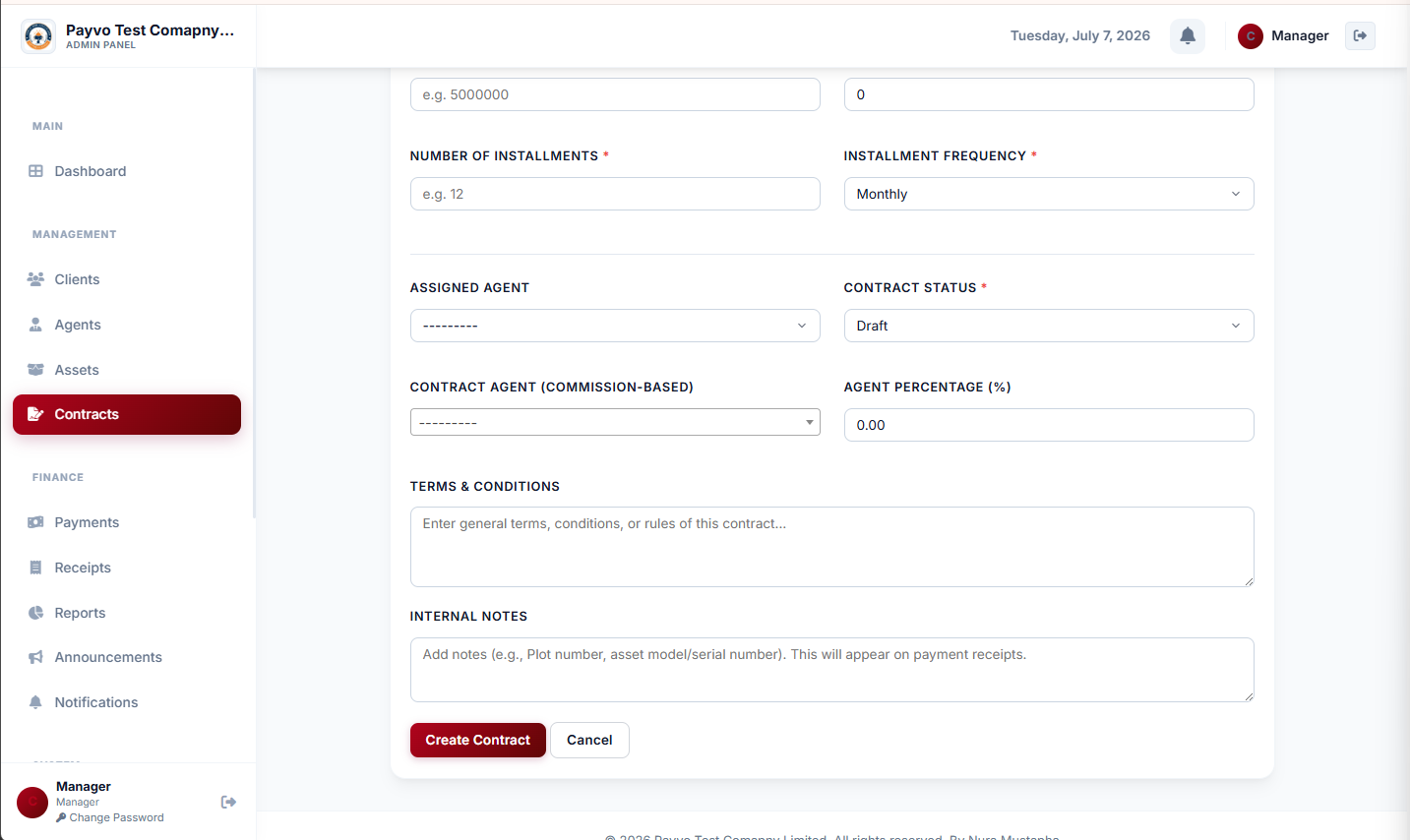 Management: Add contract page (bottom)
Side-by-Side: Old Way vs. New Way for Land Payment Tracking
Let's break down the practical differences between how most real estate businesses currently operate and how they could operate with a dedicated installment management software Nigeria businesses are adopting.
| Feature / Task | Traditional Approach (Excel/Notebooks/WhatsApp) | Modern Approach (Dedicated Installment Software like Payvo) |
|---|---|---|
| Client & Plot Linking | Manual entry in spreadsheet, separate notes, risk of mismatching client to plot. | Each client linked directly to a specific plot (asset) within their contract. |
| Payment Schedule Setup | Manual calculation and entry of dates and amounts; easy to make errors. | Automated generation of payment schedules based on contract terms; consistent. |
| Payment Recording | Manual entry from bank alerts/cash; often delayed, prone to typos. | Quick, accurate recording against specific contracts; real-time updates. |
| Outstanding Balance | Manual calculation, requires reviewing multiple entries; time-consuming, error-prone. | Instantly visible for each contract; automatically updates with every payment. |
| Receipt Generation | Hand-written receipts, generic templates, or manual PDF creation. | Professional digital receipts generated automatically; easy to send and store. |
| Payment Reminders | Manual WhatsApp messages, often forgotten or sent late. | Automated reminders via email or WhatsApp (with integration); consistent follow-up. |
| Agent Performance Tracking | Manual tallying of sales and collections; difficult to verify. | Clear visibility of agent-assigned clients and their payment status. |
| Dispute Resolution | Lengthy process of searching through fragmented records, often leads to arguments. | Quick access to comprehensive payment history; clear evidence to resolve disputes. |
| Data Security & Backup | Risk of lost notebooks, corrupted files, or phone damage; no centralized backup. | Cloud-based storage, regular backups, secure access; data protected. |
| Financial Reporting | Manual aggregation of data, prone to errors, slow to produce. | Instant access to reports on collections, outstanding balances, and payment trends. |
You can see the stark difference. The "old way" is riddled with inefficiencies and risks, while the "new way offers control, accuracy, and peace of mind.
The Numbers: What This Actually Means for Your Business
Let's talk money, because that's what truly matters for your real estate business. What does moving to a proper installment management system actually save or earn you?
First, consider lost payments. If you're managing 20 installment contracts, and just 10% of those (2 clients) fall through the cracks due to poor tracking, you're looking at significant losses. If each plot is worth ₦10 million and a client defaults after paying ₦3 million, you're struggling to recover the remaining ₦7 million. Over a year, this could easily cost you ₦5 million to ₦15 million in uncollected revenue, depending on your volume and client base.
Then there's administrative efficiency. Manually tracking land installment payments for 50 clients could easily take an admin officer 3-4 hours per day just on data entry, reconciliation, and chasing payments. At a monthly salary of ₦70,000 to ₦180,000 for an account/admin officer, that's a substantial operational cost. A system that automates much of this, like Payvo, can free up that staff member for more productive tasks, or even reduce the need for additional hires as you grow.
Let's not forget dispute resolution. I know a developer in Owerri who had to spend ₦250,000 on legal fees and countless hours in court because a client disputed a payment. All because the original receipt was misplaced and the spreadsheet entry was unclear. With clear, digital records and a receipt generator app Nigeria businesses can trust, these disputes are either avoided entirely or resolved quickly, saving you those hefty legal fees (which can go up to ₦750,000 for complex cases).
Finally, think about opportunity cost. When you're bogged down in manual tracking and chasing payments, you're not out there scouting new land, closing new deals, or strategizing for growth. Every hour spent on fragmented record-keeping is an hour not spent growing your profit margin, which can range from 15% to 40% per land sale. This is the part most people don't expect: the biggest cost isn't just what you lose, but what you fail to gain.
So, when you invest in a proper system, you're not just buying software; you're buying back time, preventing losses, and enabling growth. It’s a strategic move, not just an expense. If you're interested in seeing how this plays out for your business, you can always book a demo to see the specifics.
FAQ: Questions Nigerian Business Owners Actually Ask
Here are some common questions I get from real estate developers and other business owners about managing installment payments.
Q1: How do I track land installment payments effectively without a huge budget?
You don't need to spend millions on custom software development (which can cost ₦500,000 - ₦5,000,000). Start with a dedicated, affordable installment management software Nigeria providers offer. Look for solutions that are subscription-based, so you pay monthly (like ₦5,000 - ₦25,000 for basic accounting software, or even less for dedicated installment tools) and scale as you grow. The key is finding a system designed specifically for installment tracking, not a generic accounting tool trying to do everything.
Q2: Can I use WhatsApp to send payment reminders and receipts?
Yes, you can use WhatsApp for communication, but it should not be your primary record-keeping system. A good installment management software will integrate with WhatsApp or email to send automated reminders and digital receipts, while still keeping all the financial records securely stored in the system. This gives you the best of both worlds: convenient communication with robust record-keeping. Payvo, for instance, offers a WhatsApp payment notification system as an optional feature.
Q3: How can I manage agent commissions when clients pay in installments?
This is a common headache. With a centralized system, you can assign clients to specific agents. As payments are recorded, the system can track which agent is responsible for that client's collections. This provides clear data for calculating commissions, whether they are based on sales or collected payments. This functionality is often included in comprehensive agent commission tracking software.
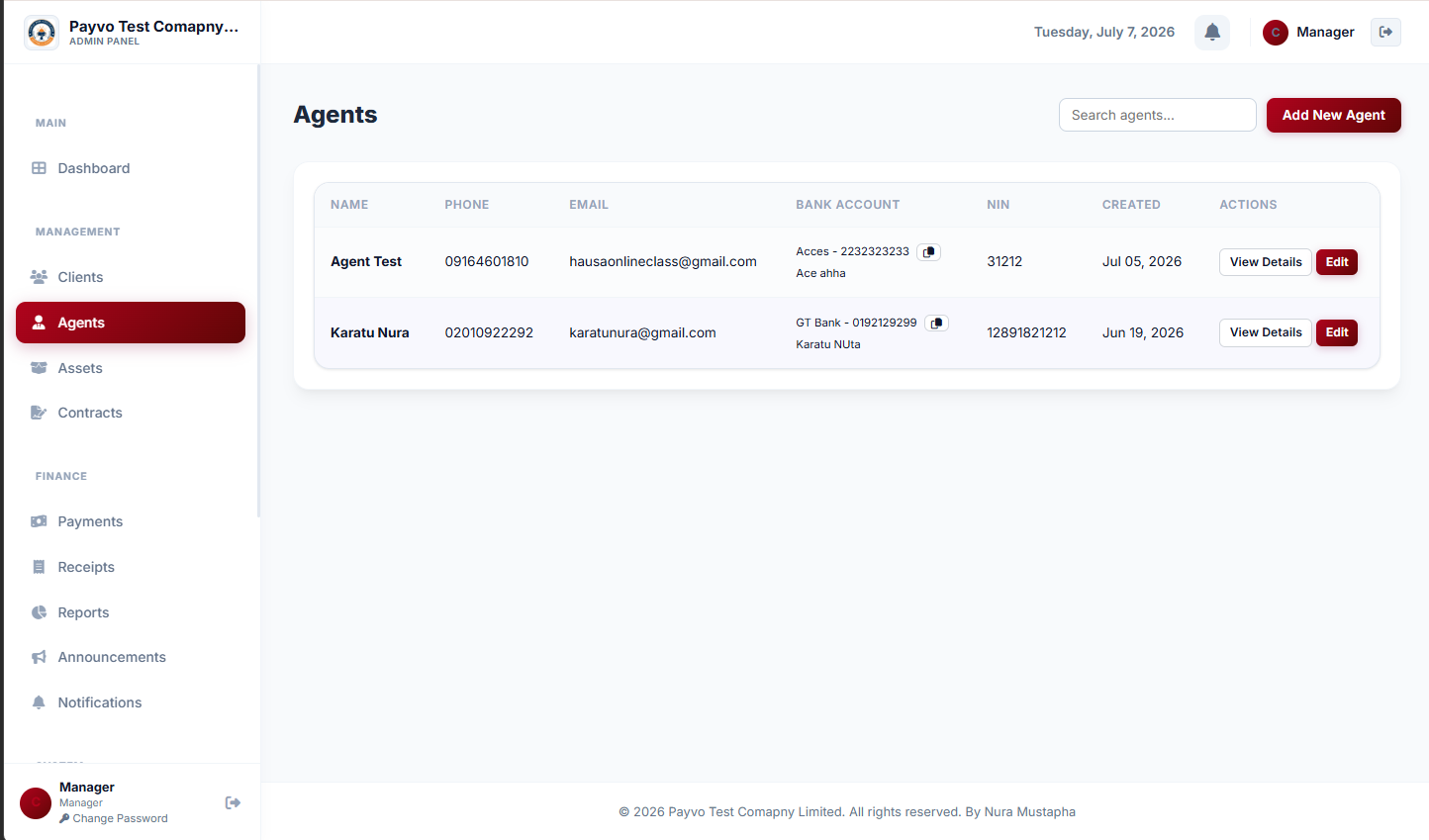 Agent: Agents list page
Q4: What happens if a client disputes a payment? How do I prove they paid or still owe money?
This is where detailed records save you. If all payments are logged in a dedicated system, you'll have an undeniable transaction history, including dates, amounts, and digital receipts. This clear audit trail is invaluable for resolving disputes quickly and professionally, protecting your reputation and avoiding costly legal battles. This is a core benefit of robust business payment tracking app Nigeria businesses should use.
Q5: Is it really worth investing in software when I can use Excel for free?
"Free" often comes with hidden costs: lost time, errors, missed payments, and potential disputes. While Excel is a powerful tool, it's not designed for the specific workflow of installment management. Think of it this way: you wouldn't use a screwdriver to hammer a nail. For a growing real estate business, the cost of a good installment software is usually far outweighed by the revenue protected, the time saved, and the peace of mind gained. It's an investment in your business's stability and growth. For real estate businesses, using a dedicated real estate installment software can be a game-changer.
Q6: How do cooperative societies manage their members' installment contributions?
Cooperative societies, like real estate businesses, rely heavily on consistent, scheduled payments. They need to track member contributions, outstanding balances, and ensure transparency. A cooperative society management software designed for installment tracking works perfectly here. It allows them to register members, set up contribution schedules, record payments, and generate reports, much like tracking land payments. This ensures accurate financial records and member trust.
Take the First Step
You've seen the challenges, and you've seen a better way. The journey to more organized, profitable land installment payment tracking for your real estate business doesn't have to be complicated. The first step is simple: explore the tools that are built specifically for this challenge.
Ready to bring clarity and control to your land installment payments? Take a moment to register for Payvo today. It's time to move beyond scattered records and embrace a system that helps your real estate business thrive.