Ever felt that familiar knot in your stomach as you scroll through WhatsApp messages, desperately trying to confirm if Mrs. Okoro from the Ikoyi project made her last payment? Or maybe you're staring at a stack of ledgers, wondering how many plots are truly sold and how many remain outstanding across your Abuja developments? You're not alone. Many property developers in Nigeria, even in 2026, grapple with the challenge of how property developers can organize buyer payment schedules, losing valuable time and sometimes, even money, to scattered records and manual tracking. It’s a common frustration, and frankly, it doesn't have to be this hard.
 Modern real estate office with diverse team collaborating
The Honest Breakdown: What Managing Payments Manually Actually Costs You
Let's be real, running a property development business in Nigeria is capital-intensive. From land acquisition to construction, every kobo counts. When you add the complexity of installment sales, where buyers pay over months or even years, the administrative burden can quietly eat into your profits.
Consider the typical costs involved in a property deal:
- Land Acquisition: A plot in a developing area might go for ₦1,500,000, but in a prime urban location like Lekki, you're looking at ₦50,000,000 or more.
- Construction: Building a basic structure can cost ₦150,000 per square meter. For a high-end finish, that jumps to ₦400,000 per square meter.
- Initial Deposit/Commitment Fee: Buyers usually start with a significant upfront payment, anywhere from ₦500,000 for a small plot to ₦5,000,000 for a luxury apartment.
- Infrastructure Levy: Estate roads, drainage, power connections – these can add ₦200,000 to ₦1,500,000 per unit.
- Legal Fees: Documentation and title transfers aren't cheap, often ranging from ₦150,000 to ₦1,000,000 depending on the complexity of the sale.
- Survey Plan & Permits: Budget around ₦100,000 to ₦300,000 for a standard survey, plus ₦50,000 to ₦500,000 for local government development levies.
- Chasing payments: Manually calling or messaging buyers.
- Reconciling accounts: Trying to match bank alerts to specific contracts.
- Resolving disputes: When a buyer insists they've paid, but your records say otherwise.
- Calculating outstanding balances: Fiddling with spreadsheets and calculators, prone to errors.
The Income Side: What You Can Realistically Earn (and How to Protect It)
The good news is that property development in Nigeria, especially with installment plans, offers significant returns. A 2-bedroom apartment in a suburban area might sell for ₦15,000,000, while a prime Lagos location could fetch ₦80,000,000. A 3-bedroom detached house could range from ₦30,000,000 to a staggering ₦250,000,000.
The key to unlocking these earnings lies in how effectively you manage your cash flow, particularly from those crucial off-plan payments. Typically, developers require a 20% to 40% down payment, with the remaining balance spread over 12 to 36 months. This structured payment schedule is what makes property accessible to a wider market, but it also creates a continuous stream of financial obligations you must track.
Here’s where it gets interesting: if you're using manual methods, how confident are you in your projections? Can you accurately forecast your monthly income from all ongoing projects? Can you quickly pull a report showing which units are fully paid for versus those still under an active real estate installment plan? This kind of clarity isn't just nice to have; it's essential for making smart business decisions, like knowing when you can comfortably start a new project or invest in more land. Without it, you're essentially flying blind.
The Hidden Costs Nobody Mentions
Beyond the obvious operational inefficiencies, there are "hidden" costs that can silently erode your property payment tracking efforts:
- Opportunity Cost of Time: Every hour spent manually tracking payments is an hour you're not spending on site visits, negotiating new deals, or strategizing for growth. What's an hour of your time worth? For many developers, it's easily ₦15,000 to ₦50,000.
- Employee Turnover & Training: If your system relies on one person's memory or complex spreadsheets only they understand, what happens when they leave? The cost of retraining new staff on a convoluted manual system can be substantial, not to mention the errors during the transition.
- Client Dissatisfaction: Imagine a buyer who genuinely believes they've cleared their balance, only for your records to show otherwise. These disputes, even when resolved, damage trust and can lead to negative word-of-mouth, which is terrible for a business built on reputation.
- Missed Payment Reminders: With dozens or hundreds of contracts, it’s easy to miss a payment due date. Each missed reminder could mean delayed payments, impacting your cash flow and potentially extending the project timeline. This is why a reliable WhatsApp payment notification system or email reminder is so critical.
- Agent Commission Disputes: If your sales agents work on commission, how do you accurately track their sales and payments against each property buyer payment schedule? Discrepancies can lead to demotivated agents or even legal issues. An effective agent commission tracking software can prevent this headache.
How Successful Nigerian Business Owners Control These Numbers
So, what's the secret? It's not about working harder, but smarter. Successful property developers, whether in Lagos, Abuja, or Kano, understand that growth demands robust systems. They've moved past the notebooks and fragmented spreadsheets.
Here's how they do it:
- Centralized Data Management: They consolidate all buyer information, property details, and payment schedules into one accessible platform. This means no more searching through multiple files or asking different team members for updates. Every piece of data related to a contract management software Nigeria is in one place.
- Automated Payment Scheduling & Reminders: Instead of manually calculating due dates or sending reminders, they use systems that automatically schedule payments and send out notifications. This ensures consistency and significantly reduces the chance of missed payments.
- Real-time Financial Overview: They can instantly see which payments are due, which are overdue, and the total outstanding balance across all their projects. This provides a clear, up-to-the-minute picture of their financial health, helping them make informed decisions.
- Professional Receipt Generation: When a payment is made, a professional, branded receipt is automatically generated and sent to the buyer. This builds trust and provides clear documentation for both parties. It’s far more credible than a hastily typed WhatsApp message.
- Agent Performance Tracking: They use tools that allow them to track agent-specific sales and payment collections, making commission calculations transparent and fair. This empowers their sales teams and ensures accurate agent commission tracking software.
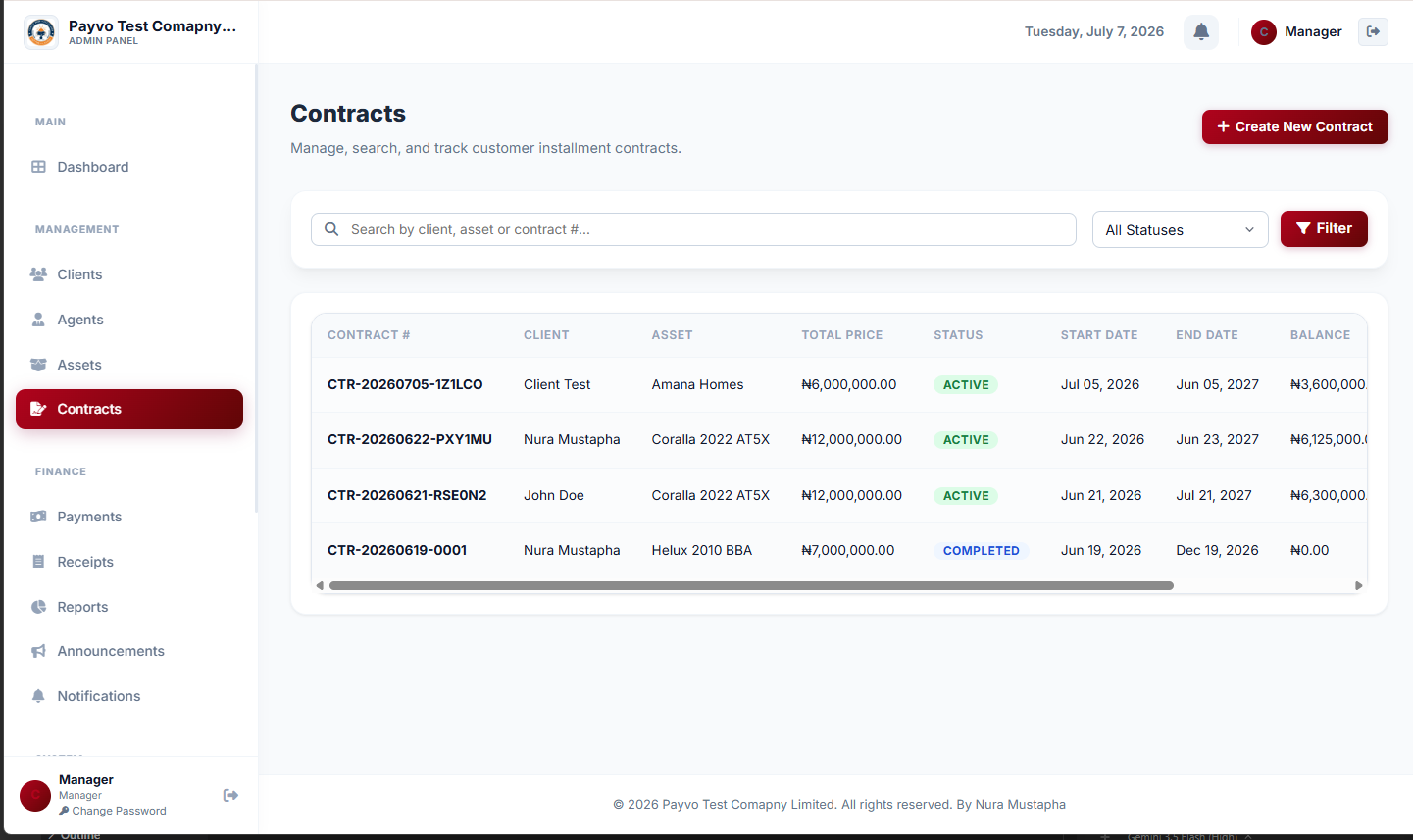 Payvo dashboard with contracts list
Real Comparison: Manual vs. Systemized Operations
Let's break down the tangible differences between trying to manage your property sales manually versus using a dedicated system like Payvo.
| Feature/Cost Area | Manual Operations (Notebooks, Spreadsheets, WhatsApp) | Systemized Operations (e.g., Payvo) |
|---|---|---|
| Payment Tracking | Time-consuming, error-prone calculations. Scattered data across multiple platforms (bank statements, WhatsApp, paper ledgers). | Centralized, automated tracking. Real-time outstanding balances. Clear history for each property buyer payment schedule. |
| Buyer Communication | Manual calls, WhatsApp messages, individual emails. High risk of forgetting reminders or sending incorrect information. | Automated WhatsApp payment notification system and email reminders for due dates, payment confirmations, and receipts. Consistent messaging. |
| Record Accuracy | Prone to human error, lost papers, outdated spreadsheets. Difficulty reconciling payment discrepancies. | High accuracy with automated calculations. Digital records are harder to lose or corrupt. Clear audit trail for all transactions. |
| Time Spent on Admin | 10-20 hours/week (for a growing developer with 20+ active contracts). | 2-4 hours/week (focused on reviewing, not manual tracking). |
| Risk of Disputes | High, due to unclear records, forgotten payments, or miscommunications. | Low, with clear, accessible records and automated receipts. |
| Cash Flow Visibility | Poor. Difficult to forecast accurately or know immediate liquidity. | Excellent. Instant overview of expected income, overdue payments, and overall financial health. |
| Agent Management | Manual tracking of agent sales and commissions; prone to errors and disputes. | Dedicated agent commission tracking software module ensures transparency and accuracy. |
| Cost of Inefficiency | Potential for lost payments, delayed projects, staff burnout, customer churn, and legal fees. Easily ₦150,000 - ₦500,000+ monthly in indirect costs for a medium-sized developer. | Subscription fee (e.g., Payvo's plans start at accessible rates) but significant savings in time, accuracy, and reduced disputes. Boosted customer and agent satisfaction. |
| Receipt Generation | Manual writing, printing, or sending simple text messages. Inconsistent branding. | Automated, professional receipt generator app Nigeria for every payment, with custom branding. |
The choice is clear, isn't it? The initial investment in a system might seem like an added cost, but it quickly pays for itself by plugging financial leaks, saving time, and building a more professional, trustworthy operation.
How to Set Up an Effective Property Payment Tracking System
Implementing a robust system for your property buyer payment schedules doesn't have to be daunting. Here’s a practical, step-by-step guide to help you transition from chaos to clarity:
1. Document Every Single Contract Detail
Before anything else, you need a clear record of every agreement. This goes beyond just the selling price. For each property and buyer, ensure you document:
- Buyer Information: Full name, contact details (phone, email, WhatsApp), valid ID.
- Property Details: Unit number, plot size, location, specific features.
- Total Contract Value: The full agreed-upon price of the property.
- Initial Deposit: The exact amount paid upfront.
- Installment Amount: The fixed amount to be paid per installment.
- Payment Frequency: Weekly, monthly, quarterly, etc.
- Installment Duration: Total number of months or years for payments.
- Start and End Dates: The exact dates the installment plan begins and ends.
- Due Dates: Specific dates for each subsequent payment.
- Agent Details: Which agent facilitated the sale (crucial for agent commission tracking software).
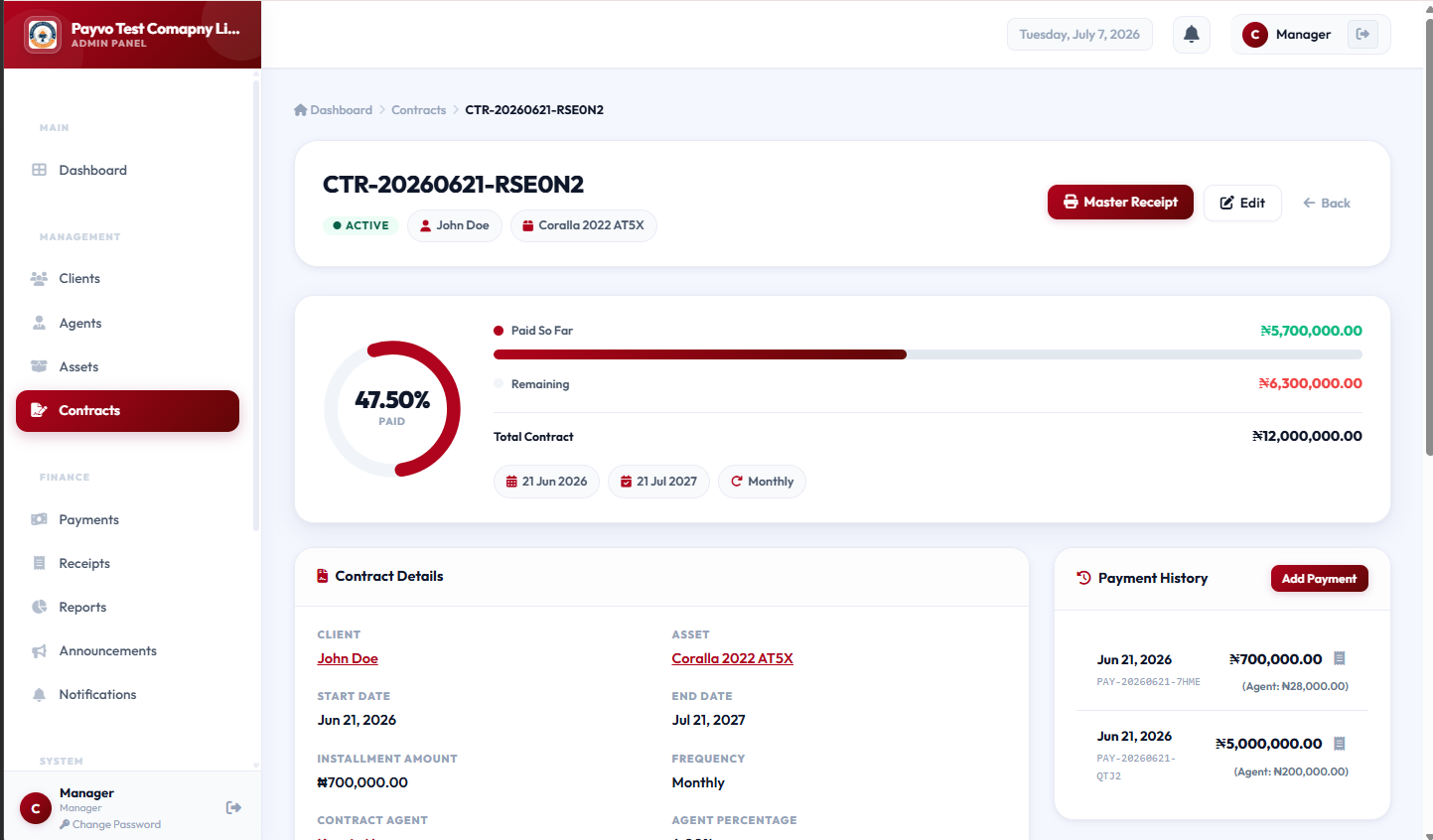 Payvo screenshot showing contract details
2. Standardize Your Payment Schedules
While each contract is unique, you can standardize the structure of your installment plans. For instance, decide on common frequencies (e.g., 12, 18, 24, or 36 months). This makes it easier to manage and predict cash flow.
- Example: If a ₦30,000,000 property requires a 30% down payment (₦9,000,000), and the remaining ₦21,000,000 is to be paid over 24 months, your monthly installment is ₦875,000. Ensure this is clearly communicated and agreed upon.
3. Choose the Right Tool for the Job
This is where many businesses get stuck. They try to force spreadsheets or generic accounting software to do a job it wasn't built for. For managing installment sales, you need dedicated installment management software Nigeria.
Look for a solution that:
- Allows you to easily add customers and properties.
- Lets you create flexible payment schedules.
- Automatically tracks payments and outstanding balances.
- Generates professional receipts.
- Offers reporting features to give you a clear financial overview.
- Can send automated reminders via email or even a WhatsApp payment notification system.
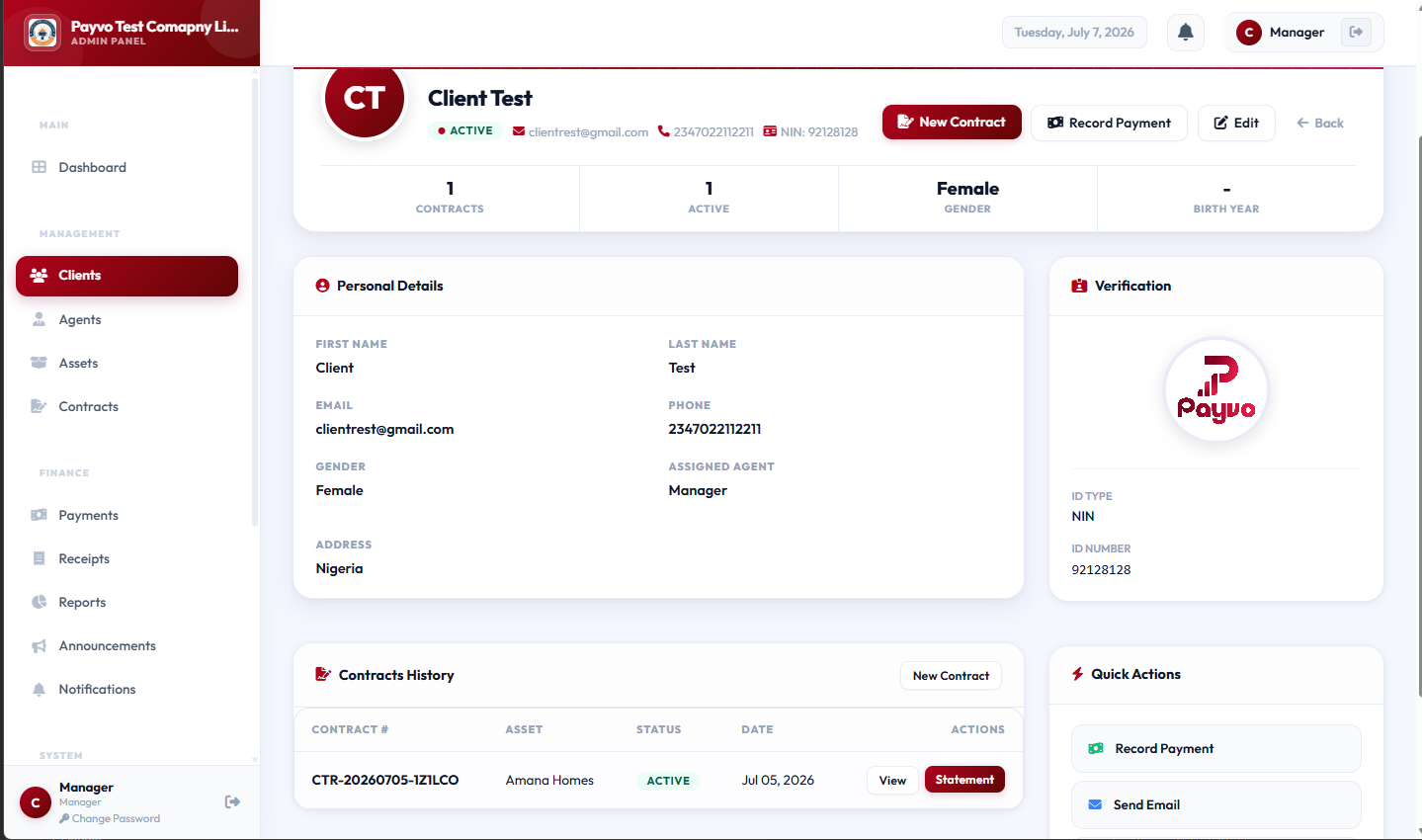 Payvo dashboard showing a client's detail view
4. Implement a Consistent Payment Recording Process
No matter how sophisticated your software, the data going in must be accurate. Train your team on a consistent process for recording payments:
- Verify Payment: Always confirm bank transfers or cash payments before marking them as received.
- Immediate Entry: Enter payments into your system as soon as they are verified. Don't wait till the end of the day or week.
- Issue Receipts: Ensure every payment triggers a formal receipt. This is non-negotiable for transparency and trust. A good receipt generator app Nigeria will handle this automatically.
5. Leverage Automated Reminders and Follow-Ups
One of the biggest advantages of a systemized approach is automation. Configure your software to send:
- Payment due date reminders: A few days before an installment is due.
- Payment confirmation messages: Immediately after a payment is recorded.
- Overdue notices: Promptly for missed payments.
6. Regularly Review Financial Reports
Don't just set up the system and forget it. Regularly review the financial reports generated by your chosen software. Look at:
- Outstanding balances: Who owes what, and for how long?
- Payment trends: Are payments generally on time, or are there recurring delays?
- Projected income: How much cash flow can you expect in the coming weeks/months?
7. Manage Agents Effectively
If agents are crucial to your sales, ensure your system integrates their activities. A good agent commission tracking software will allow you to:
- Assign contracts to specific agents.
- Track their sales performance and collected payments.
- Calculate commissions accurately based on actual payments received.
Frequently Asked Financial Questions for Property Developers
Q1: How can I track installment payments for multiple properties and buyers efficiently?
The most efficient way is to use a dedicated installment management software Nigeria. Manual methods like spreadsheets or notebooks become unwieldy and prone to errors as your buyer base grows. A system like Payvo allows you to register each property as an asset, link it to a specific buyer, and create a unique property buyer payment schedule, all in one centralized platform.
Q2: What's the best way to manage a property payment tracking system to avoid disputes?
Transparency and clear records are key. Ensure every payment is immediately recorded and a professional receipt is issued. An automated receipt generator app Nigeria within your management software helps ensure consistency. Also, having clear, accessible contract details for both you and the buyer minimizes misunderstandings.
Q3: How do I calculate and track outstanding balances accurately across all my real estate installment plans?
Trying to do this manually with a calculator is a recipe for errors. A specialized contract management software Nigeria automatically calculates outstanding balances based on recorded payments against the original contract amount and installment schedule. This gives you a real-time, accurate figure for each client.
Q4: Can I automate payment reminders for my property buyers?
Absolutely, and you should! Many modern installment management systems offer integrated notification features, including email and a WhatsApp payment notification system. This automation sends timely reminders to buyers before their due dates and confirms payments once received, significantly reducing late payments and administrative load.
Q5: How can agent commission tracking software improve my real estate sales operations?
An integrated agent commission tracking software allows you to assign specific sales to agents, track the payments received for those sales, and accurately calculate their commissions based on your agreed terms. This transparency motivates agents, reduces disputes, and gives you a clear picture of individual and team performance.
Your Next Step to Financial Clarity
Managing property buyer payment schedules in Nigeria doesn't have to be a constant source of stress. The tools exist to bring order, transparency, and efficiency to your operations. By adopting a systemized approach, you're not just tracking payments; you're safeguarding your investments, enhancing your reputation, and positioning your business for sustainable growth.
Ready to take control of your property payment schedules? Explore how Payvo, the dedicated installment management software Nigeria, can transform your real estate business. Visit our Real Estate page to see how we help developers like you manage contracts, track payments, and maintain financial clarity. You can also register for an account and experience the difference yourself. Don't let scattered records hold your business back in 2026. Get organized, grow smarter.