Do you ever feel like you're playing detective with your own business records, trying to piece together who paid what, when, and how much is still outstanding? It's 2026, and far too many Nigerian businesses, from the bustling car dealerships in Lagos to the land sellers in Abuja, are still wrestling with notebooks, scattered WhatsApp messages, and error-prone spreadsheets. This chaos isn't just frustrating; it's costing you real money. In fact, businesses that don't effectively track their sales, especially when dealing with both outright payments and hire purchase arrangements, can lose up to 15% of their potential revenue through missed payments and administrative inefficiencies. Understanding the difference between Hire Purchase vs. Outright Payment: What Businesses Should Track is not just an academic exercise; it’s a survival strategy.
 A small business owner in nigeria looking frustrated
The Hidden Costs of Unorganized Installment Sales
Let's be honest, offering installment options is fantastic for business. It opens up your market to customers who might not have the upfront cash, whether they're buying a plot of land in Kano, a new generator for their shop in Aba, or a Keke Napep for commercial transport. But this flexibility comes with a heavy administrative burden if you're not properly set up to manage it.
Think about a car dealer in Kaduna. They sell a vehicle for an outright price of ₦2,000,000. That's one transaction, one payment received, done. Simple. Now, imagine they sell another identical vehicle on hire purchase. The customer pays an initial deposit of ₦450,000 and agrees to monthly installments of ₦75,000 for 36 months. The total cost via hire purchase could easily climb to ₦3,150,000 – a significant difference from the outright purchase price, reflecting the cost of financing and risk.
Here's where the pain starts. For that outright sale, you just need to record the final payment and issue a receipt. For the hire purchase, you're tracking 36 separate payments over three years. You need to know when each payment is due, whether it's been made, if it's late, and what the remaining balance is. Multiply this by dozens, even hundreds, of customers, and you have a full-blown tracking nightmare. Without a robust system, you risk:
- Lost Revenue from Missed Payments: A customer misses a ₦75,000 payment. If your records are shaky, you might not notice for weeks, or even months. That's money you could have collected.
- Customer Disputes: "I swear I paid that last month!" Sound familiar? When you can't quickly produce a clear payment history or a receipt generated from an accurate system, trust erodes, and you spend precious time arguing instead of doing business.
- Inaccurate Financial Reporting: How much revenue did your hire purchase division actually generate last quarter? If you're manually tallying figures from multiple sources, you're likely making decisions based on incomplete or incorrect data. This affects everything from tax calculations to strategic planning.
- Agent Commission Headaches: If you have agents selling for you, especially in real estate or car sales, how do you accurately track their commissions on installment payments? An agent for a property in Abuja might claim commission on a payment you haven't yet received or fully reconciled. This is where agent commission tracking software becomes invaluable.
Why the Usual Advice Doesn't Work
Many business owners, especially those running cooperative societies or managing installment vehicle sales, often try to make do with what they have. I've seen it countless times. The "advice" usually boils down to:
- "Just use a big ledger book." Oh, the infamous big book! It works for a handful of transactions, maybe. But what happens when Mama Ngozi from Balogun Market wants to know her outstanding balance on the clothes she bought on credit two years ago, and you have to flip through 20 different pages, deciphering faded handwriting? It's slow, prone to human error, and completely unscalable. And what if the book gets lost or damaged? All your records, gone.
- "Excel spreadsheets are your friend." Yes, Excel is powerful. For budgets, for calculations, it's great. But as a primary installment management software Nigeria solution? Not so much. You still have to manually input every payment, update formulas, and ensure consistency across multiple sheets. One wrong copy-paste, one deleted row, and your entire financial picture is skewed. Plus, how do you share it securely with agents without risking data breaches or accidental edits? It's not built for collaborative, real-time payment tracking.
- "WhatsApp is all you need for communication and payment notifications." WhatsApp is fantastic for instant messaging, but it's not a contract management software Nigeria solution. Relying solely on WhatsApp for payment confirmations or reminders means sifting through endless chats to find specific payment details. It's disorganized, unprofessional, and offers zero structure for your records. A WhatsApp payment notification system is useful, but it needs to be integrated with a robust backend, not be the backend.
The Better Way: A Centralized Installment Management System
The solution isn't to stop offering hire purchase or installment payments. That would be a huge disservice to your customers and a massive missed opportunity for your business. The better way is to embrace a centralized, purpose-built system that handles the intricacies of installment sales with precision and ease.
This isn't just about tracking payments; it's about managing your entire customer and contract lifecycle. Think about it:
- Customer Records: A single place to store all customer information, from contact details to purchase history. No more searching through different files or asking customers to repeat themselves.
- Asset/Product Tracking: Whether you're selling plots of land, vehicles, or solar panels, you need to link the specific item to the customer and their contract. This is especially vital for hire purchase, where you retain ownership until the final payment.
- Contract Management: Clearly defined terms, payment schedules, initial deposits, and outstanding balances, all in one digital contract. This eliminates disputes and ensures everyone is on the same page.
- Automated Payment Schedules: Imagine a system that automatically calculates upcoming payments, flags overdue accounts, and even sends reminders. This frees up your time from manual calculations and follow-ups.
- Digital Receipts: Professional, instantly generated receipts for every payment. This builds trust with your customers and provides undeniable proof of transactions.
- Financial Reporting: Real-time insights into your cash flow, outstanding receivables, and overall business performance. This is critical for making informed decisions.
How Payvo Fits Into This
This is where Payvo comes in. Payvo is an installment management software Nigeria solution designed specifically for businesses like yours – car dealers, real estate developers, cooperative societies, and equipment leasing companies. It takes all those scattered notebooks, spreadsheets, and WhatsApp conversations and brings them into one organized, easy-to-use platform.
Instead of wrestling with manual calculations for a hire purchase agreement, you simply input the contract details into Payvo. It then automatically generates the payment schedule, tracks every installment, and keeps a real-time record of the outstanding balance. For example, if you're a car dealer managing hire purchase records, you can easily see which customers have paid their monthly ₦60,000 installment, and which ones are due next week. It's a game-changer for managing complex payment structures.
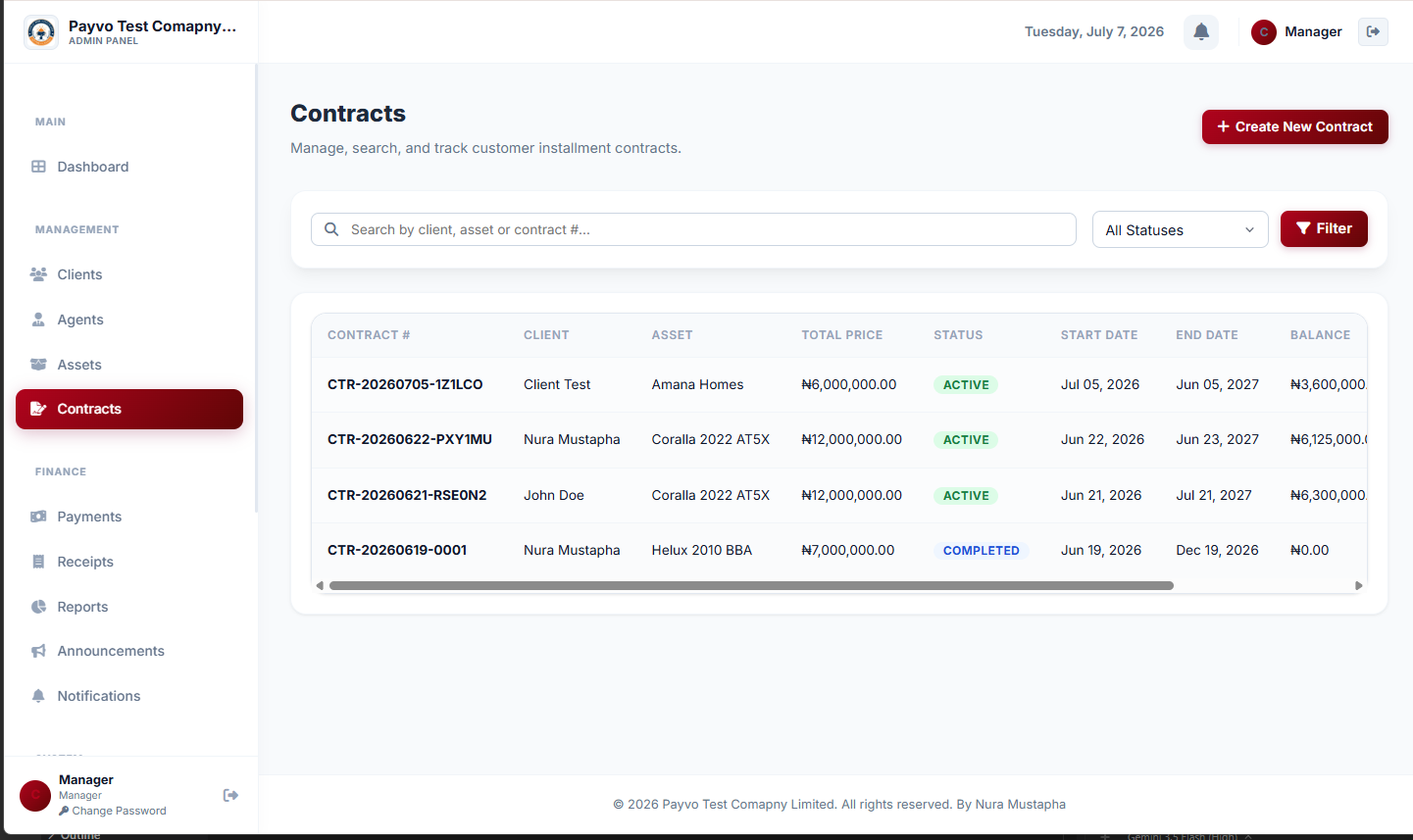 A sleek, modern dashboard of Payvo showing a list of contracts with their statuses and payment due dates
This isn't just about making your life easier (though it certainly does that!). It’s about building a more professional, efficient, and profitable business. You get a clear picture of your finances, reduce payment discrepancies, and empower your agents with accurate, real-time information.
Side-by-Side: Old Way vs. New Way
Let's break down the difference between the traditional, often painful, methods of managing installment sales and the modern approach with a dedicated system like Payvo.
| Feature / Task | Traditional Approach (Notebooks, Spreadsheets, WhatsApp) | Modern Approach (Payvo)