Navigating the world of installment sales in Nigeria can feel like walking a tightrope. Every day, businesses lose out on potential revenue and customer trust due to opaque fee structures, manual tracking errors, and a lack of clear communication. In 2026, with inflation and economic shifts, understanding and managing the true costs of installment applications is more critical than ever for both businesses and their customers.
 A nigerian entrepreneur meticulously reviewing financial documents
The Evolving Landscape of Installment Sales in Nigeria in 2026
The Nigerian economy in 2026 presents both challenges and opportunities for businesses offering installment sales. High interest rates and fluctuating currency values mean that the cost of capital is significant, directly impacting the fees associated with installment plans. Consumers, too, are more discerning, seeking transparency and flexible payment options. Businesses in sectors like real estate, automobile sales, solar energy, and cooperative societies are increasingly relying on installment models to make high-value goods and services accessible.
For example, a car dealer offering hire purchase might face higher loan origination fees from their financing partners, which they then need to factor into their customer's installment plan. Similarly, a real estate developer in Abuja selling property on credit needs to account for legal documentation fees and collateral valuation, which can be substantial. According to a recent survey by the National Bureau of Statistics, over 40% of small and medium-sized enterprises (SMEs) in Nigeria are now leveraging some form of credit or installment financing to drive sales, highlighting the widespread adoption and importance of these payment structures. This makes a clear understanding of all associated fees paramount for maintaining profitability and customer satisfaction.
What You Need Before You Start
Before you even think about setting up an installment plan for your customers, ensure you have these foundational elements in place:
- Clear Business Registration & Licensing: Ensure your business is properly registered with the Corporate Affairs Commission (CAC) and has all necessary permits to operate, especially if dealing with financial transactions or high-value assets.
- Defined Product/Service Pricing: Have a clear, non-negotiable base price for the goods or services you are offering on installment. This forms the bedrock for calculating all fees.
- Understanding of Applicable Regulations: Familiarize yourself with consumer protection laws and any specific regulations governing installment sales in your industry (e.g., microfinance regulations for cooperative societies).
- Capital/Credit Line: Whether you're self-financing or partnering with a microfinance institution, confirm your access to the necessary capital to cover the upfront costs or the value of the goods/services.
- Standardized Contract Templates: Prepare legally sound contract templates that clearly outline payment terms, fees, penalties, and dispute resolution mechanisms.
- Reliable Tracking System: You'll need a robust system to manage client details, assets, payment schedules, and receipts. Manual methods quickly become unsustainable as your business grows.
Step-by-Step: Managing Fees in Your Installment Application Process
Effectively managing fees in installment applications is crucial for business sustainability and customer trust. Here’s a detailed, step-by-step guide:
Step 1: Define Your Fee Structure and Justification
Before presenting any plan to a customer, you must clearly define what fees you will charge and why. Transparency builds trust.
Start by itemizing all potential costs beyond the principal amount of the good or service. This could include:
- Application Processing Fee: A non-refundable fee to cover the administrative cost of reviewing an application. This typically ranges from ₦5,000 to ₦15,000 for small business loans or microfinance, depending on the institution and loan size. For a real estate developer, this might cover initial background checks.
- Guarantor Verification Fee: If guarantors are required, there will be a cost to verify their details. This often falls between ₦2,000 and ₦7,500.
- Credit Report Fee: To assess the applicant's creditworthiness, you might need to pull a credit report. The cost for this is usually ₦1,000 to ₦3,000.
- Legal Documentation Fee: For drafting the installment agreement, especially for significant assets like property or vehicles, legal fees are inevitable. Expect to pay anywhere from ₦10,000 to ₦50,000, depending on the complexity and the lawyer's rates.
- Collateral Valuation Fee: If collateral (like another property or vehicle) is required, it must be professionally valued. This fee can range from ₦20,000 to ₦150,000, varying significantly by asset type and location (e.g., valuing a plot of land in a rural area versus a commercial building in Lagos).
- Interest Rate (Monthly): This is the core cost of financing. For microfinance or informal installment plans, monthly interest rates can range from 2.5% to 10%, reflecting the risk and the lender's cost of capital.
- Loan Origination Fee: A one-time fee deducted from the principal amount, often 1% to 5% of the loan. This covers the cost of setting up the loan.
- Insurance Premium (Loan Protection): For larger installment plans, especially for vehicles or property, insurance might be mandatory to protect against default. This can be 0.5% to 2% of the loan amount.
Step 2: Communicate Fees Clearly and Obtain Consent
Once you have your fee structure, the next step is transparent communication. This is not just good business practice, but often a legal requirement. Present a comprehensive breakdown of all fees to the customer before they sign any agreement.
Use simple, understandable language. Avoid jargon where possible. Explain what each fee covers and how it impacts their total payment. For instance, if you are a car dealer offering a hire purchase, clearly state the interest rate, the loan origination fee, and any insurance premium, showing how these add up to the total cost. Obtain explicit written consent from the customer for all charges. This could be a separate section in your application form or contract where they initial next to each fee. This practice protects your business from future disputes and builds customer confidence.
Step 3: Integrate Fees into Installment Schedules
Once fees are agreed upon, they need to be seamlessly integrated into the customer's payment schedule. This means calculating the total amount payable (principal + all fees + interest) and then dividing it into manageable installments.
This process can be complex, especially with varying interest rates, down payments, and installment frequencies. A robust system is crucial here. Tools like Payvo can automate this. You input the asset details, the client information, and the agreed-upon payment terms, and the system automatically generates a complete installment schedule, including all fees. This eliminates manual calculation errors and ensures consistency across all your contracts.
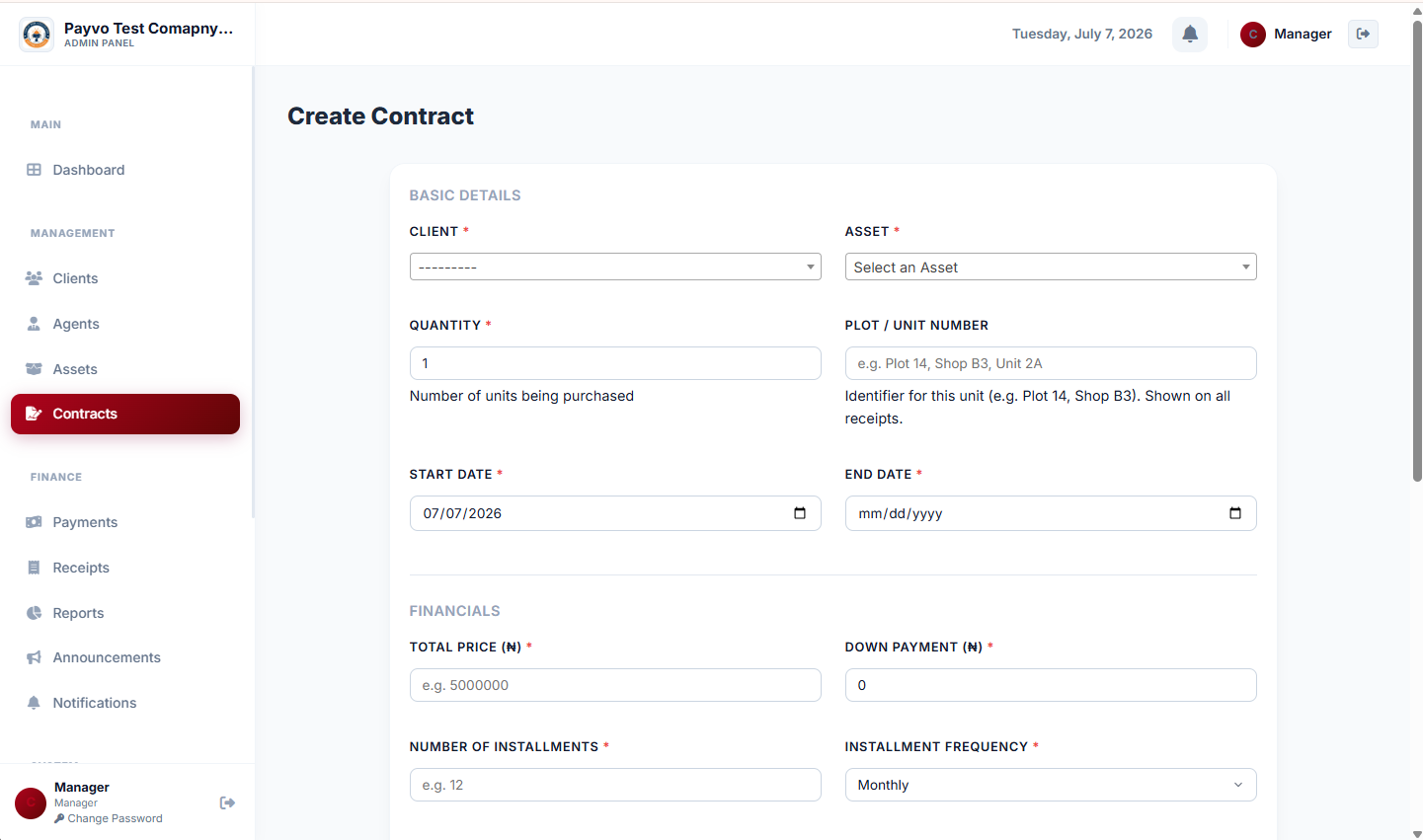 Management: Add contract (top)
Step 4: Automate Payment Collection and Reminders
Manual tracking of payments and sending reminders is incredibly time-consuming and prone to human error, especially for businesses with many installment plans. This is where automation becomes a game-changer.
Implement a system that can:
- Send Automated Reminders: Before a payment is due, the system should automatically send reminders via SMS, email, or WhatsApp. This significantly reduces late payments.
- Record Payments Accurately: Every payment received should be logged against the correct installment and client account.
- Generate Receipts: Immediately generate and send branded receipts for every payment. This provides proof of payment for the customer and maintains clear records for your business.
- Track Late Payments and Penalties: Automatically calculate and apply late payment penalties (e.g., ₦1,000 - ₦5,000 per day or 1% - 5% of the overdue amount) as defined in your contract.
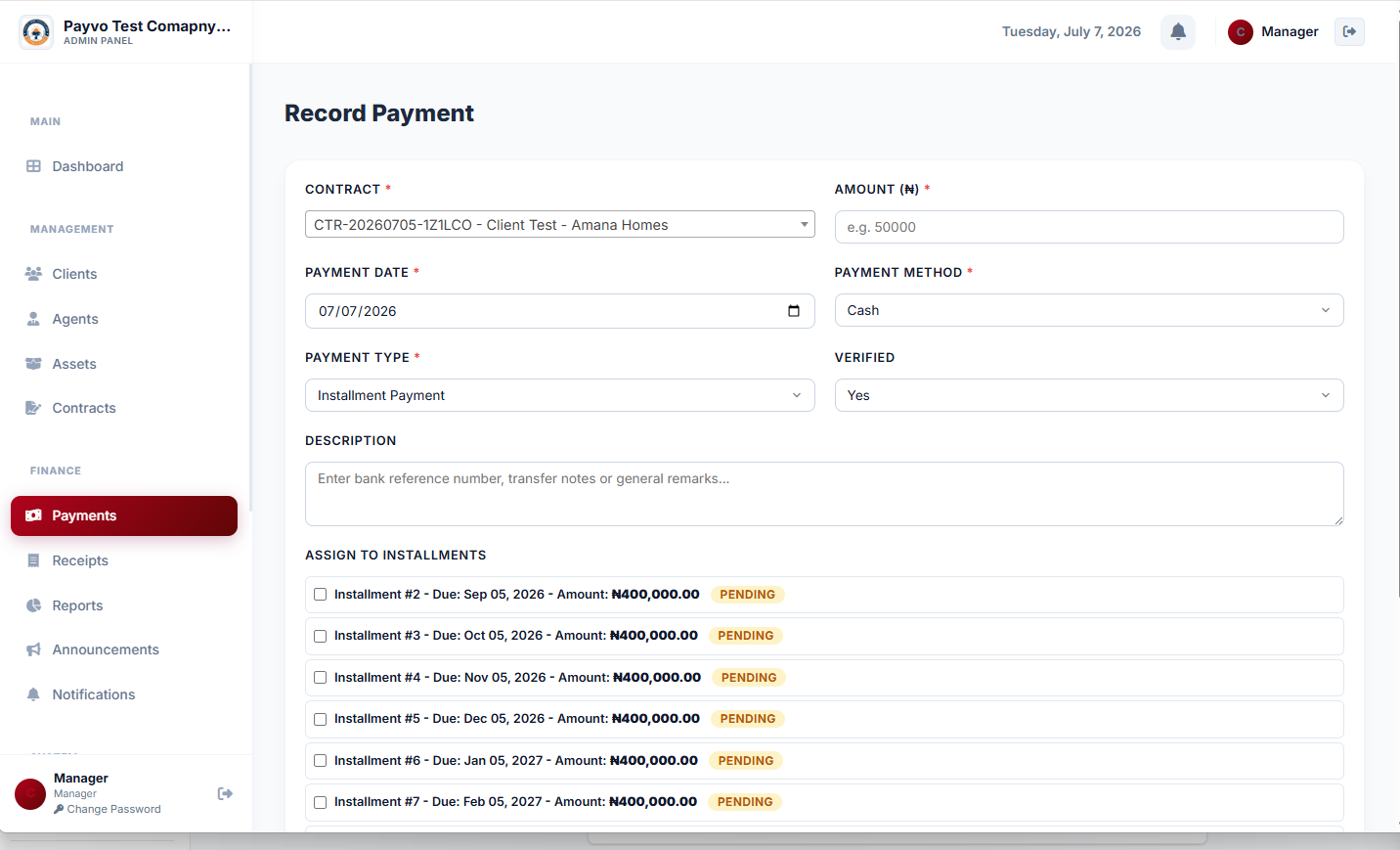 Finance: Record Payments Page
Step 5: Manage Client and Asset Information
For businesses dealing with multiple installment contracts, keeping track of client details and the assets associated with each contract is paramount. Imagine a real estate seller managing hundreds of plots or a solar leasing company tracking scores of solar panel installations.
Your system should allow you to:
- Register and Manage Clients: Store full client details, including contact information, identification, and a complete history of their payments and contracts.
- Register and Manage Assets: Track specific items sold on installment (e.g., car VIN, property address, solar panel serial number), linking them directly to the relevant client and contract. This is crucial for inventory management and repossession processes if a default occurs.
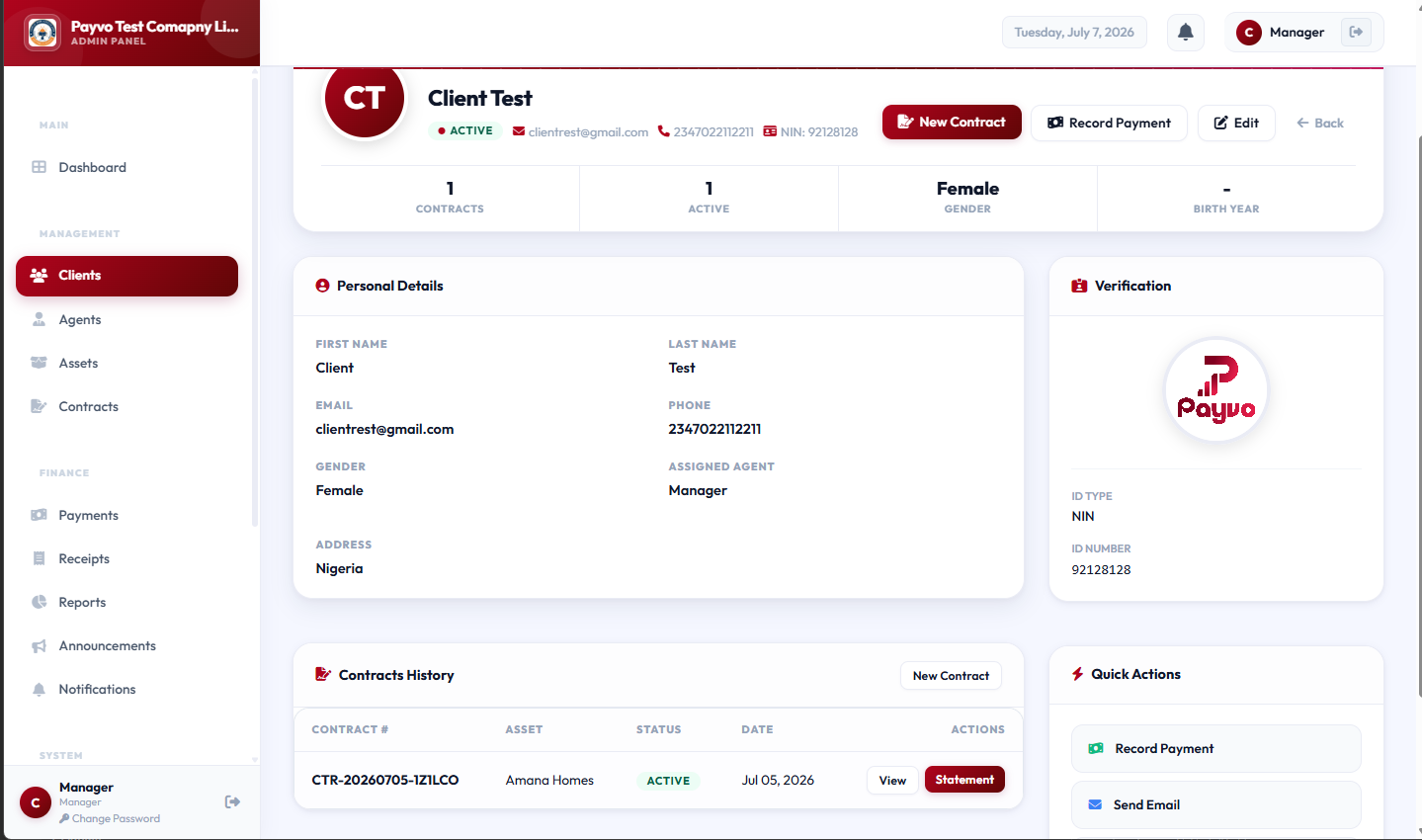 Cllient: Client Details page
Step 6: Monitor Performance and Generate Reports
Regularly review the performance of your installment plans. This means more than just checking if payments are coming in. You need to understand trends, identify potential issues early, and make data-driven decisions.
A good system will provide:
- Real-time Dashboards: Giving you an instant overview of total clients, active contracts, amount collected, outstanding balances, and upcoming payments.
- Financial Reports: Exportable data (PDF or Excel) for accounting, tax purposes, and deeper analysis of your cash flow and profitability.
- Weekly Company Reports: Automated summaries sent to your email, highlighting key performance indicators and flagging areas that need attention.
Common Mistakes to Avoid
Managing installment applications and fees can be complex. Avoiding these common pitfalls will save your business time, money, and customer goodwill:
- Lack of Transparency on Fees: Hiding fees or not clearly explaining them upfront leads to customer distrust and disputes. Always disclose all costs before signing.
- Manual Tracking Over-reliance: Using notebooks, spreadsheets, or scattered WhatsApp messages to track payments and contracts is unsustainable and highly prone to errors, especially as your client base grows. This is a common pitfall for many small businesses, leading to missed payments and lost revenue.
- Inconsistent Application of Terms: Applying different terms or fees to similar clients without clear justification can lead to perceptions of unfairness and potential legal issues.
- Ignoring Late Payment Follow-ups: Allowing late payments to slide without timely reminders or penalty application encourages further delinquency and impacts cash flow.
- Neglecting Legal Documentation: Vague or incomplete contracts can leave your business vulnerable in case of disputes or defaults. Always have legally sound agreements.
- Insufficient Due Diligence: Skipping credit checks or proper guarantor verification can lead to high default rates and significant losses.
How to Track and Grow After Launch
Once your installment application process is streamlined and your fees are clearly managed, the focus shifts to tracking performance and driving growth.
- Key Performance Indicators (KPIs) to Watch:
- Collection Rate: Percentage of due payments successfully collected.
- Default Rate: Percentage of contracts that go into severe arrears.
- Average Payment Period: How long it takes for customers to complete their installment plans.
- Customer Acquisition Cost (CAC) for Installment Sales: How much it costs to bring in a new customer for an installment plan.
- Agent Performance: For businesses using agents, track their sales volume, collection rates, and commission earnings. This is where an agent commission tracking software becomes indispensable.
- Growth Tactics:
- Optimize Payment Reminders: Fine-tune your WhatsApp payment notification system and email reminders based on effectiveness.
- Customer Feedback Loop: Regularly solicit feedback from customers on their experience with your installment plans. Use this to refine your process and offerings.
- Agent Incentives: Motivate your sales agents with clear commission structures and performance bonuses, tracked seamlessly by your system.
- Data-Driven Product Development: Use insights from your sales data to identify popular products for installment sales or to develop new offerings.
- Expand Your Reach: With a robust backend system, you can confidently expand your installment offerings to new markets or customer segments.
Frequently Asked Questions
Q1: What is the typical interest rate for installment plans in Nigeria in 2026?
A1: Monthly interest rates for microfinance or informal installment plans in Nigeria typically range from 2.5% to 10% in 2026. This wide range depends on factors like the perceived risk of the borrower, the duration of the loan, the type of collateral, and the specific lending institution or business offering the installment plan.
Q2: How can I minimize the risk of late payments from customers?
A2: Minimizing late payments starts with thorough customer vetting during the application process. Beyond that, implementing an automated WhatsApp payment notification system and email reminders significantly improves collection rates. Clear communication of late payment penalties upfront also acts as a deterrent. Consistent follow-up and offering flexible payment renegotiation options for customers facing genuine hardship can also help.
Q3: Are legal documentation fees mandatory for all installment sales?
A3: For high-value installment sales like real estate, vehicles, or significant equipment, legal documentation fees are highly recommended and often mandatory. They ensure that the terms of the agreement are legally binding and protect both the buyer and the seller in case of disputes. For smaller, lower-risk items, simpler contracts might suffice, but it's always wise to have a clear, written agreement.
Q4: What is the benefit of using a dedicated installment management software Nigeria instead of spreadsheets?
A4: A dedicated installment management software like Payvo offers automation, accuracy, and scalability that spreadsheets cannot. It automates payment scheduling, reminders, receipt generation, and penalty calculations. It provides real-time dashboards, comprehensive reporting, and secure client/asset management, reducing manual errors and saving significant time. Spreadsheets become unwieldy and prone to mistakes as your client base grows, whereas specialized software is built to handle this complexity efficiently.
Q5: How do I track agent commissions effectively for installment sales?
A5: Tracking agent commissions effectively requires a system that links agents to specific contracts and automatically calculates their commission based on payments received. A robust agent commission tracking software allows you to set up commission structures, track agent performance, and view their earnings in real-time. This ensures transparency for agents and simplifies payout management for your business, eliminating manual calculations and disputes.
Ready to Streamline Your Installment Sales?
Managing installment applications and their associated fees doesn't have to be a manual headache. With the right tools, you can ensure transparency, boost collections, and grow your business with confidence. If you're a real estate developer, car dealer, cooperative society, or any business offering installment plans, discover how an all-in-one contract management software Nigeria can transform your operations. Visit our public home page today to learn more or register your business and experience the difference yourself.