You know, most people will tell you that if you're selling land or property in installments, a simple Excel spreadsheet is all you need to keep things straight. "Just set up your columns," they'll say, "and you're good to go." Honestly, that's one of the biggest myths in Nigerian real estate, and it’s why so many developers and property sellers in places like Kaduna, Kano, and Abuja spend their days chasing payments and untangling records. The truth is, relying solely on Excel vs. software: the best way to track real estate installment payments isn't about saving money; it’s about losing it, slowly but surely. I'm here to tell you why that common advice is wrong and what smart business owners are doing instead to actually grow their profit.
 Architect reviewing blueprints with a tablet
The Gap: Revenue vs. Profit in Real Estate Payment Tracking Nigeria
You’re busy, right? Your agents are bringing in new clients, people are making initial deposits, and plots are moving. On paper, it looks like revenue is flowing. But then you check your bank account, and you ask yourself, "Where is the money?" This is the classic revenue vs. profit gap, and it hits real estate businesses selling on installment particularly hard. You might have ₦150,000,000 in outstanding contracts for your estate in Lugbe, Abuja, but if you can't accurately track who owes what, when it's due, and what's actually been paid, that money might as well be imaginary.
Think about it: a client bought a ₦15,000,000 plot with a ₦3,000,000 down payment, agreeing to pay ₦500,000 monthly for two years. Sounds simple enough. But multiply that by 50, 100, or even 200 clients, each with their own unique payment plan, and suddenly your "simple" Excel sheet becomes a spiderweb of formulas, manual updates, and potential errors. You lose track of your real outstanding balances. You miss due dates. Your agents waste time reconciling payments instead of finding new buyers. It's a mess. When you can't precisely track your monthly profit margins, how do you even know if you're making money or just moving numbers around?
Excel's Hidden Costs: When Your Land Payment Excel Sheet Becomes a Liability
Let's be honest, everyone starts somewhere. When you have just a handful of clients buying properties or land on installment, a basic Excel sheet for land payment tracking might seem to do the trick. You list the client's name, plot number, total cost, down payment, monthly installment, and a few columns for payment dates and amounts. Easy. But that "easy" quickly becomes a nightmare.
Here's a micro-story: Imagine Mrs. Adeola, a real estate developer in Enugu, running her business from a small office. She has about 80 clients paying for plots across three different estates. Her Excel file, which she built herself, has grown to over 30 tabs. One afternoon, a client calls, insisting they paid their last installment two weeks ago, but Mrs. Adeola's sheet shows it as overdue. She spends the next three hours sifting through bank statements, WhatsApp chats, and her convoluted spreadsheet, only to find a manual entry error she made herself. That's three hours she could have spent closing a new deal or strategizing. Sound familiar?
The biggest problem with using Excel for real estate installment tracking is the sheer potential for human error. One wrong formula, one missed entry, one accidentally deleted row, and your entire financial picture is skewed. And because it's manual, it's incredibly time-consuming. You're not just tracking payments; you're constantly validating, cross-referencing, and troubleshooting. That time costs you money – real money. Your staff spending hours on reconciliation means they're not focused on sales, marketing, or customer service.
Then there's the lack of real-time visibility. You want to know which clients are overdue across all your properties right now? You have to manually filter, sort, and calculate. What about knowing the total amount collected this week by your agents? Again, manual aggregation. This isn't just inefficient; it's a huge barrier to making timely, informed business decisions. You're always looking at yesterday's data, not today's reality.
The WhatsApp Mess: Why Your "Payment Notification System" Isn't Working
Many businesses, especially smaller ones, try to bridge the gap by using WhatsApp. They'll send payment reminders, share bank details, and even send screenshots of payment receipts via chat. It feels immediate, personal, and free, right? Wrong. This approach, while popular, is a recipe for chaos when it comes to a proper WhatsApp payment notification system and real estate payment tracking Nigeria.
Let me tell you about Mr. Biodun, who sells solar equipment on installment in Port Harcourt. He used to manage all his customer communications and payment reminders through WhatsApp groups and individual chats. He thought it was efficient. Then, one day, his phone crashed. All his individual chats with payment agreements, promises, and partial payment details were gone. He lost critical records, leading to arguments with clients and a huge headache trying to reconstruct payment histories. He realized then that WhatsApp is for communication, not for secure, auditable financial record-keeping.
Here's the thing: a WhatsApp message is not a formal record. It's easily lost, deleted, or misinterpreted. When you're managing multiple clients, each paying installments for their plot in an estate in Lekki or a car on hire purchase in Ikeja, relying on chat history for contract management software Nigeria is asking for trouble. How do you pull a report of all overdue clients from WhatsApp? How do you generate a professional, branded receipt? You can't.
This fragmented approach means you have no single source of truth. Your finance team has to scroll through endless chats, your sales agents have their own versions of client payment status, and you, the business owner, are left guessing. This lack of centralized data is a massive vulnerability, especially when dealing with high-value assets like property. It makes how to track installment payments a constant uphill battle.
<blockquote cite="https://payvo.ng/blog/excel-vs-software-best-way-to-track-real-estate-installment-payments/">
"In real estate, every installment payment is a step closer to realizing a client's dream and your business's profit. When you lose track of those steps, you risk losing both."
</blockquote>
What Smart Business Owners Do Instead: A Structured Approach to Property Payment Management Software
Smart business owners, especially those growing beyond a handful of clients, understand that manual systems are a bottleneck. They realize that to effectively manage multiple property buyers, car dealer installment software, cooperative society management software, or even solar installment payments, they need a structured, dedicated system. They move from reactive firefighting to proactive management.
First, they recognize the need for a property payment management software that centralizes all client and contract data. This means every client's details, every property they've bought, the total contract value, the down payment, the installment schedule, and every single payment received is in one secure place. No more scattered notebooks or searching through old emails.
Second, they prioritize clear, automated payment scheduling and tracking. Instead of manually updating spreadsheets, their system automatically calculates due dates, remaining balances, and identifies overdue accounts. This frees up staff time and drastically reduces errors.
Third, they empower their agents with tools that give them real-time access to their client's payment status, but within controlled permissions. This means an agent can quickly answer client queries, remind them of upcoming payments, and record payments efficiently, without needing to bother the finance department constantly. This is where agent commission tracking software often integrates, allowing for transparent performance management.
Finally, they implement a reliable receipt generator app Nigeria that automatically issues professional receipts for every payment. This builds trust with clients, provides clear proof of payment, and maintains an auditable trail, which is crucial for any business, especially those in real estate.
Essentially, they treat their installment payment process like a core business operation that deserves its own dedicated management system, not just a side task handled by a generic tool.
Where Payvo Gives You Back Control: Your Installment Management Software Nigeria Solution
This is where a purpose-built solution like Payvo comes into play. You see, Payvo isn't just another generic spreadsheet or a fancy calculator. It's a specialized installment management software Nigeria designed specifically for businesses like yours – real estate developers, car dealers, solar equipment providers, and cooperative societies – who rely on scheduled payments.
Think back to Mrs. Adeola and her Excel nightmare. With Payvo, she would register her business once, then add all her clients and their respective plots. The system would automatically set up the installment schedule based on the agreed terms. When a client pays, her staff simply records the payment against the specific contract. Payvo handles the calculations, updates the outstanding balance, and even generates a professional receipt.
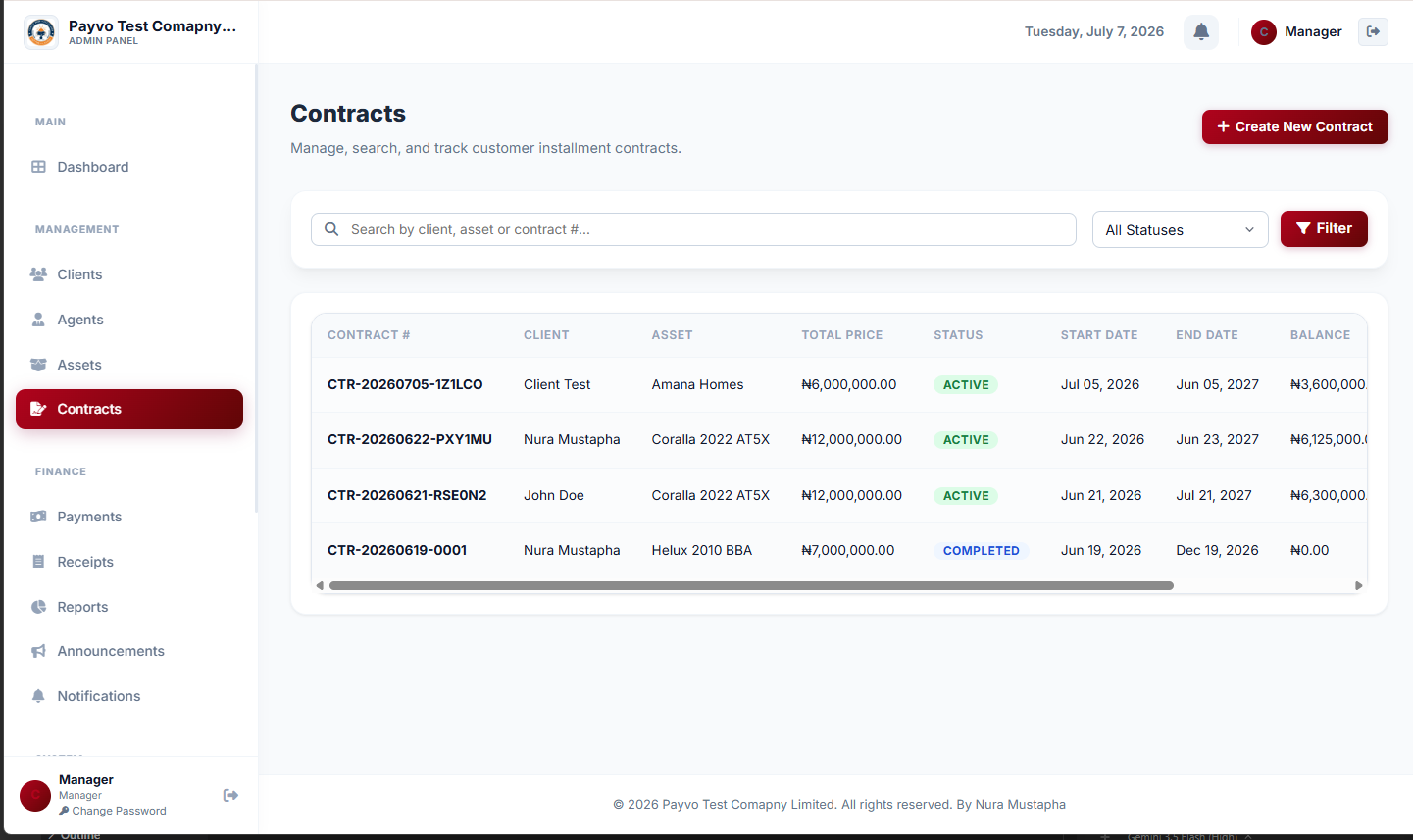 Contracts list page
You can see all your contracts at a glance, know their status, and quickly find who needs to pay next. It simplifies real estate payment tracking Nigeria by giving you a clear, consolidated view. No more digging through multiple files or trying to reconcile bank statements with fragmented records.
For your agents, Payvo offers controlled access, so they can manage their clients, record payments, and track their commission without seeing sensitive financial data from other parts of the business. This is crucial for agent commission tracking software, ensuring transparency and accuracy. And that WhatsApp payment notification system you wanted? Payvo offers optional capabilities to send automated payment reminders and confirmations, making client communication seamless and professional. It’s a dedicated business payment tracking app Nigeria that brings order to your operations.
<br>
 Team manager reviewing agent performance on a dashboard
<br>
Payvo is built to be your single source of truth for all your installment contracts. Whether you're managing land payments for an estate in Kano, hire purchase agreements for vehicles in Lagos, or solar equipment leases in Owerri, it centralizes everything. You can learn more about how Payvo specifically supports real estate businesses by visiting their dedicated real estate page.
The Numbers That Change When You Fix This
Let's talk money, because that's what this is all about. When you move from chaotic manual tracking to a dedicated installment management system, your numbers start looking a lot better.
Consider the cost of manual tracking in 2026:
Time spent on reconciliation: If an agent or administrative staff earning ₦80,000/month spends 10 hours a week (40 hours/month) reconciling payments across spreadsheets and WhatsApp, that's ₦20,000 in direct wages lost to inefficiency. Multiply that by 3 staff members, and you're at ₦60,000 monthly* just on wasted time.
- Cost of errors: A single miscalculation or missed payment in an Excel sheet could mean a client underpays by ₦50,000 on their plot, or worse, you lose track of an overdue payment for months. Over a year, these errors can easily cost a business ₦300,000 to ₦1,000,000 or more in uncollected revenue or disputes.
- Opportunity cost: If your lead sales agent spends 5 hours a week fixing payment issues instead of prospecting new clients, how many potential deals are you missing? Even one missed sale of a ₦10,000,000 plot, with a 5% commission, is ₦500,000.
- A basic laptop for Excel: ₦180,000 - ₦450,000.
- Microsoft Office Suite (one-time): ₦35,000 - ₦80,000.
- Internet Data (monthly): ₦5,000 - ₦15,000.
- Entry-level real estate management software (monthly subscription): ₦10,000 - ₦50,000.
- Training on Excel for tracking (per session/person): ₦15,000 - ₦50,000.
- Training on software usage (per session/person): ₦20,000 - ₦70,000.
FAQ: Your Questions on Real Estate Installment Tracking Answered
Q1: Is Excel completely useless for tracking real estate installments?
Not completely useless for a very small operation, say 1-5 clients. But as soon as you hit 10 or more clients, or if you have multiple agents, it quickly becomes error-prone, time-consuming, and a major headache. For serious real estate installment tracking, it's simply not scalable or reliable.
Q2: What's the biggest risk of using Excel for land payment tracking?
The biggest risk is human error. A single mistake in a formula or a missed entry can skew your entire financial record, leading to payment disputes, uncollected revenue, and wasted time. It also lacks proper audit trails and security compared to dedicated software.
Q3: Can I integrate a WhatsApp payment notification system with my tracking?
Yes, some dedicated installment management software Nigeria solutions, like Payvo, offer optional WhatsApp communication features. This allows you to send automated payment reminders, confirmations, and receipts directly to clients from a centralized system, rather than relying on manual chats.
Q4: How does dedicated software help with agent commission tracking?
Many contract management software Nigeria platforms, including Payvo, allow you to assign contracts to specific agents. This means the system can track which agent is responsible for which sale and payment collection, making it much easier to calculate and manage agent commissions accurately and transparently. You can even find specific tools for agent tracking.
Q5: What kind of businesses benefit most from this type of software?
Any business that sells high-value products, properties, or services on installment. This includes real estate developers, car dealers (especially for car dealer installment software), solar equipment leasing companies, cooperative societies, and even building material suppliers who offer credit. If your business relies on scheduled payments, you need a proper system.
Stop Letting Money Walk Out the Door
You've worked hard to build your real estate business, to get those plots moving, to secure those clients. Don't let your hard-earned money slip through the cracks because of outdated, inefficient tracking methods. It’s 2026, and the tools are available to help you manage your sales, track payments, and monitor outstanding balances in one organized place.
It's time to move beyond the limitations of Excel and the chaos of scattered WhatsApp chats. Take control of your finances, empower your team, and get a clear, real-time picture of your business's health. Visit the Payvo website today to see how a dedicated system can transform your operations. You can even register for Payvo and start organizing your contracts right away. Your profit margins will thank you.