Managing installment sales in Nigeria can feel like navigating a maze blindfolded. Are you tired of chasing payments, sifting through ledgers, or dealing with clients who claim they paid but have no proof? The manual effort involved in tracking every kobo, every due date, and every client interaction can quickly overwhelm even the most organised businesses.
 Nigerian business owner looking stressed at a desk
The Hidden Costs of Manual Installment Tracking
Many Nigerian businesses, from car dealers offering hire purchase to real estate developers selling plots, still rely on notebooks, spreadsheets, and endless WhatsApp messages to manage their installment sales. While seemingly cost-free at first glance, this approach carries significant hidden costs and risks that erode profitability and hinder growth.
Consider the time spent:
- Recording payments: Manually updating ledgers, issuing receipts, and reconciling accounts can consume hours each day. For a business with 50 active installment contracts, this could easily be 2-3 hours daily.
- Chasing overdue payments: Calling, messaging, and visiting clients takes precious time away from sales and core business operations. This is often the most time-consuming task for businesses offering consumer installment loans.
- Resolving disputes: When a client disputes a payment, proving who paid what and when without a robust system can be a nightmare, leading to lost revenue and damaged relationships.
Furthermore, manual systems are prone to errors. A misplaced digit, an overlooked payment, or a forgotten reminder can lead to:
- Revenue leakage: Payments might be missed or incorrectly recorded.
- Cash flow instability: Inaccurate projections of incoming funds make financial planning difficult.
- Compliance risks: Without proper records, businesses can face challenges during audits or legal disputes.
Why Inefficient Tracking Stifles Growth for Nigerian Businesses
The inability to efficiently track installment payments isn't just about lost time; it's a direct impediment to scaling your business. Imagine a microfinance operator in Kano or a solar equipment leasing company in Abuja wanting to expand their client base from 50 to 500. Their current manual system would simply collapse under the weight of increased transactions.
Here's how inefficient tracking limits growth:
Limited Client Capacity
Without an automated system, every new client adds a disproportionate amount of administrative burden. This forces businesses to cap their growth, turning away potential customers simply because they lack the capacity to manage them effectively. A car dealer selling on hire purchase might struggle to manage more than a handful of concurrent contracts if they're relying on paper files.
Poor Decision-Making
Real-time insights are crucial for any business, especially those extending credit. Manual systems offer delayed, often inaccurate, data.
- How many clients are consistently late?
- Which installment plans have the highest default rates?
- What is the total outstanding balance across all contracts?
Answering these questions quickly and accurately is nearly impossible with manual tracking. This leads to uninformed decisions regarding new loan offerings, credit policies, and even marketing strategies.
Difficulty in Staff and Agent Management
For businesses like real estate developers or building material suppliers who rely on agents, tracking commissions and agent performance manually is a Herculean task. Calculating agent payouts per payment received, ensuring transparency, and giving agents visibility into their earnings becomes complicated and error-prone. This can lead to agent dissatisfaction and high turnover, directly impacting sales.
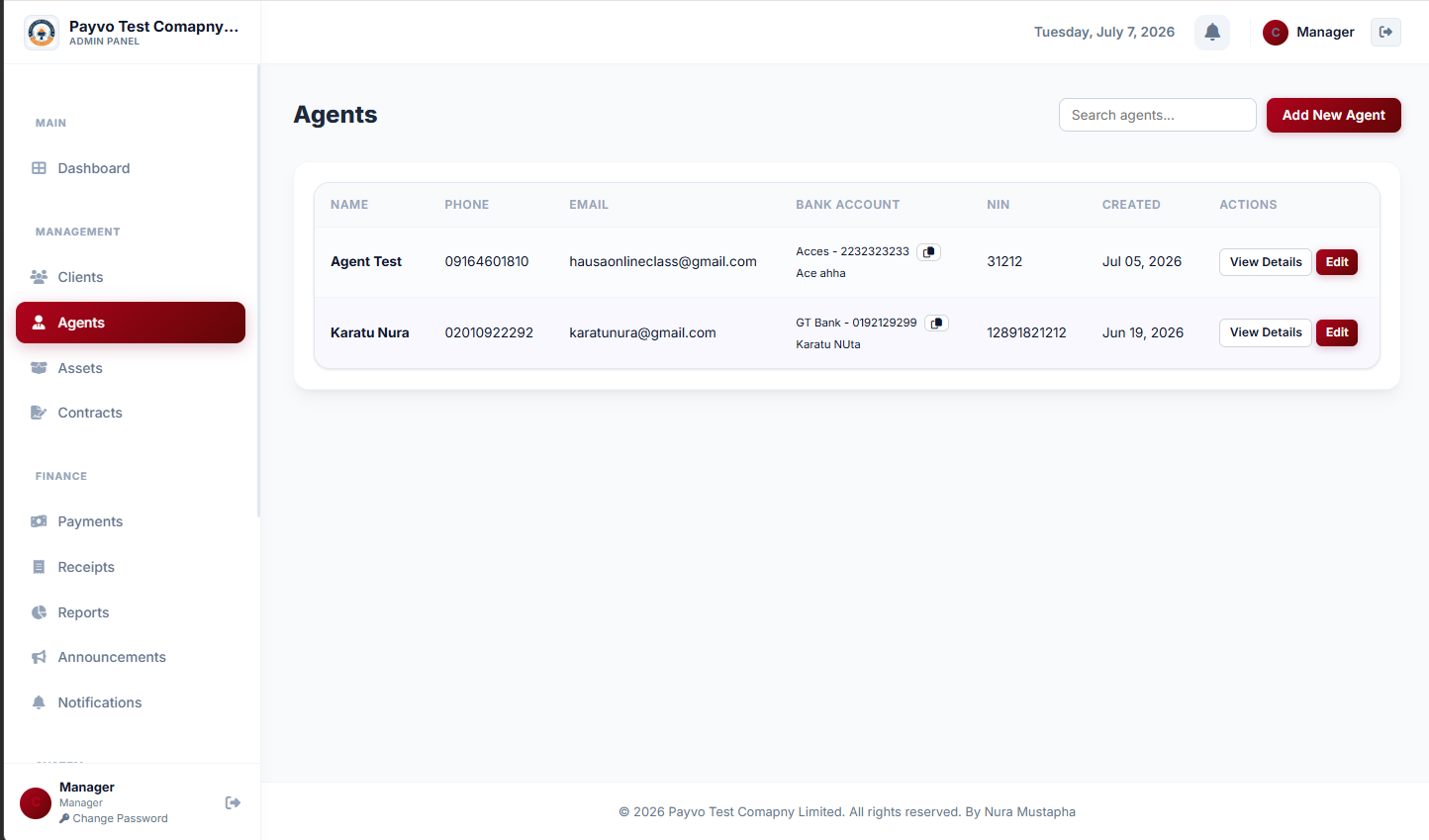 Agent: Agents list page
Inconsistent Customer Experience
In today's competitive landscape, customer experience is paramount. Manual systems often result in:
- Delayed or missing payment receipts.
- Inconsistent communication regarding due dates.
- Lack of a clear, accessible record for clients to view their payment history.
This creates distrust and frustration, which can lead to higher churn rates and negative word-of-mouth. Businesses need a reliable receipt generator app Nigeria clients can trust.
> "The backbone of any successful installment-based business is not just the product or service, but the integrity and efficiency of its payment collection and management system. Without it, you're building on sand."
Embracing a Smarter Approach: Digital Installment Management
The solution to these challenges lies in adopting a dedicated consumer installment loan software. This isn't just about digitising your records; it's about transforming your entire installment sales operation into a streamlined, efficient, and scalable process.
A robust installment management software Nigeria can handle the complexities of consumer loan management, from initial contract creation to final payment reconciliation. It automates repetitive tasks, reduces human error, and provides instant access to critical data.
Here's what a smarter approach entails:
Centralized Client and Contract Data
All client information, including contact details, payment history, and associated assets (like cars, properties, or equipment), should be stored in one secure location. This eliminates scattered records and provides a 360-degree view of each client.
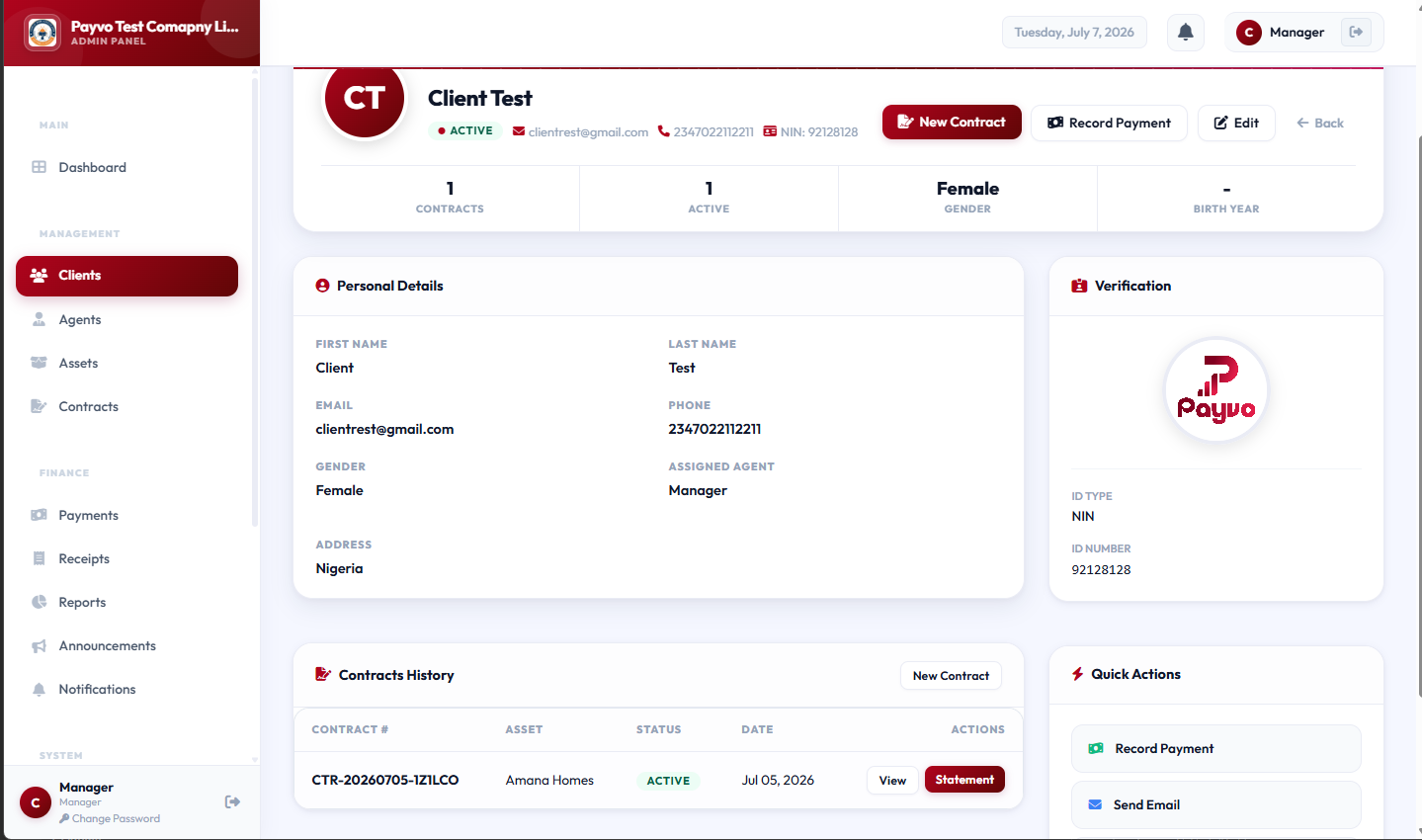 Cllient: Client Details page
Automated Payment Scheduling and Reminders
Instead of manually calculating due dates and sending reminders, the system should automatically generate installment schedules based on predefined terms. More importantly, it should send automated payment reminders to clients via SMS, email, or even WhatsApp payment notification system, significantly reducing the manual effort of follow-up.
Instant Receipt Generation
Every payment recorded should instantly trigger the generation of a branded, professional receipt. This not only builds customer trust but also provides an undeniable record of transaction. This is where a good receipt generator app Nigeria comes in handy.
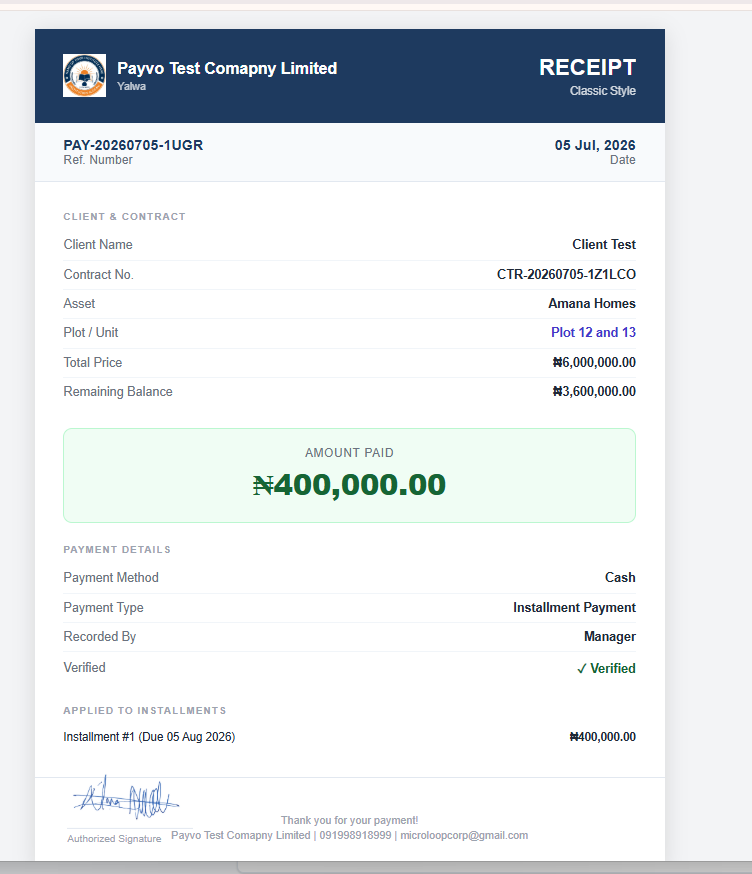 Finance: Paymnet Receipt Sample
Real-time Financial Oversight
Business owners and managers need dashboards that display key performance indicators (KPIs) at a glance: total outstanding balances, amount collected, upcoming payments, and overdue accounts. This allows for proactive decision-making and better cash flow management.
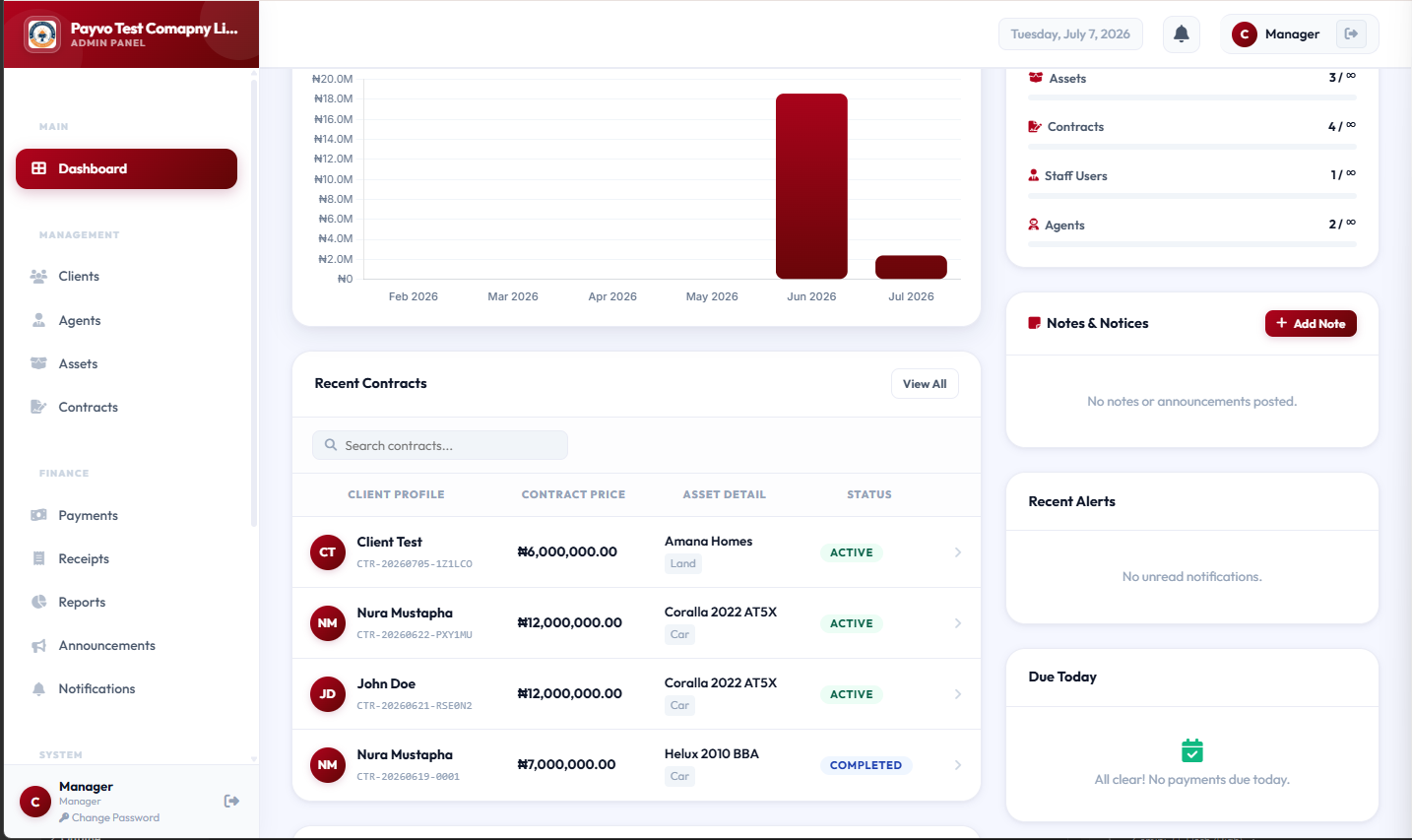 Dashobard (top)
Streamlined Agent and Staff Management
For businesses working with agents, the system should facilitate easy agent assignment to contracts, automated commission calculation, and a transparent way for agents to track their own earnings. This is crucial for effective agent commission tracking software.
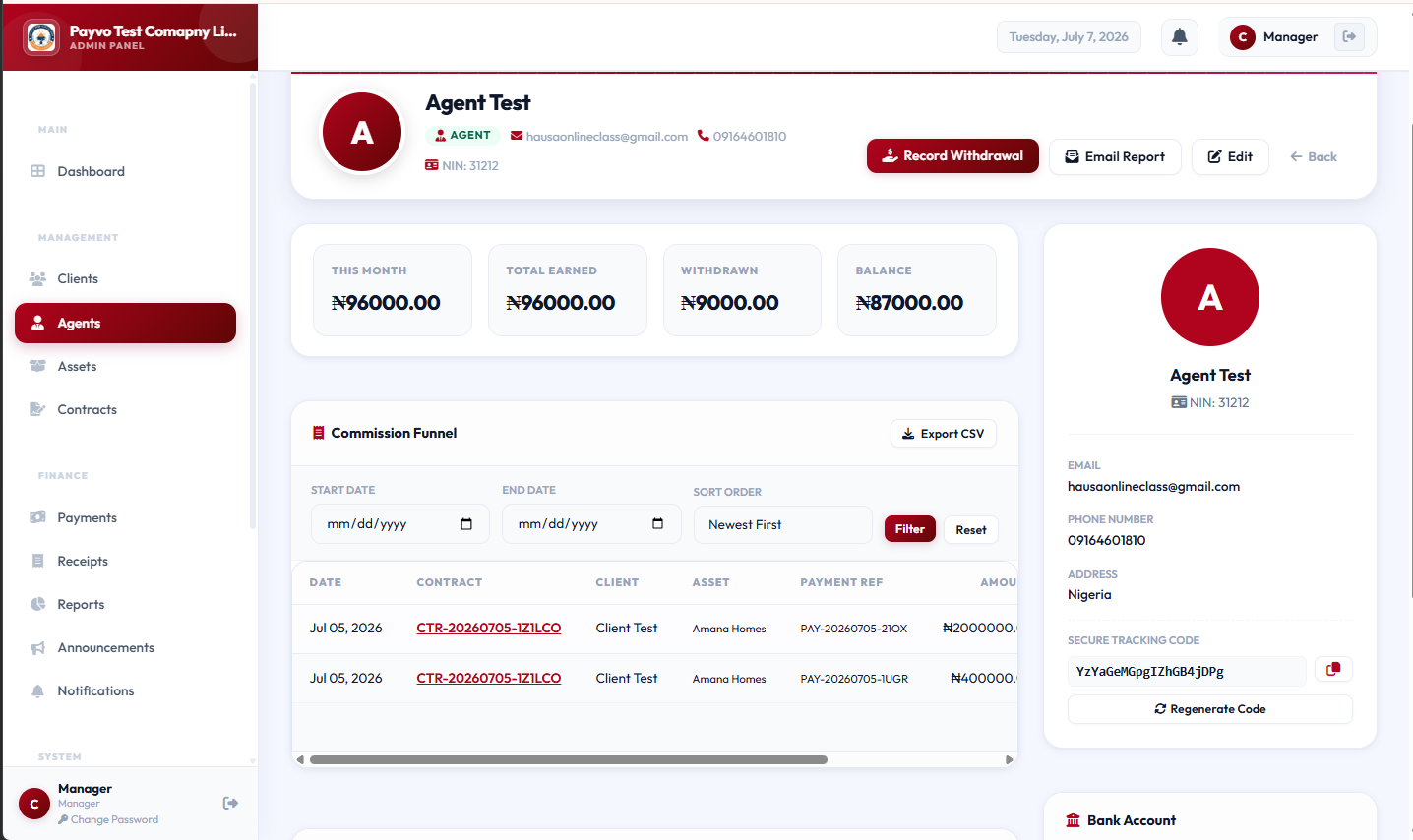 Agent: Agent details page
By embracing such a system, businesses can shift their focus from administrative drudgery to growth strategies, customer service, and product innovation.
How Payvo Transforms Your Installment Sales Operations
For Nigerian businesses seeking to modernise their installment sales, Payvo offers a comprehensive and intuitive solution. It’s designed to be the ultimate contract management software Nigeria needs, simplifying every step of the installment process.
Payvo replaces the chaos of notebooks and scattered messages with a single, automated platform. From the moment a client is added, to contract creation, to every payment being recorded, receipted, and followed up on – it’s all handled automatically.
Here’s how Payvo helps you adopt this smarter approach:
- Effortless Client and Asset Management: Register and manage all your clients and assets (cars, property, equipment) in one secure place. Link assets directly to contracts for clear tracking.
- Automated Contract Creation: Define payment terms once, and Payvo automatically generates detailed installment schedules. This eliminates manual calculations and reduces errors, making it an ideal consumer instalment loan software.
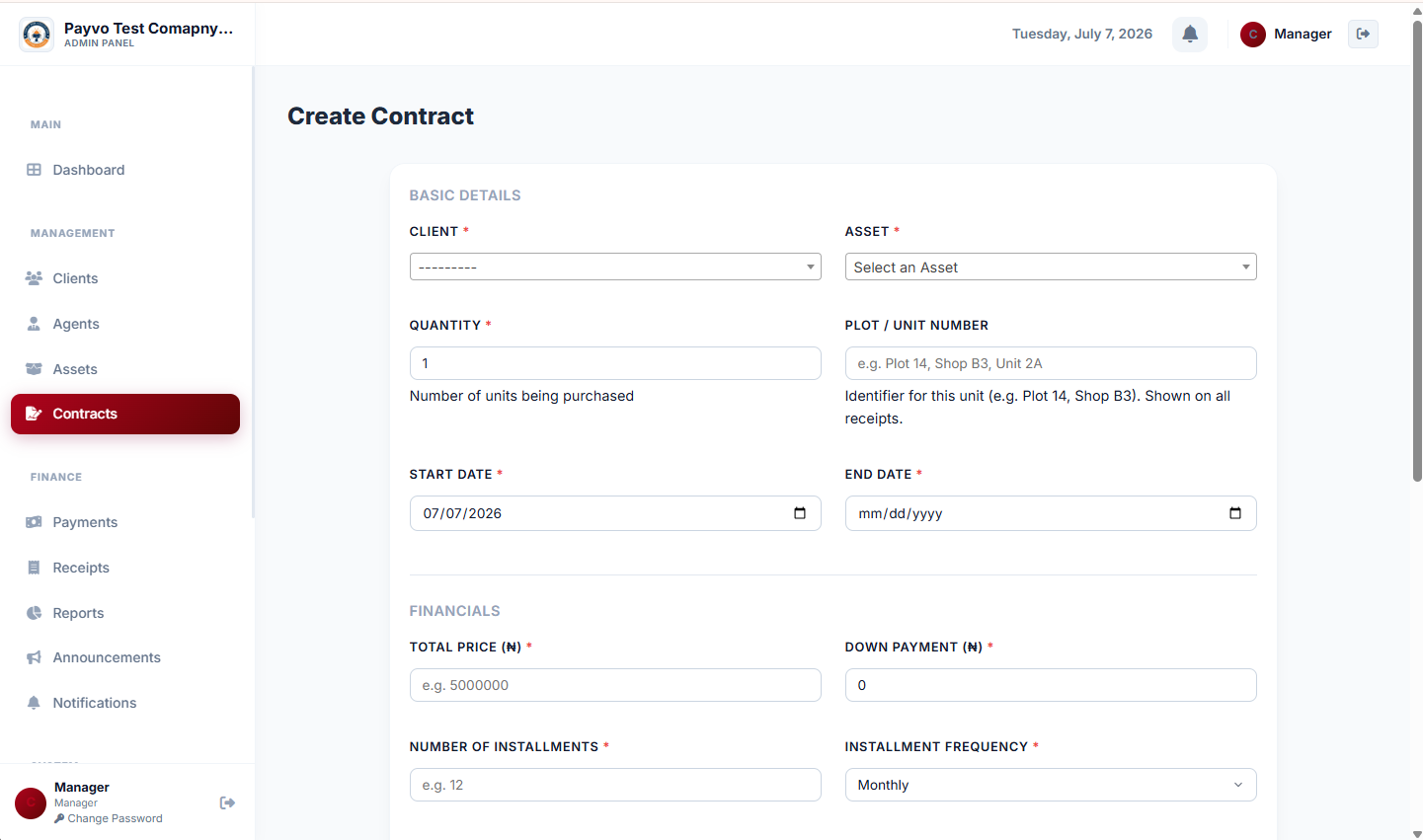 Management: Add contract (top)
- Seamless Payment Recording & Receipts: Log single payments against any contract, with a full history tracked. Payvo acts as your receipt generator app Nigeria, automatically creating branded receipts with your logo and signature for every payment, and even a master receipt for full contracts.
- Intelligent Notification System: Keep clients informed with automated notifications for new contracts, payment receipts, and crucial payment reminders via email and WhatsApp. Clients receive a public receipt link they can view, save, or share, enhancing transparency. This is your reliable WhatsApp payment notification system.
- Robust Agent and Staff Management: Assign agents to contracts, and Payvo automatically calculates their commission per payment, tracking full earnings and payout history. Agents can even log in to track their own KPIs and submit withdrawal requests directly, providing invaluable agent commission tracking software. You can also manage staff accounts with role-based permissions, ensuring data security and control.
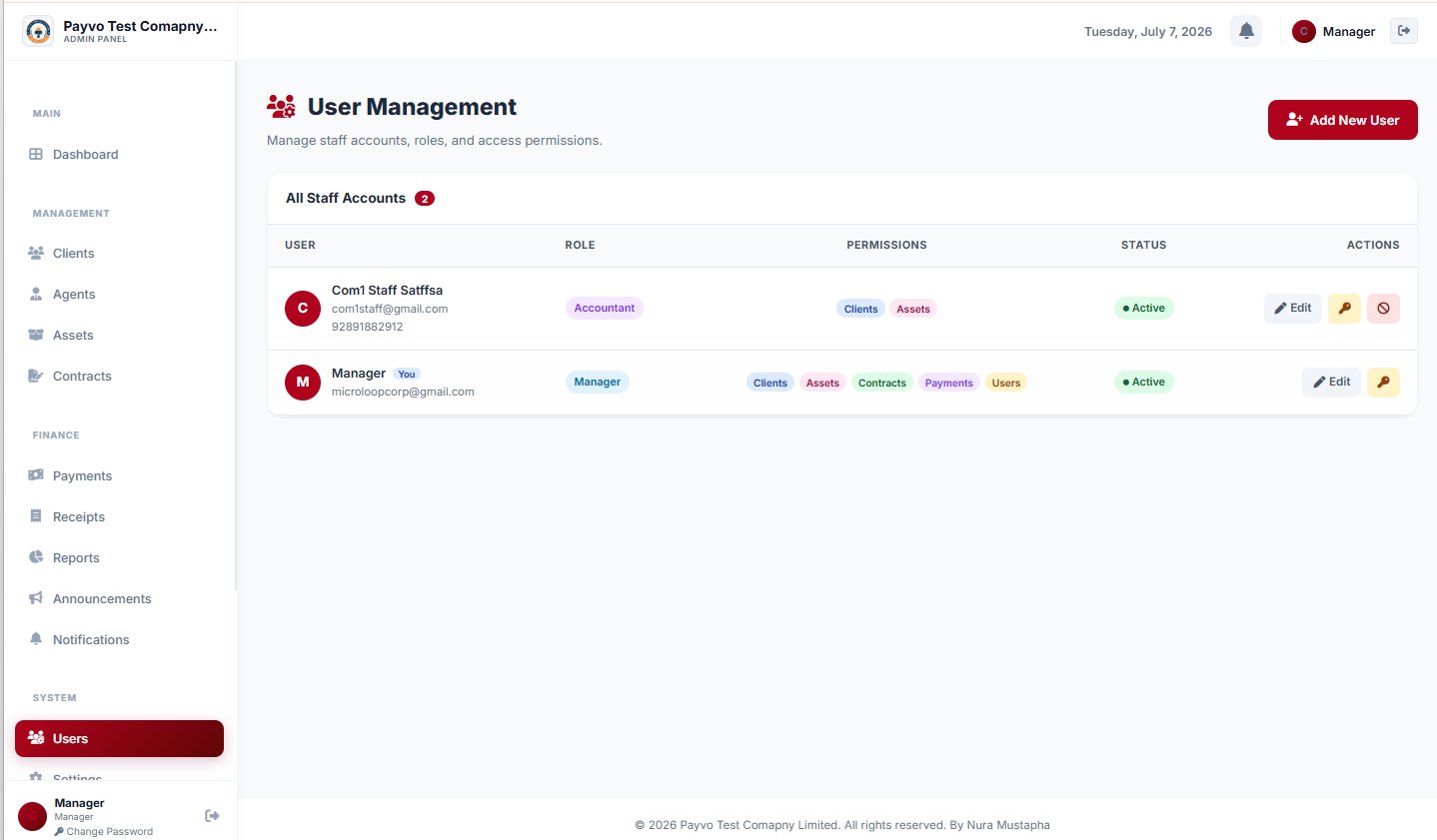 Admin: User Management Page
- Real-time Business Insights: Access intuitive dashboards showing total clients, active contracts, amount collected, outstanding balances, and next payment due at a glance. Generate detailed reports in PDF or Excel for accounting and record-keeping, giving you the power of a true business payment tracking app Nigeria.
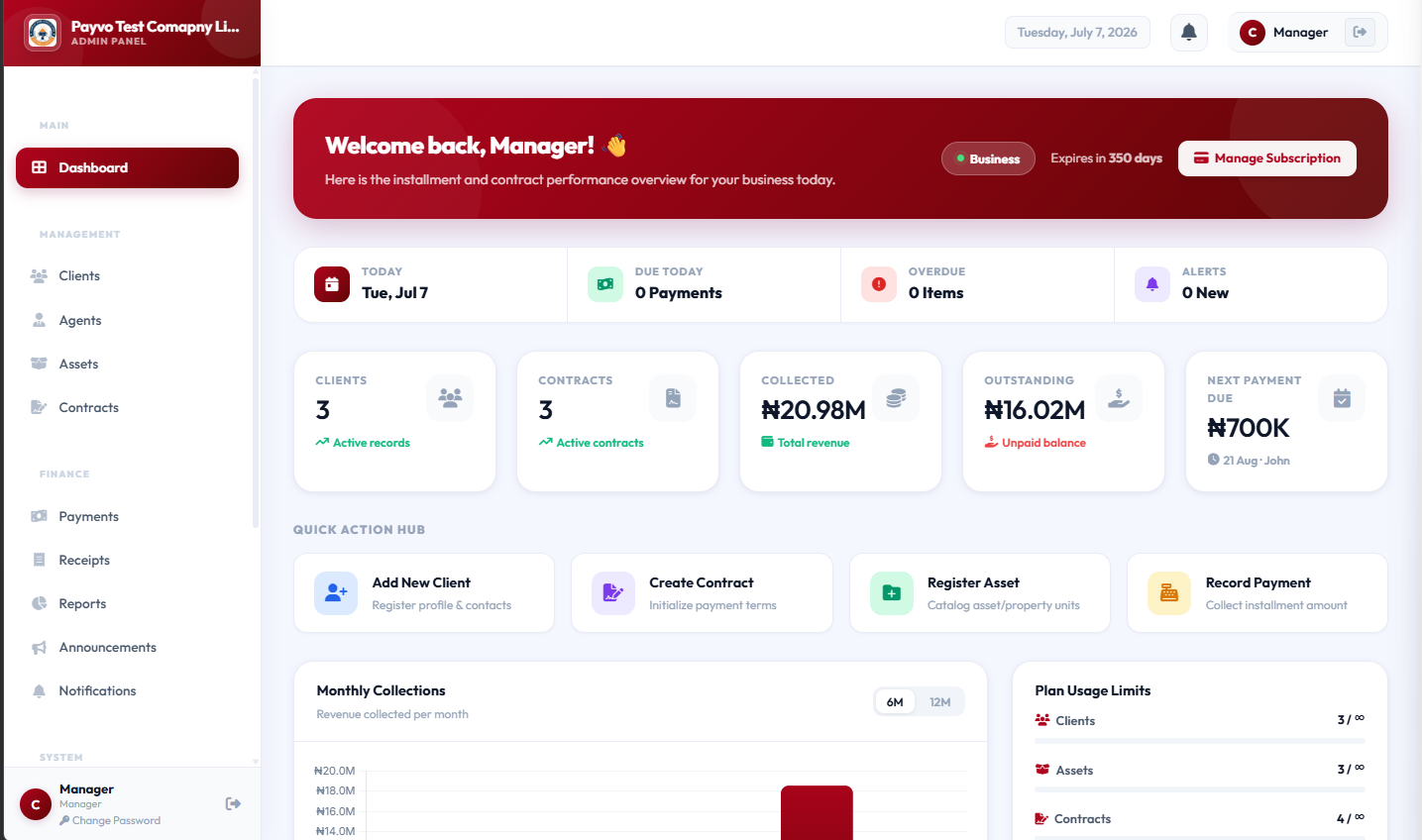 Dashboard (bottom)
- Enhanced Security and Branding: Customize your company branding with your logo, colors, and digital signature, applied automatically to all client-facing documents. Payvo also offers audit logs and API access for deeper system oversight, ensuring your instalment loan tracking is secure.
Proof: Side-by-Side Comparison
Let's look at how a dedicated software solution like Payvo stacks up against traditional, manual methods.
| Feature / Aspect | Traditional Manual Methods (Notebooks, Spreadsheets, WhatsApp) | Modern Installment Management Software (e.g., Payvo) |
|---|---|---|
| Client & Contract Mgmt. | Scattered notes, physical files, difficult to retrieve history. | Centralized database, complete client profiles, linked assets, instant history. |
| Payment Tracking | Manual entries, high risk of errors, disputes common. | Automated recording, accurate reconciliation, clear audit trails. |
| Receipt Generation | Hand-written, generic, time-consuming, easy to lose. | Automated, branded, digital receipts (PDF/WhatsApp link), secure and verifiable. |
| Payment Reminders | Manual calls/SMS, easily forgotten, inconsistent. | Automated, scheduled reminders via WhatsApp/Email, reducing manual effort. |
| Agent Commission Tracking | Manual calculation, prone to errors, lack of transparency for agents. | Automated calculation per payment, transparent agent dashboards, withdrawal requests. |
| Reporting & Analytics | Time-consuming to compile, often outdated, difficult to get accurate overview. | Real-time dashboards, instant reports (PDF/Excel), actionable insights for growth. |
| Operational Costs | High hidden costs in staff time, error correction, dispute resolution. | Reduced operational costs through automation, improved efficiency, higher accuracy. |
| Scalability | Extremely limited, significant administrative burden with growth. | Highly scalable, supports growth without proportional increase in admin staff. |
| Customer Experience | Inconsistent, prone to delays, potential for distrust. | Professional, transparent, reliable communication, builds customer loyalty. |
| Security | Vulnerable to loss, damage, unauthorised access. | Secure digital storage, user permissions, audit logs. |
Frequently Asked Questions
Q1: How much does installment management software cost in Nigeria in 2026?
A1: The cost varies based on features and provider. For a basic local solution, software licenses can range from ₦150,000 to ₦750,000 annually. Monthly subscriptions typically fall between ₦20,000 and ₦100,000, depending on the number of loans or users. One-time implementation fees might be ₦50,000 to ₦300,000. It’s an investment that quickly pays for itself through efficiency gains and reduced losses.
Q2: Can this software help me track payments from customers who pay via bank transfer or cash?
A2: Absolutely. A good loan collection software is designed to record payments received through any channel – bank transfers, cash, POS, or mobile money. You simply log the payment in the system, and it updates the client's record, generates a receipt, and adjusts their outstanding balance. This ensures all payment types are consolidated and tracked accurately.
Q3: Is it possible to manage multiple types of installment sales, like car hire purchase and real estate, on one platform?
A3: Yes, the best contract management software Nigeria offers is flexible enough to handle various asset types. Whether you're a car dealer selling on hire purchase, a real estate developer, or a solar equipment leasing company, the system allows you to define different contract types and link specific assets (vehicles, plots, solar panels) to each agreement, providing comprehensive installment loan tracking.
Q4: How does the software ensure my customer data is secure?
A4: Data security is paramount. Reputable consumer installment loan software providers employ robust security measures including encryption, regular backups, and access controls. Features like role-based permissions mean only authorised staff can view or modify specific data. Audit logs track every action taken within the system, ensuring accountability and compliance, as detailed in our privacy policy.
Q5: What if my agents need to see their earnings but not sensitive client data?
A5: This is a common requirement, and modern agent commission tracking software handles it effectively. Agents can be given limited access, allowing them to view their assigned contracts, track their commission earnings, and even submit withdrawal requests, all without access to sensitive client financial details or other company-wide reports. This transparency empowers agents while maintaining data security. You can find out more about this on our agent tracking page.
Q6: What if I have poor internet connectivity in my area?
A6: While most modern software solutions are cloud-based and require an internet connection, many are designed to be light and efficient, minimizing data usage. Furthermore, businesses operating in Nigeria often budget for reliable internet (₦10,000 - ₦30,000 monthly) and generator fuel (₦20,000 - ₦80,000 monthly) to ensure continuous operation. Even with occasional outages, the benefits of a robust system far outweigh these considerations.
---
Ready to transform your installment sales and unlock your business's true potential? Stop losing time and money to manual tracking. Discover how Payvo can streamline your operations, improve cash flow, and delight your customers.