You ever wonder why managing car installment payments feels like trying to catch fish with your bare hands in the Lagos lagoon? You spend so much time chasing down payments, reconciling ledgers, and arguing with customers about their balances that you wonder if selling cars on credit is even worth the headache. Honestly, about 60% of small business owners I talk to, especially those in car sales, tell me managing these repayments is their biggest operational nightmare in 2026. It’s like you’re running a business, but also a full-time detective agency. This is particularly true for Car Hire Purchase Nigeria: How the Payment Process Works for many dealers.
 A car dealer in a busy nigerian showroom
The Constant Stress of Manual Hire Purchase Tracking
Let's be real, you got into the car business to sell cars, not to become an accountant or a debt collector. But when you offer car hire purchase in Nigeria, that's exactly what you become. You've got customers driving off your lot in an Accord, a Corolla, or maybe even a clean used Mercedes, and now the real work begins.
You've agreed on an initial deposit, maybe somewhere between ₦500,000 and ₦2,500,000, depending on the car and whether you're in a smaller town or a busy spot like Ladipo Market. Then there are the monthly installments, anything from ₦80,000 to ₦350,000, stretched over 12, 24, or even 36 months. Each of those payments needs to be recorded accurately.
I remember my early days running a retail electronics shop in Surulere. We started offering installment plans for fridges and TVs. Suddenly, my notebook became my life. Every customer, every payment date, every balance. I'd spend hours at the end of the day, sometimes late into the night, trying to make sense of scribbled notes and bank alerts. If a customer paid ₦187,500 instead of their usual ₦190,000, the whole thing would get thrown off. And what about when you have multiple agents, each with their own customers and payment schedules? Keeping track of agent commission tracking software becomes another layer of complexity. It's a recipe for headaches and lost money.
Why the Usual Advice Doesn't Work for Car Installment Payments
Most business gurus will tell you, "Just use Excel!" or "Get a bigger notebook!" That's like telling someone with a leaking roof to just buy a bigger bucket. It might seem like a solution, but it doesn't fix the core problem.
Here's the thing: Excel is great for calculations, no doubt. But it’s not built for the dynamic, customer-centric nature of car installment payments. Imagine you have 50 customers, each with a unique payment schedule, different down payments, and varying interest rates (which can range from 18% to 35% annually for hire purchase). One customer pays early, another pays late and incurs a ₦10,000 penalty, a third makes a partial payment. Updating all those cells, making sure formulas aren't broken, and then trying to generate a clear statement for the customer? It's a full-time job.
And then there's the human element. Staff turnover. Misplaced notebooks. Data entry errors that lead to arguments with customers who swear they paid. I once had a customer in my shop insist he'd paid for a washing machine in full, but my ledger showed a balance. It turned out my new assistant had recorded his payment under another customer's name. We eventually sorted it, but the trust was shaken, and it cost me a lot of time and stress. This is why having a robust business payment tracking app Nigeria needs is crucial.
Manual systems also make it nearly impossible to get a quick, accurate overview of your business. How many vehicles are currently under hire purchase? What's your total outstanding balance across all contracts? Which customers are consistently late? If you can't answer these questions instantly, you can't make smart business decisions. You're flying blind.
> "The biggest challenge for businesses offering installment plans isn't getting customers, it's efficiently managing the ongoing relationship and financial commitments after the sale."
The Better Way: A Structured Approach to Car Installment Payments
Forget the spreadsheets and the notebooks. The smart way to handle hire purchase cars Nigeria offers is to adopt a structured, systematic approach. This means centralizing all your customer, vehicle, and payment data, and automating as much of the tracking as possible.
Here’s how you can do it:
- Standardize Your Contracts: Before anything else, make sure your hire purchase agreements are clear, concise, and cover all eventualities. This includes the initial deposit, monthly installment amount, payment due dates, interest rates, late payment penalties (e.g., ₦5,000 - ₦20,000 per instance), and what happens in case of default. Also, factor in costs like tracker installation (₦40,000 - ₦80,000) and comprehensive insurance (₦150,000 - ₦500,000 annually), which are often mandatory. Clear contract management software Nigeria businesses need is foundational.
- Centralize Customer and Vehicle Records: Every customer, every car. Their details, the car's make, model, VIN, and cash price. All in one place. Not scattered across different folders or different staff members' phones. This makes it easy to pull up any information you need instantly.
- Automate Payment Scheduling: Once a contract is signed, the system should automatically generate the entire payment schedule. No manual calculations for each installment. This includes the principal and interest breakdown for each payment.
- Simplify Payment Recording: When a customer pays, whether by bank transfer, cash, or POS, recording that payment should be quick and straightforward. It should immediately update their outstanding balance and mark the payment as received. A good receipt generator app Nigeria dealers can rely on is key here.
- Automate Reminders and Notifications: This is where you save massive amounts of time. Instead of calling every customer, the system can send automated reminders a few days before a payment is due, and follow-up notifications if a payment is late. This can even include a WhatsApp payment notification system.
- Real-time Reporting: You need to know, at any given moment, how your hire purchase portfolio is performing. How much is outstanding? Who owes you money? What's your collection rate? This kind of insight allows you to take proactive steps, not just react to problems.
How Payvo Fits Into This
This is exactly where a tool like Payvo comes in. You see, Payvo isn't just another generic software; it's designed specifically for businesses like yours that manage installment payments. It takes that structured approach I just talked about and puts it into an easy-to-use platform. For example, if you're a car dealer in Abuja, you can use Payvo to manage all your car installment payments from the initial deposit to the final payment. It helps you organize your customer records, track every vehicle you have on hire purchase, and set up clear payment schedules.
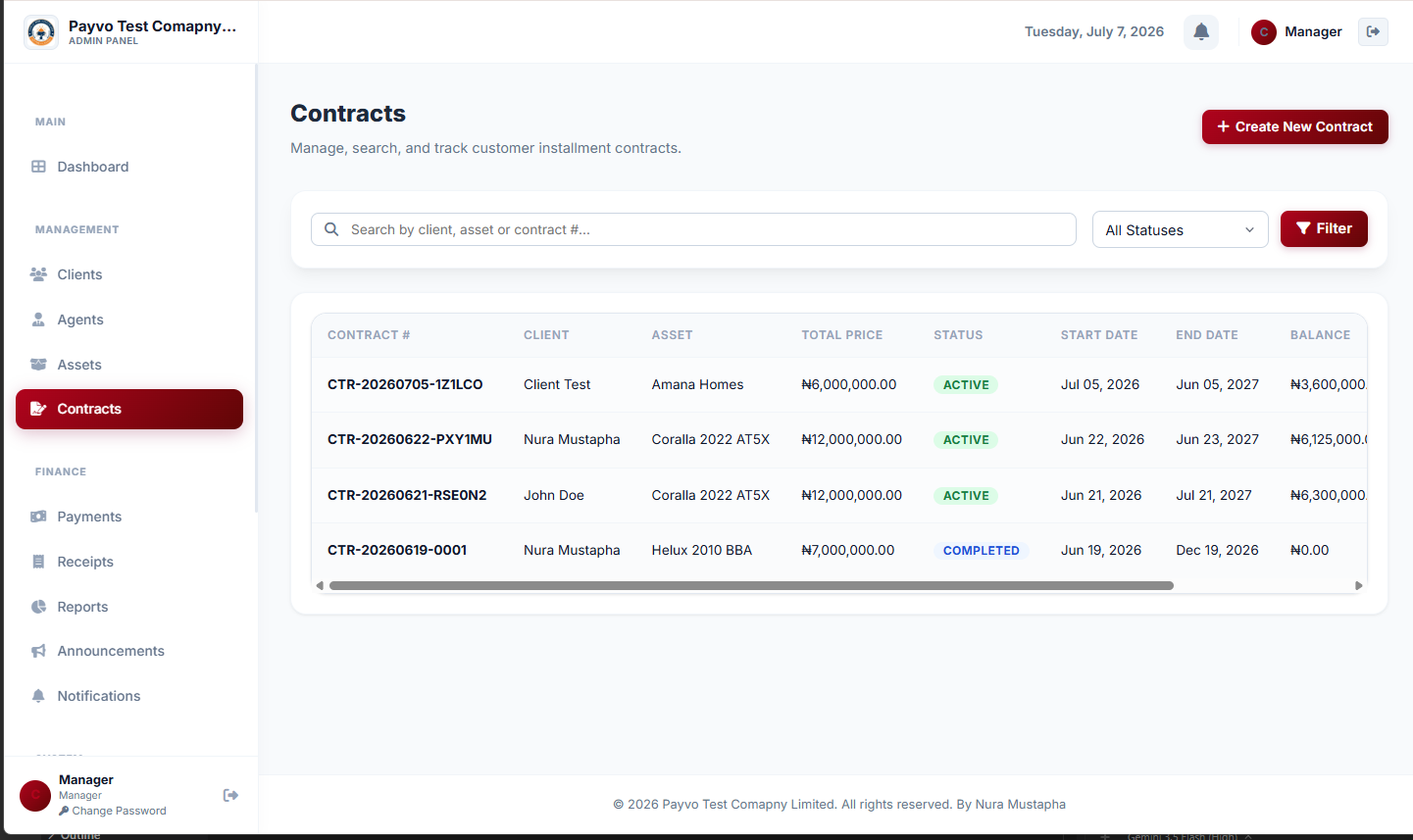 The Payvo dashboard showing a list of active contracts and their statuses
The Contracts list page on Payvo, showing active agreements.
You can register a customer, add the car they're buying, create a contract with all the agreed terms, and then Payvo automatically generates the payment schedule. When a customer pays, you simply record it, and their balance updates instantly. No more manual calculations or scribbled notes. This is the kind of installment management software Nigeria needs for businesses to thrive.
Side-by-Side: Old Way vs. New Way
Let's look at how the traditional approach to managing car hire purchase compares to using a modern system.
| Feature | Traditional Approach (Notebooks/Spreadsheets) | Modern Approach (e.g., Payvo) |
|---|---|---|
| Customer Records | Scattered, prone to errors, hard to retrieve quickly. | Centralized, searchable, always up-to-date. |
| Payment Schedules | Manual calculation, easy to miss dates or make errors. | Automated generation, clear due dates, system reminders. |
| Outstanding Balances | Requires manual reconciliation, often leads to disputes. | Real-time updates, clear balance for both you and the customer. |
| Payment Reminders | Manual calls, SMS, time-consuming. | Automated email/WhatsApp notifications, saving time and effort. |
| Receipt Generation | Paper receipts, prone to loss, manual record-keeping. | Digital receipts, easily sent, securely stored. |
| Overall Visibility | Hard to get a clear picture of your entire portfolio. | Instant dashboards and reports on all active contracts and payments. |
| Late Payment Penalties | Manual tracking and application, often forgotten or miscalculated. | System-configured penalties, automatically applied and tracked. |
| Agent Management | Difficult to track individual agent performance and commissions accurately. | Dedicated agent tracking features, clearer commission calculations. |
| Cost of Operations | High in time spent, potential for lost revenue due to errors/missed payments. | Lower operational costs, reduced errors, improved cash flow predictability. |
| Scalability | Limited, breaks down as your customer base grows. | Highly scalable, handles hundreds or thousands of contracts with ease. |
The Numbers: What This Actually Means for Your Business
Let's put some real naira figures to this. Imagine you're a car dealer in Kano, selling 10 cars a month on hire purchase.
Scenario 1: Manual Tracking
- Time Spent: If each customer takes you just 30 minutes a month to track (calls, recording, reconciliation), that's 5 hours per customer over a 10-month contract. For 10 customers, that's 50 hours of your or your staff's time. At ₦50,000/month salary for a staff, that's almost their full month's work just on tracking!
- Lost Payments/Errors: Even a small error of ₦5,000 per customer, across 10 customers, is ₦50,000 lost. Over a year, that adds up.
- Late Payments: Without automated reminders, let's say 2 customers are consistently late, costing you ₦20,000 in late fees you don't even track, plus delayed cash flow.
- Processing Fees: The initial application/processing fee for each car can be ₦20,000 - ₦100,000. If you miss collecting a few of these due to poor record-keeping, that's money walking out the door.
- Total Cost of Car: Remember, a car on hire purchase can end up costing the customer 1.2x to 1.5x the cash price due to interest and fees. If your tracking is poor, you might not even be collecting all those fees, eroding your profit margins.
- Time Saved: With automated scheduling and payment recording, that 30 minutes per customer drops to maybe 5 minutes. You've just freed up 40 hours of staff time, which can be used for sales or customer service.
- Reduced Errors: A system like Payvo ensures calculations are always correct, minimizing disputes and lost revenue.
- Improved Cash Flow: Automated reminders mean fewer late payments. You get your money closer to when it's due, improving your overall cash flow.
- Clear Reporting: You can instantly see your total outstanding balances, which contracts are performing well, and which need attention. This helps you manage your risk and make better decisions.
- Agent Efficiency: If you have agents on the field, an agent commission tracking software built into your system helps you manage their sales and commissions transparently.
FAQ: Questions Nigerian Business Owners Actually Ask
Q1: Is car hire purchase in Nigeria a good business model?
A: Absolutely, it can be. With the average Nigerian earning between ₦50,000 and ₦150,000 monthly in 2026, buying a car outright can be a huge hurdle. Hire purchase makes vehicles accessible, opening up a much larger market for car dealers. However, the success hinges on efficient management of contracts and payments, which is where many businesses struggle.
Q2: How do I track installment payments for multiple cars?
A: Manually, it's a nightmare of spreadsheets and notebooks. The best way is to use a dedicated installment management software Nigeria offers, like Payvo. It allows you to create individual contracts for each car, track deposits, schedule payments, and monitor outstanding balances automatically. This makes managing 5 cars or 50 cars equally straightforward.
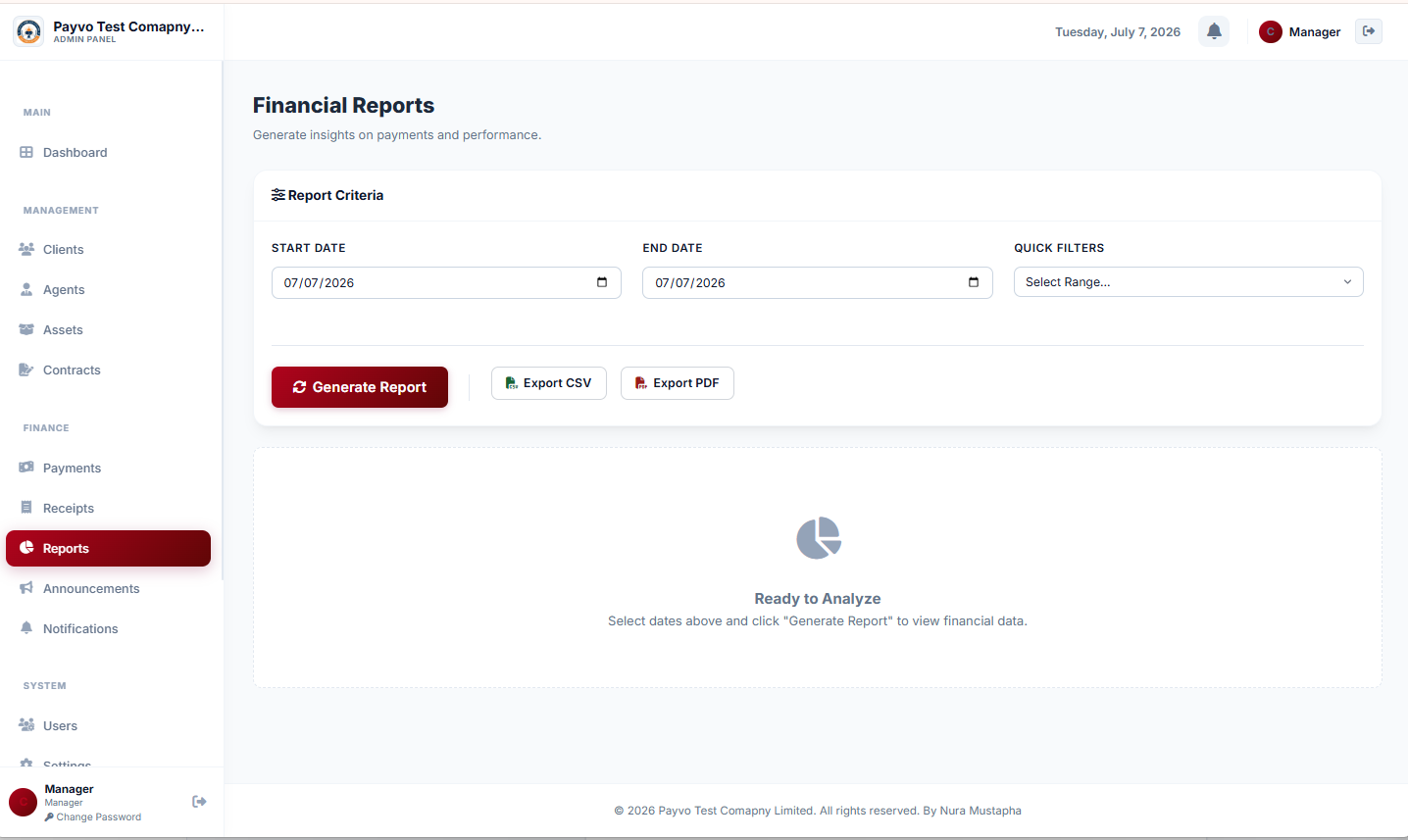 The Payvo dashboard showing an overview of financial data and reports
The Financial Reports Page within Payvo, providing insights into payment activity.
Q3: What about late payment penalties and interest rates? How do I manage those?
A: Your hire purchase agreement should clearly state the annual interest rate (typically 18% to 35%) and any late payment penalties (e.g., ₦5,000 - ₦20,000 per instance). A good system will allow you to configure these terms within each contract, so calculations are automatic. This saves you from having to manually calculate penalties every time a customer misses a payment.
Q4: Can I track agent commissions for car sales on installment?
A: Yes, you can. Many businesses use agent commission tracking software or features within their installment management system to assign sales to specific agents and calculate their commissions based on deposits or collected installments. This ensures transparency and motivates your sales team. Payvo, for example, has features for agent management that help you do just that. You can learn more about how to manage your team on our agent tracking page.
Q5: What's the biggest risk in offering car installment payments in Nigeria?
A: The biggest risk isn't just default; it's poor record-keeping and inefficient follow-up. When you don't have a clear, real-time understanding of who owes what and when, you lose money. Disputed balances, missed payments, and lack of clarity on contract terms are common pitfalls. That's why having robust contract management software Nigeria businesses can rely on is non-negotiable.
Take the First Step
If you're tired of the headaches that come with managing car hire purchase in Nigeria, it's time to ditch the old ways. You deserve a system that works as hard as you do, giving you peace of mind and clear financial visibility.
Ready to see how a dedicated solution can transform your car sales business? Register for Payvo today and experience the difference. It’s time to move from stress to streamlined success. You can also explore our specific solutions for hire purchase businesses.