Car Dealership Software: Manage Installment Sales & Payments
You ever look at your pile of ledgers, scattered WhatsApp chats, and half-filled Excel sheets for your hire-purchase customers and just feel a headache coming on? You’re not alone. In 2026, many car dealers across Nigeria, from the bustling showrooms of Lagos to the busy markets of Kano, are still losing an estimated 5-15% of potential revenue due to poor payment tracking and high default rates. That’s a lot of naira leaving your pocket, simply because you can't keep tabs on who owes what, and when.
 A car dealer in a busy showroom reviewing
The Silent Killer: Manual Installment Tracking in Car Sales
Let's be honest: selling cars on installment is a goldmine. It opens up your market to a whole new segment of buyers who might not have the cash for a full upfront payment. But it also introduces a whole new level of wahala if you're not properly organized. Imagine this: you've just sold a clean Toyota Corolla for ₦6,500,000 to a customer in Abuja, with a ₦1,500,000 down payment and ₦250,000 monthly installments for 20 months. Sounds good on paper, right?
Now multiply that by 50 or even 100 customers. Suddenly, you're drowning in paperwork. You've got Mr. Audu in Kaduna who is always a week late, Mrs. Ngozi in Port Harcourt who pays erratically, and then there’s the customer whose number you can't even find in your phone because your agent left last month. You spend hours every week just trying to reconcile payments, figure out who’s overdue, and chase down agents for updates. This isn't just about the stress; it's costing you real money. When you can't easily identify overdue payments, you miss out on timely follow-ups, leading to higher default rates. Those hours you spend manually updating spreadsheets? They could be spent closing new deals or sourcing better vehicles. That’s a direct hit to your bottom line, sometimes up to ₦2,000,000 a month in missed opportunities or uncollected funds for a busy dealership.
The Hidden Costs of Disorganization
- Lost Revenue from Defaults: If you can't track payments effectively, you can't act fast when someone misses a payment. That 5-15% reduction in payment default rate that software can bring? That's substantial. For a dealership with ₦10,000,000 in monthly installment receivables, even a 5% reduction means ₦500,000 extra in your account.
- Wasted Staff Time: Your staff are valuable. Paying someone ₦80,000 a month to spend half their day sifting through documents or WhatsApp chats is inefficient. That time could be used for sales, customer service, or even preparing vehicles.
- Customer Disputes: Ever had a customer swear they paid, but your records say otherwise? These disputes damage trust and take forever to resolve, sometimes leading to lost customers or even legal fees.
- Poor Cash Flow Visibility: You can't make smart business decisions if you don't truly know your cash flow. How much is coming in next month? How much is outstanding? Without a clear picture, you're flying blind.
Why the Usual Advice Doesn't Work
Most guides will tell you to just "use Excel" or "keep better records." That's the wrong way to think about it. Excel is great for budgets and simple lists, but it falls apart when you need dynamic tracking, automated reminders, and multi-user access. Imagine trying to manage hundreds of car installment sales contracts with different payment schedules, due dates, and varying down payments, all in one giant spreadsheet. It becomes a nightmare of broken formulas, accidental deletions, and version control issues. You're constantly worried if the numbers are even correct.
Then there's the "notebook method." Oh, I've seen it. Dealers with stacks of exercise books, each one dedicated to a customer or a year. It works for a handful of sales, maybe, but as soon as your business starts to grow, it becomes a recipe for disaster. What happens if the book gets lost? Or damaged? What if your sales agent forgets to record a payment received in the field? It’s not about keeping better manual records; it’s about recognizing that manual records, by their very nature, are limited and prone to human error, especially for something as complex as car installment sales.
<blockquote cite="https://payvo.ng/blog/">
"In Nigeria's dynamic market, the difference between a thriving business and one barely surviving often comes down to the efficiency of its payment collection and tracking systems. Manual methods are no longer sufficient for managing the complexities of installment sales."
</blockquote>
The Better Way: A Centralized System for Hire Purchase Software Nigeria
The real solution isn't to work harder at your manual system; it's to change the system entirely. You need a centralized, digital approach that brings all your car dealership software operations for installment sales under one roof. Think of it like this: instead of having separate folders for each customer, a separate ledger for payments, and a separate WhatsApp group for communication, everything lives in one secure place. This isn't just about going digital; it's about gaining control, transparency, and efficiency.
Here’s how you approach it:
- Digitize Customer Records: Every customer who buys a vehicle on installment needs a clear, accessible profile. This includes their contact details, guarantor information, and a complete history of their dealings with you.
- Standardize Contract Creation: Forget scribbled agreements. You need a way to generate consistent, clear installment contracts for each car sale. These contracts should outline the vehicle details, total price, down payment, installment amount, frequency, and due dates.
- Automate Payment Schedules: This is key. Instead of manually calculating when the next payment is due, your system should automatically generate a schedule based on the contract terms.
- Simplify Payment Recording: Whether it's a bank transfer, POS payment, or cash, recording payments should be quick and easy, with automatic updates to the customer's outstanding balance.
- Track Agent Performance: If you have agents, you need to know which agent is responsible for which sale and how well they are performing in terms of collections. This also ties into agent commission tracking software.
- Generate Instant Receipts: Professional, digital receipts build trust and serve as undeniable proof of payment for both you and your customer. No more arguments about whether a payment was made.
- Real-time Financial Overview: You should be able to see at a glance how much is owed, how much is collected, and who is overdue. This gives you the power to make informed decisions and act quickly.
How Payvo Fits Into This
This is where a specialized tool becomes invaluable. You see, trying to piece together a solution with generic tools is like trying to fix a car with a hammer and screwdriver when you need a full mechanic's toolkit. You need something designed specifically for businesses like yours that handle installment sales. This is exactly what Payvo offers. It’s a complete contract management software Nigeria solution, built to help car dealers, real estate developers, cooperative societies, and others manage their installment payment processes seamlessly.
With Payvo, you can register your customers, add vehicle details, create custom hire purchase agreements, set up installment schedules, and track every single payment. It’s a dedicated business payment tracking app Nigeria needs. Instead of juggling multiple tools or drowning in paperwork, you get a clear, organized view of your entire installment portfolio. This means less stress, fewer errors, and a much better handle on your cash flow.
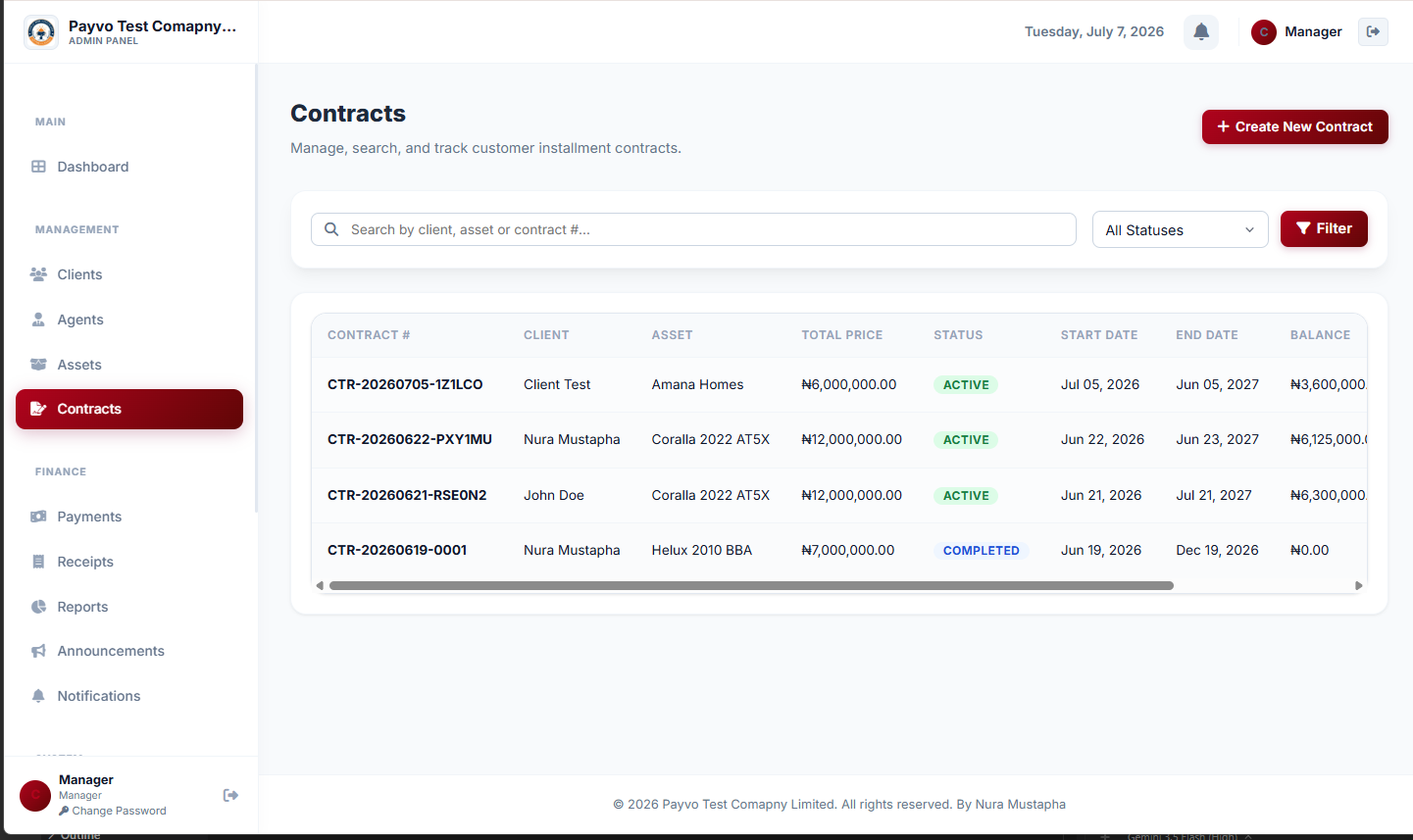 Payvo dashboard showing a list of contracts with their details
Side-by-Side: Old Way vs. New Way
Let's break down the practical differences.
| Feature / Aspect | Traditional Approach (Manual/Spreadsheets) | Modern Approach (Dedicated Car Dealer Installment Software) |
|---|---|---|
| Customer Records | Scattered across notebooks, phone contacts, WhatsApp chats. Hard to find complete history. | Centralized customer profiles with full payment history, contact details, and linked contracts. Easy search. |
| Contract Management | Paper contracts, often handwritten. Difficult to retrieve, verify, or update. | Digital contracts generated and stored securely. Easy access, version control, and clear terms. |
| Payment Tracking | Manual entries in ledgers or spreadsheets. Prone to errors, difficult to reconcile. | Automated tracking with real-time balance updates. Quick recording of payments. |
| Overdue Payments | Discovered by manually reviewing records, often too late. High default rates. | Automatic identification of overdue payments. Automated reminders and alerts. Reduced default rates. |
| Receipt Generation | Manual receipts, carbon copies. Time-consuming, can be lost or misplaced. | Instant, professional digital receipts (can be printed or sent via WhatsApp). |
| Financial Overview | Requires hours of reconciliation to get a rough estimate. Poor cash flow visibility. | Real-time dashboards and financial reports. Clear picture of receivables and collections. |
| Agent Management | Relying on agents' verbal updates or personal records. Lack of transparency. | Agent commission tracking software built-in. Clear visibility into agent-assigned contracts and collection performance. |
| Data Security | Vulnerable to physical damage, loss, or unauthorized access. | Secure, cloud-based storage with backups and access controls. |
| Efficiency/Productivity | Low. High administrative burden, time spent on reconciliation instead of sales. | High. Streamlined processes, more time for sales and customer engagement. |
The Numbers: What This Actually Means for Your Business
You want to know what this means for your pocket, abi? Let's crunch some numbers, based on real Nigerian market data for 2026.
Say you run a medium-sized car dealership in Lagos or Port Harcourt, and you have about 70 active hire-purchase contracts.
- Software Subscription (Basic): You're looking at something like ₦15,000 - ₦40,000/month for a basic plan. Let's say ₦30,000/month.
- Internet Data Costs: Reliable internet is a must. Budget ₦15,000 - ₦25,000/month for consistent connectivity. Let's say ₦20,000.
- Computer Hardware: You might need a decent laptop or desktop, perhaps ₦250,000 for one good workstation. This is a one-off cost, but factor it in.
- Staff Training (Initial): Getting your staff up to speed might cost ₦30,000 - ₦100,000 for 2-3 people, let's say ₦60,000. Another one-off.
- Monthly Electricity/Generator Fuel: To keep the system running, budget ₦30,000 - ₦70,000, let's say ₦50,000.
Now, what's the gain?
- Increased Sales Efficiency: With better inventory and payment tracking, you could potentially add an extra ₦500,000 to ₦2,000,000+ in revenue monthly. Let's be conservative and say an extra ₦800,000 from quicker sales cycles and better management.
- Reduced Payment Default Rate: Even a 5% reduction in defaults on, say, ₦10,000,000 in monthly receivables means ₦500,000 saved. Many businesses see a 10-15% reduction, which is ₦1,000,000 - ₦1,500,000. Let's go with a modest 7% reduction, saving you ₦700,000.
- Time Savings: If your staff spend 10 fewer hours a week on manual reconciliation (which they easily could), that's 40 hours a month. If you pay them ₦80,000/month (about ₦500/hour), that's ₦20,000 directly saved, or more importantly, ₦20,000 worth of productive time redirected to sales or customer service.
Subtracting your monthly software and operational costs of ₦100,000, you're looking at a net gain of ₦1,420,000 per month.
This isn't magic, my friend. This is just good business. The initial investment pays for itself very quickly.
 A car dealer and customer shaking hands in
FAQ: Questions Nigerian Business Owners Actually Ask
Q1: Is this car dealer installment software too expensive for my small dealership?
A: Not at all. Many small businesses think software is only for big corporations. But the costs of not using software – lost payments, wasted time, customer disputes – often far outweigh the subscription fee. You can find basic software subscriptions starting from around ₦15,000 to ₦40,000 a month. Consider it an investment that quickly pays for itself by reducing losses and improving efficiency.
Q2: What if my staff are not tech-savvy? Will they be able to use it?
A: That’s a common concern, but modern business payment tracking app Nigeria solutions are designed to be user-friendly. Most come with straightforward interfaces and clear workflows. Look for providers that offer initial staff training, which might cost between ₦30,000 and ₦100,000 for a few staff members. The goal is to make it easier, not harder, for your team.
Q3: Can this system handle my agents and their commissions?
A: Absolutely. A good car dealer software for installment sales will include features for agent commission tracking software. You can assign contracts to specific agents, monitor their collections, and even calculate their commissions directly from the system. This brings transparency and accountability to your sales force. You can even check out Payvo's dedicated page on agent tracking for more details.
Q4: How do I track payments received via bank transfer or cash with this kind of software?
A: The best installment management software Nigeria offers allows you to manually record payments from any source – cash, bank transfer, or POS. Once recorded, the system automatically updates the customer's balance and generates a digital receipt. You can then use the receipt generator app Nigeria provides to send it to the customer. This helps you keep a unified record, regardless of how the payment was made.
Q5: What about security? Is my customer data safe?
A: Data security is paramount. Reputable providers of contract management software Nigeria hosts ensure that your data is stored securely in the cloud, often with encryption and regular backups. This is usually far more secure than keeping physical ledgers or unbacked-up spreadsheets on a single computer. Just ensure the provider has clear security and privacy policies, like Payvo's Privacy Policy Page.
Take the First Step
You've worked hard to build your car dealership, your cooperative society, or your real estate business. Don't let outdated methods hold you back from maximizing your profits and growing your operations. The time for guessing games with your finances is over. Take control of your installment sales and payments today.
Ready to see how a dedicated solution can transform your operations? You can explore more about managing hire-purchase sales on Payvo’s dedicated hire purchase page. Or better yet, why not take the first step and register your business with Payvo to experience how organized your installment sales can truly be.