In Nigeria, over 63% of small businesses fail within their first five years, and for car dealers offering hire-purchase, a huge chunk of that failure comes from poor record-keeping and managing customer payments. It's not just about selling cars; it's about making sure those payments actually come in, week after week, month after month. If you’re a car dealer, especially one dealing in hire-purchase agreements, you know this struggle in your bones.
 A car dealer in lagos shaking hands with
The Silent Killer: Disorganized Hire-Purchase Agreement Records
Let's be honest, many of you started your car dealing business, maybe from a small lot in Ikeja or even from your compound, with dreams of moving metal and making profit. You saw the demand for affordable cars, and hire-purchase seemed like the perfect way to make it happen. But then the paperwork started piling up. The calls from customers saying they paid but you can't find the record. The confusion about who owes what.
This disorganization isn't just a headache; it’s a financial bleeding. Imagine you have 15 vehicles out on hire-purchase. Each car is priced between ₦3,000,000 and ₦15,000,000. Your expected profit margin per car, on hire-purchase, could be anywhere from ₦200,000 to ₦1,500,000. Now, what happens when just two customers default because you lost track of their payment dates or couldn't prove their last payment? That's a minimum of ₦400,000 in potential profit gone. And the cost to recover a defaulted vehicle? That can run you ₦100,000 to ₦500,000 per instance, including legal fees and logistics. This is money directly out of your pocket.
You see, the core issue isn't a lack of willing buyers or good cars. It's the administrative burden of tracking every single detail for every single vehicle sales contract. From the initial deposit to the final payment, every naira, every date, every conversation needs to be logged. Otherwise, you’re just running a charity, not a business. And in 2026, with the cost of doing business rising – annual shop rent for a decent lot in Lagos could be ₦3,000,000, and a staff salary is ₦60,000-₦150,000 per month – you can't afford to lose money due to sloppy records. This is where a solid business payment tracking app Nigeria becomes indispensable.
Why the Usual Advice Doesn't Work for Car Dealer Installment Software
Most people, when you tell them about record-keeping problems, will jump straight to "Just use Excel!" or "Get a bigger notebook!" And yes, for one or two cars, that might work. But for a growing business, especially one that aims to scale and have 20, 30, or even 50 cars out on hire-purchase, those methods fall apart faster than a cheap car on a Lagos road.
Here's the thing: Excel sheets are great for calculations, but they are not built for managing dynamic customer relationships or ensuring data integrity across multiple users. Who updates it? What if someone accidentally deletes a row? How do you track conversations? And how do you generate professional payment receipts for customers without spending hours formatting? You end up with multiple versions, outdated information, and a lot of arguments. I remember one time, when I had my retail shops, we had three different Excel sheets for inventory. Three! None of them matched. It was pure chaos.
Then there's the WhatsApp approach. Many of you rely on WhatsApp for customer communication and even payment confirmations. It’s convenient, no doubt. But WhatsApp is a messaging app, not a contract management software Nigeria. Trying to trace a payment history through hundreds of chat messages, especially when a customer changes their phone or deletes chats, is a nightmare. It’s like trying to find a needle in a haystack, and that needle is a ₦150,000 weekly payment you need to confirm.
These "usual" methods are stop-gap solutions. They don't provide the structure, security, or efficiency you need to run a profitable hire-purchase car business in 2026. You need something purpose-built for managing car dealer customer records and all the complexities that come with installment sales.
The Better Way: A Comprehensive Record-Keeping Checklist for Hire-Purchase
The real solution isn't just about having a record; it's about having the right records, organized in a way that makes sense and reduces your risk. This is the foundation of effective installment management software Nigeria. Let's break down what you absolutely must record for every single hire-purchase agreement.
1. Detailed Vehicle Information
You need to know everything about the asset you’re selling. This goes beyond just the make and model.
- Vehicle Identification Number (VIN): This is non-negotiable. It's the unique identifier for the car.
- Make, Model, Year: Basic but essential for identification.
- Registration Number: Once registered, this is crucial.
- Color & Key Features: Any distinguishing marks, specific features (e.g., leather seats, special rims).
- Initial Valuation/Purchase Price: What you bought it for.
- Selling Price (Hire-Purchase): The agreed-upon price with the customer.
- Insurance Details: Comprehensive insurance, which can cost ₦150,000 to ₦800,000 annually, is often mandatory for hire-purchase. Record policy number, company, and expiry.
- Tracking Device Information: For hire-purchase, a tracking device is your guardian angel. Record the device ID, installation date, and tracking service provider. Installation costs alone can be ₦40,000 to ₦120,000 per car.
 A sleek 3d illustration of a car dashboard
2. Comprehensive Buyer Information
You need to know who you’re doing business with.
- Full Name & Contact Details: Phone numbers (primary and secondary), email address.
- Residential Address: Physical address, not just a P.O. Box.
- Next of Kin Details: Name, relationship, phone number, address. This is a vital backup.
- Valid ID Details: Driver's license, National ID, International Passport. Scan and keep copies.
- Employer/Business Details: Name of employer, business address, contact person (if applicable). This helps verify their ability to pay.
- Guarantor Information: If applicable, all the above details for the guarantor.
3. Clear Contract Terms (Hire-Purchase Agreement Records)
This is the backbone of your agreement. Every single detail must be explicitly stated.
- Date of Agreement: When the contract was signed.
- Total Purchase Price: The full amount the customer will pay.
- Initial Deposit/Down Payment: How much they paid upfront.
- Installment Amount: The fixed amount they need to pay periodically.
- Payment Frequency: Weekly, bi-weekly, monthly, etc.
- Payment Due Dates: Specific dates for each installment.
- Total Number of Installments: How many payments until the car is fully owned.
- Late Payment Penalties: What happens if they miss a payment? Be clear.
- Default Clause: Conditions under which the agreement is breached and repossession occurs.
- Stamp Duty: Remember to factor in stamp duty, which can be ₦5,000 to ₦50,000 per agreement depending on the transaction value.
4. Meticulous Payment History and Receipts
This is where most businesses struggle. You need an iron-clad system for tracking every naira that comes in.
- Date of Each Payment: When the money actually hit your account.
- Amount Paid: The exact sum.
- Payment Method: Bank transfer, cash, POS, etc.
- Reference Number: For bank transfers, this is critical.
- Outstanding Balance: How much is still left to pay after each payment.
- Receipt Number: Every payment needs a unique receipt.
- Issued By: Who in your team recorded the payment.
- Payment Reminders Sent: Date and method of any reminders.
5. Communication Log
It’s not just about money; it’s about conversations.
- Date of Communication: When you spoke or messaged.
- Method: Call, WhatsApp, email, in-person.
- Summary of Discussion: What was discussed, especially regarding payments, issues, or agreements.
- Action Items: What was agreed upon by both parties.
All these details, when properly managed, form your robust car dealer installment software. They protect you, clarify expectations for your customer, and make your business run smoother.
How Payvo Fits Into This
Now, you might be thinking, "Emeka, this is a lot of information. How am I supposed to track all this without hiring an army of clerks?" And you're right. Trying to manage all these vehicle sales contracts manually, especially as you grow, is a recipe for disaster. This is where a proper installment management software Nigeria comes in.
This is where Payvo steps in. It’s designed specifically for businesses like yours, car dealers selling on hire-purchase, who need a solid system for how to track installment payments. Instead of scattered notebooks and confusing spreadsheets, Payvo gives you one centralized place to manage all your car dealer customer records. You can register each vehicle as an asset, input all the buyer's details, set up the entire payment schedule with due dates, and record every single payment as it comes in. It helps you generate professional receipts automatically, track outstanding balances in real-time, and even see which payments are overdue. This is the kind of agent commission tracking software and contract management software Nigeria needs to thrive.
You can see a clear overview of all your contracts from a single dashboard, making it easy to identify who owes what and when. This means less time chasing payments and more time focusing on selling cars.
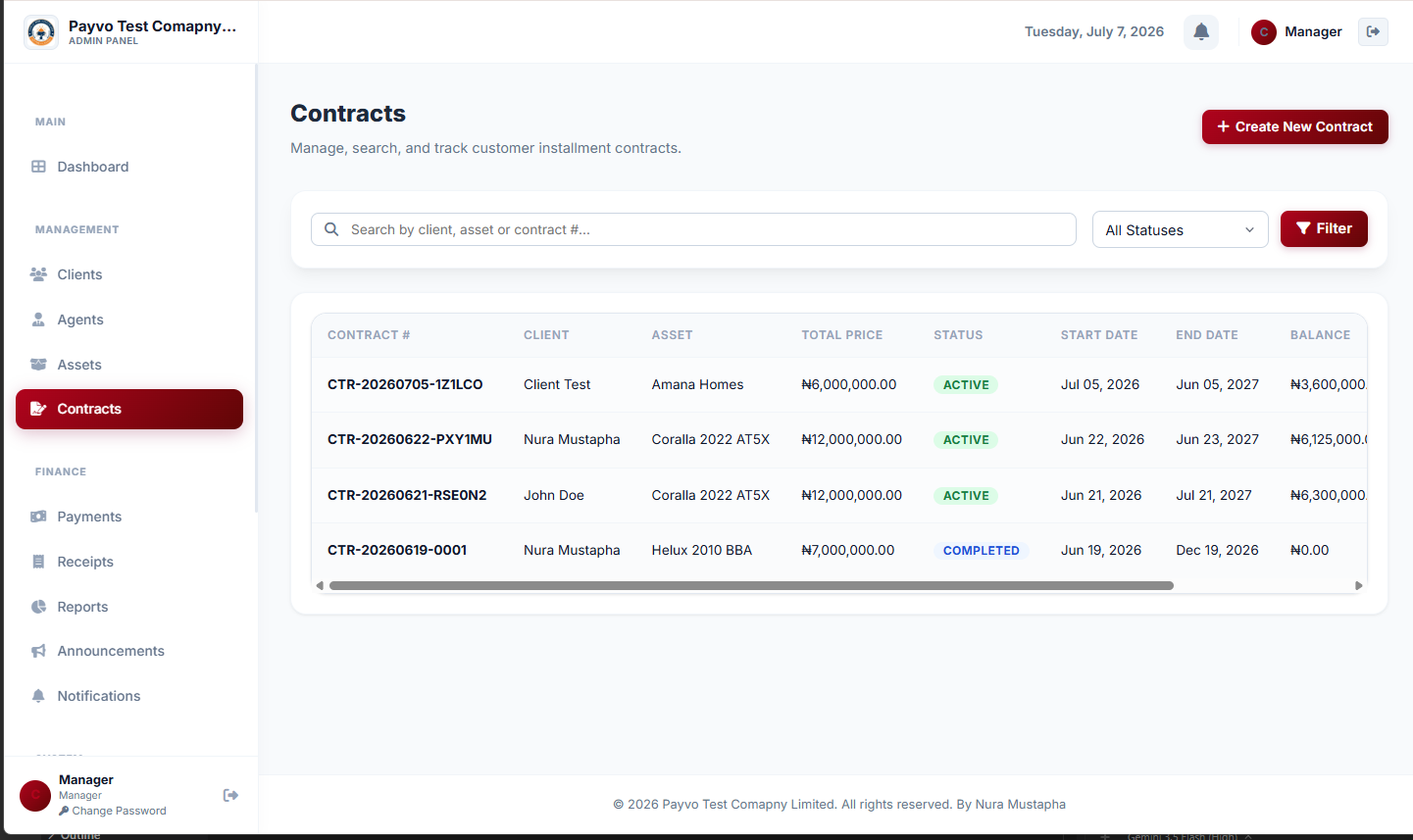 Screenshot of Payvo's Contracts list page
Screenshot of Payvo's Contracts list page
Side-by-Side: Old Way vs. New Way
Let's look at the contrast between how many of you are currently operating and how you could be operating.
| Feature / Task | Traditional Approach (Notebooks/Excel/WhatsApp) | Modern Approach (Using Payvo as a car dealer installment software) |
|---|---|---|
| Contract Creation | Manual drafting, printing, signing multiple copies. High risk of errors. | Digital contract creation with pre-defined templates, clear terms, and automated scheduling. |
| Customer Records | Scattered across notebooks, phone contacts, WhatsApp chats. Hard to update or verify. | Centralized customer database with all contact, ID, and guarantor details linked to their contracts. |
| Payment Tracking | Manual entry in ledgers, checking bank alerts, WhatsApp confirmations. Prone to missing entries. | Automated tracking of scheduled payments, easy recording of manual payments, real-time outstanding balance updates. |
| Receipt Generation | Hand-written receipts, manual calculations, inconsistent formatting. | Instant digital receipt generator app Nigeria functionality with professional templates, unique receipt numbers, and automatic sending. |
| Overdue Payments | Manually checking due dates, often missed or delayed. Reactive chasing. | Automated alerts for upcoming and overdue payments. Clear dashboard view of all outstanding accounts. |
| Agent Management | Manual tracking of sales, commissions, and customer allocation. | Dedicated agent tracking page, assigning contracts to agents, monitoring performance and commissions. |
| Dispute Resolution | Difficult to prove payment history, leading to customer arguments and lost time. | Clear, undeniable record of every payment, date, and amount, resolving disputes quickly. |
| Business Overview | Guesswork or tedious compilation of data from various sources. | Real-time financial reports, dashboards showing total collections, outstanding amounts, and payment trends. |
| Security & Backup | High risk of loss (fire, theft, misplaced documents). No easy backup. | Cloud-based data storage, secure access, automatic backups, protecting your vital business information. |
The Numbers: What This Actually Means for Your Business
Let's talk about naira and kobo. Because at the end of the day, that's what keeps your business moving.
Consider a small car dealer in Ibadan or Abuja, with about 10 cars out on hire-purchase.
- Average profit per car: Let's say a modest ₦500,000.
- Total potential profit from 10 cars: ₦5,000,000.
- Lost payments/untraceable funds: Even if it's just ₦50,000 per month across all customers, over a year, that's ₦600,000 gone.
- Default recovery costs: If you have to repossess just one vehicle due to poor tracking, you're looking at ₦100,000 to ₦500,000 in legal and logistics costs.
- Staff time wasted: Let's assume your staff (earning ₦60,000-₦150,000/month) spends 10 hours a week chasing payments or reconciling records. That's 40 hours a month, which could be 25-50% of their productive time. That's money you're paying for inefficiency.
- Opportunity cost: The time you spend fixing record issues is time you're not spending sourcing new cars, negotiating better deals, or closing more sales.
- Reduced payment discrepancies: Clear records mean fewer arguments and lost payments. You recover that ₦600,000.
- Lower default rates: Proactive tracking and reminders (which Payvo can facilitate, even with a WhatsApp payment notification system) mean customers are less likely to miss payments, reducing recovery costs.
- Increased staff efficiency: Your staff can focus on sales and customer service, not manual reconciliation. That 40 hours a month can be reallocated to revenue-generating activities.
- Better cash flow prediction: Knowing exactly when payments are due helps you manage your finances better, allowing you to plan for new stock (initial capital for 3-5 basic used cars can be ₦3,000,000 - ₦15,000,000).
FAQ: Questions Nigerian Business Owners Actually Ask
Q1: Is this installment management software Nigeria specific?
A: Absolutely. Payvo is built with Nigerian businesses in mind. It handles naira transactions, understands the local payment frequencies (weekly, monthly), and addresses the common challenges faced by businesses operating here, from car dealers to cooperative societies and even real estate payment tracking Nigeria.
Q2: Can I track my agents' sales and commissions with this?
A: Yes, you can. Payvo includes agent tracking software features that allow you to assign contracts to specific agents, monitor their sales performance, and track commissions, making it easier to manage your sales team.
Q3: What if my customers pay with cash or bank transfer? Can I still record it?
A: Of course. Payvo allows you to manually record payments received via cash, bank transfers, POS, or any other method. The goal is to centralize all payment data, regardless of how it was received. You can even generate a digital receipt for these manual payments.
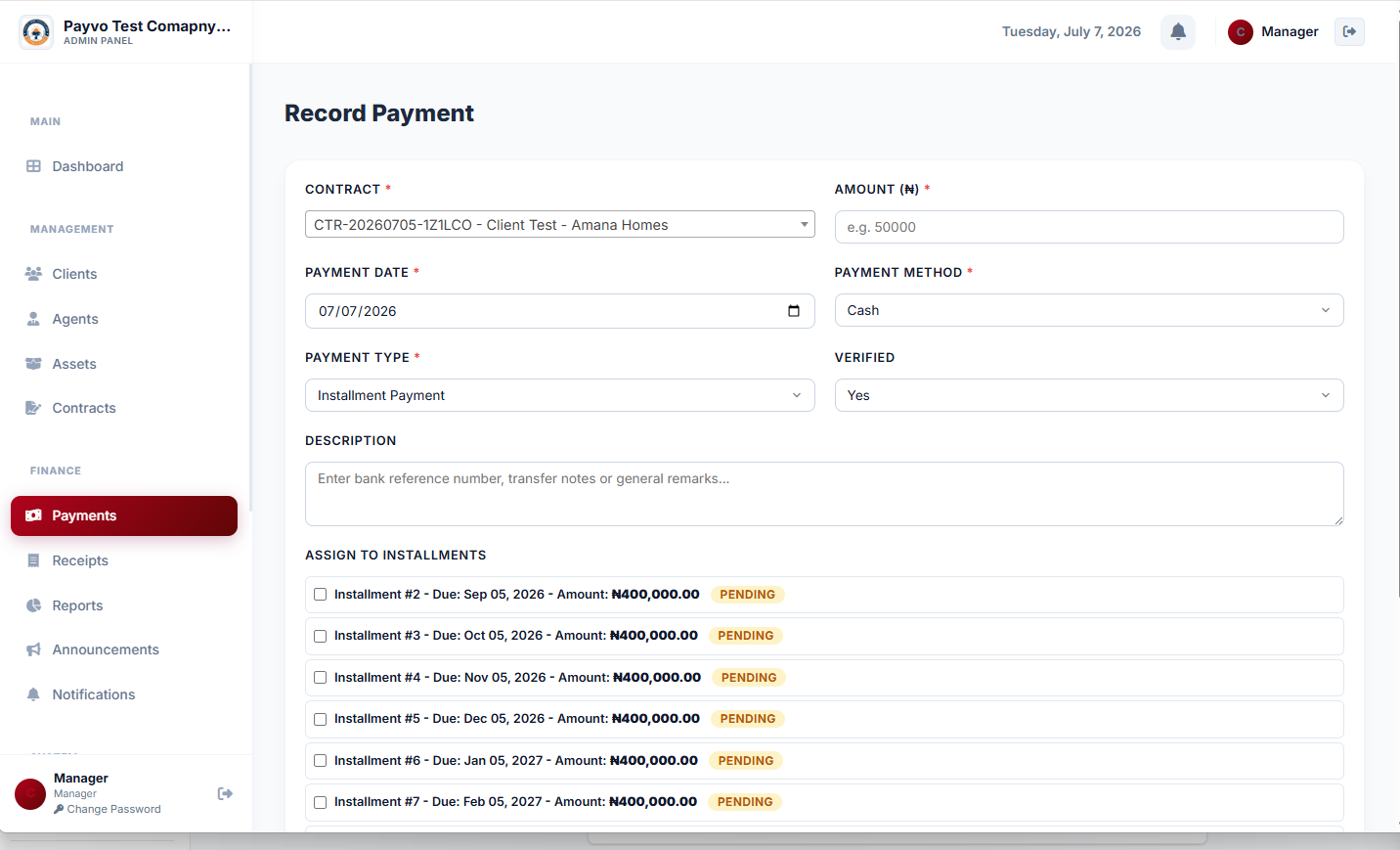 Screenshot of Payvo's Record Payment Page
Screenshot of Payvo's Record Payments Page
Q4: Is it complicated to set up? I'm not very tech-savvy.
A: Payvo is designed to be user-friendly. The workflow is straightforward: register your business, add customers, add assets (your cars), create contracts, and record payments. You don't need to be a tech expert to use it effectively. Many businesses find they can get started quickly with minimal fuss, making it a viable car dealer installment software solution for everyone.
Q5: How does Payvo help with avoiding payment defaults?
A: By providing clear, real-time visibility into who owes what and when, Payvo helps you be proactive. You can easily identify upcoming payment due dates and overdue accounts, allowing you to send timely reminders. This consistent follow-up, coupled with clear records, significantly reduces the chances of customers "forgetting" to pay or disputing amounts, which is crucial for managing hire purchase agreement records.
Q6: Can I use this for other parts of my business, not just cars?
A: While this article focuses on car dealers, Payvo is a versatile installment management software. If you also sell other high-value items on credit – like electronics, solar panels, or even building materials – or manage repayments for a cooperative society, Payvo can help you manage those installment sales too. It’s designed for any business that needs to track customer payments over time.
Take the First Step
Managing car dealer customer records and hire-purchase agreements doesn't have to be a constant struggle. You've seen the financial drain that comes from disorganized systems. It’s time to move past the notebooks and messy spreadsheets and embrace a smarter way to run your business.
If you’re serious about protecting your profits, streamlining your operations, and growing your car dealership, then having a dedicated car dealer installment software is not a luxury, it's a necessity. Take a look at how Payvo can transform your business. You can explore its features for managing hire purchases or simply register to start organizing your vehicle sales contracts today. Your peace of mind, and your bottom line, will thank you for it.