The struggle is real for Nigerian car dealers. You’ve sourced a fantastic vehicle, negotiated a great price, and found a buyer, but then the real work begins: managing installment payments. Tracking who paid what, when, and how much is a constant headache, often leading to lost revenue and strained customer relationships.
 Nigerian car dealership owner reviewing financial documents
Car Dealer Profit Per Car: Hire Purchase in Nigeria Explained
Selling cars on hire purchase in Nigeria is a lucrative business model, offering accessibility to buyers who can’t afford an outright purchase. For dealers, it promises significantly higher profit margins than cash sales. However, this increased profit comes with a complex administrative burden. Understanding the true profit potential requires a deep dive into the costs, risks, and, crucially, the management of these extended payment plans.
The Anatomy of a Hire Purchase Deal: Costs and Revenue Streams
Before we talk about profit, let's break down the typical journey of a used car in Nigeria sold via hire purchase.
Sourcing and Acquisition Costs:
- Car Purchase Price: This is your primary cost. For an entry-level sedan like a Toyota Corolla (2008-2012 model), you're looking at ₦3,500,000 - ₦6,000,000. A mid-range SUV like a Honda CR-V (2010-2014) could cost ₦6,500,000 - ₦10,000,000. These figures vary greatly depending on the car's condition and the city of purchase (e.g., Lagos prices often differ from those in Kaduna).
- Import Duty & Clearing: If importing, expect to pay ₦800,000 - ₦2,500,000 for duties and port charges. This is a substantial cost that directly impacts your base price.
- Transportation: Getting the car from the port to your dealership can range from ₦150,000 - ₦400,000, especially if you're transporting from Lagos to a northern state.
- Preparation for Sale: Minor repairs, servicing, and detailing are crucial to make the car appealing and reliable. Budget ₦100,000 - ₦500,000 for this.
Operational Overheads:
- Dealership Rent: Whether it’s a small lot in a developing town or a prime spot in Lagos or Abuja, rent is a major recurring expense. Expect to pay ₦80,000/month - ₦500,000/month (or ₦960,000 - ₦6,000,000 annually).
- Staff Salaries: Sales personnel are essential. An entry-level staff member might earn ₦70,000/month, while an experienced one could command ₦180,000/month or more, often supplemented by commissions.
- Marketing & Advertising: Reaching customers requires investment, whether online or through local channels.
Hire Purchase Specific Costs:
- Legal Fees: Drafting and notarizing robust hire purchase agreements is critical to protect your investment. This typically costs ₦50,000 - ₦150,000 per contract.
- Vehicle Tracking Device: Essential for security and recovery in case of default. Installation ranges from ₦60,000 - ₦150,000.
Revenue Streams:
- Initial Deposit: Most hire purchase agreements require an upfront deposit, typically 20% - 40% of the car's value. This helps cover immediate costs and signals buyer commitment.
- Installment Payments: The core of your revenue. These are spread over 12 to 36 months.
- Interest/Markup: This is where the significant profit lies. Annualized interest rates on hire purchase in Nigeria can range from 25% - 45%, depending on the dealer, risk assessment, and market conditions. This markup compensates for the deferred payment and the inherent risk.
The Profit Potential: Cash vs. Hire Purchase
Let's compare the profit from a cash sale versus a hire purchase agreement for a car with a landed cost of ₦5,000,000.
- Cash Sale Profit: For a straightforward cash sale, dealers typically aim for a profit margin of ₦300,000 - ₦1,000,000 per car. This is a quick turnover but with a lower margin.
- Hire Purchase Profit: This is where the numbers get interesting. Beyond the cash profit margin, the interest charged over the repayment period adds a substantial amount. For a typical used car, this additional profit from interest can range from ₦800,000 - ₦3,500,000 over the full repayment period. This means a car that might yield ₦700,000 in cash profit could generate a total profit of ₦1,500,000 - ₦4,200,000 or even more through hire purchase, depending on the interest rate and duration.
The Hidden Costs of Poor Management
Many car dealers, especially smaller ones, rely on manual methods: notebooks, spreadsheets, and scattered WhatsApp messages to track payments. This approach, while seemingly cost-free upfront, introduces significant hidden costs:
- Lost Payments: Manual tracking is prone to errors. A misplaced receipt, an incorrectly noted payment, or a forgotten entry can lead to thousands of Naira in lost revenue.
- Time Drain: Chasing payments, reconciling accounts, drafting receipts, and sending reminders manually consumes countless hours that could be spent selling more cars.
- Customer Disputes: Discrepancies in payment records can lead to heated arguments with customers, damaging your reputation and potentially resulting in legal battles.
- Default Risk: Without timely reminders and clear payment schedules, customers are more likely to miss payments, increasing the risk of default and the costly process of vehicle recovery.
- Inaccurate Reporting: It's almost impossible to get a real-time, accurate picture of your business's financial health, outstanding balances, or agent performance with manual tracking. This hinders strategic decision-making.
The Smarter Approach: Streamlined Installment Management
The key to unlocking the full profit potential of hire purchase is moving beyond manual tracking to a streamlined, automated management system. This involves a comprehensive approach to client onboarding, contract generation, payment recording, and proactive communication.
Imagine a system where:
- Every client's details and payment history are in one secure place.
- Contracts are generated automatically with clear installment schedules.
- Payments are recorded instantly, generating branded receipts.
- Customers receive automated reminders before payments are due, reducing defaults.
- You have a real-time overview of your business's financial status.
- Your sales agents' commissions are calculated accurately and transparently.
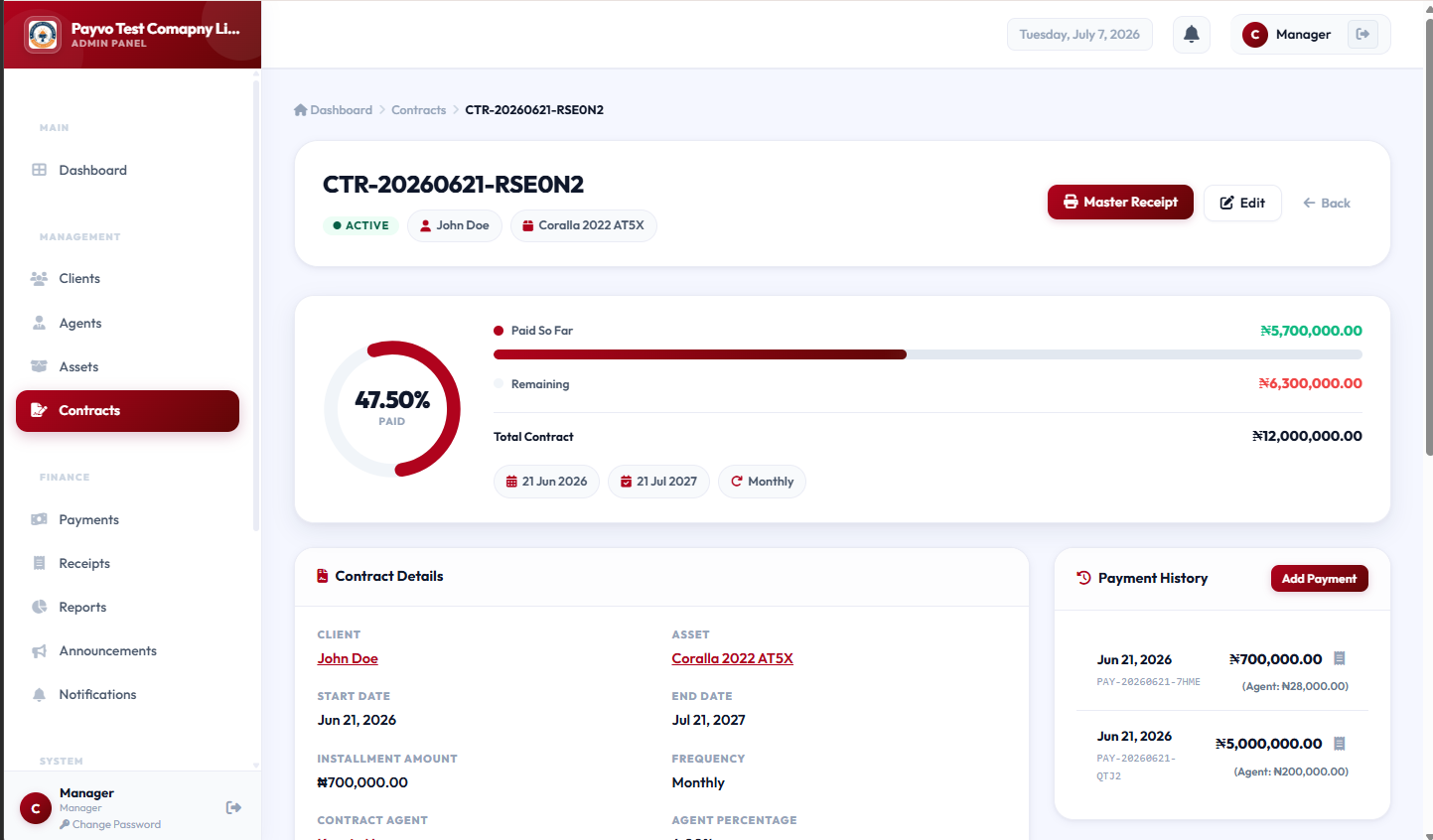 Dashboard showing contract details and payment schedule
How Payvo Helps Car Dealers Maximize Hire Purchase Profits
This is precisely where Payvo comes in. Payvo is a comprehensive contract and installment management system designed for businesses like yours that sell on credit or installment plans. It directly addresses the pain points of manual tracking, transforming your operations into a smooth, efficient, and profitable engine.
Here’s how Payvo helps you secure and grow your hire purchase profits:
- Centralized Client & Asset Management: Easily with all their details and payment history in one place. Link each client to the specific vehicle (asset) they've purchased, ensuring you always know who owns what and their payment status.
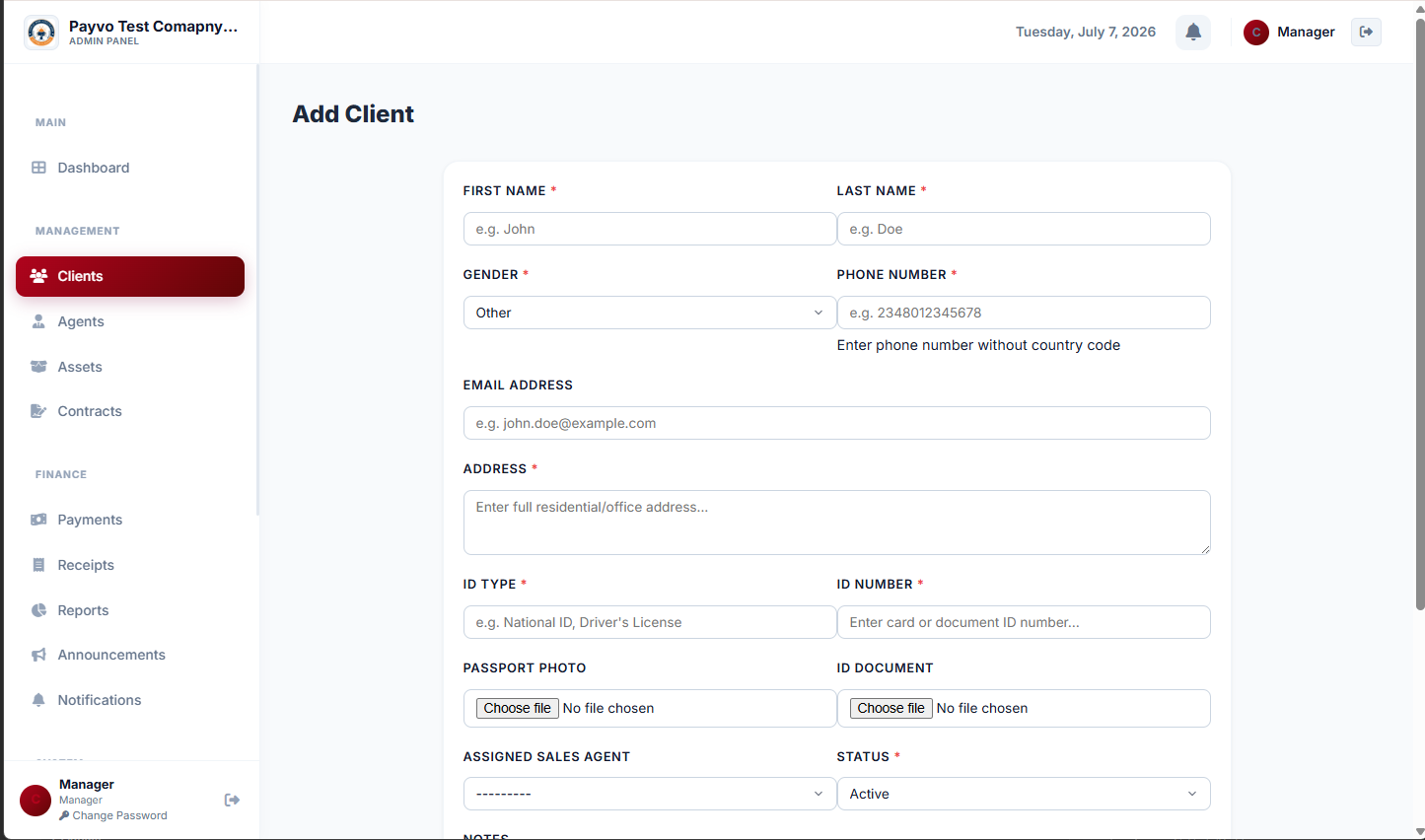 register and manage clients
 - Automated Contract Generation: Say goodbye to manual contract drafting. Simply set your payment terms once, and Payvo automatically generates detailed installment schedules. This ensures accuracy and consistency across all your deals.
- Effortless Payment Recording & Receipting: Record single payments quickly. Every payment automatically generates a professional, branded receipt with your company logo, colors, and digital signature. Clients can receive these instantly via email or WhatsApp, complete with a public link to view, save, or share their receipt.
- Proactive Payment Reminders: Reduce defaults significantly with automated payment reminders sent via email and WhatsApp before due dates. This removes the need for manual follow-up calls, saving you time and improving collection rates.
- Real-time Business Overview: The Payvo dashboard provides an instant snapshot of your total clients, active contracts, amount collected, outstanding balances, and next payments due. This real-time data empowers you to make informed decisions and identify potential issues early.
- Agent & Commission Tracking: If you work with sales agents, Payvo simplifies commission management. Assign agents to contracts, and the system automatically calculates their commission per payment. Agents can even track their own earnings and submit withdrawal requests through a secure portal, fostering transparency and motivation.
- Enhanced Security & Accountability: With role-based staff accounts and detailed audit logs, you control who sees what and track every action within the system. This significantly reduces internal fraud and improves accountability.
- Seamless Communication: Automated notifications for new clients, new contracts, and payment receipts keep all parties informed without extra effort. This WhatsApp payment notification system ensures clients are always aware of their transaction status.
Proof: Side-by-Side Comparison
| Feature/Aspect | Traditional Manual Methods (Notebooks, Spreadsheets) | Automated Installment Management System (e.g., Payvo) |
|---|---|---|
| Client Management | Dispersed notes, scattered files, difficult to retrieve full history. | Centralized client profiles, complete payment history, contact details, and asset linkage. |
| Contract Creation | Manual drafting, prone to errors, time-consuming. | Automated generation of contracts and installment schedules based on predefined terms. |
| Payment Tracking | Manual entries in ledgers, easy to miss or misrecord payments, no real-time view. | Instant recording of payments, automatic reconciliation, real-time outstanding balances. |
| Receipt Generation | Manual carbon copies, often unbranded, time-consuming. | Automated, branded digital receipts sent instantly via email/WhatsApp, public link available. |
| Payment Reminders | Manual calls or messages, easily forgotten, inconsistent. | Automated reminders sent before due dates via email and WhatsApp, reducing defaults. |
| Agent Commission | Manual calculation, prone to errors, disputes, lack of transparency. | Automated calculation per payment, clear tracking of agent earnings, self-service portal. |
| Business Reporting | Laborious manual compilation, often outdated or inaccurate. | Real-time dashboards, exportable reports (PDF/Excel) for comprehensive financial oversight. |
| Data Security | High risk of loss (fire, theft), no audit trail, prone to unauthorized access. | Secure cloud storage, role-based access, audit logs, data integrity. |
| Time Efficiency | Extremely time-consuming, administrative burden on staff. | Significant time savings, frees up staff for sales and growth activities. |
| Profit Margin Impact | Reduced due to lost payments, defaults, administrative overhead. | Increased due to improved collections, reduced defaults, operational efficiency, clear oversight. |
Frequently Asked Questions
Q1: How can a car dealer minimize the risk of default on hire purchase agreements?
A1: Minimizing default risk involves a multi-pronged approach. Firstly, thorough background checks on prospective buyers are crucial. Secondly, having a clear, legally sound hire purchase agreement is non-negotiable. Thirdly, consistent and automated payment reminders, like those offered by a robust business payment tracking app Nigeria solution, significantly reduce missed payments. Finally, installing vehicle tracking devices is a critical security measure for recovery if all else fails.
Q2: What legal documentation is essential for hire purchase sales in Nigeria?
A2: For hire purchase sales in Nigeria, you absolutely need a comprehensive hire purchase agreement. This document should clearly outline the total cost, initial deposit, installment amounts, repayment schedule, interest rates, terms of default, repossession clauses, and responsibilities of both parties. It's advisable to have this agreement drafted or reviewed by a legal professional and notarized to ensure its enforceability. Many businesses also use a receipt generator app Nigeria to provide proof of every payment.
Q3: Can I track my sales agents' performance and commissions effectively with this system?
A3: Absolutely. A good installment management software Nigeria system allows you to assign agents to specific contracts. It then automatically calculates their commission based on the payments received for those contracts. Agents can often log in to a dedicated portal to view their own performance metrics and commission earnings, promoting transparency and motivation. This agent commission tracking software capability is vital for managing a distributed sales team.
Q4: Is this type of software only for car dealers, or can other businesses use it?
A4: While this article focuses on car dealers, the principles and functionalities of such a system are highly transferable. Any business that sells products or services on installment or credit can benefit immensely. This includes real estate payment tracking Nigeria for property developers, cooperative society management software, solar/equipment leasing companies, and building material suppliers selling on credit. The core need to manage contracts, track payments, and communicate with clients remains the same across these sectors.
Q5: How important are automated payment notifications via WhatsApp?
A5: In the Nigerian context, automated WhatsApp payment notification systems are incredibly important. WhatsApp is a primary communication channel for many Nigerians. Sending timely reminders and payment confirmations directly to their WhatsApp can dramatically improve collection rates, reduce payment delays, and enhance customer satisfaction. It bridges the communication gap that often leads to missed payments in manual systems.
Ready to transform your hire purchase operations and boost your profits? Explore how Payvo can simplify your contract management, automate payments, and empower your business. Visit Payvo.ng to learn more and get started today!