In 2026, over 70% of Nigerian businesses still rely on manual ledgers, spreadsheets, or even memory to track installment payments, leading to an estimated ₦150 billion in lost revenue annually due to missed payments and poor record-keeping. For businesses selling on credit, managing hundreds of clients and their varying payment schedules can feel like an impossible task, often resulting in cash flow problems and strained customer relationships.
 Nigerian business owner reviewing ledgers
The Evolving Landscape of Installment Sales in Nigeria (2026)
The Nigerian economy is dynamic, and installment sales, hire purchase, and credit facilities are cornerstones for many sectors, from real estate and car dealerships to solar equipment providers and cooperative societies. In 2026, the demand for flexible payment options is higher than ever, driven by economic realities and consumers' desire for asset acquisition without upfront capital. This shift, while offering immense growth opportunities, also presents significant operational challenges. Businesses are moving away from purely cash transactions, but many are still grappling with outdated methods for managing these complex payment structures.
The sheer volume of transactions, coupled with fluctuating economic conditions, means that businesses need robust systems to ensure timely collections, accurate record-keeping, and compliance. Manual processes are not only inefficient but also prone to errors, fraud, and disputes. Imagine a car dealer in Abuja trying to track payments for 200 vehicles sold on hire purchase, each with a different payment plan. Or a real estate developer in Kano managing hundreds of property buyers paying in installments over several years. The complexity quickly escalates. Without a reliable system, businesses risk losing track of payments, miscalculating agent commissions, and ultimately, losing money. The digital transformation sweeping through other sectors is now critically important for businesses engaged in installment sales, making the adoption of specialized payment management software a necessity, not a luxury.
What You Need Before You Start
Before diving into selecting a payment management software, a solid foundation will ensure a smoother transition and maximize your investment. Here’s a quick checklist:
- Clear Understanding of Your Needs: Document your current process, identify pain points (e.g., missed payments, reconciliation errors, agent disputes), and list essential features you require. Are you tracking assets, managing agents, or needing specific reporting?
- Budget Allocation: Determine how much you are willing to spend. Consider both subscription fees and potential one-time costs like setup or training. Basic subscriptions can range from ₦5,000 to ₦15,000 per month, while advanced options might be ₦25,000 to ₦70,000 monthly.
- Internet Access & Basic Devices: Reliable internet connectivity is crucial for cloud-based software. You'll also need basic devices like smartphones, tablets, or computers for your staff to access the system.
- Designated Team Member: Appoint someone to champion the software implementation, learn its functionalities, and train other staff members.
- Data Readiness: Prepare any existing client, contract, and payment data for migration. This might involve organizing spreadsheets or digitizing physical records.
- Legal & Compliance Awareness: Understand any specific regulatory requirements for installment sales in your sector (e.g., consumer protection laws, tax regulations) to ensure your chosen software can support compliance.
Step-by-Step: Choosing and Implementing the Best Payment Management Software
Selecting and integrating the right payment management software is a strategic decision that can transform your business operations. Follow these steps to ensure you make an informed choice and achieve a successful rollout.
Step 1: Define Your Specific Business Requirements
Before looking at any software, clearly outline what you need it to do. Are you a real estate developer needing to track long-term property payments and agent commissions across multiple projects? Or a car dealer managing a high volume of hire purchase agreements? Your unique business model dictates the features you'll prioritize. Consider how many clients you manage, the average duration of your installment contracts, whether you sell physical assets that need tracking, and if you work with a sales agent network.
For instance, a cooperative society managing member contributions and loans will have different needs than a solar equipment leasing company tracking equipment and recurring monthly payments. Jot down a list of "must-have" features versus "nice-to-have" features. This clarity will help you filter through the many options available and prevent you from overpaying for features you don't need or, worse, choosing a system that falls short on critical functionalities.
Step 2: Research Available Software Solutions in Nigeria
Once your requirements are clear, begin researching solutions tailored for the Nigerian market. Look for software that understands the local context, including payment methods, regulatory nuances, and the common challenges faced by Nigerian businesses. Search for terms like "car dealer installment software," "real estate payment tracking Nigeria," or "cooperative society management software." Pay attention to reviews from other Nigerian businesses in your sector.
When evaluating options, compare their core offerings. Some might specialize in simple payment tracking, while others offer comprehensive contract management software Nigeria businesses truly need. Look at their pricing structures – some charge per user, others per contract, and many offer tiered subscriptions. Basic subscriptions can start from around ₦5,000 per month for small businesses, while more advanced solutions might cost ₦25,000 to ₦70,000 monthly, depending on features and user count.
Step 3: Evaluate Key Features and Capabilities
This is where you match your needs to what the software offers. A robust payment management system should provide more than just payment recording. Look for features that automate and streamline your operations.
- Client and Contract Management: Can you easily register and manage clients, store their details, and link them to multiple contracts? Does it allow for flexible contract creation with automated installment schedules?
- Payment Tracking and Receipts: How easily can you record payments? Does it automatically generate branded receipts (with your company logo and digital signature) for every payment? A good receipt generator app Nigeria businesses can rely on is crucial for professionalism and record-keeping.
- Automated Notifications and Reminders: Does the system send automated payment reminders via email and WhatsApp? This is a game-changer for reducing manual follow-ups and improving collection rates. A WhatsApp payment notification system can significantly enhance customer communication.
- Agent and Commission Management: If you work with agents, can the software track agent commissions per payment and manage payouts? An agent commission tracking software is vital for transparency and motivating your sales force.
- Reporting and Analytics: Does it provide real-time dashboards to see key metrics like total clients, active contracts, and outstanding balances? Can you generate comprehensive financial reports for accounting and business analysis?
- Security and Access Control: Can you add staff accounts with role-based permissions, ensuring data security and control over who sees what?
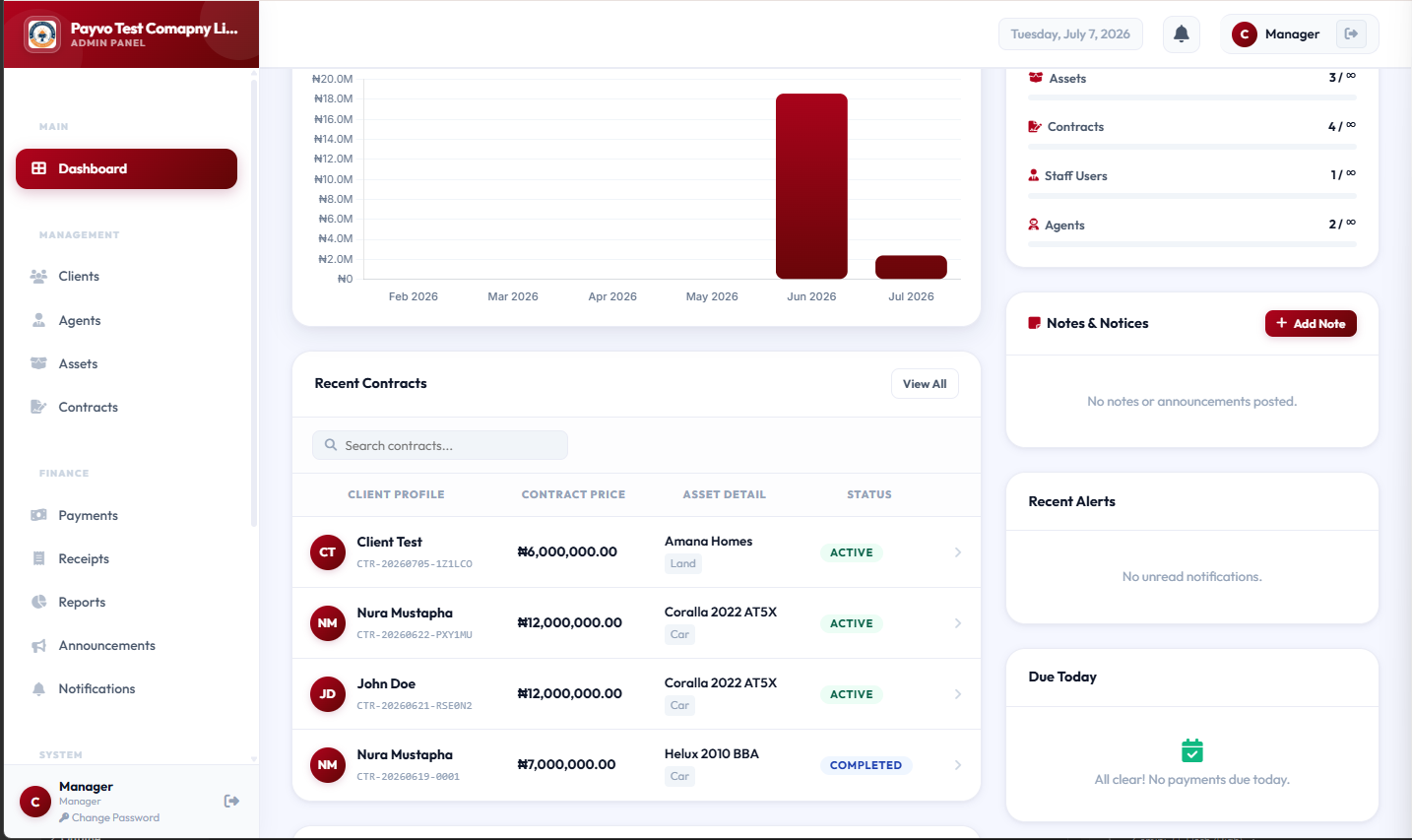 Dashboard (top)
When considering a platform like Payvo, you’ll find it directly addresses these points. It's built as a full business management platform for companies that sell on installment, offering capabilities from client and asset registration to automatic contract generation and payment recording. The system replaces manual processes, providing a centralized hub for all your installment sales operations.
Step 4: Consider Pricing, Support, and Scalability
Beyond features, practical considerations are vital.
- Pricing: Understand the total cost of ownership. Beyond monthly subscriptions (which can range from ₦5,000 to ₦70,000), consider one-time costs like onboarding (₦10,000 - ₦30,000) or complex integration fees (₦50,000 - ₦200,000). Some providers might also charge transaction fees (0.5% - 1.5% per transaction, often capped at ₦2,000). Compare these costs with the potential savings in staff time and increased collections. You can explore a detailed breakdown of costs on a platform's pricing page.
- Customer Support: What kind of support does the provider offer? Is it via phone, email, or chat? Is it responsive and available during your business hours? Good local support can be invaluable.
- Scalability: Can the software grow with your business? If you plan to expand your client base or asset offerings, will the system accommodate that without requiring a complete overhaul? Look for solutions that offer different tiers or custom solutions for enterprise-level needs.
Step 5: Test and Implement
Before fully committing, take advantage of any free trials or demos offered. This hands-on experience is crucial. During the trial:
- Input Real Data: Try adding a few actual clients and contracts to see how the system handles your specific data.
- Process Payments: Simulate recording payments and generating receipts. Check if the automatic notifications work as expected.
- Test Reporting: Generate some reports to ensure they provide the insights you need.
- Train Your Team: Involve key staff members in the testing process. Their feedback is invaluable, and early training will ease adoption. Some providers offer staff training sessions, which can cost ₦15,000 to ₦40,000 per session.
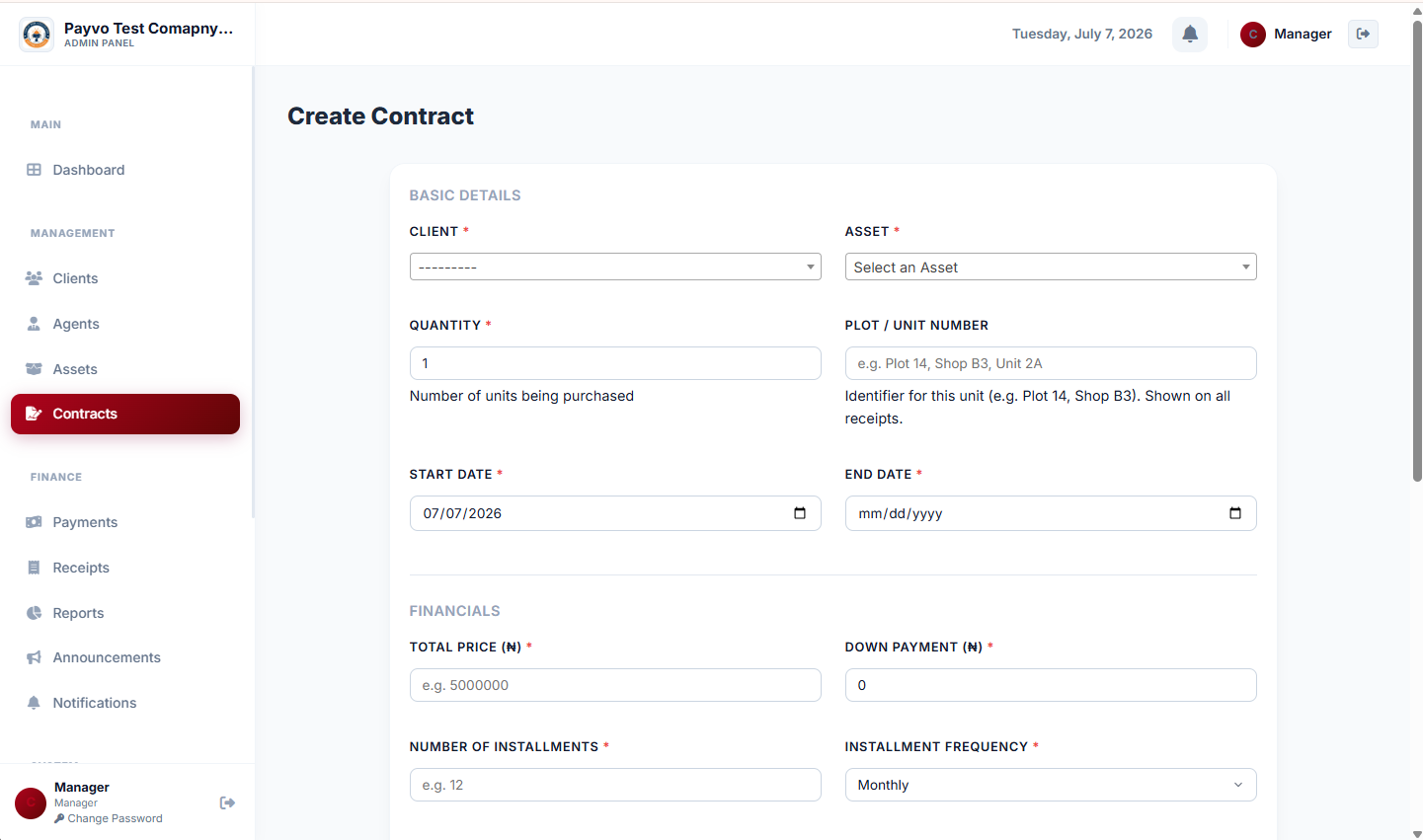 Management: Add contract (top)
> "In the Nigerian market, businesses that embrace technology for payment management don't just gain efficiency; they build trust and significantly improve their cash flow, separating themselves from competitors stuck in the past."
Common Mistakes to Avoid
Navigating the world of payment management software can be tricky. Here are some common pitfalls Nigerian businesses encounter:
- Ignoring Your Specific Needs: Choosing a generic solution that doesn't cater to the nuances of installment sales or your industry (e.g., real estate, car dealerships). This often leads to needing workarounds or having to switch systems later.
- Underestimating Training Requirements: Assuming staff will intuitively grasp a new system. Proper training, sometimes requiring professional sessions (₦15,000 - ₦40,000), is crucial for adoption and preventing errors.
- Neglecting Data Migration: Not planning for how existing client and contract data will be transferred to the new system. This can be a time-consuming and error-prone process if not managed carefully.
- Overlooking Security Features: Choosing a system without robust security, role-based access control, or audit trails, which can expose your business to fraud or data breaches.
- Failing to Automate Reminders: Opting for a system that doesn't offer automated payment reminders via WhatsApp or email, leaving you to manually chase payments, which defeats a major purpose of such software.
- Ignoring Local Support: Selecting a provider with offshore support that doesn't understand local context or operate within Nigerian business hours, leading to frustration when issues arise.
- Not Reviewing Terms and Conditions: Skipping the privacy policy page and terms of service page, potentially missing crucial details about data ownership, service level agreements, or contract termination.
How to Track and Grow After Launch
Implementing payment management software is just the beginning. To truly leverage your investment, you need to actively track performance and use insights for growth.
Key Performance Indicators (KPIs) to Monitor:
- Collection Rate: The percentage of due payments actually collected. A good system provides dashboards to track this in real-time.
- Average Payment Delay: How many days, on average, payments are late. Automated reminders should significantly reduce this.
- Client Churn Rate: How many clients default or cancel their contracts. High churn might indicate issues with your sales process or product.
- Agent Performance: For businesses with agents, track individual agent collection rates and commission earnings. An agent tracking page can provide invaluable insights.
- Outstanding Balance: Keep a close eye on the total amount owed across all active contracts.
- Customer Satisfaction: Gather feedback on the new payment experience – are receipts clear? Are reminders helpful?
- Improved Cash Flow: By reducing missed payments and automating reminders, you'll see a more predictable and healthier cash flow, allowing for better business planning.
- Enhanced Customer Relationships: Clear communication through automated receipts and reminders builds trust. Clients appreciate professionalism and transparency.
- Data-Driven Decisions: Use the reports and analytics generated by your software to identify trends. Which products sell best on installment? Which payment plans are most successful? This informs your sales strategy.
- Scalability: With an efficient system in place, you can comfortably take on more clients and contracts without needing to exponentially increase administrative staff. This is crucial for expanding your real estate portfolio, car dealership inventory, or microfinance operations.
- Staff Efficiency: Free up your staff from manual tasks, allowing them to focus on sales, customer service, and other value-added activities.
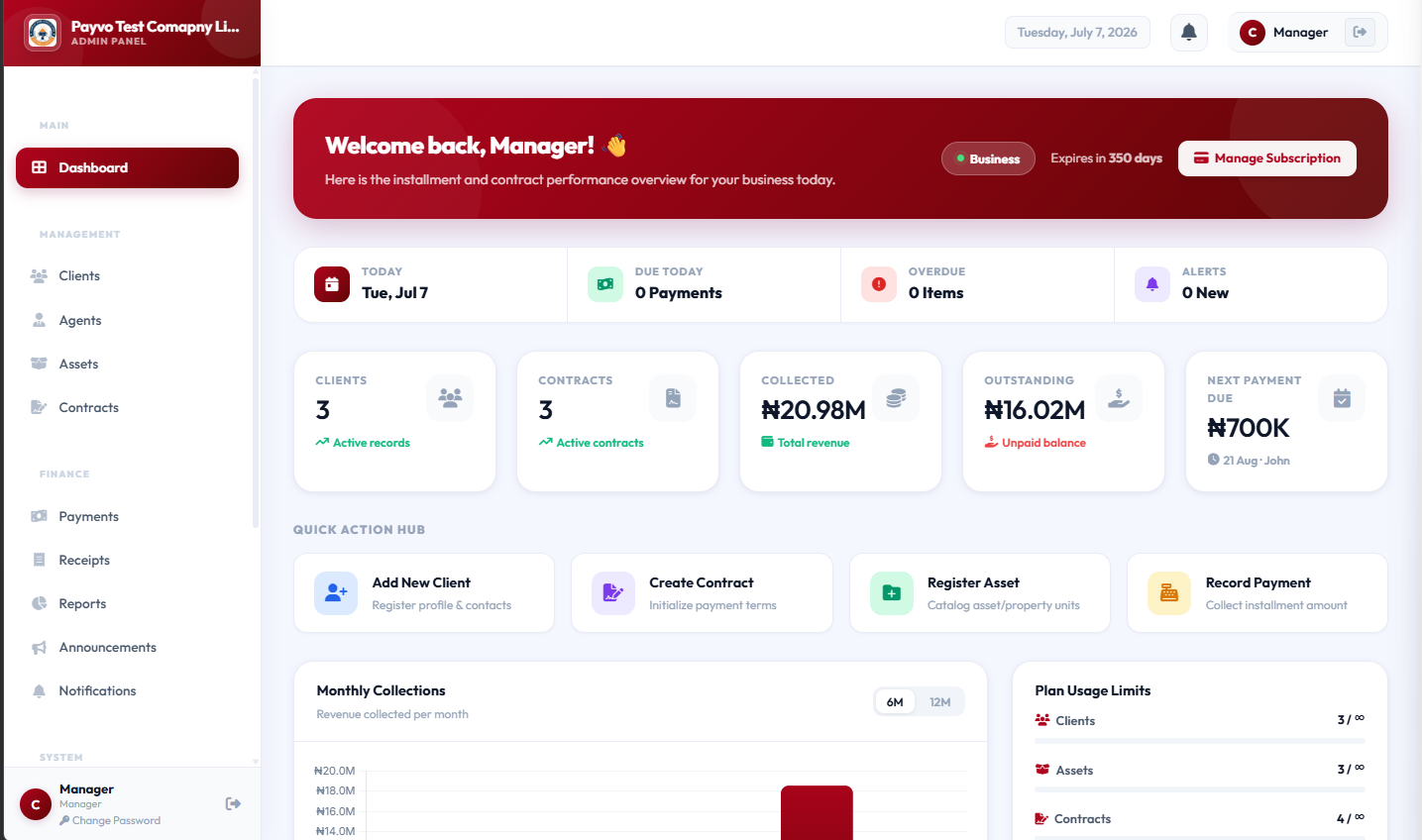 Dashboard (bottom)
Frequently Asked Questions
Q1: What is the average cost of payment management software in Nigeria?
The cost varies significantly based on features and provider. Basic monthly subscriptions for small businesses typically range from ₦5,000 to ₦15,000. More advanced solutions with extensive features and integrations can cost between ₦25,000 and ₦70,000 per month. Enterprise-level custom solutions can go upwards of ₦100,000 to ₦500,000+ monthly. Don't forget to factor in potential one-time costs like setup (₦10,000 - ₦30,000) or complex integration fees (₦50,000 - ₦200,000), and transaction fees (0.5% - 1.5%, often capped at ₦2,000).
Q2: Can these systems help with tracking agent commissions?
Yes, many specialized payment management software solutions, particularly those designed for installment sales, include robust agent commission tracking software. They allow you to assign agents to contracts, automatically calculate their commission per payment received, and track their full earnings and payout history. Some even offer agent self-tracking portals where agents can view their KPIs and submit withdrawal requests, enhancing transparency and efficiency.
Q3: How secure is my client and payment data on these platforms?
Reputable payment management software providers prioritize data security. Look for platforms that offer features like role-based user permissions, audit logs (to track all activities on the system), and secure data encryption. Cloud-based solutions typically have advanced security measures in place, but it's always wise to review their privacy policy and terms of service to understand their data protection protocols.
Q4: Is it possible to integrate these systems with WhatsApp for notifications?
Absolutely. A key feature of modern payment management software, especially in Nigeria, is the ability to send automated notifications and payment reminders via WhatsApp. This WhatsApp payment notification system is highly effective for improving communication with clients and increasing collection rates, as WhatsApp is a primary communication channel for many Nigerians.
Q5: Will this software generate receipts for my customers?
Yes, a core function of payment management software is to automatically generate professional, branded receipts. These receipts often include your company logo, brand colors, and even a digital signature. They can be generated for every single payment received and also as a master receipt for the full contract upon completion, providing clear documentation for both your business and your clients. This acts as an efficient receipt generator app Nigeria businesses can trust.
Ready to Streamline Your Installment Sales?
Stop losing money to manual errors and missed payments. Discover how a dedicated contract and installments management system can transform your business, from real estate and car sales to microfinance and equipment leasing. Explore the features, pricing, and benefits of automated payment tracking today. Ready to take control of your finances and grow your business with confidence? Register for Payvo and experience the difference.