Is managing your installment sales starting to feel like a full-time job of its own? Are you constantly chasing payments, reconciling spreadsheets, and sifting through WhatsApp chats just to figure out who owes what? If manual tracking of customer payments, contracts, and outstanding balances is eating into your profits and peace of mind, it’s time for a smarter approach.
 Nigerian business owner looking stressed while reviewing scattered
The Hidden Costs of Manual Installment Tracking
Many Nigerian businesses, from real estate developers in Abuja to car dealers in Lagos, rely on installment sales to make high-value products accessible. But without proper tools, this flexibility comes with significant operational headaches. Manually tracking payments, especially for businesses with many clients, can lead to costly errors and inefficiencies.
Consider a real estate developer selling plots of land in Kano or Kaduna. Each plot might have a dozen buyers, each on a unique payment plan. Tracking deposits, monthly installments, and outstanding balances across multiple notebooks or complex spreadsheets becomes a nightmare. A single mistake can lead to disputes with customers, hours spent re-checking records, and even lost revenue.
For cooperative societies or microfinance operators managing hundreds of loan repayments, the challenge is even greater. Imagine trying to reconcile daily payments for ₦50,000 to ₦150,000 monthly earners using only paper ledgers. The risk of miscalculation, missed payments, or forgotten due dates skyrockets. According to a 2023 report by the Nigerian Bureau of Statistics, small and medium enterprises (SMEs) contribute nearly 48% of the national GDP, yet many still struggle with rudimentary record-keeping, hindering their growth and ability to secure financing. This highlights a critical need for efficient payment tracking solutions.
Manual systems often involve:
- Time-consuming reconciliation: Staff spend hours cross-referencing bank statements, cash receipts, and customer records.
- Increased error rates: Human error in calculations or data entry can lead to incorrect balances and customer disputes.
- Poor cash flow visibility: Without a real-time overview, it's hard to predict incoming payments or identify overdue accounts.
- Difficulty scaling: As your customer base grows, manual processes quickly become unmanageable, limiting your business's expansion.
- Lack of accountability: Tracing who recorded which payment or approved a particular contract can be difficult in paper-based systems.
Why Your Current Method Might Be Holding You Back
If you're still using a combination of notebooks, Excel spreadsheets, and WhatsApp for your installment sales, you're likely facing these frustrations daily.
The Limits of Spreadsheets and Paper
While a basic Excel sheet can help with initial calculations, it struggles with dynamic data. What happens when a customer misses a payment, pays extra, or requests an updated balance? You have to manually adjust formulas, update multiple cells, and ensure consistency across various files. This isn't just inefficient; it's a breeding ground for errors. Paper ledgers are even worse, prone to loss, damage, and difficult to search. Imagine a car dealer in Port Harcourt trying to track hire-purchase payments for dozens of vehicles using only physical files – the administrative burden is immense.
The WhatsApp Conundrum
WhatsApp is a fantastic communication tool, but it's not designed for financial record-keeping. Relying on chat histories for payment confirmations or balance inquiries means crucial data is scattered, unsearchable, and easily lost among casual conversations. A simple WhatsApp payment notification system needs to integrate with your core records, not replace them. Without a centralized system, reconciling payments becomes a forensic exercise, costing valuable time and leading to customer frustration.
The Cost of Inefficiency
Beyond the time spent, inefficient tracking leads to tangible financial losses. Overdue payments go unnoticed, outstanding balances are miscalculated, and agents might not be properly credited for their sales, impacting motivation. For a building material supplier selling on credit, accurate tracking of each customer's account is crucial for managing inventory and ensuring timely collections. The average cost of manual data entry errors can range from ₦1,000 to ₦5,000 per error, not including the potential loss of customer trust or business.
> "The true cost of inefficiency isn't just lost time; it's the invisible drain on trust, accuracy, and ultimately, your business's ability to grow."
The Smarter Approach: Centralized Installment Management
The solution lies in adopting a centralized system for managing your installment sales. This isn't about replacing your entire business operation with complex software; it's about streamlining the specific, often messy, process of tracking installment payments and contracts. A dedicated installment management software Nigeria allows you to:
- Consolidate all customer data: Keep client details, payment history, and contract terms in one secure place.
- Automate payment schedules: Set up payment plans once and let the system track due dates and calculate balances automatically.
- Gain real-time visibility: Instantly see who has paid, who is due, and who is overdue, giving you better control over your cash flow.
- Generate accurate reports: Quickly pull reports on sales, collections, and outstanding balances for better decision-making.
- Improve customer communication: Provide clear, consistent payment reminders and digital receipts.
contract management software Nigeria is indispensable for maintaining customer relationships and ensuring consistent revenue.
How Payvo Helps You Master Installment Sales
This is where Payvo steps in. Payvo is a purpose-built installment business software designed to simplify how Nigerian businesses manage their installment sales, track customer payments, and monitor outstanding balances. It moves you away from the chaos of scattered records to a clear, organized system.
With Payvo, you can easily:
- Onboard customers and assets: Register new clients and link them to the specific products or properties they're acquiring, whether it's a plot of land or an inverter.
- Create flexible contracts: Define payment terms, down payments, installment amounts, and frequencies with ease. The system automatically generates payment schedules.
- Record payments accurately: Log cash, bank transfers, or POS payments against specific contracts, instantly updating outstanding balances. You can also generate professional digital receipts with a built-in
receipt generator app Nigeria. - Track balances and due dates: Get an at-a-glance view of all contracts, see who's paid, who's due, and identify overdue accounts, improving your collections process.
- Manage agents and commissions: For businesses with sales teams, Payvo offers
agent commission tracking softwareto ensure fair and accurate payouts. - Communicate effectively: Use optional features like automated SMS or
WhatsApp payment notification systemto send payment reminders and updates to customers, reducing manual follow-ups.
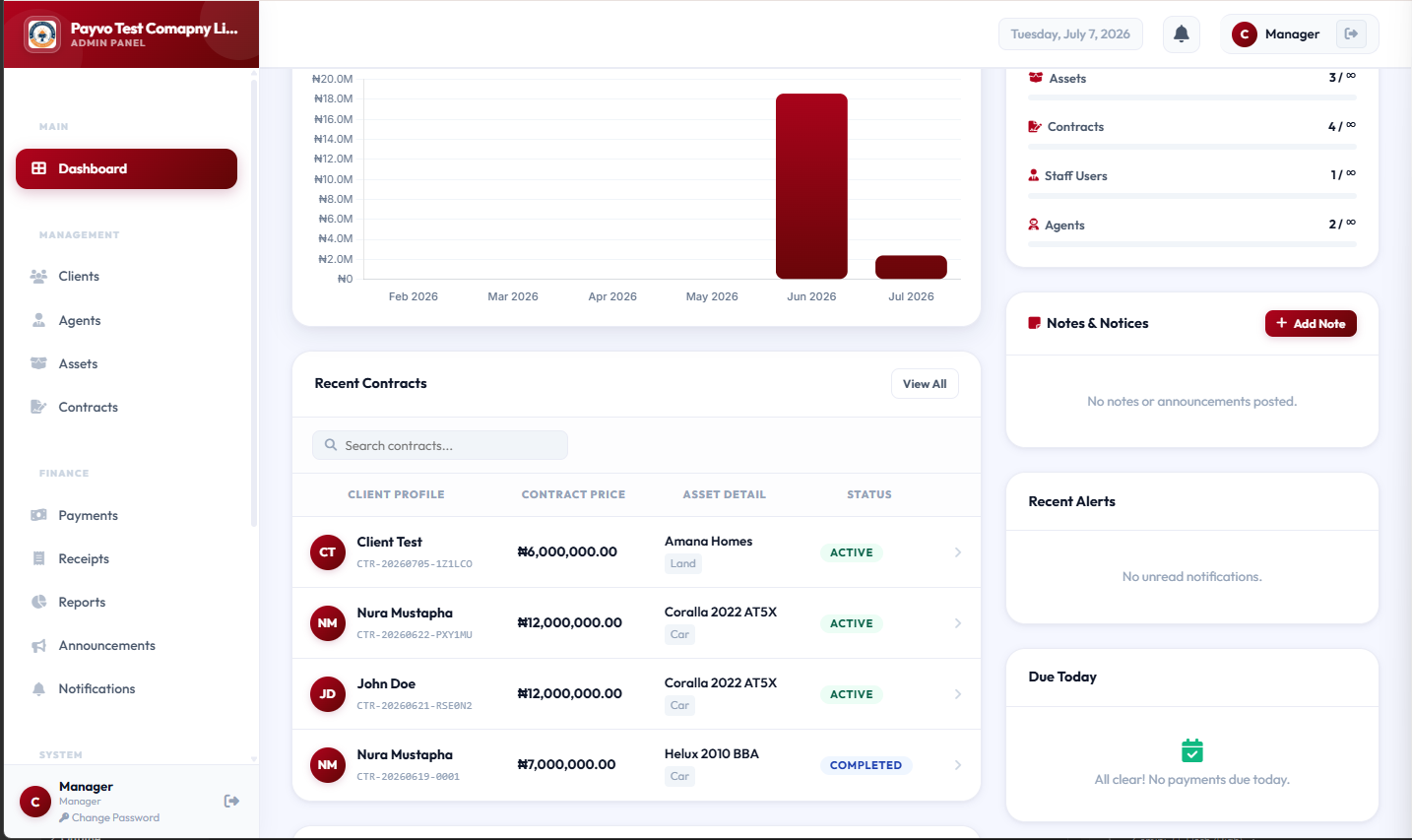 Dashobard (top)
Proof: Side-by-Side Comparison
Let's look at how a dedicated business payment tracking app Nigeria like Payvo compares to traditional methods:
| Feature/Aspect | Traditional Manual Methods (Notebooks, Excel, WhatsApp) | Modern Installment Software (Payvo) |
|---|---|---|
| Contract Management | Spread across physical documents, emails, and chat histories; difficult to retrieve. | Centralized digital contracts with all terms, payment schedules, and history easily accessible. |
| Payment Tracking | Manual entry in ledgers/spreadsheets; prone to errors; time-consuming reconciliation. | Automated tracking of payments against contracts; instant balance updates; reduced errors. |
| Balance Visibility | Requires manual calculation for each customer; often outdated. | Real-time outstanding balances for all customers; clear overview of who owes what. |
| Payment Reminders | Manual calls, texts, or WhatsApp messages; inconsistent and time-intensive. | Automated SMS/WhatsApp notifications for due dates and payments; consistent communication. |
| Reporting | Manual aggregation of data; basic reports; prone to inaccuracies. | Comprehensive financial reports; insights into collections, arrears, and sales performance. |
| Scalability | Becomes unmanageable with growing customer base; limits business expansion. | Designed to handle hundreds or thousands of contracts and customers; supports business growth. |
| Error Rate | High risk of human error, miscalculations, and data loss. | Minimized human error through automation and structured data entry. |
| Agent Management | Manual tracking of sales and commissions; potential for disputes. | Integrated agent commission tracking software for transparent and accurate payouts. |
| Data Security | Vulnerable to physical loss, damage, or unauthorized access. | Secure, cloud-based storage; data backups; restricted user access. |
| Cost | Hidden costs in wasted time, errors, lost revenue, and potential disputes. | Clear subscription costs (e.g., ₦5,000 - ₦50,000/month) with significant ROI from efficiency gains. |
Evaluating the Best Installment Sales Software: Your Checklist
Choosing the right installment software is a crucial decision for your business. Here’s a practical checklist to guide your evaluation, ensuring the software meets your specific needs:
1. Core Installment Management Capabilities
- Contract Creation & Management: Can you easily set up and modify installment contracts, including initial deposits, payment frequencies (weekly, monthly, quarterly), and durations?
- Payment Scheduling: Does it automatically generate a clear payment schedule based on contract terms?
- Payment Recording: Is it straightforward to record various payment types (cash, bank transfer, POS) against contracts?
- Outstanding Balance Tracking: Does it provide real-time updates on each customer’s outstanding balance?
- Payment History: Can you view a complete, detailed history of all payments made by a customer?
2. Customer & Asset Management
- Customer Database: Does it allow you to maintain comprehensive customer records (contact info, multiple contracts)?
- Asset/Product Tracking: Can you link specific products, properties, or services to each installment contract? This is especially vital for
real estate payment tracking Nigeriaorcar dealer installment software.
3. Financial Visibility & Reporting
- Dashboard Overview: Does it offer a clear dashboard summarizing key metrics like total outstanding, payments due, and overdue accounts?
- Financial Reports: Can you generate reports on collections, arrears, sales performance, and agent commissions?
- Digital Receipts: Does it support generating and sending professional digital receipts to customers?
4. Communication & Notifications
- Automated Reminders: Can it send automated payment reminders (SMS, email, WhatsApp) to customers? This is a key feature for a robust
WhatsApp payment notification system. - Customizable Messages: Can you customize the content of these notifications?
5. Ease of Use & Accessibility
- Intuitive Interface: Is the software easy to navigate and understand, even for staff with limited technical skills?
- Cloud-Based Access: Can you access it from anywhere with an internet connection, on various devices (laptop, tablet, smartphone)?
- Setup & Onboarding: Is the setup process straightforward, or does it require significant technical expertise?
6. Scalability & Integration (Optional, but important for growth)
- User Management: Can you add multiple users (staff, agents) with different access permissions?
- Data Export: Can you export your data for accounting or other purposes?
- Integration Potential: Does it offer options for integrating with other tools you use (e.g., payment gateways, accounting software)?
7. Cost & Support
- Pricing Structure: Is the pricing clear, transparent, and suitable for your budget (e.g., monthly subscription plans)?
- Customer Support: Is reliable customer support available when you need assistance?
By using this checklist, you can objectively compare options and find the installment business software that best fits your operational needs and budget. Remember, the goal is to reduce administrative burden, not add more complexity.
 Business owner looking at dashboard on laptop
Cost Considerations for Installment Sales Software in Nigeria (2026)
When evaluating cooperative society management software or any software for installment business, it's important to consider the total cost of ownership. Here's a breakdown of typical expenses in Nigeria as of 2026:
- Installment Sales Software Subscription (Basic Plan): Expect to pay between ₦5,000 - ₦15,000 per month for essential features suitable for small businesses or individual users.
- Installment Sales Software Subscription (Advanced Plan): For growing businesses needing multiple users, inventory management, and robust reporting, costs range from ₦20,000 - ₦50,000 per month.
- Custom Software Development (Basic Installment Module): If your needs are highly niche, a local developer might charge ₦300,000 - ₦800,000 for a custom-built solution, though this comes with higher maintenance overhead.
- One-time Setup/Implementation Fee: For more complex software requiring data migration and staff training, anticipate ₦50,000 - ₦200,000.
- Internet Data: Reliable internet is essential, costing approximately ₦5,000 - ₦15,000 monthly, depending on usage and provider.
- Hardware (Laptop/Desktop): A dependable device to run the software costs ₦150,000 - ₦350,000.
- Mobile Access (Smartphone/Tablet): For on-the-go management, budget ₦60,000 - ₦200,000.
- Staff Training (per person): If external training is needed, it could cost ₦10,000 - ₦30,000 per person.
- Payment Gateway Transaction Fees: Integrating online payments will incur 1.5% - 2.5% per transaction.
- SMS Notification Costs: Automated payment reminders cost ₦3 - ₦8 per SMS.
Frequently Asked Questions
Q1: What is installment management software and who needs it?
Installment management software is a specialized tool designed to help businesses track and manage customer payments for products or services sold over an agreed period. It's essential for businesses that offer payment plans, such as real estate developers, car dealers selling on hire purchase, cooperative societies, solar/equipment leasing companies, and building material suppliers selling on credit. Essentially, anyone who needs to track recurring payments and outstanding balances for multiple customers will benefit.
Q2: How does installment software help prevent payment defaults?
While no software can guarantee zero defaults, installment software significantly reduces them by providing clear visibility and proactive communication. It automatically tracks due dates and outstanding balances, allowing you to identify potential issues early. Features like automated SMS or WhatsApp payment notification system send timely reminders to customers, encouraging prompt payments and reducing the likelihood of late or missed installments.
Q3: Can I integrate installment management software with my existing accounting system?
Many advanced installment management software solutions offer integration capabilities, either directly or through APIs, allowing you to connect with your existing accounting systems. This can streamline data flow and reduce manual entry between platforms. For example, Payvo offers advanced integration options for businesses that require them, though its core installment management software Nigeria functionality works perfectly standalone. You can learn more about its capabilities on the Payvo website.
Q4: Is installment sales software suitable for small businesses in Nigeria?
Absolutely. While the term "software" might sound intimidating, many solutions, including Payvo, offer affordable basic plans tailored for small businesses. Even a small business with just a few installment contracts can benefit immensely from the organization and efficiency a dedicated system provides, freeing up time otherwise spent on manual tracking. The cost of a basic plan, typically ₦5,000 - ₦15,000 per month, is often a small price to pay for the reduction in errors and improved cash flow visibility.
Q5: What features should I prioritize when choosing an installment tracking solution?
When evaluating software for installment business, prioritize features like easy contract creation, automated payment scheduling, real-time outstanding balance tracking, customer and asset management, and the ability to generate digital receipts. For businesses with sales agents, agent commission tracking software is also crucial. Look for an intuitive interface, cloud accessibility, and good customer support. Consider your specific industry needs; for instance, real estate payment tracking Nigeria might require specific features for property units.
Ready to transform your installment sales management from a headache into a streamlined process? Discover how Payvo can simplify your operations and give you greater control over your business finances. Start your free trial today and experience the difference.