<h1>Best Free Installment Management Software Downloads for Nigeria 2026</h1>
Are you tired of chasing down installment payments with endless phone calls and scattered WhatsApp messages? Does the thought of manually reconciling payment records and tracking commissions give you a headache? For Nigerian businesses dealing with hire purchase, credit sales, or recurring payments, managing these transactions manually isn't just inefficient; it's a direct drain on your profits and growth.
 A nigerian small business owner looking stressed while
The Hidden Costs of Manual Installment Tracking
Many Nigerian businesses, from car dealers to cooperative societies and building material suppliers, still rely on notebooks, spreadsheets, and informal communication to manage installment sales. While seemingly "free," this approach carries significant hidden costs that can cripple your operations in 2026.
Consider the time wasted. An employee spending hours each week manually updating ledgers, generating receipts, and sending reminders isn't focused on sales or customer service. This inefficiency translates directly into lost productivity. For a business paying staff an average of ₦80,000 per month, even just 10 hours a week spent on manual tracking could cost you ₦20,000 monthly in lost output per staff member.
Then there's the issue of errors. Manual data entry is prone to mistakes – a misplaced decimal, a forgotten payment, or an incorrectly calculated commission. These errors can lead to:
- Under-collection of revenue: Missed payments or incorrect balances mean you're not getting all the money you're owed.
- Customer disputes: Discrepancies in payment records can damage customer trust and lead to lengthy, frustrating arguments.
- Agent dissatisfaction: Incorrect commission calculations can demotivate your sales agents, leading to high turnover and reduced sales.
- Compliance risks: Inaccurate financial records can create problems during audits or when seeking financing.
The lack of real-time visibility is another major hurdle. Without an automated system, knowing your exact outstanding balance, who owes what, and which payments are due next requires laborious data compilation. This makes strategic decision-making, like forecasting cash flow or identifying at-risk accounts, incredibly difficult. According to a 2025 survey of Nigerian SMEs, businesses relying on manual processes reported a 30% higher incidence of cash flow problems compared to those using digital solutions.
Why "Free" Solutions Often Fall Short
When searching for "free installment management system downloads" or a "receipt generator app Nigeria," many small businesses turn to generic spreadsheet templates, basic accounting software not designed for installment sales, or even just WhatsApp groups. While these might seem like immediate fixes, they often lack the specialized features crucial for businesses that sell on installment.
Here’s why these "free" options can quickly become a headache:
- Lack of Automation: They rarely offer automated payment reminders, receipt generation, or contract scheduling. This means you’re still doing most of the heavy lifting.
- Poor Scalability: As your client base grows, managing hundreds or thousands of contracts and payments in a spreadsheet becomes a nightmare. What works for 10 clients won't work for 100.
- Security Risks: Storing sensitive client and financial data in unencrypted spreadsheets or scattered across multiple devices poses a significant security risk. Data loss due to device failure or cyber-attacks can be catastrophic.
- Limited Reporting: Generic tools offer basic reporting at best, making it hard to track key metrics like collection rates, agent performance, or outstanding balances at a glance.
- No Customization for Installments: They don't understand the nuances of installment plans, such as calculating interest, handling partial payments, or tracking specific assets tied to contracts.
For real estate developers tracking property payments in Abuja, or a solar leasing company managing equipment installments in Lagos, these general tools simply don't cut it. They might save you money upfront, but the long-term operational inefficiencies and potential for errors far outweigh any initial savings.
Embracing a Smarter Approach: Integrated Installment Management
The smarter approach for managing installment sales in Nigeria involves adopting an integrated installment management system. This isn't just about recording payments; it's about automating the entire lifecycle of an installment contract, from client onboarding to final payment and beyond.
An effective installment management system should centralize all your client data, contract details, payment schedules, and communication history in one secure platform. This single source of truth eliminates discrepancies, reduces manual effort, and provides real-time insights into your business performance. Think of it as having a dedicated, tireless administrator working 24/7 to manage your installment sales.
Key functionalities to look for in such a system include:
- Automated Contract Creation: Define payment terms once, and the system automatically generates installment schedules.
- Client Management: A comprehensive database for client details and their complete payment history.
- Asset Tracking: Link specific assets (like a car or a plot of land) to individual contracts.
- Automated Reminders and Notifications: Send payment reminders and status updates automatically via email and WhatsApp.
- Receipt Generation: Instantly create branded receipts for every payment.
- Agent & Commission Management: Track agent performance and calculate commissions accurately per payment.
- Real-time Dashboards & Reporting: Get an instant overview of your business health and generate detailed financial reports.
- Role-Based Access: Allow different staff members to access only the information relevant to their role.
By implementing such a system, businesses can significantly reduce administrative overhead, improve cash flow predictability, enhance customer satisfaction, and empower their sales agents. This shift from reactive, manual tracking to proactive, automated management is crucial for growth in a competitive market like Nigeria.
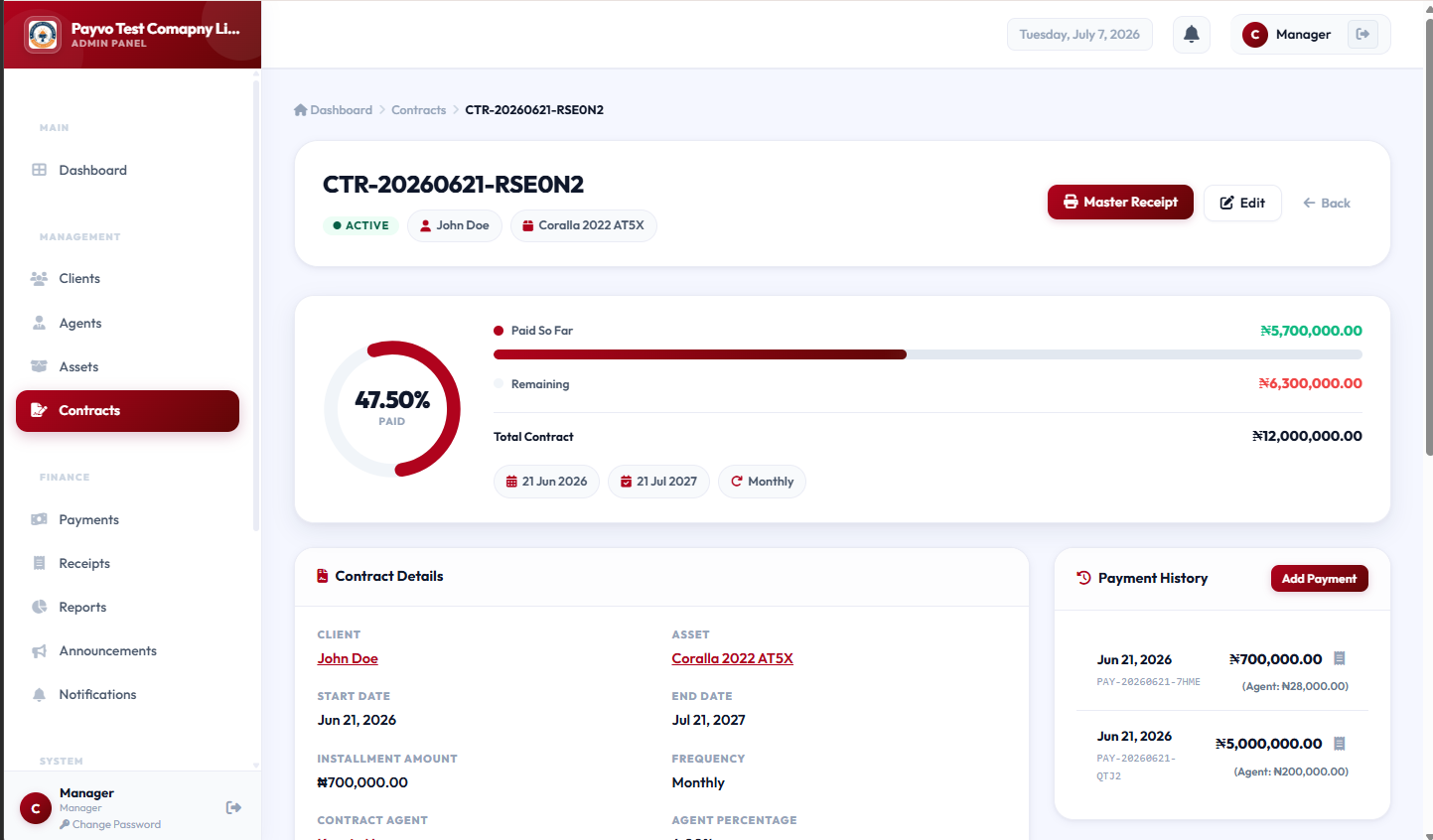 Dashboard showing contract details and payment schedule
How Payvo Transforms Installment Sales Management
This is where Payvo steps in as a robust solution for Nigerian businesses grappling with installment sales. Payvo is a comprehensive business management platform specifically designed for companies that sell on installment, offering a powerful alternative to fragmented manual processes and inadequate generic software. It streamlines every aspect of your installment operations, bringing efficiency and clarity to your business.
With Payvo, you can register and manage clients with ease, storing full client details and providing a complete payment history for each individual. This eliminates the need for bulky physical folders or scattered digital records. For real estate developers, this means instantly knowing the payment status of every buyer in your estate. Car dealers can track each vehicle sold on hire purchase by linking it directly to the client's contract using Payvo's asset management feature.
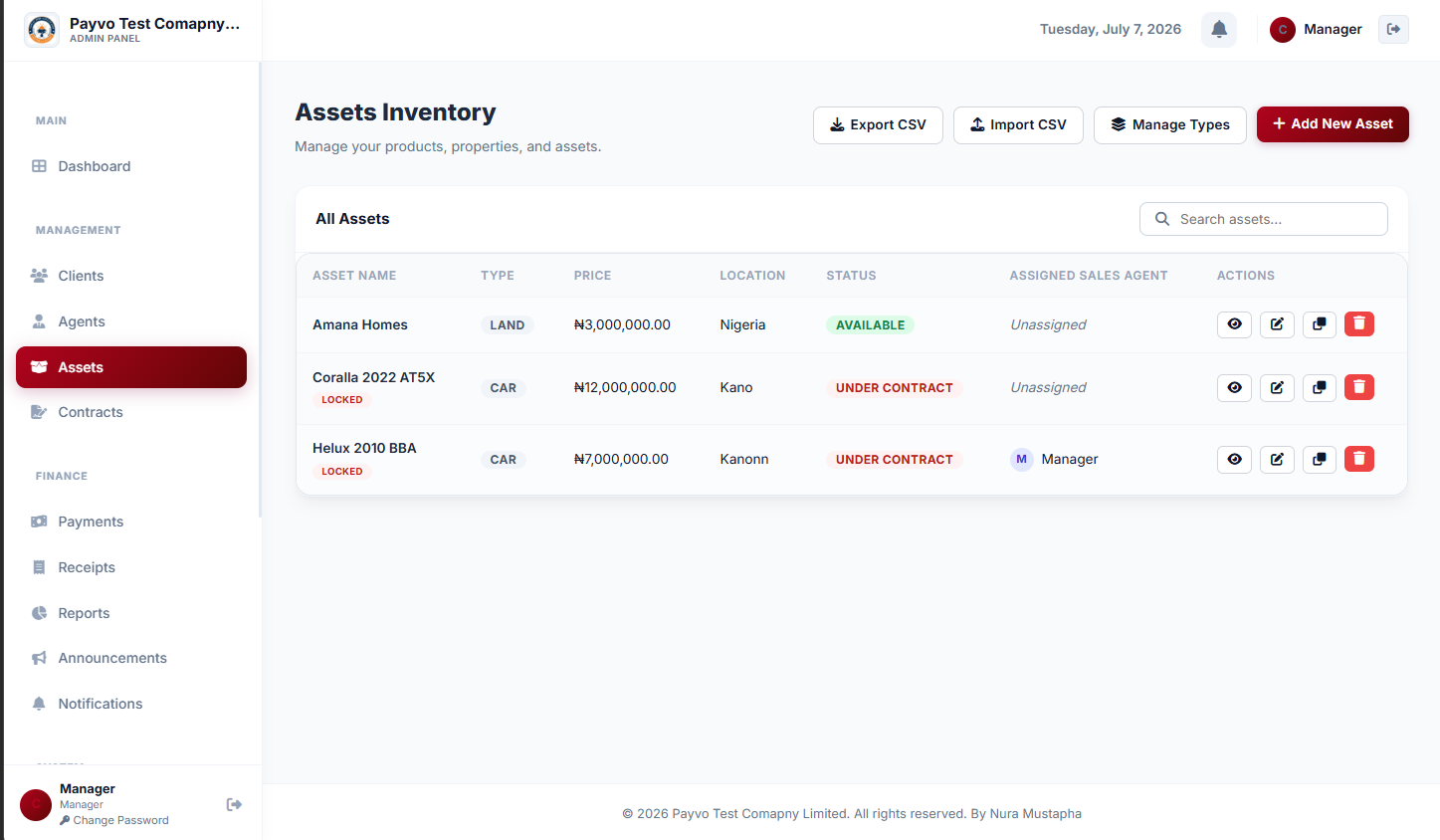 Assets list page
Creating contracts becomes effortless. You simply set payment terms once, and Payvo automatically generates the entire installment schedule. When payments come in, you can record payments quickly, and the system instantly generates branded receipts with your company logo, colors, and digital signature. These receipts are professional and can be sent automatically to clients via email or WhatsApp, including a public link for easy access – a significant upgrade from handwritten receipts or manual PDF generation.
One of Payvo's most impactful features is its automated notification system. It sends payment reminders before due dates, removing the need for tedious manual follow-up calls and messages. This not only improves your collection rates but also frees up your staff to focus on more strategic tasks. New client registrations, contract creations, and payment receipts are also communicated automatically, keeping everyone informed.
For businesses relying on a sales force, Payvo includes powerful agent and commission management tools. You can assign agents to contracts, and the system automatically calculates their commission per payment received, tracking their full earnings and payout history. Agents can even use a self-tracking feature to view their own earnings and submit withdrawal requests directly, fostering transparency and motivation.
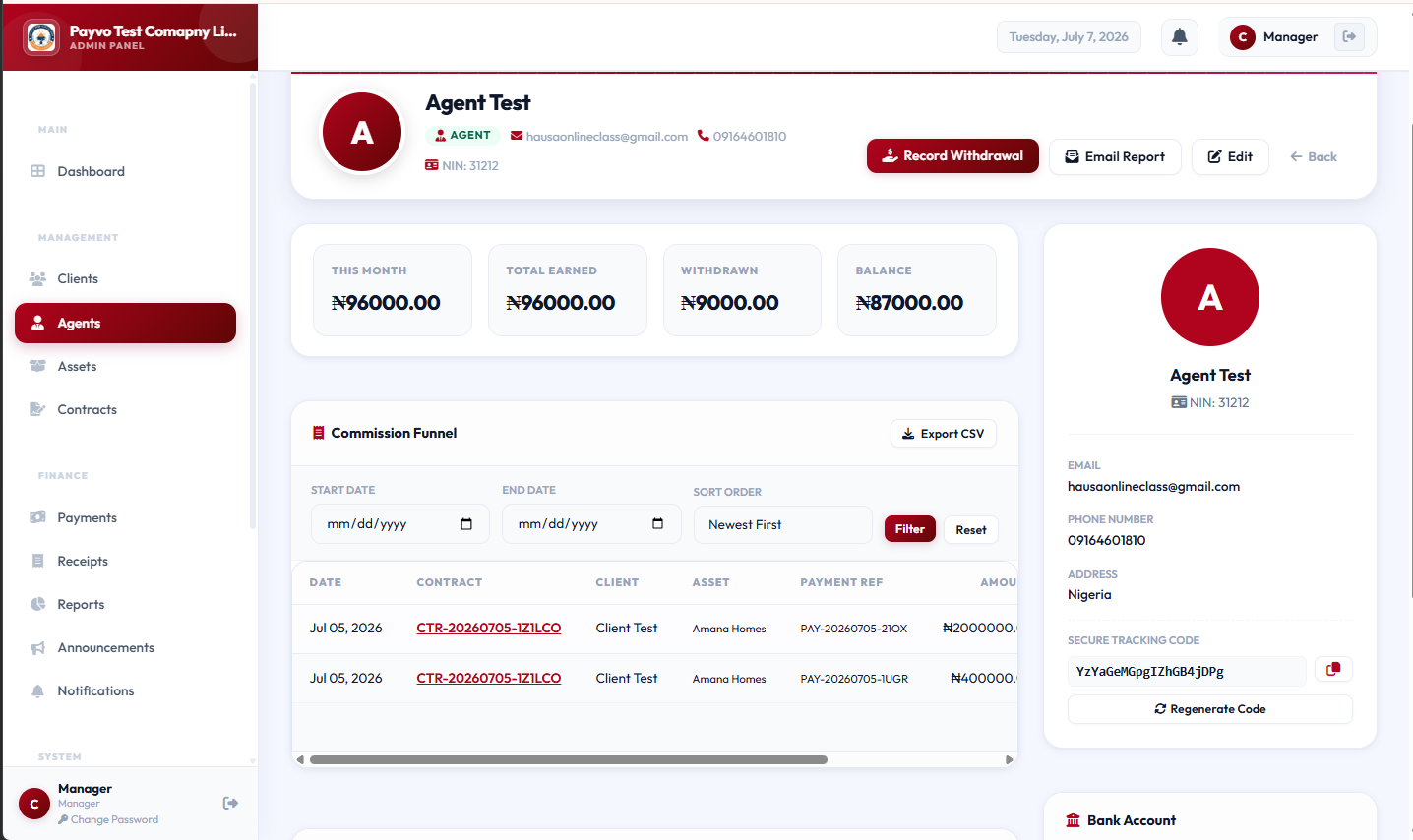 Agent details page
Finally, Payvo provides real-time dashboards that give you an instant overview of total clients, active contracts, amounts collected, outstanding balances, and next payment due dates. This data is invaluable for strategic planning and staying on top of your finances. You can also generate detailed reports in PDF or Excel format for accounting and record-keeping, and receive weekly company reports via email summarizing key performance metrics.
In essence, Payvo replaces the chaos of notebooks, scattered WhatsApp messages, and manual tracking with one automated system, managing everything from client registration and contract creation to payment recording, receipt generation, and automated follow-ups. Businesses looking for a robust "installment management software Nigeria" or "cooperative society management software" will find Payvo's comprehensive features incredibly beneficial. You can learn more about all the features Payvo offers on our dedicated Features Page.
Proof: Side-by-Side Comparison
Let's look at how an integrated system like Payvo compares to traditional, manual methods for managing installment sales in 2026.
| Feature / Aspect | Traditional Manual Methods (Notebooks, Spreadsheets, WhatsApp) | Integrated Installment Management System (e.g., Payvo) |
|---|---|---|
| Client & Contract Setup | Manual entry in ledgers/spreadsheets, prone to errors. No automatic linking of clients to assets. | Digital client profiles, automated contract generation with predefined terms, direct linking of assets to contracts. |
| Payment Tracking | Manual recording, difficult to reconcile, easy to miss payments. | Automated payment logging, real-time balance updates, full payment history per client. |
| Receipt Generation | Hand-written receipts, manual PDF generation, time-consuming. | Automated, branded digital receipts generated instantly for every payment, sent via email/WhatsApp. |
| Payment Reminders | Manual calls, WhatsApp messages, often inconsistent and time-consuming. | Automated reminders sent via email and WhatsApp before due dates, improving collection rates. |
| Agent Commission | Manual calculation, prone to errors, disputes. | Automated calculation per payment, transparent tracking of agent earnings and payouts. |
| Reporting & Insights | Laborious data compilation for basic reports, no real-time overview. | Real-time dashboards, comprehensive financial reports (PDF/Excel), weekly performance summaries. |
| Data Security & Backup | High risk of data loss (physical damage, device failure), no centralized backup. | Secure, cloud-based data storage, regular backups, audit logs for all actions. |
| Staff Collaboration | Difficult to share up-to-date information, prone to miscommunication. | Role-based access, centralized data, clear communication channels, staff and agent self-tracking. |
| Typical Monthly Cost | Hidden Costs: ₦20,000 - ₦50,000+ (lost productivity, errors, disputes, data recovery). | Direct Costs: ₦5,000 - ₦50,000 (software subscription, internet, device upkeep – but with significant ROI). |
| Scalability | Extremely poor, becomes unmanageable with growth. | Highly scalable, supports unlimited clients and contracts as your business expands. |
Essential Tools and Costs for Digital Installment Management
While the core software might have a subscription fee, the overall investment in a digital installment management system is significantly lower than the hidden costs of manual tracking. Here’s a realistic breakdown of what a Nigerian business might need in 2026 to effectively use an installment management software like Payvo:
- Initial Software Setup/Customization: For a small business requiring basic customization from a local developer, expect to pay ₦50,000 - ₦250,000. More complex setups for larger SMEs might be higher.
- Monthly Internet Data for Software Access: A small shop using mobile data might spend ₦5,000 - ₦15,000 monthly. A larger business with a dedicated internet plan could spend more. Consistent internet access is crucial for cloud-based solutions.
- Smartphone/Tablet for Software Access: A basic Android phone can cost ₦40,000, while a more robust tablet or higher-end smartphone might be ₦180,000. Many businesses already own these devices.
- Basic Laptop/Desktop for Software Access: An entry-level refurbished laptop could be around ₦150,000, while a new mid-range desktop might cost up to ₦400,000. This provides a more comfortable interface for managing contracts.
- Power Bank/Inverter for Device Charging: Essential for Nigeria's power situation. A basic power bank is about ₦15,000, and a small inverter setup for consistent power could be ₦80,000.
- Staff Training on New Software: This can range from ₦10,000 for self-training with online resources to ₦50,000 for hiring a local IT person for a few hours. Good software should be intuitive.
- Printer for Receipts/Invoices (Optional): A basic thermal printer for immediate physical receipts is around ₦35,000, while a more versatile inkjet printer could be ₦120,000. Digital receipts often reduce this need.
- Monthly Electricity Costs (for devices): For a small shop relying on public power, this might be ₦3,000. A business running devices on a generator for longer hours could see costs up to ₦10,000.
- Potential Data Storage Costs (Cloud, if free tier exceeded): Most dedicated installment management systems include storage. If using other cloud services, exceeding free limits might cost ₦2,000 - ₦10,000/month.
- IT Support (Ad-hoc, if issues arise): For a local technician troubleshooting a software or device issue, expect ₦10,000 - ₦30,000 per incident.
When considering the costs, remember the massive returns on investment from reduced errors, improved cash flow, and increased staff productivity. A system that helps you recover even one or two missed payments can easily pay for itself.
> "In the Nigerian market, businesses that embrace technology for operational efficiency are not just surviving; they are setting new benchmarks for growth and customer satisfaction. Manual processes are no longer competitive."
Implementing a WhatsApp Payment Notification System
One of the most powerful features of modern installment management software in Nigeria is the integration of a WhatsApp payment notification system. Given WhatsApp's ubiquity across Nigeria, this functionality is a game-changer for businesses like car dealers and real estate developers.
Here’s why it’s critical:
- Instant Communication: Notifications reach clients directly on their most used messaging platform, ensuring high open rates.
- Cost-Effective: Far cheaper than SMS for bulk notifications and reminders.
- Personalized Touch: Automated messages can still feel personal, enhancing customer relationships.
- Proof of Delivery: WhatsApp provides read receipts, giving you a level of confidence that the message was received.
A good installment management system, like Payvo, allows you to send automatic notifications for new clients, new contracts, payment received, and payment reminders directly via WhatsApp. This includes a public receipt link that clients can view, save, or share, making the process incredibly smooth and professional. This capability transforms how businesses manage customer engagement and payment collections, making it an indispensable tool for any "business payment tracking app Nigeria" in 2026. You can explore how Payvo handles notifications and integrations on our About Payvo Page.
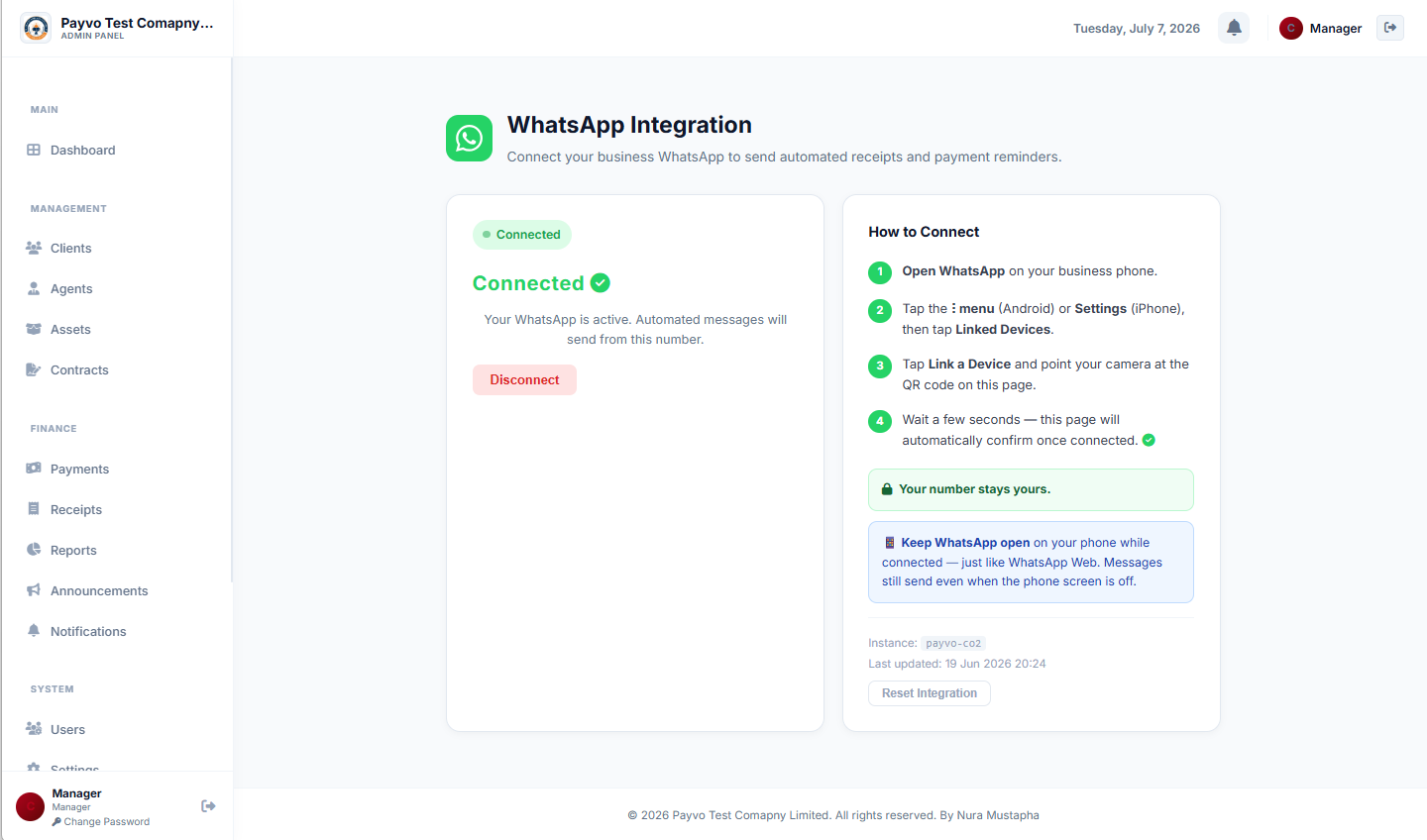 Admin: Whatsapp Integration
Frequently Asked Questions
Q1: What is the best free installment management software in Nigeria for small businesses?
While truly "free" comprehensive installment management software with all the necessary features (like automated reminders, client tracking, and receipt generation) is rare, many providers offer free trials or freemium versions. These can be a good starting point to test functionality. However, for serious businesses, investing in an affordable, feature-rich solution like Payvo often provides a much better return on investment by eliminating the hidden costs of manual management. Always evaluate the long-term benefits against the initial cost.
Q2: Can I use basic accounting software to track installment payments?
Basic accounting software is excellent for general ledger and financial reporting, but it often lacks the specialized features needed for detailed installment payment tracking. It typically won't automate installment schedules, link assets to contracts, send payment reminders via WhatsApp, or manage agent commissions per payment. For businesses with significant installment sales, a dedicated "installment management software Nigeria" or "contract management software Nigeria" is far more efficient and accurate.
Q3: How can I track agent commissions effectively for hire purchase sales?
Manually tracking agent commissions for hire purchase or installment sales is notoriously complex and error-prone. The most effective method is to use specialized software that integrates agent management directly with your contracts and payment records. A good system allows you to assign agents to specific contracts, automatically calculates their commission percentage as payments are received, and provides a clear history of their earnings and payouts. This transparency reduces disputes and motivates your sales team. Payvo offers robust Agent Tracking Page capabilities to manage this seamlessly.
Q4: Is there a reliable receipt generator app for Nigerian businesses selling on credit?
Yes, modern installment management systems often include robust receipt generation capabilities. Instead of a standalone "receipt generator app Nigeria," look for an integrated solution that automatically creates branded digital receipts for every payment recorded against a contract. These receipts should include your company logo, colors, and digital signature, and be easily shareable via email or WhatsApp. This ensures professionalism and eliminates manual receipt creation.
Q5: What are the benefits of using an installment management system for cooperative societies?
Cooperative societies and microfinance operators can greatly benefit from an installment management system by streamlining loan repayment tracking, member contributions, and dividend calculations. Such a system provides a centralized database for all member information, automates payment schedules and reminders, and generates accurate financial reports. This improves transparency, reduces administrative burden, enhances member trust, and ensures better financial health for the cooperative. It acts as a comprehensive "cooperative society management software," enabling efficient operations and growth.
Ready to Streamline Your Installment Sales?
Stop letting manual tracking hinder your business growth. Discover how a dedicated installment management system can transform your operations, improve cash flow, and boost profitability.
Get Started with Payvo Today