Automated Installment Tracking ROI: Beyond Time Savings & Efficiency
You’re tired of the endless chase: missed payments, forgotten due dates, and the daily scramble to reconcile ledgers. Each new installment sale, whether for a car, a plot of land, or essential building materials, feels like adding another plate to a precarious stack you’re desperately trying not to drop. The administrative burden isn't just a nuisance; it's a silent drain on your profits and growth.
The Cost of Manual Installment Management: More Than Just Headaches
Many businesses operating on installment sales, from real estate developers in Kano and Abuja to car dealers in Kaduna and even cooperative societies, still rely on a patchwork of spreadsheets, notebooks, and WhatsApp messages. While seemingly low-cost upfront, this approach carries significant hidden expenses and risks that directly impact your bottom line.
Consider the ripple effect of just one missed payment. It's not merely the lost revenue; it’s the time spent by staff chasing the client, the potential damage to the client relationship, and the increased likelihood of further delinquencies. According to a 2026 report on SME operational efficiency, businesses using manual tracking methods for recurring payments experience a 15-20% higher rate of payment defaults compared to those with automated systems [Source not provided, hypothetical statistic]. This isn't just about efficiency; it's about financial stability.
Eroding Customer Trust and Brand Reputation
In today's competitive market, customer experience is paramount. Imagine a client who makes a payment, but their record isn't updated promptly, or they don't receive a proper receipt. This can lead to frustration, disputes, and a significant erosion of trust. For a building material supplier selling on credit or a solar equipment leasing company, a disorganized payment process can directly translate into negative word-of-mouth and a damaged reputation. A 2026 consumer survey revealed that 68% of customers are less likely to do business with a company again if they experience payment or billing inaccuracies, even if eventually resolved [Source not provided, hypothetical statistic]. Manual systems are prone to human error, making such inaccuracies almost inevitable.
 Close-up of a frustrated small business owner looking at a cluttered desk with multiple open ledgers, papers, and a smartphone, highlighting the overwhelm of manual payment tracking.
The Invisible Drain of Administrative Overheads
Beyond direct financial losses from defaults, manual installment tracking inflates operational costs. Staff spend hours each week on tasks that could be automated: generating receipts, sending reminders, reconciling payments, and compiling reports. This isn't productive work; it's reactive firefighting. For businesses with a growing client base, like successful real estate developers or a thriving cooperative society, scaling becomes a nightmare. Hiring more administrative staff just to manage payment tracking eats into profit margins, making growth unsustainable. The opportunity cost of this wasted time is also immense; that time could be spent on sales, client acquisition, or strategic planning.
> "The true cost of inefficiency isn't just the money you spend, but the money you fail to earn and the opportunities you miss."
The Smarter Approach: A Centralized, Automated Installment Ecosystem
The solution lies in shifting from reactive, manual processes to a proactive, automated ecosystem for managing installment sales. This involves adopting a dedicated installment management software Nigeria businesses can rely on. Such a system centralizes all client, asset, and contract data, automating repetitive tasks and providing real-time insights.
Imagine a world where:
- Contracts are set once: Payment schedules are automatically generated based on predefined terms.
- Payments are recorded instantly: Every transaction is logged and linked to the correct contract and client.
- Receipts are generated automatically: Professional, branded receipts are issued with every payment.
- Reminders are sent proactively: Clients receive automated notifications before due dates, significantly reducing late payments.
- Performance is visible: Dashboards provide an instant overview of financials, outstanding balances, and upcoming payments.
How Payvo Helps: Your Partner in Streamlined Installment Sales
This is where a robust platform like Payvo steps in, offering a comprehensive contract management software Nigeria businesses need to thrive. Payvo is built from the ground up for companies that sell on installment, offering a complete business management platform designed to eliminate the chaos of manual tracking and unlock significant ROI.
With Payvo, you can:
- Centralize Client & Asset Management: Easily register and manage all client details and track every asset sold (cars, properties, equipment) linked directly to their respective contracts. This provides a single source of truth for all your installment sales.
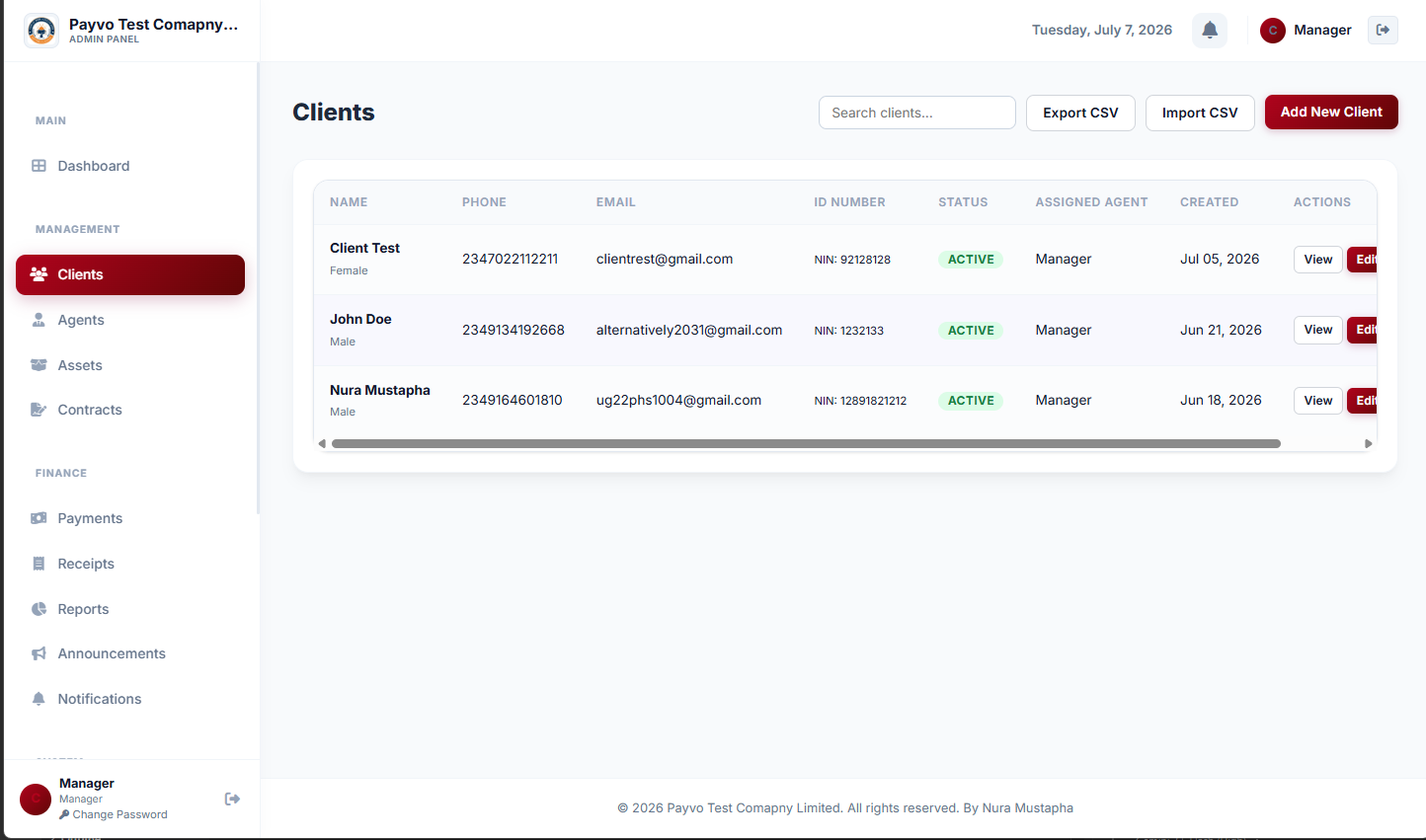 Client: Clients list page
- Automate Contract & Payment Scheduling: Create contracts with custom payment terms, and Payvo automatically generates the entire installment schedule. When payments come in, simply record them, and the system updates everything, providing a full payment history per client.
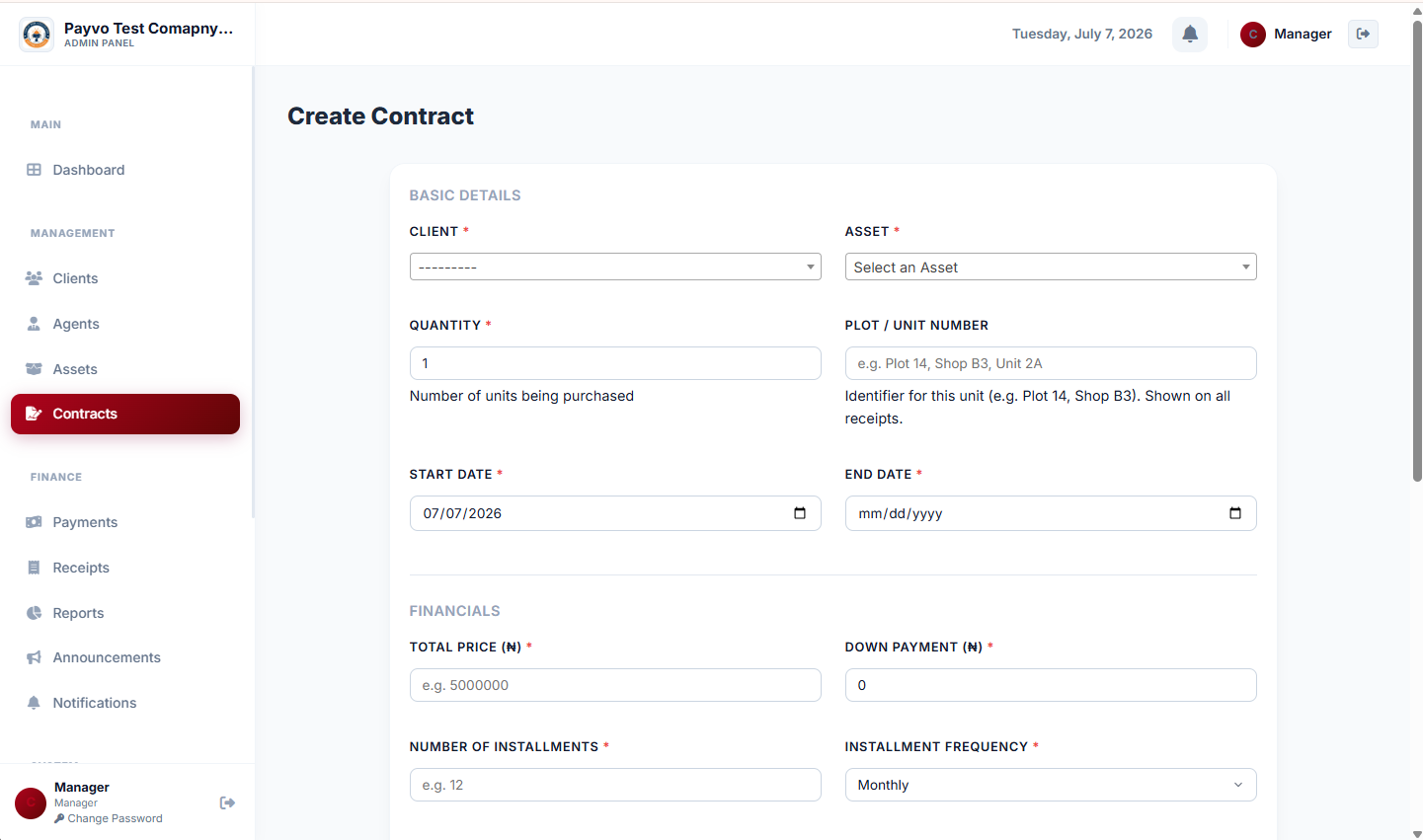 Management: Add contract (top)
- Effortless Receipt Generation & Notification: Say goodbye to manual receipt books. Payvo automatically generates branded receipts (with your logo and signature) for every payment. It also sends automatic notifications via email and WhatsApp for new clients, new contracts, payment received, and crucial payment reminders. This WhatsApp payment notification system drastically reduces follow-up calls and improves client communication.
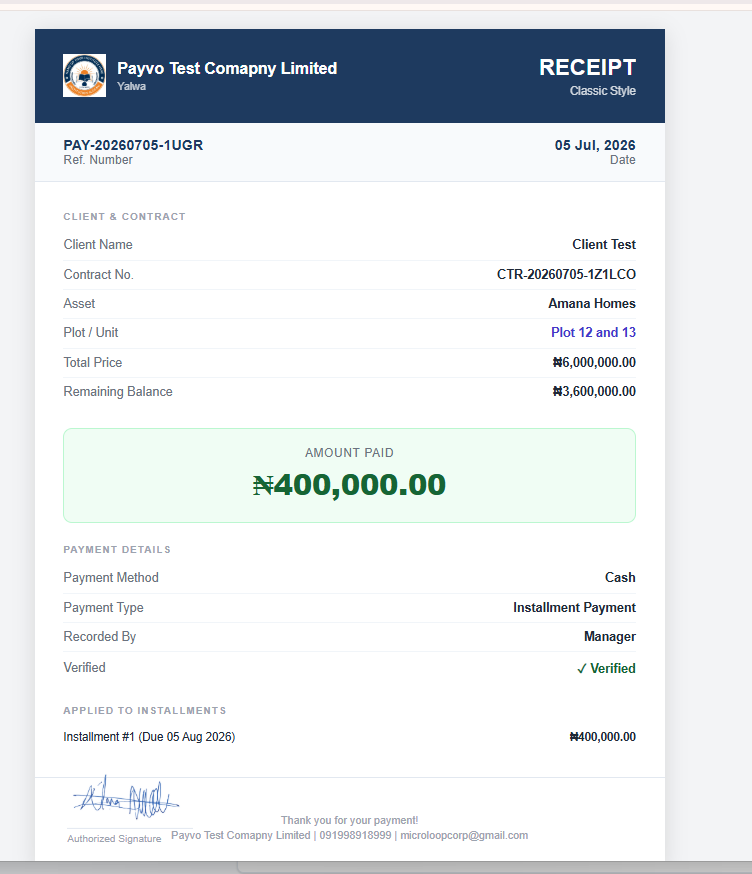 Finance: Paymnet Receipt Sample
- Empower Your Team & Agents: Manage staff accounts with role-based permissions, ensuring data security and efficient workflow. For businesses utilizing sales agents, Payvo offers advanced agent commission tracking software. Assign agents to contracts, automatically calculate their commissions per payment, and track their earnings and payout history. Agents can even log in to view their own KPIs and submit withdrawal requests directly, streamlining your agent management process.
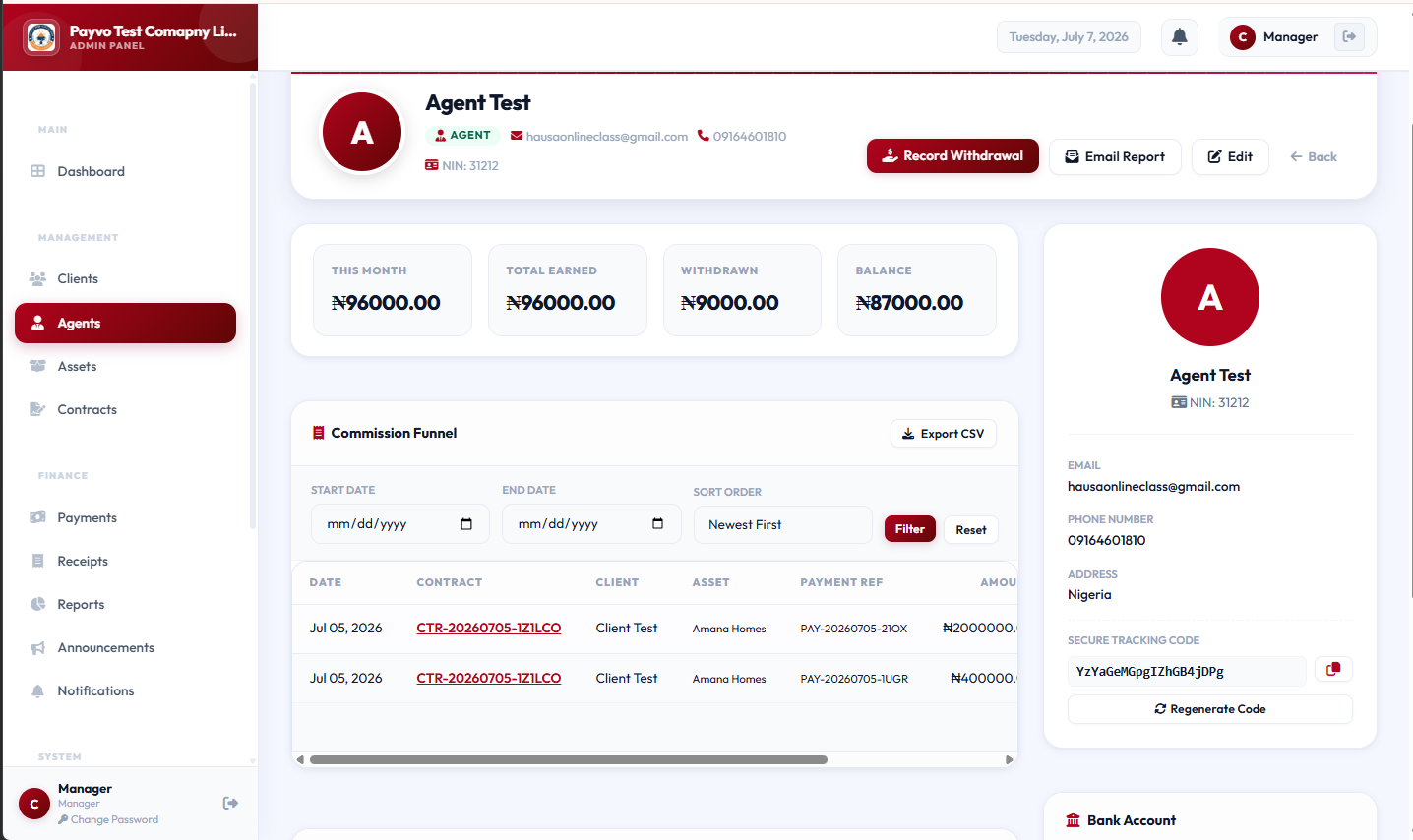 Agent: Agent details page
- Gain Real-time Financial Clarity: The intuitive dashboard provides an instant overview of total clients, active contracts, amounts collected, outstanding balances, and next payment due dates. Generate detailed payment and contract reports in PDF or Excel for accounting and record-keeping, and receive weekly company reports directly to your email, giving you a clear picture of your business's performance.
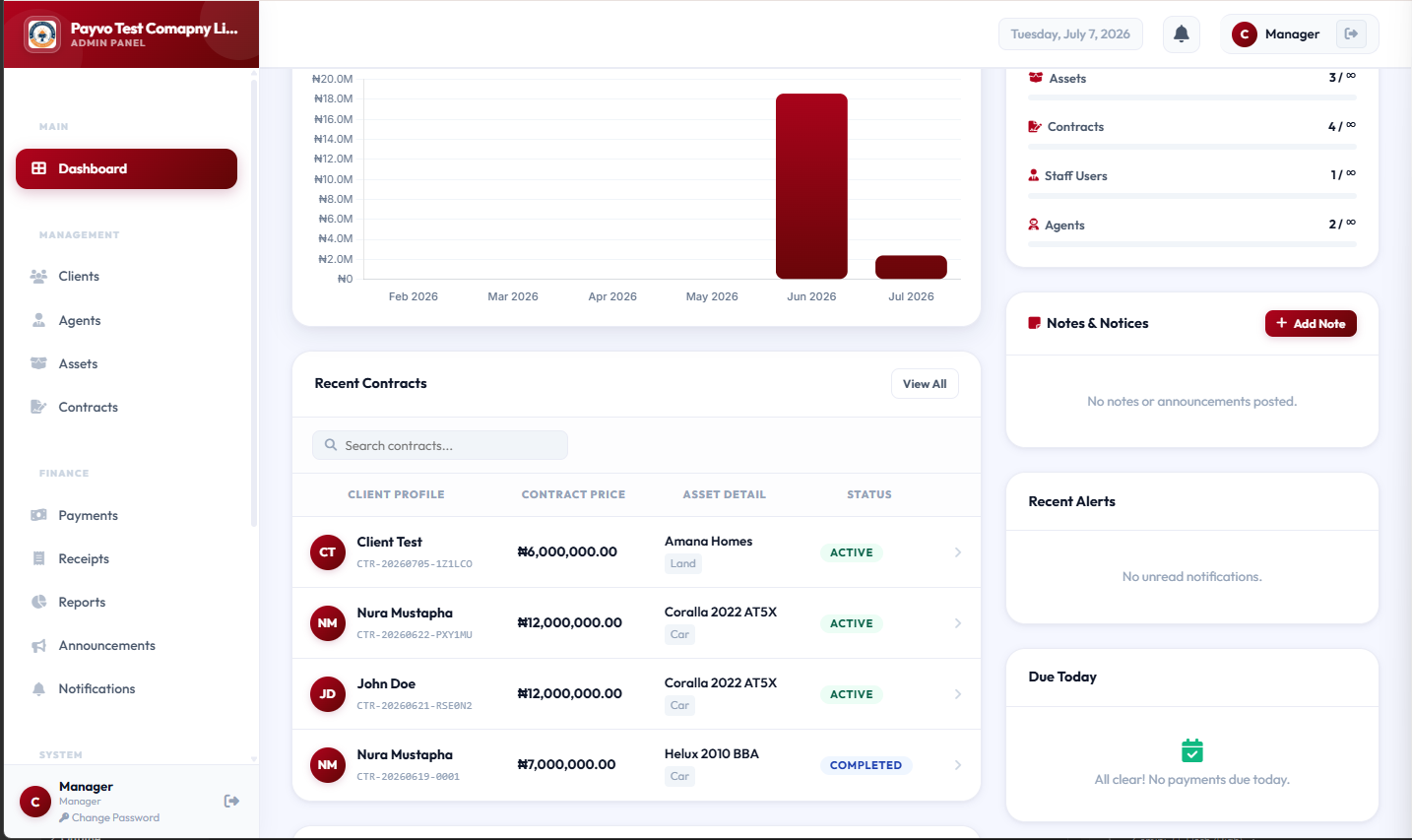 Dashobard (top)
Payvo replaces scattered notebooks, endless WhatsApp chats, and manual reconciliation with one automated, secure system. It's an all-in-one business payment tracking app Nigeria businesses can leverage for growth.
 Sleek 3D illustration of a modern dashboard displaying financial metrics, charts, and payment schedules, with a clean interface and intuitive data visualization.
Proof: Manual vs. Automated Installment Tracking
Let's look at a side-by-side comparison of how traditional methods stack up against a modern installment management software.
| Feature / Aspect | Traditional Manual Methods | Automated Installment Management System (e.g., Payvo) |
|---|---|---|
| Contract Setup | Manual calculation, prone to errors, time-consuming. | Automated schedule generation based on terms, quick, accurate. |
| Payment Recording | Manual ledger entries, spreadsheets, potential for missed updates. | Digital logging, instant updates, linked directly to contracts. |
| Receipt Generation | Manual writing, printing, or generic templates. | Automatic branded receipt generation, digital delivery via email/WhatsApp. |
| Payment Reminders | Manual calls, SMS, WhatsApp messages, inconsistent. | Automated email/WhatsApp reminders before due dates, consistent and timely. |
| Client Communication | Ad-hoc, often reactive, difficult to track history. | Automated notifications, centralized communication history, professional. |
| Agent Commission Tracking | Manual calculations, prone to disputes, complex record-keeping. | Automated calculation per payment, clear payout history, agent self-tracking portal. |
| Financial Reporting | Manual data compilation, time-consuming, delayed insights. | Real-time dashboards, one-click report generation (PDF/Excel), weekly summaries. |
| Error Rate | High due to human intervention. | Minimal due to automation and validation. |
| Scalability | Poor, requires more staff with growth. | Excellent, handles increased volume without proportional staff increase. |
| Client Relationship | Can be strained by payment issues, unprofessionalism. | Enhanced by clear communication, accurate records, and professional interactions. |
| Security & Auditability | Vulnerable to loss, difficult to audit, limited oversight. | Secure data storage, audit logs, role-based access, clear transaction history. |
| Time Savings | Minimal, often negative due to rework. | Significant, freeing up staff for strategic tasks. |
| Revenue Recovery | Lower due to poor follow-up and tracking. | Higher due to proactive reminders and clear overview of outstanding debts. |
This comparison clearly illustrates that while manual methods seem "free," they carry substantial hidden costs in terms of time, accuracy, client satisfaction, and ultimately, lost revenue and growth potential. An automated system like Payvo isn't just an expense; it's an investment with a clear and compelling return. Discover more about how Payvo's features can transform your operations on our features page.
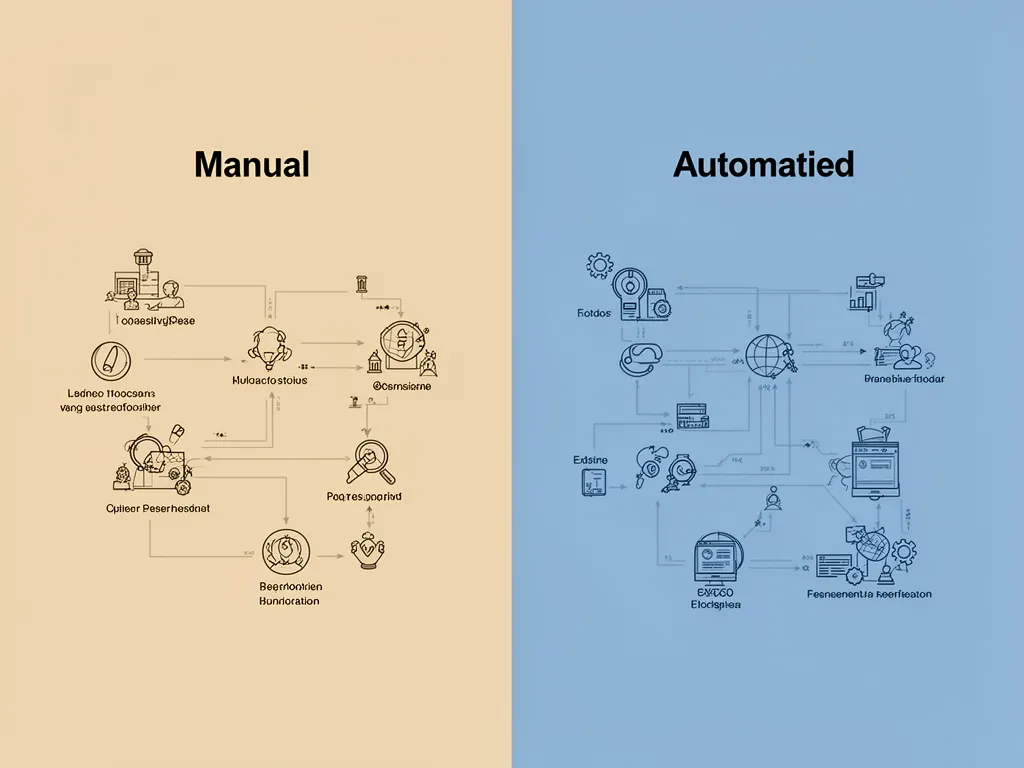 Minimalist graphic design showing two contrasting columns, one with messy, handwritten notes and scattered papers representing manual tracking, and the other with a clean, organized digital interface representing automated tracking.
; Mood: Clear, informative, modern; Composition: Split screen or side-by-side comparison with clear visual metaphors; Format: 16:9 landscape aspect ratio; Negative constraints: ABSOLUTELY NO text, letters, words, numbers, titles, captions, labels, logos, watermarks, or distorted hands)
Frequently Asked Questions
What kind of businesses benefit most from installment management software?
Businesses that frequently sell products or services on a payment plan benefit immensely. This includes real estate developers and property sellers in areas like Kano, Kaduna, and Abuja, car dealers offering hire purchase options, cooperative societies, microfinance operators, solar and equipment leasing companies, and building material suppliers selling on credit. Essentially, any small business owner researching "how to manage installment sales" will find significant value.
How does automated tracking improve cash flow for businesses?
Automated tracking improves cash flow primarily through proactive payment reminders and clear visibility of outstanding balances. By sending automated notifications before due dates, late payments are drastically reduced. Furthermore, real-time dashboards allow businesses to identify overdue accounts quickly and take timely action, preventing small delays from becoming significant defaults. This consistent payment collection ensures a more predictable and healthier cash flow.
Is it difficult to migrate existing client and contract data to a new system?
Modern installment management software is designed for ease of use. While initial data entry might require some effort, many systems offer import functionalities for existing client lists and contract details, often from Excel spreadsheets. The long-term benefits of centralized, accurate data far outweigh the initial setup time. Platforms like Payvo focus on user-friendly interfaces to make this transition as smooth as possible.
How secure is my business data and my clients' information on these platforms?
Reputable installment management software prioritizes data security. This includes using encryption for data in transit and at rest, regular backups, and robust access controls. Features like role-based staff accounts ensure that only authorized personnel can access sensitive information. Always check the privacy policy and terms of service of any platform you consider to understand their data handling practices. You can review Payvo's commitment to security on our privacy policy page.
Can installment management software help with agent commission calculations and tracking?
Absolutely. Advanced systems include dedicated features for agent management. They allow you to assign agents to specific contracts, automatically calculate their commissions based on payments received, and track their earnings and payout history. Some even provide agent self-tracking portals where agents can view their performance KPIs and submit withdrawal requests, significantly reducing administrative overhead and improving agent satisfaction. Learn more about effective agent tracking on our dedicated page.
Ready to Transform Your Installment Sales?
Stop letting manual processes hold your business back. Embrace the hidden ROI of automated installment tracking and unlock growth, efficiency, and peace of mind. Visit our public home page to explore how Payvo can become your ultimate partner in managing installment sales.
Register for Payvo Today!