Managing commissions for a sales team on installment plans can quickly turn into a spreadsheet nightmare, rife with manual calculations, disputes, and delayed payouts. In fact, a recent survey in 2026 found that businesses spending over 10 hours weekly on manual commission calculations are 30% more likely to experience agent dissatisfaction and higher turnover rates. This administrative burden directly impacts your bottom line and your sales team's morale.
The Evolving Landscape of Installment Sales in 2026
The installment sales market in Nigeria continues its robust growth in 2026, driven by increasing consumer demand for flexible payment options across various sectors. From real estate and automotive sales to solar equipment leasing and cooperative societies, businesses are increasingly adopting installment models to attract and retain customers. The Nigerian real estate market alone is projected to grow by 9.5% annually through 2027, with a significant portion of transactions facilitated by installment plans, as reported by the National Bureau of Statistics https://www.nigerianstat.gov.ng/. Similarly, the used car market, heavily reliant on hire purchase, saw a 12% increase in sales volume in 2025, according to a report by PwC Nigeria https://www.pwc.com/ng/en/.
This growth, while promising, brings complexity. Businesses are finding that traditional, manual methods of tracking sales, payments, and especially agent commissions, are no longer sustainable. The sheer volume of transactions and the staggered nature of payments make accurate and timely commission calculation a significant challenge. Delays or errors in commission payments can demotivate agents, leading to decreased productivity and even departure. In a competitive market, retaining a motivated sales force is paramount. This necessitates a shift towards automated solutions that can handle the intricacies of installment-based commissions with precision and transparency.
What You Need Before You Start
Before diving into setting up an automated commission system, ensure you have the following prerequisites in place:
- Clear Commission Structure: Define your commission rates and rules for different products, payment milestones, and agent tiers. This includes understanding if commissions are paid on initial deposits, per installment, or upon full payment.
- Agent Information: A comprehensive list of all your sales agents, including their contact details, unique identifiers, and bank account information for payouts.
- Product/Asset Catalog: A detailed list of all items or services you sell on installment, complete with pricing and any specific commission rules tied to them.
- Contract Templates: Standardized contract agreements that clearly outline payment schedules and terms for clients.
- Dedicated System Access: You'll need access to a robust installment management software Nigeria solution that supports agent tracking and automated commission calculations.
Step-by-Step: Automated Commissions for Installment Sales Agents
Setting up an automated commission system is a strategic move that can transform your operations. Follow these steps to implement a streamlined process.
Step 1: Define Your Commission Rules and Tiers
Before any automation, you must have an unequivocally clear commission policy. This policy should cover:
- Commission Type: Is it a flat fee, a percentage of the sales price, or a percentage of collected payments? For installment sales, paying commissions as a percentage of each collected payment is often the fairest and most sustainable model, aligning agent incentives with successful payment collection.
- Payment Triggers: When is a commission earned? Is it upon contract signing, initial deposit, or as each installment is successfully paid?
- Tiered Structures: Do different products or sales volumes warrant different commission rates? Consider performance-based tiers to incentivize higher sales.
- Deductions and Clawbacks: Outline any scenarios where commissions might be reduced or reversed (e.g., returned goods, canceled contracts, or delayed payments).
 Professional financial analyst reviewing commission reports on a digital tablet, surrounded by charts and graphs.
Step 2: Onboard Your Sales Agents into the System
Once your commission rules are clear, the next critical step is to integrate your sales team into your chosen installment management software. This involves creating individual profiles for each agent.
- Agent Profile Creation: For each agent, input their full name, contact information, and any unique identifiers. This is also where you'll link their bank details for commission payouts.
- Role-Based Access: Assign appropriate roles and permissions. Agents should typically have access to view their own sales, contracts they are assigned to, and their commission earnings, but not necessarily sensitive financial data for the entire company.
- Commission Rate Assignment: Within each agent's profile, or during contract creation, you'll assign the specific commission rate applicable to them or the particular deal. This ensures that the system automatically applies the correct percentage or flat fee.
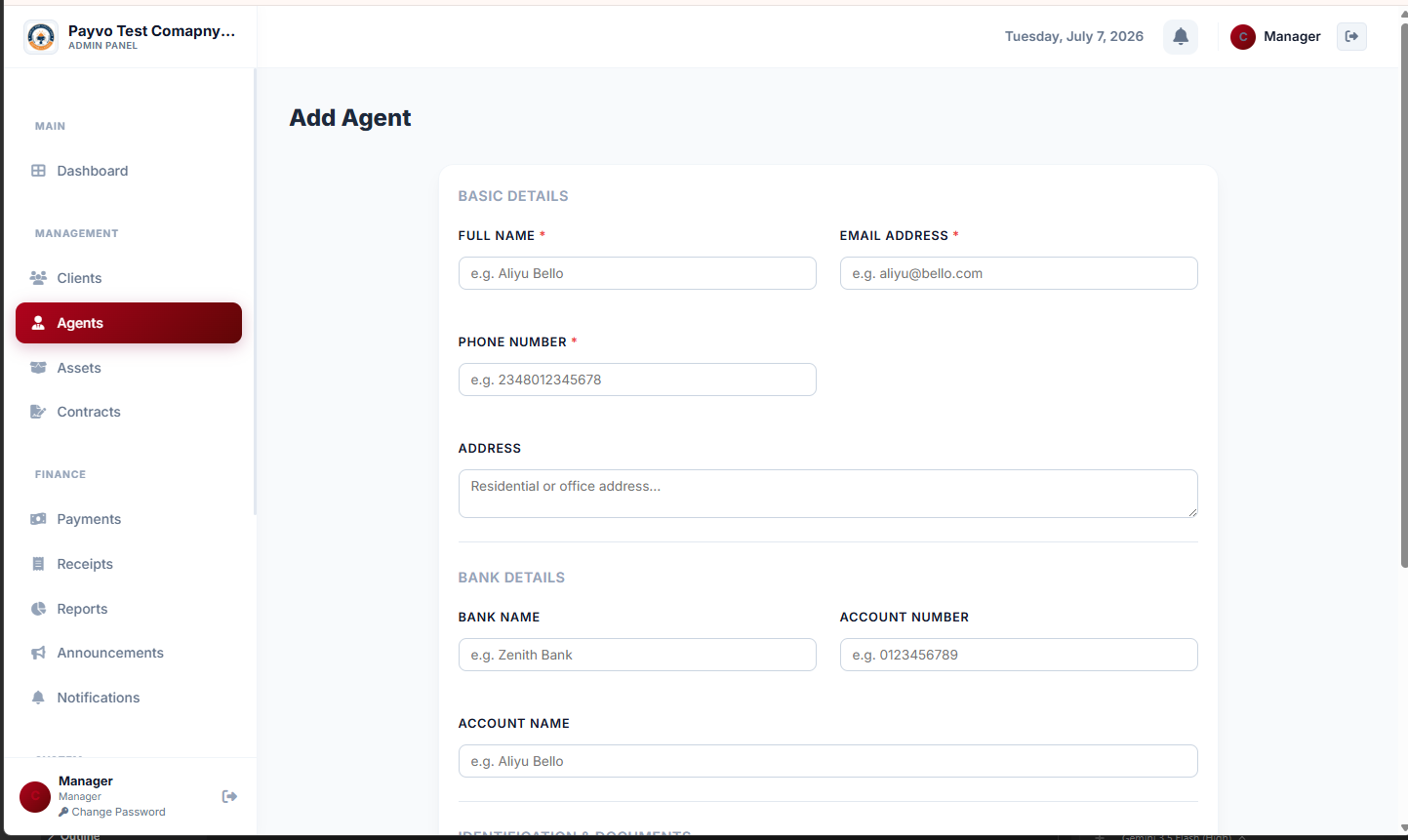 Agent: Add agent page
Step 3: Integrate Products and Assets
For accurate commission tracking, your installment management software needs to understand what is being sold.
- Asset Registration: Register all assets or products you sell on installment. This includes details like the asset name, unique identification numbers (e.g., chassis number for cars, plot number for land), and the base selling price.
- Link to Contracts: Ensure that when a contract is created, it is directly linked to a specific asset. This linkage is crucial for tracking the asset's payment status and, consequently, the agent's commission entitlement. For a car dealer installment software or real estate payment tracking Nigeria, this step is non-negotiable.
Step 4: Configure Contract Creation with Agent Assignment
The core of automated commission lies in how contracts are set up. Each contract should explicitly link to the responsible sales agent.
- Contract Details: When creating a new contract, input all relevant details: client information, asset details, total sale price, down payment, installment amount, frequency, and due dates.
- Agent Assignment: Crucially, assign the specific sales agent responsible for that contract. This is the direct link that enables the system to attribute commissions correctly.
- Automated Schedule Generation: A good system will automatically generate the full installment schedule based on the terms you set, eliminating manual calculation errors. This feature is a cornerstone of effective contract management software Nigeria.
Step 5: Automate Payment Tracking and Commission Calculation
This is where the automation truly shines. As payments come in, the system should do the heavy lifting.
- Record Payments: When a client makes an installment payment, record it accurately in the system. This can often be done manually by an administrator or, in more advanced setups, integrated with payment gateways.
- Automatic Commission Calculation: Upon recording a payment, the system should automatically calculate the agent's commission based on the predefined rules and the amount collected. This removes the need for manual spreadsheets and reduces errors significantly.
- Real-time Updates: Agents should be able to see their updated commission earnings in real-time or near real-time. This transparency boosts morale and trust.
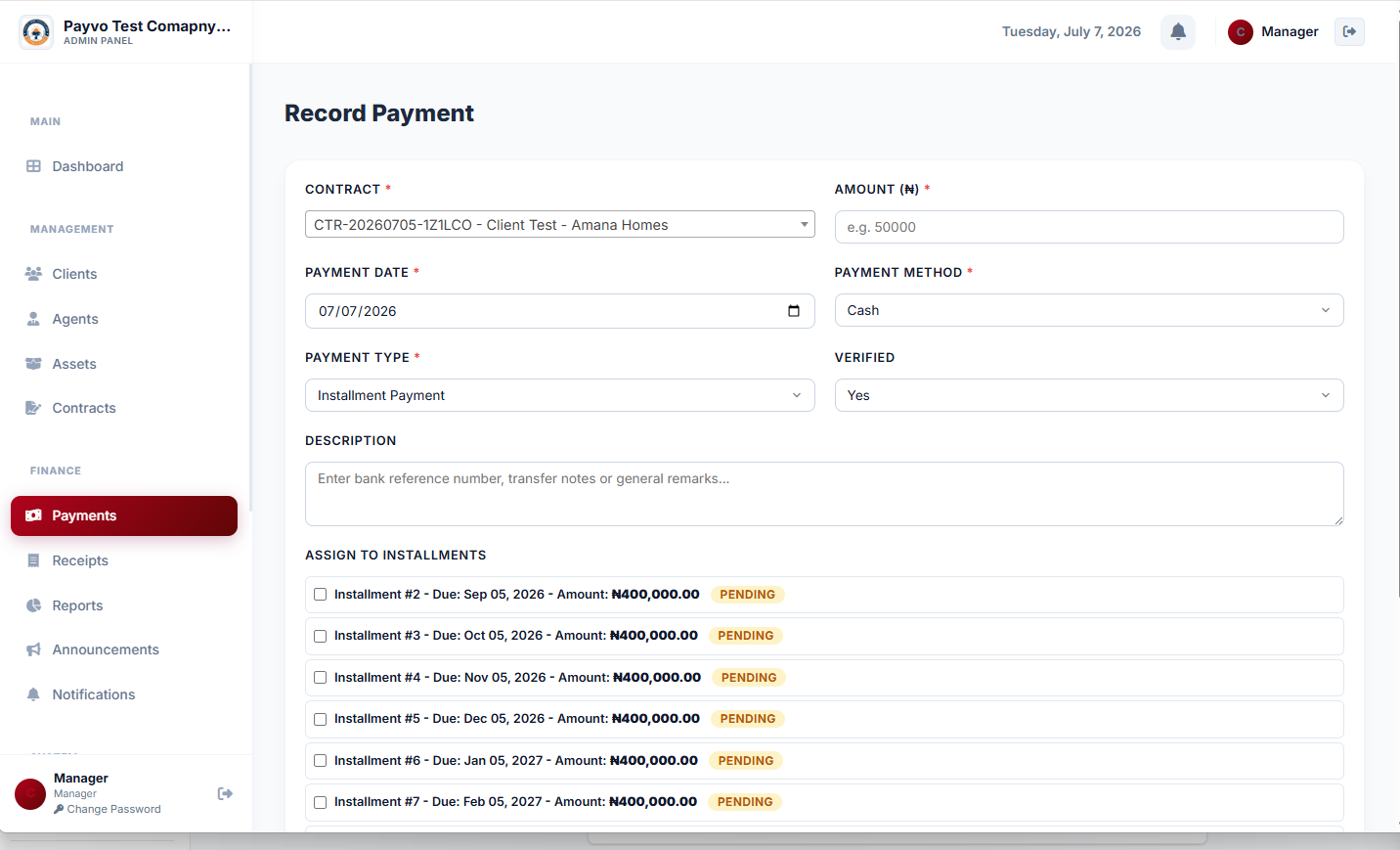 Finance: Record Payments Page
Step 6: Facilitate Agent Self-Tracking and Payout Requests
Empowering agents with visibility into their earnings is a powerful motivator.
- Agent Portal/Dashboard: Provide agents with a secure login where they can view their assigned contracts, payment statuses, and accumulated commission earnings.
- Withdrawal Requests: Allow agents to submit withdrawal requests directly through the system. This centralizes the process and provides an audit trail.
- Manager Notifications: Ensure that managers are instantly notified of agent withdrawal requests, enabling prompt review and approval. This feature is a key component of effective agent commission tracking software.
 A sales team dashboard displaying real-time commission earnings, contract statuses, and agent performance metrics.
Step 7: Generate Receipts and Send Automated Notifications
Communication is key in installment sales.
- Automated Receipts: For every payment recorded, the system should automatically generate a branded receipt. This not only serves as proof of payment for the client but also confirms the transaction within the system, which directly impacts commission calculations.
- Payment Reminders: Implement an automated WhatsApp payment notification system to send reminders to clients before their due dates. This significantly reduces late payments, which in turn ensures a steady flow of commissionable income for agents.
- Agent Notifications: Inform agents about successful payments on their contracts and any updates to their commission balance.
Step 8: Monitor, Report, and Optimize
The final step is continuous improvement.
- Real-time Dashboards: Utilize a real-time dashboard to monitor overall sales performance, collected payments, outstanding balances, and total commissions accrued. This provides an instant snapshot of your business health.
- Commission Reports: Regularly generate detailed commission reports. These reports are vital for payroll, accounting, and resolving any potential agent queries. They should show commissions earned per agent, per contract, and per payment.
- Performance Analysis: Use the data to analyze agent performance, identify top performers, and understand trends. This can inform future sales strategies and commission structure adjustments.
- Audit Trails: Ensure your system maintains an audit log of all activities, providing transparency and accountability for every transaction and commission adjustment.
Common Mistakes to Avoid
Implementing an automated commission system can significantly boost your operational efficiency, but it's crucial to sidestep common pitfalls:
- Unclear Commission Policies: Vague or frequently changing commission structures lead to confusion, disputes, and agent distrust. Ensure policies are documented, understood, and consistently applied.
- Lack of Agent Training: Introducing a new system without proper training for your sales agents will result in low adoption rates and errors. Provide comprehensive guides and support.
- Ignoring System Security: Failing to implement proper role-based access controls can expose sensitive financial data. Ensure only authorized personnel can view or modify commission settings and payouts.
- No Audit Trail: Without a robust audit log, it becomes impossible to trace changes, resolve disputes, or verify calculations, leading to accountability issues.
- Over-reliance on Manual Overrides: While flexibility is good, constantly overriding automated calculations defeats the purpose of automation and introduces human error back into the system.
- Neglecting Communication: Failing to communicate system changes, payment updates, or commission statements to agents can lead to frustration and a feeling of being left in the dark.
How to Track and Grow After Launch
After successfully launching your automated commission system, the work shifts to tracking performance and leveraging data for growth.
Key Performance Indicators (KPIs) to Watch:
- Total Commissions Paid: Monitor the aggregate amount paid out to agents over time. This helps in financial planning and understanding sales team costs.
- Average Commission per Agent: Track this to identify top performers and areas for improvement.
- Commission as a Percentage of Revenue: This ratio helps assess the efficiency of your commission structure relative to your sales.
- Agent Turnover Rate: A well-managed commission system can positively impact agent retention. Monitor this closely.
- Payment Collection Rate: Since commissions are often tied to collected payments, tracking this KPI directly reflects the health of your installment contracts and the effectiveness of your agents in closing viable deals.
- Performance-Based Incentives: Use detailed commission data to design new incentive programs. For example, offer bonuses for agents who consistently achieve high payment collection rates or for those who bring in the largest contracts.
- Targeted Training: Identify agents who might be underperforming based on their commission earnings or payment collection rates. Provide targeted training or mentorship to help them improve.
- Optimize Product Offerings: Analyze which products generate the most commission and sales volume. This data can inform your product development and marketing strategies.
- Refine Commission Structures: Periodically review your commission rules. Are they motivating the right behaviors? Are they fair and competitive? Use your automated system's reporting capabilities to model different scenarios.
- Enhanced Agent Motivation: With transparent, real-time tracking, agents are naturally more motivated. They can see their earnings grow with each payment, fostering a sense of ownership and driving them to close more deals and ensure payments are collected. Payvo offers real-time dashboards where you can see total clients, active contracts, amounts collected, and outstanding balances at a glance, alongside detailed reports that can be exported for deeper analysis. These insights are invaluable for strategic growth and optimizing your installment sales operations.
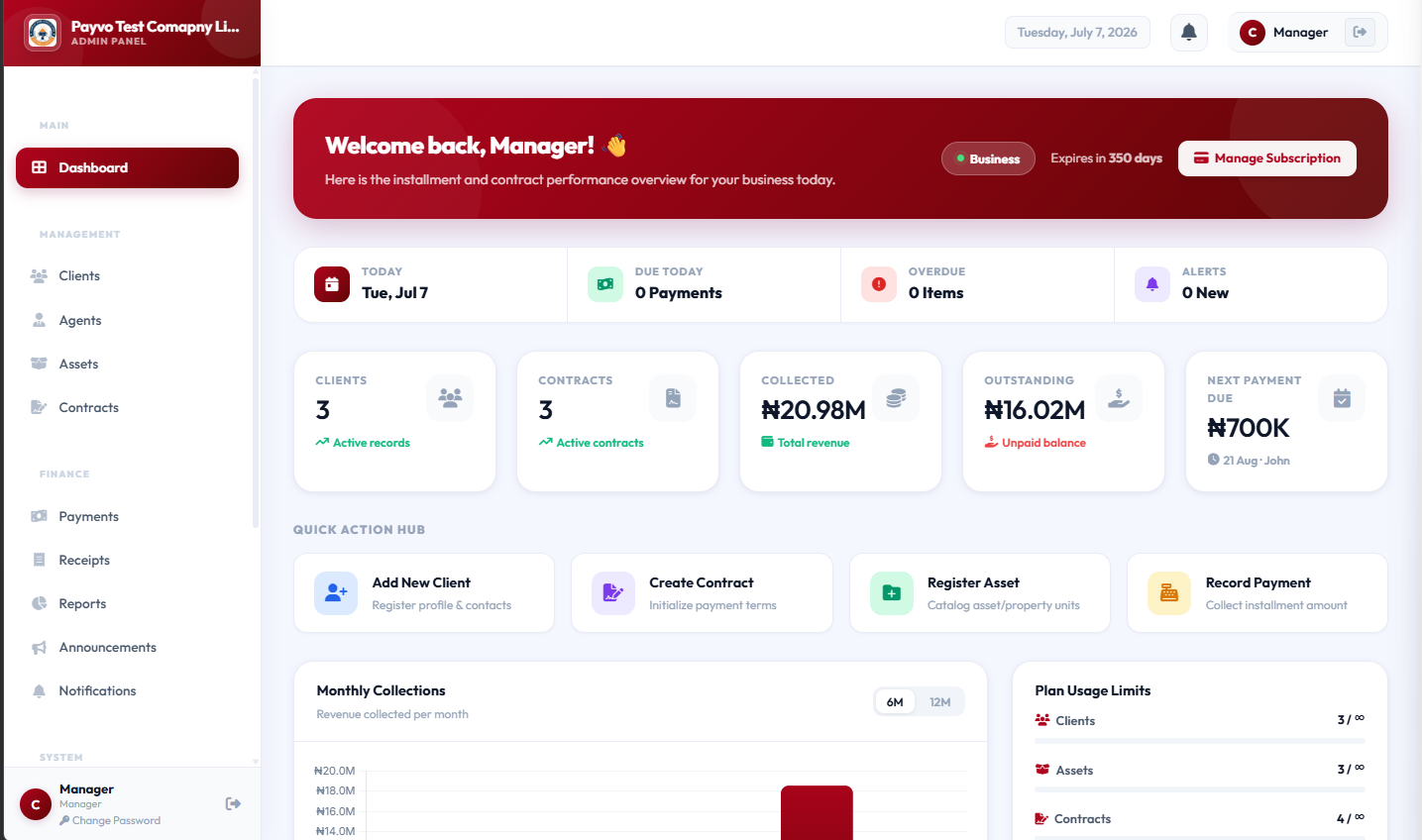 Dashboard (bottom)
Frequently Asked Questions
Q1: How does automated commission tracking handle partial payments?
A1: A robust installment management software Nigeria system is designed to handle partial payments seamlessly. When a partial payment is recorded against an installment, the system will calculate the commission as a pro-rata percentage of the amount received, based on your predefined commission rules. The remaining commission for that installment will then be paid out once the balance is collected. This ensures agents are compensated accurately for every portion of a payment they help secure.
Q2: Can I set different commission rates for different products or services?
A2: Absolutely. A key advantage of an automated agent commission tracking software is its flexibility. You can typically configure different commission rates not only per agent but also per product, service, or even specific contract types. This allows for nuanced incentive structures that align with the profitability or strategic importance of various offerings. For instance, a higher commission might be set for a new property development compared to a standard car sale.
Q3: What happens if a client defaults on their payments after an agent has earned commission?
A3: Your commission policy should clearly address this. In automated systems, you can define "clawback" rules. If a client defaults and the contract is terminated, the system can be configured to reverse or adjust future commission payouts to the agent, especially if commissions were paid upfront on the full sale value. If commissions are paid per collected installment, the agent simply stops earning commission once payments cease, which is a more common and fairer approach for installment sales.
Q4: Is it possible for agents to track their own commissions in real-time?
A4: Yes, modern installment management solutions provide agent self-tracking capabilities. Agents are typically given secure access to a dedicated portal or dashboard where they can view their assigned contracts, the status of payments, and their accumulated commission earnings. This transparency is crucial for agent motivation and trust, allowing them to see how their efforts directly translate into income, a core feature of an effective business payment tracking app Nigeria.
Q5: How does the system ensure transparency and prevent commission disputes?
A5: Automation significantly enhances transparency. Every payment is recorded, every commission calculation is logged, and agents have direct access to their earnings data. Furthermore, systems often include audit logs that track every action taken within the platform, providing an undeniable record for dispute resolution. Clear, pre-defined commission rules, combined with accessible data, form the bedrock of a dispute-free commission management process.
Q6: Can the system integrate with WhatsApp for payment reminders and notifications?
A6: Yes, many advanced installment management platforms, including Payvo, offer a WhatsApp payment notification system. This allows businesses to send automated payment reminders, payment received confirmations, and other critical alerts directly to clients via WhatsApp. This not only improves payment collection rates but also enhances customer engagement and reduces the manual effort involved in follow-ups.
Ready to Streamline Your Commission Management?
Stop wrestling with spreadsheets and manual calculations. Take the leap towards efficient, transparent, and motivating commission management for your installment sales agents. Explore how a dedicated platform can transform your operations. Visit our features page to learn more about how Payvo can help you manage clients, contracts, and commissions effortlessly, or register into Payvo today to get started.