Tracking sales commissions for installment payments in Nigeria often feels like solving a complex puzzle with missing pieces. Manual spreadsheets are prone to errors, leading to frustrated agents and inaccurate payouts, while chasing down payments and calculating commissions by hand eats into valuable business time. This struggle is particularly acute for businesses like real estate firms, car dealerships, and cooperative societies that rely heavily on staggered payments.
 Busy nigerian market street with traders and customers
The Evolving Landscape of Installment Sales in Nigeria (2026)
In 2026, the Nigerian economy continues to see a significant shift towards flexible payment models, especially in sectors like real estate, automotive, solar energy, and even building materials. Businesses are increasingly offering installment plans to make high-value products and services accessible to a broader customer base, ranging from individuals to small and medium enterprises. This approach helps boost sales velocity and broadens market reach, but it also introduces complexities in managing cash flow, client relationships, and critically, sales commissions.
The average Nigerian household income, while growing, still necessitates payment flexibility for major purchases. This reality means businesses must adapt or risk losing out. However, with this opportunity comes the challenge of managing a large volume of recurring payments and ensuring that the sales force, often comprising agents working on commission, is paid accurately and on time. Delays or errors in commission payouts can severely demotivate agents, leading to high turnover and a direct impact on sales performance. Businesses are looking for robust systems that can handle these intricacies, moving away from outdated, manual methods that are no longer sustainable for growth. The need for efficient contract management software Nigeria has never been more pressing.
What You Need Before You Start
Before diving into automating your sales commissions, ensure you have these foundational elements in place:
- Clear Commission Structure: Define your commission rates and rules. Will agents earn a percentage of the total sale, a percentage per installment collected, or a tiered bonus based on performance? Clarity here is paramount.
- Detailed Sales Data: Access to comprehensive records of sales, contracts, payment schedules, and actual payments received. This data is the backbone of accurate commission calculation.
- Reliable Internet Access: Automation requires consistent connectivity. Budget for dedicated internet data, which can range from ₦5,000 to ₦15,000 per month for consistent use.
- Basic Digital Literacy: Your staff and agents should be comfortable using computers or smartphones for data entry and tracking.
- Designated Hardware: A reliable laptop or desktop for managing the system. A basic, functional machine might cost between ₦150,000 and ₦400,000.
- Backup Power: Given grid inconsistencies, a generator or inverter is crucial to ensure uninterrupted operations. Factor in fuel costs, which could be ₦10,000 to ₦50,000 monthly, depending on usage.
Step-by-Step: Automating Sales Commissions for Installment Businesses
Automating sales commissions transforms a tedious, error-prone process into an efficient, transparent system. Here’s how to do it, step-by-step.
Step 1: Define Your Commission Rules
The first and most critical step is to clearly outline your commission structure. This goes beyond just a percentage. Consider:
- Commission Triggers: Is commission paid when the contract is signed, upon the first installment, or only after a certain percentage of the total amount is collected? For installment businesses, it's often more prudent to tie commissions to actual payments received, not just the sale itself, to align agent incentives with cash flow.
- Commission Tiers: Do commission rates increase for higher sales volumes or for specific products? For example, an agent might earn 5% on property sales up to ₦10,000,000 and 7% on sales above that.
- Payment Schedules: Will commissions be paid weekly, bi-weekly, or monthly? How will partial payments affect commission calculations?
- Deductions and Clawbacks: What happens if a client defaults or cancels a contract? How will this impact already-paid commissions? Having these rules clearly documented prevents disputes and ensures fairness.
Step 2: Choose the Right Installment Management Software
Once your rules are clear, you need the tools to enforce them. A robust installment management software Nigeria is indispensable. Look for a system that can handle complex payment schedules, track client payments accurately, and most importantly, automate commission calculations.
Evaluate software options based on their ability to:
- Manage Clients and Contracts: Store full client details, track assets (like cars, property, or solar panels), and create contracts with automated installment schedules.
- Record Payments: Log single payments against any contract with a full history.
- Automate Commission Calculation: This is key. The system should calculate commissions based on your predefined rules as payments are recorded.
- Generate Reports: Provide clear insights into sales performance, payments received, and commissions due.
Step 3: Configure Your System and Onboard Data
With your software chosen, it's time to set it up. This involves inputting your specific business rules and existing data.
- Input Commission Structures: Enter your defined commission rates, tiers, and triggers into the software. This is where the automation truly begins.
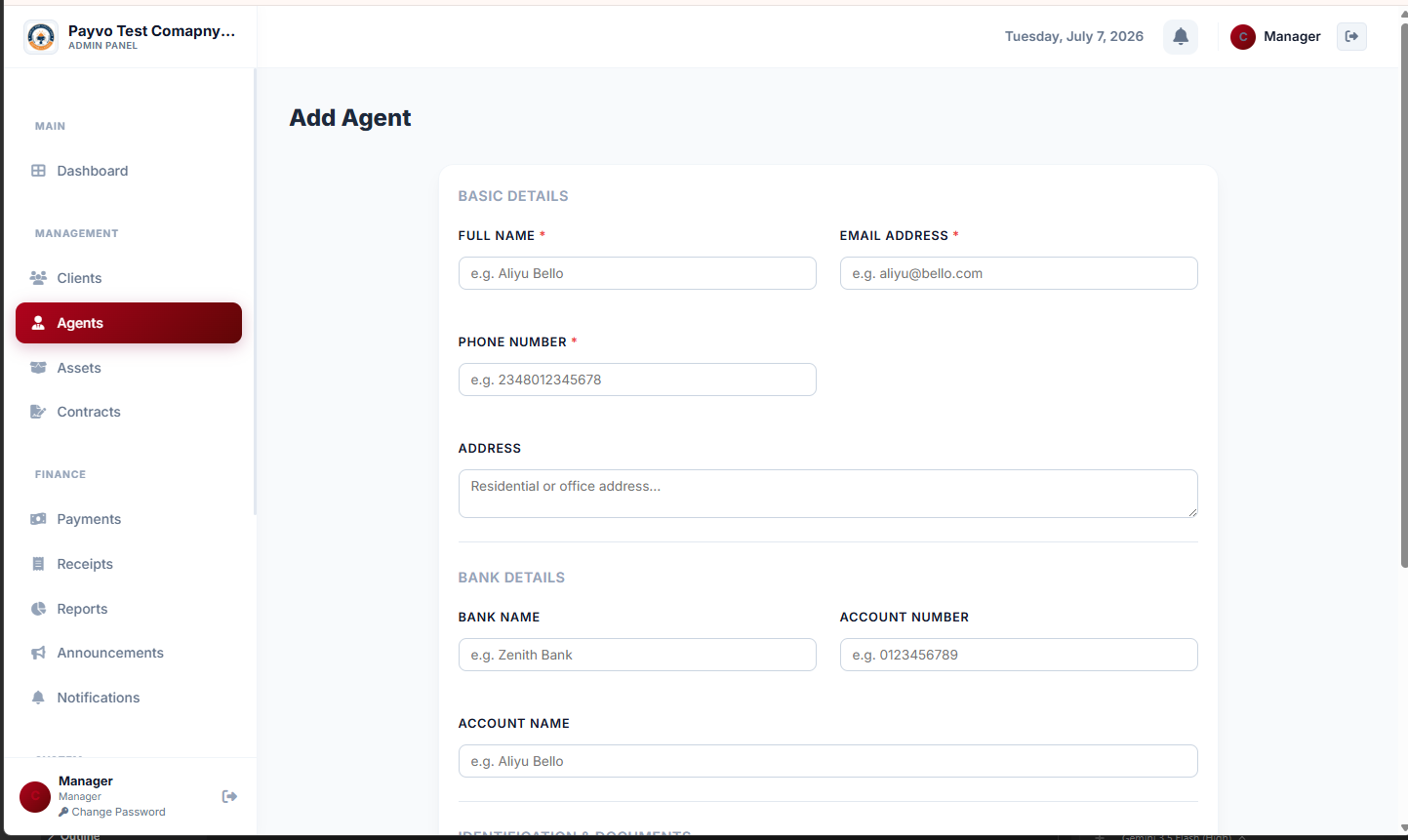 Agent: Add agent page
- Migrate Client and Contract Data: Upload all your existing client information, active contracts, and asset details. Ensure all payment terms and schedules are accurately reflected.
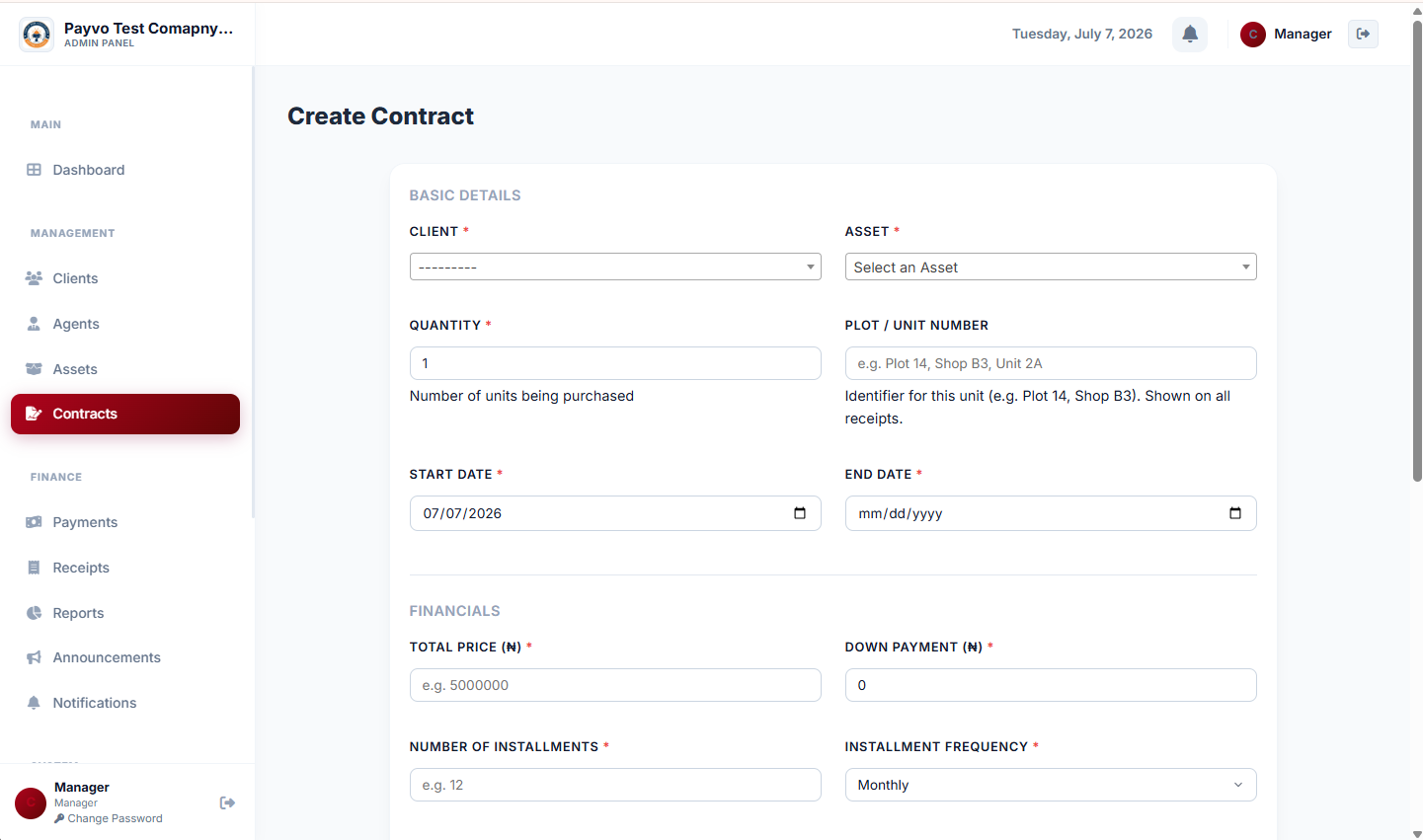 Management: Add contract (top)
- Add Your Sales Agents: Create profiles for all your sales agents. Link them to their respective contracts or sales as appropriate. For effective agent commission tracking software, each agent needs a unique identifier within the system.
- Set Up Notifications: Configure automated notifications for payment reminders, new contract confirmations, and payment receipts. A WhatsApp payment notification system is particularly effective in Nigeria for reaching clients promptly.
Step 4: Streamline Payment Recording and Receipt Generation
Accurate payment recording is fundamental for accurate commission calculation. Your chosen system should make this process seamless.
- Log Payments Immediately: As soon as a client makes an installment payment, record it in the system. This triggers the commission calculation for the associated agent.
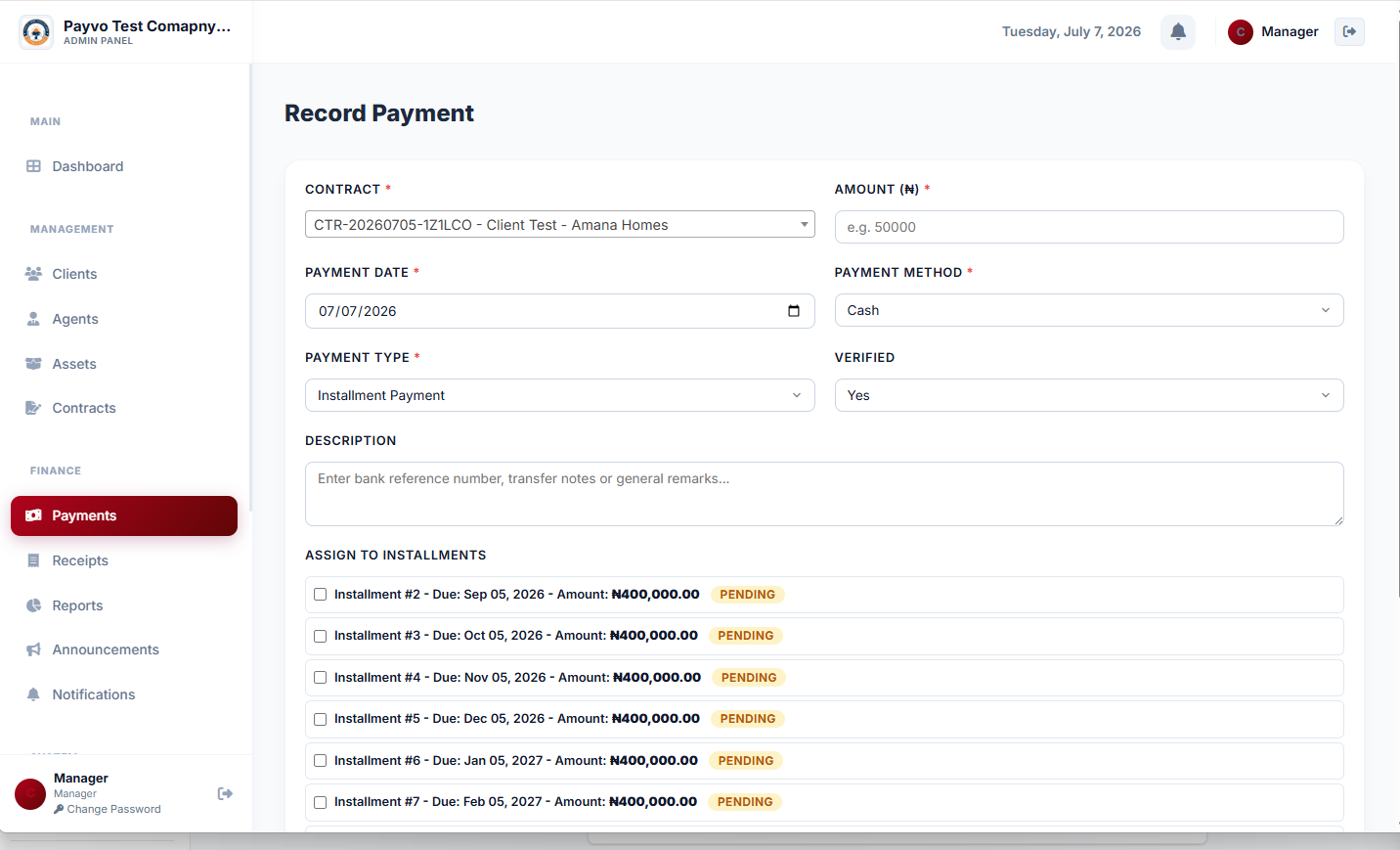 Finance: Record Payments Page
- Automate Receipts: The system should automatically generate branded receipts for each payment. This provides proof of payment for the client and a clear record for your business. A good receipt generator app Nigeria will include your company logo, colors, and digital signature.
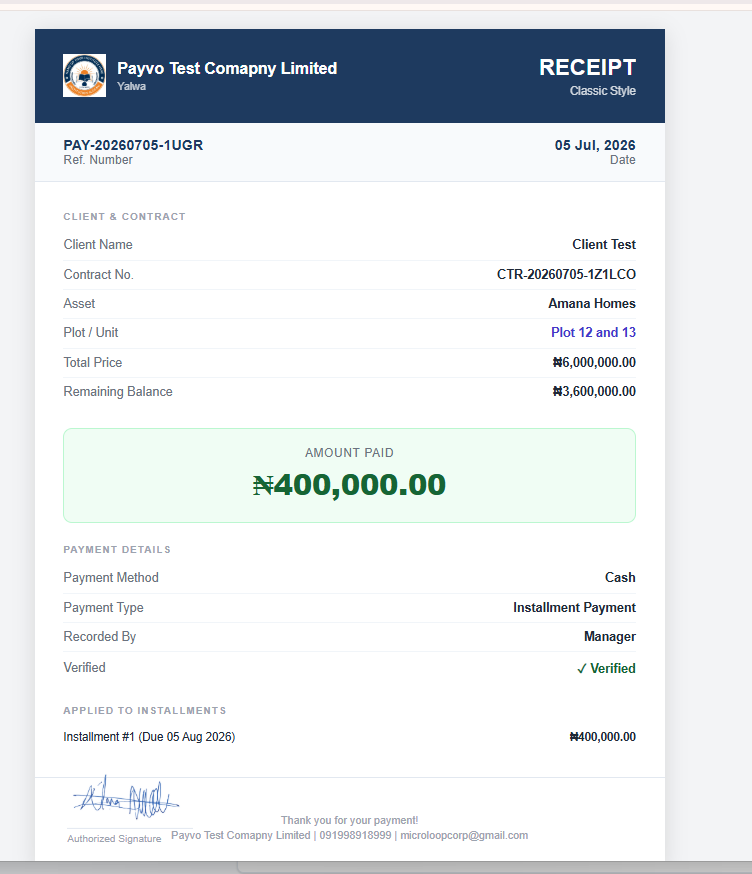 Finance: Paymnet Receipt Sample
- Send Automatic Notifications: Ensure the system sends automated payment received notifications to clients via email and WhatsApp. This improves client satisfaction and reduces queries. Such features are critical for any business payment tracking app Nigeria.
Step 5: Automate Commission Calculation and Payout Tracking
This is where the power of automation truly shines. The system, like Payvo, will automatically calculate the commission due to each agent based on the payments recorded against their contracts and your pre-defined rules.
- Real-time Updates: Agents should be able to see their earnings updated in real-time as payments come in. This transparency builds trust and motivates performance.
- Payout Management: The system should track commissions due, commissions paid, and outstanding commission balances. This simplifies payroll processing for your agents.
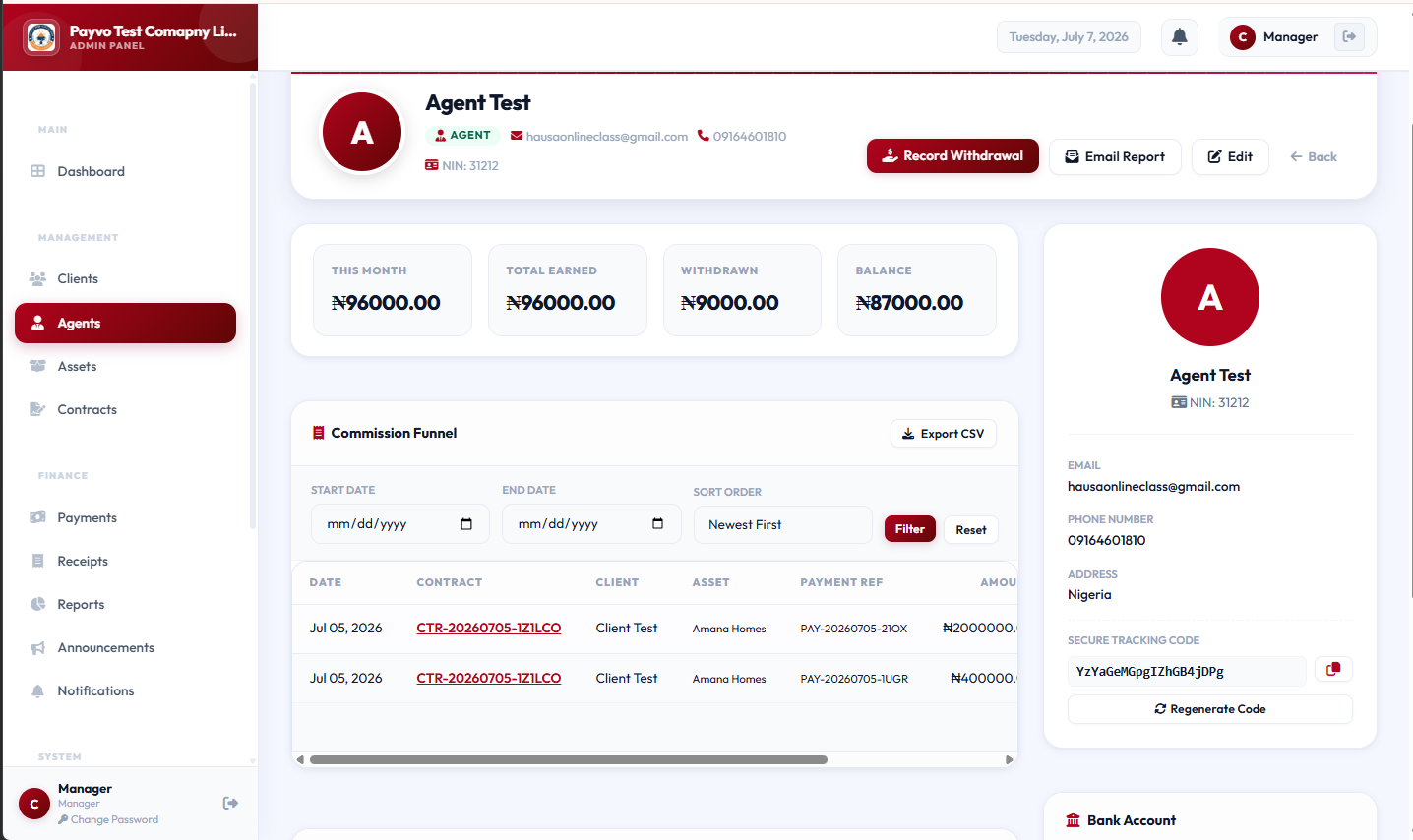 Agent: Agent details page
- Agent Self-Tracking: Empower agents to log in and view their own earnings and performance metrics. This can significantly reduce administrative overhead and improve agent satisfaction. For example, Payvo allows agents to log in with a code to view their KPIs and even submit withdrawal requests directly, which managers are instantly notified of. This is a crucial aspect of effective sales commission software.
Step 6: Monitor Performance and Generate Reports
Automation isn't just about calculation; it's also about insights. A good system provides dashboards and reports to help you monitor performance, identify trends, and make informed decisions.
- Dashboards: At a glance, view key metrics like total clients, active contracts, amount collected, outstanding balances, and next payments due.
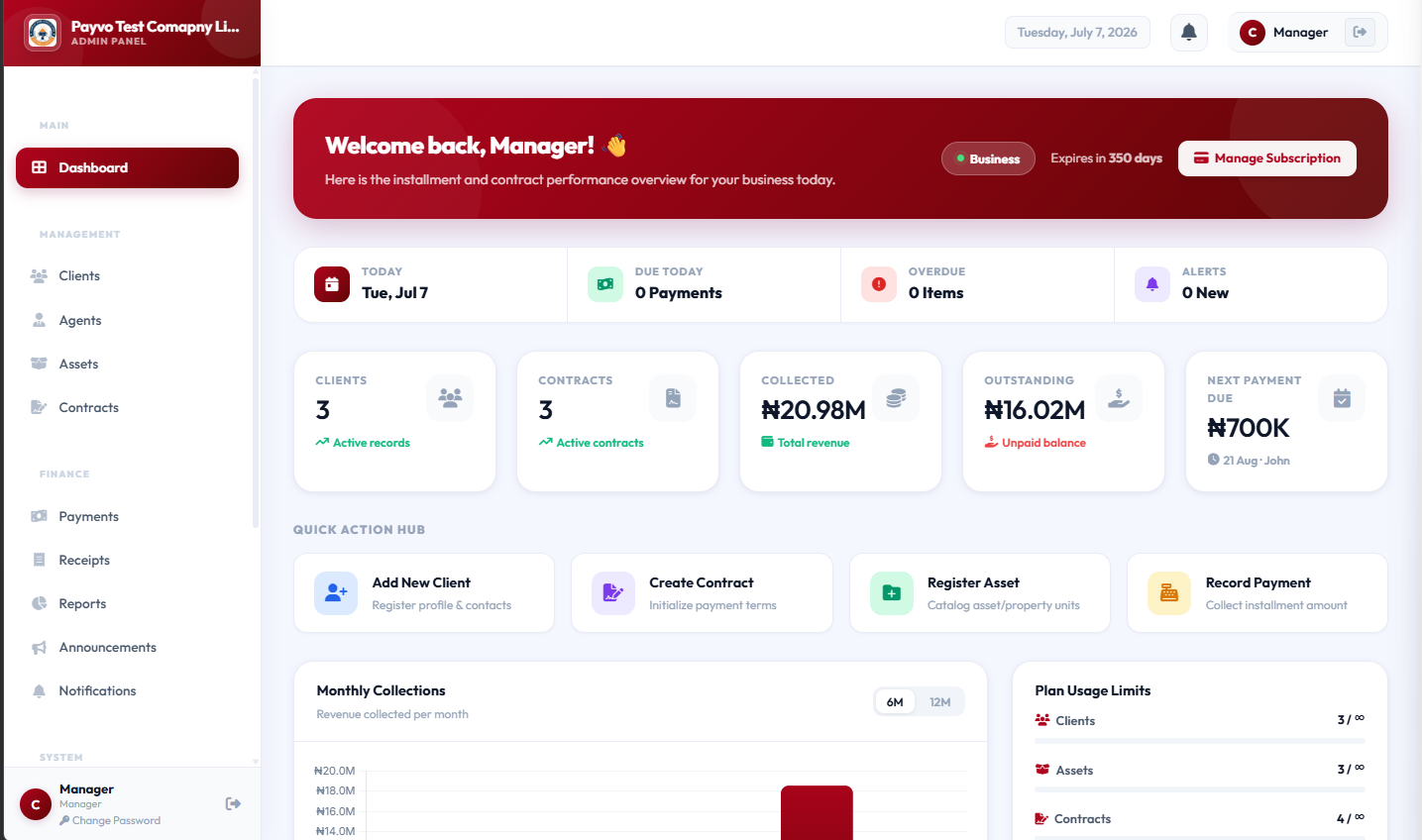 Dashboard (bottom)
- Commission Reports: Generate detailed reports showing commissions earned by each agent, per contract, and over specific periods. This simplifies accounting and ensures compliance.
- Sales Performance Reports: Analyze which agents are performing best, which contracts are collecting well, and identify areas for improvement. This data is invaluable for optimizing your sales strategy and agent incentives.
- Weekly Summaries: Receive automated email summaries covering key business performance metrics, keeping you informed without needing to manually pull reports.
Common Mistakes to Avoid
Automating sales commissions can be transformative, but pitfalls exist. Avoid these common mistakes:
- Unclear Commission Structures: Entering vague or ambiguous rules into a system will lead to incorrect calculations and agent dissatisfaction. Define everything precisely in Step 1.
- Ignoring Agent Feedback: Agents are on the front lines. Their input on commission structures and system usability is invaluable. Involve them early.
- Lack of Staff Training: Even the most intuitive software requires proper training. Invest in showing your team how to use the system effectively. Budget ₦10,000 to ₦40,000 per session for internal training.
- Poor Data Entry: "Garbage in, garbage out." If payment details are entered incorrectly, commissions will be wrong. Emphasize accuracy.
- Neglecting System Updates: Software providers regularly release updates. Ensure your system is kept current to benefit from new features and security enhancements.
- Over-reliance on Manual Overrides: While flexibility is good, constantly manually adjusting automated calculations defeats the purpose of automation and introduces errors. Refine your rules, not your manual interventions.
How to Track and Grow After Launch
Once your automated commission system is up and running, the journey doesn't end. Continuous tracking and strategic growth are key.
Firstly, monitor your Key Performance Indicators (KPIs). For agents, this includes:
- Sales Volume: Number of new contracts closed.
- Collection Rate: Percentage of installments collected on time.
- Commission Earned: Total earnings over a period.
- Client Retention: How many clients introduced by an agent complete their contracts successfully.
Secondly, leverage the insights for growth. If your system shows that certain payment reminder strategies lead to higher collection rates, double down on those. If specific agents consistently achieve high client retention, analyze their methods and share best practices. A platform that provides detailed reports, like Payvo, allows you to export payment and contract data as PDF or Excel for accounting and record-keeping, giving you a clear picture of your financial health and agent performance. This data also informs decisions on how to optimize your how to automate sales commissions process further.
Thirdly, ensure your agents are actively using the self-tracking features. When agents can see their earnings and performance transparently, it fosters motivation and reduces queries to management, freeing up valuable administrative time. This transparency is a powerful tool for agent retention and morale.
 Modern office desk with digital dashboard displaying data
Frequently Asked Questions
Q1: How does an automated system handle varying commission rates for different products or services?
A1: A well-designed automated system allows you to set up multiple commission rules or tiers. For example, a car dealer installment software can be configured so that agents earn 3% on SUV sales and 2% on sedan sales, or a tiered percentage based on the vehicle's price. When you create a contract and link it to a specific product or service, the system automatically applies the correct commission rate.
Q2: What if a client misses an installment payment? How does that affect agent commissions?
A2: This depends on how you configure your rules in Step 1. Most sophisticated systems allow you to tie commission payouts directly to actual payments received, not just scheduled payments. If a client misses an installment, the commission for that specific installment is simply not triggered until the payment is made. This ensures agents are paid for successful collections and aligns their incentives with your cash flow. The system will track the outstanding payment and, once collected, the corresponding commission will be calculated.
Q3: Can an automated system integrate with our existing accounting software?
A3: Many modern commission management systems offer integration capabilities. This often happens through APIs (Application Programming Interfaces) or via data export functions (e.g., CSV, Excel). While direct, real-time integration might require a more advanced plan or custom setup, the ability to export detailed commission reports easily for import into your accounting software is a standard feature. This helps maintain accurate financial records and streamlines reconciliation.
Q4: Is it secure to store client and payment data in an online system?
A4: Reputable online systems prioritize data security. They employ encryption, secure servers, regular backups, and access controls to protect sensitive information. Look for providers that adhere to international data security standards and offer features like audit logs, which track every action taken within the system. Understanding the Privacy Policy Page and Terms of Service Page of your chosen provider is crucial.
Q5: How can a small business afford such a system?
A5: Many providers offer tiered pricing plans to suit different business sizes and budgets. Basic plans are often designed for small businesses with fewer clients and simpler commission structures, making them affordable. The long-term savings from reduced manual errors, improved agent motivation, and increased efficiency often outweigh the monthly subscription costs. Consider the overall value and return on investment, not just the upfront price. You can explore options on a Pricing Page.
Ready to Streamline Your Operations?
Automating sales commissions for your installment-based business is no longer a luxury but a necessity for growth and efficiency in 2026. By moving away from manual, error-prone processes, you can empower your agents, improve client satisfaction, and gain invaluable insights into your business performance. If you're looking for a comprehensive solution to manage contracts, track payments, and automate commissions, learn more about Payvo's features and how it can transform your business. Visit our Public Home Page or Register into Payvo page today to start your journey towards smarter business management.