Imagine spending hours each week chasing overdue payments, manually drafting receipts, and sifting through notebooks to verify client payment histories. This administrative burden isn't just time-consuming; it actively stifles growth, diverting precious resources from sales and operations. For businesses relying on installment sales, inefficiency in tracking payments can directly translate to lost revenue and client dissatisfaction.
The Shifting Landscape of Installment Sales in 2026
The Nigerian market for installment-based sales is experiencing significant growth and transformation in 2026. From real estate developers offering flexible payment plans in bustling cities like Kano, Kaduna, and Abuja, to car dealers providing hire purchase options, and solar companies making renewable energy accessible, businesses are increasingly adopting installment models to meet consumer demand. A recent report by the National Bureau of Statistics indicated a 15% year-on-year increase in consumer credit facilities in 2025, with a projected similar trajectory for 2026, highlighting a robust appetite for deferred payment options. This growth, while promising, brings with it a complex administrative challenge: managing a high volume of recurring payments, contracts, and client communications effectively. Manual systems, once sufficient for smaller operations, are now proving to be bottlenecks, leading to errors, delayed payments, and strained customer relationships. The need for sophisticated yet easy-to-use installment management software Nigeria is no longer a luxury but a necessity for competitive advantage.
What You Need Before You Start
Before diving into automating your installment payment tracking and receipt generation, ensure you have the following prerequisites in place:
- Clear Sales Policies: Documented terms for all installment sales, including down payments, interest rates (if any), payment frequencies, and late payment penalties.
- Client Information: A centralized, organized record of all client details, including contact information, identification, and next of kin.
- Asset Register: A comprehensive list of all assets or services sold on installment, including unique identifiers, purchase prices, and current status.
- Payment Channels: Established methods for receiving payments (e.g., bank transfers, POS, cash) and a clear process for confirming receipt.
- Designated Staff: Identify the team members responsible for managing sales, payments, and client communication, and define their roles.
- Initial Data: Gather all existing client, contract, and payment data, even if it's currently in spreadsheets or physical ledgers, for migration.
Step-by-Step: Automate Installment Payment Tracking & Receipts
Automating your installment sales process can transform your business operations. This step-by-step guide walks you through setting up an efficient, error-free system.
Step 1: Centralize Client and Asset Information
The foundation of any robust installment management system is accurate and accessible data. Begin by consolidating all client and asset details into a single platform. This eliminates data silos and ensures that everyone in your organization works with the most current information. For instance, a real estate developer needs to link a specific property unit to a client's contract, while a car dealer must track vehicle identification numbers (VINs) against hire purchase agreements.
Start by inputting each client's full details, including contact information, identification, and any relevant background. Next, register every asset you sell on installment, whether it’s a plot of land, a vehicle, a solar panel system, or building materials. Assign a unique identifier to each asset and link it to its corresponding client and contract.
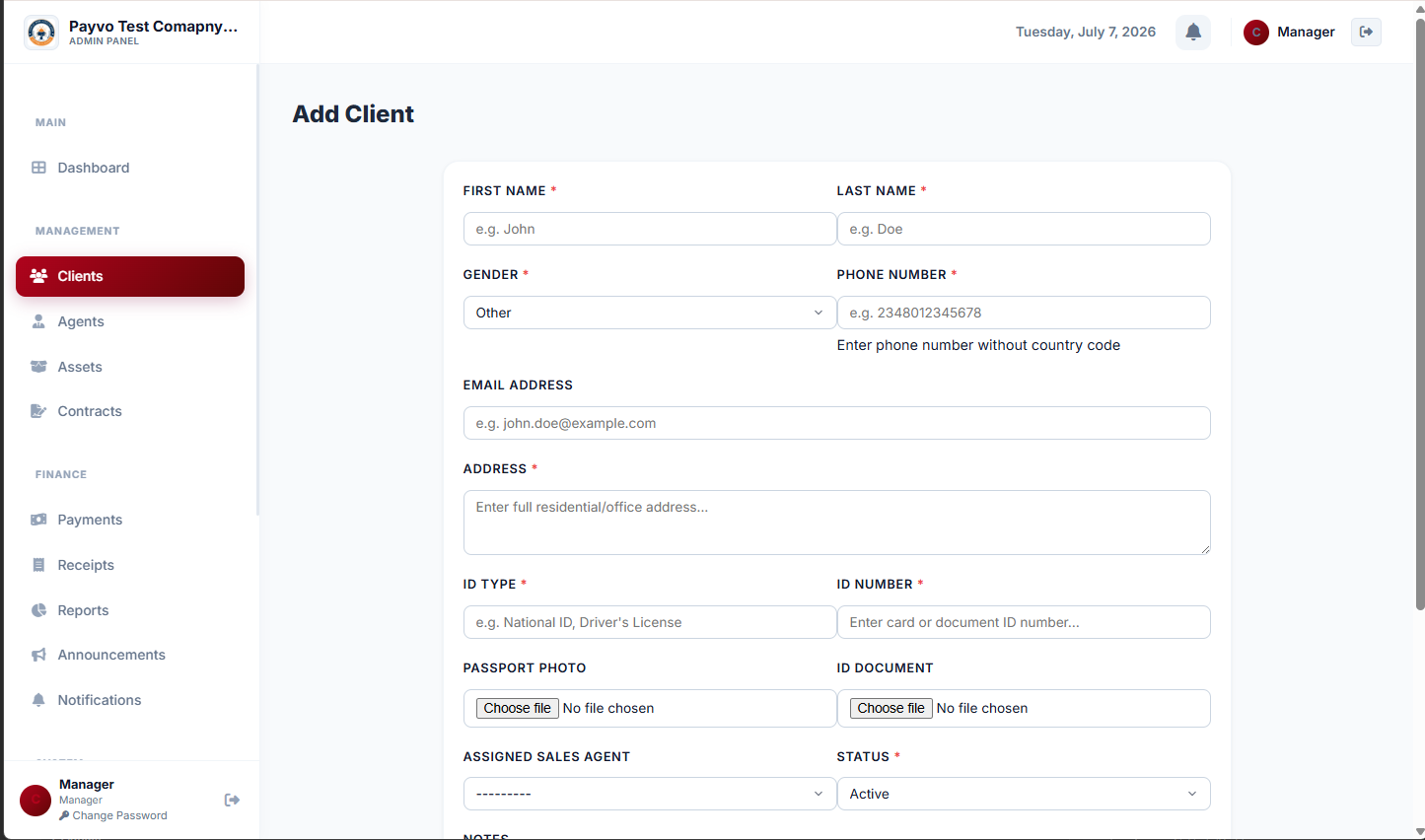 Client: Add Client page
Step 2: Define Contract Terms and Generate Schedules
Once your client and asset data are centralized, the next critical step is to formalize your installment contracts. This involves setting clear payment terms, which are then used to automatically generate a precise payment schedule. Manual calculations are prone to human error and can lead to disputes with clients. An automated system ensures consistency and transparency.
For each contract, specify the total amount, the down payment, the number of installments, the frequency (e.g., weekly, monthly, quarterly), and the due dates. The system should then automatically create a detailed payment schedule, outlining each installment amount and its specific due date. This serves as the blueprint for all future payment tracking and reminders. For businesses like cooperative societies or microfinance operators, this step is crucial for managing numerous small loans with varying terms.
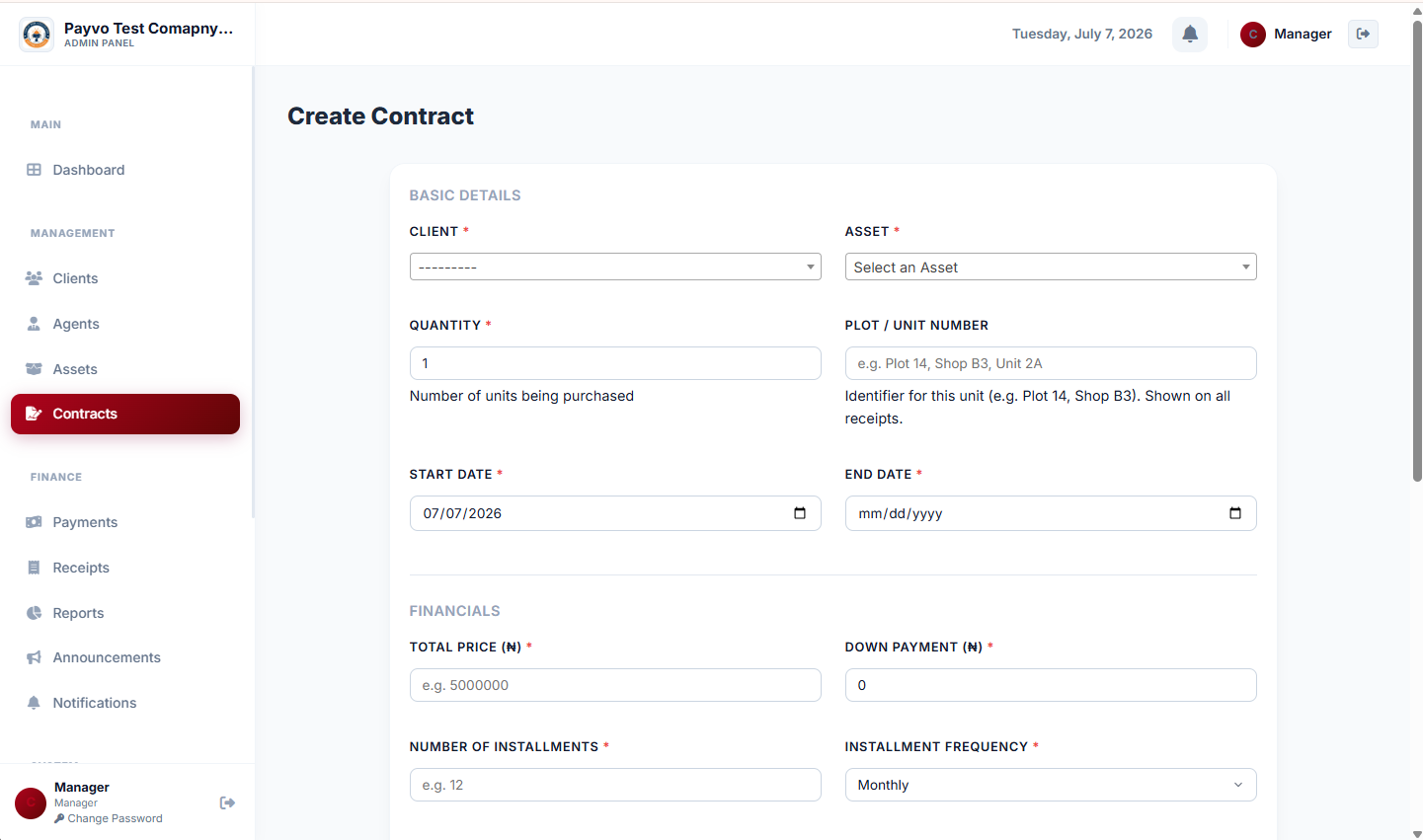 Management: Add contract (top)
Step 3: Streamline Payment Recording and Receipt Generation
Recording payments accurately and generating professional receipts are fundamental to maintaining trust and compliance. In a manual system, this often means writing out receipts, updating ledgers, and then manually informing clients. Automation drastically simplifies this process, ensuring every payment is logged correctly and acknowledged instantly.
When a payment is received, it should be logged against the specific contract and installment. The system should automatically update the client's payment history and calculate the remaining balance. Crucially, a branded receipt should be generated automatically for every payment. This receipt, complete with your company logo, colors, and digital signature, can then be instantly shared with the client. This not only saves administrative time but also enhances your company's professional image. An effective business payment tracking app Nigeria will handle this seamlessly.
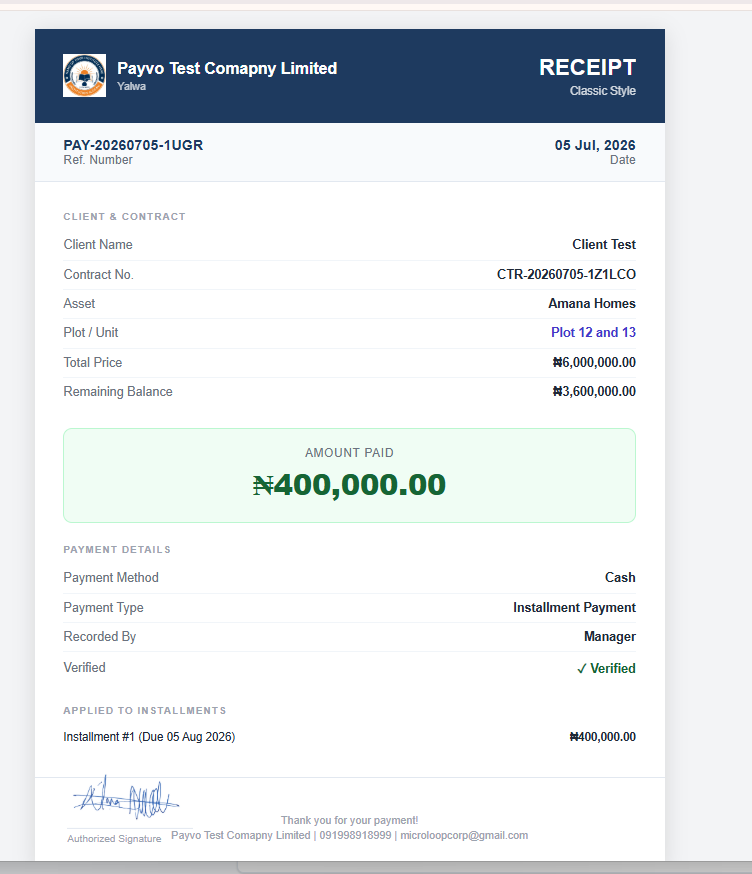 Finance: Paymnet Receipt Sample
Step 4: Implement Automated Client Notifications and Reminders
One of the biggest time-sinks in installment sales is manual follow-up. Chasing payments, confirming receipts, and sending reminders can consume countless hours. An automated notification system liberates your team from this repetitive task, ensuring clients are always informed and nudged about upcoming payments.
Set up automated notifications for key events: new client onboarding, new contract creation, and payment received confirmations. Most importantly, configure automated payment reminders to be sent out before due dates. These reminders can be delivered via email and WhatsApp, providing a convenient and accessible way for clients to stay on top of their obligations. The inclusion of a public receipt link allows clients to easily view, save, or share their payment confirmations. This proactive communication significantly reduces late payments and improves the overall customer experience.
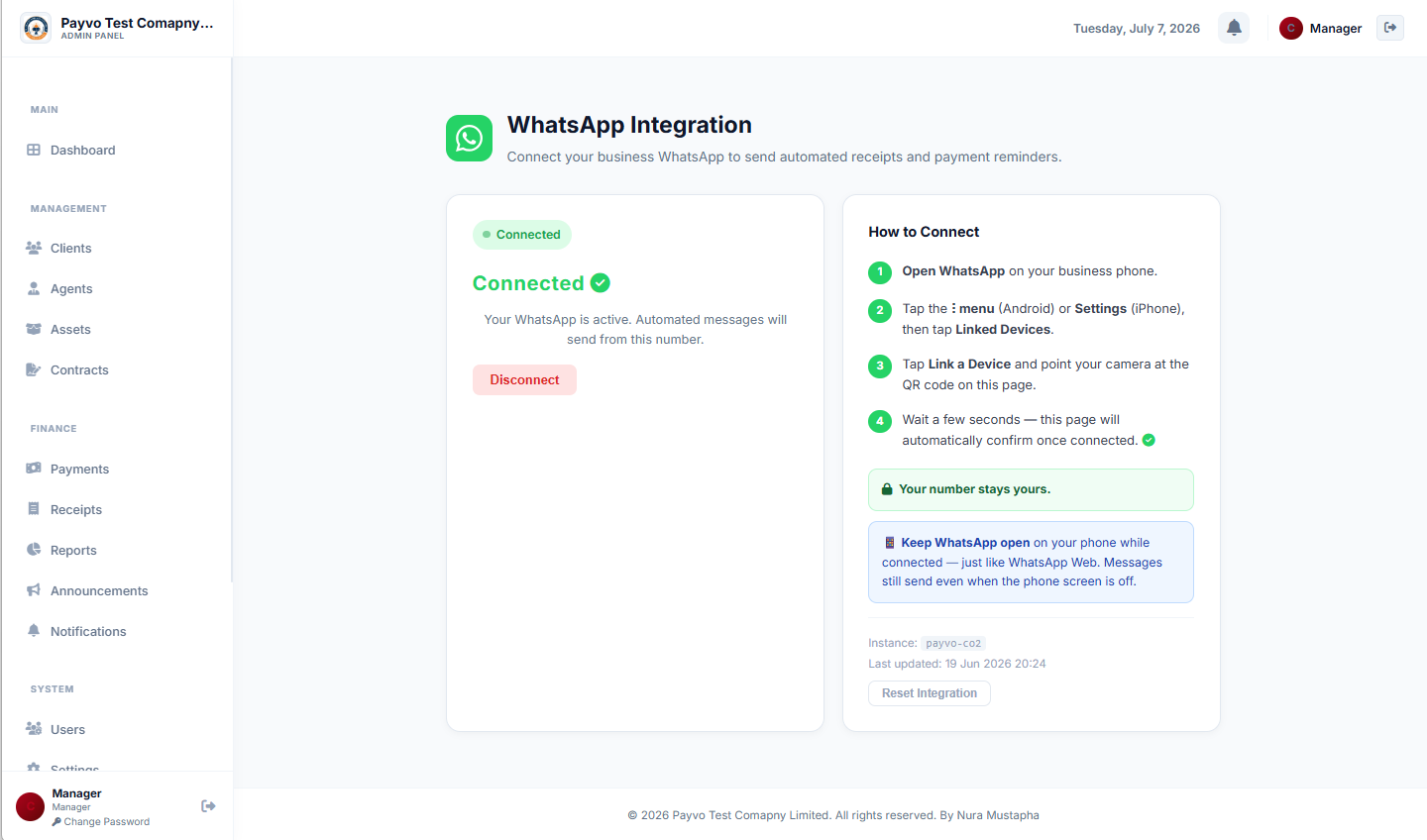 Admin: Whatsapp Integration
Step 5: Manage Staff and Agent Access with Role-Based Permissions
As your business grows, so does your team. Allowing multiple staff members to access and manage contracts and payments requires careful control to maintain data integrity and security. Implementing role-based permissions ensures that each team member only has access to the information and functions relevant to their role.
Business owners should be able to add staff accounts and assign specific roles, such as sales, finance, or administrative support. This way, a sales agent might only see their assigned contracts and client details, while a finance officer has access to all payment records and reporting. For companies working with external sales agents, an agent commission tracking software feature is invaluable. Agents can be assigned to contracts, and their commissions automatically calculated per payment received, with full earnings and payout history tracked. Agents can even have self-tracking access to view their KPIs and submit withdrawal requests directly, streamlining the commission management process. This granular control is a hallmark of robust contract management software Nigeria.
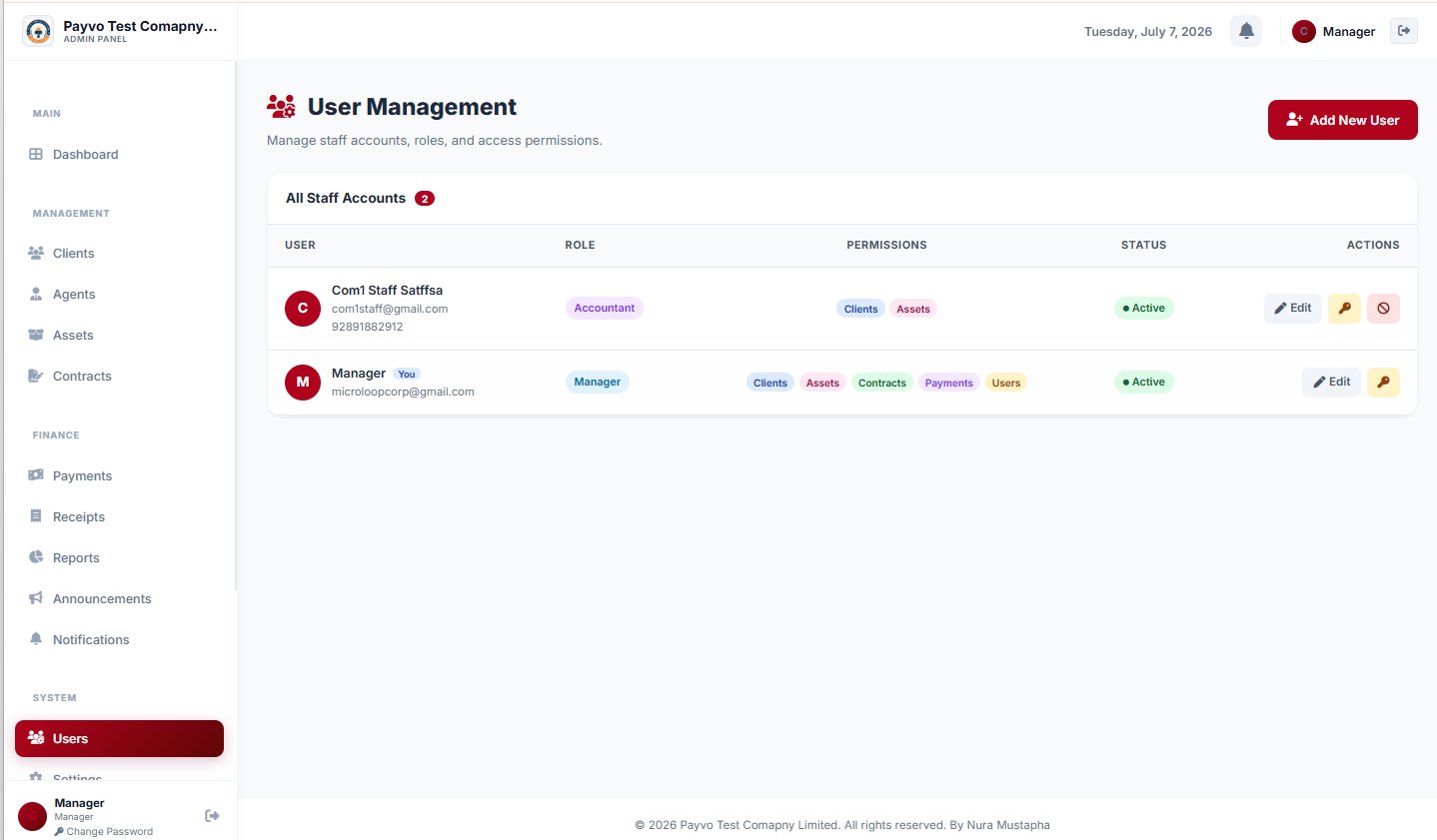 Admin: User Management Page
Step 6: Monitor Performance with Real-time Dashboards and Reports
After setting up your automated system, continuous monitoring and analysis are crucial for informed decision-making and sustained growth. Manual data compilation for reports is tedious and often outdated by the time it's complete. Automated dashboards and reporting provide instant insights into your business's financial health and operational efficiency.
A good system should offer real-time dashboards that display key metrics at a glance: total clients, active contracts, amount collected, outstanding balances, and next payments due. Beyond dashboards, the ability to generate comprehensive reports is essential. These reports, exportable as PDF or Excel, are vital for accounting, auditing, and strategic planning. Furthermore, receiving weekly company reports via email provides a consistent overview of key business performance metrics, allowing you to quickly identify trends, address issues, and capitalize on opportunities. This comprehensive oversight is what drives effective cooperative society management software and enables sustainable growth for building material suppliers selling on credit.
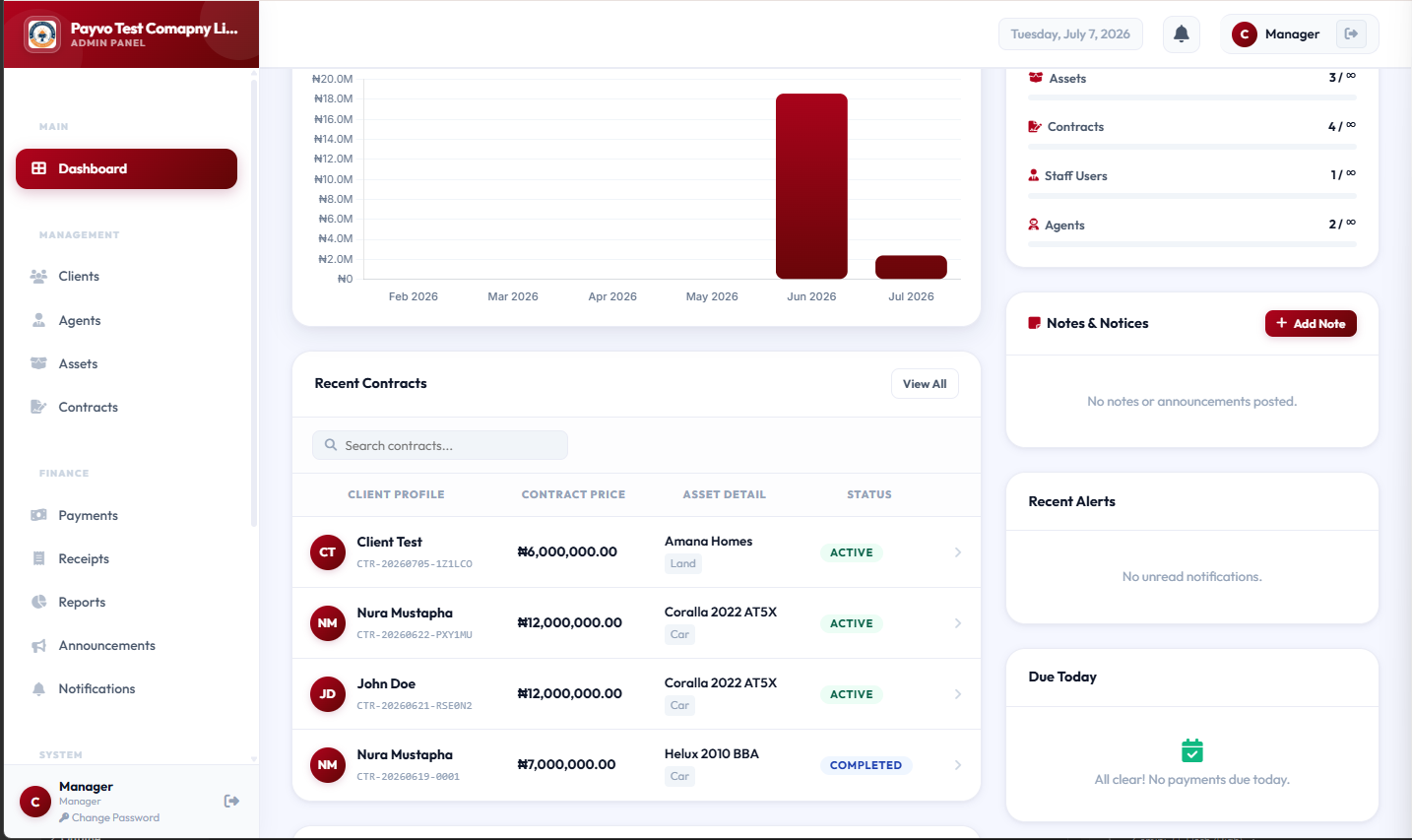 Dashobard (top)
Common Mistakes to Avoid
Automating your installment payment process can yield significant benefits, but several common pitfalls can derail your efforts. Being aware of these can help you navigate the transition smoothly.
- Underestimating Data Migration: Don't rush the process of transferring existing client and contract data. Incorrectly migrated data can lead to widespread errors and client disputes.
- Ignoring Staff Training: A new system is only as effective as the people using it. Provide thorough training to all staff members who will interact with the platform to ensure proper adoption and utilization.
- Overlooking Customization Needs: While off-the-shelf solutions are powerful, ensure the system can be customized to fit your specific business logic, branding, and unique installment terms.
- Neglecting Client Communication: Even with automated notifications, maintain clear communication with clients during the transition. Inform them about the new system and what to expect.
- Skipping Regular Reviews: Don't "set it and forget it." Regularly review your automated processes, payment schedules, and report data to ensure accuracy and identify areas for optimization.
- Lack of Security Measures: Ensure your chosen platform has robust security features, including audit logs and role-based access, to protect sensitive financial and client data.
How to Track and Grow After Launch
Once your automated installment payment system is up and running, the real work of leveraging its capabilities for growth begins. Tracking key performance indicators (KPIs) and implementing growth tactics will ensure you maximize your investment.
Start by regularly reviewing your dashboard metrics. Monitor your total active contracts and outstanding balances to get a snapshot of your loan book health. Pay close attention to the amount collected versus amount due to identify any collection inefficiencies. The next payment due section helps in proactive planning for cash flow.
Beyond the dashboard, delve into the financial reports. These reports can highlight trends in payment behavior, identify your most profitable contract types, and pinpoint clients who consistently pay on time versus those who frequently default. This data is invaluable for refining your credit policies and marketing strategies. For instance, if you notice a particular type of installment plan consistently performs well, you might emphasize it more in your sales efforts.
Leverage the automated payment reminders to maintain consistent cash flow. The reduction in manual follow-ups frees your team to focus on higher-value activities like client acquisition or resolving complex issues. Utilize the WhatsApp payment notification system to maintain a direct and convenient communication channel with clients, which can significantly improve payment rates and customer satisfaction.
Consider how the agent commission tracking software can motivate your sales force. By providing agents with clear, real-time insights into their earnings (via agent self-tracking), you foster transparency and incentivize performance, leading to increased sales and contract closures. Regularly analyze agent performance reports to identify top performers and areas where additional training might be needed.
Finally, use the insights gained from your installment management software Nigeria to inform your growth strategies. Are there underserved markets you can target with installment plans? Can you optimize your product offerings based on payment patterns? The ability to export payment and contract data as PDF or Excel for accounting and record-keeping also ensures you have all the necessary information for financial planning and securing future investment.
> "In the competitive landscape of installment sales, efficiency isn't just about saving time; it's about building customer trust and unlocking scalable growth that manual processes simply cannot sustain."
Frequently Asked Questions
What kind of businesses benefit most from installment payment automation?
Businesses that rely heavily on deferred payment models, such as real estate developers, car dealerships (hire purchase), solar/equipment leasing companies, cooperative societies, microfinance institutions, and building material suppliers selling on credit benefit immensely. Any business processing recurring payments for goods or services over time will find automation invaluable.
How does automation help reduce late payments?
Automation significantly reduces late payments by implementing proactive measures. This includes automated payment reminders sent via email and WhatsApp before due dates, and instant notifications upon payment receipt. This consistent communication keeps clients informed and reduces the likelihood of them forgetting or missing payments, thereby improving cash flow for businesses.
Can I manage multiple types of contracts and assets with one system?
Yes, a robust installment management software Nigeria is designed to handle diverse contract types and assets. Whether you're tracking properties, vehicles, equipment leases, or loan agreements, the system allows you to register and manage various assets, link them to specific contracts, and customize payment terms accordingly. This centralization simplifies management across different product lines.
Is it secure to manage client and financial data on such a platform?
Security is paramount for any financial management system. Leading platforms employ robust security measures, including data encryption, secure access protocols, and role-based permissions to control who can access what information. Features like audit logs also track all activities, ensuring transparency and accountability for sensitive client and financial data.
How does automated receipt generation work?
When a payment is recorded, the system automatically generates a professional, branded receipt. This receipt typically includes your company's logo, branding elements, and a digital signature. It can then be instantly shared with the client via email or WhatsApp, often with a public link for easy access and download. This eliminates manual receipt creation, saving time and ensuring consistency.
Can agents track their commissions and performance?
Yes, advanced installment payment tracking apps often include features specifically for agent management. Agents can be assigned to contracts, and the system automatically calculates their commissions based on payments received. Many platforms offer agent self-tracking portals where agents can log in to view their earnings, KPIs, and even submit withdrawal requests, streamlining commission payouts and fostering transparency.
Ready to Streamline Your Installment Sales?
Stop wrestling with manual records and embrace the power of automation. Discover how effortless managing your installment contracts, tracking payments, and generating receipts can be. Visit our features page to explore the full capabilities of Payvo and see how we can transform your business operations.