The queues are growing, customers are impatient, and your cashiers are stretched thin. You’ve heard about self-checkout, but the thought of losing that personal touch or, worse, increasing theft, keeps you up at night. How can you streamline operations and improve customer experience without sacrificing oversight or security in your Nigerian retail business?
 Nigerian market scene with bustling activity and various
The High Cost of Traditional Checkout in 2026
In today's competitive retail landscape, efficiency isn't just a buzzword; it's essential for survival. Manual checkout processes, while familiar, come with significant hidden costs and operational bottlenecks that can severely impact your bottom line.
Staffing Challenges and Their Financial Impact
Hiring and retaining skilled cashiers is a constant challenge. The average monthly salary for a cashier in Nigeria in 2026 ranges from ₦60,000 in smaller towns to ₦120,000 in major cities like Lagos or Abuja. While these figures might seem manageable for a single staff member, they quickly add up when you need multiple lanes open during peak hours. Beyond salaries, there are costs associated with training, benefits, and managing staff turnover.
Moreover, human error is an unavoidable factor. Mis-scans, incorrect change given, or even intentional shrink can erode profits. The time spent on manual inventory checks to reconcile discrepancies further drains resources.
Customer Experience Bottlenecks
Long queues are a universal frustration. In a market where customers have increasing choices, a slow checkout experience can lead to abandoned carts and lost sales. A recent survey indicated that over 70% of Nigerian consumers consider checkout speed a critical factor in their shopping decisions. This directly impacts customer loyalty and repeat business, which are vital for sustained growth.
"In the evolving retail environment, businesses that fail to adapt their checkout experience risk falling behind. Efficiency and customer satisfaction are two sides of the same coin."
The Burden of Manual Payment Tracking
For businesses that offer installment sales – like car dealerships, real estate developers, or even building material suppliers – the complexity multiplies. Tracking individual payments, generating receipts, sending reminders, and managing client accounts manually is a monumental task. This often involves spreadsheets, notebooks, and countless WhatsApp messages, leading to:
- Payment Delays: Without automated reminders, customers might forget due dates, leading to inconsistent cash flow.
- Disputes: Manual records are prone to errors, causing disagreements with clients over payment history or outstanding balances.
- Time Sink: Staff spend hours chasing payments and reconciling accounts instead of focusing on sales or business development.
- Lack of Visibility: Business owners often lack a real-time overview of their financial health, making strategic decisions difficult.
Embracing the Assisted Checkout Model: A Hybrid Solution
The solution isn't to completely abandon human interaction for full self-checkout, which can be daunting for many Nigerian shoppers and present security concerns. Instead, many forward-thinking retailers are adopting an "assisted checkout" or "self-checkout with cashier payment" model. This hybrid approach allows customers to take control of the scanning process while retaining the crucial human element for verification, payment, and customer service.
How Assisted Checkout Works
In this model, customers use a self-service kiosk to scan their items. Once all items are scanned, the system generates a summary or a barcode. The customer then proceeds to a designated cashier or service counter where:
- Verification: The cashier quickly reviews the scanned items against the summary, ensuring accuracy and deterring theft.
- Payment: The cashier handles the payment transaction, whether it's cash, card, or mobile money, providing a familiar and secure process.
- Assistance: The cashier is available to answer questions, resolve issues, and provide that personal touch that builds customer loyalty.
Benefits of the Assisted Checkout Approach
- Improved Efficiency: Reduces queue times significantly, enhancing the overall shopping experience.
- Optimized Staff Deployment: Cashiers can manage multiple self-checkout kiosks, focusing on oversight and problem-solving rather than repetitive scanning. This can potentially reduce the need for additional cashier hires, saving on monthly salaries.
- Enhanced Security: The cashier's final verification step acts as a strong deterrent against "scan avoidance" or intentional under-scanning, a common concern with unmonitored self-checkout systems. Basic security camera systems (₦150,000 - ₦400,000 for a 4-camera setup) can further bolster this.
- Customer Empowerment: Customers who prefer to be in control appreciate the ability to scan their own items.
- Data Accuracy: Integrated POS software (annual license ₦50,000 - ₦250,000) ensures accurate sales data, improving inventory management and sales forecasting.
- Reduced Training Burden: While initial installation and setup fees for a basic self-checkout kiosk can range from ₦80,000 - ₦250,000, training staff (₦30,000 - ₦80,000 per session) becomes more focused on oversight and customer service rather than extensive product code memorization.
 Digital dashboard showing financial metrics and client information
Streamlining Installment Sales with Smart Management Tools
While assisted checkout handles the immediate transaction, many Nigerian businesses operate on installment plans. This is where a robust contract and installment management solution becomes indispensable, whether you're a car dealer using car dealer installment software, a real estate developer tracking property payments, or a cooperative society managing member contributions.
The challenges of manual installment tracking are immense. Imagine a real estate developer in Abuja trying to manage hundreds of property payments, all with different schedules. Or a solar equipment leasing company in Kano manually sending WhatsApp payment notifications for each client. This is where a dedicated system transforms operations.
How Payvo Revolutionizes Your Payment Tracking
Payvo is a comprehensive business management platform specifically designed for companies that sell on installment. It takes the pain out of manual tracking, offering an automated, secure, and transparent way to manage every aspect of your installment sales, from client onboarding to final payment.
With Payvo, you can effortlessly register and manage clients, storing their full details and viewing complete payment histories. This eliminates the need for scattered notebooks or unreliable spreadsheets. You can also register and manage assets – whether it's a car, a piece of land, or equipment – linking them directly to specific contracts. This provides a clear, auditable trail for every transaction.
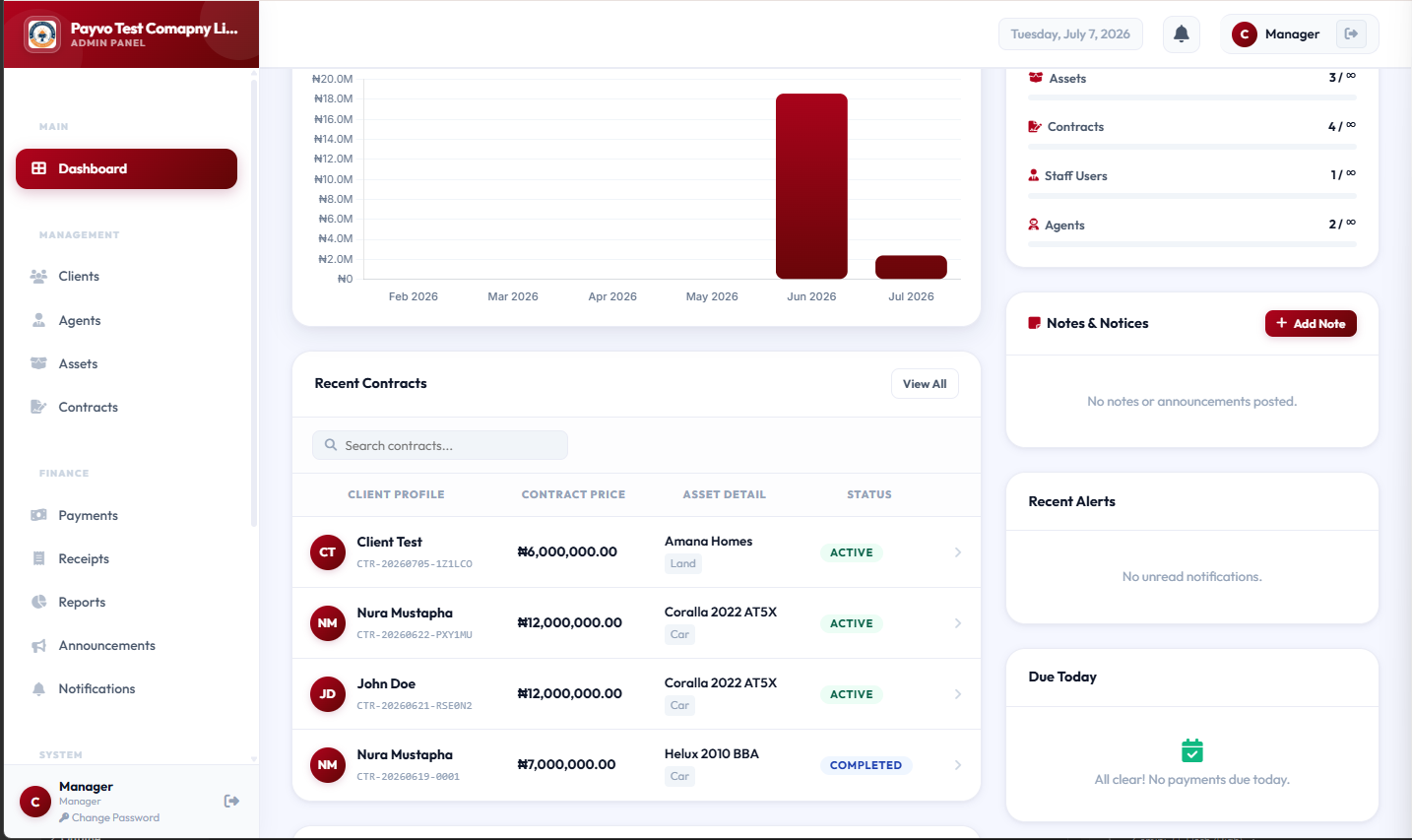 Dashobard (top)
The platform allows you to create contracts by setting payment terms once, and it automatically generates detailed installment schedules. This feature is a game-changer for businesses like building material suppliers selling on credit, as it ensures consistency and accuracy. Recording payments is straightforward, with every single payment logged and a full history maintained.
One of the most powerful features is the automatic generation of branded receipts. Every payment processed through Payvo creates a professional receipt with your company logo, colors, and digital signature. For businesses relying on a WhatsApp payment notification system, Payvo seamlessly integrates by sending automatic notifications for new clients, new contracts, payments received, and crucial payment reminders via email and WhatsApp. These notifications include a public receipt link that clients can easily view, save, or share, enhancing transparency and trust.
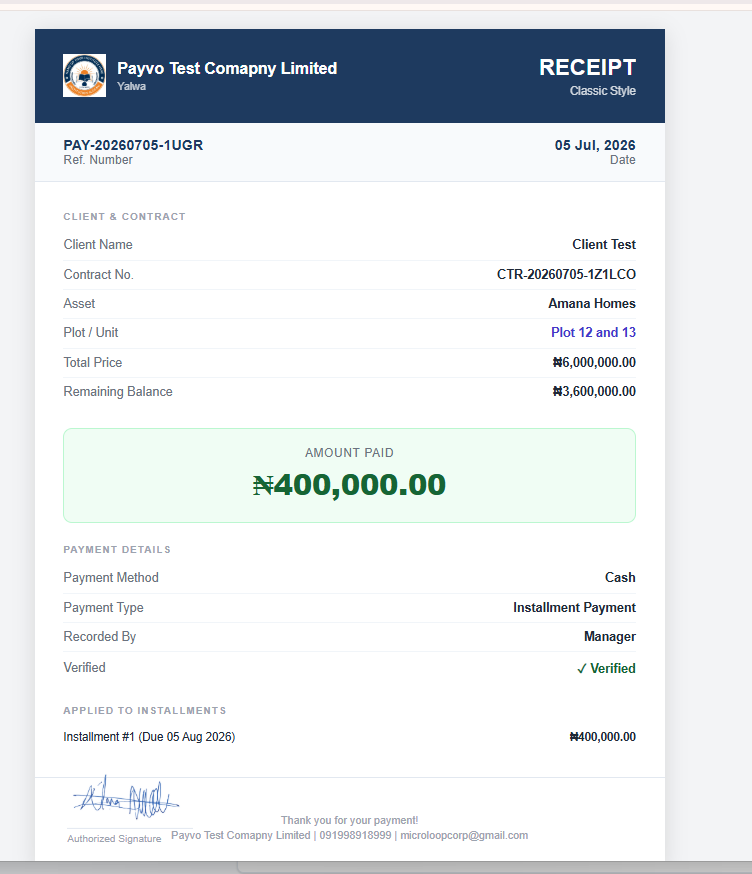 Finance: Paymnet Receipt Sample
This automated reminder system dramatically reduces the need for manual follow-up calls, ensuring consistent cash flow and freeing up your staff. For businesses with agents, Payvo offers advanced agent commission tracking software. You can assign agents to contracts, and the system automatically calculates their commission per payment, tracking full earnings and payout history. Agents can even log in to view their own earnings and submit withdrawal requests, providing unparalleled transparency and efficiency.
Payvo also helps you maintain oversight by allowing business owners to add staff with role-based permissions, controlling what each person can see and do – a crucial feature for retail payment verification and overall security. The real-time dashboards provide an instant overview of total clients, active contracts, amounts collected, outstanding balances, and next payment due, empowering you with data for informed decision-making. You can easily generate reports for accounting and record-keeping, and receive weekly company reports delivered directly to your email. Learn more about how Payvo's features can transform your business by visiting our features page.
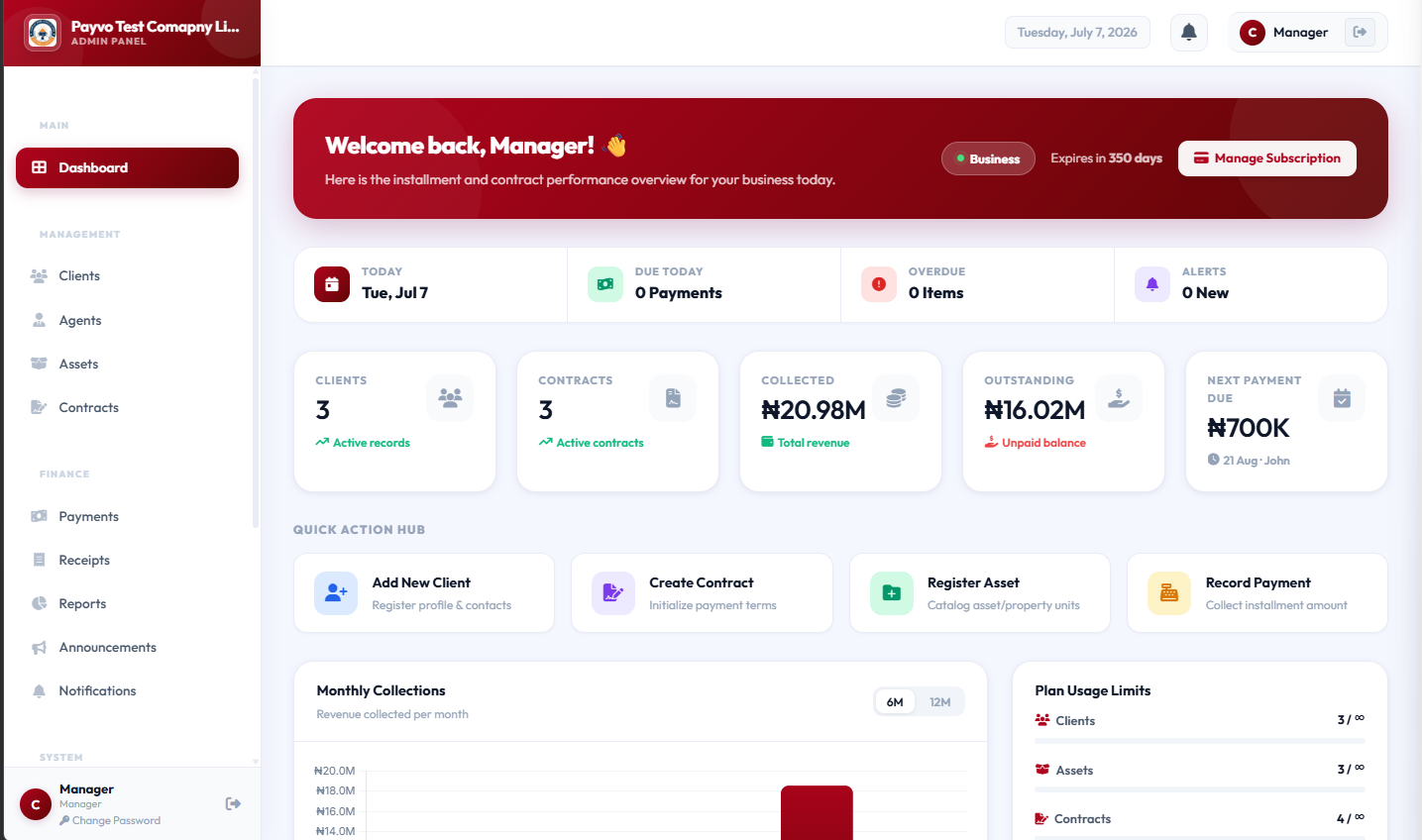 Dashboard (bottom)
Proof: The Smarter Way to Manage Payments
Let's look at a side-by-side comparison of traditional payment management methods versus leveraging a modern installment management software like Payvo.
| Feature | Traditional Manual Methods | Modern Installment Management Software (e.g., Payvo) |
|---|---|---|
| Client Registration | Paper forms, notebooks, scattered files | Digital client profiles, centralized database |
| Contract Creation | Manual calculations, handwritten agreements | Automated schedule generation, digital contracts |
| Payment Recording | Spreadsheets, ledgers, WhatsApp messages | Digital logging, real-time updates, audit trails |
| Receipt Generation | Manual receipts, often generic | Branded, automated digital receipts (via email/WhatsApp) |
| Payment Reminders | Manual calls, text messages, easy to miss | Automated WhatsApp payment notification system, email reminders |
| Overdue Payments | Time-consuming follow-ups, inconsistent | Automated overdue alerts, streamlined communication |
| Staff/Agent Management | Manual tracking of commissions, limited oversight | Role-based permissions, automated agent commission tracking software |
| Financial Visibility | Periodic, often outdated reports, guesswork | Real-time dashboards, comprehensive financial reports |
| Security & Data Loss | High risk of errors, physical damage, human oversight | Secure cloud storage, data backups, audit logs |
| Scalability | Very difficult to scale with growing client base | Designed for growth, handles unlimited clients and contracts |
This comparison clearly illustrates how a dedicated business payment tracking app Nigeria can dramatically improve efficiency, reduce errors, and provide invaluable insights for your business.
Frequently Asked Questions
What is the typical cost of setting up an assisted checkout system in Nigeria?
The cost varies widely based on the sophistication and origin of the equipment. A basic self-checkout kiosk, possibly locally fabricated or refurbished, might cost between ₦350,000 and ₦800,000. For an advanced imported model with integrated scanner and scale, expect to pay between ₦1,200,000 and ₦3,500,000. Don't forget annual POS software licenses (₦50,000 - ₦250,000) and installation fees (₦80,000 - ₦250,000). Many businesses also budget for power backup systems (₦250,000 - ₦800,000) given Nigeria's power challenges.
How does an assisted checkout system improve retail payment verification?
In an assisted checkout model, customers scan their items, but a cashier performs a final verification check before processing payment. This human oversight helps to prevent errors, deter theft, and ensure that all items are correctly accounted for. It combines the speed of self-scanning with the security of a human-assisted cashier payment system.
Can a contract management software Nigeria integrate with existing retail operations?
Yes, modern contract management software, like Payvo, is designed to be flexible. While it specializes in installment sales, its core functionalities for client management, payment tracking, and receipt generation can complement any retail business, especially those offering hire purchase or credit facilities. For businesses needing deeper integration, audit logs and API access are often available.
Is a receipt generator app Nigeria truly necessary if I already send payment confirmations via WhatsApp?
While WhatsApp payment notifications are convenient, a dedicated receipt generator app Nigeria provides formal, branded, and verifiable receipts. These digital receipts include your company logo, colors, and digital signature, making them professional and legally sound. They offer a comprehensive record for both your business and the client, reducing disputes and aiding in financial reconciliation. Payvo provides this functionality automatically for every payment and contract.
What are the benefits of agent commission tracking software for businesses selling on installment?
For businesses that rely on agents, such as real estate developers or equipment leasing companies, an agent commission tracking software streamlines the entire process. It automates commission calculations per payment, tracks agent earnings, and manages payout history. This transparency motivates agents, reduces administrative burden, and ensures accurate commission dispersal, allowing agents to focus on sales rather than manual tracking. You can find more details on agent tracking here.
Ready to take control of your installment sales and bring efficiency to your payment management?
Start your journey with Payvo today!